
Appendix H
Federal Rulemaking Process1
INTRODUCTION
Federal regulation, like taxing and spending, is one of the basic tools of government used to implement public policy. In fact, the development and framing of a rule has been described as “the climactic act of the policy making process” (Driver, 1989). Another observer described the rulemaking process as “absolutely central to the definition and implementation of public policy in the United States,” and said that “no significant attempt to alter the direction of a public program can succeed without effective management of the rulemaking process” (Kerwin, 1999). Regulations generally start with an act of Congress, and are the means by which statutes are implemented and specific requirements are established. Federal agencies issue more than 4,000 final rules each year on topics ranging from the timing of bridge openings to the permissible levels of arsenic and other contaminants in drinking water. The costs and benefits associated with all federal regulations have been a subject of great controversy, with the costs estimated in the hundreds of billions of dollars and the benefits estimates even higher. The costs federal regulations impose on regulated entities to accomplish policy goals are not reflected in the federal budget process, and some view these off-budget regulatory costs as greater than all federal domestic discretionary spending. Estimates of the benefits of federal regulations are even higher.
|
1 |
This appendix and Figure H-1 are reprinted from Copeland, C. 2008. The federal rulemaking process: An overview. RL32240. Washington, DC: Congressional Research Service. |
The terms “rule” or “regulation” are often used interchangeably in discussions of the federal regulatory process. The Administrative Procedure Act (APA) of 1946 defines a rule as “the whole or part of an agency statement of general or particular applicability and future effect designed to implement, interpret, or prescribe law or policy.”2 The process by which federal agencies develop, amend, or repeal rules is called “rulemaking,” and is the subject of this report.
Figure H-1 illustrates in a general manner the process that most federal agencies are generally required to follow in writing or revising a significant rule. However, we should be quick to point out that some aspects of Figure H-1 do not apply to all rulemaking. For example, as discussed later in this report, an agency may, in certain circumstances, issue a final rule without issuing a notice of proposed rulemaking, thereby skipping several steps depicted in the figure. On the other hand, some rules may be published for public comment more than once. Also, independent regulatory agencies3 are not required to submit their rules to the Office of Management and Budget’s (OMB) Office of Information and Regulatory Affairs (OIRA) for review, and no agency is required to do so for rules that are not “significant.”
Note at the top of Figure H-1 that the rulemaking process begins when Congress passes a statute either requiring or authorizing an agency to write and issue certain types of regulations. An initiating event (e.g., a recommendation from an outside body or a catastrophic accident) can prompt either legislation or regulation (where regulatory action has already been authorized). For example, in response to lethal chemical releases by plants in Bhopal, India, and West Virginia, Congress enacted section 313 of the Emergency Planning and Community Right-to-Know Act of 1986 (42 USC §§ 11001-11050, 11023). The act required the owners and operators of certain types of facilities to report the amounts of various toxic chemicals that the facilities release to the environment above certain thresholds, and requires the Environmental Protection Agency (EPA) to make this information available to the public. EPA subsequently issued detailed regulations implementing these requirements and, using the authority provided to it through the statute, has required reporting for more than 300 toxic substances in addition to those delineated in the law.
As this example illustrates, the authority to regulate rests with Congress, and is delegated, through law, to an agency. The statutory basis for
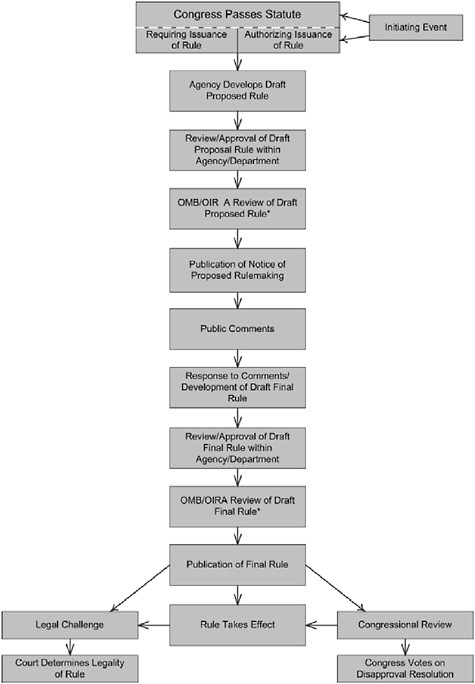
a regulation can vary greatly in terms of its specificity, from (1) very broad grants of authority that state only the general intent of the legislation and leave agencies with a great deal of discretion as to how that intent should be implemented, to (2) very specific requirements delineating exactly what regulatory agencies should do and how they should take action. Note also in Figure H-1 the roles that Congress and the courts can play at the end of the rulemaking process, which may result in a rule being returned to an earlier point in the process or being vacated by the reviewing body. Congress may also play a role at other stages in the process through its oversight and appropriations responsibilities.
Implicit within the steps depicted in Figure H-1 is an elaborate set of procedures and requirements that Congress and various Presidents have developed during the past 60 to 65 years to guide the federal rulemaking process. Some of these rulemaking requirements apply to virtually all federal agencies, some apply only to certain types of agencies, and others are agency-specific. Collectively, these rulemaking provisions are voluminous and require a wide range of procedural, consultative, and analytical actions on the part of rulemaking agencies. Some observers contend that the requirements have resulted in the “ossification” of the rulemaking process, causing agencies to take years to develop final rules (McGarity, 1992; Pierce, Jr., 1995; Verkuil, 1995). For example, the National Advisory Committee on Occupational Safety and Health noted that it takes the Occupational Safety and Health Administration (OSHA) within the Department of Labor an average of 10 years to develop and promulgate a health or safety standard (National Advisory Committee on Occupational Safety and Health, 2000). On the other hand, while these congressional and presidential rulemaking requirements are numerous, it is not clear whether they or some other factors (e.g., lack of data, congressionally imposed delays, court challenges, etc.) are the primary cause of the long timeframes that are sometimes required to develop and publish final rules.
REFERENCES
Driver, C. 1989. Regulatory precision. In Making regulatory policy, edited by K. Hawkins and J. Thomas. Pittsburgh, PA: University of Pittsburgh Press. P. 199.
Kerwin, C. M. 1999. Rulemaking: How government agencies write law and make policy. 2nd ed. Washington, DC: CQ Press.
McGarity, T. O. 1992. Some thoughts on “deossifying” the rulemaking process. Duke Law Journal 41:1385-1462.
National Advisory Committee on Occupational Safety and Health. 2000. Report and recommendations related to OSHA’s standards development process. Washington, DC: Occupational Safety and Health Administration.
Pierce Jr., R. J. 1995. Seven ways to deossify agency rulemaking. Administrative Law Review 47:59-93.
Verkuil, P. R. 1995. Rulemaking ossification—A modest proposal. Administrative Law Review 47:453-459.


