
Appendix A
Brief Overview of the Defense Acquisition System for Information Technology
THE DEFENSE ACQUISITION MANAGEMENT SYSTEM
The Defense Acquisition Management System (DAMS), defined in DOD Instruction 5000.2, specifies a single framework to address both information technology (IT) systems (termed “automated information systems” [AISs] in DOD regulations) and weapon systems. The milestone decision process defined in the instruction and applied to the acquisition of both weapon systems and information technology is depicted in Figure A.1.
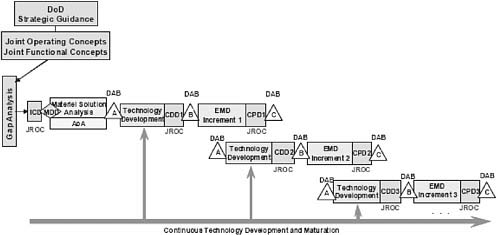
DODI 5000.2 allows for differentiation of the prescribed acquisition process based on the underlying technological maturity. It identifies evolutionary acquisition as the “preferred strategy for the rapid acquisition of mature technology” and notes that in an evolutionary acquisition strategy, close cooperation is required between users, testers, and developers. The DOD 5000.2 milestone decision process flow for evolutionary acquisition is shown in Figure A.2. It further states that “MDAs [milestone decision authorities] may tailor regulatory program information to fit the particular conditions of an individual program.” Implicit in this statement is that regulatory program information must still be provided, since the MDAs may tailor only the instruction implementation.
Joint Capabilities Integration and Development System
The Joint Capabilities Integration and Development System (JCIDS) supports the Chairman of the Joint Chiefs of Staff and the Joint Require-
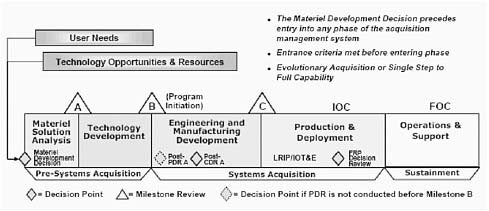
FIGURE A.1 The milestone decision governance and oversight process of the Defense Acquisition Management System applied to both weapon systems and automated information systems.
ments Oversight Council (JROC) in identifying, assessing, and prioritizing joint military capability needs as required by law. The capabilities are identified by analyzing what is required across all functional areas to accomplish the mission.
The JROC recognizes that the same level of oversight is not required for all information systems. Therefore, information systems are divided into four categories with appropriate oversight for each:
-
Information systems with a post-Milestone B developmental cost of less than $15 million are not subject to joint oversight or approval under the JCIDS process. The sponsor manages the requirements, approves the JCIDS documents, and complies with appropriate acquisition requirements.
-
Information systems that are defense business systems, regardless of cost, are to comply with the process defined by the Defense Business Systems Management Committee. These systems will employ a business case document using the business capability life-cycle process in lieu of an Initial Capabilities Document/Capabilities Development Document (ICD/CDD) to justify the need for a solution. In those cases where the JCIDS gatekeeper, on the advice of the lead functional capabilities board (FCB), determines that joint oversight of the business system is required, the business case document will be reviewed and validated in lieu of the appropriate JCIDS documents.
-
Information systems that are an integral part of a weapon or weapon system and enable weapon capabilities are considered to be part
-
of the weapon system program and do not require separate JCIDS documents or oversight.
-
Information systems that provide capabilities through software development and integration with commercial off-the-shelf hardware require an ICD for initiation of new-capability development. The CDD will support the development and fielding process. A CPD is not required unless the program is going through a formal Milestone C decision and the MDA requires it.
The Joint Staff Director of Force Structure, Resources, and Assessment/ Requirements Management Division (J-8/RMD) and/or the Lead FCB will make a determination if it is not clear which definition applies to a particular information system.1
The JCIDS processes, as illustrated in Figure A.3, overlay and support the Defense Acquisition Management System. The JROC decision tree and membership are illustrated in Figure A.4.
Recently, the JCIDS process for information technology systems was changed to reflect the evolving nature of requirements for IT systems. This new JCIDS policy2 recognizes the need for the JROC to focus on top-level requirements at the beginning of a program and delegates refinement of subsequent requirements to a lower-level flag-officer-level body.
Planning, Programming, Budgeting, and Execution System
The purpose of the PPBES is to allocate resources within the DOD. It is important for program managers and their staffs to be aware of the nature and timing of each of the events in the PPBE process, since they may be called on to provide critical information that could be important to program funding and success.
In the PPBE process, the Secretary of Defense establishes policies, strategy, and prioritized goals for the DOE that are subsequently used to guide resource allocation decisions that balance the guidance with fiscal constraints. The PPBE process consists of four distinct but overlapping phases:
-
Planning. The planning phase of PPBE, which is a collaborative effort by the Office of the Secretary of Defense and the Joint Staff, begins with a resource-informed articulation of national defense policies and military strategy known as the Strategic Planning Guidance.
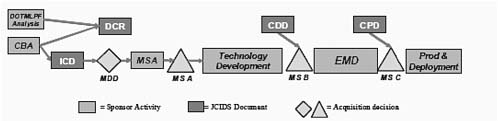
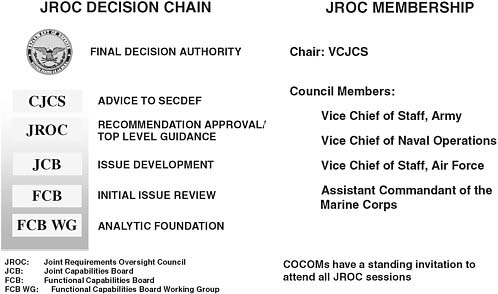
FIGURE A.4 JROC decision tree and membership. NOTE: Functional capability boards (FCBs) exist for command and control, battlespace awareness, logistics, force support, force protection, force application, and network-centric operations, focused logistics, force management, and joint training. FCBs are led by general-officer-level JCS staff. Membership consists of O6-level representation of the Services, the Combatant Commands, OSD(AT&)L, OSD(I), ASD(NII)/DOD CIO, Director of PA&E, DIA, and the specific FCB Executive Secretary. SOURCE: Pat Wills, JCIDS Brief, DefenseAcquisition University, January 2009, available at https://acc.dau.mil, accessed June 2009.
-
Programming. The programming phase begins with the development of a program objective memorandum (POM) by each DOD component.
-
Budgeting. The budgeting phase of PPBE occurs concurrently with the programming phase; each DOD component submits its proposed budget estimate simultaneously with its POM.
-
Execution. The execution review occurs simultaneously with the program and budget reviews. The purpose of the execution review is to provide feedback to the senior leadership concerning the effectiveness of current and prior resource allocations.3
The PPBES, as currently implemented, follows a biennial cycle to reduce the number and amount of budget artifacts provided and reviewed by DOD components and OSD/JCS, respectively, on an annual basis. New initiatives, theoretically, can be started in any budget year; however, the activities required in an “off” year are based on exception processing, as opposed to the normal budget process. However, even during an “on” year, the window to successfully present and argue for a new initiative or a major change in an initiative is formally from mid-August to mid-October.
INFORMATION TECHNOLOGY AND THE DEFENSE ACQUISITION MANAGEMENT SYSTEM
Although some specific requirements of DOD acquisition regulations apply only to weapon system programs or to AIS programs, the same overall program structure template and milestone decision process are applied to both. A key facet of the DAMS is a series of thresholds that establish the acquisition category (ACAT) of an acquisition program, and with that determination also establish the MDA responsible for oversight of the acquisition program. The largest or most highly visible programs are designated as major defense acquisition programs (MDAPs) or major automated information system (MAIS) programs, and the MDA for them is assigned to the Defense Acquisition Executive (DAE), Under Secretary of Defense for Acquisition, Technology and Logistics (USD AT&L), or to the Service or component acquisition executives within the military Services or defense agencies.
The criterion that governs the assignment to specific acquisition categories is codified in Title 10 U.S.C. Chapter 144 and 144A and is provided in DOD 50004 as shown in Table A.1. The expenditure-level
TABLE A.1 Criteria for Acquisition Category Designation
|
Acquisition Category |
Reason for ACAT Designation |
Decision Authority |
|
ACAT I |
|
ACAT ID: USD(AT&L) |
|
|
ACAT IC: Head of the DOD Component or, if delegated, the CAE (not further delegable) |
|
|
ACAT IAM: USD(AT&L) or designee |
|
|
|
ACAT IAC: Head of the DOD Component or, if delegated, the CAE (not further delegable) |
|
ACAT II |
|
CAE or the individual designated by the CAE4 |
|
ACAT III |
|
Designated by the CAE4 |
|
1In some cases, an ACAT IA program, as defined above, also meets the definition of an MDAP. The USD(AT&L) shall be the MDA for such programs unless delegated to a DOD Component. The statutory requirements that apply to MDAPs and MAIS shall apply to such programs. 2The MDA (either the USD(AT&L) or, if delegated, the ASD(NII)/DOD CIO or another designee) shall designate MAIS programs as ACAT IAM or ACAT IAC. MAIS programs shall not be designated as ACAT II. 3Automated Information System: A system of computer hardware, computer software, data, or telecommunications that performs tasks such as collecting, processing, storing, transmitting, and displaying information. Excluded are computer resources, both hardware and software, that are: a. an integral part of a weapon or weapon system; b. used for highly sensitive classified programs (as determined by the Secretary of Defense); c. used for other highly sensitive information technology programs (as determined by ASD(NII)/DOD CIO); or d. determined by the USD(AT&L) or designee to be better overseen as a non-AIS program (e.g., a program with a low ratio of RDT&E funding to total program acquisition costs or that requires significant hardware development). 4As delegated by the Secretary of Defense or Secretary of the Military Department. SOURCE: DODI 5000.2. |
||
thresholds for MAIS programs are significantly lower than they are for MDAP programs, subjecting more AIS programs to increased oversight and governance from the highest levels of the DOD. In fact, the overall program size thresholds for the ACAT IAM designation (where the M denotes a MAIS ACAT I program) for AIS programs are smaller than the corresponding ACAT II for non-AIS programs, and there is no ACAT II for AIS programs.
As a consequence of these differences in program threshold levels for oversight between MAIS programs and MDAP programs, the former are subjected to the same level of intensive management as are the ACAT 1D weapon systems programs. This level of management has resulted in the ponderous oversight of ACAT IAM IT programs that are funded at much lower levels. Specifically, an IT program funded at $32 million for research, development, test, and evaluation (RDTE) in any fiscal year gets the same level of oversight as a weapon system program funded at $365 million or more over its RDTE phase. A more extreme metric is that an IT program funded with a total life-cycle cost (including operation and maintenance) of $378 million receives the same level of oversight as a weapon system program funded at $2.190 billion in procurement funding. Moreover, the two-tier acquisition category definitions for IT programs appear to drive more systems into the “major” category (and thus oversight by the Office of the Secretary of Defense) than do the weapon system acquisition category definitions, which are three-tiered.
The governance structure that ultimately brings recommendations forward to the MDA for MDAP or MAIS programs varies as a function of the types of programs, but in virtually every case it is a four-tier process with the program management office (PMO) at the bottom responsible for preparing for a milestone decision review; a collection of integrated product teams (IPTs) with an overarching integrated product team (OIPT) to work with the PMO and provide review and oversight in preparation for a milestone decision review; a formal decision body with a group such as the Defense Acquisition Board (DAB) or Information Technology Acquisition Board (ITAB) to advise the MDA; and the MDA as the responsible party in making the milestone decision at each of the key Milestone A, B, and C decision points identified in Figures A.1 and A.2. This structure is depicted for various types of programs in Figure A.5.
The formal decision forums are key bodies in this oversight and governance process. It is instructive to examine their composition. DAB board members and advisors are listed in Table A.2.5 Although some specific
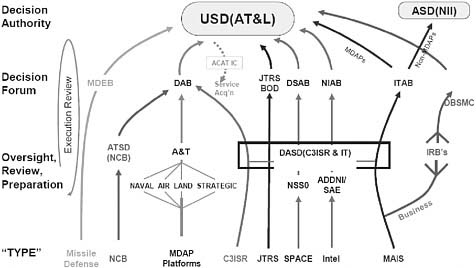
FIGURE A.5 Governance and oversight process flows for various types of programs. SOURCE: Information Technology Acquisition briefing provided by DASD (C3ISR & IT Acquisition), February 25, 2009.
TABLE A.2 Defense Acquisition Board Membership and Advisors for MDAP Program Oversight
|
DAB Members |
DAB Advisors |
|
Under Secretary of Defense (Comptroller) |
Principal Deputy USD(AT&L) |
|
Under Secretary of Defense (Policy) |
Director, Defense Research & Engineering |
|
Under Secretary of Defense (P&R) |
OIPT Leader(s) |
|
Under Secretary of Defense (Intelligence) |
Chairman, Cost Analysis Improvement Group |
|
Assistant Secretary of Defense for Networks and Information Integration/DOD CIO |
Director, Defense Procurement and Acquisition Policy |
|
Director, Operational Test & Evaluation |
Program Executive Officer |
|
Chairman, Program Analysis and Evaluation |
Program Manager |
|
Secretaries of the Army, the Navy, and the Air Force |
Deputy Under Secretary of Defense (Logistics & Material Readiness) |
|
Director, Acquisition Resources & Analysis |
DOD General Counsel |
|
Director, Force Structure (J8) |
Deputy Under Secretary of Defense (Industrial Policy) |
|
|
DOD Component Acquisition Executives |
|
|
Commander, United States Joint Forces Command |
|
|
Chair, Functional Capabilities Board(s) |
TABLE A.3 Information Technology Acquisition Board Membership and Advisors for MAIS Program Oversight
|
ITAB Members |
ITAB Advisors |
|
Under Secretary of Defense (Comptroller) |
Under Secretary of Defense (Policy) |
|
Under Secretary of Defense (P&R) |
Under Secretary of Defense (Intelligence) |
|
Deputy DOD Chief Information Officer |
Domain Owner |
|
Director, Operational Test & Evaluation |
Component CIOs |
|
Deputy DOD Chief Information Officer |
Director, Defense Intelligence Agency |
|
Director, Operational Test & Evaluation |
Director, Cost Analysis Improvement Group |
|
Chairman, Program Analysis and Evaluation |
Representatives of the Joint Staff |
|
Component Acquisition Executives of the Army, Navy, and Air Force |
Director, Defense Procurement and Acquisition Policy |
|
DOD Component User Representatives |
Director, International Cooperation |
|
Director, Defense Procurement and Acquisition Policy |
Deputy Under Secretary of Defense (Logistics and Materiel Readiness) |
|
IT OIPT Lead |
Deputy Under Secretary of Defense (Industrial Policy) |
|
Program Executive Officer(s) |
Director, Acquisition Resources and Analysis |
|
Program Manager(s) |
Deputy Under Secretary of Defense (Installations and Environment) |
|
Cognizant OSD Principal Staff Assistant(s) |
|
|
Director, Force Structure (J8) |
|
|
DOD General Counsel |
|
|
Deputy Director, Developmental Test & Evaluation |
|
positions and levels of the participants differ, the ITAB has a very similar overall composition, as shown in Table A.3.
Operational test and evaluation (OT&E) to determine the effectiveness and suitability of systems is also a key consideration of the DAMS. Test and evaluation artifacts ranging from strategy documents to final test reports are required for every milestone review. OT&E results are a key factor in the limited-rate initial production and full-rate production decisions. (For software-intensive programs with no production components, Milestone C is a deployment decision.) Prior to achieving a Milestone C production or deployment decision, the system must undergo OT&E under realistic conditions to determine if the threshold requirements have
been met and critical operational issues have been satisfied. These threshold requirements come from the approved capabilities development document developed in the JCIDS process. For AIS programs, additional specialized testing is integrated into the OT&E process. This includes interoperability testing and network-ready certification conducted by the Joint Interoperability Test Command (JITC), and information assurance certification and accreditation testing conducted by the designated accrediting authority.6 For evolutionary programs following the model of Figure A.2, this testing and certification must occur for every evolutionary spiral undertaken by the program.
In short, the DAMS is a complex system of governance and oversight. For any MDAP or MAIS program, preparing for and successfully conducting the series of milestone reviews necessary to deploy capability to end users is a major undertaking.


