
3
The Research Vision–Priority Research Themes
The records of hominin evolution and dispersal outlined in the preceding chapter highlight important events in our past—the split between ancestors of chimpanzees and hominins at 8-6 Ma, the split that produced Homo from an Australopithecus ancestor around 3-2.5 Ma, the first dispersal of hominins (probably H. erectus) out of East Africa into North Africa and Asia about 1.8 Ma ago, the extinction of Paranthropus between ~1.4 and 1.2 Ma ago, and the more recent dispersals out of Africa about 0.9 Ma and after 0.1 Ma ago. Paralleling these records, we now have, and continue to acquire, more detailed records from marine and lacustrine sediments and polar ice cores of the environmental history of Africa, Eurasia, the Americas, and Australia. The dominant environmental signals over the past several million years have been the global cooling trend, the growth of polar ice sheets, the climate variability at orbital-variation timescales (20, 40, 100, and 400 ky) as reflected in glacial/interglacial and monsoon cycles, and the existence of millennial-scale variability and abrupt changes.
An overall global climate history based on oxygen isotope records obtained from benthic foraminifera in ocean sediments indicates that the gradual cooling of the planet, which began tens of millions of years ago, has continued, with only minor variations, during the past 8 Ma (Figure 3.1). Orbitally-paced glacial/interglacial variations of Northern Hemisphere ice sheets began around 2.7 Ma, and increased dramatically in amplitude and duration around 0.9 Ma. Additional records from land and ocean, from lake cores, and from ice cores, document changes in glacier extent, sea level, vegetation, lake levels and lake chemistry, river runoff, dust deposition, and atmospheric carbon dioxide (CO2) concentrations. There is also evidence for changes in ocean circulation based in part on the opening or closing of oceanic gateways (e.g., the Isthmus of Panama, the
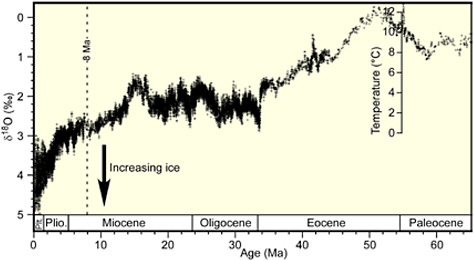
FIGURE 3.1 Synthesis of global deep-sea benthic foraminiferal oxygen isotope records, based on analyses of cores from Deep Sea Drilling Program and Ocean Drilling Program sites, updated with high-resolution records for the interval spanning the middle Eocene to the middle Miocene. Raw data were smoothed using a 5-point running mean. The conversion of oxygen isotope data to a temperature scale was computed for an ice-free ocean, and therefore only applies to the portion of the curve older than about 35 Ma. Note the strong cooling trend, with only minor perturbations, over the past 8 Ma. SOURCE: Modified from Zachos et al. (2008).
Straits of Gibraltar, and the Indonesia seaway). Despite this broad understanding of the history of global environmental change, there is limited understanding of the regional environments in which hominins evolved, and an incomplete understanding of the processes that have forced these global and regional climatic and environmental changes over the past 8 Ma.
Did climate change shape human evolution, and if so, how? As noted above, there is now evidence that several major junctures in human evolution and behavior were coincident with fundamental changes in global and regional climate. As intriguing as these temporal coincidences are, demonstrating a causal linkage between them is a much more challenging and intensive task. This chapter defines a set of research activities that will develop the paleoclimatic, paleoanthropological, and archaeological observations needed to test hypotheses linking climatic and biotic change that encompass the major events in hominin evolution. A range of potential research topics and initiatives to clarify the relationships and interactions between these evolutionary and environmental histories were advanced by the wider community during the open workshop held as part of this study. The committee assessed these topics, and identified the following two high-priority research themes as having the greatest potential to transform our understanding of the origin of human adaptations to environmental change.
THEME I: DETERMINING THE IMPACTS OF CLIMATE CHANGE AND CLIMATE VARIABILITY ON HUMAN EVOLUTION AND DISPERSAL
This section articulates a vision for making substantive advances into the central question concerning the role of climate change in human origins. Simply put, how can we bridge the divide separating our current state of knowledge from what would be needed to address this question in a qualitatively improved way. Significant progress on this fundamental question of human origins cannot be attained without first recognizing that the problem is fundamentally data-limited. Data limitations include, but are not restricted to
-
gaps or poorly-studied intervals in the fossil and archaeological record, coupled with the highly-variable fossil density from different time periods and regions;
-
the inconsistent collection of all components of available fossil assemblages (e.g., invertebrates, vascular plants and algae, as well as vertebrates), which have potential to offer critical tests of the climate-evolution relationship;
-
stratigraphic and geochronologic limitations;
-
the rarity of quantitative paleoenvironmental records situated close to fossil localities; and
-
the need for broad application of newly-emerging techniques for quantitatively and accurately reconstructing past climates.
The central goal of the research activities encompassed by this research theme is to make substantial progress in overcoming these limitations and to introduce novel analytical approaches that build upon the existing scientific foundation, thereby enabling rigorous tests of how human evolution and the adaptability of our own species have been shaped by climate change.
This research vision depends upon data collection and analysis that is strategically focused on a number of critical time windows in which pivotal evolutionary events occurred. This approach to data collection will stimulate, for example, an in-depth analysis of how the earliest origin of the human lineage, the broad trajectory of technological change, the increase in human brain size and cognitive complexity, and the origin of the social behaviors characteristic of humans today emerged in relation to the pace and patterning of climate change, and thus whether the core adaptations of human beings revolve around the ability to solve the challenges of climate change.
This research vision also depends on a new level of integration of disciplines and training of scholars in ways that motivate the growth of a richly collaborative enterprise. Furthermore, these vital activities of data integration and collaborative analysis need to be focused on advances in hypothesis testing in which evolutionary and climatic records are treated as sources of natural history “experiments.”
This concept means that whereas the particulars of historical or evolutionary phenomena are not replicable in the sense of laboratory science, evolutionary and climate records do exhibit a surprising number of iterations—for example, the repeated emergence of certain food processing adaptations, recurrent geographic expansions, or the concurrent rise or loss of species diversity across diverse animal groups, all of which can be examined in relation to repeated periods of climate warming, cooling, heightened variability, or stability, along with the repetitive expansion and contraction of habitats. These iterations mean that there are numerous cases over time and space where the detailed relationships between climate and evolutionary response in humans can be defined, examined, and compared against the responses in the contemporaneous biota. Common patterns or regularities have the potential to yield new understandings of evolutionary processes and the influences of climate.
Overarching Research Strategy
Common to all hypotheses linking climate change and faunal evolution is the notion that large-scale shifts in climate or climate variability altered the landscape ecology, which, in turn, presented specific adaptive or speciation pressures leading to genetic selection and innovation. This view holds that the most significant evolutionary junctures—those evolutionary and behavioral transitions that were fundamental to shaping who and what we are today—were linked to some aspect of paleoenvironmental change. As noted earlier, the possibility that environmental change had negligible impact on evolutionary change also needs to be considered, because factors such as genetic mutation, resource competition, and social interaction were in effect under all environmental conditions and thus may have impinged on evolution independent of specific environmental transitions. Even if this were so, evolutionary success or extinction depends on the increase or reduction of a species and its particular way of life, which are inevitably influenced by large-scale or abrupt changes in environmental conditions. On the basis of well-tested ideas in evolutionary biology, therefore, environmental variables are critical in shaping the adaptations and geographic distributions of all organisms, and are expected to have made a difference in shaping the course of human evolution, the success and demise of earlier hominin species, and, ultimately, the existence and influence of our own lineage.
Hypotheses of how climate change affected evolution generally start by correlating patterns of evolution recorded in continental basins with marine or lake climate records that are located hundreds or thousands of kilometers away. Identification of such broad correlations has stimulated productive research, but these largely independent efforts have yielded fossil samples and climate records that are distant from one another, unable to be analyzed quantitatively, or are otherwise inadequate to address critical questions about evolutionary processes (see, e.g., Barnosky, 2001). Future progress depends on how well scientists move
beyond general correlations to address the causal processes by which climate and evolutionary change have interacted. The following strategies of primary data collection and analysis will enable such progress:
-
Improve the density of the evidence concerning the origin and spread of evolutionary innovations. Concerted international efforts to substantially enhance the fossil hominin, archaeological, and other faunal records of evolution are necessary in order to establish with statistical reliability the precise first and last appearances of species, adaptations, and behaviors within particular geographic regions and temporal sequences of strata. Precise determinations of the timing of evolutionary events will facilitate more rigorous analyses of the climate–evolution relationship.
-
Close the geographic gap in the study of evolution and climate by obtaining high-precision climate records in close proximity to locations where the evolutionary events in question are recorded. Although progress has been made concerning certain hypothesized linkages between climate and evolution, many of the specific relationships and processes are largely unknown and/or untested, e.g., the relationship between global climate change and local environmental effects; the causal processes that relate climate and evolutionary change observed at specific sites; and the precise temporal expression of novel behaviors and ecological interactions in early humans as these may relate to climate. Bringing the evidence of climate change and evolutionary events into close proximity, particularly the development of high-resolution environmental records at the fossil sites, will substantially improve the ability to assess the extent to which those evolutionary events reflect responses to climate.
-
Integrate the evidence of as many evolutionary events as possible, using the histories of other organisms to assess environmental effects on human evolution. This integrative aspect of the research is important in addressing which dimensions of human evolution (e.g., shifts in mobility, food processing, brain size, and population size, along with species formation and extinction) were coordinated with responses in other organisms or, alternatively, reflect uniquely human responses to climate change. In addition, by comparing adaptive change over time, scientists will be able to assess whether the variety of milestones in human evolutionary history tended to coincide with only specific types of climatic forcing or, alternatively, whether evolutionary events occurred under diverse environmental conditions that belie any generalized relationship between climate and evolution. A comparative approach that integrates findings across many taxa, time periods, and regions will necessarily provide numerous examples of both change and stasis, and thus offer the ability to test the diverse range of potential interactions between climatic and evolutionary change.
-
Build collaborations across the physical, biological, and human sciences that are essential to dissect the array of geological, atmospheric, marine, biotic, and hominin factors that underlie the climate–evolution relationship. Undertak-
-
ing a program that successfully investigates this relationship will require high-level coordination among earth scientists, paleoanthropologists, and a network of professional researchers and students dedicated to understanding the detailed interplay between past climates and human evolution. The overall objective of this transdisciplinary vision is to develop a robust empirical foundation for understanding human interactions with their surroundings and for strengthening the interrelationships among disciplines in the natural sciences around one of the most profound scientific questions, the origin of our species.
Research Priorities
The following four research priorities are critical for bringing this visionary research theme to fruition.
The first priority is to develop an integrated, cross-disciplinary focus on crucial time windows of evolutionary change and stasis. Research on the climate-evolution relationship is now best conducted by strategic hypothesis testing and data collection focused around the four time intervals in which critical climatic or evolutionary events occurred (Table 2.1). Within the 4- to 2-Ma interval, the appearance of ice-rafted material in marine deposits in the North Atlantic around ~3.0-2.8 Ma along with the onset of moderate amplitude glacial/interglacial variations at periods around 41 ky is one example of a key climatic event for study. The origination of hominins at 8-6 Ma or of Homo sapiens around 200 ka offer examples of time windows defined from an evolutionary standpoint. Since important events are distributed throughout the past 6 to 8 million years, analysis of the entire period of human evolution can be framed in terms of intervals that are tightly focused in a way that stimulates the development of precise hypotheses, the improved recovery of evidence of biotic evolution, and the acquisition of high-resolution climate records.
The second—and related—priority is to develop high precision records of climate change from long stratigraphic sequences proximal to hominin sites and, simultaneously, to expand lake and ocean drilling efforts that will be essential to integrating the local climate records from hominin sedimentary basins with regional and global records. By bringing together environmental records at diverse geographic scales the climatic forcing factors that relate global, regional, and local climate can be investigated and better understood.
A third research priority is to develop and apply new environmental indicator records. All understanding of past climate depends on indicators of climatic variables, that is, proxy measurements that can be used to quantitatively reconstruct temperature, precipitation, seasonality, vegetation and land cover, paleoaltitude, among other variables. Climate records of unprecedented detail can be obtained by comparing across a wide range of such proxies. The integration of new and existing indicators will improve the evidence and resolution of environmental states, variability, and rates of change.
A fourth priority is to formalize research funding to encourage scientific exchange and strategic analysis of climate-evolution hypotheses by earth scientists, paleoanthropologists, and faunal researchers. High-precision analyses of climate and paleoecology should be integrated with the efforts of climate modelers. This overall approach, in which projects are unified by shared strategic goals, requires unprecedented collaboration across disciplines and encourages the development of innovative scientific tools and data exchange.
THEME II: INTEGRATING CLIMATE MODELING, ENVIRONMENTAL RECORDS, AND BIOTIC RESPONSES
The integration of physical and biotic records of past environmental change with regional climate modeling studies offers considerable potential for an improved understanding of the causes of the changes, as a basis for exploring specific questions concerning potential connections between environmental changes and hominin evolution and dispersal. Experiments using climate models can help us understand why climate changed (e.g., did greenhouse gas concentrations decrease sufficiently so that winter snows persisted through summer and created the conditions for glacial growth?), what happened (where and by how much did ice sheets grow?), and how events in one region influenced environments elsewhere through global and regional changes in atmospheric and oceanic circulation. A corresponding set of questions can be formulated for orbital-forcing of insolation changes, for ocean gateway changes, or for combinations of these factors. Moreover, climate models simulate spatial and temporal patterns on a regular grid and at regular time intervals that can provide a context for integrating or synthesizing environmental and fossil records that are discontinuous in space and time, or are otherwise incomplete. They can also provide the basis for predictions in data-sparse regions, to provide hypotheses that can be tested by the collection of new data.
In some cases, it will be highly desirable to simulate the climate (or climate change) at small spatial scales. This might be the case, for example, in regions with large topographic variability (see Box 3.1) such as within the East African Rift Valley or the East African highlands. In such regions, large differences in climate (or climate change) are found on scales of several 10s or 100s of kilometers. At present, there are two main approaches to simulating the climate at such high spatial resolution. The most straightforward approach is to run a global climate model at very high resolution, thereby avoiding the problem of spurious effects from lateral boundary conditions that occur when using a regional or limited-area model. With adequate computer resources, using a global model of high spatial resolution is the preferred approach. In some cases, however, lateral boundary conditions from a global model of intermediate spatial resolution may be useful to force a limited-area model (e.g., for the region of East Equatorial Africa). In that case, an awareness of the problems of lateral boundary conditions
“contaminating” the climate solution in the interior of the domain is required, and considerable experimentation with a variety of domain sizes might be necessary. In either approach (global model or limited-area model), it will be necessary to have accurate estimates of the topographic (and other) boundary conditions for the particular times and places of interest, or alternatively, to run a series of experiments that span the range of uncertainties about past surface (and other) boundary conditions. These uncertainties must be assessed both inside the region of immediate interest as well as in the broader and ultimately global context. Both kinds of modeling have been applied in the past, and can form a starting point for future experimentation.
Major initiatives linking climate models and environmental records have contributed significantly to our understanding of the causes and patterns of climate at particular times, for example, during the mid-Holocene (6 ka) and the last glacial maximum (21 ka) (CLIMAP Members, 1976; Gates, 1976; Kutzbach and Guetter, 1986; COHMAP Members, 1988; Braconnot et al., 2007), the previous interglacial (125 ka) (Otto-Bliesner et al., 2006), and the mid Pliocene (about 3 Ma) (Chandler et al., 2008). These studies have demonstrated the value of evaluating environmental records in combination with the insights gained from climate model simulations. However, none of these pioneering studies has adequately explored the full range of climates of the past 8 Ma, or conducted systematic comparisons of the simulations with environmental records.
Four generalized time windows within the past 8 Ma illustrate the potential of a program of integrated data and modeling studies—the period prior to extensive continental glaciations of North America or Europe (8-4 Ma), the period within which glacial/interglacial cycles commenced (4-2 Ma), the period containing the transition to very large amplitude and long duration glacial/interglacial cycles (2-0.5 Ma), and the most recent period of continuing large glacial/interglacial cycles (0.5-0 Ma).
Time Window 1: Prior to Widespread Northern Hemisphere Glaciation (8-4 Ma)
Environmental records show important trends in global climate between 8 and 4 Ma. The global cooling trend that commenced around 15 Ma (Figure 3.1) led to growth of the West Antarctic ice sheet and the Greenland ice sheet between 7 and 4 Ma—a drop in CO2 levels is a likely candidate for a proximate cause of this cooling. In support of this inference, carbon isotope records from plants show a shift from C3 to C4 vegetation in East Africa and Asia during approximately this same time interval (Cerling, 1992), a shift that indicates a likely lowering of the atmospheric concentration of CO2 from values higher than 500 parts per million (ppm) to values below this threshold. However, analysis of marine sediments suggest that atmospheric CO2 levels were relatively stable and closer to preindustrial levels (200-300 ppm) prior to and during this period (Pagani et al., 1999, 2005).
|
BOX 3.1 Potential of Regional Climate Models Recent modeling experiments demonstrate the potential of regional models for improving our understanding of climate-evolution interactions in Africa at various timescales relevant to human evolution. Sepulchre et al. (2006) examined the probable climatic impact of the uplift of mountain ranges associated with the East African Rift System (EARS) during the late Neogene (Figure 3.2). Their experiments suggest that prior to this uplift, the absence of a topographic barrier to moisture allowed zonal circulation across equatorial Africa, which would 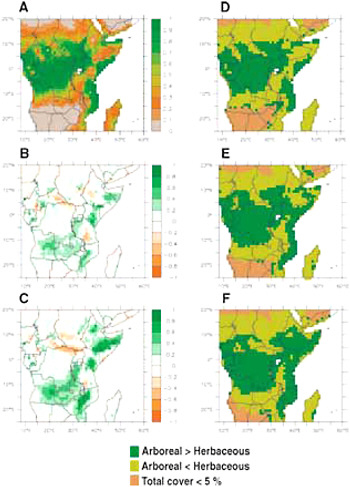 FIGURE 3.2 Simulated vegetation for three model runs showing biosphere responses to topographic changes linked to eastern and southern African uplifts. A-C depict the modeled differences between the present-day vegetation (A) and vegetation patterns for reduced (B) and low (C) topography situations. D-F show the distribution of arboreal-dominant, herbaceous-dominant, and desert-like fractions for the present day (D), reduced topography (E), and low topography (F). Note the massive spreading of arboreal fraction at the expense of herbaceous fraction over eastern Africa. SOURCE: Sepulchre et al. (2006). |
|
have in turn maintained forests throughout the region. The modeling indicates that EARS uplift at ~8 Ma results in a dramatic reorganization of atmospheric circulation in the region, and subsequent aridification during the early phase of hominin evolution. On a much shorter timescale, Cowling et al. (2008) simulated paleovegetation patterns for Africa during the Last Glacial Maximum (LGM) and preindustrial times (i.e., interglacial conditions unperturbed or little perturbed by anthropogenic CO2 emissions) (Figure 3.3). Their experiments for the LGM suggest a tropical broadleaf forest reasonably similar in extent to that of the present, but with some reduction at the edges (especially in the north). However, the structure of these forests differed dramatically from modern ones, in terms of reduced leaf area, tree height, and carbon content. In contrast, their interglacial simulations suggest transcontinental broadleaf forests in Central Africa which could have acted as barriers to more open-habitat environment organisms, with possible implications for Homo sapiens distribution patterns. Similar experiments for earlier time periods might illuminate biogeographic and diversification/extinction events associated with earlier hominins. 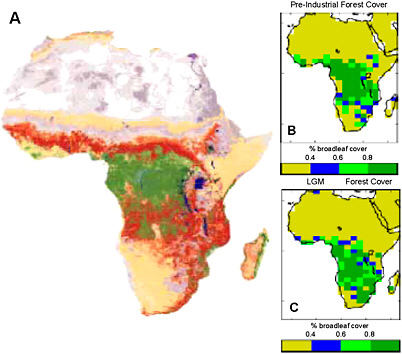 FIGURE 3.3 Model simulations for vegetation cover in (B) preindustrial and (C) Last Glacial Maximum time, compared with (A) modern-day vegetation distribution reconstructed from remotely sensed data. For the modern-day image, green colors represent forests and red colors represent woodlands and shrublands. SOURCE: Cowling et al. (2008). |
By comparing modeled climate scenarios both to the polar glaciation records and to the terrestrial records of change from C3 to C4 vegetation, it may be possible to resolve this apparent difference in greenhouse gas levels and to place bounds on the likely climates associated with different greenhouse gas levels.
Changes in oceanic gateways may also have played a role in climate change during this period. A particularly dramatic example of a gateway change was the closing of the connection between the Atlantic and the Mediterranean around 7 Ma, which led to periodic episodes of drying of most or perhaps all of the huge inland sea (the Messinian salinity crisis) until about 5.3 Ma, when the gateway reopened (Rouchy et al., 2006). The effects of this drying in the core of the African-Eurasian land mass have not been studied in detail, but must have profoundly influenced regional climates both through changes in the heating of the African/Eurasian landmass and through circulation and other changes in adjacent oceans.
Although these largely marine-based environmental records of global and regional trends, along with sparse terrestrial records from Africa and Eurasia, indicate large changes in climate during this time window, the details are obscure. Climate models for the pre-Northern Hemisphere ice sheet expansion period (the 8- to 4-Ma interval) can be used to simulate the geographic patterns of African climate and vegetation, and to help constrain the causes and magnitudes of African climate and vegetation shifts in terms of the relative influences of possible ranges of atmospheric CO2 concentrations, orbital forcing, and orographic and seaway changes, as well as to estimate ranges of uncertainty.
Time Window 2: The Onset of Glacial/Interglacial Cycles (4-2 Ma)
After 3 Ma, oxygen isotope records from marine sediment cores indicate continued cooling and development of continental ice sheets in the north. However, this general cooling trend was interrupted by a relatively brief warmer interval in the mid-Pliocene (~3 Ma), when there is evidence of increased warmth on global and regional scales, and perhaps somewhat elevated levels of greenhouse gases.
By 2.8 Ma, the general cooling trend continued, ice-rafted debris is found in North Atlantic Ocean sediments (an indication that icebergs were calving from polar ice sheets), and the marine-based oxygen isotope records show the onset of increased climatic variability. The waxing and waning of the developing northern continental ice sheets occurred at periods of known orbital cycles—the 41,000-year cycle in the tilt of Earth’s rotational axis and the 23,000-year cycle of the precession of the rotational axis (see Box 2.1). Ocean sediment cores contain records of windborn (eolian) dust emanating from the African continent and show both a gradual increase in dust over time and cycles of more or less dust at 23,000-year and 41,000-year periods. The isotopic records from terrestrial and marine sediments show a continued shift from a more wooded to a more open grassland environment, particularly in East Africa.
Yet another huge change in Earth’s climate between 3 and 2 Ma is recorded
by equatorial ocean sediment cores. During this time, the equatorial ocean temperature in the Pacific, Atlantic and Indian Oceans changed from near east-west uniformity to the present-day pattern of strong east-west gradients. In modern terms, for example, the equatorial Pacific changed from being a “permanent El Niño pattern” to a dominant La Niña pattern (warm in the west, cold in the east), a change that had major effects on tropical continents worldwide (Wara et al., 2005; Fedorov et al., 2006).
These records of major climate shifts—both trends and changes in variability, and changes in climate forcing—occur within the span of important events in hominin evolution or dispersal, including the split between 3 and 2.5 Ma that produced Homo from an Australopithecus ancestor. A major new research initiative, focused on the 4- to 2-Ma time interval, would illuminate the extent to which changes in climate and/or biotic communities influenced the origin of Homo. New paleoclimate studies and faunal/vegetation analysis would also constrain the likely dispersal routes and corridors or examine the potential for long-term contact among populations of Homo across environmental boundaries (e.g., the Sahara). And, with more focused paleoecological studies, it should be possible to finally understand whether Homo first dispersed as part of an integrated faunal community, with other individual species, or on its own.
The environmental records alone are still too sparse to draw firm conclusions about geographic patterns of climate in Africa and Asia and their variability, or about climate conditions along pathways to southern Eurasia, or temporal and spatial variability of Eurasian climates. In our vision, targeted and more resolved climate simulations during the 4- to 2-Ma period, when global sea surface temperature gradients were rapidly changing and global ice volume was rapidly increasing, will play a critical interactive role with new data collection to test the likely climate system drivers underlying the new paleoenvironmental records. These will, in turn, allow us to link models of these rapidly changing earth system processes in the late Pliocene to studies of hominin history and evolution. This combination of blending current and new environmental records with new climate model experiments represents a great opportunity.
One aspect of this opportunity to provide a much improved knowledge of the environmental context in which hominin evolution occurred is that, although we understand the potential response of climate (and environment) to individual mechanisms, we have not studied combinations of these processes. For example, climate models have proven to be quite accurate in their ability to predict middle-latitude and tropical monsoonal responses to orbital forcing, the critical factors that might have triggered the onset of high-latitude glaciation, and the cause of the dramatic shift in equatorial ocean temperatures that may have had major consequences for tropical and subtropical climates. The great challenge will be to study the combination of these processes, including multiple experiments with different greenhouse gas levels to take into account uncertainties in CO2 concentrations at this time, and uncertainties about the degree of ocean transport through
the Panama and Indonesian seaways. It will also be important to investigate how likely scenarios of moisture transport would have impacted the vegetation and water resources on which early hominins depended. This combined use of models and environmental records should then provide, for the first time, the opportunity to compare our best estimates of spatial and temporal patterns of environmental change with the fossil record of hominins.
Time Window 3: Longer and Larger Glacial/Interglacial Cycles (2-0.5 Ma)
A major shift in the tempo of climate and its extremes began about 1.2 Ma, and was in full swing by 0.9 Ma. The dominant period of glacial/interglacial cycles switched dramatically to the 100,000-year eccentricity cycle, although the 23,000 and 41,000-year components remained present. Although details of the geographic extremes of these glacial boundaries are uncertain, we know from the most recent extremes (22 ka) that ice sheets probably extended from the European Arctic southward as far as western and central Europe, with belts of tundra reaching into middle latitudes and with dramatic drops in global sea level of well over 100 meters. In the tropics, the 23,000-year precession cycle influencing tropical wet/dry cycles remained strong, but with perhaps even more pronounced episodes of aridity in some parts of the tropics. During much of this period, starting at about 0.8 Ma, ice cores provide a key additional environmental variable—we know CO2 and methane concentrations of the atmosphere through extraction and analysis of fossil air samples from the ice cores. Lowered CO2 helped amplify the cold swings and higher levels of ρCO2 occurred during the warmer interglacials. Both ice sheet changes and changes in CO2 levels could also have influenced tropical and subtropical precipitation.
What we do not understand, and would be the focus of the new research initiative proposed here, is how these climatic changes and resulting vegetation and water resource changes were transmitted to the specific regions where hominins lived. Another dispersal of Homo from Africa to Eurasia happened around the time of the climatic transition to large and long glacial/interglacial cycles (1.2-0.8 Ma) and these major climate swings must have modified the environments inhabited by Homo in Africa and Eurasia. Moreover, the changing amplitude and duration of the orbitally forced changes in climate, other quasi-periodic changes of shorter duration, or relatively gradual changes in forcing, may have had different effects on ecosystems than the abrupt changes that are also a characteristic of the climate record. With improved density, accuracy, and dating of environmental records during this period, there is a major opportunity to use climate models to ask more detailed questions and to obtain more detailed information about both the climate and vegetation comprising hominin habitats. In particular, the availability of accurate estimates of atmospheric CO2 will permit simulation of both the direct effects of greenhouse gases on climate (and vegetation) and the possible physiological effects on vegetation of changing levels of CO2. These models can only
be accurately tested by reference to actual paleoenvironmental data from Africa and Eurasia and the surrounding oceans. With the availability of greenhouse gas records and known orbitally controlled changes in solar radiation, along with known changes in orography, volcanism, coastlines, and ocean gateways, models have proven to be remarkably accurate in simulating past climates. However, challenges remain in accurately simulating the waxing and waning of ice sheets and the effects of glacial climates on tropical climates due to the complex interactions of several critical factors—the tropical forcing of monsoons by precession changes and forcing due to high-latitude climate changes, CO2 changes, sea-level changes, and deep-ocean circulation changes.
Time Window 4: Continuing Large Glacial/Interglacial Cycles (0.5-0 Ma)
The last several glacial/interglacial cycles, and in particular the climate of the last 150,000 years, is relatively well documented worldwide, although details of the spatial and temporal variability of climate on the continents are scant except for the past 20,000 years. The previous interglacial, the period around 125 ka, has been the subject of detailed study, as has the subsequent onset of glaciation around 115 ka, the LGM around 22 ka, and the subsequent warming trends culminating in the mid-Holocene, around 9-6 ka. The changes in forcing are relatively well known—primarily the orbitally-forced changes in insolation and the changing levels of CO2 and methane. This period then offers unique opportunities for detailed time-space simulation of climate, the comparison of the simulated climate with observations, and the subsequent analysis of potential linkages with hominin evolution and dispersal.
There are H. erectus fossils in China as recent as 250 ka and it should be possible to simulate the climate in Asia at this time and in particular the intensity of both summer and winter monsoons. Both H. neanderthalensis and H. sapiens appear in the period directly before or slightly into the penultimate glaciation (190-130 ka), and it should be possible to simulate the climate and vegetation of this period in considerable detail. There is evidence of megadroughts in tropical Africa between 135 ka and 90 ka, a period that preceded the dispersal of humans out of Africa around 60 ka and their widespread movements thereafter. It will be possible to use climate models, focusing primarily on the known orbital forcing and known glacial boundary condition forcing (ice sheets, sea level, CO2 level) to simulate the period of the past 125 ka with considerable accuracy and make detailed comparisons with the observations, both spatial and temporal. Millennial-scale changes in climate are also well documented in both polar and tropical latitudes during much of this most recent period, and offer the unique opportunity to study the possible causes of these events and the possible effects on ecosystems and humans.


