
CHAPTER 3
Review of Central Research Efforts Within the Methane Hydrate Research and Development Program
Since the start of fiscal year 2006, the Department of Energy (DOE) Methane Hydrate Research and Development Program has supported 27 new research projects and has continued to support an additional 11 projects that had begun between 2000 and the end of fiscal year 2005. Of these new or continuing projects, 25 remain active through the end of fiscal year 2009 or beyond (Appendix F). The projects supported by the Program cover several focus areas and have included discipline-specific research activities proposed by investigators at academic institutions and national laboratories as well as large, multidisciplinary projects conducted jointly with industry and/or other federal agencies, national laboratories, and academic institutions. DOE and some of its federal partners, at the U.S. Geological Survey (USGS), for example, have also participated in internationally organized projects.
This chapter provides a topical review of the Program’s scientific projects and major achievements and an assessment of knowledge gaps for research areas that the committee has determined are central to the Program’s mission and success (e.g., Appendix A) and follow naturally
from the “state of the science” and broad challenges in methane hydrate research outlined in Chapter 2. Thus, field projects with aims toward production tests and drilling, reservoir simulation modeling, geomechanics, remote sensing, and environmental and geohazard-related research are examined here. Although the focus is on research conducted since the last review of the Program (NRC, 2004), background information prior to 2004 is provided where appropriate (Appendix F contains a complete inventory of ongoing and completed projects supported by the Program).1
FIELD STUDIES WITH AIMS TOWARD DRILLING AND PRODUCTION TESTS
The Program’s field studies2 have focused in the Gulf of Mexico and on the Alaska North Slope. Research projects in both regions have been important cornerstones of the Program’s portfolio since 2001 and have been oriented toward improving exploration methods and quantifying the hydrate resource, and more recently, toward evaluating the challenges of methane hydrate production (Appendix F).3 Other research specific to the geologic and physical conditions of each region has also been conducted. An important component of the research in both regions has been their coordination with significant input to research coordination, resources, and execution from industry, other federal agencies, national laboratories, and the academic community, in addition to DOE (and the National Energy and Technology Laboratory [NETL]).
|
1 |
Project listings and information, including publications and reports, are catalogued on- line at http://www.netl.doe.gov/technologies/oilgas/FutureSupply/MethaneHydrates/projects/ DOEProjects/DOE-Project_toc.html. |
|
2 |
In this review “field studies” refers to those research projects within the DOE portfolio with active orientation toward production testing (see Appendix F). |
|
3 |
In Appendix F, Project Category “Field studies—Production and drilling projects,” Report identifiers 1 through 4. |
Alaska North Slope Field Projects: Investigating Methane Hydrate Occurrences and Production Response
The undertaking of methane hydrate field studies in northern Alaska has many practical advantages including a long history of scientific investigation in the area, a wealth of conventional hydrocarbon drilling and production experience, and access to logistics infrastructure. Recognizing the efficiencies of working in the Arctic and that the knowledge gained there can have broad applications to other settings, DOE has supported several field programs to date and is working closely with partners in the hydrocarbon industry to develop a number of new initiatives.
The geologic setting of methane hydrate in the Alaska North Slope is well described with a geothermal environment conditioned by thick occurrences of terrestrial permafrost (Osterkamp and Payne, 1981; Lachenbruch et al., 1988; Clow and Lachenbruch, 1998). Regional studies initiated in the 1980s (Collett, 1993, 1995), based mainly on well-log interpretations and data from a coring project carried out in 1972, indicate that evidence for the occurrence of methane hydrate is most commonly found in the vicinity of the Kuparuk River, Milne Point, and Prudhoe Bay oil fields (Figure 3.1; see also Figure 2.3). Occurrences of methane hydrate are thought to be primarily within coarse-grained clastic sediments often overlying deeper conventional oil and gas occurrences.
ALASKA NORTH SLOPE METHANE HYDRATE RESERVOIR CHARACTERIZATION
Initiated in 2001, this project, managed by BP Exploration Alaska, Inc. (BPXA) with participation of 16 different research groups has had overarching goals to (1) characterize the in-place methane hydrate resource on the Alaska North Slope and (2) conduct field and laboratory studies to evaluate the commercial potential for its production. The focus of the four-phase study (Phases 1, 2, and 3A) has been BPXA’s Milne Point production unit (Figure 3.1). Completion of Phases 1 and 2 (in 2005) resulted in seismic and well-log characterization, structural mapping, and
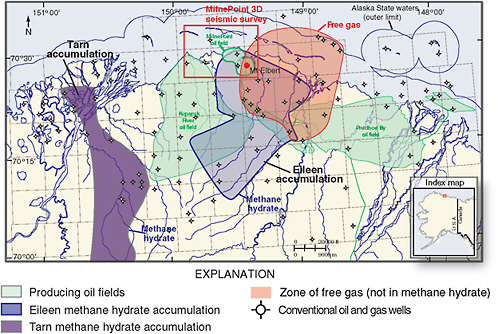
FIGURE 3.1 Map of northern Alaska near the Kuparuk, Milne Point, and Prudhoe Bay oil fields. Location of the Mount Elbert stratigraphic test well is also shown. Analysis of the methane hydrate reservoir and resource characterization relies upon access to subsurface data including industry seismic and well-log information. Data coverage decreases away from the Bay well cluster (see regional well distribution also in Figure 2.3). SOURCE: U. S. Geological Survey.
geophysical and reservoir modeling of the Milne Point area to calculate the regional in-place reservoir potential of a specific structural trend, and to allow economic analysis of field development scenarios.
Phase 3A focused on planning, drilling, and analysis of a stratigraphic test well at the Mount Elbert prospect at Milne Point.4 Field work was completed in February 2007 with extensive methane hydrate coring, advanced open-hole well logging, in situ formation testing, and a comprehensive post-field laboratory and modeling effort (Boswell et al., 2008; Hunter et al., 2008). This program was effectively managed with special attention to site selection and completion of a state-of-the-art research and development program that for the first time documented the in situ formation properties of a concentrated methane hydrate deposit on the North Slope. Methane hydrate was recovered from two sandstone intervals, each approximately 43-44 feet thick (Figure 3.2) with about 65 percent methane hydrate saturation. Saturation refers to the percentage of the pore space between sand grains that is occupied by methane hydrate. By integrating detailed core investigations, well-log attributes, and regional three-dimensional (3D) seismic interpretations, the project successfully developed a petroleum system model for the methane hydrate occurrences which established the geothermal setting, gas source, migration and trapping mechanisms, and the in situ properties of reservoir sands and enclosing sediments above and below them. These concepts were subsequently extended by the USGS in their assessment of the resource potential of the entire Alaska North Slope (Collett et al., 2008; Lee et al., 2008; USGS, 2008; see also Chapter 2).
The Mount Elbert methane hydrate stratigraphic test well also advanced research pertinent to evaluating the production response of methane hydrate. Small-scale in situ formation testing was undertaken using Schlumberger’s wireline Modular Dynamic Formation Tester (MDT) tool (Boswell et al., 2008; Hunter et al., 2008; see also Chapter 2). With this tool, a 1-meter formation interval was isolated and the formation pressures
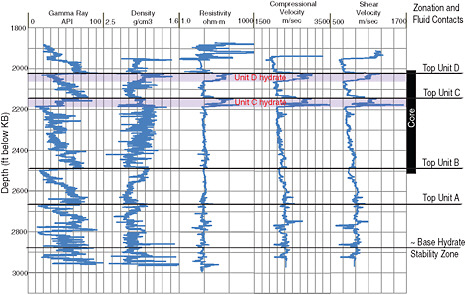
FIGURE 3.2 Geophysical wireline log data with gamma-ray, density, resistivity, compressional, and shear velocity values from the Mount Elbert-01 stratigraphic test well. The well was drilled to 1,987 feet and cored to 2,492 feet below kelly bushing (BKB). Core and logs revealed methane hydrate in two clastic sand intervals within the Sagavanirktok formation “Unit C” and “Unit D.” The methane hydrate intervals have distinct geophysical signatures on the well logs, including high resistivity and velocity relative to the surrounding sedimentary units. The base of the methane hydrate stability zone is interpreted at about 2,854 feet BKB. The KB references the elevation of the “kelly bushing” at the rig floor and is 55 feet at this location; log depths are in measured depth, which in this approximately vertical well are about 55 feet deeper than subsea depths. SOURCE: http://www.netl.doe.gov/ technologies/oil-gas/publications/Hydrates/2009Reports/NT41332_BPXA-Hunter.pdf.
manipulated. Surface readout of the subsequent pressure response, quantification of the inflowing material (formation water, gas, and sediment), and sampling capability permitted detailed interpretation of the formation response to reducing the pressure regime at the site. This technique had been successfully used in a cased-hole configuration at the Mallik site in 2002 (Dallimore and Collett, 2005; see also Chapter 2) and offshore in the Nankai Trough (Fujii et al., 2008).
At Mount Elbert, the MDT yielded the first tests in the open-hole configuration to enable more accurate formation testing without the infuence of casing and cement (Boswell et al., 2008). Although interpretation of the MDT results proved complex (Anderson et al., 2008; Hunter et al., 2008), when combined, the MDT and nuclear magnetic resonance log data from Mount Elbert enabled accurate assessments of the in situ and relative permeability of methane hydrate intervals. Methane hydrate dissociation and free-gas production were observed in the later stages of each test when the formation pressure was reduced below methane hydrate equilibrium conditions. Complex pressure buildups were also observed when the methane hydrate dissociated, perhaps indicating more complicated behavior of the methane hydrate or formation of ice (Hunter et al., 2008). Developing a better understanding of the behavior of methane hydrate during pressure drawdown and the efficiency of pressure drawdown in producing methane hydrate remains important for future work at this site.
Within the context of these substantial gains in knowledge, three main challenges and needs remain with regard to understanding the potential to produce methane from methane hydrate reservoirs on the Alaska North Slope. These include
-
Further research to ascertain the detailed ground temperature regime of the in situ methane hydrate occurrences;
-
Investigation of the significance and detailed associations of free methane and methane hydrate, especially within the context of identification of geohazards; and
-
Long-term production testing.
NEW ALASKA NORTH SLOPE FIELD STUDIES
Phase 3B of Alaska North Slope project
Building upon the considerable progress made to date in Phases 1, 2, and 3A of the cooperative agreement between DOE and BPXA on the Alaska North Slope, the participant group has expressed interest in continuing the work with increased focus on production testing. In particular, the
group agrees that the small-scale MDT testing is not sufficient to assess the production response of a methane hydrate reservoir. The results of this project to date are important, particularly with regard to verification of a proposed geologic model for methane hydrate occurrence. At present, the results of the initial phases of the project are being used to evaluate and rank locations for the development of a long-term production test site in the Prudhoe Bay area. Several sites are under examination by BPXA management for consideration to proceed to Phase 3B. Land ownership and access issues are also part of this process. A decision by BPXA to move to Phase 3B—production testing—is anticipated by the end of March 2010.
North Slope Borough Project
The DOE reached agreement in December 2008 with the North Slope Borough to assess drilling and long-term production testing opportunities to evaluate the methane hydrate resource potential associated with the Barrow Gas Fields (see location in Figure 2.3) where free-gas occurrences have already been developed as an energy source for the community of Barrow. This project is the second-phase follow-on of a 2-year project (“Phase 1”) with the North Slope Borough (conducted from 2006 to 2008) to characterize and quantify the methane hydrate resource potential of the Barrow Gas Fields. During Phase 1, methane hydrate stability modeling was conducted to identify the base of the hydrate stability zone in three areas; the aim was to identify areas where a hydrate-stable zone exists in an up-dip position relative to known gas reservoir sands (free gas). Further analysis during Phase 1 defined two locations for potential hydrate test wells.
Research during Phase 2 will include (1) geologic studies to verify this accumulation model of methane hydrate occurrences up-dip and in contact with the free gas and (2) the design, drilling, logging, coring, and continuous monitoring of a production well to test the commercial potential of producing gas through depressurization dissociation from the free-gas zone underlying the hydrate deposits. Although methane hydrate accumulations with lower contacts to free gas have in the past been proposed as a common occurrence, recent field studies around the world have suggested that the free gas may often exist in low concentrations. The Barrow project will pro-
vide field verification of this type of accumulation model and allow assessment of the degree of the porous media associations of methane hydrate and free gas. Success with the project will increase industry’s understanding of the role of methane hydrate in the recharge of producing conventional gas fields and of how dissociation of methane hydrate may improve field performance.
Methane Hydrate Production Trial Using Carbon Dioxide–Methane Exchange
In fall 2008, ConocoPhillips and DOE agreed to pursue a field research project on the Alaska North Slope with a stated goal to define, plan, and conduct a field trial of a methane hydrate production methodology whereby carbon dioxide molecules can be exchanged in situ for the methane molecules within a hydrate structure, thus releasing the methane for production. The purpose of the project is to evaluate the viability of this hydrate production technique and to understand the implications of the process at a field scale (Farrell and Howard, 2009). Conceptually, this novel production scheme has the very desirable attribute that it could reduce the greenhouse gas footprint of methane hydrate production by sequestering carbon dioxide while producing methane. However, achieving this goal presents several significant challenges because the concept is based largely on small-scale laboratory experiments conducted on artificial media (Stevens et al., 2008), and no experiments have been performed to date on fully representative, unconsolidated samples. Scaling these experiments to a full-sized field trial will likely present significant technical challenges including complex well completions and operational procedures.
The project is divided into three phases, with work completed under Phase 1 that included developing a ranked set of possible field sites on the Alaska North Slope. Final field site selection occurred during Phase 2, which began in May 2009. Phase 2 work will include both experimental and well-design components. The third phase of the project, assuming successful completion of Phase 2, aims to validate the laboratory tests in the field. At the time of preparation of this report, the project will initiate Phase 3 in January 2010.
Gulf of Mexico Project Overview
The joint industry project (JIP) in the Gulf of Mexico is a collaborative undertaking led by Chevron Energy Technology Company with a central goal in the initial phases to address critical questions in marine methane hydrate exploration and geohazard assessment. The project has involved 18 industry partners, federal agencies (including DOE, the Minerals Management Service [MMS], and the USGS), national laboratories, and university research groups.5
During the first two phases of the project (2001-2007) the JIP made several contributions to the overall understanding of marine methane hydrate, as well as of detailed aspects of local methane hydrate occurrences in the Gulf of Mexico. Phases 1 and 2 culminated in the first successful Gulf of Mexico drilling and coring expedition for methane hydrate in May 2005 at two sites (Atwater Valley and Keathley Canyon; Figure 3.3) during which a substantial quantity of well logs, cores, and borehole seismic data were acquired. Laboratory analyses of the cores included analysis of the physical and mechanical properties of fine-grained hydrate-bearing sediments. New tools specific to the shipboard drilling environment were also tested for acquiring and analyzing field samples.
Among the notable, specific contributions from the project’s first two phases were the development of laboratory equipment for making the first physical property measurements on pressure cores under in situ pressure conditions and developing a procedure of predrilling site-survey and siteselection efforts. The site-selection process was based on substantial industry 3D seismic datasets, normally unavailable for academic research. The data and results from these phases (summarized in a special volume of Marine and Petroleum Geology6) were used to develop the third phase of
|
5 |
http://www.netl.doe.gov/technologies/oil-gas/FutureSupply/MethaneHydrates/projects/DOEProjects/CharHydGOM-41330.html; members include Chevron Energy Technology Company, Schlumberger Oilfield Services, Halliburton Energy Services, ConocoPhillips, Total, Japan Oil, Gas and Metals National Corporation, Reliance Industries Ltd., StatoilHydro, Korean National Oil Company, MMS, Naval Research Lab, USGS, Rice University, Aumann & Associates Inc., Scripps Institute of Oceanography, Georgia Institute of Technology, AOA Geophysics, and Geotek Ltd. |
|
6 |
Marine and Petroleum Geology, Volume 25, Issue 9, November 2008. |
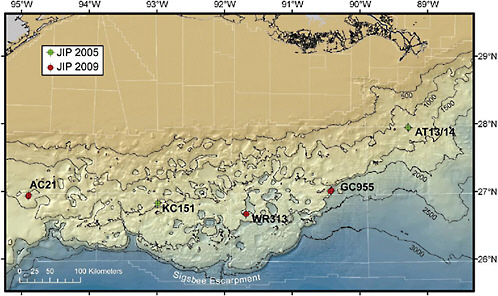
FIGURE 3.3 Bathymetric map of the northern Gulf of Mexico. The outline of the southeastern tip of Louisiana is visible between 89°W and 92°W. Bathymetric contours are in meters below sea level. Sites considered for drilling during Phases 1 and 2 (JIP 2005) and Phase 3A (2009) are indicated. Three sites selected for the logging-while-drilling JIP expedition in spring 2009 (shown in red) were in the Alaminos Canyon (21) (which is also referred to as the “East Breaks” site), Green Canyon (955), and Walker Ridge (313). In water depths of about 1,600 to 2,200 meters (5,250 to 7,218 feet), a semi-submersible rig was used to drill seven wells at these three sites. AC = Alaminos Canyon, KC = Keathley Canyon, WR = Walker Ridge, GC = Green Canyon, AT = Atwater Valley. Isobaths are in meters. SOURCE: Deborah Hutchinson, U.S. Geological Survey.
the JIP which defined a new science plan around selection of new drilling and logging (Phase 3A, begun in 2007) and coring (Phase 3B, slated to begin in the latter half of 2009) sites at Walker Ridge, Alaminos Canyon (East Breaks), and Green Canyon (Figure 3.3). Processing and interpreting the 3D industry datasets before drilling using a methane hydrate petroleum system approach were essential to the success in the latest logging-while-drilling (LWD) expedition (Phase 3A), carried out in March and April 2009.
A significant shift in science strategy in Phase 3 was to identify and sample concentrated methane hydrate occurrences in sand beds as opposed to regional occurrences associated with muds; in keeping with the project’s focus on the drilling hazards in the sediments that typify the shallow section in the deepwater Gulf of Mexico, muds had been the targets of Phases 1 and 2. A detailed site-selection process was conducted prior to the 21-day expedition in spring 2009. Seven wells were drilled in Walker Ridge, Alaminos Canyon, and Green Canyon (Figure 3.3). The Phase 3 work aims to refine the use of seismic analysis and geologic information to develop prediction methodologies for hydrate-bearing, coarse-grained sediments, and to develop new pressure-coring tools and core transfer capabilities to enable in situ laboratory measurements of hydrate properties. Success with these studies will advance the capability to assess marine hydrate reservoirs and technical recovery of gas from marine hydrate. Assessing and understanding potential safety hazards associated with drilling wells through and running pipelines over sediments containing methane hydrate, and developing wellbore and seafloor stability models pertinent to hydrate-containing sediments remain stated components of the research program.
The main results from the LWD drilling in spring 2009 confirmed predrilling predictions from seismic data (in terms of depth to the methane hydrate target and estimated concentrations), although ground truthing with coring is still required to verify these results (Phase 3B).7 Four of the
wells found high concentrations of methane hydrate in porous, permeable sands. Two wells contained low concentrations of methane hydrate in sands and one well intersected good-quality sands with no indications of methane hydrate. The delineation of thick methane hydrate–bearing sand accumulations is a significant result of the LWD drilling. These sands could be producible when a recovery (or production) scenario for marine deposits is developed.
With these substantial gains in knowledge of marine hydrate in the Gulf of Mexico taken into consideration, three main challenges still remain with regard to understanding the potential to produce gas from these marine hydrate resources:
-
Remote-sensing techniques with sufficient resolution to detect methane hydrate occurrences with confidence at a scale that corresponds to the known geologic occurrences need to be developed;
-
Geohazards associated with the natural occurrence of methane hydrate in areas with conventional petroleum production are only beginning to be assessed quantitatively (e.g., Birchwood et al., 2007); and
-
Geohazard and geomechanic issues associated with the production of methane from methane hydrate remain to be addressed quantitatively. Specifically, the response of the shallow formations to removal of gas, and the seafloor response and associated stability issues of the wellbore and pipelines have not been analyzed.
EXPERIMENTAL AND MODELING STUDIES TO ASSESS THE GEOMECHANICS AND FEASIBILITY OF METHANE HYDRATE PRODUCTION
The Program has supported 15 experimental laboratory and modeling projects during the course of this review. An additional five projects were completed prior to the start of this review. A majority of the projects are performed through various national laboratories and universities
(Appendix F).8 The common goal of these projects has been to provide data on physical properties, formation/dissociation behavior, and kinetics of hydrate-bearing sediments to assess the feasibility of methane hydrate production and geomechanical issues associated with the production of gas from methane hydrate deposits.
In the active project portfolio, the Program includes eight experimental projects focused on physical property measurements and five computer modeling projects, which range from reservoir modeling of the geomechanical behavior of methane hydrate–bearing sediments, to molecular-scale simulations of the growth and dissociation of methane hydrate, to methane hydrate growth at the grain/bed scale. In the latter project the model is used to investigate the hypothesis of whether coupling among geomechanics, dynamics of gas–water interfaces, and phase behavior of gas–brine–hydrate systems result in coexistence of free gas and hydrate in the hydrate stability zone. Results from this type of research may have implications for interpretation of seismic and borehole log data, as well as enabling refinements in the petroleum systems concepts for methane hydrate assessment.
In addition, a reservoir production modeling project has been supported to assess methane gas production using carbon dioxide injection. The project is starting to involve collaborations with the ConocoPhillips field project in which carbon dioxide injection with methane production is integral. One additional project has been focused on the development of the U.S. methane hydrate database for retrieval/submission of thermo-dynamic, structural, and geophysical property data, which will be linked to international databases through a portal under development from the CODATA hydrate workgroup. Of the eight experimental projects, all involve methane hydrate growth and dissociation kinetics measurements (e.g., evaluation of gas production rates from methane hydrate–bearing sediments) and/or physical property measurements, such as permeability, thermal properties, and geomechanical properties.
|
8 |
In Appendix F: Project Category “Experimental and laboratory modeling studies and NETL projects, Report identifiers 36 through 46 and 52 through 55. |
In all the laboratory-based experimental projects, a major limitation is the nature of the sample that is being characterized and measured: The sample needs to be a close analog to naturally occurring methane hydrate formations if measurement results are to be scaled and extended to the reservoir system. In the current studies, samples are largely synthesized from free gas plus water plus sediment, with a limited number of studies employing recovered core samples and even fewer, if any, using pressure-cored samples that have not been depressurized. Given these limitations as well as the need to obtain accurate and reproducible data, synthetic cores are needed, but these need to be analogous to the methane hydrate that occurs naturally within the subsurface formations. Pressure-cored samples provide a closer representation to in situ hydrate formations compared to unpressurized cored samples or typical laboratory-synthesized samples. Although the effect of sample disturbance is not completely eliminated by pressure coring, these effects will be significantly reduced compared to unpressurized core samples (also see Chapter 2). Clearly, in situ measurements would be the ideal method, but these are not always practical and cannot be performed as extensively and systematically as laboratory measurements. As indicated in Box 2.4, the synthesis method (i.e., using dissolved gas in liquid water, free gas and liquid water, or ice) strongly influences the pore-scale distribution of the methane hydrate, and hence the structural and physical properties of the synthetic core, including stiffness and strength of sediments and bulk conduction properties, which will subsequently determine the level to which these synthetic samples will represent natural formations (Lee et al., 2008; Waite et al., 2009).
The synthesis of samples analogous to natural hydrated sediment systems is a critical step toward being able to scale the laboratory measurement results to the reservoir system, and has been one of the focus areas of some of the currently funded projects. The laboratory measurements of the physical property responses to carefully controlled variables, such as hydrate saturation, grain size and type, pressure, and temperature, for example, can be useful to the field production and resource assessments.
A high-profile initiative in the DOE-supported modeling program has been the DOE/NETL- and USGS-led international code com-
parison study in which the leading methane hydrate reservoir simulators (CMG STARS, HydrateResSim, MH21, HYDRES, STOMP-HYD, and TOUGH+HYDRATE; see Chapter 2, Table 2.1) were used to predict hydrate production rates and to characterize the natural hydrate-bearing sediments. This code comparison study has been ongoing since late 2004. The DOE-supported reservoir modeling results have produced a number of experience-based techniques, or heuristics, which may be valuable during the field tests/production assessments. Despite the progress made by the modeling projects to assess the production potential of methane hydrate reservoirs, the accuracy of the results is still uncertain because the models have not been validated against ground-truthing field data because of the lack of data from long-term production field tests.
The state-of-the-art advanced simulator from Lawrence Berkeley National Laboratory TOUGH+HYDRATE code (see also Chapter 2) has also been applied to aid in the interpretation of laboratory experimental data, such as in reverse-modeling of computed tomography x-ray data to determine the physical property parameters (e.g., thermal conductivity and relative permeability data for heterogeneous hydrated sediment samples) (Figure 3.4). Recently, the TOUGH+HYDRATE code has been coupled with a commercial geomechanical code, FLAC3D, to assess the yield (failure) distribution during production of hydrate-bearing sediments. Again, experimental data are critical to validate the geomechanical predictions.
REMOTE SENSING
The Program has supported 7 remote-sensing–related projects since 2006, of which four have focused on the Gulf of Mexico (Appendix F).9 This emphasis is logical given that the JIP project in the Gulf of Mexico requires predrilling site evaluations, including assessing existing industry geophysical data, collecting new geophysical data, and processing these datasets for the specific needs of shallow-drilling and shallow-hazard
|
9 |
In Appendix F: Project Category “Resource characterization and remote sensing,” Report identifiers 5 through 10 and 21. |
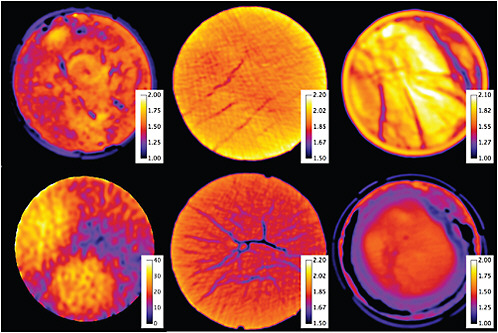
FIGURE 3.4 Computed tomography x-ray core images showing significant heterogeneity in hydrate-bearing sediment cores synthesized in the laboratory (bottom left), and in recovered natural cores from the ocean floor (top left), Mt. Elbert well (middle), and the Indian National Gas Hydrage Program expedition (far right). The color scales for all natural cores represent the bulk density distribution (in grams per cubic centimeter), and for the synthetic hydrate core the color scale represents methane hydrate saturation (%). SOURCE: Kneafsey (2009).
surveys. The result, with the exception of the USGS-related interagency collaboration activities, which include the Alaska North Slope and off-shore India, is that remote-sensing–related projects are marine oriented. The research is conducted by various university groups, federal agencies, national laboratories, and industry partners and concentrates on two main types of remote-sensing techniques: (1) seismic and/or acoustic techniques and (2) controlled-source electromagnetic (CSEM) imaging.
Seismic Techniques
A major goal of the Program is to stimulate the development of new geophysical tools and techniques to detect and quantify methane hydrate in nature, primarily using seismic reflection profiling techniques. Some projects attempt to also link this general theme to geomechanical and geohazard issues by coupling with the development of rock physics models to help understand the physical properties (particularly seismic velocities) of the sediments that may contain methane hydrate.
Among the seismic-related projects supported by the Program, one in particular has achieved notable success in combining multicomponent seismic attributes, new rock physics models, and in situ data to estimate methane hydrate concentrations in deepwater, near-seafloor strata of the Gulf of Mexico. This project has also advanced the use of other, or nonstandard, seismic techniques such as ocean-bottom cables or ocean-bottom seismometers in understanding methane hydrate in marine sediments10 (see Chapter 2) (e.g., Hardage et al., 2009; Figure 3.5).
Increasing use in the DOE-supported remote-sensing projects is being made of available industry 3D seismic data, which provide an opportunity to better delineate the prospective methane hydrate deposits within the framework of the petroleum-system concept. One shortcoming of using industry seismic data for methane hydrate detection and quantification is that these data typically were acquired with a deeper target depth in mind, and thus the resulting vertical and horizontal resolution within the methane hydrate stability zone is significantly less than could be obtained if the surveys were optimized for methane hydrate targets. Lack of dedicated seismic surveys for (shallow) methane hydrate targets, particularly those across sites with high-quality LWD data such as those recently acquired during Phase 3A of the Gulf of Mexico JIP (see section Field Studies with Aims Toward Drilling and Production Tests), compromises identification and quantification of the methane hydrate resource.
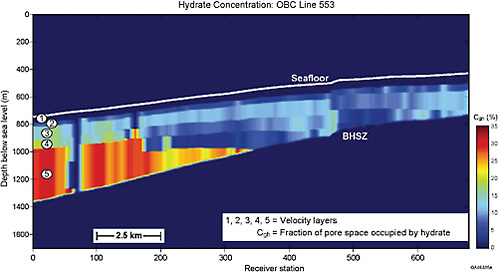
FIGURE 3.5 New technology was developed for imaging near-seafloor geology with four-component ocean-bottom cable (OBC) data. This figure shows hydrate concentrations estimated along one of the study’s OBC profiles in the Gulf of Mexico. The units are “percent of pore space occupied by methane hydrate.” (Cgh = color scale from 0 to 35 percent on the right-hand side of the figure). Methane hydrate concentrations were estimated for layers identified by the numbers 2 through 5 (left side of the diagram). Concentrations were not estimated for Layer 1 because no log data were available across this shallowest interval immediately below the seafloor. The calculated hydrate concentrations exhibit considerable lateral variation within each velocity layer and considerable vertical variability from layer to layer. The maximum methane hydrate concentration found along this OBC profile was in the left-hand side of the line where methane hydrate occupied a little more than 30 percent of the pore space of the host sediment (red colors). At the south end (left-hand side) of the line, the base of the hydrate stability zone (BHSZ) boundary is defined by a reversal of VP velocity. At the north end, a published thermal constraint is used to define the BHSZ. The concepts established through this study allowed the researchers to conclude that evaluating deepwater hydrate systems with multicomponent seismic data is highly desirable. SOURCE: Hardage et al. (2009).
CSEM
Two projects in the DOE Program’s remote-sensing portfolio have focused on developing new tools, approaches, and equipment to use CSEM techniques as a method for methane hydrate detection. Although CSEM techniques are widely used in exploration for conventional marine hydrocarbons, the technique has not yet attracted significant use in methane hydrate research. However, CSEM techniques hold considerable promise for methane hydrate detection because of the electrical resistivity contrasts between methane hydrate–bearing and water-saturated rocks (Chave et al., 1985; Edwards, 2005; Ruppel, 2009).
Research Challenges
At present, both seismic and CSEM methods as applied specifically to exploration for methane hydrate require additional research and development. Although exploratory drilling and production tests have been conducted in both Alaska and the Gulf of Mexico areas with success (see section Field Studies with Aims Toward Drilling and Production Tests), a critical contribution to advancing the research in these areas involves acquisition of dedicated, new seismic surveys specifically focused on methane hydrate detection. The combined use of seismic and CSEM in remote sensing for methane hydrate has the potential to minimize ambiguity and resolution limits compared to the use of either technique alone.
As outlined in Chapter 2, exploration for methane hydrate occurrences requires detailed assessment of the temperature and pressure regime within the potential methane hydrate–bearing sediment section to make better predictions of the depth to the base of methane hydrate stability. At this point, the Program’s research portfolio does not include temperature (and, if possible, pressure) surveys, either through marine heat-probe deployments or through assessment of existing well data. Results from such studies could narrow the uncertainty in regional methane hydrate assessments and site-specific analyses, for example, through installation
of fiber-optic distributed temperature sensors, similar to those used in the Mallik program (Henninges et al., 2005).
ENVIRONMENTAL AND GEOHAZARD RESEARCH RELATED TO METHANE HYDRATE DEGASSING THROUGH GEOLOGIC TIME
The Methane Hydrate Research and Development Act of 2000 (Appendix A) specifically encourages DOE to support basic and applied research “to assess and mitigate the environmental impact of hydrate degassing (including both natural degassing and degassing associated with commercial development).” To this end, the Program has supported a variety of projects from national laboratories, industry, and academic institutions that address many aspects of the environmental consequences of the degassing of methane hydrate. The Program has thus provided an opportunity for investigators to obtain fundamental information concerning the environmental impacts of methane hydrate degassing through geologic time, including impacts caused by current human activities and those predicted for the future.
Of 14 environmental impact projects supported by the Program since 2005, 10 have focused on some aspect of environmental impacts resulting from the natural degassing of methane hydrate (Appendix F).11 Different approaches have been taken in these 10 projects to obtain relevant information. Some projects deal mainly with methane oxidation, another focuses on the biological origins of methane, some use modeling of methane hydrate geodynamics, and still others consider rates of methane seepage (methane flux) (a) in thermokarst lakes of the Arctic, (b) in the water column of the Gulf of Mexico, (c) inferred in sediment of the Bering Sea, (d) from the stratigraphy of carbonates, and (e) in oceanic sediment based on sulfate profiles. The Gulf of Mexico serves as the field site for five of the 14 projects (Figure 3.6).
|
11 |
In Appendix F: Project Category “Environmental studies,” Report identifiers 4, 11 through 19, and 24 through 27. |
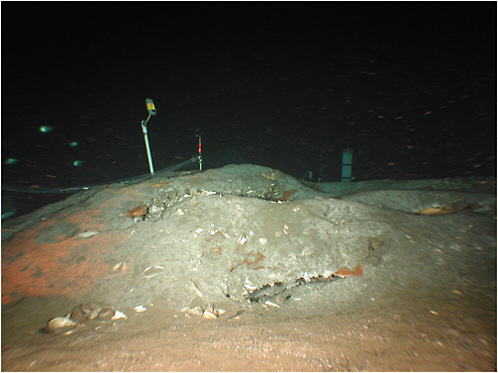
FIGURE 3.6 Gulf of Mexico methane hydrate deposit on the seafloor. A remotely operated vehicle was used to take photographs over a 350-day time series to document methane hydrate occurrences and the drivers for their stability, including bottom water temperatures and the water temperature profile. SOURCE: MacDonald (2009).
Most projects specifically proposed to generate new information regarding the role of methane hydrate in the global carbon cycle and/or in global climate change. Research aimed toward placing methane hydrate degassing into a global context relative to the carbon cycle and climate change is ambitious. As yet no major breakthroughs have appeared from this research in the understanding of possible global roles for methane hydrate resulting from its natural degassing.
To date, none of the Program’s projects have substantially addressed the potentially enhanced impacts expected from the commercial exploitation of methane hydrate although four of the projects in the environ-
mental portfolio have described some research goals that address geohazards and environmental issues associated with drilling and production. Also, no project to date has considered the mitigation of the environmental impacts of natural degassing and degassing associated with commercial development as specified in the enabling legislative language. These latter kinds of studies are critical for the development of strategies to minimize the environmental impacts resulting from any future commercial production of methane from methane hydrate.
REFERENCES
Anderson, B. J., J. W. Wilder, M. Kurihara, M. D. White, G. J. Moridis, S. J. Wilson, M. Pooladi-Darvish, Y. Masuda, T. S. Collett, R. B. Hunter, H. Narita, K. Rose, and R. Boswell. 2008. Analysis of modular dynamic formation test results from the Mount Elbert-01 stratigraphic test well, Milne Point Unit, North Slope Alaska. In Proceedings of the Sixth International Conference on Gas Hydrates (ICGH 2008), July 6-10, Vancouver, BC, Canada. Available online at http://www.fekete.com/resources/papers/analysis_modular_dynamic_paper.pdf. Accessed January 2, 2010.
Birchwood, R., S. Noeth, M. Tjengdrawira, S. Kisra, F. Elisabeth, C. Sayers, R. Singh, P. Hooyman, R. Plumb, E. Jones, and B. Bloys. 2007. Modeling the mechanical and phase change stability of wellbores drilled in gas hydrates by the Joint Industry Program (JIP) gas hydrates project Phase II. SPE Annual Technical Conference. November 11-14, Anaheim, CA. SPE 110796; doi:102118/110796-MS.
Boswell, R., R. Hunter, T. S. Collett, S. Digert, S. Hancock, M. Weeks, and Mount Elbert Science Team. 2008. Investigation of gas hydrate bearing sandstone reservoirs at the Mount Elbert stratigraphic test well, Milne Point, Alaska. In Proceedings of the Sixth International Conference on Gas Hydrates (ICGH 2008), July 6-10, Vancouver, BC, Canada. Available online at http://circle.ubc.ca/handle/2429/1167. Accessed January 2, 2010.
Chave, M. R., J. L. Ribeiro, A. Selmi, P. Gibart. 1985. Electrical resistivity and seebeck effect in HgCr2Se4. Physica status solidi (a) 92(1):263-271. Available online at http://adsabs.harvard. edu/cgi-bin/nphabs_connect?fforward=http://dx.doi.org/10.1002/pssa.2210920126. Accessed January 2, 2010.
Clow, G., and A. Lachenbruch. 1998. Borehole locations and permafrost depths, Alaska, USA. In International Permafrost Association, Data and Information Working Group, comp. Circumpolar Active-Layer Permafrost System (CAPS), version 1.0. CD-ROM available from National Snow and Ice Data Center, nsidc@kryos.colorado.edu. Boulder: NSIDC, University of Colorado.
Collett, T. S. 1993. Natural gas hydrates of the Prudhoe Bay and Kuparuk River area, North Slope, Alaska. American Association of Petroleum Geologists Bulletin 77(5):793-812.
Collett, T. S. 1995. Gas hydrate resources of the United States. In National Assessment of United States Oil and Gas Resources (on CD-ROM), D. L. Gautier, ed. Digital Data Series, Vol. 30. Reston, VA: U.S. Geological Survey.
Collett, T. S., W. F. Agena, M. W. Lee, M. V. Zyrianova, K. J. Bird, R. R. Charpentier, T. A. Cook, D. W. Houseknect, T. R. Klett, R. M. Pollastro, and C. J. Schenk. 2008. Assessment of Gas Hydrate Resources on the North Slope, Alaska, 2008. U.S. Geological Survey Fact Sheet FS-2008-3073, 4 pp.
Dallimore, S. R., and T. S. Collett. 2005. Summary and implications of the Mallik 2002 Gas Hydrate Production Research Well Program. In Scientific Results from the Mallik 2002 Gas Hydrate Production Research Well Program, Mackenzie Delta, Northwest Territories, Canada, S. R. Dallimore and T. S. Collett, eds. Bulletin 585. Ottawa, Ontario: Geological Survey of Canada.
Edwards, N. 2005. Marine controlled source electromagnetics: Principles, methodologies, future commercial applications. Surveys in Geophysics 26:675-700.
Farrell, H., and J. Howard. 2009. Experimental Basis CO2-CH4 Exchange for Production from Hydrate Reservoirs: Field-Test Plans. Presentation to the Committee on Assessment of the Department of Energy’s Methane Hydrate Research and Development Program: Evaluating Methane Hydrates as a Future Energy Resource, Washington, DC, March 5.
Fujii, T., T. Saeki, T. Kobayashi, T. Inamori, M. Hayashi, O. Takano, T. Takayama, T. Kawasaki, S. Nagakubo, M. Nakamizu and K. Yokoi. 2008. Resource assessment of methane hydrate in the eastern Nankai Trough, Japan. Offshore Technology Conference Proceedings, May 5-8, Houston, TX, pp. 1-15; doi:10.4043/19310-MS.
Hardage, B. A., P. E. Murray, D. Sava, M. M. Backus, M. V. DeAngelo, R. J. Graebner, and D. E. Wagner. 2009. Combining multicomponent seismic attributes, new rock physics models, and in situ data to estimate gas-hydrate concentrations in deep-water, near-seafloor strata of the Gulf of Mexico: Final report for U.S. Department of Energy Project DE-FC26-05NT42667.
Henninges, J., J. Schrötter, K. Erbas, and E. Huenges. 2005. Temperature field of the Mallik gas hydrate occurrence: Implications on phase changes and thermal properties. In Scientific Results from the Mallik 2002 Gas Hydrate Production Research Well Program, Mackenzie Delta, Northwest Territories, Canada, S. R. Dallimore and T. S. Collett, eds. Bulletin 585. Ottawa, Ontario: Geological Survey of Canada.
Hunter, R., S. A. Digert, R. Boswell, and T. S. Collett. 2008. Alaska Gas Hydrate Research and Stratigraphic Test Preliminary Results. Arctic Energy Summit. Available online at www. arcticenergysummit.org. Accessed September 29, 2009. 12 pp.
Kneafsey, K. 2009. Hydrologic, Geomechanical, and Geophysical Measurements on Laboratory-Formed Hydrate-Bearing Samples. Presentation to the Committee on Assessment of the Department of Energy’s Methane Hydrate Research and Development Program: Evaluating Methane Hydrates as a Future Energy Resource. Washington, DC, March 5.
Lachenbruch, A. H., J. H. Sass, L. A. Lawver, M. C. Brewer, B. V. Marshall, R. J. Munroe, J. P. Kennelly, Jr., S. P. Galanis, Jr., and T. H. Moses, Jr. 1988. Temperature and depth of permafrost on the Arctic slope of Alaska. Pp. 645-656 in Geology and Exploration of the National Petroleum Reserve in Alaska, 1974 to 1982, G. Gryc, ed. USGS Professional Paper 1399. Reston, VA: U.S. Geological Survey.
Lee, M. W., T. S. Collett, and W. F. Agena. 2008. Assessing Gas-Hydrate Prospects on the North Slope of Alaska—Theoretical Considerations. Scientific Investigations Report 2008–5175, 28 pp. Available online at http://pubs.usgs.gov/sir/2008/5175/pdf/SIR08-5175_508.pdf. Accessed January 2, 2009.
MacDonald, I. 2009. Remote Sensing Detection of Active Hydrocarbon Seeps: Implications For Methane in the Sea. Presentation to the Committee on Assessment of the Department of Energy’s Methane Hydrate Research and Development Program: Evaluating Methane Hydrate as a Future Energy Resource. Washington, DC, March 5.
NRC (National Research Council). 2004. Charting the Future of Methane Hydrate Research in the United States. Washington, DC: The National Academies Press. 202 pp.
Osterkamp, T. E., and M. W. Payne. 1981. Estimates of permafrost thickness from well logs in northern Alaska: Cold Regions Science and Technology 5:13-17.
Ruppel, C. 2009. Prospecting for Hydrates—Evolution of Detection and Evaluation Approaches. Presentation to the Committee on Assessment of the Department of Energy’s Methane Hydrate Research and Development Program: Evaluating Methane Hydrate as a Future Energy Resource, Washington, DC, March 5.
Stevens, J., J. Howard, B. Baldwin, G. Ersland, J. Husebø, and A. Graue. 2008. Experimental hydrate formation and production scenarios based on CO2 sequestration. In Proceedings of the Sixth International Conference on Gas Hydrates, July 6-10, Vancouver, BC. Available online at http://www.netl.doe.gov/technologies/oil-gas/publications/hydrates/2009Reports /NT06553_StevensEtAl.pdf. Accessed October 15, 2009.
USGS (U.S. Geological Survey). 2008. Assessment of Gas Hydrate Resources on the North Slope, Alaska Fact Sheet 2008-3073. October.
Waite, W. F., J. C. Santamarina, D. D. Cortes, B. Dugan, B. N. Espinoza, J. Germaine, J. Jang, J. W. Jung, T. J. Kneafsey, H. Shin, K. Soga, W. J. Winters, and T. S. Yun. 2009. Physical properties of hydrate-bearing sediments. Reviews of Geophysics 47:RG4003; doi:10.1029/2008RG000279.


