
IDR Team Summary 7
How do we move beyond genetics to engage chemical and physical approaches to synthetic biology?
CHALLENGE SUMMARY
The controlled manipulation of genetic information constitutes the “standard model” of synthetic biology. But biological behavior is subject to control at many levels, and biological systems respond to a wide range of chemical and physical stimuli. As cells and organisms adapt to their environments, they change the genes they express, the chemical substrates they use and the metabolites they produce. They respond to changes in temperature, pH, and ionic strength, to light and mechanical forces, and to many other chemical and physical signals. Researchers interested in creating new biological function can therefore draw on a set of tools that extends well beyond genetic manipulation.
Recent advances in chemistry, physics, and engineering have provided powerful new routes to novel biological behavior. Chemists have demonstrated the capacity of cells and organisms to use non-standard substrates, including amino acids, fatty acids and sugars that don’t occur naturally. Non-standard nucleotides can be processed with high fidelity by DNA polymerase, non-canonical amino acids are readily incorporated into natural and artificial proteins, and novel sugars and fatty acids have been used to probe post-translational modification on a proteome-wide scale. Engineering of proteins and pathways has extended the diversity of substrates and products still further.
Physical tools such as patterning of cells on surfaces, microfabrication of three-dimensional cellular structures, and microfluidic delivery of proteins and other soluble factors also create significant opportunities
for control of biological function. Such tools will become increasingly important as synthetic biology embraces more fully the design of complex multicellular systems.
Key Questions
-
What are the most promising approaches to chemical and physical control of biological function? Inhibition or re-wiring of cellular pathways? Introduction of light-sensitive or mechanically-sensitive components? Others?
-
Which cellular pathways are most promising with respect to control by chemical and physical means?
-
What advantages might accrue from the development of novel chemical substrates (e.g., “abiological” nucleotides, amino acids, sugars, and other biosynthetic intermediates) for use in synthetic biology?
-
Can we create organisms that prefer or even require altered sets of molecular substrates? If so, what kinds of biological behavior might emerge from such adaptations?
-
To what extent can we change the properties of biological macromolecules? Will such changes allow us to overcome some of the most important limitations of macromolecular therapeutics or industrial enzymes (e.g., sensitivity to proteases, surfactants, or dehydration)?
-
How can control of spatial relationships among cells contribute to the engineering of novel biological function?
-
Are there advances in bioreactor design and micro- and nano-fluidic technologies that should be brought to bear on problems in synthetic biology?
Reading
Ismagilov RF and Maharbiz MM. Can we build synthetic, multicellular systems by controlling developmental signaling in space and time? Curr Opin Chem Biol 2007;11:604: http://www.sciencedirect.com/science?_ob=ArticleURL&_udi=B6VRX-4R5G8H6-1&_user=4422&_rdoc=1&_fmt=&_orig=search&_sort=d&_docanchor=&view=c&_searchStrId=968299332&_rerunOrigin=google&_acct=C000059600&_version=1&_urlVersion=0&_userid=4422&md5=19d13726d6c3f69e1412a28950ae0340. Accessed online 28 July 2009.
Justman QA, Serber Z, Ferrel Jr. JE, El-Samad H, Shokat KM. Tuning the activation threshold of a kinase network by nested feedback loops. Science 2009;324:509: http://www.sciencemag.org/cgi/content/full/324/5926/509. Accessed online 28 July 2009.
Krueger AT and Kool ET. Redesigning the architecture of the base pair: Toward biochemical and biological function of new genetic sets. Chemistry & Biology 2009;16:242: http://www.sciencedirect.com/science?_ob=ArticleURL&_udi=B6VRP-4VXKM2P-4&_user=4422&_rdoc=1&_fmt=&_orig=search&_sort=d&_docanchor=&view=c&_acct=C000059600&_version=1&_urlVersion=0&_userid=4422&md5=7133111653937b30f7c5b6195c93e218. Accessed online 28 July 2009.
Zhou H, Xie XK, and Tang Y. Engineering natural products using combinatorial biosynthesis and biocatalysis. Curr Opin Biotechnol 2008;19:590: http://www.sciencedirect.com/science?_ob=ArticleURL&_udi=B6VRV-4TYFKX1-2&_user=4422&_rdoc=1&_fmt=&_orig=search&_sort=d&_docanchor=&view=c&_searchStrId=968299717&_rerunOrigin=google&_acct=C000059600&_version=1&_urlVersion=0&_userid=4422&md5=67fbd052002bcc2a06bb48d7c4a0fb46. Accessed online 28 July 2009.
Due to the popularity of this topic, two groups explored this subject. Please be sure to review the second write-up, which immediately follows this one.
IDR TEAM MEMBERS—GROUP A
-
Anthony Forster, Vanderbilt University Medical System
-
Miguel Fuentes-Cabrera, Oak Ridge National Laboratory
-
Kent Kirshenbaum, New York University
-
Paul Laibinis, Vanderbilt University
-
Qing Lin, University at Buffalo
-
Noah Malmstadt, University of Southern California
-
Alanna Schepartz, Yale University
-
Bing Xu, Brandeis University
-
Elsa Yan, Yale University
-
Peng Yin, California Institute of Technology
-
Sonya Collins, University of Georgia
IDR TEAM SUMMARY—GROUP A
By Sonya Collins, Graduate Science Writing Student, University of Georgia
The words MEN AT WORK alert passersby that construction is underway. While we see cranes conveying steel beams, concrete pouring forth from trucks, and people working, we are unconsciously aware that those at work here are not the ones who designed the building under construction. The building was designed by architects who constantly seek innovations to push the limits of what can be built.
Synthetic biologist Drew Endy, assistant professor of bioengineering at Stanford University, recommends that synthetic biology adopt the paradigm of building construction: that the work be divided between designers and builders working independently of one another. This analogy drove the discussions of an interdisciplinary research team (IDR) at the 2009 National Academies Keck Futures Initiatives Conference on Synthetic Biology that grappled with the challenge of devising chemical approaches to synthetic biology in order to push the limits of biology.
The construction analogy, in fact, serves multiple purposes in illustrating both the need for synthetic biology and the challenge to this team, which asked: How do we move beyond genetics to engage chemical and physical approaches to synthetic biology? While the “standard model” of synthetic biology is to manipulate genetic information, synthetic biology is not limited to this approach. One team member noted that construction once relied only on the elements found in nature—trees for lumber, mud for bricks, granite for blocks—and, thus, construction was restricted to what builders and designers could do with these materials. Today synthetic materials allow builders and designers literally to reach heights that nature has not: the construction of skyscrapers in cities and work stations on the moon.
Reliance solely on biological elements limits problem solving capacities in science as in construction. In addition to their capacity to reach beyond the limits of nature, synthetic materials possess predictable properties and, by definition, can be designed, engineered and programmed by man. The team explored means to develop new tools for synthetic biology, like new construction materials, with the goal of exploiting the renewability and evolvability of biology to synthesize non-biological materials that will improve the likelihood that synthetic biology will produce useful products for medicine, the environment, and other fields of endeavor.
The team approached the challenge by asking “What are the best ways to go beyond natural molecules to augment the central processes of life?” They identified several goals, each of which was based on orthogonal functions, meaning functions entirely separate from and not interacting with existing biological function. The goals were presented in a final presentation as follows:
-
Orthogonal Performance: Augment cells to include new macromolecules with new and desirable functions.
-
Orthogonal Encoding: Program molecules other than DNA and RNA to encode information.
-
Orthogonal Compartmentalization: Design sub-cellular compartments containing pathways separate from the cell’s own machinery.
-
Orthogonal Interactions: Engineer organisms and molecules to interact with each other or with engineered devices.
These goals are bound by the need for scientists to learn how to synthesize, evolve, and organize non-biological polymers efficiently and with high fidelity. Noting that research into orthogonal interactions is currently taking place, the team further explored the prospects of orthogonal performance and compartmentalization and recommended that orthogonal encoding is also worthy of future research.
Orthogonal Performance
An ability to code for and select a novel function of a synthesized molecule from a library of genetically encoded compounds could greatly assist in finding new therapeutics. Introducing new genetically encodable synthetic molecules into a cell to perform desired novel functions could allow for the production of new pharmaceuticals. For example, in order to achieve a therapeutic effect, a drug must be designed to resist degradation or rapid metabolism. Because the body tends to degrade natural biochemicals much faster than it does unnatural compounds, it is advantageous to incorporate unnatural chemical groups into drugs. For this to take place on the ribosome—the cell’s protein factory where the compounds will be synthesized—incorporation of synthetic amino acids must be allowed. The ribosome possesses an amino acid-polymerizing active site that must be engineered, or mutated, to selectively accept new substrates with high efficiency.
Several areas, however, still need research. Because mutation of the ribosome polymerization center could kill the cell, the solution would require that ribosomes be synthesized in a cell-free system. However, in vitro transcribed ribosomal RNA from which ribosomes are made lacks between 1 and 6 critical chemical modifications required to synthesize ribosomes in a cell-free system (see figure). The team then proposed modifying in vitro transcribed ribosomal RNA with known and recently discovered enzymes (highlighted in the figure below)—or with crude cellular extract that contains these enzymes—then selecting desirable ribosome mutants based on their evolved function.
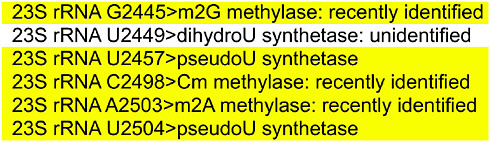
Figure adapted from Forster, A.C. and Church, G.M. (2006). Towards Synthesis of a Minimal Cell. Molecular Systems Biology, 2(45), 1-10.
Orthogonal Compartmentalization
Compartmentalization of biochemical pathways would provide a safety mechanism for compounds, such as therapeutics, manufactured using synthetic biology by ensuring that new synthesized functions would not interfere with the biological functions of the cell. The team recommends exploring and synthesizing novel molecules that promote orthogonal compartmentalization, such as a series of fluorolipids—fatty acid-like molecules that contain a fluorocarbon chain in place of a hydrocarbon chain—that would organize themselves into compartments and be easy to track inside cells. These lipids would differ in length, level of saturation, and level and position of fluorination. Researchers could test the extent to which each one is presented by, and sequesters on, the surfaces of mammalian cells. Once a set of fluorolipids with desirable properties is identified, the team proposes re-engineering lipid biosynthesis pathways to enable their biosynthesis. An alternate solution would be to engineer viral capsids that sequester biosynthetic pathways.
Additional Areas for Future Research
In addition to their exploration of orthogonal compartmentalization and performance, the team concluded with the following outline of areas for future research:
-
Orthogonal information coding. Use synthetic (nucleic acid or protein) nanostructure to augment genomic information, for example, to create novel scaffolds for transport within the cell or to organize other molecules (such as a nonribosomal peptide synthetase pathway).
-
Adapt other biopolymers to possess an encoding function such as proteins with base pairs to organize their function.
-
Design lipids that respond to enzymes, light, chemical signals, magnetic or electric fields and change their segregation properties.
-
Develop modules that translate signals into genetic or regulatory events (much like the way membrane proteins sense changes in lipid structure).
-
Develop morphogens that respond to an engineered device. Explore guiding cell fate in a spatially controlled way, perhaps even in three dimensions.
-
Design orthogonal communication pathways. Explore developing a community controlled by nucleic acid sender-receiver systems.
-
Develop specific surface interactions to direct connections between cells and engineered devices.
Synthetic biology is too young for us to know to what ends current research may one day be used. However, we do know that we are not bound by the limits of nature or genetics. The work of this team only begins to illustrate the ways in which synthetic biology can reach across disciplines to achieve greater control of biological functions and one day more fully reflect the design of complex multicellular systems.
IDR TEAM MEMBERS—GROUP B
-
Linda Chrisey, Office of Naval Research
-
Ratmir Derda, Harvard University
-
Bing Gong, University at Buffalo
-
Michael Jewett, Northwestern University
-
Melissa Knothe Tate, Case Western Reserve University
-
Jennifer Maynard, University of Texas at Austin
-
Richard Roberts, University of Southern California
-
Katherine S. Ryan, Scripps Institution of Oceanography at UCSD
-
Clifford Wang, Stanford University
-
Hang Yin, University of Colorado at Boulder
-
Yohei Yokobayashi, University of California, Davis
-
Brandon R. Reynolds, University of Southern California
IDR TEAM SUMMARY—GROUP B
By Brandon R. Reynolds, Graduate Science Writing Student, University of Southern California
While genetic engineering presents many possibilities for programming cells, it must play by those very rules that govern biological development—namely, those that drive mutation and, by extension, evolution. A scientist can fabricate a totally unique cell, either by modifying existing genomes or inventing new ones, but every generation spun off that initial engineered one always runs the risk of taking off in some other direction: evolution up to its oldest trick. So as life tends to avoid stagnation through mutation and other variability, scientists must look for other strategies for influencing and controlling cellular behavior.
As physician and author Lewis Thomas wrote:
The capacity to blunder slightly is the real marvel of DNA. Without this special attribute, we would still be anaerobic bacteria and there would be no music. Viewed individually, one by one, each of the mutations that have brought us along represents a random, totally spontaneous accident, but it is no accident at all that mutations occur; the molecule of DNA was ordained from the beginning to make mistakes.
With the unpredictability of genomics in mind, an Interdisciplinary Research Team (IDR) at the National Academies Keck Futures Initiative 2009 Conference on Synthetic Biology was asked: How can cells be influenced or controlled without rewriting their genetic blueprints?
It’s a tricky question. As the team discovered in its discussions, the appeal of genetic engineering is strong. In proposing potential solutions to hypothetical problems, often the team found that manipulating DNA really is the easiest way to solve the problem. Consequently, their thinking got more creative and the two solutions proposed got fairly unorthodox.
It helped to think of the disadvantages of genetic engineering, and devise solutions around them. Aside from being prone to mutation, genes that are genetically modified can be very difficult to integrate into a cell. And once there, for better or worse, changes are heritable, and can be transmitted to future cellular generations. Lastly, the technology to create these changes is not portable; in other words, there is not a standard tool that will reliably engineer the same kind of change in each kind of cell’s DNA.
The team’s solutions involved creating agents to act on an existing host cell without altering its DNA. If that host is human, the advantage of not
manipulating its DNA is clear—keeping humans as human as possible. The IDR team came up with two solutions, both of them more easily controlled, reversible, and portable than genetic engineering. One solution is biotic; the other is abiotic.
The Biotic Approach: Trojan Horses
Rather than build a whole new cell from the ground up, the team proposed building much simpler synthetic transporter proteins, synthetic organelles or intracellular bacteria that could infiltrate the cell to stimulate a response. This is a Trojan modulator. The benefit would be an immediate response—inject the modulator when the response is desired. No rewiring of the host is necessary.
This application of synthetic biology is excellent for existing organisms as opposed to creating new ones. A desired reaction simply requires a specific synthetic receptor. For example, an engineered T-cell receptor could be sent into a host to train a T-cell to react to cancer cells in a certain way. Growth factor receptors could be inserted to regulate stem cell or osteocyte division.
These organelles or bacteria could also be built with a feature that has been a staple of the synthetic biology conversation: the killswitch. Scientists in this field, as in others that deal with manipulating genes, want to make sure there’s a way out of a situation—to make sure that genetic unpredictability, its ability to mutate or otherwise get out of control, can be regulated by pre-programmed destruction before a cell or its host is harmed. The Trojan modulators could be designed with an expiration date: an organelle made to self-destruct after completing its task, for example, so it will not be floating around the cell.
The Abiotic Approach: Cellular Radio
For even greater influence over a cell, with literal push-button timing, the IDR team discussed what is known as cellular radio—a carbon nano-tube inserted into the cell and remotely controlled to create one of a few different reactions in the cell.
Less than a micron long and ten nanometers wide, the radio could be designed to respond to radio signals from outside the cell—outside the organism, even—and thereby remotely induce heat, mechanical vibrations, or hydrolysis in a region of the cells where the tube resides.
The signal itself would have to be small to activate the nanotube, and be set at a specific wavelength (or combination of wavelengths) so the radio would recognize it—in effect, the radio would have its own channel. Once perfected, the cellular radio could be a new interface of genetic and electronic components—a bionic, biotic thing. A six-million-dollar cell.
A radio tuned to heat up the cell uncontrollably serves just one purpose: to destroy the cell, potentially handy for eliminating undesirable cells like cancer. Nanotube radio can also initiate electrolysis in surrounding water, producing protons which acidify the area around the nanotube. Though lethal in high doses, local acidification in specific organelles of the cell can potentially instruct the cell to perform other functions than just self-destruction. Cells change the pH of their organelles in many occasions. So, why not do it remotely via the radio?
A more complex action is to channel the action of the nanotube to influence just one biomolecule in the cell and to perform a specific function, such as stimulating production of calcium ions. Calcium has different functions at different times in different cells based on the function of the cell, so this one strategy represents many possibilities in regulating cell behavior, from neurotransmitter activation to muscular contraction. Activating the nanotube in leukocytes would excite the calcium ions to stimulate an immune response; and in some stem cells and progenitor cells, triggering the calcium burst by nanotube could activate cell division. Tissue homeostasis, then, could also be controlled remotely: Push a button, and the radio triggers cell division, leaving the radio in the original stem cell while the newly produced cell goes on to replicate over and over and become some kind of tissue. Need a new piece of pancreas? Tune in to cellular radio.
Beyond Genetics
As the IDR team discussions proved, genetic engineering is a staple of synthetic biology. Drawing up new genetic blueprints presents possibilities for new cells. But to make changes in existing cells, a subtler approach is sometimes required—something chemical or physical that can be controlled remotely. It’s a whole different approach to synthetic biology, not intended to replace genetic manipulation, but to augment its possibilities without getting into the tricky wiring of the DNA. Because while genetic engineering presents better and better models for manipulating life, there is always the noise of evolution acting on the creation, the static of mutation threatening to change the engineered thing. At times like this, sometimes it’s best to turn up the radio.


