
5
Operation of the Federal Helium Reserve Facilities
INTRODUCTION AND HISTORY
The Federal Helium Reserve1 has been an important component of the global helium supply chain for as long as the helium market has existed and, just as importantly, served over that same time period as a national resource, created and maintained to meet our nation’s critical needs. This chapter discusses the Reserve, first summarizing its history and then (in response to a portion of the statement of task) evaluating how effectively the Reserve has served as a flywheel, enabling more efficient use of the Bush Dome Reservoir and the refineries connected to it via the Helium Pipeline. The chapter continues by describing recent efforts to better characterize the nature and capabilities of the Bush Dome Reservoir and gives supplemental recommendations to improve those capabilities. It concludes by evaluating the implications of the 1996 Act’s mandate for the management of the Reserve—that is, that the federally owned helium on deposit in the Federal Helium Reserve be sold on a straight-line basis—and proposes alternative approaches for extracting the crude helium in the Reserve that might better meet the nation’s needs.
Facilities
The history of helium as a valuable national resource began in 1903, in Dexter, Kansas, when a natural gas field produced gases that would not burn. It was discov-
ered that the gas contained primarily nitrogen but also almost 2 percent helium. Further exploration revealed that a number of the fields beneath the Great Plains contained significant percentages of helium that could be extracted relatively easily. It was quickly realized that helium’s buoyancy and relative inertness, particularly when compared to the intensely flammable alternative, hydrogen, made it an ideal lifting gas for military airships. Consequently, during the 1910s the United States, through its Bureau of Mines (BOM), contracted for the construction of three small experimental helium production facilities in Texas.
Although World War I ended before helium from these facilities could be used in the war effort, the U.S. Navy immediately began a program to develop rigid air-ships and by 1921 had built a full-scale helium production plant near Forth Worth, Texas, linked by pipeline to the Petrolia gas field, an early source of helium-rich natural gas. Several years later, Congress enacted the Helium Act of 1925 (1925 Act), formalizing the importance of helium and transferring operation of the Fort Worth production facility from the Navy to BOM. The 1925 Act declared helium a critical war material, tightly controlled its production, and curtailed exports.
Several more plants went into production shortly thereafter, including a unit near Amarillo, Texas, fed with natural gas from the nearby Cliffside field. World War II saw dramatic increases in helium production to support lighter-than-air naval reconnaissance aircraft—dirigibles flown by the Navy to locate and protect its convoys from enemy submarines and warships. By the end of the war, five helium plants were operating at full capacity.
In the 1950s and 1960s, the cold war initiated yet another major expansion of the federal helium program, with helium then being used mainly for rocket development and in scientific research. In 1960, as part of those efforts, Congress amended the 1925 Act to accomplish two things. First, it gave natural gas producers incentives to separate helium from natural gas and sell it to the federal government. Second, it established that a partially depleted dome reservoir in the Cliffside gas field (referred to in this report as the “Bush Dome Reservoir”) would serve as a helium depository to build up a strategic reserve of helium. The incentives caused several private oil and gas producers to enter long-term helium purchase agreements with BOM and to build five helium extraction plants in the most promising natural gas fields in Kansas, Texas, Colorado, and Oklahoma. The existing pipeline for helium was significantly extended to link those plants, running from the Bush Dome Reservoir to Bushton, Kansas, over 400 miles away (as described in Box 1.1, its current manifestation is referred to in this report as the “Helium Pipeline”).
By 1973, it had become apparent that demand for helium was much less than the amount that private parties and the remaining government facilities were supplying. At that time, BOM had accumulated 35 Bcf2 of crude helium in storage (see
|
2 |
The units used in this report for volumes of helium are listed in footnote 4 of Chapter 1. |
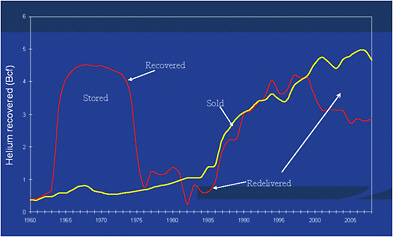
FIGURE 5.1 Crude helium recovered and removed from storage in the Bush Dome Reservoir, 1960-2008. A positive difference between the amount of helium recovered and sold in a given year constitutes an increase (by the amount of the difference) in the amount of helium stored in the Bush Dome Reservoir; a net negative difference constitutes a decrease (by the amount of the difference) in the amount of stored helium. SOURCE: U.S. Department of the Interior’s BLM.
Figure 5.1), plus a large and growing debt to the Treasury. That amount far exceeded the approximately 650 MMcf of crude helium being used each year.3 Given those circumstances, the federal government cancelled the long-term contracts with private suppliers, resulting in litigation that lasted for several years. As shown in Figure 5.1, from that time until the mid-1990s the amounts of helium placed into storage at the Bush Dome Reservoir roughly equaled the amounts withdrawn.
The 1996 Privatization Act
In 1996, Congress sought to resolve outstanding issues regarding the federal government’s role with respect to helium through the Helium Privatization Act of 1996 (P.L. 104-273). The 1996 Act, as it is known, has four principal components:
-
It directs the Secretary of the Interior (“Secretary”)4 to close all government-owned facilities for refining helium and to terminate the marketing of refined helium.
|
3 |
Bureau of Mines, 1973. |
|
4 |
Shortly before enactment of the 1996 Act, Congress closed BOM. In that legislation, BOM’s responsibilities with respect to the federal helium program were transferred to the Bureau of Land Management (BLM), which also operates under the Department of the Interior. Available at http://www.doi.gov/pfm/par/acct1995/ar1995bom.pdf. |
-
With the shutting down of the federal government’s helium refining facilities under the 1996 Act, the in-kind program was initiated5 and requires federal agencies to indirectly purchase helium from BLM. To do so, these users are to purchase refined helium from private firms, which are in turn under contract to purchase equivalent amounts of crude helium from the BLM.
-
BLM is allowed to continue to provide helium storage, transportation, and withdrawal services to any person, as long as it recovers the full costs of those services from those persons.
-
Finally, BLM is directed to sell all but 600 MMcf of the crude helium then in storage in the Bush Dome Reservoir under the following terms and conditions:
-
The sales are to be conducted so as to minimize market disruption.
-
The selling prices must be sufficient to cover the Reserve’s operating costs and to produce a total amount, adjusted for inflation, sufficient to reimburse the federal government in full plus accrued interest for the amounts it had expended to purchase the stored helium.
-
The sales are to be conducted on a straight-line basis and completed by January 1, 2015.
-
Post-1996 Activities by BLM
In accordance with the 1996 Act, BLM sold its helium refining facilities but continues to manage the rest of the Federal Helium Reserve. In 2003 it began to sell off federally owned crude helium in accordance with the 1996 Act and continues to conduct sales every quarter.
To provide a more reliable flow of crude helium to the refineries linked to the Bush Dome Reservoir, BLM worked with the owners of the refineries to install a crude helium enrichment unit (CHEU) and related compression facilities (Figure 5.2). The CHEU was financed (at roughly $26 million) and currently is managed by the Cliffside Refiners Limited Partnership (CRLP), a partnership set up by the four companies then operating the refineries connected to the Helium Pipeline. Briefings from CRLP member firms to the committee had suggested that CRLP recently assumed increased responsibility for monitoring and managing the flow of crude helium from the reservoir to members’ refineries.
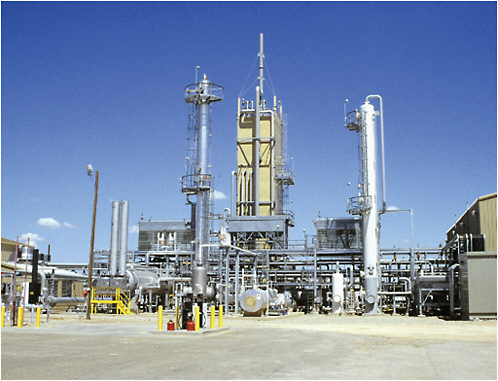
FIGURE 5.2. Crude helium enrichment unit installed to provide a more reliable flow of crude helium to refineries. SOURCE: U.S. Department of the Interior’s BLM.
The terms of the cooperative agreement between CRLP and BLM were criticized in a 2008 report by the Interior Department’s Inspector General (Interior IG). In addition to responding to these criticisms from the Interior IG, the CRLP may need to consider further investments in facilities that can enhance long-term recovery and reliability of access to the remaining Bush Dome Reservoir crude helium. Since these facilities will take years to plan, design, and build, their feasibility and financing are linked directly to the management of the Bush Dome over the next 10-15 years, well beyond the 2015 cessation of Federal Helium Reserve operations stipulated in the 1996 Act.
BLM’S OPERATION OF THE HELIUM RESERVE
The preceding section laid out the history of the federal government’s efforts to develop and sustain a helium program to meet the nation’s needs and the legislative
mandates for the current activities of BLM. The rest of this chapter examines the current operations of the Federal Helium Reserve, focusing on three components that resonate with the issues being addressed in this report.
The first component is the procedures by which federally owned crude helium is being sold by BLM, pursuant to both the in-kind program and the sell-off provisions of the 1996 Act. In the judgment of the committee, BLM’s management of crude helium sales under the authority granted to it by the 1996 Act has had significant effects on overall “market” pricing of crude helium: It has accelerated the exhaustion of the Bush Dome Reservoir and discouraged the conservation of refined helium by users. At the same time, however, a new approach to management of the in-kind program authorized by the 1996 Act could enable BLM to take steps that would partially mitigate both the rising prices and the periodic shortages experienced by some of the scientific users of helium in 2006-2008.
The second component is the use of the Federal Helium Reserve system as a flywheel, whereby crude helium extracted during periods of low demand is stored and then retrieved when market conditions improve. The committee’s charge directed it to assess the benefits of BLM’s operation of the Bush Dome Reservoir as a flywheel, and the subsection “Efficiency and Conservation Benefits of the Flywheel,” later in this chapter, discusses this issue.
The final component is management of the Reserve, especially the Bush Dome Reservoir. Because BLM is charged with managing the large crude helium reserves in the reservoir for the benefit of current and future taxpayers, the committee includes in its discussion of BLM’s operation of the Federal Helium Reserve some consideration of the complex issues in reservoir management and investment in reservoir facilities that BLM will confront very soon. It appears highly desirable to the committee that BLM’s management of the Bush Dome Reservoir, like its management of other aspects of the Reserve, should adopt a longer-term perspective that extends well beyond the 2015 date by which the 1996 Act mandates sell-off of substantially all of the federally owned crude helium stored in the Bush Dome Reservoir.
BLM Sales of Crude Helium
BLM regularly sells federally owned crude helium under the in-kind program and in accordance with the 1996 Act’s directive that it sell substantially all of the crude helium in the Bush Dome Reservoir. As discussed in Chapter 4, the amount of helium sold by BLM makes up a significant fraction of the world supply for a given year. This section describes these programs in more detail and discusses the pricing of these sales and how the pricing impacts other aspects of the helium market.
In-Kind Program of Crude Helium Distribution
The in-kind program is a legislatively prescribed procedure that federal agencies must follow to obtain helium. Before enactment of the 1996 Act, all federal agencies were required to meet any major helium requirement6 by purchasing helium directly from BLM’s predecessor, BOM. With the shutting down of the federal government’s helium-refining facilities under the 1996 Act, the in-kind program was initiated and requires federal agencies to meet their major helium requirements by buying, “to the extent that supplies are readily available,” refined helium from an authorized federal helium supplier that is under contract to purchase an equivalent amount of crude helium from BLM.7
BLM has promulgated regulations governing such sales (43 CFR Part 3195). These regulations cover not only major helium purchases by federal agencies but also purchases by any private contractor or subcontractor that uses a large amount of helium in performing a federal contract. Pursuant to these regulations, in the event of shortages in helium supplies, authorized federal helium suppliers must give federal agencies and their contractors priority over nongovernment users.
Once an entity determines that it must participate in the in-kind program, it obtains a list of authorized suppliers from BLM and then arranges to purchase helium from one of them. The supplier then must purchase an equivalent amount of crude helium from BLM. The price is negotiated between the buyer and supplier and is intended to be on a cost-plus basis, whereby the price paid by the buyer includes the costs of crude helium charged by BLM plus estimated costs of refining and delivering that helium and a reasonable profit for the seller. Table 5.1 shows recent federal agency and contractor use of the in-kind helium program.
At the time this report was being written, most of the small academic research programs that use helium did not participate in the in-kind program even though they are funded through federal grants. BLM reported to the committee that it distinguishes between parties that are under contract to a federal agency and parties that obtain funding through grants from federal agencies. The first group falls within the scope of the in-kind program; the second does not. Further, the amount
TABLE 5.1 In-Kind Sales by BLM to Federal Agencies and Contractors, 2005-2008 (thousand cubic feet)
|
Purchasing Agency |
2005 |
2006 |
2007 |
2008 |
|
National Aeronautics and Space Administration |
156,478 |
111,049 |
118,961 |
118,917 |
|
Navy |
6,206 |
6,534 |
11,607 |
9,928 |
|
Army |
125 |
14 |
19 |
3 |
|
Air Force |
16,659 |
17,742 |
16,537 |
12,245 |
|
DOE |
31,327 |
25,273 |
22,244 |
16,723 |
|
Other federal agencies |
25,351 |
32,160 |
33,762 |
36,897 |
|
Total |
236,146 |
192,772 |
203,130 |
194,713 |
|
SOURCE: Bureau of Land Management, 2005, 2006, 2007, 2008. |
||||
of helium used by many of these parties is not enough to qualify as a “major helium requirement.”8
In addition to the sales provisions mandated by 50 U.S.C. Section 167d(a), the 1996 Act gives BLM discretionary authority to sell crude helium for “federal, medical, scientific, and commercial uses in such quantities and under such terms and conditions as [the Secretary] determines” (50 U.S.C. Section 167d(b)). No regulations have been adopted that delineate BLM’s authority to sell helium pursuant to these provisions, and according to conversations with a representative of BLM, no sales currently are taking place under subsection 167d(b). However, to the extent that the statutory language for the mandatory program under subsection 167d(a) is ambiguous, it appears the language of subsection 167d(b) provides BLM sufficient leeway to fashion a program that could mitigate some of the negative consequences for academic helium users of the rising prices and periodic shortages encountered in the past.9
Sell-Down of Crude Helium Pursuant to 1996 Act
The 1996 Act required BLM to begin to sell substantially all federally owned helium in the Bush Dome Reservoir and Helium Pipeline no later than January 1, 2005. The sales, often referred to in the helium industry as open-market sales,10 are to take place on a straight-line basis between the starting date and 2015 but must be carried out with minimal market disruption. The statute does not say which of the two potentially conflicting provisions takes precedence. The minimum selling price for all helium sales, in both the in-kind and the sell-off programs, is set by the 1996 Act. BLM’s practice has been to use the minimum selling prices defined by the 1996 Act as the actual prices at which it sells crude helium.
BLM holds each open market sale in two steps: an allocated sale and a non-allocated sale. The allocated sale generally accounts for 90-96 percent of the total offering and can be bid on only by owners of the crude helium refining facilities connected to the Helium Pipeline in 2000. Bids are for volume desired. Each refiner has a percentage allocation determined by its share of the total capacity of plants connected to the Helium Pipeline in that year. If one or more refiners request less than their allocated share, refiners that requested more than their share will be allowed to purchase the excess volume. If multiple refiners have requested more than their share, the excess volume is sold based on the proportionate refining capacities of those refiners. Additional proration stages ensue until all requests are filled or no more allocated-sale helium is available. Any volume of allocated-sale helium not sold is offered in the nonallocated sale. Any refiner’s request not filled in the allocated sale will be carried over to the nonallocated sale.
The amount available for the nonallocated sale initially is divided into equal shares, based upon the number of bidders. Those who bid for an amount of helium equal to or less than this share amount receive the amount of helium for which they bid. If one or more bidders bid for more than the share amount, then the helium remaining will be allocated equally among remaining bidders, who will then receive their bid or their allocation, whichever is less. The process will continue to additional proration rounds, if necessary.
Table 5.2 shows the results of open-market sales from March 2003 to the fourth quarter of FY 2008 (July-September). Of the 15,225 MMcf of crude helium offered for sale, only 8,936 MMcf, or 56 percent, was taken. The four crude helium refiners took 8,586 MMcf, or 96 percent, of the total sold.
The BLM “open market” sales are not “market” sales at all, nor are they “open” to anyone who might wish to bid. For almost all the helium being sold, this sale process effectively creates an entitlement share for each entity that owned a facility with refining capability on the Helium Pipeline in the year 2000. Each refiner is guaranteed to
|
10 |
See, for example, http://www.balloonsbycarolyn.com/download/1006HeliumMarketGarvey.pdf. |
TABLE 5.2 Sell-off Helium Sales by BLM, 2003-2008
|
Date of Sale |
Amount (MMcf) |
Crude Helium Refiners |
Other Purchasers |
|||||||
|
Offered |
Sold |
Not taken |
Keyes |
BOC |
Prax |
AP |
Lin |
Math |
AL |
|
|
3/03 |
1,640 |
1,640 |
0 |
|
834 |
76 |
680 |
|
|
50 |
|
11/03 |
2,100 |
675 |
1,425 |
|
550 |
75 |
|
50 |
|
|
|
10/04 |
2,100 |
490 |
1,610 |
|
150 |
160 |
160 |
20 |
|
|
|
4/05 |
1,610 |
300 |
1,310 |
|
150 |
100 |
|
50 |
|
|
|
9/05 |
1,310 |
600 |
710 |
40 |
|
200 |
360 |
|
|
|
|
10/05 |
2,100 |
1,565 |
535 |
|
485 |
500 |
500 |
80 |
|
|
|
FY07, Q1 |
525 |
505 |
20 |
|
140 |
150 |
180 |
|
|
|
|
FY07, Q2 |
525 |
380 |
145 |
|
|
170 |
180 |
|
|
|
|
FY07, Q3 |
690 |
690 |
0 |
30 |
240 |
170 |
245 |
|
5 |
|
|
FY07, Q4 |
525 |
455 |
70 |
20 |
200 |
50 |
180 |
|
5 |
|
|
FY08, Q1 |
525 |
396 |
129 |
46 |
|
170 |
180 |
|
|
|
|
FY08, Q2 |
525 |
469 |
56 |
49 |
150 |
170 |
100 |
|
|
|
|
FY08, Q3 |
525 |
381 |
144 |
36 |
|
200 |
130 |
|
|
15 |
|
FY08, Q4 |
525 |
392 |
133 |
36 |
130 |
|
214 |
|
|
12 |
|
TOTAL |
15,225 |
8,936 |
6,287 |
257 |
3,029 |
2,191 |
3,109 |
200 |
10 |
27 |
|
NOTE: Keyes, Keyes Helium, Inc.; BOC, BOC Group; Prax, Praxair, Inc; AP, Air Products and Chemicals, Inc.; Lin, Linde North America, Inc.; Mid, Midstream Energy Services, LLC; Math, Matherson Tri-gas, Inc.; AL, Air Liquide. SOURCE: Available at http://www.blm.gov/nm/st/en/prog/energy/helium/helium_operators_information.html. Last accessed August 10, 2009. |
||||||||||
get its share or any part of it for which it is willing to pay the fixed, noncompetitive price. Each refiner may seek a share larger than its entitlement but may or may not get the extra amount, depending on whether the other three refiners have asked for their full entitlement. While bidders other than the refiners can and do participate in the nonallocated part of a sale, such bidders are bidding not on price but for a share of the nonallocated crude. As a practical matter, a winning bidder has no way to get its purchase to market except by having a refiner refine and package it.
BLM Pricing Policy for Crude Helium
The 1996 Act mandated selling off the federally owned helium at a minimum crude price of approximately $47 per Mcf, with a yearly escalation of this minimum at the rate of increase in the preceding year’s consumer price index. As this report was being written, the price charged by BLM was $64.75 per Mcf.11
|
11 |
Available at http://www.blm.gov/nm/st/en/prog/energy/helium/helium_operators_information/crude_helium_price.html. Last accessed on July 1, 2009. |
At the time the 1996 Act was enacted, the mandated minimum price for federally owned crude helium was at least double the typical price in contracts for the sale of privately owned crude helium. As discussed in the 2000 Report and in Chapter 1 of this report in the section “Review of the 2000 Report’s Conclusions,” it was anticipated that because of the long-term nature of those contracts, prices for privately owned crude helium would remain significantly below the price charged by BLM. This turned out not to be true.
After BLM began its sales of crude helium in earnest in 2004, private sector sellers of crude helium started to drive the prices at which they sold crude helium toward the BLM prices established by the 1996 Act. Assisted by surging demand and tight supplies, it now appears that private sector suppliers have been able to increase their prices such that the average private sector crude price is now on a par with the BLM price and in some instances exceeds it by up to 10 percent. Further, the escalation provisions of practically all U.S. and international crude or liquid helium pricing agreements are now tied to the BLM price.
Because the BLM crude price is now comparable to or even below the price of privately owned crude helium, federally owned crude helium from the Bush Dome Reservoir is no longer serving as a backup source of crude helium, as envisioned when the Federal Helium Reserve was originally developed (a vision essentially abandoned by enactment of the 1996 Act). Although BLM acted in good faith in setting the price of federally owned crude helium at the minimum price defined by the 1996 Act, its pricing policies no longer serve the interests of the U.S. taxpayers who financed the Federal Helium Reserve.
While direct evidence is sparse, general economic and business considerations suggest that BLM’s pricing practices, because they provide ready access to relatively cheap crude helium to only a limited number of refiners, could easily distort the incentives of those who participate or might participate in the crude helium market, as follows:
-
Refiners without access to federally owned crude helium are at a disadvantage in participating in the marketing of federally owned helium.
-
Because the BLM selling price now effectively establishes the price for crude helium, market forces that otherwise might increase crude helium prices and encourage the development of additional sources of crude helium have lost their influence. This includes nearby private producers in smaller fields with helium-bearing natural gas that might otherwise develop those fields, connect to the Helium Reserve pipeline and supply additional privately owned crude helium to the refineries on the pipeline.
-
To the extent that current crude helium pricing depresses the prices of refined helium, incentives are weakened for users of refined helium to invest in alternative gases and/or to invest in conservation and reuse of refined helium.
The unusual structure of the Federal Helium Reserve, with its publicly owned pipeline (the Helium Pipeline) that links privately owned refineries to a publicly owned reservoir of crude helium (the Bush Dome Reservoir), makes it difficult for BLM to develop policies that would establish a market-based price for the Bush Dome crude helium. Selling the Bush Dome crude helium in periodic auctions, for example, would require that purchasers of that crude helium have guaranteed access to the refinery capacity owned by the four major industrial-gas firms on the Helium Pipeline or some other mechanism for acquiring, indirectly, helium purchased in any sale. However, absent a mechanism for those refiners to process any crude purchased at auction or otherwise acquire credit for helium purchased, there is little incentive for purchasers other than the four firms operating these refineries to bid on BLM crude helium.
Nonetheless, there are a number of ways in which BLM could establish a more competitive process for selling federally owned crude helium. BLM could use surveys and analytical studies to approximate a competitive price for crude and set it as the minimum bid. More information on items to consider in evaluating different auction approaches to the sale of crude helium can be found in Appendix E. The Secretary of the Interior also could seek authority to require refiners connected to the BLM system to refine crude helium purchased by other parties when they have the capacity to do so, or BLM could develop alternative mechanisms for delivery of purchased helium, perhaps in the form of a crediting system whereby successful bidders would be entitled to delivery of refined helium by one of the parties with access to the Helium Pipeline.
In summary, the current sale and pricing mechanism for federally owned crude helium significantly distorts the market and promotes inefficient utilization of a publicly owned reservoir of an irreplaceable resource with very few substitutes in some applications. These market distortions have encouraged the extraction of crude helium from the Bush Dome Reservoir and the exploitation for private profit of this reserve by a small number of firms having refineries connected to the publicly financed Helium Pipeline. The pricing for Bush Dome crude helium could also discourage the development of alternative sources of crude helium supply, resulting in the venting of crude helium from natural gas fields in the United States and abroad. Indeed, it is plausible that some of the sharp price increases and supply disruptions from 2005 to 2008 reflected the suppression of market incentives—by, for example, substituting other gases for helium and investing in conservation and recovery—that might otherwise have dampened market disruptions.
Efficiency and Conservation Benefits of the Flywheel
The 2000 Report defined the Helium Reserve as a “flywheel” in the following sense:
The private refiners in the Hugoton-Panhandle complex that are on the federal pipeline rely on the Cliffside facility to act as a flywheel. Natural gas extraction companies generally sell crude helium to helium refiners on the basis of long-term (e.g., 20-year) take-or-pay contracts, which stipulate that the refiners must buy a negotiated quantity of helium per year from natural-gas producers for an extended period of time regardless of whether they store it, refine it, or vent it. The refiners with access to the pipeline store all of their crude helium in the Cliffside facility and remove and refine it as necessary. Any crude helium in excess of current market demand will thus remain in the Cliffside facility and become part of the company’s private stockpile. The amount of helium ultimately produced from the Hugoton-Panhandle complex would certainly be less if the Cliffside facility were not available. (NRC, 2000, p. 6)
This working definition of the flywheel concept suggests that the existence of the Bush Dome Reservoir prevents refiners from wasting helium (mainly by venting it), because it assumes that these refiners have no facilities of their own to store crude helium during periods of low demand for refined helium.
The flywheel system described in the statement of the committee that wrote the 2000 Report seems to imply a pattern of fluctuating deposits and withdrawals by helium refiners into and out of the Bush Dome Reservoir. Figure 5.1 indicates that such fluctuations in deposits and withdrawals arguably were present for much of the period between roughly 1975 and 1996 or 1997. Since the late 1990s, however, refiners have largely ceased making significant deposits into the Bush Dome Reservoir.12 One reason why such deposits no longer are taking place might be because the amount of helium being produced from the natural gas fields connected to the Helium Pipeline has been decreasing as those fields mature. Table 4.3 indicates that, as of 2008, the crude helium available from those fields is only 38 percent of the capacity of the helium refineries connected to the Helium Pipeline. Even after including the amount of crude helium that the 1996 Act expects BLM to sell each year, the total helium available to those refineries is only 82 percent of their refining capacity.
Since late 2008, however, anecdotal information suggests that global demand for crude helium has collapsed below the amount being supplied from other sources in the Hugoton-Panhandle complex to the refineries on the publicly financed Helium Pipeline. The weak demand could soon lead to increased deposits of crude helium from these private firms into the Bush Dome Reservoir. Such deposits would reduce the venting of crude helium from natural gas wells in the Hugoton-Panhandle complex, thereby contributing to crude helium conservation in a fashion that is broadly consistent with the statement just quoted from page 6 of the 2000 NRC Report.
Briefings to this committee by representatives of the companies owning refining facilities connected to the Helium Pipeline suggested a second possible efficiency gain from the Federal Helium Reserve that differs somewhat from the flywheel mechanism discussed above. Planned and unplanned refinery shutdowns pose challenges to the production efficiency of any helium extraction complex. The Helium Reserve infrastructure enables BLM to regulate deliveries of crude helium to refiners in ways that accommodate such shutdowns and avoid the loss of helium from the natural gas wells connected to the Helium Pipeline and the Bush Dome Reservoir.
One way to assess the argument that the Federal Helium Reserve enhances the efficiency of crude helium recovery would be to compare the efficiency of extraction of crude helium (or, equivalently, the fraction of recoverable helium that is vented) from the Hugoton-Panhandle complex by refiners on the Helium Pipeline with the extraction efficiency of other large crude helium production sites not connected to the Helium Reserve, such as the ExxonMobil complex in Wyoming. The committee that wrote the 2000 Report apparently had no such data. The current committee sought similar data, which does not appear to be available in public records. In the absence of such data, the 2000 Report’s claims that the BLM fly-wheel has enhanced helium recovery from the Hugoton-Panhandle complex lack an empirical foundation.
The current status and operation of the Bush Dome Reservoir also appears to limit its use as a flywheel. For the flywheel to operate effectively, crude helium owned by private operators of wells and refineries on the Helium Pipeline and injected into the Reservoir must be recoverable during periods of higher demand and/or lower crude helium supply. This, in turn, requires that the Bush Dome Reservoir’s helium injection wells be able to produce high-quality crude helium, with no invasion into the wells by native gas (the gas originally in the reservoir—mostly methane). At present, however, the intermixing of native gas with crude helium in significant parts of the Bush Dome Reservoir means that only one helium injection well, Bi-A6 (see the subsection entitled “Validation”), can produce relatively high-quality crude helium.13 The capacity for production from well Bi-A6 declined from 3 MMcf per day in earlier years to 1.9 MMcf per day because of the decline in reservoir pressure. This raises a question: Do the Helium Reserve facilities that extract helium, increase its concentration, and pressurize the crude helium for delivery to the refineries have the surplus capacity to provide privately stored helium on top of the helium sold pursuant to the 1996 Act that BLM currently is delivering to the refiners?
BLM Management of the Bush Dome Reservoir
The 1996 Act gave BLM the responsibility for managing the drawdown of federally owned crude helium in the Bush Dome Reservoir to 600 MMcf by 2015. It also mandated that extraction of crude helium from the Bush Dome Reservoir take place on a straight-line basis, requiring a very different approach to managing the drawdown than is employed for all known commercial subterranean gas deposits. This section assesses BLM’s management of these complex tasks. First the committee discusses BLM’s analysis and modeling of the Bush Dome Reservoir, activities that are critical to efficient extraction of the crude helium in the reservoir over the years. It then considers the issues for efficient reservoir management created by the 1996 Act’s mandate that the crude helium in the Bush Dome Reservoir be extracted on a straight-line basis, defying the guidance of most experts on reservoir management. Finally, the 1996 Act’s failure to address how the Helium Reserve is to be managed after 2015 raises other serious issues for BLM and for the United States, which the committee discusses in the last section of this chapter.
Challenges in Managing the Reservoir
To understand the magnitude of BLM’s management task, it is useful to describe the characteristics of the Bush Dome Reservoir.14 Figure 5.3, a schematic cross section, depicts the processes of crude helium storage and retrieval from the reservoir. When crude helium is injected into the reservoir, the influence of gravity tends to cause it to rise relative to other gases present. However, different layers in the reservoir have different fluid conductivities, so the helium moves further in some layers than in others as it displaces the native gas. This uneven movement in the different layers promotes mixing of helium and native gas. Preservation of the quality of the crude helium in the reservoir requires that any such mixing be monitored carefully and, to the extent feasible, minimized.
When helium is recovered from storage in the Bush Dome Reservoir, it again moves unevenly in different layers. Some layers with unusually high flow conductivities may produce all the stored helium relatively quickly, while other layers
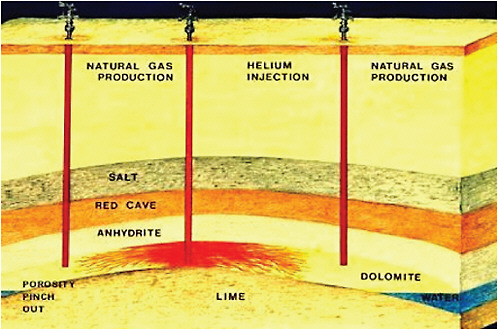
FIGURE 5.3 Cross section of the Cliffside field at the Bush Dome Reservoir illustrates key features of the helium storage project. Crude helium (red) is injected into the reservoir through injection wells and displaces native natural gas (yellow, mostly methane). The injected helium moves with different velocities in different layers of the reservoir, and mixes with the native natural gas. The reservoir is bounded on the north and east by a gas water contact (blue), and on the south and west by a porosity pinch-out. SOURCE: Bureau of Land Management, U.S. Department of the Interior.
may allow native gas to break through to the producing wells, reducing the helium concentration in the overall produced gas stream and promoting additional mixing of the helium and native gas remaining in the reservoir.
The cross section in Figure 5.3 shows water beneath the gas in the reservoir. As pressure in the reservoir drops during a prolonged period of sustained production (such as happened beginning in 2003), the water can expand and move into pore space formerly occupied by gas. When the water is sufficiently close to the area in the formation open for production by a well, it may “channel” or “cone” into the well bore and may reduce or altogether eliminate the ability of the well to produce gas.
BLM Contract with NITEC for Analysis of the Reservoir
To develop a more sophisticated understanding of the complex dynamics of the Bush Dome Reservoir, BLM contracted with an independent consulting firm,
NITEC, LLC, to model the characteristics and future operational challenges associated with the Bush Dome Reservoir. Founded in 1995, NITEC is a petroleum exploration and production consulting firm in Denver. The company focuses on integrated (geological, geophysical, and engineering) reservoir studies, including reservoir simulation, and includes naturally fractured reservoirs as a specialty.
NITEC’s contract with BLM was a sole-source one, and there is little evidence that BLM searched extensively for alternative sources of expertise.15 In the committee’s judgment, BLM should undertake a broader review of the capabilities of NITEC and seek out other sources of expertise for its management of the Bush Dome Reservoir. The committee suggests that any renewal of BLM’s contract with NITEC should be considered on a competitive basis. By making this suggestion, the committee is not questioning the capability of either NITEC or staff members of BLM responsible for maintaining the reservoir. Rather, as discussed in more detail in the following section, even under the best scenario, efforts to model the reservoir are quite challenging and the committee believes that all reasonable steps be taken to ensure it is accomplished with all due care.
NITEC Models of the Bush Dome Reservoir
One of NITEC’s first tasks was the development of a numerical simulation of the Bush Dome Reservoir. The main purpose of the simulation was to determine how BLM could best recover 98 percent of the federally owned helium in the reservoir, given that the helium is to be sold in equal annual volumes over 12 to 13 years pursuant to the terms of the 1996 Act. The total helium to be recovered during this time period is 29.9 Bcf, of which 28.5 Bcf is owned by the government and 1.4 Bcf is privately owned. The amount of helium to be left in the reservoir is 600 MMcf. These figures require an average production rate of 2.3 Bcf per year, or 6.3 MMcf per day, operating 365 days per year (or, more realistically, 6.57 MMcf per day for 350 days per year).
NITEC developed at least two models—one basic and then one more refined—in its studies. The first model was a material balance model16 used in the inventory verification phase of the study. It allowed for multiple region-weighted pressures to establish representative field-average pressures and pressure-volume-temperature
estimates for native gas and crude helium gas injections. The volumes of original gas in the reservoir and helium in place in the reservoir were determined with this model.
NITEC’s second model was a finite-difference reservoir model that used a commercially available reservoir simulator, often called a “compositional simulator,” widely used in the petroleum industry. This simulator differs from a tank-type model in that the reservoir is divided into thousands of “cells” between which gas flows in response to pressure differences between adjacent cells. For each cell into which the reservoir is divided the simulator keeps track of the composition of four distinct components: helium, nitrogen, methane, and all other natural gas components lumped together. This component tracking is critical for determining the location of helium in the reservoir and for predicting when other components, such as methane, could break through into helium-producing wells.
The Bush Dome Reservoir is modeled as a naturally fractured formation. Most of the reservoir’s flow capacity toward the producing wells occurs in the highly conductive fractures, but significant amounts of gas in the reservoir are also contained in the much less conductive rock matrix. Some of the fractures appear to be mostly “open” and therefore fully conductive; others appear to have been partially or totally filled with mineral deposits and therefore serve as flow barriers rather than flow paths. Special features of the reservoir simulator that NITEC used allow modeling of the naturally fractured characteristics of the reservoir. Figure 5.4 exemplifies the displays generated by this modeling.
Neither of NITEC’s models of the Bush Dome Reservoir adequately analyzed the effects of an influx of formation water into the reservoir on the quality or quantity of recoverable crude helium.17 In the opinion of the committee, the absence of such analysis is a significant deficiency in the NITEC models. As the committee notes below, the encroachment of water into various pockets of crude helium within the Bush Dome Reservoir has been a serious problem for reservoir management and, especially in the face of limited BLM funding, is likely to become even more serious with the passage of time, particularly after 2015.
Data Used in the NITEC Models (Weinstein, 2003) Geological models of reservoirs such as Bush Dome are typically constructed from a combination of seismic
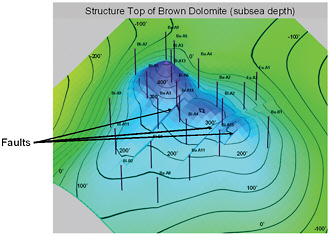
FIGURE 5.4 Three-dimensional structure map of the Bush Dome Reservoir, showing the placement of existing wells (identified in the form XX-X#) and calculated fault lines. The contour lines represent heights with respect to sea level. For reference, ground level is at approximately 3,500 feet. SOURCE: NITEC LLC.
data, which provide insight into structure, size, and flow barriers such as faults; geophysical log data, which provide insight into pore space distribution; and core data, which provide an understanding of rock types and flow conductivity.
The Bush Dome Reservoir, discovered in 1924, lacks data obtained with modern tools. In particular, modern seismic data and interpretations are not available. The geophysical logs available were for the most part outmoded. With only static data (data not related to flow of fluids in the reservoir), it is not possible to describe important features of the reservoir, including faults such as fractures and barriers. This means that high-conductivity flow paths and barriers to flow had to be inferred from observed production. Reservoir modelers almost always depend on observed performance to describe a reservoir, but in this case the dependence was unusually great. The uncertainty and ambiguity surrounding the performance predicted using the model are therefore greater than usual. Other locations of high-conductivity flow paths and flow barriers and different lengths and properties of these paths and barriers might have led to equally good or even better matches to observed data, but would have led to at least slightly different predictions of future performance.
Fortunately, NITEC had an unusually large amount of pressure data (6,650 measurements in 26 wells) and fluid composition data (2,844 helium concentration measurements). It was able to start with a geological model based on static data, such as seismic and well logs, and to adjust the model and place barriers and
high-conductivity flow paths in the reservoir such that the available data were well matched. NITEC also adjusted reservoir volume (thickness and porosity) in local areas to improve the match between observations and calculations.
Production and injection rates and volumes were recorded throughout the life of the reservoir, as were compositions of produced and injected fluids. Injected volumes and rates were treated as known, as was the composition of injected fluids. Produced volumes were also treated as known, but compositions of produced fluids were treated as unknown, and matching observed and calculated fluid compositions was a key step in model calibration (determining the spatial distribution of gas and properties of the formation).
Stabilized pressures in individual wells of the Bush Dome Reservoir were measured at frequent intervals. In the tank-type modeling efforts, average pressures throughout the reservoir, along with total amounts of helium, nitrogen, methane, and other gases injected and produced, were used to determine total reservoir pore volume. In numerical simulator modeling, comparisons of observed and calculated pressures and produced gas compositions in individual wells were used to calibrate the model.
One difficulty in predicting future performance with a model like the one used by NITEC is that future production and injection rates must be known (i.e., assumed) and imposed by the model for each well. Pressures and fluid compositions in the production streams must then be calculated. If assumed production and injection rates for the wells are not achieved in practice, then predicted pressures and produced fluid compositions cannot be correct. Only by rerunning the model after more observations have been made and the actual rates have been imposed as boundary conditions in the model can the reservoir description be validated.
NITEC’s Validation of Its Model NITEC validated its reservoir model (the spatial description of fluid contents, flow paths, and flow barriers) by comparing calculated and observed data such as compositions of produced fluids and stabilized pressures in each well for which data were available until it considered the match satisfactory. This process was used in 2002 to make initial predictions and was repeated in 2008 (and in earlier years), at which time the reservoir description was improved and alternative reservoir models were considered. Figures 5.5 and 5.6 show matches of pressures and helium concentrations for two of the more used wells on the reservoir. The figures show that the reservoir description used for the match in 2002 had to be modified to match pressure and helium concentration data observed between 2002 and 2008 (Weinstein, 2008).
Recently, well Bi-A9 ceased to produce gas because of the unexpected invasion of water, and well Bi-A3 began to produce water, limiting its ability to produce gas. As was noted earlier, NITEC’s model failed to take into account that water might intrude into the reservoir, so this aspect of the description was oversimplified.
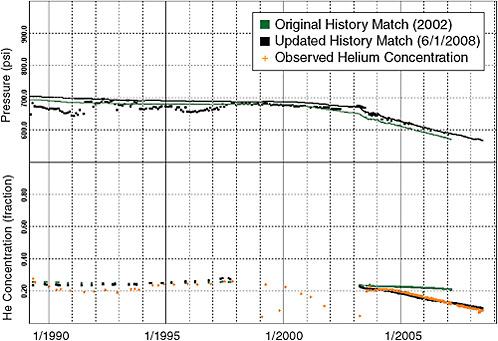
FIGURE 5.5 Matches of pressures and helium concentrations are shown for well Bi-A2. Observed data points are indicated; trends calculated using the original (2002) model are shown in green, and improved matches with the 2008 model are shown in black. Changes in trend, particularly notable in helium concentration predictions, were caused by changes in reservoir description (size and location of flow barriers and high conductivity flow paths). SOURCE: NITEC LLC.
Continued and more extensive intrusion of water could make NITEC’s predictions unrealistically optimistic.
In its 2008 update of the model, NITEC investigated the implications of a major change in reservoir description. In the 2002 model, higher conductivity in the vertical direction allowed helium to move vertically to the top of the formation. The 2008 alternative model restricted the vertical movement of helium—that is, relatively lower vertical conductivity—with the result that helium moved further into the reservoir from the injection area. The quality of historical comparisons of helium concentrations and well pressures was as good in 2008 as it had been earlier with higher vertical conductivity, so there is no basis at present for preferring one reservoir description over the other (Weinstein, 2008). Unfortunately, the choice of one or the other description of the reservoir will greatly affect its future management. The conductivity in the reservoir and the associated vertical movement of crude helium will affect both the location of crude helium during the final
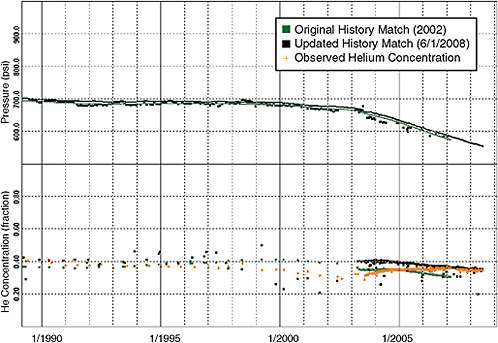
FIGURE 5.6 Matches of pressures and helium concentrations are shown for well Bi-A7. Observed data points are indicated; trends calculated using the original (2002) model are shown in green, and improved matches with the 2008 model are shown in black. Changes in trend, particularly notable in helium concentration predictions, were caused by changes in reservoir description (size and location of flow barriers and high conductivity flow paths. SOURCE: NITEC LLC.
years of production and the location of the 600 MMcf of helium that the 1996 Act directs should be left in the reservoir after 2015.
NITEC’s Performance Predictions In 2008, as in previous years, NITEC used its model to predict future reservoir performance under several different scenarios, which are described in Table 5.3 (Weinstein, 2008).
Figure 5.7 shows helium production under three scenarios: the base case and cases F and G. It shows that case G, which assumes pipeline and field compression are added and that six new wells are drilled, most nearly maintains the target helium production rate from the field. With current facilities, target rates can be maintained only through 2011. Although NITEC now acknowledges that water influx rates will increase as reservoir pressure declines and that water production is likely to limit productivity in other wells, it has not incorporated this probability into its forecasts.
TABLE 5.3 Six NITEC Scenarios
|
Case |
Description |
|
Base |
Current facilities. Maintain 6.3 MMcf per day withdrawal rate as long as possible. |
|
D |
Add pipeline compressor in October 2009. |
|
D2 |
D + add field compressor in October 2010. |
|
D3 |
D2 + maintain maximum rate in well Bi-A6 to October 2010; reinject until February 2010. |
|
F |
D3 + drill three new wells in 2010 and another three wells in 2011. |
|
G |
F + hold well Bi-A6 in reserve and reinject as long as possible. |
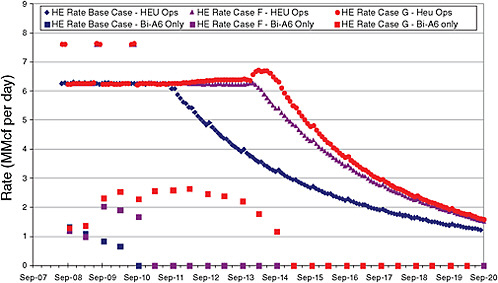
FIGURE 5.7 Forecast helium withdrawal rates for the base case (no changes to current facilities) and in case F (pipeline and field compression, 6 new wells) and case G (compression, new wells, and special handling of well Bi-A6). For each of these cases, forecasts are provided for production rates obtained by operating the Helium Enrichment Unit (HEU Ops) and by operating well Bi-A6 only. Case G maintains the required production rate longer than others. SOURCE: NITEC LLC.
NITEC’S Recommendations On the basis of these forecasts, NITEC recommended that BLM take the following actions (Weinstein, 2008):
-
BLM should address the constraints on the productivity of well Bi-A3, which are caused by the intrusion of water.
-
BLM needs to start upgrading facilities soon, so that compression is in place before well rates start to decline owing to the decline in compression.
-
BLM needs to drill additional wells to improve recovery and to assure that helium production can meet its targets in the face of well aging and declining reservoir pressure.
-
The Cliffside Helium Enrichment Unit operated by the CRLP has constraints that limit helium production. If these constraints can be mitigated, targets should be more attainable, but additional runs with the simulator will be required.
COMMITTEE’S SUPPLEMENTAL RECOMMENDATIONS
NITEC also noted in late 2008 that the Bush Dome Reservoir faced unusually high demand for crude helium and suggested that a series of steps be taken to reduce limits on production and improve the quality of the crude helium being extracted. NITEC’s observations are persuasive and led the committee to make three additional recommendations to supplement Recommendation 4 in Chapter 1:
Recommmendation 4a. BLM should encourage the members of the CRLP to study and either remove the constraints on helium production in the crude helium enrichment unit or find a more economical alternative to increase the capacity of the unit.
Recommmendation 4b. BLM should implement NITEC’s recommendations discussed in the section immediately preceding this section. These recommendations include:
-
Short-term solutions
-
Add compression to well Bi-A6.
-
Work over well Bi-A3 (currently rate-limited owing to water production) to increase productivity from 1 MMcf per day to more than 2 MMcf per day.
-
-
Medium- to long-range solutions
-
Upgrade production capability with compression and new wells.
-
Reduce constraints imposed by the crude helium enrichment unit.
-
Encourage owners of helium refineries to improve their plants’ ability to process lower quality crude helium.
-
Recommmendation 4c. Because an emergency situation (helium production shortfall) could arise at any time, BLM should avert this risk by upgrading facilities in the field and crude helium enrichment unit as soon as possible.
Several significant uncertainties and challenges remain for BLM’s management of the Bush Dome Reservoir, according to information presented by NITEC (Weinstein, 2003, 2008). The accuracy of the reservoir description that is the basis for the NITEC model is uncertain. Because only older seismic and geophysical log data were available, NITEC had to at first base critical parts of its reservoir description on matches of observed pressures and helium concentrations in producing wells. Now, however, NITEC has obtained an equally good alternative match and associated reservoir description in which the distribution of helium in the reservoir differs substantially from that in the earlier reservoir description. Thus, predictions using the model are uncertain, and the uncertainties will only increase as the amount of helium remaining in the reservoir diminishes. These uncertainties are compounded by not knowing the degree of vertical conductivity of fluids within the reservoir. Does helium injected in lower parts of the reservoir rise toward the top or does it remain in the reservoir layers near the point where it was injected?
There are additional possibilities that might be considered for increasing the production capacity of the reservoir not proposed by NITEC. For example, horizontal wells might be able to increase production (and injection) capacity substantially at any given pressure difference between the surface and the reservoir. Fewer horizontal wells, placed strategically, could be a better alternative from the standpoint of both economics and dependable spare capacity in the Bush Dome Reservoir. Nor do NITEC’s proposals provide any spare capacity, which could be needed if old wells in the field have mechanical problems, if water influx increases and causes productivity problems, or if the forecasts are simply overoptimistic because of incorrect details in the reservoir description.
STRAIGHT-LINE EXTRACTION MANDATE FOR BUSH DOME CRUDE HELIUM
This section evaluates the consequences, from a resource-management perspective, of the mandate in the 1996 Act that substantially all of the helium in the Federal Helium Reserve must be sold off on a straight-line basis by 2015. This is not a realistic production plan, because it is not feasible to continue to add wells and/or compression to the field. Reservoir pressure is declining, and maintaining a straight-line drawdown will become increasingly cost-prohibitive and, eventually, physically impossible. This can be seen from the reservoir simulations that have been done on the field (see, for example, Figures 5.5 and 5.6). Additionally, the aggressive production strategy could degrade reservoir properties, making it even more difficult to follow the strategy (Weinstein, 2008).
Best practices for economically efficient resource extraction (Chermak et al., 1999) include extraction rates that vary, usually declining over the economic life of a deposit. This approach avoids unnecessary pollution of the deposit by other
liquids such as water, utilizes the natural pressure of a reservoir to extract the resources more efficiently, and avoids leaving substantial quantities in peripheral or less accessible portions of the reservoir. The language of the 1996 Act mandating straight-line extraction could therefore lead to inefficient exploitation of this taxpayer-funded resource.
If cost recovery is the ultimate objective, imposing straight-line drawdown is inappropriate. Instead, an objective of maximizing production within the constraint of cost recovery would add more flexibility. This would allow for a declining production path over time and might require fewer new wells. It would also allow for taking reservoir characteristics into account in the production plan and would consider the potential for reservoir degradation due to overly aggressive production. Appendix F contains a more detailed discussion on drawdown options.
BLM MANAGEMENT OF THE BUSH DOME RESERVOIR AFTER 2015
Finally, the 1996 Privatization Act is silent on policies for management of the Cliffside storage facility and the BLM pipeline after 2015, the mandated date for disposal of the crude helium reservoir. It is virtually certain that substantially more than 600 MMcf of crude helium will remain in the Bush Dome Reservoir by the end of 2015; indeed, most current projections estimate that this target will not be achieved until 2020 at the earliest. If BLM is unable to develop a market-based approach to pricing its sales of crude helium—and even if it does, given uncertainties about future prices and the capacity of the BLM pipeline—2016 may arrive with more than 600 MMcf in the Bush Dome Reservoir and incomplete retirement of the facilities’ debt. What is to be done with the remaining crude helium? How will BLM’s operations beyond 2015 be financed? As noted elsewhere, the progressive exhaustion of non-Bush Dome sources of crude helium in the Hugoton field also means that maintaining refinery capacity for the next decade or more poses additional challenges for which responses must be developed very soon.
The issues raised by the high probability that the Bush Dome Reservoir will contain significantly more than 600 MMcf by 2015 and by the possibility that the Helium Reserve’s debt may not be retired before 2015 go well beyond the study charge to this committee. No matter the scope of the charge, these issues urgently require study. They will almost certainly need additional legislative or policy guidance from the Congress, senior policymakers within the Interior Department, and perhaps even the White House Office of Science and Technology Policy.


