
4
Helium Sourcing and Reserves
INTRODUCTION
This chapter discusses in greater detail the history of and trends in helium sources, both in the United States and abroad. The first section focuses on the helium reserves—the natural gas fields that have sufficient concentrations of helium so that helium can be commercially extracted. The second section discusses current and near-term future capacities to produce helium. The final section compares that capacity to the current and anticipated global demand for helium described in Chapter 3, with a focus on the Bureau of Land Management’s (BLM’s) component of the supply side of the market and some of the possible scenarios that might allow BLM to change its supply strategy for the Federal Helium Reserve in the future.
CURRENT AND PROJECTED SOURCES OF HELIUM
The natural occurrence of helium on Earth is widespread—approximately 5 parts per million of the atmosphere is helium. However, because the cost of removing helium from the air is significantly higher than that of procuring it from alternative sources, it is unlikely that air will be a source of helium in the foreseeable future. Instead, almost all commercially available helium is extracted from a small number of natural gas reservoirs with relatively high concentrations of helium. In the last several years, as natural gas liquefying facilities have come on line, the amount of potentially recoverable helium has increased, since one consequence of liquefying natural gas is to increase the relative concentration of helium and,
therefore, the cost effectiveness of extracting it. This section discusses current and projected sources of helium, both in the United States and elsewhere.
Overview
Every year the BLM, acting on behalf of the U.S. Geological Survey (USGS), summarizes global helium resources. Table 4.1 lists estimates for helium reserves and the helium reserve base in 2008. “Reserves” are resources that “could be economically extracted or produced at the time of determination, [but] need not signify that extraction facilities are in place and operative.”1
For helium resources abroad, the “reserve base” is the “in-place demonstrated resource … [that has a] reasonable potential for becoming economically available within planning horizons beyond those that assume proven technology and current economics [and] includes those resources that are currently economic (reserves), marginally economic (marginal reserves), and some of those that are currently subeconomic (subeconomic reserves).”2 For the United States, the reserve base reported in Table 4.1 includes measured (153.2 Bcf) and probable (192.2 Bcf) helium reserves but specifically excludes the possible (213.8 Bcf) and speculative reserves (184.4 Bcf) published in the 2009 USGS report on helium (USGS, 2009). It is important to note that all listed reserves and reserve bases are estimates and with few exceptions have not been certified by any accrediting institution.
For the world, the total estimated reserves of 638 Bcf divided by the current global helium refining rate of approximately 6.2 Bcf per year3 indicates reserves should last about 100 years. However, if consumption continues to grow at recent rates (4 percent per year), these reserves fall to a less comfortable 40 years. Furthermore, it is important to note that this estimate is valid only if the entire amount of natural gas produced from each reservoir is processed for helium. An improved assessment of the life of a country’s reserves would require adjusting for the amount of helium that is bypassing helium-processing plants for that country—that is, gas that is being vented to the atmosphere never to be recovered. To account for such losses would require obtaining, for each field with commercially available helium, information about the amount of natural gas produced from that field over a given period and the helium concentrations in that gas and then comparing the result to the amount of helium actually produced. The ratio of helium extracted to the amount of helium withdrawn, extrapolated to the amount of reserves estimated for the field, would provide an effective reserve for that field. For almost all coun-
|
1 |
USGS, 2009, Appendix B. |
|
2 |
Ibid. |
|
3 |
Discussed later in this chapter in the section entitled “Refined Helium: Current Capacity and Production.” |
TABLE 4.1 Estimates of Helium Reserves Worldwide, 2008 (billion cubic feet)
|
Country |
Reservesa |
Reserve Basea |
|
United states |
153 |
350b |
|
Algeria |
64 |
300 |
|
Australia |
NA |
6.9c |
|
Canada |
NA |
72 |
|
China |
— |
40 |
|
Indonesia |
NA |
14c |
|
Poland |
0.9 |
10 |
|
Qatar |
360d |
360 |
|
Russia |
60 |
250 |
|
Other countries |
NA |
8.1 |
|
Total |
638d |
1,410 |
|
NOTE: NA means not applicable, as the country has no refining capacity. aEntries are those from USGS, 2009, unless otherwise specified and are current estimates based on available information. They are not certified by any accrediting institution. bIncludes measured and probable reserves rather than measured and indicated, as for other countries. cConservative estimates based on planned liquid helium plant capacity (see discussion in text) and a 25-year minimum plant productive life. dAccording to information compiled by the DOE’s Energy Information Administration, as discussed in the text. |
||
tries, the aggregate effective reserves for their fields would be substantially less than the reserves shown in Table 4.1. In the one case outside the United States where information was available, this determination decreased the effective reserves of that country by as much as 70 percent.4 The information necessary to make such estimates is generally not publicly available, but it can be stated that in the United States such losses in reserves—that is, losses due to bypassing—though not negligible, are much less severe than in Qatar.
United States
The United States has reserves of approximately 153 Bcf and a reserve base of 350 Bcf. Table 4.2 details the amount of reserves for all principal fields in the United States currently believed to contain economically accessible concentrations of
TABLE 4.2 U.S. Helium Proven Reserves, 2007 (billion cubic feet)
|
Location |
Reserves (Bcf) |
|
|
Hugoton-Panhandle complex |
47 |
|
|
Hugoton-Panhandle complex (except Bush Dome) |
20.5a |
|
|
BLM helium stored at Bush Dome |
|
23.1b |
|
Private storage at Bush Dome |
|
1.1b |
|
Native helium |
|
2.3b |
|
Riley Ridge Field, Wyoming (ExxonMobil) |
49c |
|
|
Rands Butte, Wyoming (Cimarex Energy) |
17d |
|
|
St John’s Field, Arizona (Enhanced Oil Resources Inc.) |
14 |
|
|
Others |
26a |
|
|
Total |
153b |
|
|
aBy difference. bUSGS, 2009. cFrom analyses of data in NRC, 2000, and State of Wyoming, 2008. dCimarex, 2008. |
||
helium (USGS, 2009). The two most important U.S. sources of helium are the Mid-continent Hugoton-Panhandle field complex, in Texas, Oklahoma, and Kansas, and ExxonMobil’s Riley Ridge Field in southwestern Wyoming. Most production from the Hugoton-Panhandle complex is connected to or could be connected to the Helium Pipeline and the Bush Dome Reservoir, all noted in Figure 4.1.
The sources of the estimated amounts for the fields other than the Hugoton-Panhandle complex are footnoted in Table 4.2. For example, Table 4.2 of the 2000 Report gives the Riley Ridge field helium reserves as 67 Bcf in 1997. The cumulative helium extracted from 1998 to 2006 inclusive is 18 Bcf (State of Wyoming, 2008), resulting in the 49 Bcf reserves reported in Table 4.2.
The Rands Butte resource is a project proposed by Cimarex Energy Co. to recover methane and helium from the Madison formation. Cimarex expects to recover 620 Bcf of methane and 17 Bcf of helium over the life of the project. Acid gases would be injected back into the formation, and no NGLs or sulfur will be produced. The St. John’s Dome field, in Arizona, is a project whose primary purpose is to recover CO2 for enhanced oil recovery (EOR) in the Permian Basin of New Mexico and Texas. The estimated volume of gas in the field is several trillion cubic feet. It contains about 95 percent CO2, 4.4 percent N2, and 0.6 percent He, along with minor amounts of CH4 and argon.5 The associated helium reserves
|
5 |
Available at http://www.tristonecapital.com/upload/divestiture/41/04/eor_om.pdf?1237509665. Last accessed August 6, 2009. |
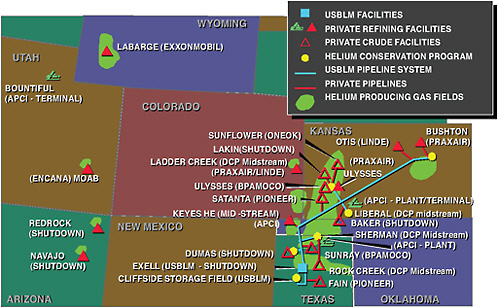
FIGURE 4.1 Map of helium supply sources and major facilities in the United States. SOURCE: Air Products and Chemicals, Inc.
for Phase I of that project are about 14 Bcf. The reserves for the Rands Butte and St. John’s projects reported in Table 4.2 will not be proven until their processing plants become operational.
The quantities of reserves in parts of the Hugoton-Panhandle complex are determined by combining information gathered by the USGS and other entities. The 2009 USGS survey estimates that as of December 31, 2006, the combined reserves of the Hugoton-Panhandle complex, the Riley Ridge field, and the Bush Dome Reservoir were 96 Bcf (USGS, 2009). Subtracting the 26.5 Bcf present in the Bush Dome Reservoir and the 49 Bcf estimated to be in Riley Ridge, the net amount of helium remaining in the Hugoton-Panhandle complex is 20.5 Bcf. The “Others” category, with reserves of 26 Bcf, obtained by taking the difference, includes future contributions to reserves from both known and unknown resources.
Dividing the 153 Bcf U.S. reserves in 2008 by the helium refining rate of 4.7 Bcf per year6 indicates that the U.S. helium reserve lifetime is about 30 years. That is, current U.S. helium reserves would last 30 years if the refining rate continues at 4.7 Bcf per year and no helium bypasses the refining plants. The committee notes
|
6 |
As discussed in the section “Refined Helium: Current Capacity and Production” (see Table 4.3). |
that approximately 50 percent of that amount currently is being exported. So, if the exporting of helium were curtailed, then helium reserves in the United States would last almost 56 years at the present domestic rate of consumption of approximately 2.5 Bcf per year.
International
Algeria, Qatar, and Russia have reserve bases comparable to that of the United States. Qatar is unique in that essentially all of its natural gas is in the huge North Field, reported to have proven natural gas reserves of approximately 900 trillion cubic feet (Tcf) at the end of 2008 (U.S. Energy Information Administration-Qatar, 2009). The helium concentration in that field is 0.04 percent by volume, or 360 Bcf of helium. Algeria also has very large natural gas reserves but the helium concentrations are lower than those of Qatar.
Russia has the largest natural gas reserves in the world (U.S. EIA-Russia, 2009), and those reserves include some gas fields that have attractive helium concentrations, particularly in the Russian Far East. In fact, the helium contained in the Kovykta field alone could be as much as 180 Bcf.7 Although there are large volumes of helium in the natural gas reserves in Kovykta as well as other fields in the former Soviet Union, decisions affecting helium development, such as the location of pipelines and liquefied natural gas (LNG) processing plants to satisfy domestic and external markets, are in various stages of planning and it is not known how much planning is being done to develop helium production facilities alongside the other gas handling and processing facilities.
Australia and Indonesia have natural gas reserves with threshold-mass concentrations of helium comparable to that of countries that already are major exporters of LNG. Australia has a helium plant under construction in Darwin and Indonesia is considering helium as an export product.
REFINED HELIUM: CURRENT CAPACITY AND PRODUCTION
Following from the discussion in the preceding section of possible sources of helium, this section turns to a discussion of the current and near-term-future capacity to separate that helium from the natural gas, refine it, and place it into the supply chain discussed in Chapter 2.
Table 4.3 presents helium capacity and actual production in 2008 for those countries with significant sources of helium and facilities for refining it. For purposes of this table, crude helium capacity (column labeled (a)) is the amount of
TABLE 4.3 Worldwide Crude and Refined Helium Plant Capacities Compared to Refined Helium Produced, 2008
|
Country |
Capacity (Bcf/yr) |
Liquid Helium Refined (Bcf/yr) (c) |
a/b (%) |
Refining Plant Usage c/b (%) |
|
|
Crude Helium (a) |
Liquid Helium (b) |
||||
|
United States |
|
|
|
|
|
|
BLM System |
|
|
|
|
|
|
Plants connected |
1.55 |
4.05 |
3.34 |
38 |
82a |
|
Bush Dome Reservoir |
2.10 |
0.00 |
0.00 |
NA |
NA |
|
Subtotal BLM system |
3.65 |
4.05 |
3.34 |
90 |
82 |
|
Nonconnected plants |
1.68 |
2.04 |
1.40 |
82 |
69 |
|
Subtotal U.S. |
5.33 |
6.09 |
4.74 |
88 |
78 |
|
Outside the United States |
|
|
|
|
|
|
Algeria |
0.92 |
0.92 |
0.80 |
100 |
87 |
|
Poland |
0.09 |
0.14 |
0.09 |
64 |
64 |
|
Qatar |
0.60 |
0.60 |
0.45 |
100 |
75 |
|
Russia |
0.25 |
0.22 |
0.23 |
114 |
105 |
|
Subtotal non-U.S. |
1.86 |
1.88 |
1.56 |
99 |
83 |
|
World total |
7.19 |
7.97 |
6.30 |
90 |
79 |
|
NOTE: See text for description of crude helium and liquid helium capacity definitions. NA, not applicable. aThe total crude capacity supplying the refining plants associated with the BLM system is 1.55 + 2.10 = 3.65 Bcf/yr. |
|||||
crude helium that can be delivered for a given reservoir or collection of reservoirs, as limited by the delivery infrastructure and the upgrading stages of the refining processes. Liquid helium refining capacity (column labeled (b)) is equal to 95 percent of the maximum rated output, or nameplate capacities, of the plants considered in the line item. Crude capacity is vulnerable to reservoir depletion and the associated natural reduction in the rate at which gases can be extracted from the reservoir.
United States
To properly account for the various flows of crude to marketable refined high-purity helium products, the U.S. helium supply is considered in three groupings:
-
Plants connected to the Helium Pipeline and the Bush Dome Reservoir (the BLM system) that also have their own source of crude helium,
-
The BLM crude reserve, stored in the Bush Dome Reservoir, and
-
Plants not connected to the BLM system.
The total U.S. refining capacity substantially exceeds the amounts of helium that have been refined every year in recent years. In 2008, while refining capacity was 6.09 Bcf, the crude capacity feeding the refiners annual output was only 5.33 Bcf, or 88 percent of refining capacity. The amount of refined helium produced in the United States in 2008 was 4.74 Bcf, or 88 percent of crude capacity and 78 percent of refining capacity. Also note that 2008 crude capacity from the natural gas fields surrounding the Helium Pipeline was only 38 percent of the related refining capacity. The 2008 worldwide crude capacity was 90 percent of refining capacity and refined production was only 79 percent of refining capacity. Note that if the world’s crude capacity of 7.19 Bcf is reduced by the 2.1 Bcf of crude helium supplied from the Federal Helium Reserve, the remaining net crude capacity is 72 percent of the refining capacity.
U.S. Helium Facilities Connected to the BLM System
As discussed in Chapter 2, the natural gas producers for most facilities in the United States generate crude helium in the process of their refining of the natural gas, with the crude helium considered a relatively minor by-product of the much larger natural gas production. Crude helium produced from the Hugoton-Panhandle complex, located in the midcontinental region of the United States, is sold to one of four refined-helium producers with refining facilities connected to the Helium Pipeline.8 Typically, the refining facilities are near the natural gas processing facilities and the crude helium is delivered pursuant to long-term take-or-pay contracts whereby the buyer takes any crude helium produced or pays for the amount which is not taken. The crude helium can generally be delivered to a helium refining facility directly or to the Helium Pipeline. Crude helium not needed by current demand from the refiner can be stored for future refining in the Helium Pipeline or the Bush Dome Reservoir.
One of the principal issues facing facilities connected to the Helium Pipeline is the lack of feedstock due to the maturity of the gas fields. This has made it difficult to maintain the delivery of helium to the refining facilities at sufficiently high rates without additional and sometimes substantial capital investments.9 Since the reserves remaining in these fields are relatively low, these investments are often not very attractive.
In the committee’s judgment, the amount of available helium is decreasing to the point that most if not all U.S. helium refining facilities connected to the Helium Pipeline will cease to operate in less than 10 years. The collective cost of replacing these refining plants, which could still be operated for many years, is close to $1 billon. One avenue that could be pursued to avoid shutting these facilities down would be to explore the possibility of connecting other fields to the Helium Pipeline to increase the feedstock and keep the refining facilities operating.
Another avenue would be to reconsider the current policy requiring the sell-down of the helium in the Bush Dome Reservoir and, instead, to restrict that helium’s use to limited purposes. This alternative would result in the retiring of a significant portion of the refining capacity connected to the Helium Pipeline. Inasmuch as the committee believes that the Bush Dome Reservoir is likely to contain significant crude helium reserves well beyond 2015, this likely imbalance between crude helium supplies and refining capacity in the Federal Helium Reserve and the associated Hugoton field requires attention. Moreover, the long lead times associated with any reconfiguration of the helium refining infrastructure connected to the Helium Pipeline means that plans for this eventuality must be developed very soon.
U.S. Helium Facilities Not Connected to the BLM System
ExxonMobil’s Shute Creek gas processing facility in Wyoming handles approximately 700 MMcf of natural gas per day from its Riley Ridge gas field. Gas recovered from that field contains approximately 66.5 percent CO2, 20.5 percent methane, 7.4 percent nitrogen, 5.0 percent hydrogen sulfide, and 0.6 percent helium. The processing facility produces methane gas, CO2 (for EOR), and helium. The hydrogen sulfide recovered as a by-product is injected back into the reservoir. In 2008 the facility operated at peak capacity, processing 242.7 Bcf of natural gas and producing approximately 1.5 Bcf of refined helium. In calendar year 2008, Shute Creek provided more refined helium than any other facility in the world.
As mentioned in the earlier discussion on helium sources, Cimarex Energy Co., the operator of Riley Ridge Unit 15, has proposed the Rands Butte project to recover methane and helium from the Madison formation. The initial planned capacity is 36.5 Bcf of field gas per year, which would double if so warranted by the gas rates from the field. Acid gases would be reinjected into the formation, and no NGLs or sulfur would be produced. The plant is forecast to come on stream in late 2012, later than originally planned.
The St. John’s Dome field project, in Arizona, is being developed primarily to recover CO2 for EOR in the Permian Basin or in California. The estimated volume of gas in the field is as much as 15 Tcf, with a composition estimated to average 95 percent CO2, 4.4 percent nitrogen, and 0.6 percent helium, along with minor
amounts of methane and argon. The 20-year production outlook estimates the amount of helium that can be recovered may be as much as about 24 Bcf.10 The project is still under development and the main hurdles include the development of the CO2 side of the project together with the costly pipeline required to connect the CO2 recovery facilities to the oil fields’ EOR systems.
The refining facilities at Moab, Ladder Creek, and Shiprock are relatively small, having contributed only a small fraction to domestic refined helium production in 2008. Both Moab and Ladder Creek suffer from a shortage of natural gas input to process.
BLM Crude Helium Reserve
The final source of crude for U.S. refined helium is the Bush Dome Reservoir itself. BLM is the only entity with an upgrading plant for supplying crude helium that is not integrated with the final refining stage to make high purity helium. Beginning in 2003,11 when sales pursuant to the 1996 Act began in earnest, the Federal Helium Reserve became a critical source of crude helium and now provides a significant share of the refined helium consumed in the United States and approximately one-third of the amount consumed worldwide.12 In fact the Federal Helium Reserve has become the source of first and last resort for refiners on the Helium Pipeline. Chapter 5 discusses sales of crude helium from the Federal Helium Reserve in detail.
Non-U.S. Helium Supply
Outside the United States, the refining capacity of companies producing refined helium in 2008 was 1.88 Bcf, but only 1.56 Bcf of helium was actually refined. The main reason for the difference is mechanical difficulties experienced during start-up of the plants in Algeria and Qatar. Low gas delivery rates from low-pressure mature fields in Russia and Poland were also important. Algeria produced approximately 0.8 Bcf of helium in 2008. Smaller amounts of helium were produced in Russia, Qatar, and Poland.
In both Algeria and Qatar the helium is recovered from the liquefaction of natural gas, where the helium is concentrated in the gases remaining in the tail-
gases of the liquefaction process, which are then fed to helium purification and liquefaction facilities. These processes are totally integrated. If the crude helium off the liquified natural gas (LNG) tail-gases is not used, then it is vented. Both Algeria and Qatar have very large and established natural gas businesses and LNG operations that will provide the basis for significant expansion of their helium businesses in the years to come. Both are now planning that expansion.
FUTURE HELIUM CAPACITY AND SUPPLY VERSUS HELIUM DEMAND
This final section of Chapter 4 combines the forecast demand discussed in Chapter 3 and the estimated capacity being developed to meet that demand through 2020. It provides a framework for assessing the role that the Federal Helium Reserve could play for different helium capacity scenarios.
Figure 3.3 in Chapter 3 contains forecasts of U.S. and foreign demand for refined helium through 2020. Figure 4.2 shows actual crude helium capacity from 2005 through 2008 and forecasts for that capacity from 2009 to 2020. Other than a facility in Australia that is to produce modest amounts of helium beginning in 2009, no significant new crude or refined capacities will be added before 2012. However, the capacity of many U.S. and foreign plants that recover crude helium and then refine it will continue to be improved. These improvements will help to offset the
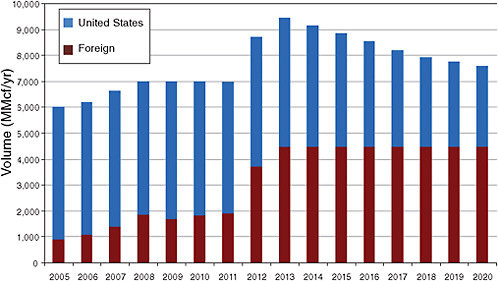
FIGURE 4.2 Actual (2005 to 2008) and estimated (2009 to 2020) crude capacity in the United States (blue) and in other countries (red).
reduction in field crude production from the Hugoton-Panhandle complex, which will decline as deposits are depleted. It is the committee’s judgment that this decline will begin in 2010 and accelerate to 10 percent per year by 2012.
Starting in 2012, several new plants for recovering crude helium and refining it, now in construction or in the planning stage, will begin operations. All such plants are likely to be in operation by 2015, are natural gas-based, and integrate refining capacity with crude recovery and processing capacity to produce refined liquid helium:
-
Linde in Darwin, Australia, projected to come on stream in 2009;
-
The Cimarex project in Wyoming, a venture of Cimarex Energy Co., Taiyo Nippon Sanso (TNSC), and Air Products, forecast to come on stream in 2012;
-
One or more of the large refining facilities to come on stream in Qatar by 2013; and
-
One or more of the large refining facilities to come on stream at Arzew, Algeria, by 2013.
While there are other projects under consideration, it is likely that the only additional capacity by 2015 will be the above. After 2015, significant new refined helium capacity in the United States, Canada, Indonesia, and the Russian Far East is under consideration. Except for the project in St. John’s Dome field, in Arizona, all of the projects being planned are based on natural gas and/or LNG facilities.
Figure 4.3 shows the split in crude capacities by sources in the United States and foreign countries for the critical years of 2005 (actual history), 2008 (most recent documented), 2015 (when significant increases in foreign crude/refined capacity have been fully developed), and 2020 (the end of this study’s forecast period). The changes in capacities in Figure 4.3 are mainly attributable to the following:
-
The significant increase in foreign capacity from plants with integrated crude and refined capacities,
-
The very modest increase in U.S. crude and refined capacity from plants not connected to the Helium Pipeline,
-
The notable reduction in the amount of helium produced in those fields connected to the Helium Pipeline, and
-
The modest reduction in crude from the Bush Dome Reservoir because of reduced reservoir withdrawal rates.
Figure 4.4 shows the development of crude helium capacity by region. “Other” includes Australia, Canada, and Indonesia. Australia is under construction and is therefore included in the forecast, but Canada and Indonesia are still considered speculative and no new capacity is forecasted for them.
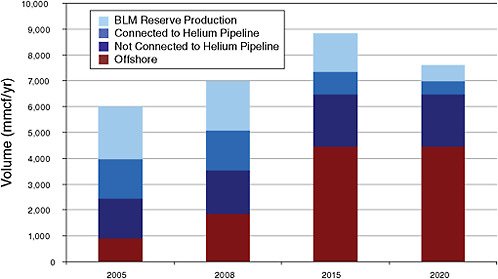
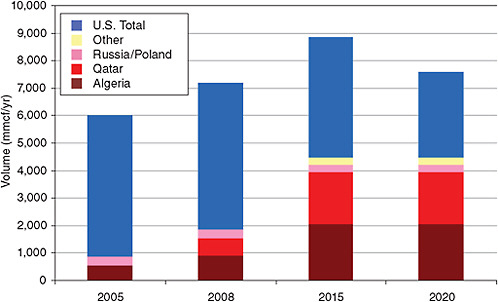
Figure 4.4 illustrates how the distribution of crude capacities by country will change significantly over the next decade. The very large share of crude and refined capacity that existed in the United States in 2005 permitted the United States to serve all of its own needs and much of the need of the rest of the world. The abundance of U.S. helium at reasonable costs led to the development of many of the largest and most critical uses of helium (see Chapter 3).
As discussed earlier, significant increases in foreign capacity are expected to develop by 2015, at which time U.S. capacity will begin to decline owing to accelerating net depletion of the U.S. midcontinental crude reserves and the associated decline in extraction capacity. By 2020, U.S. crude capacity will have severely declined, and that decline is expected to continue unless more U.S. helium sources are developed.
Figure 4.5 shows demand and crude capacity from 2005 through 2008 for both U.S. and foreign markets and anticipated demand and crude capacity from 2009 to 2020. From 2005 until 2012, the United States has been and will continue to be a net exporter of helium, supplying the difference between foreign demand and foreign capacity. In the years 2005 through 2008, the difference between foreign crude capacity and demand has been approximately 2.0 Bcf, roughly equal to the amount of helium withdrawn annually from the Bush Dome Reservoir during
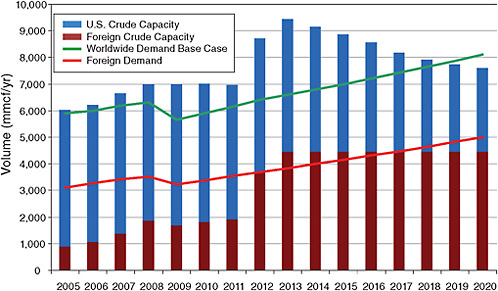
FIGURE 4.5 Actual (2005-2008) and estimated (2009-2020) demand and capacity for crude helium in the United States and other countries.
those years. It is expected that under the current drawdown schedule for the Bush Dome Reservoir and with the depletion of several of the domestic helium sources, the United States will become a net importer of helium in the near future.
Several other points are important as well. The slight surplus in refining capacity from 2005 to 2007 did not allow supply to keep up with actual demand, as a surplus in capacity of at least 10 percent is normally needed to accommodate seasonal and month-to-month fluctuations in demand. During the last half of 2008, U.S. and worldwide demand began to slip against a relatively flat supply, so that there was a surplus of at least 10 percent of demand, permitting a much more reliable supply.
By 2012, after planned refining facilities come online, foreign capacity is expected to be able to supply virtually all of foreign demand, at least when based on annualized capacity. Should world demand continue to grow as forecast beyond 2016, world capacity would have to increase faster than current expectations. If it fails to do so, the price of helium will increase, which would probably constrain demand, jeopardizing the world’s helium demand/supply balance as in 2005 through 2007. This is where additional capacity in Algeria, Qatar, and the Russian Far East could come into play.
AN ALTERNATIVE ROLE FOR THE FEDERAL HELIUM RESERVE
As shown in Figure 4.5, reductions in world demand for the next several years as a result of the economic downturn and the start-up of helium extraction and refining facilities thereafter will result in substantial excesses in helium production capacity through approximately 2015 (Case A). This would be an opportunity for the Federal Helium Reserve to depart from its current role as the source of first resort for crude helium and take on a new role as a source of last resort, thereby allowing BLM to provide helium for domestic use for a significantly longer time than is currently projected.
As a source of last resort, helium would be drawn from the Federal Helium Reserve only to make up for shortfalls in all other supply sources (Figure 4.6, blue). Note that in this scenario, called Case B, very little federally owned crude helium would be required to meet world demand from 2012 to 2017.
As shown in Figure 4.7, the net effect of reducing BLM withdrawal rates under this alternative model would be to greatly increase the amount of federally owned helium at critical points in the supply and demand forecasts to 2020, allowing BLM to better provide for the long-term helium needs of the United States.
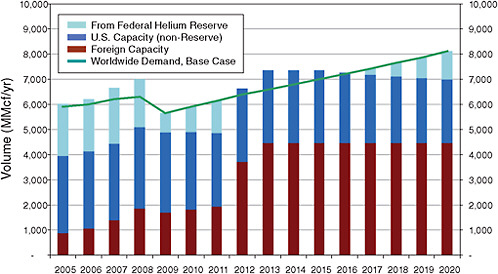
FIGURE 4.6 The alternative usage of federally owned crude helium as a source of last resort. The colored bars show the helium capacity of the various potential sources of helium; the green line shows actual (2005-2008) and estimated (2009-2020) worldwide demand.
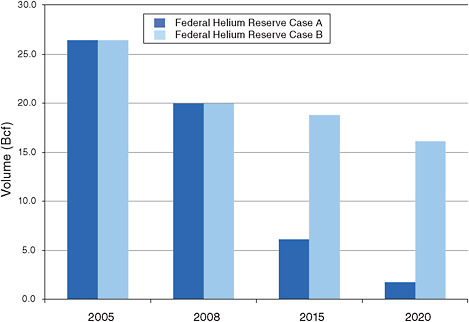
FIGURE 4.7 Amount of crude helium in the Bush Dome Reservoir under the current scenario (Case A), where 2.1 Bcf of helium is withdrawn from the reservoir each year, compared with the amount under the alternative scenario (Case B), in which the Bush Dome Reservoir is treated as a source of last resort, drawn on only to meet the needs of helium users not satisfied by other sources.


