
1
Introduction
In the United States, medium- and heavy-duty vehicles (MHDVs) consume a significant and increasing amount of fuel. In 2008 these vehicles consumed 26 percent of all U.S. transportation liquid fuels and 20 percent of all U.S. liquid fuels. MHDVs consumed 3.9 million barrels per day (mbpd), compared to total 2008 U.S. liquid fuel consumption of 19.5 mbpd.
Liquid fuel consumption by MHDVs has increased more rapidly—in both absolute and percentage terms—than consumption by other sectors, and the Energy Information Administration (EIA) forecasts that this will continue. EIA projects that in 2035 these classes of vehicles will consume 30 percent of all U.S. transportation liquid fuels and 23 percent of all U.S. liquid fuels. That total will represent 5.1 mbpd, compared with total projected 2035 U.S. liquid fuel consumption of 22.1 mbpd. Thus, the fuel efficiency of these classes of vehicles is of high and increasing importance (DOE, EIA, 2009c). Furthermore, in December 2009 the U.S. Environmental Protection Agency (EPA) formally declared that greenhouse gas (GHG) emissions endanger public health and the environment within the meaning of the Clean Air Act, a decision that compels EPA to consider establishing first-ever GHG emission standards for new motor vehicles, including MHDVs. If the United States is to reduce its reliance on foreign sources of oil, and reduce GHG emissions from the transportation sector, it is important to consider how the fuel consumption of MHDVs can be reduced.
ORIGIN OF STUDY AND STATEMENT OF TASK
The National Research Council (NRC) Committee to Assess Fuel Economy Technologies for Medium- and Heavy-Duty Vehicles was formed in response to a congressional mandate to the National Highway Traffic Safety Administration (NHTSA), an agency of the U.S. Department of Transportation (DOT), under Section 108 of the Energy Independence and Security Act (EISA) of 2007. NHTSA was directed to contract with the National Academies to undertake a study and develop a report that evaluates medium- and heavy-duty truck fuel economy. The legislation also (1) mandates that NHTSA itself conduct a study on the fuel efficiency of commercial medium- and heavy-duty on-highway vehicles and work trucks and (2) mandates that NHTSA then conduct a rulemaking to implement a commercial medium- and heavy-duty on-highway and work-truck fuel efficiency improvement program.1
The language in Section 108 directs the National Academy of Sciences to address the following items in its report:
-
an assessment of technologies and costs to evaluate fuel economy for medium-duty and heavy-duty trucks;
-
an analysis of existing and potential technologies that may be used practically to improve medium-duty and heavy-duty truck fuel economy;
-
an analysis of how such technologies may be practically integrated into the medium-duty and heavy-duty truck manufacturing process;
-
an assessment of how such technologies may be used to meet fuel economy standards to be prescribed under section 32902(k) of title 49, United States Code, as amended by this subtitle; and
-
associated costs and other impacts on the operation of medium-duty and heavy-duty trucks, including congestion.
In response to that language, the NRC developed a statement of task for the committee that directs it to:
-
Consider approaches to measuring fuel economy for medium- and heavy-duty vehicles that would be required for setting standards;
|
1 |
The legislation uses both the terms “fuel economy” and “fuel efficiency.” Fuel economy, generally miles per gallon or kilometers per liter, is commonly used in comparing the efficiency of light-duty vehicles, which have similar size and driving cycles. In comparing the fuel consumption of trucks and buses, its usefulness is limited, given there is a wide difference in mass and driving cycles. In particular, a metric is needed that reflects the work done by the vehicle. The committee discusses the appropriate metric for trucks and buses later in Chapter 1 and in Chapter 2. |
-
Assess current and potential technologies and estimate improvements in fuel economy for medium-duty and heavy-duty trucks that might be achieved;
-
Address how the technologies identified in Task 2 above may be used practically to improve medium-duty and heavy-duty truck fuel economy;
-
Address how such technologies may be practically integrated into the medium-duty and heavy-duty truck manufacturing process;
-
Assess how such technologies may be used to meet fuel economy standards;
-
Discuss the pros and cons of approaches to improving the fuel efficiency of moving goods as opposed to setting vehicle fuel economy standards; and
-
Identify the potential costs and other impacts on the operation of medium-duty and heavy-duty trucks. (See Appendix A for the full statement of task.)
The committee discussed these tasks with the DOT/NHT-SA representatives, as well as relevant congressional staff, prior to and at the committee’s first meeting. The purpose of these discussions was to explore what information and data could be made available to the committee and to take advantage of the expertise available on the committee to determine the extent to which the tasks could be addressed. It should be noted that the study does not address the use of alternative fuels to substitute for fossil-fuel-based diesel or gasoline. Domestic production of alternative fuels such as biodiesel or natural gas could help to reduce demand for imports of petroleum or reduce emissions of greenhouse gases, but these technologies and/or strategies are not addressed. The committee provides some insights in Chapter 6 into the unintended consequences that could arise from various approaches that might be used to reduce the fuel consumption of vehicles. In addition, Chapter 7 explores the advantages and disadvantages of alternative approaches to reducing fuel consumption, since many of these alternatives involve regulatory changes, and Chapter 8 discusses fuel consumption regulatory approaches.
POLICY MOTIVATION
The President and Congress have placed among the highest national objectives that of reducing petroleum imports. Despite efforts to wean the United States away from oil toward more acceptable fuels, it has become increasingly dependent on oil (Figure 1-1).
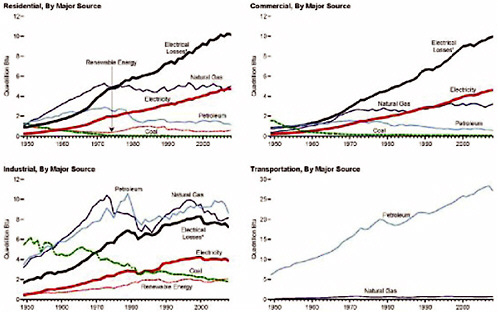
FIGURE 1-1 Energy consumption by major source end-use sector, 1949-2008. SOURCE: DOE, EIA (2009b, p. 39).
While fuel consumed per mile by light-duty vehicles improved substantially between 1966 and 2007, fuel consumption of the average heavy-duty vehicle remained nearly constant (Figure 1-2). However, this trend hides an important factor regarding trucking. The mission is not just to move the truck and driver from one place to another but to deliver cargo. If total fuel consumed, total miles traveled, and total tons shipped are considered for the United States as a whole, a U.S. average payload specific fuel consumption for the entire medium- and heavy-duty fleet can be calculated for this sector. Figure 1-3 shows the results of dividing the total fuel consumed by the miles traveled and tons moved each year, to produce a fuel consumption per ton shipped and per mile driven (gallon/ton-mile) from 1975 to 2005. The amount of fuel required to move a given amount of freight a given distance has been reduced by more than half over this time period. This is a result of many factors, including:
-
Improved efficiency of engines and drivelines
-
Improved vehicle aerodynamics
-
Improved tire rolling resistance
-
Widespread implementation of electronic control features such as road speed governors
-
Regulatory changes that allowed the use of longer, wider, and taller trailers and higher maximum weight limits
-
Operational efficiency improvements by trucking companies to reduce the amount of distance traveled with little or no load
The improvement trend in this U.S. average payload specific fuel consumption for trucks has slowed in the past several years, at least in part due to the requirement to introduce new pollution controls for EPA-regulated air pollutants such as nitrogen oxides (NOx) and particulate matter (PM). The resulting changes to diesel engines have tended to degrade their thermal efficiency. Gasoline engines also suffered degradation in performance when first required to meet regulated emission standards. The development of the three-way catalyst has allowed the recapture of much of the
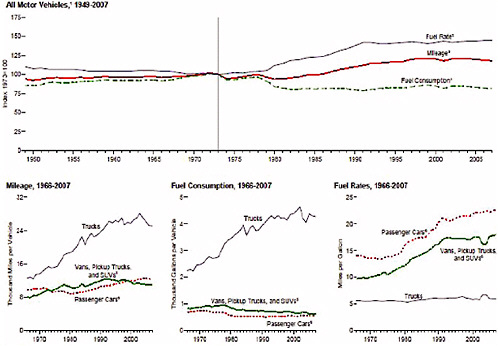
FIGURE 1-2 Motor vehicle mileage, fuel consumption, and fuel rates. SOURCE: DOE, EIA (2009a, Figure 2.8).
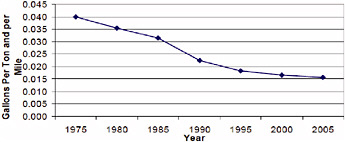
FIGURE 1-3 U.S. average payload-specific fuel consumption. SOURCES: Data from Federal Highway Administration, Highway Statistics Summary to 1995, Table VM-201A, and Highway Statistics (annual releases), Table VM-1, Washington D.C., available at http://www.fhwa.dot.gov/ohim/summary95/vm201a.xlw, accessed Feb. 25, 2010; total tons hauled from Bob Costello, American Trucking Association.
lost performance; however, the three-way catalyst mandates that current gasoline engines must operate at stoichiometric air/fuel ratios. If effective lean air/fuel ratio aftertreatment systems could be developed, further reductions in gasoline engine fuel consumption would be readily achievable. Gasoline-powered medium- and heavy-duty vehicles have followed the same historical fuel consumption and emission trends as the light-duty gasoline-powered vehicles.
The improved efficiency of both light- and heavy-duty vehicles has been overwhelmed by an increase in annual vehicle miles traveled (VMT). VMT has grown more quickly in the trucking sector than in the light-duty sector, resulting in medium- and heavy-duty vehicles taking up a growing share of total transportation-related petroleum consumption.
In fact, the U.S. transportation system relies nearly exclusively on petroleum, as shown in Figure 1-1 (DOE, EIA, 2009a). That dependence grows more each year, despite attempts to substitute other fuels and energy sources. NHTSA’s programs to improve fuel consumption are generally consistent with the EISA of 2007. The law also requires the DOT, for the first time in history, to establish fuel economy standards for medium- and heavy-duty vehicles. The gross vehicle weight ratings (GVWRs) for these vehicles range from 8,500 to more than 80,000 lb. (GVW and gross combined weight [GCW] refer to gross vehicle weight, which is limited by regulation. GVWR is the manufacturer’s stated maximum GVW rating for a vehicle. The legal weight limit may be lower than the manufacturer’s rating in some cases. GVW and GVWR apply to single-unit vehicles and to the tractor in a tractor-trailer combination.)
In addition, the use of fossil fuels for transportation produces carbon dioxide, an important greenhouse gas that contributes to climate change; governments around the world have taken action to reduce the use of fossil energy in their economies. The United States in particular is pursuing alternative sources of fuel and attempting to increase efficiency in oil usage, which will lower oil consumption and reduce greenhouse gas emissions.
As a result of these initiatives, vehicle manufacturers are required to reduce both fuel consumption and exhaust emissions. Light-duty vehicle manufacturers have already made significant improvements in reducing fuel consumption and even more progress in reducing vehicle emissions. The improvements in light-duty vehicle (cars and light trucks) fuel economy have been spurred in part by corporate average fuel economy (CAFE) standards. For medium- and heavy-duty vehicles greater than 8,500 pounds GVW, no such standards currently exist. Emissions of NOx and PM from heavy-duty vehicles will be significantly reduced by regulations that have gone into effect. However, reductions in fuel consumption of the large medium- and heavy-duty vehicle fleet have not been as impressive, partly because of the growth in the number of miles driven by large trucks during the past decade. If current trends continue, heavy vehicles will consume an important fraction of the fuel used for on-the-road vehicles. Therefore, if the United States is to reduce its reliance on foreign sources of oil, it will be necessary to reduce the fuel consumption of medium- and heavy-duty vehicles.
The recession has interrupted the constant growth in demand. The trucking industry and manufacturers continue to lay off workers on a vast scale (something that does not show in the 2007 data used throughout this report), and it is difficult to accurately extrapolate demand.
WEIGHT CLASSES AND USE CATEGORIES
Figure 1-4 gives the reader an idea of the diversity of medium- and heavy-duty vehicles. It is based on the DOT classification system using a truck’s GVWR. This information was developed by Davis and Diegel of Oak Ridge National Laboratory for the U.S. Department of Energy (DOE) Transportation Databook (Davis et al., 2009) and used extensively by the NESCCAF/ICCT (2009). The committee refers to that material (Table 5.7) for the following observations:
-
Class 1 and 2 vehicles lighter than 10,000 lb are considered light trucks, such as pickups, small vans, and sport utility vehicles. They generally have spark-
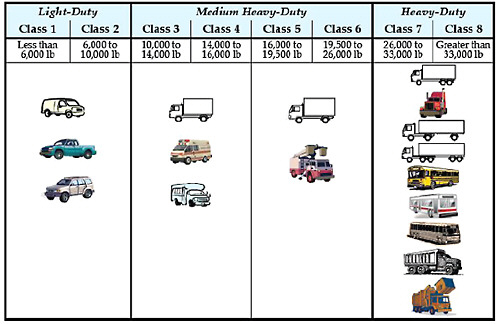
FIGURE 1-4 Illustrations of typical vehicle weight classes. SOURCE: Davis et al. (2009, pp. 5-6).
-
ignited gasoline-fueled internal combustion engines, and more than 80 percent are for personal use. This class of vehicle up to about 8,500 lb comes under CAFE requirements for cars. Class 2 trucks with GVWR above 8,500 lb are similar to Class 3 trucks.
-
Class 3 and above are primarily commercial vehicles. A mix of gasoline and diesel engines is used in Classes 3 through 7, and diesel engines are almost exclusively used in Class 8.
-
Classes 3 through 6 are medium- and heavy-duty vehicles with single rear axles.
-
Classes 7 and 8 are heavy-duty vehicles with two or more rear axles.
-
Class 8 combination trucks have a tractor and one or more trailers and a GCW of up to 80,000 lb, with higher weights allowed in specific circumstances.
ENERGY CONSUMPTION TRENDS AND TRUCKING INDUSTRY ACTIVITY
The number of medium- and heavy-duty trucks has increased substantially as the U.S. economy has grown. Over the period from 1970 to 2003, energy consumption by lightweight trucks grew 4.7 percent annually, while that of passenger cars grew only 0.3 percent. Meanwhile, energy consumption by heavy trucks increased 3.7 percent annually. Figure 1-3 displays this divergence in growth. It also displays the underlying pattern that it is not so much the change in fuel economy as a dramatic increase in annual miles driven by heavy vehicles. The continuation of these trends is documented in recent data through 2008 (NRC, 2008).
Trucks and trucking are important contributors to the national income, of course. According to the Economic Census of 2002 (the latest available), the truck transportation industry consisted of more than 112,698 separate establishments, with total revenues of $165 billion (DOC, Census Bureau, 2005). These establishments employ 1.4 million workers, who take home an annual payroll of $47 billion. Truck and bus manufacturing also accounts for a significant share of national income. According to the same census, light truck and utility vehicle manufacturers have total shipments of $137 billion. Heavy-duty truck manufacturing had sales of $16 billion. Another way to look at the trucking industry’s economic contribution is to compare it with other industries in the transportation sector, in which it accounts for about one-fourth of the sector’s total revenues (see Figure 1-5).
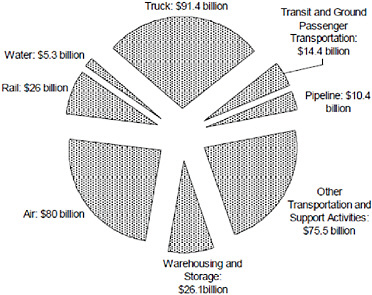
FIGURE 1-5 Total revenue of for-hire transportation services compared with revenue of other sectors of the transportation industry, 2002. SOURCE: DOC, Census Bureau (2005).
FACTORS AFFECTING IMPROVEMENTS IN FUEL CONSUMPTION
Medium- and heavy-duty trucks and buses are load-carrying vehicles that are designed to perform work in an efficient and timely manner. This makes them different from light-duty vehicles. In the U.S. EPA light-duty fuel economy tests, the vehicle is tested at its empty weight plus the equivalent weight of a couple of passengers.
For light-duty vehicles, load has only a modest impact on fuel consumption. For example, a car with four passengers and luggage will use only slightly more fuel than the same car with only a driver. For most light-duty vehicles, the loaded weight is approximately 25 to 35 percent more than the empty weight. However, for a heavy-duty vehicle, a loaded vehicle weighs more than double the empty weight.
Light-duty vehicles use the sales-weighted average of the fuel consumption (e.g., gallons/mile) for the urban and highway schedule converted into fuel economy (e.g., miles/gallons) to compare to the CAFE standards. Therefore, from a regulatory viewpoint, fuel consumption is also the fundamental measure (or “metric”).
Because trucks and buses are designed to carry payloads, and the loaded weight of a truck may be more than double the empty weight, the way to represent an appropriate attribute-based fuel consumption metric is to normalize the fuel consumption to the payload the vehicle hauls. As noted previously, this metric is called load-specific fuel consumption (LSFC) and is measured in gallons of fuel per payload tons per 100 miles. The lower the fuel consumption (FC) of the vehicle and the higher the payload the vehicle carries, the lower the LSFC. The payload has an important effect on the fuel consumption, and the average value used for potential standards should be based on national data representative of the class and duty cycle of the vehicle.
This report uses FC or LSFC data throughout except where fuel economy (FE) data are specified in the literature. Later in the report, metrics for the fuel efficiency of medium- and heavy-duty vehicles sold and used in the United States will be discussed. How best to quantify this will be addressed consistent with U.S. national objectives to reduce the nation’s reliance on oil. More detailed discussion of FE, FC, and LSFC is presented in Chapter 2.
TASK ORGANIZATION AND EXECUTION
Recognizing the challenge and complexity of its work, the committee organized its members in working groups focused on the individual tasks outlined in its charge. There were four such groups, each with its own leader responsible for task work, coordination, and scheduling under the umbrella of the broader committee.
Given the constrained time and legislative deadline it faced, the committee used specialized consultants to execute various portions of the study directed by a committee working group. The consultants and their assignments were:
TIAX, LLC—Developing Detailed Forecasts of Fuel Consumption Reducing Technologies:
-
Supported the committee’s evaluation of medium- and heavy-duty vehicle technologies by researching the technologies and their costs through intensive interviews of manufacturers, fleet owners and, others to produce a detailed matrix relating technologies and vehicle types over time.
-
Developed a detailed matrix of fuel-saving technologies, their fuel consumption benefits, and their costs.
-
Focused on a 10-year time frame.
-
Arranged specific site visits for the committee.
Argonne National Laboratory—Modeling and Simulation:
-
Provided quantitative data to support the committee in its task of establishing a report to support rulemaking on medium- and heavy-duty vehicle fuel consumption.
-
Provided modeling and simulation analyses of technologies now and into the future for eight vehicle applications: pickup truck, van, delivery straight truck, bucket truck, combination tractor trailer, refuse hauler, urban bus, and intercity highway bus.
Cambridge Systematics and ERG:
-
Examined possible consequences or side effects of fuel economy standards or of technologies to improve the fuel efficiency of medium- and heavy-duty vehicles.
-
Examined alternative approaches to improving fuel efficiency.
The four consultants’ reports are available in the National Academies Public Access File associated with this study.
In addition, the committee distributed a questionnaire to aerodynamics technology stakeholders in the private and academic sectors from which it received useful input. The committee’s efforts were also aided by several industry organizations that hosted site visits providing relevant information, which proved especially helpful for the work of TIAX. They included the following:
-
The University of Michigan Transportation Research Institute (UMTRI), Ann Arbor
-
Ford Motor Co.
-
Azure Dynamics Corp.
-
Arvin Meritor, Inc.
-
Navistar International Corp.
-
ISE Corp.
-
Allison Transmission, Inc.
-
Peterbilt Trucks (PACCAR Co.)
-
Auto Research Center, Inc., Indianapolis, Ind.
-
U.S. Environmental Protection Agency (EPA), Ann Arbor, Mich.
-
Southwest Research Institute (SwRI), San Antonio, Tex.
-
Detroit Diesel Corp.
-
Eaton Corp.
-
Tank and Automotive Research, Development and Engineering Center (TARDEC), U.S. Army
-
PACCAR, Inc.
-
Volvo Trucks North America
-
Cummins, Inc.
-
Great Dane Trailers (Great Dane LLC)
-
Walmart
-
Transportation Research Center, Inc.
-
National Highway Transportation Safety Administration (NHTSA), Washington, D.C.
All of these consultants and industry partners provided invaluable assistance to the committee in its efforts.
REPORT STRUCTURE
This report begins with a summary of the key findings and recommendations. Chapter 1, the introduction, lays the factual background for the reader. Next, Chapter 2 provides vehicle fundamentals necessary for a thorough understanding of the topics addressed in the report. Chapter 3 surveys the current U.S., European, and Asian approaches to fuel economy and regulations. Chapter 4 reviews and assesses power train technologies for reducing load-specific fuel consumption. Chapter 5 covers vehicle technologies for reducing load-specific fuel consumption. The direct and indirect costs and benefits of integrating fuel economy technologies medium- and heavy-duty vehicles are addressed in Chapter 6. Chapter 7 discusses alternative approaches to be considered for reducing the fuel consumption of such vehicles. Chapter 8 discusses approaches to measurement and regulation of fuel consumption.
BIBLIOGRAPHY
DOC (U.S. Department of Commerce), Census Bureau. 2005. 2002 Economic Census, Industry Product Analysis. Washington, D.C. March.
DOE, EIA (U.S. Department of Energy, Energy Information Administration). 2009a. Annual Energy Review 2008. Report No. DOE/EIA-0384(2008). Washington, D.C.
DOE, EIA. 2009b. Annual Energy Outlook 2009. Report No. DOE/EIA-DOE/EIA-0383(2009). Washington, D.C. March.
DOE, EIA. 2009c. Annual Energy Outlook 2010 (Preliminary). Washington, D.C. December.
Davis, S., S. Diegel, and R.G. Boundy. 2009. Transportation Energy Data Book, Edition 28, Table 5.7. Knoxville, Tenn.: U.S. Department of Energy, Energy Efficiency and Renewable Energy. Report No. ORNL-6984.
Federal Highway Administration, Highway Statistics Summary to 1995, Table VM-201A, and Highway Statistics (annual releases), Table VM-1. Washington D.C.
ICCT (Northeast States Center for a Clean Air Future/International Council on Clean Transportation). 2009. Setting the Stage for Regulation of Heavy-Duty Vehicle Fuel Economy and GHG Emissions: Issues and Opportunities. February.
NRC (National Research Council). 2008. Review of the 21st Century Truck Partnership. Washington, D.C.: The National Academies Press.


