
Summary
In the United States, data from the 2007-2008 National Health and Nutrition Examination Survey indicate that nearly 34 percent of adults aged 20 years or older are obese and about 68 percent are overweight or obese. Among children and adolescents aged 2 to 19, nearly 17 percent are obese and close to 32 percent are overweight or obese. The epidemic reflected by these figures poses major challenges for policy makers, public health professionals, and other decision makers.
Federal health authorities have called for decisive action to address this epidemic for more than a decade, and their appeals have increased in urgency in recent years. Their alarm is linked to the adverse health outcomes of obesity and overweight, including potential negative effects on quality of life and life expectancy. It is also triggered by the negative economic impact of these levels of obesity. A recent analysis calculated that the annual national medical burden of obesity is nearly 10 percent of all medical spending and could have risen to $147 billion per year by 2008.
INTRODUCTION
Policy makers and practitioners who take action to address this epidemic need evidence to explain why the actions are needed and to help determine what actions to take and how to go about them. They also need evidence to determine whether the intended results are obtained, who benefits, and whether there are positive or negative side effects that deserve attention. Ideally, there would be ready sources of such evidence at hand relevant to these information needs.
Unfortunately, a review of the existing evidence base reveals a striking contrast between the high prevalence and consequent importance of addressing obesity and the paucity of the knowledge base with which to inform prevention efforts. Specifically for evidence-based obesity prevention efforts, a body of intervention research on policy and environmental approaches is largely absent from the literature.
The types of questions that are being asked by decision makers interested in obesity prevention cannot be answered without broadening the concept of evidence to include new ways of using traditional or existing information; information drawn from a wider range of sources; and newly generated evidence that is more focused on the design, implementation, and outcomes of policies and programs to prevent obesity—whether initiated in research or practice settings.
THE NEED FOR A NEW FRAMEWORK
The scenarios in Boxes S-1 and S-2, respectively, illustrate the need to assist decision makers in finding evidence to inform decisions and to help researchers determine useful areas of study. Considerable progress has been made in building on the strengths of methods used in evidence-based medicine to develop research methods and evidence standards applicable to decision making about other population-level health problems. Leveraging these accomplishments holds the potential to advance understanding of how to develop and evaluate evidence for use in decision making on obesity prevention.
The Institute of Medicine Committee on an Evidence Framework for Obesity Prevention Decision Making was formed to address these challenges. The overall charge of the committee was to develop a framework for evidence-informed decision making in obesity prevention, with a focus on assessing policy, environmental, and
|
Box S-1 The Need for Evidence to Support Decision Making on Obesity Prevention Imagine that you are the mayor, or a health commissioner, in a city in which both children and adults have high rates of obesity—perhaps higher than in some peer cities that appear to have a better handle on the problem. You need to decide which of a spectrum of actions to take and how to justify these actions against some inevitable opposition from various stakeholders. Consumer advocates are calling for policies that require posting of calories on the menu boards of fast food restaurants. Some city council members are calling for taxes on soft drinks to lower consumption levels but also to raise revenue to offset budget deficits. The school board is debating whether to make the collection of child weight-for-height data mandatory and to send the information home to parents. Ideally, among the many considerations factoring in to your decision making, you or your staff would readily find or have at hand a rich and frequently replenished set of reports to support your decision about a particular strategy or a choice among options. These reports would relate to the types of policy and environmental changes you are considering and provide an idea of their pros and cons—for example, estimated benefits, unintended adverse consequences, costs, and the practicalities of implementation. You would find few such reports, however. |
|
Box S-2 The L.E.A.D. Framework and New Opportunities for Research Imagine that you are a researcher who has become aware of the value of conducting research with an impact on public health. You have seen a call for proposals for policy-oriented research related to obesity or have recognized the need to expand your current obesity research to incorporate more of a multilevel perspective. Your research might focus on obesity or some other health issue or be in another field, such as city planning, education, or law. What are innovative ways to think about relevant research questions that would be fundable and publishable? Are there ways to research complex, big-picture questions that need answering? How far can research that might be relevant to those questions deviate from the status quo with respect to methods considered to be the gold standard in your field? How can you ensure that your research is responsibly designed to assess a policy adequately? One purpose of the L.E.A.D. framework is to stimulate new ways of thinking about research that can yield answers to such questions. |
community interventions that influence food, eating, and physical activity. Inherent in this charge was a recognition that, while treatment and prevention focused on the individual remain relevant, there is a growing need for obesity prevention strategies that focus on whole populations—multicomponent, multilevel strategies that can favorably impact communities or other complex systems.
In developing the L.E.A.D. framework (for Locate Evidence, Evaluate Evidence, Assemble Evidence, Inform Decisions), the committee was instructed to provide an overview of the current nature of the evidence base; identify the challenges faced in integrating scientific evidence into the broader array of factors that influence community interventions and policy change; provide practical, action-oriented recommendations for using this framework to choose, implement, and evaluate obesity efforts; identify new research and evaluation tools and methods, and existing ones that can be deployed more effectively; and develop a plan for communicating, disseminating, evaluating, and refining the framework. The committee’s charge emphasized the need for a framework that guides decision making on children and adults. The committee also was directed to focus on the role of a systems perspective in making obesity prevention decisions, as well as to contribute to more general efforts to address complex, multifactorial public health challenges.
STUDY APPROACH
In responding to its charge, the committee’s main goal was to support decision makers in choosing and implementing obesity prevention interventions or in assessing the outcomes of interventions already in place or under way. This report has two primary audiences: (1) decision makers and the intermediaries who assist them in making decisions and (2) those who conduct research relevant to obesity prevention or who
evaluate existing programs. Other important audiences include research funders and publishers of research findings.
Two caveats are necessary as a prelude to presenting the L.E.A.D. framework. First, this framework does not offer shortcuts that can provide high-quality evidence as rapidly as it might be needed. The framework offers suggestions for ways to increase flexibility and broaden perspectives while adhering closely to concepts of what makes evidence credible as well as useful. Second, this is not a framework that can be used as an algorithm for making decisions; rather, it is a framework for using evidence to inform decision making. A richer, more relevant evidence base will inform and vastly improve decision making, but will not make the design, selection, and assessment of interventions automatic or free decision makers from exercising judgment.
This report’s audiences need answers to two fundamental questions:
-
How can evidence that is currently available and potentially relevant to decisions on obesity prevention be identified, evaluated, and compiled in ways that will best inform decision makers?
-
How can more evidence be developed that is of high quality and framed to be directly relevant to decision making on obesity prevention?
USING THE L.E.A.D. FRAMEWORK
The L.E.A.D. framework is illustrated in Figure S-1. This framework includes concepts and approaches that are standard procedure in the development of practice guidelines. However, the committee incorporated major innovations that expand and enhance these approaches for use in policy and programmatic decision making on complex public health problems like obesity. The framework and its supporting narrative:
-
explain why it is critical to use a systems perspective;
-
characterize the types of questions policy makers ask;
-
broaden the concept of evidence;
-
reframe the definition of quality of evidence to accord with the type of evidence;
-
recommend ways to consider other relevant information when evidence is limited;
-
propose a template for assembling evidence; and
-
highlight opportunities to generate new and relevant evidence.
The framework leads decision makers and researchers through a series of steps, from specifying questions to informing decisions. However, a user can begin at any point on the framework and return to earlier steps, for example, moving back from the “assemble” step to elaborate further on the questions and broaden the search for evidence.
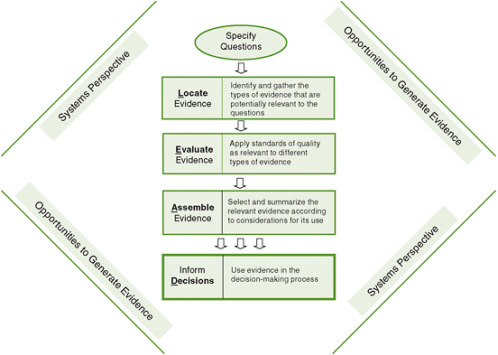
FIGURE S-1 The L.E.A.D. framework.
The presence of the term “systems perspective” surrounding the steps in the L.E.A.D. framework in Figure S-1 emphasizes the importance of taking such a perspective throughout the process of applying the framework—from specifying questions to guide the search for evidence to taking advantage of opportunities to generate new evidence. The presence of the term “opportunities to generate evidence” surrounding the framework steps emphasizes the importance of identifying research opportunities throughout the process. Following are brief explanations of each aspect of the L.E.A.D. framework in Figure S-1. The “Key Action” boxes are primarily for the use of decision makers and their intermediaries (i.e., individuals who may assist decision makers in using the framework).
Systems Perspective
|
Key Action: Approach every aspect of decision making and research with a fuller appreciation of the complex context in which programs and policies are implemented. |
The real world is a complex system, and the many influences on the energy-balance equation are all interacting simultaneously. A systems perspective helps decision makers and researchers think broadly about the whole picture rather than merely studying the component parts in isolation. Such a perspective can help to frame, explain, and resolve complex problems such as obesity. It can lead to a better understanding of interactions and highlights the importance of taking into account the context in which public health problems occur and how that context may affect the implementation and impact of interventions.
A systems perspective can enhance the ability to develop and use evidence effectively and suggest actions with the potential to effect change. It can allow the forecasting of potential consequences of not taking action, possible unintended effects of interventions, the likely magnitude of the effect of one or more interventions, conflicts between or complementarity of interventions, and priorities among interventions. Systems maps—in which relevant factors and pathways are illustrated graphically—can help organize an overwhelming array of potential influences and pathways relevant to the determinants of obesity.
Specifying Questions
|
Key Action: Identify the questions that need to be answered in order to make the needed decision. |
There are many kinds of decisions that are likely to be made on obesity prevention at the local, state, and national levels. The common applications of evidence for which the L.E.A.D. framework can be useful are:
-
justifying interventions;
-
setting priorities with respect to specific outcomes;
-
justifying particular actions in high-risk population segments;
-
distinguishing actions that are likely to be effective from those that are not;
-
quantifying likely impacts;
-
estimating costs and cost-effectiveness;
-
anticipating unintended consequences; and
-
understanding implementation variables, i.e., what to do and how to do it.
Thus, decisions about the selection, implementation, and evaluation of interventions are closely tied to questions about why an intervention is needed and how a specific intervention can be expected to work in a given context. The L.E.A.D. framework adapts an evidence-based public health typology to differentiate among three categories of interrelated questions—“Why,” “What,” and “How.” These general questions can help decision makers identify related questions that may inform their policy and program decisions, underscore the fact that no one type of evidence will be
able to answer all relevant questions, and facilitate the process of locating useful evidence for different questions.
“Why” questions relate to the overall question of “Why should we do something about this problem in our situation?” “What” questions ask, “What specifically should we do about this problem?” “How” questions call for examining “How do we implement this information for our situation?”
Locating Evidence
|
Key Actions: (1) Based on the questions that need to be answered, determine all the types of evidence that could be useful in answering them. (2) Think broadly about the sources of these types of evidence, including the potential for obtaining relevant evidence from other disciplines. |
Locating evidence requires a clear concept of the types of information that may be useful for a particular purpose, as well as an awareness of where the information can be found. The framework calls for expanding the evidence paradigm by broadening the perspective on forms of evidence that are potentially relevant and useful, taking full advantage of available research methods for studying population problems, not just those used in medical research. Some forms of available evidence may be underutilized by those who conduct research on obesity prevention because they are unfamiliar to researchers in the biomedical or public health fields.
Locating evidence also requires awareness of and access to appropriate information resources. Databases used by public health researchers and practitioners typically incorporate data from numerous disciplines but may still miss many potentially useful sources. For example, compilations from economics, education, business, and law and information from newspapers, government documents, and reports from community agencies and programs may not be obvious sources of evidence for obesity prevention researchers.
Evaluating Evidence
|
Key Actions: (1) Recognize the importance of evaluating the quality of the evidence gathered to answer the specified questions. (2) When evaluating evidence, use criteria that are appropriate and established for assessing the quality of that particular type of evidence. (3) In evidence evaluation, pay attention to both the level of certainty (internal validity) and generalizability (external validity) of the evidence. |
In the L.E.A.D. framework, the key objectives in evaluating evidence are determining the level of certainty of the causal relationship between an intervention and the observed outcomes (or internal validity) and generalizability to other individuals, settings, contexts, and time frames (or external validity). The level of certainty needed will vary depending on the question. For example, some low-cost interventions with minimal potential for harm may require less certainty than those that are costly or carry the risk of serious harm.
A key issue in evaluating evidence is aligning the question(s) of interest with the appropriate outcome(s). Outcomes may be short-term, intermediate, or long-term. For example, some obesity prevention decisions will require evidence that relates directly to weight outcomes, while others may allow evidence related to intermediate behavioral outcomes.
Evaluations of interventions should also be sensitive to the nature of the intervention. For example, outcomes that are farther downstream from a policy change might also be of interest but would be less reflective of the specific effect of the change given the other influences that might have intervened in the interim. Quality considerations in assessing evidence, while based on the same principles, vary with the form or source of the evidence. Different types of evidence require different approaches to judging validity and other aspects of quality. Evaluating relevance to the context to which the question applies may be an additional critical step in any assessment of evidence for complex population-level interventions, requiring the application of criteria to judge the generalizability of the evidence.
Assembling Evidence and Informing Decisions
|
Key Actions: (1) Develop a transparent and comprehensive summary of the evidence available on the decision that must be made, based on the information gathered by following the L.E.A.D. framework. (2) Include in this summary the question(s) asked by the decision maker; the strategy for gathering and selecting the evidence; an evidence table showing the sources, types, and quality of the evidence and the outcomes reported; and a concise summary of the evidence on why an action should be taken, what that action should be, and how it should be taken. (3) If obesity prevention actions must be taken when evidence is limited, examine the potential for blending the limited evidence with theory, professional experience, and local wisdom. (4) Use this summary to inform the decision-making process. |
Once the potentially relevant evidence has been located and evaluated with the more broadly based, interdisciplinary view called for by the L.E.A.D. framework, the evidence needs to be synthesized and summarized to help inform the decision based on the question(s) asked. Taken together, the results of the overall evaluation of the evidence should assist in providing answers to why action should be taken, what action to take, and how to take it. Implicit in this process is the understanding that more than one type and source of evidence will be needed to inform decision making, and that there will be inevitable trade-offs between level of certainty and generalizability.
A standardized approach to assembling the results of evidence gathering and evaluation facilitates transdisciplinary discussion among stakeholders and presents evidence to decision makers in a usable form. A uniform language for drawing and describing conclusions signals the use of a uniform set of procedures to evaluate the evidence and improves clarity in communication. Clarity is particularly important when expertise from many different disciplines is required, each with its own jargon and methods.
The intent of the transparent and uniform reporting of the process and conclusions of evidence gathering and synthesis is to provide decision makers with information they can understand as they make choices among alternative policies and programs. The proposed report template aligns with the main elements of the framework, describing the question(s) asked by the decision maker, the strategy for gathering and selecting evidence, and the evaluation of the evidence, and ends with a summary of the synthesized evidence. This summary should address the broad categories of effectiveness in the proposed setting, population affected and potential impact, and implementation.
The ability to use evidence to inform decision making depends in part on the availability of relevant evidence. Use of the L.E.A.D. framework can broaden what is considered to be useful, high-quality evidence and gradually increase the amount of such evidence. Yet, despite the best efforts to amass available evidence, those grappling with an emerging problem such as obesity will face decisions that must be made on the basis of inconsistent or incomplete evidence. Similar to what has been observed in tobacco control, one can anticipate cycles of planning that begin with incomplete evidence, blended with theory, expert opinion, experience, and understanding of local traditions and the probable response to proposed actions, and extend to evaluating the consequences of interventions. Decision making is complex and takes many factors, in addition to evidence, into account. The goal is to enable the best possible use of evidence within decision making processes.
Opportunities to Generate Evidence
|
Key Actions: (1) Take full advantage of opportunities to generate evidence from ongoing policy and practice. (2) If obesity prevention actions are taken when the evidence is very limited, evaluate the success of the intervention and build credible evidence for use in future decision making. (3) Treat natural experiments, emerging innovations, and ongoing programs as potential sources of useful evidence. (4) Consider forms of evidence and research designs from a variety of disciplines, including systems approaches that can handle complexity. (5) Explore research designs that can be used as alternatives to randomized experiments and that may be more feasible in relation to complex environmental and policy interventions. (6) When reporting results of obesity prevention efforts, include useful aspects of the research related to its generalizability to individuals, settings, contexts, and time frames. |
Researchers in a variety of fields, as well as those who fund and publish their research, are among the intended users of the L.E.A.D. framework. In addition to fostering a systems approach and making the best possible use of diverse types of relevant evidence, application of the L.E.A.D. framework can suggest opportunities for research. This may occur during any step of the process.
What is usually regarded as the current evidence base for obesity prevention is limited in both size and utility. New approaches based on the expanded perspective outlined in this report are urgently needed to address these limitations. Among other
problems, the limited nature of evidence on effectiveness may be interpreted as a lack of effectiveness, when what it actually indicates is that the degree of effectiveness is not yet known.
Research to inform answers to the questions that drive the use of the L.E.A.D. framework should take full advantage of opportunities to generate evidence from ongoing policy and practice, as well as evidence and research designs from a variety of disciplines, including systems approaches that can handle complexity. This report includes an extensive discussion of research designs that can be used as alternatives to randomized experiments and that may be more feasible and applicable for studying complex environmental and policy interventions such as those aimed at obesity prevention. The report also contains a discussion of the need to take advantage of natural experiments and emerging and ongoing interventions as sources of practice-based evidence. Finally, research related to obesity prevention and related public health issues is inherently transdisciplinary.
NEXT STEPS
An effective communication and dissemination plan for the L.E.A.D. framework should focus on three major objectives: (1) introducing the purpose of the framework to decision makers, their intermediaries, researchers, and others; (2) raising awareness of the importance of marshaling evidence within both policy and practice environments and research environments to support decision making for complex public health challenges like obesity; and (3) creating support for integrating the framework into current policy making and research practice. The knowledge gained as the framework is disseminated, implemented, and evaluated can be used to refine it and its application. A strategic evaluation and refinement plan for the framework can measure the adoption and utilization of the framework by the intended users and evaluate its impact on research and decision-making strategies. A well-executed communication, dissemination, evaluation, and refinement plan for the L.E.A.D. framework will help in adapting it to real-world policy making and practice.
RECOMMENDATIONS
The United States has made progress toward translating science to practice in the brief time since the obesity epidemic was officially recognized. But the pace of this translation has been slow relative to the scope and urgency of the problem and the associated harms and costs. With this in mind, the committee makes the following recommendations for assisting decision makers and researchers in using the current evidence base for obesity prevention and for generating more, and more useful, evidence.
Utilize the L.E.A.D. Framework
Recommendation 1: Decision makers and those involved in generating evidence, including researchers, research funders, and publishers of research, should apply the L.E.A.D. framework as a guide in their utilization and generation of evidence to support decision making for complex, multifactorial public health challenges, including obesity prevention.
Key assumptions that should guide the use of the framework include the following:
-
A systems perspective can help in framing and explaining complex issues.
-
The types of evidence that should be gathered to inform decision making are based on the nature of the questions being asked, including Why? (“Why should we do something about this problem in our situation?”), What? (“What specifically should we do about this problem?”), and How? (“How do we implement this information for our situation?”). A focus on subsets of these questions as a starting point in gathering evidence explicitly expands the evidence base that is typically identified and gathered.
-
The quality of the evidence should be judged according to established criteria for that type of evidence.
-
Both the level of certainty of the causal relationship between an intervention and the observed outcomes and the intervention’s generalizability to other individuals, settings, contexts, and time frames should be given explicit attention.
-
The analysis of the evidence to be used in making a decision should be summarized and communicated in a systematic, transparent, and transdisciplinary manner that uses uniform language and structure. The report on this analysis should include a summary of the questions asked by the decision maker; the strategy for gathering and selecting the evidence; an evidence table showing the sources, types, and quality of the evidence and the outcomes reported; and a concise summary of the synthesis of selected evidence on why an action should be taken, what that action should be, and how it should be taken.
-
If action must be taken when evidence is limited, this incomplete evidence can be blended carefully and transparently with theory, expert opinion, and collaboration based on professional experience and local wisdom to support making the best decision.
Sustained commitments will be needed from both the public and private sectors to achieve successful utilization of the various elements of the L.E.A.D. framework in future evidence-informed decision making and evidence generation. This responsibility lies with the academic and research community, as well as with government and private funders and the leadership of journals that publish research in this area. Necessary supports will include increasing understanding of systems thinking and incorporating it into research-related activities, creating and maintaining resources to
support the utilization of evidence, establishing standards of quality for different types of evidence, and supporting the generation of evidence, each of which is described in more detail below. Finally, it will be necessary to communicate, disseminate, evaluate, and refine the L.E.A.D. framework.
Incorporate Systems Thinking
Recommendation 2: Researchers, government and private funders, educators, and journal editors should incorporate systems thinking into their research-related activities.
To implement this recommendation:
-
Researchers should use systems thinking to guide the development of environmental and policy interventions and study designs.
-
Government and private funders should encourage the use of systems thinking in their requests for proposals and include systems considerations in proposal evaluations.
-
Universities, government agencies such as the U.S. Centers for Disease Control and Prevention, and public health organizations responsible for educating public health practitioners and related researchers should establish training capacity for the science and understanding of systems thinking and the use of systems mapping and other quantitative or qualitative systems analysis tools.
-
Journal editors should encourage the use of systems thinking for addressing complex problems by developing panels of peer reviewers with expertise in this area and charging them with making recommendations for how authors could use systems thinking more effectively in their manuscripts.
Build a Resource Base
Recommendation 3: Government, foundations, professional organizations, and research institutions should build a system of resources (people, compendiums of knowledge, registries of implementation experience) to support evidence-based public policy decision making and research for complex health challenges, including obesity prevention.
To implement this recommendation:
-
The Secretary of Health and Human Services, in collaboration with other public- and private-sector partners, should establish a sustainable registry of reports on evidence for environmental and policy actions for obesity prevention. Integral to this registry should be the expanded view of evidence for decision making on obesity prevention proposed in this report and the sharing of experiences and innovative programs as the evidence evolves. A service provided by
-
this registry should be periodic synthesis reviews based on mixed qualitative and quantitative methods.
-
The Secretary of Health and Human Services, in collaboration with other public- and private-sector partners, should develop and fund a resource for compiling and linking existing databases that may contain useful evidence for obesity prevention and related public health initiatives. This resource should include links to data and research from disciplines and sectors outside of obesity prevention and public health and to data from nonacademic sources that are of interest to decision makers.
Establish Standards for Evidence Quality
Recommendation 4: Government, foundations, professional organizations, and research institutions should catalyze and support the establishment of guidance on standards for evaluating the quality of evidence for which such standards are lacking.
To implement this recommendation:
-
Government and private funders should give priority to funding for the development of guidance on standards for evaluating the quality of the full range of evidence types discussed in this report that are useful in making obesity prevention decisions, especially those for which the scientific literature is limited.
-
Professional organizations and research institutions should encourage and bring attention to efforts by faculty, researchers, and students to establish guidance in this area.
Support the Generation of Evidence
Recommendation 5: Obesity prevention research funders, researchers, and publishers should consider, wherever appropriate, the inclusion in research studies of a focus on the generalizability of the findings and related implementation issues at every stage, from conception through publication.
To implement this recommendation:
-
Those funding research in obesity prevention should give priority to support for studies that include an assessment of the limitations, potential utility, and applicability of the research beyond the particular population, setting, and circumstances in which the studies are conducted, including by initiating requests for applications and similar calls for proposals aimed at such studies. Additional ways in which this recommendation could be implemented include adding criteria related to generalizability to proposal review procedures and training reviewers to evaluate generalizability.
-
Obesity prevention researchers and program evaluators should give special consideration to study designs that maximize evidence on generalizability.
-
Journal editors should provide guidelines and space for authors to give richer descriptions of interventions and the conditions under which they are tested to clarify their generalizability.
Recommendation 6: Research funders should increase opportunities for those carrying out obesity prevention initiatives to measure and share their outcomes so others can learn from their experience.
To implement this recommendation:
-
Organizations funding or sponsoring obesity prevention initiatives—including national, regional, statewide, or local programs; policy changes; and environmental initiatives—should provide resources for obtaining practice-based evidence from innovative and ongoing programs and policies in a more routine, timely, and systematic manner to capture their processes, implementation, and outcomes. These funders should also encourage and support assessments of the potential for evaluating the most innovative programs in their jurisdictions and sponsor scientific evaluations where the opportunities to advance generalizable evidence are greatest.
-
Research funders, researchers, and journal editors should assign higher priority to studies that test obesity prevention interventions in real-world settings in which major contextual variables are identified and their influence is evaluated.
Recommendation 7: Research funders should encourage collaboration among researchers in a variety of disciplines so as to utilize a full range of research designs that may be feasible and appropriate for evaluating obesity prevention and related public health initiatives.
To implement this recommendation:
-
As part of their requests for proposals on obesity prevention research, funders should give priority to and reward transdisciplinary collaborations that include the creative use of research designs that have not been extensively used in prevention research but hold promise for expanding the evidence base on potential environmental and policy solutions.
Communicate, Disseminate, Evaluate, and Refine the L.E.A.D. Framework
Recommendation 8: A public–private consortium should bring together researchers, research funders, publishers of research, decision makers, and other stakeholders to discuss the practical uses of the L.E.A.D. framework, and develop plans and a timeline for focused experimentation with the framework and for its evaluation and potential refinement.
To implement this recommendation:
-
Interested funders should bring together a consortium of representatives of key stakeholders (including decision makers, government funders, private funders, academic institutions, professional organizations, researchers, and journal editors) who are committed to optimizing the use of the current obesity prevention evidence base and developing a broader and deeper base of evidence.
-
This consortium should develop an action-oriented plan for funding and implementing broad communication, focused experimentation, evaluation, and refinement of the L.E.A.D. framework. This plan should be based on the major purposes of the framework: to significantly improve the evidence base for obesity prevention decision making on policy and environmental solutions, and to assist decision makers in using the evidence base.


