
10
Conclusions and Recommendations
Decisions about prevention are complex, not only for the obesity problem but also for other problems with multiple types and layers of causation. Recognition of the need to emphasize population-based approaches to obesity prevention, the urgency of taking action, and the desire of many decision makers to have evidence on which actions to take have created a demand for evidence with which to answer a range of questions. In reality, the evidence approaches that apply to decision making about the treatment of obesity or other clinical problems are inadequate and sometimes inappropriate for application to decisions about public health initiatives. The need to work around evidence gaps and the limitations of using evidence hierarchies that apply to medical treatment for assessing population-based preventive interventions have been faced by the developers of several prior Institute of Medicine (IOM) reports on obesity prevention (focused on child and adolescent obesity). These evidence issues are not new and have already been the focus of many efforts in the field of public health in relation to other complex health problems. However, they are far from resolved. Considering these issues in relation to obesity prevention has the potential to advance the field of public health generally while also meeting the immediate need for clarity on evidence issues related to addressing the obesity epidemic.
The IOM’s Food and Nutrition Board formed the Committee on an Evidence Framework for Obesity Prevention Decision Making, with funding from Kaiser Permanente, the Robert Wood Johnson Foundation, and the Centers for Disease Control and Prevention. This committee was asked to develop a framework for evidence-informed decision making in obesity prevention, focused on approaches for assessing policy, environmental, and community interventions designed to influence diet and physical activity. The committee was tasked to:
-
provide an overview of the nature of the evidence base for obesity prevention as it is currently construed;
-
identify the challenges associated with integrating scientific evidence with broader influences on policy and programmatic considerations;
-
provide a practical and action-oriented framework of recommendations for how to select, implement, and evaluate obesity prevention efforts;
-
identify ways in which existing or new tools and methods can be used to build a useful and timely evidence base appropriate to the challenges presented by the epidemic, and describe ongoing attempts to meet these challenges;
-
develop a plan for communicating and disseminating the proposed framework and its recommendations; and
-
specify a plan for evaluating and refining the proposed framework in current decision-making processes.
CONCLUSIONS
Recognition is increasing that overweight and obesity are not only problems of individuals, but also societywide problems of populations. Acting on this recognition will require multifaceted, population-based changes in the socioenvironmental variables that influence energy intake and expenditure. There exist both a pressing need to act on the problem of obesity and a large gap between the type and amount of evidence needed to act and the type and amount of evidence available to meet that need. A new framework is necessary to assist researchers and a broad community of decision makers in generating, identifying, and evaluating the best evidence available and in summarizing it for use in decision making. This new framework also is important for researchers attempting to fill important evidence gaps through studies based on questions with program and policy relevance. However, the methods used and the evidence generated by traditional research designs do not yield all the types of evidence useful to inform actions aimed at addressing obesity prevention and other complex public health challenges. An expanded approach is needed that emphasizes the decision-making process and contextual considerations.
The Framework
To meet this need, the committee developed the L.E.A.D. (Locate Evidence, Evaluate Evidence, Assemble Evidence, and Inform Decisions) framework, designed to facilitate a systematic approach to the identification, implementation, and evaluation of promising, reasonable actions to address obesity prevention and other complex public health challenges (see Figure 10-1). The framework is designed to help identify the nature of the evidence that is needed and clarify what changes in current approaches to generating and evaluating evidence will facilitate meeting those needs. This section describes the main components of the framework and issues related to these components.
Obesity prevention has not been addressed successfully by traditional study designs, which are generally linear and static. A systems approach is needed to develop more complex, interdisciplinary strategies. Accordingly, the L.E.A.D. framework
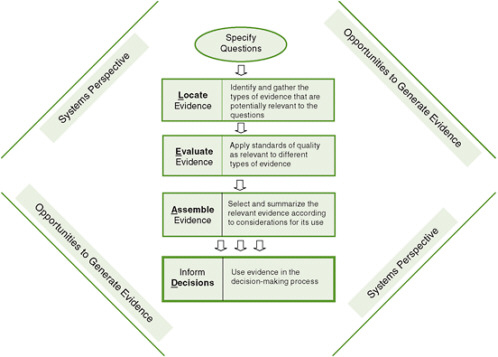
FIGURE 10-1 The Locate Evidence, Evaluate Evidence, Assemble Evidence, Inform Decisions (L.E.A.D.) framework for obesity prevention decision making.
recommends taking a systems perspective. In other words, it is necessary to use an approach that encompasses the whole picture, highlighting the broader context and interactions among levels, to capture the complexity of obesity prevention and other multifactorial public health challenges.
Addressing such challenges first requires specifying the question(s) being asked to guide the identification of evidence that is appropriate, inclusive, and relevant. Core to the framework is the orientation of the user. A variety of decisions have to be made to address obesity prevention. To capture the resulting mix of evidence needs, the framework adopts a typology that differentiates three broad categories of interrelated questions of potential interest to the user: Why should we do something about this problem? What specifically should we do? and How do we implement this information for our situation? This “Why,” “What,” “How” typology stresses the need for multiple types of evidence to support decisions on obesity prevention.
Once the question(s) of interest have been specified, locating useful evidence requires clear knowledge of the types of information that may be useful and an awareness of where that information can be found. The framework calls for the use of
diverse approaches to gather and synthesize information from other disciplines that address issues similar to those faced in obesity prevention and public health generally. Evidence identified and gathered to inform decision making for obesity prevention and other complex public health challenges should be assessed based on both its generalizability and level of certainty (i.e., its external and internal validity, respectively). The L.E.A.D. framework addresses these two key aspects of the evidence through the nature of the question(s) being asked, established criteria for the value of evidence, and the context in which the question(s) arise. Results of the overall evaluation of evidence should provide answers on what to do, how to do it, and how strongly the action is justified.
When decision makers are coming to a decision on obesity prevention actions, it is important for them to understand the state of the available knowledge relevant to that decision. This knowledge includes evidence on the specific problem to be addressed, the likely effectiveness and impact of proposed actions, and key considerations involved in their implementation. Successful evidence gathering, evaluation, and synthesis for use in obesity prevention usually require the involvement of a number of disciplines using a variety of methodologies and technical languages. The framework incorporates a standardized approach using a uniform language and structure for summarizing the relevant evidence in a systematic, transparent, and transdisciplinary way that is critical for communicating the process and conclusions clearly.
With an emergent problem such as obesity, decisions to act often must be made in the face of a relative absence of evidence, or evidence that is inconclusive, inconsistent, or incomplete. Evidence gathered from a particular intervention implemented in a closely controlled manner within a specific population with its own unique characteristics is often difficult to apply to a similar intervention with another population. The typical way of presenting results of obesity prevention efforts in journals often adds to the problem of incomplete evidence because useful aspects of the research related to its generalizability are not reported. If obesity prevention actions must be taken when evidence is limited, this incomplete evidence can be blended with theory, expert opinion, experience, and local wisdom to make the best decision possible. The actions taken then should undergo critical evaluation, the results of which should be used to build credible evidence for use in decision making about future efforts. Important alternatives to waiting for the funding, implementation, and publication of formal research on obesity prevention are natural experiments as sources of practice-based evidence, “evaluability assessment” of emerging innovations (defined as assessing whether a program is ready for full-scale evaluation), and continuous quality assessment of ongoing programs. The L.E.A.D. framework process leads to knowledge integration, or the incorporation of new knowledge gained through the process of applying the framework into the context of the organization or system where decisions are made.
The evidence base to support the identification of effective obesity prevention interventions is limited in many areas. Opportunities to generate evidence may occur
at any phase of the evidence review or decision-making process. The L.E.A.D. framework guides the generation of evidence related to “What,” “Why,” and “How” questions and supports the use of multiple forms of evidence and research designs from a variety of disciplines. In obesity prevention–related research, the generation of evi dence from evaluation of ongoing and emerging initiatives is a particular priority.
Next Steps
Researchers, decision makers, and intermediaries working on obesity prevention and other complex multifactorial public health problems are the primary audiences for communicating and disseminating the L.E.A.D. framework. With sufficient information, they can apply the framework as a guide for generating needed evidence and supporting decision making. It is important to understand the settings, communication channels, and activities of these key audiences to engage and educate them effectively on the purpose and adoption of the framework. To support the development of a communication and dissemination plan, it is critical to create partnerships, make use of existing activities and networks, and tailor the messages and approaches to each target audience.
As the target audiences begin to use the framework, assessing its use in selected settings will be essential so it can be improved and refined. Evaluation of the impact of the L.E.A.D. framework is also important for determining its relevance to current evidence-generation and decision-making processes. To this end, key outcome measures—utilization, adoption, acceptance, maintenance, and impact—should be defined and data collected on these measures. It will be important to develop or adopt data collection tools and utilize methods and existing initiatives that will best serve this purpose, as well as to systematically integrate the feedback thus obtained to sustain and improve the framework’s applicability and utilization.
RECOMMENDATIONS
The United States has made progress toward translating science into practice in the brief time since the obesity epidemic was officially recognized. But the pace of this translation has been slow relative to the scope and urgency of the problem and the associated harms and costs. As discussed above, moreover, the evidence emerging from applied research on obesity prevention can be inconclusive, incomplete, and inconsistent. A systematic process is needed to improve the use of available evidence and increase and enhance the evidence base to inform decisions on obesity prevention and other complex public health problems. Commitment to such a process is needed from both decision makers and those involved in generating evidence, including public and private policy makers and their advisors, scientific and policy think tanks, advocacy groups and stakeholders, program planners, practitioners in public health and other sectors, program evaluators, public health researchers and research scientists, journal editors, and funders. With this in mind, the committee makes the following recom-
mendations for assisting decision makers and researchers in using the current evidence base for obesity prevention and for taking a systems-oriented, transdisciplinary approach to generate more, and more useful, evidence.
Utilize the L.E.A.D. Framework
Recommendation 1: Decision makers and those involved in generating evidence, including researchers, research funders, and publishers of research, should apply the L.E.A.D. framework as a guide in their utilization and generation of evidence to support decision making for complex, multifactorial public health challenges, including obesity prevention.
Key assumptions that should guide the use of the framework include the following:
-
A systems perspective can help in framing and explaining complex issues.
-
The types of evidence that should be gathered to inform decision making are based on the nature of the questions being asked, including Why? (“Why should we do something about this problem in our situation?”), What? (“What specifically should we do about this problem?”), and How? (“How do we implement this information for our situation?”). A focus on subsets of these questions as a starting point in gathering evidence explicitly expands the evidence base that is typically identified and gathered.
-
The quality of the evidence should be judged according to established criteria for that type of evidence.
-
Both the level of certainty of the causal relationship between an intervention and the observed outcomes and the intervention’s generalizability to other individuals, settings, contexts, and time frames should be given explicit attention.
-
The analysis of the evidence to be used in making a decision should be summarized and communicated in a systematic, transparent, and transdisciplinary manner that uses uniform language and structure. The report on this analysis should include a summary of the question(s) asked by the decision maker; the strategy for gathering and selecting the evidence; an evidence table showing the sources, types, and quality of the evidence and the outcomes reported; and a concise summary of the synthesis of selected evidence on why an action should be taken, what that action should be, and how it should be taken.
-
If action must be taken when evidence is limited, this incomplete evidence can be blended carefully and transparently with theory, expert opinion, and collaboration based on professional experience and local wisdom to support making the best decision.
Sustained commitments will be needed from both the public and private sectors to achieve successful utilization of the various elements of the L.E.A.D. framework in future evidence-informed decision making and evidence generation. This respon-
sibility lies with the academic and research community, as well as with government and private funders and the leadership of journals that publish research in this area. Necessary supports will include increasing understanding of systems thinking and incorporating it into research-related activities, creating and maintaining resources to support the utilization of evidence, establishing standards of quality for different types of evidence, and supporting the generation of evidence, each of which is described in more detail below. Finally, it will be necessary to communicate, disseminate, evaluate, and refine the L.E.A.D. framework.
Incorporate Systems Thinking
Recommendation 2: Researchers, government and private funders, educators, and journal editors should incorporate systems thinking into their research-related activities.
To implement this recommendation:
-
Researchers should use systems thinking to guide the development of environmental and policy interventions and study designs.
-
Government and private funders should encourage the use of systems thinking in their requests for proposals and include systems considerations in proposal evaluations.
-
Universities, government agencies such as the U.S. Centers for Disease Control and Prevention, and public health organizations responsible for educating public health practitioners and related researchers should establish training capacity for the science and understanding of systems thinking and the use of systems mapping and other quantitative or qualitative systems analysis tools.
-
Journal editors should encourage the use of systems thinking for addressing complex problems by developing panels of peer reviewers with expertise in this area and charging them with making recommendations for how authors could use systems thinking more effectively in their manuscripts.
Build a Resource Base
Recommendation 3: Government, foundations, professional organizations, and research institutions should build a system of resources (people, compendiums of knowledge, registries of implementation experience) to support evidence-based public policy decision making and research for complex health challenges, including obesity prevention.
To implement this recommendation:
-
The Secretary of Health and Human Services, in collaboration with other public- and private-sector partners, should establish a sustainable registry of reports on evidence for environmental and policy actions for obesity prevention.
-
Integral to this registry should be the expanded view of evidence for decision making on obesity prevention proposed in this report and the sharing of experiences and innovative programs as the evidence evolves. A service provided by this registry should be periodic synthesis reviews based on mixed qualitative and quantitative methods.
-
The Secretary of Health and Human Services, in collaboration with other public- and private-sector partners, should develop and fund a resource for compiling and linking existing databases that may contain useful evidence for obesity prevention and related public health initiatives. This resource should include links to data and research from disciplines and sectors outside of obesity prevention and public health and to data from nonacademic sources that are of interest to decision makers.
Establish Standards for Evidence Quality
Recommendation 4: Government, foundations, professional organizations, and research institutions should catalyze and support the establishment of guidance on standards for evaluating the quality of evidence for which such standards are lacking.
To implement this recommendation:
-
Government and private funders should give priority to funding for the development of guidance on standards for evaluating the quality of the full range of evidence types discussed in this report that are useful in making obesity prevention decisions, especially those for which the scientific literature is limited.
-
Professional organizations and research institutions should encourage and bring attention to efforts by faculty, researchers, and students to establish guidance in this area.
Support the Generation of Evidence
Recommendation 5: Obesity prevention research funders, researchers, and publishers should consider, wherever appropriate, the inclusion in research studies of a focus on the generalizability of the findings and related implementation issues at every stage, from conception through publication.
To implement this recommendation:
-
Those funding research in obesity prevention should give priority to support for studies that include an assessment of the limitations, potential utility, and applicability of the research beyond the particular population, setting, and circumstances in which the studies are conducted, including by initiating requests for applications and similar calls for proposals aimed at such studies. Additional ways in which this recommendation could be implemented include adding crite-
-
ria related to generalizability to proposal review procedures and training reviewers to evaluate generalizability.
-
Obesity prevention researchers and program evaluators should give special consideration to study designs that maximize evidence on generalizability.
-
Journal editors should provide guidelines and space for authors to give richer descriptions of interventions and the conditions under which they are tested to clarify their generalizability.
Recommendation 6: Research funders should increase opportunities for those carrying out obesity prevention initiatives to measure and share their outcomes so others can learn from their experience.
To implement this recommendation:
-
Organizations funding or sponsoring obesity prevention initiatives—including national, regional, statewide, or local programs; policy changes; and environmental initiatives—should provide resources for obtaining practice-based evidence from innovative and ongoing programs and policies in a more routine, timely, and systematic manner to capture their processes, implementation, and outcomes. These funders should also encourage and support assessments of the potential for evaluating the most innovative programs in their jurisdictions and sponsor scientific evaluations where the opportunities to advance generalizable evidence are greatest.
-
Research funders, researchers, and journal editors should assign higher priority to studies that test obesity prevention interventions in real-world settings in which major contextual variables are identified and their influence is evaluated.
Recommendation 7: Research funders should encourage collaboration among researchers in a variety of disciplines so as to utilize a full range of research designs that may be feasible and appropriate for evaluating obesity prevention and related public health initiatives.
To implement this recommendation:
-
As part of their requests for proposals on obesity prevention research, funders should give priority to and reward transdisciplinary collaborations that include the creative use of research designs that have not been extensively used in prevention research but hold promise for expanding the evidence base on potential environmental and policy solutions.
Communicate, Disseminate, Evaluate, and Refine the L.E.A.D. Framework
Recommendation 8: A public–private consortium should bring together researchers, research funders, publishers of research, decision makers, and other stakeholders to discuss the practical uses of the
L.E.A.D. framework, and develop plans and a timeline for focused experimentation with the framework and for its evaluation and potential refinement.
To implement this recommendation:
-
Interested funders should bring together a consortium of representatives of key stakeholders (including decision makers, government funders, private funders, academic institutions, professional organizations, researchers, and journal editors) who are committed to optimizing the use of the current obesity prevention evidence base and developing a broader and deeper base of evidence.
-
This consortium should develop an action-oriented plan for funding and implementing broad communication, focused experimentation, evaluation, and refinement of the L.E.A.D. framework. This plan should be based on the major purposes of the framework: to significantly improve the evidence base for obesity prevention decision making on policy and environmental solutions, and to assist decision makers in using the evidence base.


