
5
How Will We Sustainably Feed Everyone in the Coming Decade and Beyond?
The global population will likely peak at 8 billion to 12 billion in the latter half of this century, up from 6.7 billion in 2008 (Population Reference Bureau, 2008). When global food (and related resource) consumption will crest is unknown, because the quantity of food energy consumed globally and the amount of fossil fuel energy, water, land, and soil resources used to produce these kilocalories is only partially related to the size of the global population (Imhoff et al., 2004b). The critical challenge of sustainable food production and distribution not only depends on knowing how many people live where and how fast populations are growing, but also on the quantities and types of food consumed, the cost of food, and access to food (Bayliss-Smith, 1982; Meyer and Turner, 1992). In general, as incomes rise, people consume more meat and processed foods, demand fruits and vegetables with fewer blemishes, want fresh produce in all seasons, and import foodstuffs from increasingly distant locations (e.g., Leppman, 2005). These changing food consumption preferences are straining global food production and distribution systems, leading to growing concern that these systems will not be adequate to sustainably meet rising food demands in the coming decade (e.g., Tilman et al., 2002; von Braun, 2007).
Changing food consumption patterns interact with agricultural production systems, which are increasingly interlinked across the globe and face a dynamic set of constraints. These constraints include (1) varying abilities to balance production and consumption across regions and countries, (2) accelerating conversions of agricultural land to urban uses, (3) increasing energy-intensive food production methods in a world of shrinking fossil fuel resources, and (4) expanding use of food crops for biofuel production. According to the Food and Agricultural Organization (FAO, 2008), these forces and others (such as financial speculation) have converged to drive a steady increase in global food prices since 2000, with prices rising almost 50 percent between April 2007 and March 2008 (Figure 5.1).1 Since the trajectory of the curve is uncertain in the years ahead, a key question for the future is whether the upward trend will continue, and to what effect. Rising food prices are creating hardships, especially among the poor in market economies, as suggested by the food riots that broke out in several West African cities and beyond in the wake of the 2008 spike in food prices.
On a global scale, per capita food production increased by 0.9 percent annually between 1980 and 2000, but this figure disguises considerable variation in production between regions, not to mention levels of access to the food being produced. Food production per capita during this period grew by 2.3 percent in Asia and 0.9 percent in Latin America, but it declined 0.01 percent in tropical Africa (Kates and Dasgupta, 2007). Data on food consumption in low-income countries are scarce, but an estimated 43 percent of people in Sub-Saharan Africa are chronically undernourished, as compared with 22 percent in South Asia and 12-16 percent in other low-income areas (Pinstrup-Andersen and Pandya-Lorch, 1999). At finer spatial scales, additional disparities emerge. Regional differ-
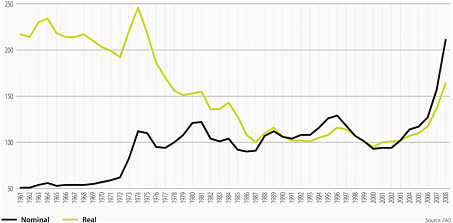
FIGURE 5.1 Extended Annual FAO Food Price Index, 1961-2008 (1998-2000 = 100). The green line traces real value, which adjusts for inflation, while the black line traces nominal value, which reflects the actual price in each year. Note the sharp rise that begins in 2006; the average growth rate over the 2000-2005 period was 1.3 percent per year, but has jumped to 15 percent since 2006. A key question for the future concerns whether the upward trend will continue, and to what effect. SOURCE: FAO (2008).
ences in food availability and consumption represent a significant societal challenge—condemning millions in some places to persistent hunger, if not death, and fostering instability. In the coming years, cultivation on prime agricultural lands will almost certainly intensify worldwide, and marginal lands will increasingly be taken out of production (Turner, 2001). This process is already beginning in the high-income countries, often in situations where critical resources (such as water from aquifers) have been depleted. Where agricultural production continues on marginal lands, it is often supported by subsidies. Intensified production relies on significant fossil fuel and chemical inputs, as well as irrigation. The overall reduction in and intensification of agricultural lands are not necessarily being repeated in lower income countries in the tropics. There, life-sustaining, yet economically marginal farming continues to expand into the forest frontier, often following roads built for timber and other extractive industries, or corporate and large-scale agriculture seeking to capture inexpensive land (Lambin and Geist, 2006). There are no clear indications that this process will cease in the near future, although it will surely vary by region.
Globally, farmland is being lost to urbanization at unprecedented rates. The expansion of cities (see Chapter 4) is converting agricultural land to nonfarm uses (Gardner, 1997; Imhoff et al., 2004a). Between 1987 and 1992, China lost more than 1 million hectares of farmland to urbanization (Seto and Kaufmann, 2003). There is growing concern that urbanization rates in the 21st century will place significant new pressure on arable land, and that the loss of farmland to urbanization will be a threat to yield and total output (Imhoff et al., 2004a). Thus, we need to better understand the links between demographic and economic circumstances on the one hand, and agricultural production and consumption on the other.
The explosive growth in industrialized or high-input agriculture raises a set of important questions. Technologically intensive agriculture uses large amounts of fossil fuel energy, water, inorganic fertilizers, and pesticides to produce large quantities of a single crop (monocultures) or to raise livestock. The mixed history of industrialized, high-input agriculture helps explain why there was much debate about how to sustainably address the 2008 global food crisis. Many of the world’s most influential policy voices called for a renewed emphasis on food production, and particularly on increased yields through biotechnology and new green revolution approaches (e.g., Borlaug, 1995, 2000;
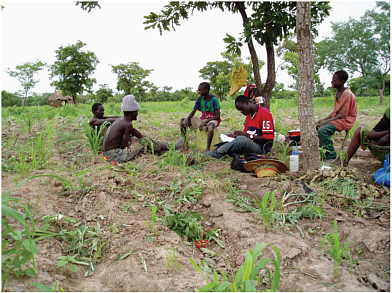
FIGURE 5.2 Smallhold farm family on break in southern Mali. The pictured field has a mix of crops (sorghum and cowpeas) and trees (shea nut or Butyrospermum parkii), an illustration of the polycropping strategies. SOURCE: William Moseley, used with permission.
Sachs, 2006; Annan, 2007). Others saw green revolution approaches to solving the world’s food problems as flawed because of associated environmental and social consequences (Yapa, 1996; Das, 2001; Carney, 2008). Better understanding of the issues relevant to this debate is critical to addressing the challenge of how to sustainably feed a growing population.
ROLE OF THE GEOGRAPHICAL SCIENCES
Geographical scientists studying food production and consumption take an approach that is distinctive in several ways.2 First, they examine food production and consumption as a form of human–environmental interaction, an approach distinguished by its treatment of both the social and biophysical sides of this coupled dynamic and by the use of the suite of systems that facilitate the acquisition, storage, and analysis of geographical information discussed in Part I. The interdisciplinary subfield of land-change science has been at the forefront of this effort over the past decade (Gutman et al., 2004; Lambin and Geist, 2006; Turner et al., 2007; Turner and Robbins, 2008). Studies of indigenous or traditional agricultural systems (e.g., Grossman, 1981; Richards, 1985; Bebbington, 1991; Grigg, 1995; Mortimore and Adams, 2001) have advanced understanding of farming in the tropics by, for example, documenting the know-how and techniques of smallhold farmers who often used mixed or poly-cropping strategies that capitalize on agroecological relationships (between crops, crops and trees, and crops and insects; Figure 5.2). These indigenous approaches, once considered backward and primitive, are now acknowledged to be more efficient from an energy input-output standpoint under most circumstances (Bayliss-Smith, 1982; Pimentel et al., 2002) and have inspired new strategies within the organic farming movement that are celebrated in such popular works as Michael Pollan’s The Omnivore’s Dilemma (2006) or Barbara Kingsolver’s Animal, Vegetable, Miracle (2007).
Geographical scientists also have contributed to debates concerning the question of whether food production is capable of keeping up with population growth. The original work of Malthus (1798/1987), and then subsequent work by neo-Malthusians (such as Ehrlich, 1968), suggested that population growth would eventually outstrip food supply. Boserup (1965) advanced an alternative proposition, largely based on historical research, suggesting that growing population density often led to the intensification of agriculture and rising output through increasing labor inputs and infrastructure investments (e.g., terracing, irrigation). The desire to test these two competing hypotheses (Malthusian and Boserupian) in the contemporary era led geographical scientists to turn to the “natural experiment” approach, exploring the relationship between population and agricultural change in many different locations.
Mortimore and Tiffen (1995) undertook an intensive study in one location—Machakos, Kenya—which showed that increasingly dense populations were able to produce more and more food. In contrast, Turner and colleagues (1993) examined several cases across Africa with differing outcomes, as did Turner and Shajaat Ali (1996) in several villages across Bangladesh, or Laney (2002) in Madagascar. These studies point to the conditions under which increasing population can lead to agricultural intensification and increased output, as opposed to declining productivity and environmental degradation.
Second, geographical scientists use spatial analysis to study food production and consumption. They are attuned to the ways in which food production and consumption systems are often connected across places and regions via processes operating at different spatial scales. A study by von Thünen (1826/1966) of the 19th-century spatial pattern of food production outside German cities showed that the type of crop a farmer (wanting to maximize his profit) would choose to cultivate at any location, and the intensity with which it would be cultivated, was a function of the distance of the location from the city, the cost of transportation, and the perishability of the crop. Newer approaches that are attuned to these relationships have provided insight into the changing character of agricultural systems, hunger and famine, and consumption. Geographic information systems can be used to organize and synthesize data on climate, hydrology, soils, and crop yield, which can facilitate the management of food production in water-scarce regions. Remote sensing can be useful in planning for arable land extension and detecting the incipient stages of water scarcity and its impacts on crop yield. Looking forward, such techniques can help pave the way to the development of a new and integrative science of dryland management (Reynolds et al., 2008), which can be of use to policy makers, resource managers, and farmers facing the challenge of water scarcity.
Third, the work of geographical scientists has also provoked researchers to think more broadly about food supply and agricultural questions by bringing scale (and the connections between regions and places) into the analysis. The historical and comparative work of Carney (2001), for example, has shown how the agricultural know-how of West African slaves—not Europeans—was largely responsible for the development of a rice export economy in the American Southeast in the 17th and 18th centuries. Work of this sort demonstrates that seemingly local questions concerning agricultural change, or the ability of a population to feed itself, need to be set within a much broader web of relationships in space and time. A multiscalar approach is also vital to understanding contemporary and future food challenges. Diana Liverman, for example, has demonstrated how we can better understand the impact of global climate change and globalization on small farmers in Mexico (see Box 5.1).
The impacts of the steep rise in food prices during spring and summer 2008 hit hardest in urban West Africa. Many pointed to declining per capita food production in Africa as the source of the problem (Sachs, 2006; Annan, 2007). Others saw the connections between different regional food markets as being important as well (Moseley et al., 2010). As of the late 1970s, those living in urban West Africa still ate largely locally or regionally produced grains. By 2008 they were purchasing rice from Thailand or Malaysia, having developed a taste over several years for this relatively cheap import (Pearson, 1981; Carney, 2008; Seck, 2008). A regional food problem developed when these imported grains skyrocketed in price. This problem was caused by a number of factors operating at multiple scales and in several locations across the world, including shifts in the global market, agricultural practices,
|
BOX 5.1 Farmers Adapting to Changing Climate and Political Economy in Mexico Diana Liverman exemplifies several aspects of what geographical scientists have to offer to agricultural questions. Trained in both human and physical geography, Liverman has a long-standing interest in the human dimensions of global change (Liverman, 1998, 1999, 2008). Born in Ghana, and educated in England, Canada, and the United States, she was interested initially in the potential and limitations of predicting climate impacts using both crop simulation models and the first generation of global models that allowed for the assessment of climate change impacts. However, as it became clear to her that the scientific community’s knowledge of climate impacts in the developing world was insufficient for modeling, and that some of the most interesting questions were about how people and places became vulnerable to climate change, much of her work came to focus on the vulnerability to drought of farmers in the drylands of Mexico. By studying small and large farmers in the Sonora and Puebla states of Mexico, Liverman was able to quantify the impacts of land tenure and technology on vulnerability to drought. Here she found that those with access to irrigation have lower drought-related crop losses, and farmers on communally held ejido land are more at risk from drought than large private farms (Liverman, 1990,1999). Of course technology and land tenure are correlated in Mexico, because the large private farms are more likely to have irrigation than communal (or ejido) land. Furthermore, private landowners are more likely to have access to higher quality land, which has a bearing on crop losses during low-rainfall years. Liverman’s work in this area was important because it showed that patterns of crop loss could depart from levels of rainfall because of differences in agricultural vulnerability between households. She also has considered the influence of politics and economics on farming and ranching decisions in the face of changing climatic conditions (Vasquez-Leon and Liverman, 2004; Liverman and Vilas, 2006). |
and urbanization. Research into the kinds of questions outlined below could enhance our understanding of what happened in 2008 and related food challenges.
RESEARCH SUBQUESTIONS
Which farming systems will be most and least able to cope with climate change?
One of the great challenges of the 21st century is to meet the growing demand for food even as climate change is affecting agricultural and farming systems (Easterling, 2007). Climate models are consistent in predicting drier conditions over much of the subtropics and adjacent dryland areas by the mid to late 21st century (Wang, 2005; Seager et al., 2007; Bates et al., 2008). The drying is driven by increased temperatures and resulting evaporation, and by decreased precipitation. Climate models have been particularly consistent in projecting drier soil conditions in southwestern North America to Central America, the circum-Mediterranean and Middle East, Australia, and southern Africa (Wang, 2005). Although climate model results are coalescing on a consistent picture of drier conditions in the subtropics and adjacent dryland regions in both the Northern and Southern Hemispheres, the degree of increased aridity may also be influenced by changes in ocean circulation that are still poorly resolved in current climate models (Vecchi et al., 2008). Looking forward, spatially explicit climate research, extending from global to regional climate models, could help refine projections of which farming systems will be most and least able to cope with climate change by predicting where aridity will increase.
Understanding which farming systems will be most affected by environmental change also requires careful assessment of the location and fragility of current systems. We know that dryland farming areas, where some 2 billion people currently live, are the most sensitive to changes in precipitation (Oki and Kanae, 2006). These sensitive areas are concentrated in the subtropics and adjacent regions—particularly Sub-Saharan Africa (Sullivan et al., 2003)—but more research is needed to understand how they would be influenced by longer term drying trends. As noted by Kates (2000), some low-income countries may be able and inclined to address climate change and protect agricultural productions via dams and irrigation schemes, yet these schemes often have serious consequences for the poorest farmers who are likely to lose land or have limited access to the water they provide (Gellert and Lynch, 2003). Livelihood systems (broader systems encompassing farming and nonfarming activities) developed in dryland regions with highly variable rainfall tend to exhibit the strategies of risk-averse smallhold farmers, such as diverse cropping strategies, grain storage, the deliberate straddling of multiple microenvironments, and the seasonal migration of certain family members (Mortimore, 1989; Davies, 1996; Moseley, 2001).
A key research question is whether these systems can accommodate more drastic levels of change. Furthermore, many systems are now more vulnerable to environmental variability because they have changed in order to meet regional and global market demands for certain products as a result of increased globalization, leading to a potential double exposure to market and climate change (O’Brien and Leichenko, 2003). As such, geographical assessments of vulnerability of the type described in Chapter 3 will also be important to the effort to understand the adaptability of different farming systems.
How do changing consumption patterns, regulations, and costs in one place affect farming systems, land use, and food security in other places?
Food networks are interconnected, spanning world regions, as well as urban and rural domains. The past two decades have been dominated by continued protection of agricultural producers in high-income countries and market-oriented reforms in low-income states. The persistence of protection for farmers in the high-in-come countries reflects the power of the farm lobby and associated input producers (Watts, 2000). Increasing free trade in food crops has often led to the demise of smallhold producers in low-income countries, as well as the consolidation of farms (Fitting, 2006). There is also evidence that certain World Trade Organization, FAO, and World Bank policies have undermined local control and human rights in some places (Pogge, 2008). Research from a geographical science perspective, taking into account the linkages between places and policies, can yield a better understanding of the implications of these changes for food security and farming systems, including who is affected by these practices, where they are located, and how they are affected. Similarly, a better understanding of the food security implications of more robust local and national food systems is critical.
We also need to understand the spatial and functional impacts of land-use changes brought about by local and regional factors. Blaikie, who undertook groundbreaking research on the topic, showed how land degradation and soil erosion in Nepal was not just a local issue, but a phenomenon influenced by broader social and economic processes (Blaikie, 1985; Blaikie and Brookfield, 1987). This research area needs to be continually updated as the nature of the global food economy changes. As discussed previously, urban expansion has eroded the availability of good agricultural land in many places, but the impacts of this process on food production are poorly understood. National and subnational geographically explicit agricultural data (including yield trends) could be combined with satellite imagery to provide assessments of the quality and availability of farmland. Scenarios of urban expansion can be coupled with maps of cultivated land to identify hotspots of farmland threatened by urban expansion. Urbanization in one area may also be affected by distant points of consumption, and can affect agricultural systems in other parts of the globe. For example, Asian urbanization and industrialization changes local diets and influences the demand for food and raw materials produced in places as far away as Africa (Muldavin, 2007). South Korea recently acquired plantations in Madagascar to produce food for its people (Walt, 2008).
Energy costs are an important factor in food production systems. Bayliss-Smith (1982) was one of the first scientists to examine food production systems around the world from an energy efficiency standpoint. Although industrialized agriculture produces higher yields, it is less efficient in terms of the amount of energy inputs required to produce a unit of output. In the United States it takes about 2.2 kcal of fossil fuel energy, on average, to produce 1 kcal of plant protein (Pimentel et al., 2002). Furthermore, food producers increasingly ship their products long distances to reach intended customers. According to the U.S. Department of Agriculture (Regmi, 2001), the United States imported 11.6 percent of its vegetables and 38.9 percent of its fruit in 2001 (up from 4.1 percent and 20.8 percent in 1970). The emergence of a more globalized food system—a phenomenon driven by cheap fossil fuel–based transportation for nearly two decades (1985 to 2005)—may change, however, if transportation costs climb (Rohter, 2008). The notion of virtual water and energy in food exports and imports (i.e., the amount of water or energy expended to produce an agricultural crop) is also important for understanding indirect exchange of these resources associated with agricultural trade (Allen, 2000; Turton, 2000).
Both spatial and functional interconnections will affect the evolving global food picture. Many of the
future research questions in this vein are inherently geographical, and given increasing food prices, growing landlessness, urbanization, and rising (food-price related) civil unrest, research at the human–environment interface will become more pressing.
Where are genetically modified crops (GMCs) being most rapidly adopted and with what consequences for food supplies and rural livelihoods?
Even though multiple factors contributed to the food crisis of 2008 (including use of grain crops for ethanol production, financial speculation, increasing meat consumption in the low-income states, rising energy prices, and a growing population), many of the proposals for avoiding another food crisis focus on technological fixes, particularly the expanded use of GMCs. GMCs often elicit a bifurcated response—they are either cast as beneficial to both the environment and food production (Federoff and Brown, 2004) or criticized for their corporate origin and control, and their potential negative effects on agriculture.3 Evaluating these different claims requires geographically grounded empirical studies at multiple scales (household, village, region) in regions where GMCs have been introduced.
While the green revolution approach (involving the use of hybrid seeds, irrigation, fertilizers, and pesticides in low-income countries) increased yields, it also created a host of environmental and social problems. Proponents of GMCs argue that these crops not only increase yields, but also they avoid many of the environmental problems associated with the green revolution approach, including pesticide and fertilizer runoff. Critics of GMCs are concerned about corporate control of seeds, the access of the poor to GMC packages, and genetic contamination of wild species (McAfee, 2003; Roff, 2008; Sitko, 2008). Early studies in South Africa indicate that genetically modified cotton was initially adopted with great success, but that later most farmers were abandoning the crop because agricultural extension services were inadequate and net profits were less than those obtained with conventional cotton (Gouse et al., 2008). In 2008, Burkina Faso became the second African state to openly adopt GMCs, essentially the same genetically modified cotton that failed in South Africa (Dowd, 2008).
Charting the social and environmental consequences of such experiments in coming years could reveal the positive and negative impacts of GMC adoption in different regions. Studies integrating the physical and human dimensions are particularly needed, as one of the critical underresearched issues concerns the changing biogeography of genetic contamination (Parker and Markwith, 2007). Finally, the GMC approach needs to be compared to other agricultural methods, such as the system of rice intensification, which was initially developed in Madagascar and is now being tested in Asia and West Africa (Broad, 2008).
SUMMARY
Sustainably feeding Earth’s population over the coming decade and beyond requires better understanding of how food systems interact with environmental change, how they are connected across regions, and how they are influenced by changing economic, political, and technological circumstances. The geographical sciences’ analysis of food production and consumption, when coupled with recent conceptual and methodological advances, can provide new insights into this critically important research arena.


