
–B–
Internet Response Options in Selected Population Censuses
In this appendix, we briefly describe provisions for an online response option in past (and upcoming) censuses of population. We begin by describing the use of online response in the 2000 U.S. census and subsequent tests before describing experiences in other countries.
B–1
THE INTERNET AND THE U.S. CENSUS
The 2000 Census
The Internet response option was implemented in the 2000 census without the benefit of prior large-scale testing. Online response was considered for the 1998 dress rehearsal but ultimately abandoned “due to security concerns” but was revived in late 1998 by a Commerce Department directive (Whitworth, 2002:1). Due to insufficient time, online response was restricted to the 2000 census short-form questionnaire only and a single language (English). Programming of the form was kept as simple as possible for compatibility with different web browsers; JavaScript was avoided because it was deemed “unstable in some environments” (Whitworth, 2002:1). As a consequence, the online form was essentially presented as a single screen page rather than walking through separate questions in different web pages; hence, real-time editing and confirmation steps were not used, nor were skip patterns to move respondents through the questionnaire.
To access the electronic questionnaire, respondents needed to have the paper questionnaire that they received in the mail in hand. Following a link from the main census web page, they were asked to enter the 22-digit Census ID printed on the paper form’s label (thus ensuring a linkage to a specific mailing address). If the 22-digit ID was confirmed as valid, then the questionnaire appeared onscreen. No publicity was given to the Internet response option.
During the time span between the opening of the online questionnaire site and the cutoff for nonresponse follow-up workload (March 3 to April 18, 2000), 89,123 submissions of Census ID numbers were made on the web site. Of these (Whitworth, 2002:5):
-
74,197 (83.3 percent) were valid Census IDs; however, only 71,333 resulted in a questionnaire submission. The other 2,864 may have been instances in which a respondent made an error entering the ID but inadvertently entered a valid number; they could have then broken off the interview and subsequently rekeyed their ID correctly. After some reconciling for unique address identifications, questionnaire data from 66,163 of the 71,133 submissions were ultimately sent on for processing; about 1,500 online submissions are unaccounted for in the Bureau’s tallies, with “no apparent explanations for this discrepancy” (Whitworth, 2002:6).
-
14,926 (16.7 percent) attempts to enter a Census ID were failures. That this proportion matches the approximate 1-in-6 coverage of the census long-form sample is perhaps telling: “since [the Census Bureau] did not advertise the Internet response option, respondents would have also had no idea that long-form households were ineligible.” Hence, “it is quite possible that many, if not most, of the submission failures” were attempts to use the Internet to answer a long-form questionnaire.
Although the vast majority of the Internet responses (98.4 percent) were each associated with only one ID number, there were some repeats of ID numbers: specifically, 1,090 ID numbers had to account for 2,853 responses. Most of these were incidents of 2 or 3 entries per ID and involved a pure replication of the same data; most likely, this was caused by a respondent clicking on the “Submit” button multiple times waiting for the browser page to load. The extreme case was a single ID associated with 17 entries; “many of these were on different days, and many with different data” (Whitworth, 2002:8–9). After final processing, 63,053 households representing 169,257 persons were included in the census through the Internet form.
The Census Bureau evaluation of the Internet response option in 2000 (Whitworth, 2002:17) deemed it “an operational success” and argued for further research:
Obviously, the Internet is here to stay. The software and hardware developed for this program could have handled tens of millions of records instead of the tens of thousands it did handle. It is our recommendation that future research focus not necessarily on how to implement the form itself, but how to promulgate the Internet form as an option and convince the public that there is sufficient data security. Future research should also focus on how to use it as a tool to increase data quality by implementing real-time data feedback and analysis.
Response Mode and Incentive Experiment
Conducted as an experiment in the 2000 census, the Response Mode and Incentive Experiment (RMIE) gauged response rates to the 2000 census questionnaire by paper, interactive voice response (IVR, a fully automated telephone interview), or the Internet. In addition, the test considered whether the offer of an incentive (specifically, a 30-minute telephone calling card) influenced the response rates. The test (including a print of the Internet census form) is documented by Caspar (2003, 2004). The Internet usage survey component of the RMIE yielded relatively small numbers of online returns (with or without the incentive of a calling card), and some respondents noted a preference for paper. However, Caspar (2003:21) argued for further work on an online response option:
Based on conservative assumptions and the data from RMIE, one might save between one and six million dollars in postage costs alone if between three percent and 15 percent of the sample uses the web rather than the mail survey…. This savings would more than offset the costs required to design, develop and maintain the web survey. Of course, the web survey would also produce savings related to reduced processing (receipt and scanning). Given this crude calculation, it is anticipated that the Internet would be cost-effective even if a relatively small proportion of respondents used it.
The 2003 and 2005 Tests
The 2003 National Census Test was designed as a mailout-only test: no fieldwork for nonresponse follow-up was planned or conducted. The mail sample was divided into 16 panels, 7 of which tested revisions of the census questions on race and Hispanic origin and 8 of which included different packages of response modes and contact strategies (e.g., sending a replacement questionnaire or a telephone reminder call, responses by telephone or the Internet). The Census Bureau concluded that offering the option of responding by telephone or the Internet along with the mailout of a paper questionnaire neither increased nor decreased the response rate. However, attempts to “force” respondents to use either of the electronic
response modes by not including a paper questionnaire resulted in lower response rates. In terms of data quality, item nonresponse rates were significantly lower for the Internet responses than for paper returns for almost all items.1
A second mailout-only National Census Test in 2005 made another attempt to implement the telephone and Internet response modes, having made interface improvements in both. Illustrative screens—of the respondent log-in section and the race question—from the 2005 online instrument are shown in Figure B-1. Apparently, this test performed comparably to the options used in 2003 and did not yield major gains in response.
In November 2000–January 2001, the Census Bureau also conducted a test using 10,000 addresses on an Internet response option for the American Community Survey (ACS), the replacement for the traditional census long-form questionnaire in 2010. The recent report Using the American Community Survey: Benefits and Challenges describes ACS methodology in greater detail (National Research Council, 2007). In brief, the sample of households selected in one month is first contacted by mail and asked to return their questionnaire by mail. If they do not respond by mail, a telephone interview is attempted in the second month; if that fails, then enumerators attempt a personal visit in the third month. The hope of an Internet response option would be to supplement mail responses in the first months so that the follow-up steps in months 2–3 need not occur. Griffin et al. (2001) found that only about 2 percent of the respondents in the experimental group used the Internet response option (compared with about 36 percent by mail). The data showed some attempts to access or partially fill out the questionnaire, but they did not result in a full online form being submitted and were not enough to explain the low response rate. Although the response was low, the quality of the resulting data (in terms of whether subsequent editing was required) was found to be slightly better in the Internet responses than the mail responses.
Decision for 2010
An initial planning framework for the 2010 census (Angueira, 2003:3) noted among the major improvements planned for 2010 that “expanded use of Internet and telephone systems (using Interactive Voice Response) will provide new opportunities for using technology to make it easier for people to complete their questionnaire.” The strategy document elaborated (Angueira, 2003:5–6):
Fundamental to the 2010 census is expanding the ways people can be counted. Following a widespread awareness campaign, households will
|
1 |
The 2003 test was summarized (albeit without specific numbers) at http://www.census.gov/procur/www/2010dris/web-briefing/dris-tel-int.html. |
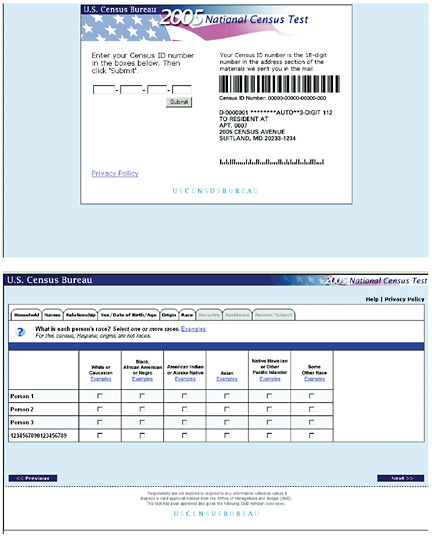
Figure B-1 Housing Unit ID log-in screen and race response screen, Internet questionnaire, 2005 census test
SOURCE: http://www.census.gov/procur/www/2010dris/omb-person-based-screens.doc.
receive an advance letter in the mail before April 1, 2010. The letter will tell them about the census and the ways they can participate, using English or other language methods…. We will also use technology to build on this strategy by combining these mailings with Internet and telephone contacts. These technologies will provide respondents with additional options for receiving and submitting their census questionnaires. Our expectation is that we can increase the response rate even further by developing and implementing the optimal mix of contacts and response options. By taking advantage of the Internet and the telephone we can significantly increase the number of forms that move directly into data capture without needing to be scanned in a data capture center….
Despite all efforts to encourage everyone to provide information, we project that we will not obtain mail, Internet or telephone IVR responses from as many as 31% of the addresses to which we deliver a questionnaire. Many of these addresses will be vacant or nonexistent, but many will be occupied. Therefore, we must still conduct a nonresponse follow-up operation….
Indeed, the initial scope of work for the Census Bureau’s Decennial Response Integrated System (DRIS) for 2010 included requirements to facilitate census responses by three modes: paper, telephone, and Internet. The first two objectives suggested for the DRIS solution were to “Enable the Public” to “Obtain assistance or request an English or foreign language questionnaire or language guide using the telephone or Internet” and “Complete their 2008 Dress Rehearsal and 2010 Census questionnaire via the telephone, Internet and paper.”2 The DRIS contract was awarded to Lockheed Martin in October 2005.
However, the perceived low Internet response rates in the 2003 and the 2005 tests—combined with concern over inherent risks and the lack of guaranteed major cost savings—led the Census Bureau to reverse course. The Bureau’s decision not to pursue online enumeration was formalized in a July 2006 decision memorandum. Earlier, on June 6, Census Director Louis Kincannon (2006) offered the following argument in testifying before a U.S. Senate subcommittee:
We have also considered other data collection methods, including Internet data collection. Based on our research, as well as our own experience and knowledge of the experiences of other countries, we do not believe Internet data collection would significantly improve the overall response rate or reduce field data collection. The Census Bureau offers an electronic response option for the Economic Census and other economic surveys and we generally obtain high response rates. It is altogether different, however, when we consider household and population surveys and censuses. The 2003 and 2005 Census Tests offered an In-
ternet response option, and in both cases, the response rates were low, and offering an internet response option did not increase the overall response rate. We have also consulted the statistical offices of Australia, Canada, and New Zealand. Each of these countries utilized the Internet in their most recent censuses. The Internet response rate ranged from 7 to 15 percent. Each of the statistical offices indicated that it was not possible to accurately anticipate the response rate, and that ultimately using the Internet did not affect the overall response rate. Anticipating the response rate has important operational considerations. Because they were unable to accurately anticipate the Internet response rate, the other countries were unable to reduce the paper data capture operations out of concern they would not have the capacity to fully process the census responses. This would be true for the Census Bureau as well. Moreover, the Internet response option did not reduce the overall cost of data collection, and the cost for some specific activities, such as security and server capacity, increased.
We have seriously considered the lessons our colleagues have learned. We are also concerned that utilizing the Internet could jeopardize other planned improvements. At this point in the decade, efforts to develop an Internet response option would divert attention and resources from tested and planned improvements such as the second mailing—which we know can increase the overall response rate by several percentage points. It is also important to keep in mind that the 2010 Census utilizes only the short form. There are very few questions in this form, and most can be answered by checking a box.
The major risks perceived by the Census Bureau—summarized in a commissioned report from the MITRE Corporation (2007)—are as follows:3
-
Above all, the Census Bureau is concerned that something gone awry in an Internet response option—publicity of the census site being hacked or establishment of a “phishing” site appearing to be related to the census, for example—could cause voluntary response to the census to decline. This would tax nonresponse follow-up capabilities and raise the overall cost of the census.
-
The Bureau’s DRIS contractor concluded that it could not provide an Internet response facility in time for testing in the 2008 dress rehearsal, so that it would have to go into the main 2010 census without a large-scale test (as happened with the 2000 census online response option).
|
3 |
The MITRE report was circulated on some technology blogs in July 2007, following a Senate subcommittee hearing at which the Census Bureau restated its intent not to pursue online enumeration. At the same hearing, Sen. Tom Coburn (R-OK) issued a public “Census Challenge” for ideas to use technology to reduce the costs of the 2010 census. See, e.g., http://www.fcw.com/blogs/archives/editor/2007/07/the\_census\_inte.asp, which contained a link to the MITRE report and references an interview with a former Census Bureau official. |
-
A problem faced by any Internet site is a “denial of service” attack: deliberate bombardment with hits in order to shut down a site’s operations.
(The MITRE evaluation also expresses concern that census data might be captured from individuals’ computers through the use of spyware.)
In evaluating the Census Bureau’s work on group quarters enumeration, the U.S. Department of Commerce, Office of Inspector General (2006:20–21) acknowledged the Bureau’s decision not to use the Internet for main data collection in 2010. However, the review strongly suggested that the Bureau consider use of Internet methods for one traditionally hard-to-count population: college students. One reason for the selection of parts of Travis County, Texas, as a census test site in 2006 was a large college student population. Yet only 719 college student census report forms were returned during the test while expectations were that more than 6,700 should be found. In the inspector general’s review, this suggested that online response options might appeal to the Internet-savvy college generation. Reacting to this recommendation, the Census Bureau reiterated its opposition to online enumeration generally.
B–2
USE OF THE INTERNET IN FOREIGN CENSUSES
In offering guidance to member countries on the 2010 round of population and housing censuses, the United Nations Economic Commission for Europe (2006) concisely summarized the basic rationale and concerns for permitting an Internet response option; this summary is presented in Box B-1. Stopping short of recommending that countries adopt an online version, the commission observed that online response is becoming an increasingly attractive option.
In this section, we profile the use of the Internet as a response mode in selected censuses around the world, focusing almost exclusively on countries that still perform a traditional census rather than rely on a population register or other methods. Online enumeration has been performed in most of these cases; however, we also describe one census that ruled out Internet enumeration in its most recent census (Japan) and another that has not yet used the Internet in the census or in a major census test but intends to do so (United Kingdom).
One common theme to several of these profiles—particularly Canada, Australia, and New Zealand—is that the drive to allow the Internet as a response option came about through longer standing commitments to making government services electronically accessible. The Canadian “Government On-Line” initiative began in 1999, with the objective of making most government services accessible online by 2004–2005. The Canadian govern-
|
Box B-1 United Nations Economic Commission for Europe Comments on Internet Data Collection in the 2010 Round of Censuses Using the Internet as a collection method means that the census collection methodology will need to be self-enumeration rather than interview based. The Internet option can be incorporated into any of the traditional methods of delivering and collecting census forms (for example drop-off/pick-up, mail-out, mail back). The key factor is managing collection control operations—that is ensuring that every household and individual is counted once and once only. This requires the ability to provide each household and individual with a unique code linked to a geographic location. An added complication for those countries where forms are collected by census enumerators (rather than mailed back) is to have adequate and timely feedback to enumerators so that they can update their own collection control information so that they do not visit households that have already returned forms. The potential level of take-up of an Internet option should be considered by assessing the proportion of the population who can access the internet from home, the proportion who use broadband services and the general use of the Internet for other business purposes (for example on-line banking, filing tax forms, shopping). The use of the Internet is likely to increase the cost of the census, at least initially. As it is not known in advance who is likely to use the Internet, there will be a need to deliver a paper form to every household including those who will subsequently use the Internet. Systems and processes that allow for Internet return of census forms will also need to be developed. These will increase costs. On the other side there are potential savings in data capture costs. However, scanning and Intelligent Character Recognition are in themselves cost efficient. Therefore, savings in data capture costs are likely to be considerable less than the costs of developing and implementing the internet system. Security is an important consideration. Industry standard encryption (SSL128) offers two-way encryption (that is it encrypts data flowing both from and to the user’s computer) and has been accepted by nearly all countries as adequate to protect the census information. Security should be a key consideration in designing the infrastructure. A physically separate infrastructure should be set up to collect the census information. Completed individual census forms should be moved behind firewalls and then into infrastructure that is completely separate from the collection infrastructure. A downloadable on-line form requires much less infrastructure than for forms that are completed on line. However, downloadable forms require a greater level of computer literacy than on-line forms. They will not necessarily work in thousands of different computer configurations and there will be an expectation that the census agency will be able to deal with each individual problem. From the respondents’ point of view, they are much more likely to prefer completing the form on-line. For these reasons it is expected that most countries will adopt on-line completion of census forms. An electronic form offers the possibility of interactive editing to improve response quality that is not possible on a paper form. People using electronic forms have a certain level of expectation that a certain amount of guidance will be offered—at a minimum that they will be sequenced through the form and not asked questions that are not relevant to their situation. How far other editing or on-line coding is built in to the form needs to be carefully considered. Some limited studies indicate that forms returned by the Internet are of higher quality than paper forms. More work is required in this area to determine whether this is a function of the type of people using the Internet or the technology itself. |
|
Providing an Internet option may contribute to improving the quality of the census by making it easier for some hard-to-enumerate groups to respond. Most countries report difficulties in enumerating young adults and people living in secured accommodation where access is restricted. Some people with disabilities will also find it easier to complete an Internet form than a paper form. These groups are also more likely to be using the Internet and, if available, this option should be promoted to these groups as a means of encouraging participation in the census. Provision of sufficient infrastructure provides one of the major challenges for offering an Internet option. The census occurs over a relatively short period of time and affects the whole population of a country, and it is unlikely that the census agency will have adequate infrastructure to cope with the peak demands of a census. It is therefore likely that this component, at least, of the Internet solution will be outsourced. It may be necessary for collection procedures to be modified to constrain demand. For example, requiring people outside predetermined target populations/areas to contact the census agency before they can use the Internet form may be a means of restricting use of the Internet form. Census agencies need to assess how they wish to promote the use of the Internet. Promotion of the Internet option should be determined by the capacity of the service to handle the expected load and should be coordinated with the collection procedures. The public relations strategy will need to encompass assurance about security of information supplied via the Internet. Assuming that the Internet option is targeted to the whole population, the public relations strategy should encompass managing public expectations about the ability to access the site during periods of peak demand. Simple messages advising people to use the internet option at “off peak” times should be prepared and used if necessary on the census internet site itself and through the census telephone inquiry service, radio and print. SOURCE: Excerpted from United Nations Economic Commission for Europe (2006:Paragraphs 119–125). Reprinted with the permission of the United Nations. |
ment also has an initiative to maintain a common visual theme on its websites, and the 2006 census website observed these basic standards (Laroche, 2005). The Government On-Line effort also included study of security and encryption protocols—an infrastructure on which Statistics Canada was able to piggyback. Similarly, the Australian Electronic Transaction Act of 1999 required agencies to permit electronic communications between citizens and the government (Trewin, 2006). In New Zealand, the “e-government strategy” adopted the goal of making the Internet “the dominant means of enabling ready access to government information and services” by mid-2004 (Smith, 2006).
Australia
In 2006 (as in previous years), the Australian quinquennial census was conducted on a drop-off–pick-up basis: enumerators delivered forms on the designated Census Night and returned within the next three weeks to pick
them up. (Respondents were urged to complete the questionnaire on Census Night, as Australia uses a de facto residence concept.) The questionnaire package delivered to households also included a Census Form Number on the printed questionnaire and a 12-digit eCensus Number in a sealed envelope. Both numbers were needed to use the eCensus application on the Internet. The Australian Bureau of Statistics contracted with IBM to develop its eCensus web application and support systems.
Because of the drop-off–pick-up strategy used for the Australian census, designers needed to provide a mechanism for advising field enumerators that questionnaires in their districts had already been returned online, so that they did not need to do a follow-up visit. Ultimately, the Australian Bureau of Statistics (ABS) settled on notification by text message to enumerator cell phones;4 this messaging system was part of a larger communications scheme connecting census field staff, central coordinators, and members of the public (who called with inquiries).
Williams (2006) observes that “the 2006 eCensus system was opened to the public just after 8pm on 27 July, with enumerators due to commence delivery of forms on 28 July. The first eCensus respondent submitted their online form at 20:29 on 27 July.” In total, ABS experienced a estimated 9 percent response rate via the Internet, representing 775,856 household forms; this slightly exceeded the system’s performance in dress rehearsal, in which 7.9 percent of dwellings responded via the Internet. Due to the de facto nature of the census and the encouragement to complete the questionnaire upon receipt, 40.4 percent of all responses received by the Internet came in between 6pm and midnight of the designated Census Night.
Prior to use in 2006, the Internet response option was tested in field tests in 2003 and 2004 and in the 2005 dress rehearsal. Based on the preliminary testing, ABS anticipated—and built its systems to accommodate—a surge of entries on Census Night. Contingency plans, including temporary service interruptions on the eCensus site and public relations messages, were also developed. As it turned out, “the capacity of the system was never really put to the test—with peak load on census night reaching only 15 percent of capacity” (Williams, 2006). ABS also developed contingency plans for malicious denial of service attacks on the census site—deliberate attempts to flood the system in order to shut it down. Mechanisms for monitoring the Internet service providers of incoming log-in attempts were put in place and, “in cases where these attacks could not have been dealt with quickly, public relations messages would have firstly assured the public that their census information is secure and secondly provide information about alternatives
such as delaying use of the eCensus system or using the paper census form.” However, no such denial of service attack was detected.
It is useful to note that Australia is effectively a long-form-only census—using only one questionnaire—rather than a distinction between short- and long-form samples or the 2010 U.S. census short-form-only model.
Canada
The 2006 Canadian census was the first to offer an online response option.5 Every paper questionnaire sent by mail or dropped off by enumerators bore a 15-digit Internet Access Code (five groups of three digits) at the upper right of the questionnaire. A banner instruction immediately before “Step A” of the questionnaire read “COMPLETE YOUR FORM ON-LINE OR ON PAPER,” and the first question advised respondents that they could complete the form online at a website (http://www.census2006.ca) using the Internet Access Code printed on the form.6 A follow-up instruction to that option reminded online respondents, “Do not mail back your paper questionnaire.”
Online response was permitted for both the census short-form (8 questions) and long-form (53 questions) instruments. The online questionnaire could be rendered in either English or French, and the two languages could be toggled back and forth during the course of completing the online form. The Internet form was designed so that “no software trace (footprint) was left on [a respondent’s] computer” once they had submitted it online. However, persons replying to the Canadian long-form questionnaire could indicate that they wished to pause and resume the questionnaire later; they were prompted to create a password and—upon logging back onto the census site—could resume the questionnaire where they left off. If they did not resume the form within some set period of time, though, the partial form was submitted for processing (Statistics Canada, 2007).
Prior to Statistics Canada’s designated cutoff date to begin nonresponse follow-up activities, 22 percent of returned questionnaires had been returned online; overall, by the end of August 2006, the online response rate
stood at 18.5 percent. Large households (5 or more people) were more likely to invoke the online option (26 percent) than smaller households, including single-member households (of which only 13.5 percent returned the form online). Online response rates did not seem to vary by form type (short or long form), but did vary by province: Alberta experienced the highest online response rate (21.4 percent) and the Northwest Territories and Nunavut—both of which are principally enumerated by personal visit rather than mail—the lowest (13.6 and 0.0 percent, respectively).
The 18.5 percent overall online response rate was consistent with expectations developed based on a 2004 census test using an Internet response option in parts of four provinces, as well as an Internet response experiment conducted as part of the 2001 census. Based on these pretests, Statistics Canada anticipated a 20 percent Internet share in 2006. Significantly, the 2004 test also led Statistics Canada to expect—and plan for—temporal patterns in questionnaire response. Like the U.S. census, Canadian census forms are delivered a few weeks before a designated reference date (Census Day); in the case of the 2006 Canadian census, Census Day was May 16. Based on the testing, Statistics Canada anticipated an early peak in online returns upon the first mailout in early March, with declining amounts until Census Day itself, at which point heightened publicity could be expected to create another response spike. Consistent with expectations, about 15 percent of responses received via the Internet came in on May 16 itself; system managers were able to devise a “graceful deferral” system on Census Day itself to limit the load on census servers.
In terms of data quality, Statistics Canada determined that Internet questionnaires produced much lower item nonresponse rates than did paper questionnaire responses: item nonresponse for paper questionnaires was 102 times higher than Internet questionnaires for short-form responses and 10 times higher for long-form responses. It was also determined that the Internet responses had lower failure rates during basic data editing than the paper forms (Duquet and Gilmour, 2007). In part, this may be due to the use of data confirmation steps that are not possible on a paper form. The Internet short-form questionnaire (as well as computer-assisted forms used in nonresponse follow-up) prompted respondents to confirm the age of household members based on what had already been entered as their dates of birth (rather than answer both questions separately and potentially have a mismatch). The section of the Internet long-form questionnaire on household income also compiled the answers that had already been collected and presented them to the respondents for review and—if necessary—correction.7 Use of the Internet option may also have saved costs in nonresponse follow-
|
7 |
These editing steps are described in Statistics Canada summary of changes in the 2006 census, available at http://www.statcan.ca/english/sdds/document/3901_D17_T9_V1_E.pdf. |
up due to the inherent limitation of space on the paper form: the version of the Internet instrument tested in 2004 permitted listings of up to 36 people, compared with the paper form’s limit of information for 6 household members and names only for an additional 4 persons (Laroche, 2005).
During the conduct of the 2006 census, Statistics Canada also performed an experiment on targeting the Internet response option to particularly receptive audiences. This study—somewhat similar to the U.S. census tests in 2003 and 2005—was intended to suggest whether households “in geographic areas with a very high Internet penetration rate” might best—and less expensively—be contacted with only a letter and an Internet Access Code (but no questionnaire). As summarized by Statistics Canada (2007:12):
A model was developed to identify a priori areas that include a significant number of dwellings likely to answer the Census online. Households in this study, called the Push Strategy, received only a letter instead of a paper questionnaire. These households were asked to complete their questionnaire online. The letter also included a 1-800 telephone number, which respondents could call for information about the study or to request a paper questionnaire. A preliminary sample of 40,000 households in mail-out areas was selected for this study. This sample was split randomly into two groups of 20,000 households each in order to create a control group [which received a paper questionnaire]…. The method was quite effective since the Internet response rate of the Push sample was 2.6 times more than the control group and 3.4 times more than the general population.
The Internet questionnaire used in the 2004 Canadian census test differed significantly from its paper counterpart in its approach to obtaining the basic resident count at a household. The paper questionnaire presents respondents with a set of detailed instructions of who should and should not be included in a household count and then asks for a roster of names. However, the Internet version asked respondents to complete a roster first and then used three follow-up questions—based on the instructions from the paper form—to guide respondents through the process of excluding temporary residents or foreign visitors from the final roster (Larouche, 2005). Whether this feature was also implemented in the final 2006 census Internet instrument is unclear.
Deemed a success in 2006, the online response option is slated for use in the 2011 Canadian census, with the hope of boosting online response to as much as 40 percent. Though definitely not a set policy, Duquet and Gilmour (2007) suggest Statistics Canada’s eventual vision for Internet collection in the census, in which an invitation to complete the census online (presumably with an Internet Access Code or the like) and in which a paper questionnaire is mailed only if the household specifically requests one or fails to respond to the initial invitation. Toward that end, Statistics Canada (2007) suggests that
it may use its Push Strategy—tested in 2006—on a somewhat larger basis in 2011.
Japan
Alone in these examples—save for the U.S. 2010 census—Japan elected not to allow online response in its 2005 quinquennial census. For 2005, Kurihara (2004) reports that the Japanese Statistics Bureau sought to improve the information technology infrastructure of the census by rebuilding its internal geographic information system, testing the use of optical character recognition (OCR) of handwritten responses, and redesigning the user interface to obtain and work with small-area census data.8
New Zealand
Like the Australian census, the New Zealand quinquennial census is collected primarily by enumerators dropping off questionnaires and returning at a future date to collect them. Since 1996, New Zealand census questionnaires have been made available in an English-only or bilingual (English/Maori) version, the latter of which uses a “swim-lane” design that is a model for the bilingual English/Spanish form the Census Bureau plans to use in some areas in 2010. For 2006, to better meet perceived user needs, Statistics New Zealand planned an Internet response. However, it purposely did so without “attempt[ing] to leverage efficiency gains in any of the traditional census processes” or forecasting a desired Internet response rate target: plans were made to complete the census using traditional methods, and such responses by the Internet as were completed were deemed “a longer-term investment in improving participation” in later censuses (Smith, 2006). Furthermore, “it was recognized that there would not be financial savings in its implementation in the 2006 Census” (Statistics New Zealand, 2007).
In implementing the Internet response option, Statistics New Zealand (2007) decided not to aggressively promote the option. Instead, the agency chose to rely on limited promotion “through selected high-usage Internet sites only” and—principally—on advocacy from the enumerators assigned to drop off the census forms. As part of their training, census enumerators were
allowed to go through the online response questionnaire themselves; this was deliberately done so that they would be familiar with the requirements and so could accurately inform people in their household workload of the capability to complete the form online. When they visited the households to drop off the questionnaire, they also offered an envelope containing an ePIN identification number in order to use the Internet response option.
The online questionnaire allowed respondents to use either English or Maori. As with the enumerator-dropoff-and-return Australian census, mobile phone text messages were sent to individual enumerators after Internet responses were received, so that those households could be removed from the enumerator’s visit workload.
Statistics New Zealand (2007) concluded that “despite very low promotion … the online option was very successful, not only in terms of the uptake” (7 percent of responses, or about 400,000 forms, via the Internet) “but an almost completely trouble-free operation.” The agency plans to use the Internet response option again—with more active promotion—in 2011.
Prior to implementing the online response option in 2006, the Internet option was included in field tests in March and November 2003 as well as the 2005 dress rehearsal.
Singapore
In 2000, Singapore transitioned from a traditional census model to a register-based approach. The Household Registration Database (HRD) was developed in 1996 from administrative records as well as 1990 census returns. Hence, the 2000 Singapore census became a sample survey, intended to cover 20 percent of the population, to ask for information not included in the basic register data. These data items included relationship between members of a household, religion, and transportation/commute mode. To carry out this smaller scale survey, the Singapore Department of Statistics adopted a multimode approach. Sample households were invited to complete the form online; if they did not do so by a particular cutoff date, then computer-assisted telephone interviewing (CATI) was attempted. Barring that, trained enumerators were sent out to conduct face-to-face interviews with households that were not reached by either electronic means.
As summarized in a discussion paper for a 2003 census conference,9 the online response option required respondents to log in using a user id and password, presumably provided in a mailing or through other contact. Once logged on, “basic data already available in the pre-Census database would be displayed” and “the respondent would then proceed to fill up the rest of the questionnaire on-line.” Provision was made for respondents to pause
the interview, save their results, and return at a later time to complete the questions. “Simple on-line checks were included and respondents would be prompted to re-enter the data if the information is incorrect or inconsistent.”
Ultimately, about 15 percent of the households in the sample completed the 2000 census form online,10 and the multimode approach was considered a success.
Spain
The 2001 Spanish decennial census incorporated two main technological developments in the area of response methodology. One was preprinting of some questionnaire items—including name, sex, birth date, and place of birth—based on entries in Padrón, the Spanish Population Register. Hence, for these questions, respondents confirmed or updated the entries rather than working from purely blank spaces. The second was an Internet response option.
The two technical changes interacted in defining the way respondents were authenticated in order to use the online questionnaire. Those users with no changes to make in the pre-printed Padrón data could enter two personalized “keys” included in the mailing with the census form; alternately, they could access the form if their web browser was equipped with a certain “electronic certificate”—essentially, a digital signature obtained through another agency of the government. Users who wished to update the Padrón information had to have this type of electronic certificate in order to use the Internet form (Moraleda, 2006).
The need for an electronic certificate played some role in dampening the response rate via the Internet. Only 1 percent of households (13,818) completed the form online, of which 29.9 percent authenticated using the certificate. More than this number of households—16,238—attempted to use the Internet census questionnaire to update their Padrón information but gave up because they lacked the requisite certificate (Moraleda, 2006).
The Internet questionnaire application was designed to accommodate completion of the form at multiple sittings: partial information could be saved and then revisited later before submitting a finished questionnaire. The Spanish Internet response option was also available in Spain’s co-official languages as well as English, French, German, and Arabic.
Switzerland
Along with Spain, Switzerland was the other European census to permit online responses as part of its e-Census initiative for the first time in 2001.
Buscher and Stamm (2001:1–2) credited the creation of a government “Service Centre” for managing information technology as a final impetus for allowing online responses—a decision made even though Swiss census officials knew that “only a minority of the Swiss population currently have Internet access.” The Swiss Federal Statistical Office reasoned that “electronic communication options are increasingly expected by potential users” and that the “PR and advertising impact of an Internet solution would be highly beneficial for the Census.” As in the New Zealand experience, the move was also made with gaining experience with new technology as the guiding goal: “the purpose was to see how far using the Internet could boost the efficiency of data entry and data quality while possibly cutting costs.”
Because the Swiss e-Census relied on Service Centre networks, eligibility to file under the e-Census was limited to those communes or regions that had already opted to use the Service Centre equipment; this represented about 90 percent of the total population. Online questionnaires could be administered in German, French, or Italian.
The Swiss online response form was launched on November 27, 2000, and was operated until March 25, 2001; Census Day in the 2000 Swiss census was December 5, 2000. Buscher and Stamm (2001:5) report that “apart from two minor down-times during the first few days of operations, due to high visitor numbers and a server configuration which had not yet been optimized, the e-census ran smoothly, with no security problems throughout the four-month operating period.” In all, 281,000 questionnaires (4.2 percent return rate) were completed via the Internet—just under 90 percent of those received during the first three weeks of operation. However, Swiss census officials also found that the form had a curiosity factor: about 20 percent of hits on the questionnaire site seemed to be “tourists” who “wanted to have a quick look at the e-census without attempting to enter their data.” Demographically, Internet responses from younger middle-class men were more likely than from other groups but not so much so as to suggests “a major ‘digital divide’ in Swiss society” (Buscher and Stamm, 2001:7). About 10 percent of visitors to the site were unable to successfully log in to fill out the data: Buscher and Stamm (2001:6) do not describe the log-in procedure, noting only that “while it guaranteed maximum security, was also fairly complicated.”
United Kingdom
The initial design document for the 2011 decennial census of England and Wales (Office for National Statistics, 2004) signaled the intent to use an online response option. Adding the Internet option is considered a useful step in improving the overall response rate, but the Office for National
Statistics (2004:10) recognizes that the option will not immediately cut the cost of the census:
By increasing the take-up of Internet completion, real cost and time savings could be made by reducing the quantity of paper forms to be captured and processed. Although we would seek to maximize the Internet response in order to realize the potential savings there is no guarantee of success, particularly since among the hard-to-count populations (such as the elderly) there would be significantly lower levels of take-up.
The Office for National Statistics conducted its first major pre-2011 field test in May 2007 with a sample of about 100,000 households. A major focus of the test was to evaluate new residence and national identity questions. However, the 2007 test did not include an Internet response option. A “frequently asked questions” list for the 2007 test posted on the Office for National Statistics website explained that, “as this is a Census Test, resources are limited especially for the large expense to provide a facility to complete the questionnaire online.” Nonetheless, the user was reassured that “it is proposed that a facility to complete the questionnaire online will be available for the Census in 2011.”11


