
8
Preparedness
Lewis Goldfrank, director of Emergency Medicine at Bellevue Hospital Center and New York University Hospitals, chaired the final major session, which examined disaster preparedness. He said that the panelists were a remarkable group of people who have focused their attention on preparing the country for the unknown.
With regard to the earlier workshop discussions, he said there has been an impressive diversity of thought and perspective that he found very helpful. The spirit of advocacy among the participants, he said, had been remarkable, although perhaps somewhat parochial. “I worry that we lack some of the communitarian spirit that Bill Haddon [the first administrator of the National Highway Safety Administration] and David Boyd [administrator of the 1973 Emergency Medical Services (EMS) Act] characterized as appropriate in the 1960s and 1970s.”
“Bill Haddon believed that every patient who presents to an ED [emergency department] is a failure of the public health system, not necessarily a success,” Goldfrank said. “The Haddon Matrix focused us on preventing these occurrences.” Goldfrank added, “Preparedness is thinking about the lives of all people, throughout the cycles of life, every single day, at all times.” He acknowledged that he is probably more interested in the rate of untreated hypertension in the population than the rate of successful revascularization of STEMIs [ST-Segment Elevation Myocardial Infarctions]. “The STEMI case is one person out of how many?” he asked. “And how many of those cases could have been prevented?” Arriving in a catheterization lab could itself be considered a failure, he said.
Goldfrank said that the entire system—public health and health care—
must work together. It’s “all the people all the time—no boundaries. Doctors Without Borders won the Nobel Prize,” he pointed out. “Can we win the Nobel Prize for our health system of preparedness? Probably not today,” he said, “but we can get there with the kind of creativity that everybody has shown.”
He introduced the panelists and said that they bring a range of perspectives to the issue of disaster preparedness, ranging from the White House to the Department of Homeland Security (DHS) to the states.
LINKING DAILY EMERGENCY CARE AND DISASTER PREPAREDNESS
David Marcozzi, emergency physician and director of public health policy for the White House National Security Staff, began by highlighting the fundamental question, “What is regionalization?” He pointed out that the H1N1 virus does not respect state or international borders. He argued that this provides us an opportunity to think about regionalization and system coordination in a way that cuts across geopolitical boundaries. This “makes the lift even heavier,” he said “but I think it’s the right thing to do.”
He recalled being on shift in an emergency department during a relatively small mass-casualty event. A system had been put in place that was supposed to be able to handle the distribution of patients during a disaster. He reported that the personnel on scene did not use the phone number that was provided to them during disaster preparedness planning; instead, responders called the number they used to transport patients on an everyday basis. “That number was posted on everybody’s wall, corkboard, and computer, and was how we do things on a daily basis,” Marcozzi said. Under a dual-use approach, he said, processes would be linked and could be adapted as situations arise.
Second, in defining regionalization, we have to incorporate not only STEMI, stroke, trauma, and pediatric care—and potentially sepsis and other specialty care areas—but also disaster care. This could help shape how we think about disaster paradigms, Marcozzi said.
Third, whatever we put forth with regard to regionalization must be all-inclusive. We should try to get our arms around all the issues—economic, political, operational, legal, and other—that may emerge with regard to acute care and develop systems that address all issues. He noted that the Health Resources and Services Administration (HRSA) trauma program has done some fantastic work. The best practices they developed should be a starting point for the next iteration of regionalization.
The fourth point, Marcozzi said, is that we need to build on the work that has already been done. In addition to the HRSA trauma program,
Marcozzi stated that the Hospital Preparedness Program has had some great successes with health care coalitions, as was recently detailed in a Center for Biosecurity report to the Office of the Assistant Secretary of Planning and Response (ASPR). Also, the DHS Metropolitan Medical Response System (MMRS) program has been able to coordinate public health, medical, police, and fire. Lastly, he said we should incorporate local emergency medical services and EMS mutual aid perspectives and capabilities as we move forward. Influencing and creating synergy with these programs with respect to regionalization will only serve to strengthen this effort.
Finally, Marcozzi said, regionalization provides an opportunity to exercise disaster plans. He referred to this as either the needle in the haystack or the diamond in the coal mine. He noted that we have lots of disaster plans that have not been exercised and we do not have corrective action plans to address gaps. Regionalization provides an opportunity to exercise disaster plans on a regular basis through the daily delivery of acute health care.
REGIONALIZATION AND PREPAREDNESS FOR CATASTROPHIC EVENTS
Jon Krohmer, the principal deputy assistant secretary and deputy chief medical officer in the DHS’s Office of Health Affairs, observed that “it’s interesting when we look at regionalization from a preparedness perspective.” But he cautioned that it’s more than just multiple-casualty events; we really need to look this topic from the perspective of preparedness for catastrophic events. That is the perspective the Department of Homeland Security takes, he said.
Krohmer said that we need to agree to a number of baseline assumptions as we look at regionalization in the context of preparing for catastrophic events. One is, as Marcozzi noted, that we need to build a system of preparedness that is complementary to, and in sync with, day-to-day emergency care. “We can’t build a separate set of capabilities. They have to be based on, and expand upon, what we do for handling situations on a day-to-day basis.”
Two, we should remember that health care response is just one component of a much larger overall response. And three, no single entity—whether it’s an ambulance company, a single hospital, or an integrated health care system—can be the end-all, be-all. “No entity can have all of the resources that are necessary for responding to a catastrophic event,” Krohmer pointed out. That reality, by its nature, supports the need for regionalization and an inclusive system.
Krohmer said that in catastrophic events, patient care changes. On a day-to-day basis, we focus on a single patient and provide them with all the resources that are needed. In catastrophic events, we have to adopt a triage process that means that “the good of the many outweighs the needs of the
few.” In other words, we have to look at patient care in a much different context. Health care providers don’t always understand how things can change in austere or overloaded medical environments.
Krohmer pointed out that “region” could refer to a number of different things. He said, for example, that there are health care regions, emergency management regions, and public health regions. Health care regions have been established essentially by default through natural patient flows. Emergency management regions have been established based on public service considerations, including law enforcement and fire service response. Public health regions have been established based on resources and, to a certain extent, jurisdictional politics. But, he said, “we have to look at a system that brings together all of those various regions.”
All disasters or catastrophic events are local for a period of time and then localities receive mutual aid and other support from state and federal resources, Krohmer said. He pointed out that “the issue of who is in charge comes into play.” He said that while, from a health care perspective, we always assume that the physicians are in charge, “I can tell you … the emergency management folks don’t buy off on that concept at all.” In fact, he said, health care is part of an overall emergency management system, and a minor one at that.
A number of other issues also come into play in a catastrophic event, Krohmer added, such as credentialing. “A wallet card that says, ‘I’m a physician licensed in Michigan and Ohio and Virginia’ doesn’t mean anything if you show up in Louisiana and want to volunteer to help.” Appropriate credentialing systems need to be in place so that we can appropriately incorporate these volunteers into the response, Krohmer said. Finally, liability coverage is an issue that is fraught with difficulty, and it is one “without any real significant solutions in sight.”
Krohmer said that “when we look at … preparing for catastrophic events, the need for regionalization is just inherent; it’s a natural. But we have to do it in the context of other systems that also exist. We can’t approach it solely from a health care perspective.”
CATASTROPHIC MEDICINE OPERATIONS IN TEXAS
Lori Upton, executive director of the Catastrophic Medicine Operations Center at the Regional Health Preparedness Council in Texas, detailed the history of the regional operation, which now extends from East Texas and the border of Louisiana through the city of Houston and south to Matagorda Bay. Upton said the Catastrophic Medicine Operations Center started in 1997 as part of the Metropolitan Medical Response System program.
Originally, the thought was that this system would build off of the
trauma system in the Houston region, which included two Level I and eight Level III hospitals. However, in 2001, Hurricane Allison wiped out four of those hospitals and the Texas Medical Center had to be evacuated. They lost over 1,200 inpatient beds and 500 intensive care unit (ICU) beds in one evening. “We learned very quickly that we cannot rely on the Mecca [Texas Medical Center] to carry the entire community,” she said.
At that point the regional providers decided they needed to establish a coordinating body that was not affiliated with any one of them, and that everyone bought into. This would be a neutral party, supported by the jurisdictions. She said, “We had to be supported by the emergency management coordinators, as well as our county judges and our mayors. We had to promise the hospitals that if they agreed to join us in this fight, we would protect their infrastructure, [and] that we would only send them the patients that they could care for—when they could care for them—and [that] if they needed the resources to care for them, we would be sure to get those resources to them.”
“Then, Katrina hit,” Upton said. They were supposed to receive 25,000 people in Houston and ended up receiving about 250,000. She said at that point the concept of a regional medical operations center came into full operation. “I’ll be the first to admit,” she said, “there was no plan for how to operate this.”
However, she said, they learned very quickly (both from Katrina and Rita) that “all disasters are not trauma” (see Figure 8-1). She said the trauma systems are in place and they work well on an everyday basis, but “Patients during a large catastrophic disaster are not trauma patients. They are dialysis patients, and patients with gastrointestinal problems and hypertensive crises. They are individuals who are in their homes and you don’t even know about them until they lose electricity or water. Then they … beat down the doors of the hospitals … trying to find a place to get to.”
She said they also realized early on that in a disaster of that magnitude, public health partners were needed to assist with patients that are community medical special needs cases. Their initial plan was to house special needs patients—for example individuals with high blood pressure and diabetes who require insulin and regular blood sugar testing and perhaps more extensive workups—at a hospital during an evacuation. “Well,” she said, “there are not enough hospital beds anywhere to take in all the diabetics, hypertensives, and people who are bed-bound and need help with activities of daily living.” So they have been working with their public health partners. They serve in the medical operations center and there is a public health branch just to deal with these epidemiology issues and the mass sheltering problem.
Also, she said “EMS providers are the experts in dispatching ambulances and air transports, so they have a seat inside the operations center to run the
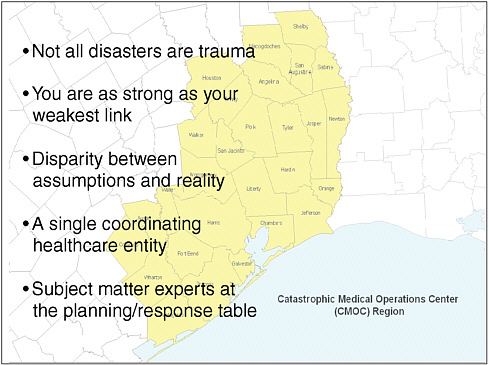
FIGURE 8-1 Regionalized response to catastrophic events in Texas: lessons learned.
SOURCE: Upton (2009).
transport sector. There are also medical personnel who are there and take the names of the people calling in. They do a brief triage over the phone and decide whether a particular patient matches the resources of a particular hospital. If the facility has the capability and capacity to take the patient at that point in time, an EMS transport is dispatched to take the patient there. The information from the case is entered into a data system, and the hospital is notified immediately.”
Upton noted that every hospital is able to see how many patients all the other hospitals are receiving. “It’s very transparent,” she said. “They can drill down to see what they have. At any time, they can call and say, ‘I’m getting full. Can you give me a break for two hours, so I can clear these people out? Then I’ll be back in the rotation.’ So,” she said, “we have in place a single coordinating entity that directs a particular patient to a particular hospital based on its resources in real-time.”
Upton said that the Regional Hospital Preparedness Council is a 501(c) (3) organization that can contract with jurisdictions and with the state. Its mission is to provide coordination, protection, and to maintain
the medical infrastructure of that regional community. All of the hospitals and other health care entities have free membership—there are no dues. She said that there is nothing that they have to do except support the concept of the operations center and “agree to play along on game day.” Also, each hospital contributes a staff member for a 12-hour shift one day a month. She said that costs them about $600 per month. But, she noted, if a hospital can avoid receiving even one GI (gastrointestinal) patient who doesn’t belong there, they can save over $2,900.
Upton said that the region encompasses 18 counties, 177 cities, and 6.5 million people, which is about 25 percent of the state population. Over 800,000 individuals have declared themselves as having medical special needs in that area. There are 121 hospitals and 220 nursing homes in the region and she said that the coordinating center provides a safety net for them. “They have just one phone number they have to call.”
A CULTURE OF PREPAREDNESS
Joe Waeckerle, chief medical officer in the Missouri Office of Homeland Security, discussed the rationale for regionalized disaster preparedness systems that are integrated into the rest of the regionalized health care system. He said that “disaster medicine is a unique experience.” He said it is often assumed that disaster response is an escalation of the everyday response of the EMS/hospital system in your community. “This is not true,” he said. “It is an uncustomary or singular response.” As Krohmer indicated in his presentation, Waeckerle said, disaster medicine is austere medicine, provided in the worst of all possible environments. He continued, “It’s very difficult to change the mindset of the health care provider and the expectations of the patient as well as the expectations of the system” in the time frame that a disaster provides. “So there are tremendous constraints in the response plan that you have to take into account,” Waeckerle said.
Waeckerle argued that there needs to be a “culture of preparedness,” and that culture of preparedness is not something that can be assumed in any local community, region, or state. Local communities may want to conduct a vulnerability analysis and then a cost-benefit analysis. “But,” he said, “what they are going to find out is that a once-in-a-lifetime incident for a local community is not cost-effective to plan for.” Nevertheless, he said, “they need to decide if they are going to plan for it or if they are going to give up.” If they do decide to plan for it, and they become regionally integrated, they are going to have to make a commitment to collaboration, coordination, and communication within the region, and use the same systems approach that other regionalized systems (e.g., trauma, STEMI, and stroke) have utilized.
Waeckerle emphasized that all disasters are local. “That mantra is finally getting through to everybody.” Most mutual aid pacts don’t allow for help
to arrive for a considerable period of time, perhaps days; until that time, the local community will be the first and only responders. Nevertheless, local communities need to make a commitment to mutual aid, understanding that they have to integrate the system and call for mutual aid, notwithstanding all the political ramifications and other issues that can accompany that.
Local communities must have a credible response plan, Waeckerle said, but most do not. “Any plan is founded on a capable system, so there has to be a capable EMS/hospital system at the local level and regional levels in order to support a good response,” he said. “This will also need to involve other partners in the community, aside from medicine and health. These include law enforcement, the intelligence communities, military assets, and even local construction companies, as we learned with the Hyatt disaster. These all have to be brought to the table during the planning, because if you assume it’s all medical, you are being arrogant in making assumptions and you are going to fail.”
AUDIENCE DISCUSSION
The panel discussed the axiom that all disasters are local—or at least start out as local responsibilities. Goldfrank noted that Waeckerle had endorsed the concept that all disasters are local, but had also explained exactly why they are not just local. Upton had also said that disasters were not only local.
Upton responded that disasters clearly reach out to different localities. During Hurricane Ike, for example, 2.1 million people had to be evacuated, which affected other cities and regions. “The receiving areas also become a disaster point,” she said. These areas have to open up shelters, shut down sports and concert venues, and make other arrangements. It’s a huge economic burden on those receiving communities, she added. “The response starts local,” she said, “but it quickly grows to a regional response.”
Krohmer said it’s important to recognize that disasters begin locally, but then quickly build up from there. Even in the case of September 11, he said, the initial response was in New York City and Arlington and Alexandria, Virginia, and then it quickly expanded. Also, Waeckerle had provided the example of agro terrorism, which has the potential to impact a large number of Americans. Krohmer argued that “an agro event will [play out in] multiple local situations [that are] occurring all at the same time, until we come to the realization that … these are all tied in together.”
Krohmer also observed that many local communities establish emergency operations centers in response to disasters. He said he would encourage them to place this operation in the context of emergency management and have the medical operations center as an annex to the emergency operations center.
Upton said that their medical operations center is situated inside the emergency operations center for the city of Houston. Inside the emergency operations center, she has a number of resources that are immediately available. She noted that “with Hurricane Ike we lost power to 3.2 million people all at once, [and] we had CenterPoint Energy sitting next to me, with the power grids, telling me when they were coming up.” Also, when water service was lost, and all of the dialysis centers went down, the public works department was sitting there. “They were able to tell me what areas they were going to be able to put back up, so I could get some dialysis folks in to an open dialysis center … even though that wasn’t their dialysis center.”
Significant Progress Over Time
David Boyd said that when he first became the EMS director for the state of Illinois in the 1960s, he also became the disaster medical officer. At that time, he said, “the bunker mentality was incredible.” Plus, he said, “folks seemed to be more interested in getting to talk to the governor over the phone … than saving anybody’s life or property.” In 1972, The Journal of Trauma published an article reviewing major disasters and found that in most instances there were actually two disasters. The first, Boyd said, was “the original natural or manmade disaster. The second disaster was when we showed up. [Responses were] uncoordinated [and] discombobulated.… [They were] just incredible, disorganized things.”
The nation, he said, is in a much better position now. “Our capability [has expanded] enormously throughout the whole system, far beyond where we were not very many years ago. You are to be congratulated.”
Advice for Atlanta
Dr. Kellermann noted that the participants had seemed to reach a clear conclusion that in most circumstances a regional system is better than one that is fragmented and disconnected, and that there are opportunities but also barriers to bringing that about. He said he believed he also heard that a regionalized system is necessary but insufficient to have an adequate response to a local or regional disaster, because that type of event would involve much more.
Kellermann said that “If a terrorist placed a bomb in the emergency center of Grady Hospital in Atlanta—the only Level I trauma center for an area encompassing over 5 million people—he would bring down the entire trauma care system for half of the state. “ And there is no Plan B in Atlanta today,” he added. The city currently has an ad hoc regionalized system, but it is vulnerable at a couple of critical chokepoints, he said. It’s “probably not a model for a resilient system.”
He asked the panel: if our federal or state partners indicated that they wanted to systematically promote regionalization in metro Atlanta in a way that enhances its resilience and capacity to deal with disasters, what practical advice would you give for that effort? What are some of the core attributes or strategies Atlantans should be thinking about if they were to design such a program?
Marcozzi said that, in his view, this type of program should not be conducted through grants. He said that it would have to be built into the daily health care delivery system. Grant funding occurs once every year, and could be less one year, more the next, and it is not a suitable vehicle. The funding mechanism might have to include payers or involve some type of regionalization tax. Marcozzi said that if we make a small initial investment in coordinating care, there will be a sizable return on investment. For example, if we know what tests the previous physician has conducted and he has the capability to share that information with a transferring hospital, then those tests will not have to be repeated—which is not the current state of affairs in evaluating patients in most hospitals. “A coordinated system will pay dividends,” he said.
Also, Marcozzi said that Atlanta needs a sister hospital that has some of the same capabilities as Grady. The city should not be relying on a single “mega-system.” Finally, he said, training is required on a range of issues, from incident command to critical care and appropriate resource utilization for an overburdened system.
Krohmer said it’s striking that Atlanta is still in this position after having lived through the Olympic bombing event. But, he said, there are a number of things that can be done. At the federal level, there are a number of grant programs that can come into play. He noted that the Metropolitan Medical Response System requires regional planning, which could provide some stimulus to the effort. Also, the Hospital Preparedness Program and the Centers for Disease Control and Prevention’s (CDC’s) public health emergency preparedness programs require regional planning activities.
The federal government has developed 15 planning scenarios, one of which involves an explosive event. Krohmer said he believes that it is incumbent upon the planners in any metropolitan area to ask, what would we do in response to this type of event? In this case, what would we do if a suicide bomber attacks the emergency department at Grady? How would we care for the community at that point? He said that it really becomes a community planning issue.
Waeckerle said that whether this involves a bomber at the hospital or whether 1,000 patients flood the hospital after a disaster event that occurs down the street, or whether that many patients are transferred and arrive from facilities that are farther out, there is not any practical difference. Astute planners will take all of these scenarios into account.
Waeckerle emphasized that there needs to be redundancy built in to the system. Communications need to be redundant and hospital systems need to be redundant. The whole system should examine this.
Another point to consider, he said, is that while a disaster in Atlanta could possibly be a suicide bomber at the emergency department, a disaster in Piedmont, Missouri, could be a car wreck with eight people, given the fact that they have no medical care and no EMS system.
Inability to Handle Day-to-Day Disasters
Lance Becker, director of the Center for Resuscitation Science at the University of Pennsylvania, said he worries we have given false reassurance to the public in indicating that we are ready for disasters that may strike. “I feel like my emergency department is a disaster on a regular basis, [even though] there is no disaster that has been called,” he said. This is true at emergency departments all over the country, he said, with patients boarded in the hallway, backlogs of people in waiting rooms who haven’t been seen, and ambulances placed on diversion.
Becker said this problem seems to be getting worse. If anybody believes that we have increased our capacity, over the past 10 years our capacity has actually diminished, with respect to emergency departments (EDs) and ED beds. He said it strains credibility for us to talk about our ability to handle a disaster.
Krohmer said that Becker was looking at the capacity issue in the context of day-to-day health care. But “when a large-scale disaster happens,” he said, “that’s going to change very, very quickly.” He said he knew of an example from several years ago where there had been a commercial airline crash in the United States. The local hospital emergency department received notification from the airport before any EMS or first responders had arrived on the scene. At the time they had about 50-55 people in the ED waiting room. These people were informed, “Folks, we just suffered an airline crash at the airport. Anybody that doesn’t need to be here, please contact your doctor tomorrow or come back tomorrow.” He said that 50 of those 55 people left.
Krohmer added that when faced with those situations, hospitalists will be going through all the inpatient beds and finding out which patients can be either discharged (by themselves or with family), sent to nursing homes, or sent to tertiary care centers, which, in turn, will be transferring some of their patients to other facilities. “I hear what you are saying,” he said, “but we need to look at capacity not in the context of day-to-day health care, but in the context of what really will be alternative standards.”
Goldfrank added that in New York City from September 17 to October 17, roughly 50 percent of the hospital beds were available, and virtually
no one came to the emergency department. He said it even appeared that people weren’t going into labor as rapidly. But Marcozzi agreed with Becker that there have been reductions in capacity. He said the system is set up to decrease resource utilization and reduce capacity—not so much to increase efficiency, but to increase profit margins. He said that if we continue to shrink our daily capacity, it should not be a shock to anyone that our surge capacity has decreased.
Altered Standards of Care
A participant observed that the panelists all spoke about the need to build on and leverage the capabilities of the day-to-day emergency care system, but that disasters are much different with respect to the austere environment and the altered community and political dynamics. One question that consistently arises from nurses in preparedness training activities is, “How do I find out when the call has been made and the altered rules of care apply?”
Upton replied that her region in Texas has a communications network that notifies all of their facilities when the order has been activated. It can only be activated by a jurisdictional authority (e.g., a city or a fire chief). She said everyone is given a very brief overview of what is known and what actions are recommended. Updates are continually provided through the Internet and other notification systems. They also have one phone number that they can call to reach the center as well as email addresses.
However, Waeckerle argued that we need to distinguish between the disaster at the local level and the disaster at the regional level. During a disaster in a local community, he said, you don’t have situational awareness, you don’t have communication, you don’t have resources, and, since in the past there has been no system of incident command, many things are decided intuitively.
In a disaster, he said, “it’s great to have an operations center. There is nothing I would like more than that. But it isn’t going to communicate with me, because there are no communications, because it’s a disaster. I’m busy, and so is everybody else in the local community. We are so busy [that] we don’t even know if they’ve communicated [to us anything about] the status of our own hospitals.” He said, “Communication remains the biggest problem in the history of disasters and always will.”
Waeckerle said flatly, “I knew to change my standards of care [because] I had no capability of offering that care anymore. I didn’t have any more IVs. I didn’t have any morphine. I didn’t have a stretcher. I didn’t have anybody else to get the patient out of there, [so] I couldn’t get them out of there.” He said he did not want to overdramatize this, and he agreed with Dr. Boyd
that we are better than we used to be, but local disasters, especially in the first 24 to 48 hours, are truly disasters.
Marcozzi said that with regard to changing standards of care, in cases where some level of resources still exist, the shift is from a clinical, one-to-one doctor-patient interaction to one that is based on a broader public health perspective. For a clinician, this is a very difficult shift, and it is one that has many ramifications, liability just being one of them.
He offered an illustration: “When a 92-year-old hypertensive patient who is septic presents in the emergency department, she would typically receive all resources, including vasopressors and ventilatory support, and be sent to the ICU. But if there were a concurrent public health emergency, with hundreds more patients to see and not enough resources to support her care, the reality is she would likely be black-tagged, provided comfort measures, and resources would be directed at more salvageable patients, reevaluating her status as conditions change and more resources become available.”
He pressed the participants to “show me the liability protection afforded [for] that scenario, and the definitive way for clinicians to proceed when [the paradigm] shifts from one-to-one to one-to-1,000. That’s a difficult discussion—medical, legal, and ethical—but one that needs attention.”
Krohmer said that he agreed completely with all the comments, but wanted to reinforce Waeckerle’s point that the first three problems in any disaster response are always communications, communications, and communications. While disaster response has improved significantly over the past 10-15 years, “we are still very much in our infancy,” he said. For example, whereas public safety agencies, such as the fire service, have been using the incident-management system for more than 35 years, health care has just begun to adopt that model in the past 5-10 years.
REFERENCE
Upton, L. 2009. PowerPoint slide presented at the Regionalizing Emergency Care Workshop, Washington, DC.


