
Synopsis
Emissions of carbon dioxide from the burning of fossil fuels have ushered in a new epoch where human activities will largely determine the evolution of Earth’s climate. Because carbon dioxide in the atmosphere is long lived, it can effectively lock Earth and future generations into a range of impacts, some of which could become very severe. Therefore, emissions reductions choices made today matter in determining impacts experienced not just over the next few decades, but in the coming centuries and millennia. Policy choices can be informed by recent advances in climate science that quantify the relationships between increases in carbon dioxide and global warming, related climate changes, and resulting impacts, such as changes in streamflow, wildfires, crop productivity, extreme hot summers, and sea level rise.
Since the beginning of the industrial revolution, concentrations of greenhouse gases from human activities have risen substantially. Evidence now shows that the increases in these gases very likely (>90 percent chance) account for most of Earth’s warming over the past 50 years. Carbon dioxide is the greenhouse gas produced in the largest quantities, accounting for more than half of the current impact on Earth’s climate. Its atmospheric concentration has risen about 35 percent since 1750 and is now at about 390 ppmv, the highest level in at least 800,000 years. Depending on emissions rates, carbon dioxide concentrations could double or nearly triple from today’s level by the end of the century, greatly amplifying future human impacts on climate.
Society is beginning to make important choices regarding future greenhouse gas emissions. One way to inform these choices is to consider the projected climate changes and impacts that would occur if greenhouse gases in the atmosphere were stabilized at a particular concentration level. The information needed to understand such targets is multifaceted: how do emissions affect global atmospheric concentrations and in turn global warming and its impacts?
This report quantifies, insofar as possible, the outcomes of different stabilization targets for greenhouse gas concentrations using analyses and information drawn from the scientific literature. It does not recommend or justify any particular stabilization target. It does provide important scientific insights about the relationships among emissions, greenhouse gas concentrations, temperatures, and impacts.
CLIMATE CHANGE DUE TO CARBON DIOXIDE WILL PERSIST MANY CENTURIES
Carbon dioxide flows into and out of the ocean and biosphere in the natural breathing of the planet, but the uptake of added human emissions depends on the net change between flows, occurring over decades to millennia. This means that climate changes caused by carbon dioxide are expected to persist for many centuries even if emissions were to be halted at any point in time.
Such extreme persistence is unique to carbon dioxide among major agents that warm the planet. Choices regarding emissions of other warming agents, such as methane, black carbon on ice/snow, and aerosols, can affect global warming over coming decades but have little effect on longer-term warming of Earth over centuries and millennia. Thus, long-term effects are primarily controlled by carbon dioxide (see Figure Syn.1).
The report concludes that the world is entering a new geologic epoch, sometimes called the Anthropocene, in which human activities will largely control the evolution of Earth’s environment. Carbon emissions during this century will essentially determine the magnitude of eventual impacts and whether the Anthropocene is a short-term, relatively minor change from the current climate or an extreme deviation that lasts thousands of years. The higher the total, or cumulative, carbon dioxide emitted and the resulting atmospheric concentration, the higher the peak warming that will be experienced and the longer the duration of that warming. Duration is critical; longer warming periods allow more time for key, but slow, components of the Earth system to act as amplifiers of impacts, for example, warming of the deep ocean that releases carbon stored in deep-sea sediments. Warming sustained over thousands of years could lead to even bigger impacts (see Box Syn.1).
IMPACTS CAN BE LINKED TO GLOBAL MEAN TEMPERATURES
To date, climate stabilization goals have been most often discussed in terms of stabilizing atmospheric concentrations of carbon dioxide (e.g., 350
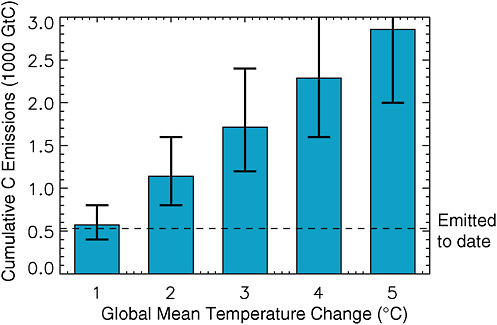
FIGURE Syn.1 Recent studies show that cumulative carbon dioxide emission is a useful metric for linking emissions to impacts. Error bars reflect uncertainty in carbon cycle and climate responses to carbon dioxide emissions due to observational constraints and the range of model results. Cumulative carbon emissions are in teratonnes of carbon (trillion metric tonnes or 1,000 gigatonnes).
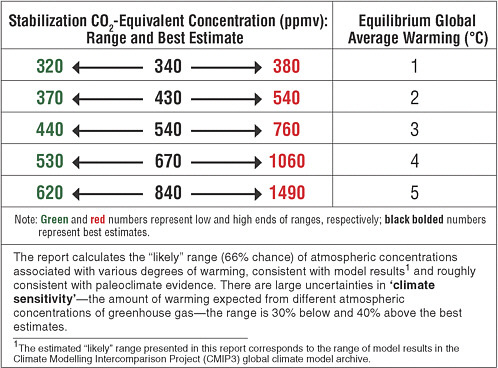
ppmv, 450 ppmv, etc.). This report concludes that, for a variety of conceptual and practical reasons, it is more effective to assess climate stabilization goals by using global mean temperature change as the primary metric. Global temperature change can in turn be linked both to concentrations of atmospheric carbon dioxide (Table 1) and to accumulated carbon emissions.
An important reason for using warming as a reference is that scientific research suggests that many key impacts can be quantified for given tem-
|
BOX SYN-1 SUSTAINED WARMING COULD LEAD TO SEVERE IMPACTS Widespread coastal flooding would be expected if warming of several degrees is sustained for millennia. Model studies suggest that a cumulative carbon emission of about 1,000 to 3,000 gigatonnes (billion metric tonnes carbon) implies warming levels above about 2ºC sustained for millennia. This could lead to eventual sea level rise on the order of 1 to 4 m due to thermal expansion of the oceans and to glacier and small ice cap loss alone. Melting of the Greenland ice sheet could contribute an additional 4 to 7.5 m over many thousands of years. |
TABLE 1 Relationship of Atmospheric Concentrations of Carbon Dioxide to Temperature
|
|
perature increases. This is done by scaling local to global warming and by “coupled linkages” that show how other climate changes, such as alterations in the water cycle, scale with temperature.
There is now increased confidence in how global warming levels of 1ºC, 2ºC, 3ºC etc. (for ºF conversion, see Figure Syn.2) would relate to certain future impacts. This report lists some of these effects per degree (ºC) of global warming (see Figure Syn.3), including:
-
5-10 percent changes in precipitation in a number of regions
-
3-10 percent increases in heavy rainfall
-
5-15 percent yield reductions of a number of crops
-
5-10 percent changes in streamflow in many river basins worldwide
-
About 15 percent and 25 percent decreases in the extent of annually averaged and September Arctic sea ice, respectively
For warming of 2 to 3ºC, summers that are among the warmest recorded or the warmest experienced in people’s lifetimes, would become frequent. For warming levels of 1 to 2ºC, the area burned by wildfire in parts of western North America is expected to increase by 2 to 4 times for each degree (ºC) of global warming.
Many other important impacts of climate change are difficult to quantify for a given change in global average temperature, in part because temperature is not the only driver of change for some impacts; multiple environmental and other human factors come into play. It is clear from scientific studies, however, that a number of projected impacts scale approximately with temperature. Examples include shifts in the range and abundance of some terrestrial and marine species, increased risk of heat-related human health impacts, and loss of infrastructure in the coastal regions and the Arctic.
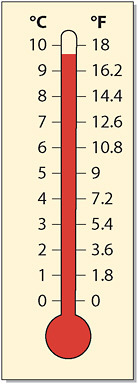
FIGURE Syn.2 Illustration of how temperature change in degrees Celsius (left side of thermometer) relates to temperature change in degrees Fahrenheit (right side of thermometer). For example, a warming of 5ºC is equal to a warming of 9ºC. In this report estimates of temperature change are in made in degrees Celsius in accordance with international scientific practice.
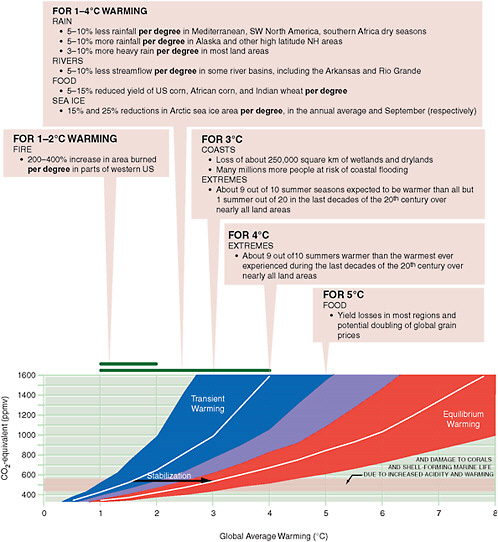
FIGURE Syn.3 What impacts can be expected? The report quantifies—per degree of warming—several anticipated effects and impacts of global warming, including changes in streamflow, wildfires, crop productivity, extreme hot summers, and sea level rise. The graphical part of the diagram shows how atmospheric concentrations of carbon dioxide correspond to temperatures—transient, or near-term warming (in blue), is only a fraction of the total warming (the equilibrium warming) expected to occur (in red).
STABILIZATION REQUIRES DEEP EMISSIONS REDUCTIONS
The report demonstrates that stabilizing atmospheric carbon dioxide concentrations will require deep reductions in the amount of carbon dioxide emitted. Because human carbon dioxide emissions exceed removal rates through natural carbon “sinks,” keeping emission rates the same will not lead to stabilization of carbon dioxide. Emissions reductions larger than about 80 percent, relative to whatever peak global emissions rate may be reached, are required to approximately stabilize carbon dioxide concentrations for a century or so at any chosen target level (see Figure Syn.3).
But stabilizing atmospheric concentrations does not mean that temperatures will stabilize immediately. Because of time lags inherent in the Earth’s climate, warming that occurs in response to a given increase in the concentration of carbon dioxide (“transient climate change”) reflects only about half the eventual total warming (“equilibrium climate change”) that would occur for stabilization at the same concentration (see Figure Syn.4). For example, if concentrations reached 550 ppmv, transient warming would be about 1.6ºC, but holding concentrations at 550 ppmv would mean that warming would continue over the next several centuries, reaching a best estimate of an equilibrium warming of about 3ºC.
Estimates of warming are based on models that incorporate “climate sensitivities”—the amount of warming expected at different atmospheric concentrations of carbon dioxide (Table 1). Because there are many factors that shape climate, uncertainty in the climate sensitivity is large; the possibility of greater warming, implying additional risk, cannot be ruled out, and smaller warmings are also possible. In the example given above, choosing a concentration target of 550 ppmv could produce a likely global warming at equilibrium as low as 2.1ºC, but warming could be as high as 4.3ºC, increasing the severity of impacts. Thus, choices about stabilization targets will depend upon value judgments regarding the degree of acceptable risk.
CONCLUSION
This report provides a scientific evaluation of the implications of various climate stabilization targets. The report concludes that certain levels of warming associated with carbon dioxide emissions could lock Earth and many future generations of humans into very large impacts; similarly, some targets could avoid such changes. It makes clear the importance of 21st century choices regarding long-term climate stabilization.
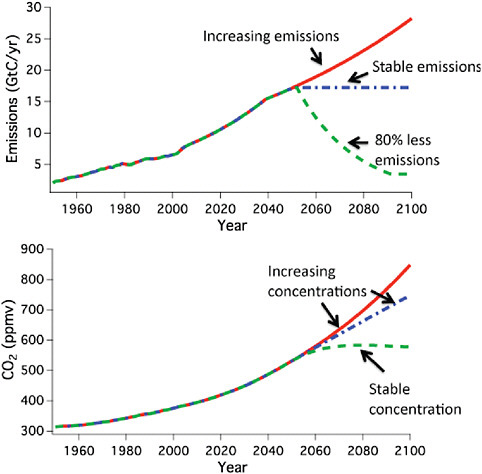
FIGURE Syn.4 Because emissions of carbon dioxide are greater than the sinks that remove it, emissions reductions larger than about 80% (green line-top graph) are required if concentrations are to be stabilized (green line-bottom graph). The lower graph shows how carbon dioxide concentrations would be expected to evolve depending upon emissions for one illustrative case, but this applies for any chosen target.


