
6
Recommendations and Remarks on Implementation
In this report, the assessment of prediction capabilities for intraseasonal to interannual (ISI) timescales has been made by focusing on the variables and processes that act as sources of predictability for the climate system. The assessment also describes the building blocks of ISI forecast systems, how forecasts are verified and disseminated, and the relationships among the building blocks, forecasting procedures, and improvements in ISI forecast quality. The committee focuses on qualitative estimates of potential improvements in ISI prediction systems, since a quantitative upper bound of predictability for the climate system cannot be made at this time (see Chapter 1).
In this chapter, the committee’s recommendations are presented. Following the recommendations, the committee presents its thoughts regarding the expanded use of observations, the prospects for seamless forecasting, and the magnitude and rate of expected forecast improvements.
RECOMMENDATIONS
The committee identified three general categories of actions to advance ISI predictions: Best Practices, Improvements to the Building Blocks of ISI Forecast Systems, and Research for Sources of Predictability. The Best Practices are largely focused on the activities of the operational forecast centers and aim to improve the delivery and dissemination of forecast information for both decision-makers and researchers. The Improvements to the Building Blocks of ISI Forecast Systems pertain to both the operational and research communities and focus on the continued development of observations, statistical and dynamical models, and data assimilations systems. Research for Sources of Predictability is aimed primarily toward the research community.
These three categories indicate the relative time horizons associated with the recommendations. Many of the Best Practices could be adopted relatively quickly. Although some of the suggestions for archiving forecasts and convening meetings may require increased resources and planning, most of the recommendations involve modifications to the routine activities of operational centers rather than new initiatives or programs. Improvements to the Building Blocks of ISI Forecast Systems will likely require more time and effort to pursue and will necessitate significant collaboration between operational forecasters and research scientists. Incorporating and validating some of these changes would likely occur over several years. The
Research for Sources of Predictability provides a set of longer-term research goals. Although many experiments can be designed and run now, results may take several years to emerge, given the pace of scientific publication and discourse. Once some of this research has been completed, translation of the results into an operational setting will require subsequent efforts by both operational centers and research scientists. Thus, the research goals constitute a longer-term vision.
Best Practices
Lack of access to forecast and verification information and issues with communication between research and operational forecasting communities are major barriers to the improvement of ISI forecast systems. The committee recommends several steps to foster expanded collaboration, create an archive of key ISI forecast data, set standards for verification techniques, and minimize subjective components of ISI forecast.
-
The synergy between operational ISI forecasting centers and the research community should be enhanced. A number of important activities would contribute greatly to the goal of accelerated synergy and progress. The committee recommends the following.
-
Targeted workshops focused on specific areas relevant to model and forecast improvement should be held at least annually at the operational centers. The workshops should produce actionable recommendations that result in specific plans for developing and testing new ideas for operational forecasting.
-
Scientists in the operational centers should participate actively in scientific meetings, especially in the areas of modeling and use of observations.
-
Short term positions in operational centers should be granted to academic researchers. These positions could focus on a particular scientific issue that is both in the researcher’s field of expertise and offers opportunities for improving operational forecast quality.
-
New data sets from both the academic researchers and scientists in operational centers should be made available to the scrutiny of the broader academic community at an early stage to help identify early strengths and weaknesses.
-
The development of new observations to support ISI forecasting should be carried out with the engagement of the operational centers through an ongoing dialog about the efficacy of the observing system and the need for further observational campaigns by the research community.
-
-
Operational ISI forecasting centers should establish public archives of all data used in forecasts, including observations, model code, hindcasts, analyses, forecasts, re-analyses, re-forecasts, verifications, and official forecast outlooks.
Archives of forecast information are needed by national and international operational centers, researchers, and the private sector in their efforts to quantify and identify sources of forecast error, provide the baseline for forecast assessment and model fidelity, develop metrics and diagnostics for model assessment, calibrate model forecasts, quantify and document model and forecast improvement, such as those that results from changing resolution or
-
parameterizations, and develop tailored forecast products for decision systems and climate risk management.
-
Archives serve as an important mechanism for bridging the gap between operational centers and forecast users, whether they are involved in making climate-related management decisions or conducting societally relevant research. Since it is not possible for operational centers to foresee or address all possible needs of these users, archives of forecast information will permit users to access the information that is most important to them and, in some cases, develop their own derivative products. Feedback from forecast users can also offer pathways to improving ISI forecast quality.
-
Operational ISI forecasting centers should broaden and make available the collection of metrics used to assess forecast quality.
No perfect metric exists that conveys all the information about a forecast. Quantitative skill assessment of forecast quality should be determined and made available through multiple metrics and graphical techniques, including ones that assess the quality of the probabilistic information and multi-model ensembles. Some of these metrics should include information on the distribution of skill in space and time.
-
The subjective components of operational ISI forecasts should be minimized.
Recent research suggests that the subjective component of many present-day forecasts can reduce forecast quality (e.g., O’Lenic et al. 2008). The subjective component generally comes from qualitative discussion and interpretation by forecasters regarding the state of the climate system and forecasting tools. The subjective component also limits reproducibility, restricting retrospective comparison of forecast systems.
Model “modularization” was an aspect of Best Practices that was considered by the committee but not recommended. Frameworks for modularizing climate modeling codes have been suggested as a way to provide the software infrastructure to enhance collaboration, research, and ultimately the transition of research into operational activities. One such example is the Earth System Modeling Framework18 (ESMF). In principle, activities such as ESMF have universal appeal; however, in practice they are more complicated than anticipated and their adaptation is often uneven. These efforts should be encouraged in the long view, but their utility in facilitating the transition of research to operations, making operational models more accessible to researchers or enhancing seasonal forecast quality has yet to be demonstrated.
Improvements to the Building Blocks of Forecast Systems
ISI forecast quality will improve with better building blocks. New observations and new uses of existing observations can provide better initializations of various components of the climate system (atmosphere, ocean, land, and ice) and information regarding poorly understood processes that operate within and among components of the climate system. New uses of
statistical methods, especially nonlinear techniques, can serve as useful forecast models. They can also be used to diagnose problems in dynamical models or to identify and characterize novel sources of variability. Dynamical models can be improved since they exhibit several well-known biases. More advanced data assimilation methods can be used in operational settings, and more observations can be assimilated into forecasts.
-
Statistical techniques, especially nonlinear methods, should be pursued in order to better characterize processes that contribute to ISI forecasts.
Comparisons between statistical models and dynamical models provide information on the deficiencies within dynamical models. Historically, linear statistical analyses of observational data have provided an awareness of important spatial patterns and teleconnections. Recent research (e.g., Lima et al., 2009) demonstrates that nonlinear methods can yield statistically significant increases in prediction skill on ISI time scales when compared to traditional linear techniques. However, these techniques have not been incorporated operationally. The committee finds that there is a value in expanding such analyses to nonlinear counterparts.
-
Systematic errors in dynamical models should be identified. Current state-of-the-art ISI prediction models have relatively large biases that reduce prediction quality. Some classic examples include: (1) the so-called double ITCZ problem, (2) the excessively strong equatorial cold tongue, (3) weak or incoherent intraseasonal variability, (4) failure to represent the multi-scale organization of tropical convection, and (5) poorly represented cloud processes, particularly low level stratus. These errors have both regional and global impacts and could be indicative of errors in the model formulations that are limiting predictability.
Sustained observations are needed to quantify model systematic errors. Examples of sustained observations include those related to describing the properties of or fluxes among the atmosphere, ocean, and land surface (e.g., boundary layer humidity, exchange of heat between the atmosphere and ocean).
-
To reduce errors produced by dynamical models, the representation of physical processes should be improved.
Systematic errors in dynamical models should be reduced by expanding the understanding of underlying physical processes, with the goal of transferring improvements into operational ISI forecasts. This includes systematic errors in the mean and the variability and their interaction. Process studies that are closely tied to operational ISI model improvement should be carried out on specific components of the climate system (e.g., sea ice, aerosols, snow cover), specific processes and variability (e.g., triggering the onset of an MJO), and the interactions among components of the climate system (e.g., air-land coupling strength, stratosphere-troposphere interactions).
The research community should be engaged in the conduct of process studies that address the physical processes governing ISI variability. Specific physical phenomena are poorly represented in most ISI prediction systems (e.g. the MJO). A strategy to expand knowledge for use in model development is exemplified by the CLIVAR climate process teams (CPTs). The CPTs focus modelers and process scientists on poorly represented or unrepresented physical process in models. Similarly, the WCRP-WWRP/THORPEX’s Year of Tropical Convection (YOTC) is another approach that focuses community effort via a virtual Intensive Observation
-
Period (IOP), combining already existing observational resources with incremental programmatic efforts to target model improvements of a few specific phenomena (e.g., MJO, easterly waves, tropical cyclones).
-
Process studies and phenomenological focus aside, enough cannot be said for seeking brute force improvements in computing capabilities for better resolving subgrid scale processes and removing as much reliance on parameterization as possible. This could be in the context of limited domain models (e.g., cloud-resolving models) used to develop and evaluate subgrid scale parameterizations as well as cloud or cloud-system resolving/permitting global models. In addition, the impact of increasing the resolution of ISI models should be further investigated19.
-
Statistical and dynamical models should continue to be used in a complementary fashion by operational ISI forecasting centers.
Using multiple prediction tools leads to improved and more complete ISI forecasts. Forecasting centers should continue to use statistical and dynamical models in a complementary fashion. Examples of statistical techniques include stochastic physics, interactive ensembles, empirical corrections or empirically-based parameterizations and process models.
The use of statistical and dynamical downscaling methods is another application that should be explored to address the information mismatch between the coarse spatial resolution of operational climate forecasts and the fine resolution needs of some end users.
-
Multi-model ensemble (MME) forecast strategies should be pursued, but standards and metrics for model selection should be developed.
Multi-model ensembles (MME) have been shown to outperform individual models for forecasting. The committee encourages continued exploration of MME experiments. Understanding why the statistics associated with them consistently outperform the predictions from individual models should be a goal for researchers and operational centers. Current multimodel techniques generally include models based simply on what is available; continued work is necessary to develop techniques of optimally selecting and weighting ensemble members. Experimentation with MME should not compete with model improvement, but rather, should contribute to the process of identifying areas for model improvement.
-
To enable assimilation of all available observations of the coupled climate system, operational centers should implement state-of-the-art 4-D Var, Ensemble Kalman Filters, or hybrids of these in their data assimilation systems.
Assimilation methods currently being used are often obsolete, and many observations are not being assimilated as part of the forecast cycle. To enable assimilation of all available observations of the coupled climate system, operational centers should implement state-of-the-art 4-D Var, Ensemble Kalman Filters, or hybrids of these in their data assimilation systems. Priority should be given to expanding operational data assimilation to ocean observations, such as sea surface heights.
Research for Sources of Predictability
-
Many sources of predictability remain to be fully exploited by ISI forecast systems. To better understand key processes that are likely to contribute to improved ISI predictions, the committee recommends that the scientific community pursue the following six areas as research goals.
To identify research priorities, the committee applied four criteria to the list of sources of predictability listed in Chapter 2. Sources that merited further research were selected based on:
-
Physical principles indicate that the source has an impact on ISI variability and predictability.
-
Empirical or modeling evidence exists to support the case made based on physical principles in (1).
-
The committee could identify gaps in knowledge that have prevented these sources from being exploited by ISI forecast systems.
-
There is potential social value for gaining knowledge of this source of variability. For example, the MJO has significant societal impact in its effect on the Indian monsoon, which determines water supply and agricultural productivity for billions of people.
The following six areas met these criteria, but are not presented with any further prioritization.
MJO
A concerted effort on improving the prediction quality associated with the MJO should be undertaken and coordinated with research activities. The path forward on this should include focused process studies, model improvement, and close collaboration between research and operational communities (e.g., Year of Tropical Convection (YOTC) project, the MJO Task Force). It will be necessary to develop and implement standardized diagnostics and metrics to gauge model improvements and track improvements in forecast quality. MJO influences on other important components of the climate system (e.g,. ENSO, monsoon onsets and breaks, tropical cyclone genesis, etc.) should continue to be explored and exploited for additional predictability.
Stratosphere-Troposphere Interactions
Operational ISI prediction models should be improved to represent stratosphere-troposphere interactions. Relatively long-lived (up to two months) atmospheric anomalies can arise from stratospheric disturbances. In sensitive areas such as Europe in winter, experiments suggest that the influence of stratospheric variability on land surface temperatures can exceed the local effect of sea surface temperature. Additionally, while our weather and climate models do not often resolve or represent the stratospheric Quasi-Biennial Oscillation very well, it is one of the more predictable features in the atmosphere, and it has been found to exhibit a signature in ISI surface climate.
Ocean-atmosphere coupling
Due to the very large heat capacity of sea water, anomalous sea surface temperatures and upper ocean heat content can have significant impacts on the atmosphere above. The impacts of the anomalies associated with ENSO are well known. However, further research is needed to examine the role of extratropical atmosphere-ocean coupling, to investigate the need to represent ocean-atmosphere coupling more realistically over a wide range of spatial scales (including down to the scales of the sharp SST gradients associated with fronts), and to better observe and represent air-sea fluxes more realistically in models.
Land-atmosphere feedbacks
Research should be directed at maximizing prediction quality associated with land-atmosphere feedbacks. Recent research shows that the realistic initialization of soil moisture in dynamical models can increase the accuracy of precipitation and (especially) temperature predictions at intraseasonal timescales. The realistic initialization of snow amount may also yield better quality predictions, though this connection is relatively unexplored. To maximize the impact of land feedbacks on prediction quality, the mechanisms underlying the land-atmosphere coupling (e.g., evaporation, boundary layer dynamics, convection) need to be better understood and better represented in forecast systems.
High impact events affecting atmospheric composition
Operational centers should be prepared to make ISI forecasts following unusual but high impact events such as volcanic eruptions, limited nuclear exchange, or space impacts that can cause a sudden, drastic change to the atmospheric burden of aerosols and trace gases. Research efforts should study the consequences of such high impact events on the climate system over ISI timescales and provide guidance for improving forecast systems.
Non-stationarity
Trends can be an important source of predictability that should be exploited since accurate trends in atmospheric compositions (e.g. greenhouse gases, aerosols) and land cover can influence ISI variability and forecasts. Current statistical techniques (such as Optimal Climate Normals) and dynamical models do not adequately deal with this non-stationarity.
Improved statistical techniques should be developed for exploiting the predictability associated with such non-stationary behavior (e.g., Livezey et al., 2007). The use of dynamical models that include a more comprehensive treatment of radiative processes, such as aerosol effects, and also incorporate trends in land use could help improve the quality of dynamical ISI forecasts on longer timescales. As statistical and dynamical models evolve, it will be important to evaluate how much improvement in forecast quality is derived from the trend and how much is derived from model improvements.
REMARKS ON IMPLEMENTATION
The committee also discussed three issues related to the adoption and implementation of the recommendations: the more effective use of many existing observations through improvements to ISI forecast systems, especially as some research-oriented observations transition to operational observations; the role of ISI forecasting as it relates to seamless
forecasting across a wide range of space scales and timescales; and, realistic expectations for the types and rate of improvement in ISI forecast quality.
More Effective Use of Observations
Observations are an essential building block of ISI forecast systems. Observations are required to provide initial values for ISI forecasts, to investigate particular processes and develop parameterizations for use in dynamical models, and to validate and verify models. There are many available observations that are not currently being utilized in data assimilation schemes that could contribute to the initialization of dynamical models. Thus, improving ISI forecasting systems offers opportunities to both collect new observations and utilize existing observations in new ways, which can influence decisions regarding the maintenance and upkeep of observational networks.
In recognition of the need to better understand and predict climate change and variability, the number and types of in situ and remotely-sensed observations have grown in the last decade under different national and international programs (e.g., the NOAA Climate Program Office, http://www.climate.noaa.gov/index.jsp?pg=./cp_oa/description.html, NASA’s Earth Observing System (EOS), http://eospso.gsfc.nasa.gov/, and the U.S. and intergovernmental Global Climate Observing System (GCOS) draft plan, http://ioc-goos.org/gcos-ip10draft). It is a challenge to make effective use of these observations, both in operations as well as research. It is also a challenge to identify observations initiated under research programs that have merit to be continued on an ongoing basis, potentially past the lifetime of the research programs themselves. For operations, one of the more notable challenges is to make use of as much data as possible in the data assimilation process, and subsequently determine the impact of these observations on forecast quality. This will be facilitated by the use of more advanced methods for data assimilation in ISI forecast systems, such as Ensemble Kalman Filter techniques, that are able to adapt the forecast error covariance to the presence of new types of observations. Efforts to improve ISI prediction should work synergistically with efforts to develop and sustain the observing system.
In situ data has value in a number of ways. Increasing our knowledge of processes that affect climate on ISI timescales will require observations targeted on phenomena that are currently either not sampled or not sampled at the appropriate resolution. The concentrated process studies done in climate research programs, in particular the CLIVAR Climate Process Teams or CPTs, are a means to develop both better understanding of processes that may yield ISI predictability and to improve the representation of key processes not explicitly resolved in dynamic models. Long time series, though sparse (especially in the ocean), yield records that can be used to identify biases in dynamic models and to improve the realism of the models’ representation of key physical processes. Observations of coupling between the components of the Earth system, in particular, guide the development of more realistic coupled models. Networks of in situ observations, such as radiosondes or drifting buoys, provide data for model initialization. In every case, it is necessary to provide metadata (including estimates of observational uncertainty) with observations and to facilitate the timely access to the observations by the modeling community. It remains an ongoing task to facilitate dialog between the observers and the modelers as well as to build and maintain accessible databases.
There are many new satellite products that have become available in the last decade (e.g., EOS A-Train) that include much more detailed information on clouds and aerosols (e.g., CloudSat, CALIPSO, MISR), atmospheric composition (e.g., TES, MLS), ice and snow, and soil moisture (e.g., AMSR, MODIS, GRACE). Considerations have to be made regarding the use that can be made of these now—despite their primary role as research satellites—as well as which elements of their respective data streams should become operational in the future. For example, despite the research-oriented nature of the Microwave Limb Sounder (MLS) on the EOS Aura platform, ECMWF assimilates radiances from MLS to provide more information about the upper troposphere and lower stratosphere. Operational forecast systems should be nimble enough to take advantage of these types of observations.
In particular, information on clouds has yet to be widely used. With the exception of cloud-tracked winds, the bulk of the satellite data employed is often associated with clear skies. However, cloudy conditions often indicate areas of small-scale gradients and inhomogeneities, i.e., locations where more coarse-scale observations are unrepresentative. The variety of available, high-resolution satellite data sets can provide a wealth of information for cloudy areas. This example with cloud data can be generalized to other data sets that have been developed primarily for research purposes but for which technical observing challenges or challenges in assimilating and incorporating such observations into prediction tools might still remain (e.g., precipitation, integrated surface water/ice mass).
Some of the new data sets can also be used to develop advanced diagnostics and metrics, as discussed above, for assessing model performance and guiding model improvement. Strong support should be given to activities that utilize these resources for model improvement, and interaction of the observing efforts with the pertinent forecast modelers should always be considered.
Conversely, some of the suggested improvements to forecast systems may provide guidance for future measurement campaigns. For example, research regarding expanded data assimilation methods could indicate the types and/or spatial and temporal resolution of data sets that could be the target of future measurement missions.
Seamless Forecasting
ISI prediction is the temporal and spatial bridge between numerical weather prediction and climate prediction and, as such, a key component of a seamless prediction system. It is worth highlighting that a seamless forecasting system is not necessarily one that uses the exact same model at all timescales (which, if only for computational reasons, is hardly practical) but a system that, by using the same modeling framework, allows us to understand and trace model biases and errors across timescales. Of concern, for example, are biases seen in ISI forecasting and how they may impact predictions at longer climate time scales that cannot be verified. As part of this concept, ISI prediction is a perfect platform for model development for all timescales (from the short-range to long-term climate) for the following reasons:
-
ISI prediction deals with an intrinsically coupled, multi-scale problem. Therefore, coupled models need to be used for ISI prediction, requiring us to properly understand and represent air-sea-land-ice exchanges and coupled variability.
-
ISI prediction deals with natural variability and long-term trends. Therefore it requires initialization of the current state of the earth system (atmosphere/land-surface/sea ice/ocean) and the long-term forcings (such as greenhouse gases or aerosols).
-
ISI predictions can be verified (as opposed to long-term climate projections), providing a robust mechanism for model validation and improvement: “Fast” physical processes (e.g., convection), low-frequency phenomena (e.g. MJO), and global teleconnections can all be verified against real-time observations.
In order to move closer to seamless prediction and leverage improvements in ISI prediction, transparency among forecast systems is paramount. Through the adoption of Best Practices, efforts to improve ISI predictions can be related back to model development and process knowledge.
Realistic Expectations for Forecast Improvement
Figure 6.1 displays the evolution of forecast skill for the ECMWF atmospheric prediction system from 1980 through 2009. During this period, there have been huge improvements in the forecast model, the observing system, and the data assimilation system. Many of the changes have been revolutionary, for instance the switch to 4D-Variational data assimilation, the availability of observations of the southern hemisphere via satellite measurements, and the direct assimilation of satellite radiances. However, in general the long-term trend in forecast quality progress is slow but monotonic.
It would not be possible to cleanly reproduce Figure 6.1 for ISI forecasts because of the disparity in sample sizes and the greater importance of episodic events such as ENSO on forecast accuracy. If we were to scale time to be forecast samples rather than years, then the progress over the past 25 years has been rapid and dramatic for ISI forecasts. As recently as 1985, although the prediction community was aware that El Niño was important, the objective incorporation of factors perceived as influential on seasonal climate, such as SSTs and soil moisture, were still in the research realm (Gilman, 1985). It was not until the mid-1990s that the National Weather Service’s Climate Prediction Center complemented their subjective forecasts based on statistical prediction guidance with objective methods that also considered dynamical ocean-atmosphere models (O’Lenic et al. 2008). The impact of these improvements on forecast quality has not been quantified, however. One approach to doing so is to compare the quality of forecast systems over a common multi-decade period. Unfortunately, very few such studies exist, and those that do often focus on ENSO. These few studies do show that modest improvements have been seen in the forecasts due to improvements in the observational network (Stockdale et al., 2010; Figure 6.2), improved prediction tools (Saha et al., 2006; Figure 4.2), and the combined effects of improvements in the dynamical model and in the assimilated system that provides the ocean initial conditions (Balmaseda et al. 2009; Figure 6.3). These improvements may be synergistic—Stockdale et al. (2010) point out that the season for which the initial conditions from the completed TAO array has the greatest impact is the season when the model has the smallest errors. Similarly Balmaseda et al. (2009) show that the regions that are least
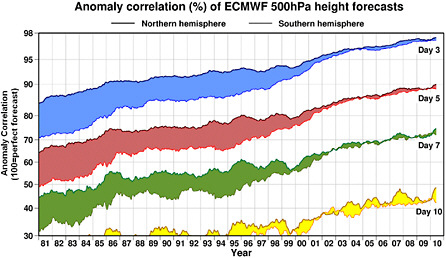
FIGURE 6.1. Evolution of ECMWF forecast skill for varying lead times (3 days in blue; 5 days in red; 7 days in green; 10 days in yellow) as measured by 500-hPa height anomaly correlation. Top line corresponds to the Northern Hemisphere; bottom line corresponds to the Southern Hemisphere. Large improvements have been made, including a reduction in the gap in accuracy between the hemispheres. Identical to Figure 2.1. SOURCE: courtesy of ECMWF, adapted from Simmons and Hollingsworth (2002).
improved by enhancements of the observing network are those where the models have serious biases in the representation of the mean climate.
The earlier sections of this report support the conclusion that ISI forecast quality should continue to slowly improve on average in the future. For example, as operational centers move to more objective methods in translating prediction inputs into issued forecasts (O’Lenic et al. 2008), modest improvements in forecast quality can be expected. The components of the climate system are currently better observed than the tropical Pacific was before the 1980s. It is unlikely, though not impossible, that there are processes with impacts as large as ENSO and the MJO that have not been detected by current observing systems. Similarly, it is unlikely though not inconceivable that available models are failing to simulate some important process that could lead to a revolutionary advance in the quality of ISI predictions. It is more likely that forecasts will improve incrementally with an improved representation or consideration of the sources of predictability (like the MJO or land surface processes); a concerted effort in building better models and better assimilation systems; and, the deployment and use of more observations.
The curves in Figure 6.1 mask one aspect of short-term weather forecasts because they have been monthly-averaged and time-smoothed. There is considerable day-to-day variability in the accuracy of predictions, some of it associated with particular phenomena in the atmosphere.
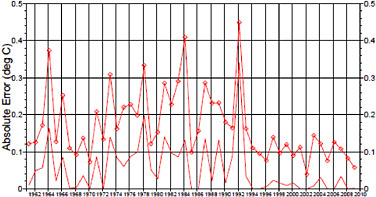
FIGURE 6.2 Time series of Mean Absolute Error (MAE) (thicker line with symbols) for the first three months of NINO3.4 predictions starting 1st February each year. Also shown (thin line, no symbols) is what is referred to as the Best Absolute Error (BAE), which is defined at each lead time as either zero (if the observations lie within the predicted range) or the distance between the observed value and the closest ensemble member, and then averaged over lead times. For a perfect forecasting system with a modest ensemble size, the BAE would be mostly zero, with occasional small positive values. The step change in skill after 1993 is evident. SOURCE: Stockdale et al. (2010), Fig 7a.
In addition, the value of forecasts to users may be far greater in some instances. For instance, the economic value of an accurate 72-hour prediction of hurricane landfall may be far greater than a forecast of fair weather cumulus for the same location. Short-range weather prediction takes advantage of this by committing increased resources to creating and disseminating forecasts of high impact events like hurricanes.
ISI forecasts also exhibit conditional accuracy; for example, forecast quality improves significantly during ENSO events. Forecasts may also be more valuable in certain instances. Given higher predictability and the opportunities as well as catastrophes within the United States associated with ENSO events, a well predicted ENSO event and a reliable forecast of its teleconnections may lead to a very positive net economic impact through reduced disaster losses and increased profits for some sectors (Chagnon, 1999; Goddard and Dilley, 2005). Similarly, MJO events can be intermittent yet have influence over tropical cyclone activity; and thus an accurate MJO forecast can yield valuable foresight into the extremes associated with enhanced or suppressed hurricane activity. More unusual events that impact conditions on intraseasonal and interannual time scales may have even greater economic impact. Unusual events like a major volcanic eruption, the impact of a large body from space, or a nuclear exchange may lead to larger deviations from recent climatology than even the largest ENSO. Producers of ISI predictions could and should be prepared to make short term climate forecasts for such situations (i.e., radical changes in atmospheric composition). Models and forecast generation procedures should be prepared to deal with such events before they happen. Good forecasts of the seasonal
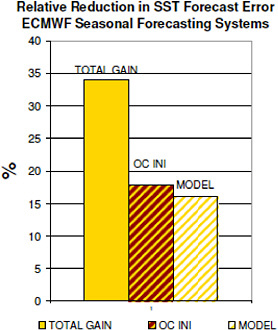
Figure 6.3 Progress in the seasonal forecast skill of the ECMWF operational system during the last decade. The solid bar shows the relative reduction in mean absolute error of forecast of SST in the Eastern Pacific (NINO3). The brown-striped bar shows the contribution from the ocean initialization, and the white-striped bar is the contribution from model improvement. SOURCE: Balmaseda et al. 2009.
response to such unusual events could have far more impact than any forecasts of the undisrupted climate system.
CLOSING REMARKS
The committee’s recommendations constitute a strategy to improve the quality of climate predictions at ISI timescales by expanding access to forecasting data and tools; broadening the suite of verification metrics that are used; enhancing collaboration among the operational, research, and user communities; upgrading the building blocks of the ISI forecast systems, which include observations, statistical and dynamical models, and data assimilation techniques; and pursuing research on incompletely understood processes that can contribute to predictability. This strategy is based largely on the lessons learned from historical improvements in the quality of weather and ISI forecasts.
The recommendations have also been crafted to draw on the respective strengths of operational forecast centers and research scientists in the broader community. Considerable expertise in producing and disseminating forecasts exists at the operational centers. Therefore, Best Practices have been designed with their protocols in mind and they will play an integral role upgrading the building blocks of ISI forecast systems. In contrast, the research community is more focused on experimenting with novel ideas, approaches, and techniques. Their role involves expanding our understanding of ISI processes and the tools that are used to measure and simulate these processes. Communication and interaction between these groups will be critical to the improvement of ISI forecast systems.
Finally, the committee stresses that improvements to ISI forecasting systems and improvements in the use of ISI forecasts are possible. In particular, adoption of Best Practices offers a near-term way to aid forecast users and researchers by enhancing access and transparency to forecast information. Incorporating these practices will facilitate more frequent and valuable interaction among these groups. Over the coming years and decades, there are ample opportunities to improve the building blocks of ISI forecast systems and expand our ability to exploit the sources of variability. Although improvements are unlikely to be revolutionary, a coordinated effort by operational centers and the broader research community is likely to yield positive results over time.


