
1
Introduction
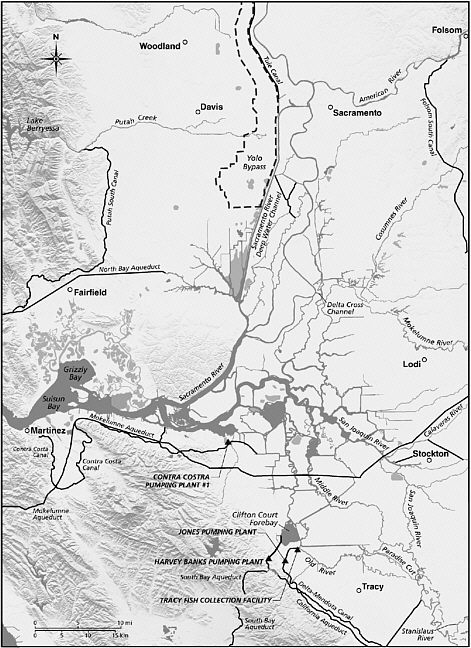
California's Bay-Delta estuary is a biologically diverse estuarine ecosystem that plays a central role in the distribution of California's water from the state's wetter northern regions to its southern, arid, and populous cities and agricultural areas (Figure 1-1). The Bay-Delta region receives water flows from the Sacramento and San Joaquin Rivers and their tributaries, which drain the east slopes of the Coast Range, the Trinity Alps and Trinity Mountains in northern California, and the west slopes of the Sierra Nevada Mountains. Outflows from the Bay-Delta, through San Francisco Bay and into the Pacific Ocean, are met by tidal inflows, resulting in a brackish water ecosystem in many reaches of the Bay-Delta. In addition to its ecological functioning and the ecosystem services it provides, there are numerous withdrawals of freshwater from the Bay-Delta, the largest being pumping stations that divert water into the federal Central Valley Project (CVP), primarily for Central Valley agriculture, and the State Water Project (SWP), primarily for southern California metropolitan areas. Other water is extracted from Bay-Delta waterways for consumptive use within the delta region itself, and for municipal and industrial use around the margins of the delta, and returned to its waterways diminished in quantity and quality. Most former wetland and marsh areas of the delta have been drained for agriculture, and are protected by an aging collection of levees (Moyle et al., 2010). Some of those areas also contain small urban settlements.
This hydrologic and engineered system has met the diverse water-related needs of Californians for decades. But construction and operation of the engineered system, along with the effects of an increasing population of humans and their activities, have substantially altered the ecosystem. Current conditions include altered water-quality and salinity regimes and the magnitude and direction of flows in the delta, with rigorous management of the location of the contour where salinity is 21 (known as X2) through flow releases from upstream reservoirs. Consequent changes in the abundance, distribution, and composition of species in the delta have been compounded by the introduction and invasion
of many species not native to the region.
Recently, several species of native fishes have been listed as threatened or endangered under the federal Endangered Species Act (ESA) and the California Endangered Species Act. This study focuses only on the federal ESA. The federal listings have led to Section 7 (of the ESA) consultations between the operators of the CVP (the U.S. Bureau of Reclamation, or USBR) and of the SWP (the California Department of Water Resources, or DWR) and the Fish and Wildlife Service (FWS), the National Marine Fisheries Service (NMFS), and the California Department of Fish and Game (DFG). Those consultations led to the issuance of opinions by the Services that required changes (“reasonable and prudent alternatives,” or RPAs) in water operations and related actions to avoid jeopardizing the continued existence and potential for recovery of delta smelt (Hypomesus transpacificus), winter-run and fall-run Chinook salmon (Oncorhynchus tshawytscha), Central Valley steelhead (Oncorhynchus mykiss), and green sturgeon (Acipenser medirostris). The impacts of the RPAs on water users and the tensions that resulted have been exacerbated recently by series of dry years. In the longer term, climate change presents uncertainties and challenges with its anticipated impact on precipitation, snowpack, streamflow, and rising sea level, which will affect not only salinity and riparian habitats in the delta but likely also will threaten the integrity of the extensive system of levees (1,100 miles in length).
The RPAs are divided into many separate actions. The RPA in the FWS opinion (FWS, 2008), divided into six actions, focuses primarily on the flow and storage regimes as affected by diversions (pumping water to the south) and on reducing entrainment, with some focus on habitat. The NMFS RPA (NMFS, 2009) is divided into five actions with a total of 72 subsidiary actions. In addition to its focus on flow regimes, storage, and passage, it includes purchasing water to enhance in-stream flow, habitat restoration, a new study of acoustic-tagged steelhead, and development of hatchery genetics management plans. This committee did not evaluate all 78 actions and subsidiary actions in the two RPAs in detail. It spent most of its time on the elements of the RPAs that have the greatest potential to affect water diversions. It also spent time on elements whose scientific justifications appear to raise some questions.
Protecting all the listed species and preserving existing and projected uses of the region’s water is a serious challenge. As the NMFS biological opinion (NMFS, 2009) says, “the current status of the affected species is precarious,” and “it has been difficult to formulate an RPA that is likely to avoid jeopardy to all listed species and meets all regulatory requirements.” Adding to this difficulty is the existence of the many anthropogenic and other factors that adversely affect the fishes in the region but which are not under the direct control of the
CVP or the SWP, and thus are not subjects of the biological opinions2. These include other human modifications to the system, including pollutants; invasive species and altered species composition; and engineered structures such as dams, canals, gates, pumps, and levees.
The complexity of the problem of the decline of the listed species and the difficulty of identifying solutions to it have led to disagreements, including concerns that some of the actions in the RPAs might cause harm and economic disruptions to many water users, and that some of the actions specified in the RPAs to help one or more of the listed species might harm others.
SYSTEM OVERVIEW
Overview of System Hydrology
We briefly describe the Sacramento-San Joaquin delta (Figure 1-1) and the two massive water storage and delivery projects that affect the area. Several publications go into great detail describing the delta and the operations of the federal and state water systems (DWR, 2006, 2009a, 2009b; USBR, 2006).
The Central Valley Project (CVP) operated by the U.S. Bureau of Reclamation and the State Water Project operated by the California Department of Water Resources provide water to farms and cities in an area encompassing the majority of the land and population of California. The two projects constitute the largest agriculture and municipal water-supply system in the United States. Water supplying both projects ultimately comes mainly from California’s two major river systems—the Sacramento and the San Joaquin—with substantial imports from the Trinity River. Water also is stored in several major reservoirs as well, including Shasta (capacity 4.6 million acre-feet3, or MAF), Oroville (3.4 MAF), Trinity (2.4 MAF), New Melones (2.4 MAF), San Luis (2 MAF), Don Pedro (2 MAF), McClure (Exchequer) (1 MAF), and Folsom (1 MAF), as well as many smaller ones. Releases from those reservoirs are used to help manage flows and salinity in the delta, as well as being used for agriculture, municipal and industrial uses, recreation, flood protection, and hydropower.
The CVP provides about 5 MAF of water to agriculture each year (about 70 percent of the CVP’s supply), 0.6 MAF for municipal and industrial (M&I) use
(serving about 2 million people) and 1.4 MAF to sustain fish, wildlife, and their habitats. The SWP provides about 70 percent of its water to M&I customers (about 20 million people) and 30 percent to agriculture (about 660,000 acres of irrigated farmland). The largest SWP contractor is the Metropolitan Water District of Southern California, which receives about 50 percent of SWP deliveries in any one year. At least two-thirds of the population of California depends on water delivered from these projects as a primary or supplemental source of supply. Other important functions provided by both projects include flood protection, recreation, power generation, and water quality to preserve fish and wildlife.
Both projects preceded and accommodated the explosive growth of California’s economy and population. The CVP was begun in the mid to late 1930s and the SWP was begun in the 1960s. Dozens of reservoirs and lakes, pumping facilities, and over 1,200 miles of pipelines and canals make up the two interdependent water-supply and delivery systems.
The Sacramento-San Joaquin Delta
In the middle of both systems and connecting the northern water supply reservoirs and southern water demands is the Sacramento-San Joaquin Delta (Figure 1-1). Thus, the delta is an integral part of the water-delivery infrastructure for both the SWP and CVP. While the focus of this report is the determination of the effects of water allocations for fish, there are many other requirements that must be met in the delta to maintain flows and quality for the many uses of water delivered by the SWP and CVP projects.
Two major pumping plants draw water from the channels and rivers feeding the delta. The SWP pumping plant (Banks Pumping Plant) can deliver an average flow of nearly 6,700 cubic feet per second (cfs) to Clifton Court Forebay for transport to users south of the delta. The Jones Pumping Plant withdraws water primarily from Old River and has the capability of 4,600 cfs to contractors in southern California. Relatively small amounts of water are extracted for the Contra Costa canal (up to 195,000 af or 195 thousand acre-feet {TAF} per year) and the North Bay Aqueduct (up to 71 TAF per year) (FWS, 2008). In addition, diversions occur upstream of the delta. These diversions affect the location of X2, the amount of water that can be withdrawn at the pumps, the flow in the San Joaquin River, and other factors.
THE PRESENT STUDY
The statement of task (Appendix A) charges the NRC committee to review the scientific basis of the Services’ RPAs and advise on how to most effectively incorporate science and adaptive management concepts into holistic programs for management and restoration of the delta. To balance the need to inform near-term decisions with the need for an integrated view of water and environmental management challenges over the longer-term, the committee was tasked to produce two reports. This first report focuses on the scientific bases of the water-management alternatives (RPAs) in the two biological opinions and whether there might be possible alternative RPAs that would be as or more protective of the fishes with lesser impacts on other water uses. The committee also has considered “other stressors,” as specified in its statement of task. These are stressors not necessarily directly associated with the water projects; they are part of the “environmental baseline,” a concept related to the Endangered Species Act that refers to other anthropogenic modifications of the environment. As such, they are not addressed by the RPAs, because RPAs must address operations of the water projects.
In this first report, most of the committee’s focus has been on the question of the scientific bases of the water-management alternatives (RPAs) in the biological opinions, with a smaller focus on potential conflicts between the RPAs, potential alternative RPAs, and other stressors. The committee’s second report will focus on broader issues surrounding attempts to provide more sustainable water supplies and to improve the ecological sustainability of the delta, including consideration of what ecological goals might be attainable.
To prepare this report, the committee met in Davis, California for five days in January 2010. It heard presentations from representatives of federal and state agencies and a variety of other experts, and from members of the public, and began work on the report. The committee was able to consider information received by February 8, 2010. Additional writing and two teleconferences occurred in February, and the report was reviewed according to the NRC’s report-review procedure (the reviewers are acknowledged in the preface).


