
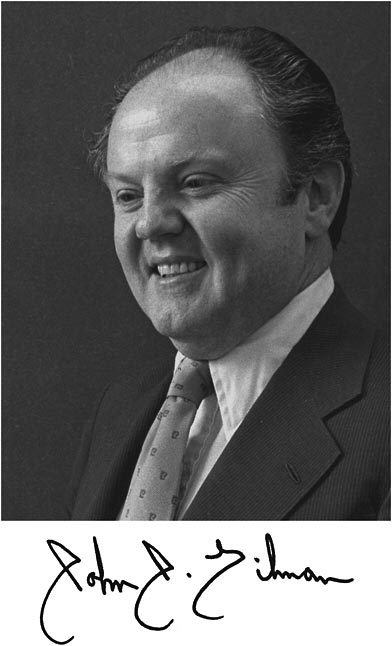
JOHN J. GILMAN
1925–2009
Elected in 1975
“For contributions to dislocation behavior of ceramics, disclination behavior of polymers, leadership in development and production of metal glasses.”
BY JOHN D. MACKENZIE
JOHN JOSEPH (JACK) GILMAN, adjunct professor with the Department of Materials Science and Engineering, Henry Samueli School of Engineering and Applied Science, University of California, Los Angeles (UCLA), passed away on September 10, 2009, at the age of 83.
Jack Gilman was indisputably one of the most renowned materials scientists in the world in the field of mechanical properties of solids. He was born on December 22, 1925, in Green Bay, Wisconsin. He received his B.S. in mechanical engineering in 1946 and his M.S. in 1948, both from the Illinois Institute of Technology. He then proceeded to Columbia University where he received a Ph.D. in physical metallurgy in 1952. After a short stay at the Crucible Steel Company of America where he did research on steels, he joined the General Electric Research Laboratory in Schenectady, New York, in 1952. There he was given total freedom to study the mechanical properties and structure of single crystals.
Jack made good use of his freedom and his talents and started a fundamental research program on dislocations and their role in the deformation of solids. His collaboration with W. G. Johnston and others at General Electric resulted in many publications on dislocations in highly respected journals, such as Philosophical Magazine and the Journal of Applied Physics,
and earned him worldwide recognition as “Mr. Dislocations.” He stayed at General Electric until 1960, leaving to become a professor of engineering at Brown University. In 1963 he transferred to the University of Illinois to become professor of physics and metallurgy. After five years, Gilman left academia and joined the Allied Chemical Corporation as director of the Materials Research Center. At Allied Chemical he made significant contributions to the development and application of metallic glasses. He became director of the Corporate Development Center at Allied Chemical in 1978, leaving in 1980 to become manager of corporate research at Standard Oil Company in Indiana. From 1981 to 1985 he was vice president and director of the Amoco Battery Technology Company. From management of industrial research, Jack moved West in 1985 to become director of the Center for Advanced Materials at the Lawrence Berkeley Laboratory at the University of California in Berkeley. Two years later, after two decades in administrative and management positions in industry and academia, Jack Gilman returned to his first love—fundamental research in materials science. He stayed on at the Lawrence Berkeley Laboratory as a senior scientist, studying the relation between crystalline structure and mechanical properties of solids. In 1993 he joined the Department of Materials Science and Engineering at UCLA as an adjunct professor.
Professor Gilman was a remarkable person not only for his great contributions to scientific understanding of the mechanical properties of all types of materials but also for his ability to successfully manage industrial research and perform outstanding individual research simultaneously. He had continued to contribute scientific papers based on his own theoretical research on materials science while he was a senior manager in industry. And he was publishing papers on management as well! He published over 330 papers of which 73 are on industrial management. Some examples of these papers are: “What Do Good Research Organizations and Good Jazz Combos Have in Common?” (Material Technology, vol. 11, pp. 70-72, 1996); “Six Management Routes to More Productive Research” (Material Technology, vol. 9, pp. 129-131, 1994); and
“Top-Down or Bottom-Up Research Management” (R&D Innovator, vol. 4, pp. 1-4, 1995). His other 257 publications are all on “pure” science and all are first-class works. The topics include metals, ceramics, glasses, semiconductors, polymers, and diamond and nano-materials. There is even an interesting paper entitled “Strength of Spider Silk” (Science, vol. 272, no. 17, 1996). To Jack Gilman there was no impenetrable boundary to scientific understanding of the relationship between structure and mechanical properties of any class of materials. In recent years he devoted some of his talents to the preparation of new super-hard materials such as osmium diboride. In addition to all his publications in many prestigious journals, Jack Gilman was editor and co-editor of three books and the author of four. His research also resulted in the award of five U.S. patents and one British patent.
For all his contributions, Professor Gilman received many honors and recognitions worldwide. He was awarded the C. H. Mathewson Gold Medal of the AIME in 1959 and the A. H. Geisler Award of the ASM in 1957. He was elected a fellow of the American Physical Society in 1969, a fellow of the American Society for Metals in 1971, and a member of the National Academy of Engineering in 1975. He was a principal invited lecturer in Moscow in 1958; in Melbourne, Australia, in 1959; in Cambridge and London, in 1960; in Tokyo in 1962; in Goettingen, Germany, in 1964; in Sendai, Japan, in 1965; in Torino, Italy, in 1967; in Beer Sheva, Israel, in 1972; in Warsaw, Poland, in 1972; in Paris in 1972; in Beijing in 1975; in Zurich in 1976; and again in Tokyo in 1988. He served on many committees of the National Research Council, including the Committee on Ship Steel (1962–1963), the Committee of the Materials Advisory Board on High Strength Materials (1964– 1966), and the Solid State Sciences Committee (1978–1982) .
Despite all the honors he received, all of his contributions to materials science and research management in industry, as shown by his over 330 publications and his books, Jack Gilman was always a quietly modest man with a ready smile. As an adjunct professor of our department at UCLA for 16 years, he continued his theoretical research to the very end. In
addition to our pride of having him as a colleague, he is best remembered as that senior professor who always sat in the front row at all our departmental seminars every Friday and asked every lecturer the most penetrating questions. Many students informed me that Professor Gilman’s questions for the seminar speakers and the resultant discussions were the best education they had received in materials science. We at UCLA will miss him and the materials science and engineering community worldwide will miss his brilliant theoretical research.
He is survived by his children, Pamela, Gregory, Cheryl and Brian; as well as his stepchildren, Kathy, John and Nicholas.


