
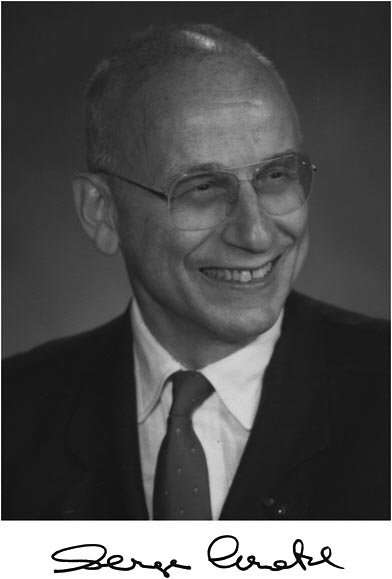
SERGE GRATCH
1921–2007
Elected in 1983
“For contributions to the thermodynamic properties of gases, development of successful automotive exhaust control systems, and utilization of alternative fuels.”
BY JULIUS J. HARWOOD
SERGE GRATCH, a much-honored member of the engineering profession, died December 4, 2007, at the age of 86. His career achievements and honors reflect a life of dedication and commitment to the advancement, innovative capabilities, and high standards of the engineering profession. His career spanned more than five decades in scientific research, in engineering developments, in research and development technical management, and as a university professor. He made distinguished contributions to such diverse fields as thermodynamic properties of gases, polymer science and synthesis, successful automotive exhaust control systems, alternate fuels, and engineering education. In the decade prior to his death, he retired first from the Ford Motor Research laboratory as director of Vehicle, Powertrain and Component Research and subsequently as professor emeritus from Kettering University (formerly GMI—General Motors Engineering and Management Institute).
Serge was born on May 2, 1921, in Monte San Pietro (Bologna), Italy. His father was a country doctor, and his mother was a homemaker with a degree in chemistry from the University of Bologna. He originally studied pre-med, but in 1939 Serge and his family emigrated to the United States to escape from the growing power and tyranny of the Fascist party. He became a naturalized U.S. citizen on February 21, 1945.
He enrolled at the University of Pennsylvania and received his bachelor’s degree in chemical engineering (1942), followed by a master’s degree (1945) and doctorate in mechanical engineering (1950). For the year following his Ph.D., he was an assistant professor at the University of Pennsylvania. In the early 1940s he had worked as a laboratory assistant under Professor John Goff, then dean of the Towne Scientific School, with whom he developed a formulation of the thermodynamic properties of moist air that was adopted in 1947 as an international standard and retained that status for more than 30 years.
Serge joined Rohm & Haas Company as a senior research scientist in 1951. Among the broad range of studies he carried out there was the discovery (with a colleague T. G. Fox) of crystallizable polymethyl methacrylate, which led to a successful application market in the automotive industry.
In 1959 he again turned to academia as an associate professor in mechanical engineering at Northwestern University.
Serge made his next move in 1961, accepting a position in research management in the scientific laboratory of Ford Motor Company. His “tenure” at Ford lasted until 1986, when he retired. During that 25-year period, he was engaged in directing a variety of research departments involving chemical processes and devices, electrical and electronic devices, fuel sciences, polymer sciences, and chemical and materials science research, and he eventually became director of Vehicle, Powertrain and Component Research—a tribute to his broad range of technical expertise and interests.
The 1970s were turbulent times for the U.S. automotive industry, with the introduction of governmental requirements for emissions control and fuel economy standards. Serge Gratch played a key role in these areas, directing the Ford research programs on engine exhaust catalysts and being responsible for coordinating Ford’s worldwide research and development activities in this area. He also initiated a Ford program on alternate fuels (having previously initiated and led the company’s electric car research program in the 1960s). Serge often was called to testify before various governmental bodies on matters of concern to Ford in these and related areas.
As a personal aside, Serge and I joined Ford within a year of each other, and we both retired from Ford in the early 1980s. During that period it was our privilege and pride for the Ford Research Laboratory to develop into one of the nation’s outstanding industrial research laboratories, with a worldwide reputation for the contributions of the talented cadre of scientists and engineers who joined the laboratory. We aspired to fulfill the vision of Henry Ford II to create a “Bell Laboratory of the automotive industry.” It was a most stimulating and exciting professional experience.
Closely coupled with Serge’s busy work schedule was his deep commitment to service for the professional engineering societies. He joined the American Society of Mechanical Engineers (ASME) in 1944 and, over the ensuing years, participated in numerous technical and policy committees. To cite a few, he served on the ASME Committee on Honors, the Policy Board, the Board of Governors, and the Board of Trustees of the ASME Foundation and he served as president of ASME from 1982 to 1983. A long-lasting contribution was his chairmanship of the ASME Committee on Planning and Organization; he helped implement the recommended new organization structure as president of ASME. He was elected a Fellow of ASME in 1968 and became an Honorary Member in 1980. A proponent of expanding technological literacy into liberal arts education, Serge’s inaugural address as ASME president called for a new breed of engineer, committed to lifelong learning, whose education and knowledge would cut across the traditional engineering and scientific disciplines. I am tempted to write that there may not have been a major activity of ASME that did not carry the brand of Serge Gratch in some way.
Serge also was active in the Engineering Society of Detroit and the Society of Automotive Engineers, becoming a Fellow of both organizations, and he also was an active member in the American Association for the Advancement of Science. Both the Coordinating Research Council and the Automobile Manufacturers Association relied on his expertise on alternate fuels, combustion research, and air pollution studies.
In 1979 Serge was appointed by President Carter to membership on the National Alcohol Fuels Commission. He was a member of the National Materials Advisory Board and served on various study committees of the National Research Council.
As might be expected, Serge also served on several academic advisory committees, including for his alma mater, the University of Pennsylvania.
Serge Gratch’s accomplishments and recognition yielded numerous honors and awards, including the University of Pennsylvania’s Alumni Award of Merit and its D. Robert Yarnell Award, the Outstanding Leadership Award (twice) from the Engineering Society of Detroit, the Outstanding Teaching Award from Kettering University/GMI, and the ASME Internal Combustion Award. He also was the recipient of two of the highest awards in the engineering community: in 1983 he was elected to the National Academy of Engineering, and in 1992 he received the John Fritz Medal from the American Association of Engineering Societies (for scientific or industrial achievement in any field of pure or applied science).
Serge closed his career by returning to where he had started: academia. He became a professor of mechanical engineering at Kettering University and took special delight in teaching and motivating the young minds of future engineers.
Serge is survived by his wife of 57 years, the former Rosemary A. Delay, and their 10 children and 13 grandchildren, two of whom are adopted—processes that were begun before Serge’s death, but which dreams he did not get to see come true. He often was teased by his colleagues for his contribution to the feminist movement with the biased distribution of his nine daughters and one son.
Serge Gratch led a busy and productive life dedicated to the teaching and application of science and technology for national and industrial betterment, combined with a deep commitment to his family and the service of the engineering profession, his government, and his students.


