
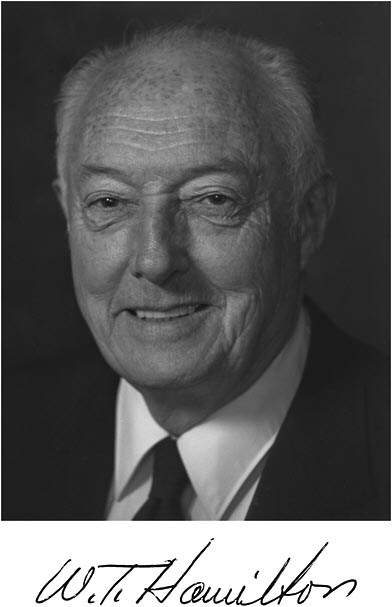
WILLIAM T. HAMILTON
1917–2002
Elected in 1978
“For contributions to the aerodynamic development of jet transports.”
BY JOHN WARNER AND PHIL CONDIT
BILL HAMILTON passed away on February 16, 2002, in Tacoma, Washington. His colleagues at Boeing affectionately noted that the W and T stood for Wind Tunnel, in recognition of his prowess as an aerodynamicist. This was to distinguish him from another Boeing engineer, William L. Hamilton, an accomplished engineering leader known as “Water Line” Hamilton. “Wind Tunnel” Hamilton was known to his colleagues as “Hammy.”
Born in 1917 in Pennsylvania, Hamilton grew up in Mt. Vernon, Washington. As a young boy he demonstrated an extraordinary aptitude for the principles of flight by building box kites. To test the capability of one box kite, he and a friend sent a neighbor’s small dog into the air. It landed safely, as did a kite that carried a lantern.
He earned his bachelor’s degree in engineering from the University of Washington in 1941. His first engineering job was at the National Advisory Committee for Aeronautics (the forerunner of the National Aeronautics and Space Administration, NASA) wind tunnel at Moffett Field, California, where he tested almost every new military plane
designed during World War II. He worked out aerodynamic kinks in what became the nation’s premier fighter, the P-51. After going back to the University of Washington for his master’s degree, Hamilton accepted a job at Boeing in 1948, where business was in decline following the war.
During his 32-year tenure at Boeing, Hamilton worked on many of the company’s top programs, from the B-52 bomber to the 767 jetliner. His best-known engineering achievements came in the area of wing design, particularly on the company’s longtime workhorse airliner, the 707. His successful wing design for an enlarged 707 enabled Boeing to compete against the Douglas DC-8. Hamilton managed Boeing’s supersonic transport program, where he made a major contribution by simplifying the wing design.
During the 1970s, Hamilton was vice president and general manager of the Aerospace Group’s Research and Engineering Division, where he was responsible for planning and execution of all the company’s technical and advanced product development. He made significant contributions to Boeing’s space shuttle design, IUS, YC-14, and the Large Space Telescope, now the successful Hubble Space Telescope. In 1974 he was designated a vice president of the Boeing Aerospace Company and later ran research and development for the Boeing Commercial Airplane Company.
Hamilton was a fellow of the American Institute of Aeronautics and Astronautics and a member of the NASA Aeronautics Advisory Committee, the Defense Intelligence Agency’s Scientific Advisory Committee, and the Atlantic Groups Aerospace Research and Development Flight Mechanics Panel. He was inducted into the National Academy of Engineering in 1978 for “contributions to the aerodynamic development of jet transports.” He served on the Panel on Constraints in Space Shuttle Launch Rates in 1982 and the Panel on Atmospheric Vehicle Technology in 1987.
“What’s the good word?” and “Small matter” were expressions employed commonly by Bill and which reflected his naturally optimistic and nearly unflappable nature. His wise and genial bearing was a constant source of strength and
comfort to his family. Little known by his peers, his dream of becoming a professional Disney cartoonist gave way to his passion for aerodynamics. His skill as an artist is still evident in drawings given to friends and family over the years.
Devoted to his wife and children, he shared with them his love of nature and the outdoors on frequent camping trips and other adventures. In his earlier years he was an avid mountain climber, scaling most of the major peaks in Washington’s Cascade Mountains. Fishing was another favorite pastime for him. The family kept a beachfront weekend and summer home, and plenty of boats—from dinghy to cabin cruiser.
A genuine fan of sports, and having been active in track events in his youth, he and his wife rarely missed attending University of Washington football games, both having attended school there where they met on a blind date, marrying in October of 1941.
He is survived by his wife, Ida Mae of Tacoma, Washington; a son, Richard of Copalis Beach, Grays Harbor County; daughters Janet of Portland and Nancy of Tacoma; and a grandson Chris of Tacoma.


