
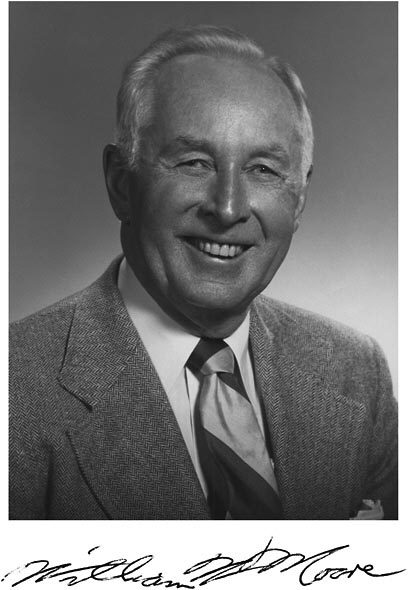
WILLIAM W. MOORE
1912–2002
Elected in 1978
”Pioneering in the field of geotechnical engineering contributing to knowledge of earth sciences.”
BY ROBIN K. MCGUIRE
WILLIAM WALLACE (BILL) MOORE passed away on October 23, 2002, at the age of 90. Born in Pasadena, California, in 1912, he attended the California Institute of Technology, where he received a B.S. degree in 1933 and an M.S. degree in 1934, both in civil engineering. Following graduation he worked for several years for the U.S. Coast and Geodetic Survey and for other consultants before he founded the consulting engineering firm of Dames & Moore in 1938, in partnership with Trent Dames, another CalTech graduate.
Bill realized early on that structural engineers designing foundations for buildings and retaining walls needed to know more than soil mechanics to make informed decisions and recommendations. At the time, in 1938, soil mechanics consisted of determining soil characteristics such as grain size and shape, density, and water content that could be used to estimate the bearing capacity of the soil under load. He recognized the need for soil engineering, by which he meant the analysis and design of alternative foundations (e.g., spread footings, wood piles, steel piles, and concrete piles), as a basis for making decisions on estimated settlements, ease of construction, integration with the superstructure, and cost. In pursuing Bill’s vision of soil engineering, Dames & Moore specialized in soil testing, sampling, and analysis that provided information to support the evaluation of alternative foundation designs.
Under Bill’s supervision, new soil sampling methods were invented, developed and used on project sites. These included leaf samplers, ring samplers, and piston samplers that could be applied in a drill hole. By today’s standards, these tools did not produce “undisturbed samples,” but he characterized the samples as “sufficiently undisturbed to make laboratory tests usable” in determining soil strength. Dames & Moore patented one of their early leaf samplers and sold versions of it to other engineers. The sampler is still in use, and its fundamental design is still considered one of the best for obtaining quick, down-hole soil samples.
During World War II, Bill was a consultant to the Naval Construction Battalion in the Middle East. The challenge was to develop a soil-sampling technique for Seabees moving into an area ahead of occupying armed forces that would enable the Seabees to build landing strips for airplanes quickly. Some landing strips had to be built on beach sands, where construction decisions had to be made in a matter of hours. Bill developed a portable ring sampler/analyzer that could be run by hand, and the results could be used to make immediate engineering decisions on the suitability of existing materials for airstrips and on compaction techniques for building airstrips quickly.
Bill also developed methods of calculating allowable loads on pile foundations that accounted for both end bearing and skin friction of the piles. A strong component of these methods involved testing, both of test piles and actual piles used in foundations. For the latter, settlement measurements were taken to substantiate and improve estimation techniques. Bill realized that standard penetration tests and pile-driving data did not necessarily indicate the ability of a pile to carry static load for long periods of time.
Bill was a strong proponent of a close relationship between the soil engineer and the contractor to ensure that recommendations on foundations would not be made without field experience. In the 1950s and 1960s, newly employed engineers at Dames & Moore were obliged to spend time in the soil laboratory and on field-drilling and soil-sampling
jobs. With his penchant for field experience and client contact, Moore became known as “Mr. Outside” at Dames & Moore; Trent Dames fulfilled the role of “Mr. Inside,” the one who handled the firm’s management and administration.
From a two-person firm in 1938, Dames & Moore grew to be one of the preeminent geotechnical engineering firms in the world. By 2000, the company had grown to 6,000 employees and 100 partners, reflecting the importance Bill placed on innovative and imaginative solutions to engineering problems and on motivating employees to pursue those solutions. He gave his employees wide latitude to pursue new business areas, whether in different parts of the world or in new engineering applications related to site investigations. As a result, his staff was incredibly loyal. He was a strong leader and mentor who help mould the careers of young engineers with an ethic of responsibility and informed decision making for clients.
During World War II, Bill had been a consultant to Standard Oil of California in its operations in Saudi Arabia, assisting with the siting and geotechnical development of the first refinery at Ra’s al Tann rah. This experience led to consulting with other oil companies in the Middle East following the war. In the mid 1950s, he recognized the potential of working for other industries internationally, and Dames & Moore expanded its efforts to obtain overseas projects, frequently supporting U.S.-based clients in building overseas facilities.
Bill placed a high priority on building client relations, because, he said, the easiest job to obtain is a repeat job from a satisfied client. He did not have a sales department in his engineering firm because he believed engineers were the best salespeople for their work. His advice to them was to sell engineering services based on the problems to be solved, not on the basis of competitive bidding or lowest cost. His favorite example was that, although any engineer could develop a quick, cheap, generic design for a foundation, that design would be more conservative and expensive to construct than the design by an engineer who could perform site tests and design a foundation for the specific conditions at hand. The total cost of the site-specific design and foundation construction
would be less than that of the generic design and foundation construction, and it was the engineer’s role to explain the cost savings in construction and overall life cycle to a potential client.
As the firm’s reputation grew, Bill himself developed a reputation as an innovative soil engineer, and this was reflected in his election to the presidency of many engineering organizations: the Structural Engineers Association of California (1947), San Francisco section of the American Society of Civil Engineers (1957), American Consulting Engineers Council (1964), and Federation Internationale des Ingenieurs Conseils (1970). For the latter organization, which is based in Europe, he was the first American to serve as president. In 1981, he was the first recipient of the Arthur M. Steinmetz Award from the American Consulting Engineers Council, in recognition of his distinguished career in consulting engineering. For his contributions to geotechnical engineering, he was elected to the National Academy of Engineering in 1978. In professional organizations, he continued to promote his view that consulting engineers are expert advisors and must remain independent of any particular construction technique, material, or design method. In this respect they differ from engineers working for a particular industry or fabricator, whose job is to promote certain solutions to engineering problems. Bill believed that engineering educators should promote an understanding among students that consulting engineers are responsible for evaluating a wide range of alternative solutions when working for clients and that consulting engineers must aggressively guard their independence and ethical reputations.
In addition to engineering consulting, Bill Moore had a deep interest in public policy decisions and how engineers could contribute to the making of those decisions. Most of the issues that affect our lives have an engineering component, he said, but most engineers, because of training or psyche, do not have the patience or temperament to participate in the often lengthy negotiations associated with developing public policy regarding the environment, land use, health regulations, and
so on. He was an early advocate of sustainable development, but had little patience for those who took extreme positions that were not economically viable or who had a very short-term perspective to maximize economic return. “The engineer has to listen to other people and help bring things together toward a workable consensus,” he said. “The process requires some compromises, while keeping in mind the ultimate objective—a sustainable world.”
Mr. and Mrs. Moore are survived by their three children, Susan, Bill, and Roy, and eight grandchildren.
Bill and Susan wrote that:
While Bill was a consummate professional and world traveler, he was also a devoted husband, father and grandfather. Genie and Bill had three children and eight grandchildren. His children Susan, Bill, and Roy remembered their father’s deeply held values and that their parents passed on the importance of honesty, integrity, and service–“giving back”–to their children. Bill loved boating on San Francisco Bay and spent many happy and adventuresome hours with his family and friends on small boats.
Bill was a natural leader, a fair and fierce competitor and a creative thinker. And he was not afraid to change his mind if someone else’s idea was better in any situation. He enjoyed a vigorous and healthy exchange of ideas. The well known twinkle in his eye revealed his great pleasure with life.


