
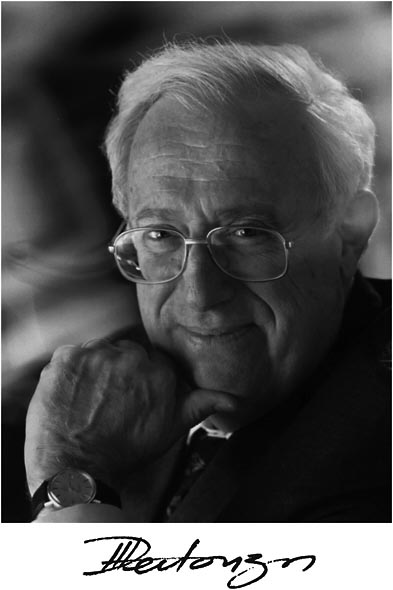
MICHAEL L. DERTOUZOS
1936–2001
Elected in 1990
“For creative leadership in computer science, technology, and education.”
BY VICTOR ZUE
MICHAEL LEONIDAS DERTOUZOS, professor of electrical engineering and computer science and longtime director of the Laboratory for Computer Science at the Massachusetts Institute of Technology (MIT), died on August 27, 2001, at the age of 64.
Michael was born on November 5, 1936, in Athens, Greece. His father was an admiral in the Greek navy and his mother was a concert pianist. These facts help explain both his lifelong love of sailing and his great interest in renaissance and baroque music. Upon graduating with a gymnasium diploma from Athens College in 1954, Michael moved from Athens to the Ozarks, having received a Fulbright scholarship to study electrical engineering at the University of Arkansas, where he received a bachelor’s degree in 1957 and a master’s degree in 1959. He then completed his Ph.D. in electrical engineering at MIT in three years (1964), having written his doctoral thesis on threshold logic. He immediately joined the faculty as an assistant professor.
Michael stayed at MIT for the rest of his life; he was promoted to full professor in 1973, and he was named the inaugural holder of the TIBCO Chair professorship in 2001. Michael’s early teaching led to a two-volume co-authored text in 1972 integrating fundamental subjects in electrical engineering with computation. For this work he won the Terman Education Award in 1975, given to the best educator in all fields of engineering under 40 years of age.
Outside MIT, Michael gained experience as an entrepreneur by founding Computek, in 1968, to manufacture and market one of the earliest graphical display terminals based on one of his patents. He later became Computek’s chairman of the board and introduced the first intelligent terminals.
In the early 1970s, Michael switched to computer science and joined Project MAC, which had been established by the U.S. Department of Defense at MIT in 1963. Project MAC set out to change the computational landscape with the development of time-shared computers and MULTICS, which laid the foundation for many of today’s basic design concepts for software systems. In 1974, Michael was appointed as its fourth director. He renamed the project a year later as the Laboratory for Computer Science, or LCS, emphasizing the long-term nature of the research being undertaken by the laboratory. He stayed on as director of LCS for 26 years, until his death.
Michael was elected to the National Academy of Arts and Sciences in Greece in 1980. In 1990 he was inducted into the U.S. National Academy of Engineering for “creative leadership in computer science, technology and education.” He received honorary doctorates from the Aristotelian University and the National Technical University in Greece.
Michael: The Visionary
Michael was first and foremost a visionary who spent much of the last quarter of the 20th century studying and forecasting future technological shifts. He had uncanny foresight, which he explained as the result of filtering his wildest technical imaginations through the sieve of human utility. Michael often thought of things years before anyone else did. For this he sometimes suffered premature ridicule. But he was invariably vindicated as time progressed.
In 1976, for example, he predicted that by the mid-1990s three out of every four homes would have desktop computers, which we now call PCs. As another example, in 1980 he wrote and spoke about the information marketplace, in which hundreds of millions of computers would be interconnected through a worldwide network, enabling billions of people to
buy, sell, and freely exchange information. It took nearly 20 years for the Internet and the World Wide Web to revolutionize the world economy and to prove him right. As Moore’s law begins to run its course in the next decade, it will soon become obvious that we need to seriously exploit distributed computing, which was a passion of Michael’s since the 1970s.
Michael: The Leader
Michael is most remembered by lab members for his unique style of leadership. With his 6-foot 4-inch frame, Michael was an imposing figure whenever he entered a room. But he also had the rare gift of bringing people together to tackle complex problems, injecting energy and passion into the process and offering his insights and criticisms while preserving the dignity of his colleagues. All this he did with flair, often accompanied by food and festivities. In his opinion, we are never simply working. Rather, we are always having fun while being productive.
Regarding leadership, he was fond of quoting the Chinese philosopher Lao-zi: “Under the best leader, the subjects are hardly aware of his existence. Next are the leaders who inspire reverence and praise. Finally there are the leaders who are feared and despised.” Lao-zi went on: “If a leader fails to inspire trust, then there must be cause for the distrust. A true leader can make things happen naturally, without the need for order or edict. When a true leader achieves success, he leads the subjects into believing that they did it all by themselves.” For nearly three decades, LCS flourished under Michael’s supreme leadership and the influence of his seemingly invisible hand.
Michael: The Technologist
Under Michael’s leadership, LCS developed many of the technologies that underlie today’s computer and information industry. Michael was a master at marshaling technical teams to bring coherence out of chaos. Two examples come to mind. The first concerned the development of the X Window system. The concept of windows in computer interfaces grew out of research at Xerox PARC in the 1970s. At MIT this notion was
incorporated into the UNIX system and was first released in 1984 under the name “X Window.” In 1988 Michael formed the “X Consortium” to produce a standard X Window system that would operate across computer platforms and operating systems. To this day, X Window continues to be a standard way of working across networked computers running Microsoft Windows, Mac OS, Unix, or Linux.
When the World Wide Web first started to take off, Michael conceived of a consortium in which member companies could work together to set standards, using academia as a neutral ground where decisions could be made. He persuaded the inventor of the World Wide Web, Tim Berners-Lee, to come to MIT and lead this effort. Since the mid-1990s, the World Wide Web consortium has been the leading force in maintaining coherence in the Web, providing standards for interoperability so that a multitude of browsers can access information from many different servers.
Michael: The Educator
Michael played a large role in bringing information technology into education at MIT. In 1982, for example, he co-founded a major educational project called Project Athena (named, following Michael’s suggestion, after the Greek goddess of wisdom). The goal of Project Athena was to provide campus-wide computing infrastructure for education. Michael was instrumental in recruiting industrial participation, and he was on the executive committee for Project Athena for several years.
Michael was a quintessential teacher, and he taught in the most effective and endearing ways, through inspiration, by example, and always with passion. In his final interview, printed in the Chronicle of Higher Education a few days before his death, Michael spoke about the qualities that he valued most in teachers—qualities that were a fundamental part of his own approach to his interactions with the MIT community. In explaining his skepticism of computer-based distance education, Michael said, “Don’t forget the impact that love has on education. If you are loved by your teacher—and I
mean this in the most innocent and platonic sense—if your teacher really cares for your well-being—and you know that, because your teacher will ask about you, will scold you for not doing the right thing, and will give you stories about why you should do this or do that—the learning can be unbelievably different.”
Michael: The Humanist
Throughout his career, Michael had always been interested in not only the development of computing and information technology but also the impact of technology on humans. Bill Gates, former chairman and chief software architect for Microsoft, said this about Michael: “More than anyone else in his field, Michael understood that technology—particularly computer technology—must serve people’s needs, not the other way round. He was the first real ‘technology humanist’—he believed that technology was largely worthless unless it truly enhanced human life, human communication, human work and play. He would often talk about his childhood in Greece, and I remember how passionate he was about what technology could do for countries such as his own.”
Michael was the author of eight books. His last book was entitled The Unfinished Revolution: Human-Centered Computers and What They Can Do for Us. In the book he expressed his frustration with the gap between the humanistic promise that he had seen for computers and how things have turned out in the commercial world. Rather than being content as a critic, Michael decided to do something about it, and led the faculty and researchers of LCS and the artificial intelligence lab to create Project Oxygen, which is intended to make computers easier to use—“as natural a part of our environment as the air we breathe.” He assembled an international team of corporate partners to form an alliance with MIT. Project Oxygen and pervasive human-centered computing together were his final legacy—a revolution unfinished.
Michael is survived by his wife, Catherine; two children from a previous marriage, Leonidas and Alexandra; and one granddaughter, Kiera.


