
CHAPTER THREE
Regulatory Context for Coalbed Methane Produced Water Management
The legal and regulatory framework governing coalbed methane (CBM) produced water management in the western United States is complex, consisting of a set of interleaved federal, tribal, and state laws and principles of water rights within which CBM projects operate. In the six states identified for this study (Colorado, Montana, New Mexico, North Dakota, Utah, and Wyoming), CBM may be developed on federal, state, tribal, or private lands. Each of the six states has different regulatory approaches toward CBM permitting and produced water management. Similarly, several tribes with lands within or adjacent to basins with active CBM development have taken different approaches toward CBM production, management of CBM produced water, and/or regulations to mitigate potential impacts of CBM produced water.
This chapter reviews the significant statutory and regulatory provisions that address the management of CBM produced water in the six western states, with an aim to provide a foundation to understand the regulatory challenges of managing CBM produced water. Several recent changes to the regulatory framework affecting CBM operations in several states took place during the course of this study and the permitting processes for CBM production and CBM produced water management are continuing to evolve. The recent changes that have been made are discussed because they exemplify the complexities and challenges of managing CBM produced water and offer insight toward the way in which federal, tribal, and state governments may be considering how to manage CBM produced water in the future.
Much of the material compiled for this chapter derived from the compendium on water rights laws in 19 western states by Hutchins (2004). Two other broadly encompassing references regarding water law, western CBM production, and CBM produced water
management are Bryner (2002) and the Produced Water Management Information System (PWMIS).1 Other references are cited where applicable.
WATER RIGHTS IN THE UNITED STATES
The legal framework for water rights substantially influences the management of all produced water in the western United States, including produced water from CBM activity and from conventional oil and gas production. This section briefly describes the basic water rights laws that are applicable to a broad range of produced water issues, including those specific to CBM activities.
Water rights and water allocation programs in the United States are primarily governed by individual states and tribes. No national water rights system exists. Generally, two divergent systems are used to administer water rights at a state level. Riparian water rights2 are more common in the eastern states. In the western states a system of prior appropriation water rights is generally applied and water rights are treated in a similar way to rights to real property: rights to water are established by actual use of the water and are maintained by continued use and need. Water rights in the western states thus can be conveyed, mortgaged, transferred, and encumbered independent from the land on which the water originates or on which it is used, as dictated by state-specific water management regulations.
Indian water rights are defined and governed by federal law that recognizes Indian tribes’ property and sovereignty rights to the water on their lands and water designated as reserved for tribal use into perpetuity. Most Indian water rights are based on Winters v. United States of 1908 (207 U.S. 564, 28 S. Ct. 207, 52 L. Ed. 340).3 Application of this ruling, as with the principle of prior appropriation for the states (see below), has been affected by developments in tribal regulation, federal legislation, and case law during the past century.
Each state has its own variations on the basic principles of prior appropriation, depending on custom, culture geography, legislation, and case law (see Table 3.1). In general, a water right is established by obtaining an authorization for use of a specified amount or term of use of water, through a state-issued water rights permit. The essential elements of a water rights appropriation are the diversion of water from its principal source and its application to a beneficial use. A diversion may be made by merely removing water from its natural course or location or by controlling water that remains in its natural course. Irriga-
|
1 |
See www.netl.doe.gov/technologies/pwmis/index.html (accessed March 4, 2010). |
|
2 |
A system of allocating water among those who own land that physically touches the water body is based on the principle that land owners have the right to make reasonable use of the water. The water may be used as it passes through the property of the land owner, but it cannot be unreasonably detained or diverted, and it must be returned to the stream from which it was obtained. See www.blm.gov/nstc/WaterLaws/appsystems.html (accessed March 4, 2010). |
|
3 |
Available at supreme.justia.com/us/207/564/ (accessed July 8, 2010). |
tion, mining and industrial applications, stock watering, and domestic and municipal use, for example, are commonly recognized beneficial uses. Exercising the water rights permit and using the water for a beneficial purpose formally creates a legal right to the water.
The underlying principle under prior appropriation doctrine is that water and its rights are allocated on a “first in time, first in right” basis. The earliest water users have priority over later water users (“appropriators”) during times of water shortage, and water diversions and beneficial uses are fully allowed, in order of seniority of the water right, until the available water supply is exhausted. The concept of establishing a “priority date”—the date when the first water user obtains priority over other users—is thus very significant. Interstate water rights agreements, such as the Colorado River Compact, the Upper Colorado River Basin Compact (see Appendix E), and the Yellowstone River Compact of 1951 are illustrative in this connection. The Yellowstone River Compact (Pub. L. No. 82-231, 65 Stat. 663) forms the basis of ongoing claims related to the impacts CBM development on the water rights of Montana and the Northern Cheyenne Tribe under the Compact (see also Appendix F) (SCOTUS, 2010).
Beneficial use of water is a fundamentally important consideration in western water law under which public waters are obligated to be used for a useful or beneficial purpose. The appropriator can use only the amount of water presently needed, allowing excess water to remain in the stream. Generally, once the water has served its beneficial use, any waste or return flow is required to be returned to the stream. To change either the point of diversion or the point of use of the water, a modification to an existing permit is often required. In this context the concept of “instream flow” also becomes important. Instream flow is defined as the amount of water flowing through a natural stream course required to sustain the instream values at an acceptable level. Instream “values” and/or beneficial uses may include protection of fish and wildlife habitat, migration, and propagation; recreation activities; navigation; hydropower; waste assimilation (water quality); and ecosystem maintenance. Water requirements adequate to maintain all of these uses at an acceptable level are the “instream flow requirements.”4 Each state considered in this study addresses the issue of instream flow in a slightly different manner: Wyoming, Colorado, and Utah recognize beneficial uses for some instream flows and have specific provisions and state agencies responsible for addressing instream flow issues; in Montana and North Dakota, beneficial uses for instream flows are not explicitly defined, although cases may be decided at the discretion of state agencies overseeing this water resource; and New Mexico does not recognize instream flow as a beneficial use at this time (Table 3.1).5 The relevance of instream flow for CBM produced water relates to managed discharge of some CBM produced water into perennial and ephemeral streams.
|
4 |
See www.fws.gov/mountain-prairie/wtr/water_rights_def.htm (accessed March 9, 2010). |
|
5 |
See www.blm.gov/nstc/WaterLaws/stateflowsummary.html (accessed March 9, 2010). |
TABLE 3.1 Approaches to Administering Water Rights and Managing CBM Produced Water in Six Western States
|
|
North Dakota |
Montana |
Wyoming |
|
Water rights doctrine |
Prior appropriation doctrine; all water is property of public, with water rights allocated for beneficial uses |
Prior appropriation doctrine; all water is property of the state of Montana, to be used for the benefit of the people |
Prior appropriation doctrine; all natural waters within the state are property of the state, with water rights allocated for beneficial uses |
|
Designated beneficial uses |
Includes domestic, municipal or public, livestock, irrigation, industrial (including mining and manufacturing), fish, wildlife, and recreational activity uses |
Defined as a use of water for the benefit of the appropriator, other persons, or the public; including, but not limited to, agriculture, commercial, domestic, dewatering, erosion control, fire protection, fish and fish raceways, geothermal, industrial, irrigation, mining, municipal, navigation, power, pollution abatement, recreational uses, sediment control, storage, stock water, waterfowl, water lease, and wildlife |
Recognized beneficial uses include irrigation, municipal, industrial, power generation, recreational stock, domestic, pollution control, instream flows, and miscellaneousa |
|
Groundwater policy |
Prevent the contamination of public water supplies, including surface and groundwater sources |
Groundwater use in declared “controlled groundwater basins” (e.g., Powder River Basin) is governed by specific regulations to protect limited or declining supplies |
Surface water and groundwater are treated as hydrologically separate; however, if upon investigation, a hydrological connection is found between the two sources, the water use is treated as one source |
|
Utah |
Colorado |
New Mexico |
|
Prior appropriation doctrine; all water is property of public, with water rights allocated for beneficial uses |
Prior appropriation doctrine; although water is considered to be the property of the state, a property right exists in the priority to use water |
Prior appropriation doctrine; all natural waters within the state are declared to be public and subject to appropriation for beneficial use |
|
Agriculture, culinary, domestic, industrial, irrigation, manufacturing, milling, mining, municipal, power, stock watering, instream flow (recreation and preservation of the natural stream environment), storage (including water supply, aquatic culture, and recreation) |
Statutorily defined as “the use of that amount of water that is reasonable and appropriate under reasonably efficient practices to accomplish without waste the purpose for which the appropriation is lawfully made.” Specific uses are not designated but have included aesthetics and preservation of natural environments, augmentation, commercial, domestic, fire protection, fishery, geothermal, groundwater recharge, industrial irrigation, livestock, minimum flow, municipal, power, recreation, silvicultural, snowmaking, wildlife watering, wildlife habitat, instream flow |
No official state designations; however, beneficial uses in the past have included agriculture, commercial, domestic, industrial, recreational uses, state conservation goals, and stock watering |
|
State divided into “groundwater areas;” policies are similar to surface water, but permit approval criteria may differ by area |
Must obtain permit from State Engineer to drill a well; if “tributary” to a surface stream, use of the groundwater falls under the prior appropriation system, and water rights must obtained; in nontributary aquifers the water is allocated based on the percentage of land owned on the surface above the aquifer |
The State Engineer establishes and regulates water use in declared “underground water basins” to protect prior appropriation, ensure water is put to beneficial use, and maintain orderly development of the state’s water resources |
|
|
North Dakota |
Montana |
Wyoming |
|
Agency responsible for water rights |
North Dakota State Water Commission, through the Office of the State Engineer |
District court (for all pre-July 1, 1973, water rights) and the Water Resources Division of the Montana Department of Natural Resources and Conservation (for all post-June 30, 1973, water appropriations) |
State Engineer’s Office. Four regional water division superintendents and the State Engineer comprise the Wyoming Board of Control, which meets quarterly to adjudicate water rights and to consider water rights matters |
|
Agency responsible for produced water management and permitting |
North Dakota Department of Health, Environmental Health Section: oversees water quality rules and regulations, reviews and issues NPDES permits for surface discharges, and administers the UIC program |
Montana Department of Environmental Quality oversees surface discharges through NPDES |
Wyoming Department of Environmental Quality Water Quality Division oversees produced water discharges; has primacy for regulating UIC permits for Class I, III, and V wells and groundwater monitoring beneath impoundments; State Engineer’s Office oversees construction permits for on-channel impoundments; Wyoming Oil and Gas Conservation Commission oversees construction permits for off-channel impoundments |
|
Agency responsible for CBM operation and permitting on state and private land |
North Dakota Industrial Commission, through its Oil and Gas Division |
Montana Board of Oil and Gas Conservation oversees oil and gas operations, including those for CBM, and has been delegated jurisdiction by EPA over the UIC program for Class II wells |
Wyoming Oil and Gas Conservation Commission responsible for permitting oil and gas wells and UIC permits for Class II reinjection wells |
|
aSee seo.state.wy.us/about.aspx (accessed July 8, 2010). NOTE: NPDES, National Pollutant Discharge Elimination System; UIC, Underground Injection Control; EPA, U.S. Environmental Protection Agency. |
|||
|
Utah |
Colorado |
New Mexico |
|
Division of Water Rights (State Engineer) |
The Office of the State Engineer (Division of Water Resources with the Department of Natural Resources) administers and distributes the state’s waters (water.state.co.us/); seven water courts oversee each major river basin |
Office of the State Engineer |
|
Utah Department of Environmental Quality Division of Water Quality (groundwater monitoring and compliance, groundwater discharge permitting, surface water quality and monitoring); Utah Division of Oil, Gas, and Mining regulates disposal operations for CBM produced water including Class II injection wells and impoundments |
One of three agencies: Colorado Oil and Gas Conservation Commission (under Department of Natural Resources; State Engineer; Department of Public Health and Environment (CDPHE) Water Quality Control Division, depending on classification of produced water as waste or beneficial use and as tributary or nontributary. CDPHE grants permits for discharge to surface water |
Oil Conservation Division of the New Mexico Department of Energy, Minerals, and Natural Resources as delegated by the New Mexico Environment Department and its associated Water Quality Control Commission |
|
Utah Division of Oil, Gas, and Mining |
Colorado Oil and Gas Conservation Commission |
Oil Conservation Division of the New Mexico Department of Energy, Minerals, and Natural Resources |
Because the prior appropriation system has beneficial use of the resource as its underpinning, a lack of use may result in “abandonment” or “forfeiture” of the right. Most western state laws provide for the loss of a water right if the water is not diverted and used over a specified period of time that may be as little as five years.
Adjudication of water rights is the responsibility of the State Engineer, or a designated executive branch department or District Court, depending on the state (Table 3.1). Competition for water, as well as proper enforcement of the priority system, necessitates a comprehensive scheme of administrative controls. The State Engineer’s office in North Dakota, Wyoming, Utah, Colorado, and New Mexico and the Montana Department of Natural Resources and Conservation’s Water Rights Bureau are charged with the development and appropriation of surface water and groundwater resources for the state. At the federal level the Bureau of Land Management (BLM) policy generally is to defer to the states in the areas of regulating the quality, beneficial uses, and appropriation of “waters of the state,” which are extracted in the development of CBM. Tribes are recognized as sovereign nations by the federal government with title to tribal lands held by the federal government in the status of a trust. Tribal governments thus have authority over their lands and associated water rights (see Winters Doctrine, above) without being subject to state laws.
FEDERAL AUTHORITIES
Three federal agencies—BLM, U.S. Department of Agriculture Forest Service (USFS), and U.S. Environmental Protection Agency (EPA)—have jurisdiction over CBM development and production activities and related CBM produced water management on federal lands or on lands beneath which the federal government retains mineral ownership, such as split estate mineral development.6 However, if a state has primacy for implementing the Clean Water Act (CWA) or for Class II injection wells under the Safe Drinking Water Act (SDWA; see below), the state shares regulatory authority on federal land. The specific responsibilities and CBM-related regulations of these agencies are described in the next section. Because some tribal lands of the western CBM basins contain commercially viable CBM reserves, tribal jurisdiction over CBM development and produced water management is also briefly described (see reference to Winters Doctrine above; also Appendix F). The various state authorities that oversee state and private lands are reviewed later in the chapter.
|
6 |
“Split estate” refers to a situation in which the surface and subsurface rights (e.g., the right to develop minerals) for a particular land parcel are owned by different parties. When mineral rights are part of the split-estate issue, mineral rights take precedence over other rights associated with the land. Regardless, the mineral owner is required to show “due regard” for the interests of the surface owner. BLM’s split-estate policy applies to circumstances in which the surface rights are in private ownership and the rights to develop the mineral resources are publicly held and managed by the federal government. See also www.blm.gov/wo/st/en/prog/energy/oil_and_gas/best_management_practices/split_estate.html (accessed May 24, 2010). |
BLM
The BLM has jurisdiction over onshore leasing, exploration, development, and production of oil and gas on federal lands in the United States.7 The magnitude and complexity of this jurisdiction with regard to CBM development are evident when the subsurface (mineral rights) and surface ownership for the Powder River Basin are examined (see Figure 3.1). A patchwork of various surface rights under federal (BLM or USFS), tribal, state, or private ownership contrasts with the extensive subsurface ownership of minerals (including oil, gas, and coal) primarily under federal (BLM) jurisdiction. When BLM issues a valid lease to extract oil and gas resources from federal lands under BLM jurisdiction, certain contractual property rights and responsibilities governing resource development are created. The BLM regulatory framework governing oil and gas operations for federal and tribal lands is contained in 43 CFR Part 3160 (Onshore Oil and Gas Operations).8
BLM is required to take into account the provisions of the National Environmental Policy Act of 1969 (NEPA) in its decision-making processes. Under NEPA all federal agencies must consider the potential environmental impacts of their proposed federal projects and activities and are required to conduct an environmental assessment (EA) and/or prepare a formal environmental impact statement (EIS). Actions requiring an EIS include those “major federal actions significantly affecting the quality of the human environment” (EPA, 1970). Thus, under NEPA, before implementing any major action or project in which the federal government is involved, the federal agency must consider the environmental impacts of that action.9 An EIS requires addressing each of the following:
-
the environmental impacts of the proposed action;
-
any unavoidable adverse environmental impacts;
-
alternatives, including no action;
-
the relationship between short-term uses of the environment and maintenance and enhancement of long-term ecological productivity; and
-
irreversible and irretrievable commitments of resources.
An EA is prepared when it is unclear whether an action will have a significant effect on the human environment. If it is determined that a federal action will have a significant
|
7 |
BLM is primarily responsible for the regulation and development of federal oil and gas mineral resources under the following acts: the Mining Leasing Act of 1920 (41 Stat. 437; see BLM, 2007); the Federal Land Policy and Management Act of 1976 (43 USC 1701-1782; see BLM, 2001a); the Federal Onshore Oil and Gas Leasing Reform Act of 1987 (101 Stat. 1330-256, an amendment to the Mineral Leasing Act of 1920); the National Forest Management Act (16 USC 1600-1604); and the National Materials and Minerals Policy, Research, and Development Act of 1980 (P.L. 96-479; 30 USC 1601-1605). Many of these acts are summarized in NRC (1989). |
|
8 |
The BLM and USFS jointly prepared a manual, The Gold Book, which summarized surface operating standards and guidelines for oil and gas exploration and development (BLM and USFS, 2007). |
|
9 |
See ceq.hss.doe.gov/nepa/regs/nepa/nepaeqia.htm (accessed July 8, 2010). |
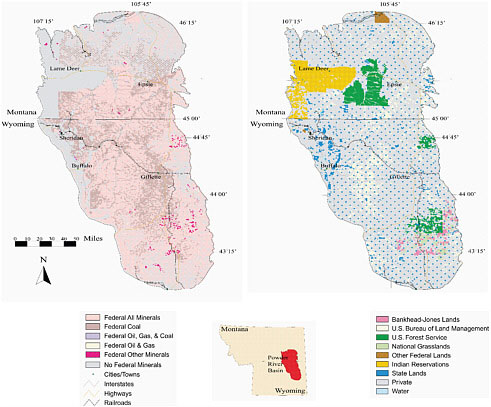
FIGURE 3.1 Comparison of subsurface (mineral rights) ownership (left) with surface ownership (right) in the Powder River Basin in 1999. Although the majority of the subsurface rights are federal (all colors except for the gray areas in the map on the left), the surface ownership is distributed among a blend of private (gray), state (blue), tribal (yellow), and federal owners. The attendant issues of split-estate ownership and responsibilities (different surface and subsurface mineral ownership) affect land and resource management. Although the committee could not find a published map of the entire Powder River Basin that displayed all current CBM well operations relative to their distribution on private, state, or federal land, the maps in this figure demonstrate the shared responsibility for CBM leasing and produced water management among the various authorities. SOURCE: Adapted from Taber and Kinney (1999).
NOTE: “Federal All Minerals” indicates federal ownership of the rights to all minerals, including oil, gas, coal, and others; “Federal Coal” indicates rights to coal minerals only; “Federal Oil and Gas” indicates rights to oil and gas and may include other mineral rights; “Federal Oil, Gas, and Coal” indicates rights to oil, gas, and coal resources; “Federal Other Minerals” indicates mineral rights not listed and may include oil and gas rights; and “No Federal Minerals” indicates subsurface mineral rights are not owned by the federal government, for example, those beneath the Northern Cheyenne and Crow tribal lands in Montana.
effect on the human environment (either through an EA or based on existing knowledge) then an EIS is prepared. EISs and EAs explore feasible alternatives to a proposed action and the likely environmental consequences of those actions. Hydrological, geological, biological, and ecological issues are among the consequences considered. EISs also consider socioeconomic (including health) impacts. Depending on the nature of a given project, archeological, historical, cultural impact analyses, and financial management plans for an action may also be addressed. Before implementing the proposed action, all of these issues must be addressed and the information in the EIS made available to the public for review and comment.
To address the management of produced water, BLM promulgated Onshore Oil and Gas Order (OOGO) No. 7 (58 FR 44354, published on September 8, 1993 with a correction to the original order [58 FR 58506] published on November 2, 1993), which applies to disposal of produced water from completed wells on federal and tribal oil and gas leases, whether from conventional oil and gas production or from CBM production. This order does not apply to approval of disposal facilities on lands other than federal or tribal lands or if the disposal method has been covered under an approved enhanced recovery project.10
OOGO No. 7 includes the following requirements:
-
Operators of onshore federal and tribal oil and gas leases may not dispose of produced water unless and until approval is obtained from the authorized officer.
-
All produced water from federal and tribal leases must be disposed of (1) by injection into the subsurface; (2) into lined or unlined pits; or (3) by other acceptable methods approved by the authorized officer, including surface discharge under National Pollutant Discharge Elimination System (NPDES) permits (see “EPA” below for discussion of NPDES). Injection is generally the preferred method of disposal.
-
Operators shall submit a formal application to request approval for disposal of produced water in injection wells and in lined or unlined pits on land on the same lease as that containing the wells from which the water was produced (“on-lease disposal”); new pits on national forest lands may also require approval of the USFS.
-
When requesting approval for disposal of produced water “off-lease” (disposal in a well or pit on leased or unleased federal and tribal lands that are different from the lease for the wells from which the water was produced), operators shall submit a formal notice and application, potentially also including a request for a right-of-way authorization.
-
For water to be disposed of in injection wells, operators must also submit a copy of the Underground Injection Control (UIC) permit (unless the well is authorized by rule).
-
An application must be submitted for CBM water produced on federal lands that is to be disposed of “off-lease” on state and privately owned lands; a copy of the UIC permit for injection wells or pit permit may also be required (BLM, 1993).
Additionally, this order identifies informational requirements for injection wells and pits; requirements governing pit design, construction, maintenance, abandonment, and reclamation; requirements for other disposal methods; and reporting requirements for disposal facilities. Operators may request different considerations from the standards of the OOGO.
Collectively, the Federal Land Policy and Management Act, the CWA (see below), and related executive orders guiding BLM’s management of public land and resources require the agency to comply with all federal and state laws and regulations governing water pollution that may result from BLM permitted projects and activities. Operations from the point of origin (primarily the well head) to the point of discharge are under the jurisdiction of the BLM. Operations from the point of discharge downstream are under the jurisdiction of EPA or the primacy state.
USFS
The USFS is primarily responsible for managing surface resources on national forest lands, while the U.S. Department of the Interior, through the BLM, has statutory responsibility for issuing and supervising mineral leases on all federal lands including national forests. The USFS cooperates with the Department of the Interior in administering exploration and development of leasable minerals, including the review of permit and lease applications and making recommendations to protect surface resources (USFS, 1994). For example, the USFS and BLM worked jointly to develop the EIS for the Northern San Juan Basin CBM Project. The EIS examined potential impacts of new CBM wells on USFS, BLM, state, and private land in southwestern Colorado (USFS, 2006). As is the case with BLM, the USFS is required to take into account NEPA provisions in its management of surface resources.
Bureau of Indian Affairs
The Bureau of Indian Affairs (BIA) manages 55 million acres of surface and 57 million acres of subsurface minerals estates held in trust by the United States for American Indians, Indian tribes, and Alaska Natives. The Office of Indian Energy and Economic Development within the BIA is responsible for assisting tribes in developing their energy and eco-
nomic resources. The BIA Office of Trust Services’ Division of Natural Resources oversees issues and provides guidance related to development and protection of natural resources, including protection of Indian water rights and fish and wildlife on Indian lands.11
The Omnibus Indian Mineral Leasing Act of 1938 and the Indian Mineral Development Act of 1982 require the Bureau of Indian Affairs (BIA) to authorize energy leases. The BLM processes Applications for Permit to Drill (APD), Master Development Plans, and Sundry Notices on tribal and allotted oil and gas leases in a way that is similar to federal leases. However, approval procedures, such as cultural resource and other environmental requirements, may vary depending on tribal ordinances and whether tribes have assumed the functions of a State Historic Preservation Office. Both the tribe and BIA may recommend further conditions of approval to the APD. NEPA applies to these decisions, although qualifying tribes are permitted to enforce environmental laws, set regulations that are more stringent than federal minimum standards, and regulate aspects not covered by federal laws or programs (Bryner, 2002). For processing APDs, BLM considers the BIA to be the surface management agency for all Indian lands unless a tribe has contracted the BIA realty function for its lands. Oil and gas operators are responsible for obtaining any special use or access permits from appropriate BIA and/or tribal offices (BLM and USFS, 2007).
Tribal governments each have their own departments in areas of environmental protection and natural resources. These departments are directly engaged in research, analysis, monitoring, and regulation of oil and gas development (including CBM) and environmental management in concert with relevant federal agencies (see Appendix F and next section on EPA).
EPA
The EPA’s involvement in water management and environmental regulation in the area of CBM produced water involves the CWA, which deals primarily with permitting of discharges to surface waters, and the SDWA, which deals with underground injection permitting and controls. Through these Acts Congress established a process whereby primary authority could be delegated to the states and recognized tribes once they have put the appropriate authorities, statutes, and regulatory frameworks in place.
CLEAN WATER ACT
The CWA is the primary federal law in the United States governing surface water pollution.12 The main goals of the act are to restore and maintain the chemical, physical,
|
11 |
See www.bia.gov/ (accessed July 8, 2010). |
|
12 |
See www.epa.gov/watertrain/cwa/ (accessed March 4, 2010). |
and biological integrity of the nation’s waters for the protection and propagation of fish, shellfish, and wildlife and to provide for protection of human health and recreation in and on the water (e.g., fishing, swimming, boating) and to eliminate discharge of pollutants to navigable (surface) waters.13 The act governs discharges of pollutants, defined as the addition of any pollutant to waters of the United States from any point source. The term “waters of the United States” has been further defined to include traditional navigable waters, wetlands adjacent to traditional navigable waters, non-navigable tributaries of traditional navigable waters that are relatively permanent and where the tributaries typically flow year-round or have continuous flow at least seasonally (e.g., typically three months), and wetlands that directly abut such tributaries. Responsible agencies will decide jurisdiction over other waters based on a fact-specific analysis to determine whether they have a significant nexus with traditional navigable water.
The CWA introduced a permit system for regulating point sources of pollution. Point sources14 presently recognized and managed under the provisions of the CWA include:
-
industrial facilities (including manufacturing, mining, oil and gas extraction, and service industries);
-
municipal governments and other government facilities (such as military bases, municipal wastewater treatment facilities); and
-
some agricultural facilities, such as animal feedlots and food-processing facilities.
Point sources may not discharge pollutants to surface waters without a permit from the NPDES. This system is managed by EPA in partnership with state environmental agencies. EPA has authorized 46 states to issue NPDES permits directly to the discharging facilities. The CWA also permits EPA to authorize tribes to issue NPDES permits if a tribe’s application for eligibility to administer water quality standards and certification programs is approved by EPA. Amongst the tribes with lands located within or near to one of the CBM basins examined in this study, the Northern Cheyenne Tribe (Powder River Basin area) and Ute Mountain Ute Tribe (near the western edge of the San Juan Basin) have received approval from EPA to administer water quality standards and certification programs, although these are not specific to CBM produced water issues (see also Appendix F). In the remaining states and territories, the permits are issued by an EPA regional office. Of the six states in this study, only New Mexico is not yet authorized by EPA to issue NPDES
permits, and this responsibility continues to lie with the EPA; however, the state has entered into the process to seek this authority from EPA.15
The CWA also created a requirement for technology-based effluent limitations (“effluent limit guidelines”) for point source discharges. EPA develops these standards for categories of dischargers, based on the performance of pollution control technologies without regard to the conditions of a particular water body receiving the discharges. This approach is intended to establish a basic national discharge standard for all facilities within a category with “Best Available Technology” as an underlying basis. The standard becomes the minimum regulatory requirement in a permit.
If water quality is still impaired for a particular water body after application of technology-based standards to an NPDES permit, the permitting agency (state or EPA) must add water quality-based limitations to that permit. The additional limitations are to be more stringent than the technology-based limitations and would require the entity that received the permit to meet those additional limitations. Such water quality standards (WQS) set site-specific allowable pollutant levels for individual water bodies, such as rivers, lakes, streams and wetlands. States set WQS by designating uses for the water body (e.g., recreation, water supply, aquatic life, agriculture) and applying water quality criteria (numerical pollutant standards and narrative standards)16 to protect the designated uses. An antidegradation (in some states referred to as nondegradation) policy is also issued by each state to maintain and protect existing uses and high-quality waters. The development of WQS is a complex process, both scientifically and legally, and tends to be a resource-intensive process for state agencies. The EPA retains oversight authority with regard to state-administered NPDES programs and state-established water quality standards. EPA can override state permit decisions (under CWA section 402(d)) and disapprove state WQS (under CWA section 303(c)).
To date, effluent guideline regulations have been published for 56 categories of pollutants (450 subcategories), covering more than 60,000 facilities that discharge directly or indirectly to the nation’s waters. EPA has updated some categories since their initial promulgation and has added new categories. EPA did not consider CBM production in developing the 1979 national technology-based effluent limitations guidelines (ELGs) for the Onshore and Agricultural and Wildlife Water Use Subcategories of the Oil and Gas Extraction Point Source Category (40 CFR 435, Subparts C and E) because no significant CBM production existed in 1979. Accordingly, these ELGs do not apply to CBM produced water discharges. EPA has made the determination that CBM extraction operations are a potential new subcategory of the Oil and Gas Extraction category, but to date no specific
|
15 |
See www.nmenv.state.nm.us/swqb/NPDES/index.html (accessed March 4, 2010). |
|
16 |
Narrative standards provide broad-scale, general guidance of a qualitative nature, whereas numerical standards provide specificity in a quantifiable manner. Narrative standards define the broad guidelines that serve as the basis for definition of numerical standards. See waterquality.montana.edu/docs/methane/standards.shtml (accessed March 4, 2010). |
requirements have been promulgated for CBM extraction operations. Current NPDES permits involving such discharges must include effluent limitations that are based on the best professional judgment of the permit issuer (whether EPA or the State). The purpose of these limits is to ensure compliance with WQS. The Montana Department of Environmental Quality, for example, under the guidance and directive of the EPA Region 8, has now established technology-based effluent limitations (TBEL) for any new CBM produced water NPDES permits (managed for the EPA by Montana and called Montana PDES, or MPDES) and technology-based effluent limitations will be applied to any permits up for renewal.
CBM operators are required to provide estimates or projections of produced water discharge volumes as part of the NPDES permit application process (or the corresponding state process if the authority is delegated to the state, see below). The estimated or projected produced water discharge volumes are reported in the permit application as a maximum volume (i.e. as “up to” a given volume, measured in million gallons per day, barrels per day, acre feet per year, or other units). The permitted discharge is typically associated with a pod of wells and water production per well (at the well-head) is not generally determinable—since water from multiple wells is comingled in a single pipeline before discharge (see also Chapter 4). No in-line flow monitoring and no end-of-pipe continuous or real-time monitoring of flow is required, once a permit is issued. CBM operators are not normally required to monitor discharge volumes except as instantaneous values or measures at a moment in time on either a monthly, quarterly, or semi-annual basis essentially to fulfill reporting requirements. CBM operators are typically required to monitor and report on an infrequent, but fixed schedule. Real-time discharge volumes and water quality concentrations can vary significantly over the course of a given year leading to variability in extrapolation or application of these measurements which is important to recognize. Another consideration applied to all live (perennial) water bodies to which discharges are permitted by NPDES is that of the “mixing zone” (Box 3.1).
The Northern Cheyenne in Montana have recently begun the process of establishing their own water quality standards to protect public health and welfare, and enhance water quality to serve the purposes of the CWA. The tribe does not yet have the water quality standards approved by EPA and is entering into a public comment period for the proposed standards at the time of this writing (see also Appendix F). The state of Montana, as noted above, is also presently engaged in a process of defining discharge limitations for a CBM produced water discharge permit using TBEL. Little agreement is established among state regulatory agencies, the EPA, industry representatives, and landowners as to what these limits should be. The limits can vary from state to state, from designated water resource use to water resource use, and from permit to permit within a state (see individual state descriptions below). EPA is currently in the process of evaluating whether to conduct a
|
BOX 3.1 Mixing Zone The mixing zone is representative of the downstream portion of a receiving stream (below the NPDES discharge point) where discharge is mixed with ambient flow. Mixing zones can be and in many cases are considerations of significance in determining discharge permit allowances to water bodies. In the case of ephemeral streams, the mixing zone is considered non-existent. Consideration is given to the ambient flow and quality, the discharged flow and quality, and the resulting water quantity and quality at the terminus of the mixing zone. The combination of these conditions and the presence of other discharges in the reach dictate the allowable discharge concentrations. In reality, mixing zone considerations are of much more significance on smaller streams than on large streams and rivers such as the Tongue and Powder rivers because the latter provide much greater opportunity for mixing and dilution. |
rulemaking to potentially revise the Oil and Gas Extraction effluent guideline to include specific limits for CBM extraction operations (see Box 3.2).
SAFE DRINKING WATER ACT
The SDWA is the principal federal law in the United States that ensures safe drinking water for the public. In accordance with the act, EPA is required to set standards for drinking water quality and to oversee all states, localities, and water suppliers that implement these standards. The SDWA also regulates the construction, operation, permitting, and closure of injection wells that place fluids underground for storage or disposal under its UIC program. Thus, the SDWA governs the reinjection of produced waters from the CBM extraction process. For the most part, states have been delegated primacy of the UIC program. EPA remains responsible for issuing permits in states that have not been delegated primacy for the UIC program and on most tribal lands. Of the six states considered in this study, the EPA has delegated primacy for UIC permits to North Dakota, Wyoming, Utah, and New Mexico, and the EPA shares authority for issuing UIC permits with Colorado and Montana.17 In applying for a UIC permit, developers must demonstrate that the injection operation will not endanger any underground drinking water source. EPA has maintained oversight for permitting CBM produced water injection by subsurface drip (which requires a UIC permit; see Chapter 4 for description of these management methods).
Five classes of injection wells are allowed under this regulatory scheme. Wells are classified by type of fluid injected and the specific location where the fluid is to be injected (e.g.,
|
17 |
See www.epa.gov/ogwdw000/uic/primacy.html (accessed March 4, 2010). |
|
BOX 3.2 EPA’s Detailed Study of the CBM Extraction Sector Under the CWA The CWA requires the EPA to review its effluent limit guidelines annually to determine if amendments might be appropriate to existing regulations. In cases where an amendment is being considered, the EPA first conducts a screening-level review to identify effluent categories needing further characterization. Candidates for potential review are then prioritized based on various factors such as industrial categories, pollutant discharges, and economic considerations. Pending the outcome of the screening and prioritization, a particular industry sector and/or pollutant category may undergo an in-depth, detailed review prior to any decision being made with regard to amending the CWA regulations. At various stages of this process, EPA results are published and open for public comment. Motivated by the growth of the CBM extraction industry and the potential impacts to surface waters from discharge of CBM produced water, the EPA began considering the potential to designate CBM extraction as a specific subcategory with its own guidelines under the Oil and Gas Effluent category of the CWA. A “detailed study” of the CBM extraction industry was therefore recently begun by EPA to consider the possibility of recommending such a designation for the CBM industry. The objective of the study for CBM extraction is to evaluate the potential environmental issues associated with the discharge of CBM produced water. The study is national in scope, with each CBM basin being considered separately with respect to potential pollutants in produced water discharges and water volumes. The work plan for the detailed study includes conducting industry surveys to collect technical, economic, and environmental data from a wide range of CBM operations across the United States; site visits and collection of ancillary data from other sources such as the Energy Information Agency; and conducting stakeholder meetings in the major CBM basins. The EPA received approval from the Office of Management and Budget to distribute the mandatory survey for the detailed study in February 2009, at which time EPA distributed a screener questionnaire. Approximately 290 operators with three or more CBM wells received the questionnaire. A detailed questionnaire was distributed to approximately 250 CBM projects in October 2009. EPA will analyze the survey results from the detailed questionnaire and identify whether to initiate a rulemaking in the final 2010 Effluent Guidelines Program Plan. To date, EPA has contacted over 700 people in eight states in over 70 outreach and data collection activities since 2007 in connection with this activity. The results of the detailed study were not available at the time of the writing of the present report. More information about effluent guideline limits under the CWA can be found at www.epa.gov/guide/304m/ (accessed March 4, 2010). Information specific to the coalbed methane extraction detailed study can be found at water.epa.gov/scitech/wastetech/guide/cbm_index.cfm (accessed August 23, 2010). SOURCE: Johnston (2009). |
below sources of drinking water). Under this program, oil and gas industry injection wells are generally regulated as Class II injection wells, which also generally cover enhanced oil recovery projects or projects involving the disposal of nonhazardous exploration and production wastes. An explanation of the distinction among classes of wells regulated under the SDWA is provided in Table 3.2. Regulatory authority for these types of wells is sometimes
TABLE 3.2 Classes of Wells in the EPA UIC Program
|
Class |
Use |
|
I |
Injection of hazardous wastes, industrial nonhazardous liquids, or municipal wastewater beneath the lowermost underground sources of drinking water (USDWs) (549 wells). |
|
II |
Injection of brines and other fluids associated with oil and gas production and hydrocarbons for storage. Injected beneath the lowermost USDWsa (143,941 wells). |
|
III |
Injection of fluids associated with solution mining of minerals beneath the lowermost USDW (18,505 wells). |
|
IV |
Injection of hazardous or radioactive wastes into or above USDWs. Banned wells unless authorized by federal or state groundwater remediation project (32 sites). |
|
V |
All injection wells not included in Classes I–IV. Generally used to inject nonhazardous fluids into or above USDWs and typically shallow onsite disposal systems. |
|
aThe table provided by EPA describes Class II wells as “injected below the lowermost USDW.” Although this may be correct in most cases, injection below the lowermost USDW is not required for Class II wells, according to UIC regulations. NOTE: Class II wells are the most common of five classes of UIC wells used in the United States and include wells used for deep-well injection of CBM produced water, as well as for injection of brines remaining after water treatment (see also Chapter 6). SOURCE: Available at www.epa.gov/ogwdw000/uic/wells.html (accessed March 4, 2010). See also www.access.gpo.gov/nara/cfr/waisidx_02/40cfr144_02.html (accessed June 21, 2010). |
|
delegated to oil and gas conservation commissions or equivalent agencies within each state (see also Table 3.1). With CBM, most reinjection of produced water is done into Class II wells although in Wyoming, a large percentage of reinjection is into Class V wells.
In addition to specific regulations associated with surface and underground discharges, EPA Region 8 has recommended guidelines for off-channel, unlined CBM impoundments to prevent impacts to surface water, high-quality shallow groundwater, domestic wells, and stock wells (EPA, 2002a, 2002b) which were developed by Wyoming Department of Environmental Quality (DEQ) in 2002.18 The guidelines include siting impoundments at distance from floodplains, terraces, and ephemeral channels and over thick unsaturated soil and geological materials (50 feet) to minimize water flow from beneath impoundments. The guidelines also recommend that a clear description be provided of the data needed to evaluate potential impacts to groundwater, including downgradient surface water and
|
18 |
See www.epa.gov/region8/ (accessed March 4, 2010). |
groundwater monitoring to help determine the degree of hydrological connection, if any, between the impoundment and surface water (EPA, 2002a, 2002b).
WESTERN STATE AUTHORITIES
The six western states included in this study have varying approaches to produced water management. Water quality standards being applied to management of produced water may be narrative or numeric. Agencies have greater latitude in translating narrative criteria to permit limits for CBM produced water discharge and enforcement of provisions of discharge than with numeric criteria. State-specific approaches for regulating CBM produced water for the five states that presently have active CBM development are described below with respect to water rights issuance, CBM production permitting, and CBM water management. Produced water management for conventional oil and gas operations is described for North Dakota, where no CBM production presently occurs. The states are presented in a general geographical and geological sequence, which groups states that produce CBM from shared basins; this presentation order is designed to facilitate comparison of produced water management approaches between states that may share CBM basins with similar geological and hydrogeological conditions. North Dakota is described first, followed by Montana and Wyoming (with the shared Powder River Basin), Utah and Colorado (which share basin similarities in the Uinta and Piceance), and New Mexico (which shares the San Juan and Raton basins with Colorado).
North Dakota
The North Dakota State Water Commission, through the Office of the State Engineer, oversees issues related to water rights. The North Dakota Department of Health’s Environmental Health Section administers the state’s water quality rules and regulations, reviews and issues NPDES permits for surface discharges, and administers the UIC program for the state, with exception of Class II injection wells, which are overseen by the North Dakota Industrial Commission, through its Oil and Gas Division (Table 3.1). The latter agency also has jurisdiction over oil and gas exploration and production permits on state and private lands. Although no CBM production has yet occurred in North Dakota (EIA, 2009), management options for produced water from conventional oil and gas operations are described here for completeness.
The North Dakota Source Water Protection Program, developed in the late 1990s and approved by the EPA, is an umbrella under which North Dakota fulfills the provisions of the SDWA.19 A primary goal of the program is to prevent the contamination of public
|
19 |
See www.ndhealth.gov/WQ/GW/sourcewater.htm (accessed March 4, 2010). |
water supplies, including surface water and groundwater sources (Table 3.1). The program includes designating a well head protection area for groundwater-dependent public water systems, or a source water protection area for surface-water-dependent public water systems. Both numerical and narrative standards are established to preserve the state’s water resources (Schafer and Sagsveen, 1999).
Underground injection, disposal to surface waters, and disposal to the ground are the primary management options in the state, with respect to produced water management from oil and gas production activities. Any saltwater liquids or brines produced during oil and gas operations are considered wastes and are required to be processed and disposed of in ways that do not pollute freshwater supplies and are not allowed to pool on the surface or infiltrate the soil. Although beneficial uses for produced water are recognized by the state (Table 3.1), reinjection is the preferred method of disposal for 96 percent of all produced water from conventional oil and gas operations (Clark and Veil, 2009). Discharge to surface waters is permitted only if the discharge does not endanger public health or degrade water quality. Surface facilities for disposal of produced water are acceptable primarily in storage tanks constructed of materials resistant to the effects of saltwater liquids, brines, or chemicals. Open ponds and pits are generally allowed only through special approval or in the case of an emergency (NDIC, 2006).
Montana
Montana is the only state in the West that addresses CBM produced water directly in its statutes, with several state agencies responsible for various aspects of CBM development and produced water management on state- and privately owned lands. The Montana Department of Natural Resources and Conservation (DNRC) oversees issues of water rights, the Montana DEQ oversees surface discharges through MPDES, and the Montana Board of Oil and Gas Conservation oversees oil and gas operations, including those for CBM, and has been delegated jurisdiction by EPA over the UIC program for Class II wells (see Table 3.1).20
The specification for CBM activities and produced water statutes in Montana stems from an order in 1999 when the DNRC created the Powder River Basin groundwater area for private and state land (but not tribal land). In addition to allowing for reduction of water levels in targeted aquifers near CBM project areas, this order included the need for monitoring water resources before, during, and after CBM production. The order also includes a requirement for the CBM operator to offer mitigation agreements to owners of wells or springs that may be impacted by CBM activities.21
|
20 |
See bogc.dnrc.state.mt.us/BoardSummaries.asp (accessed March 4, 2010). |
|
21 |
See www.bogc.dnrc.state.mt.us/CbmOrder.htm (accessed March 4, 2010). |
In 2003 the Montana Board of Environmental Review (BER) adopted numerical standards to regulate water quality in the Powder River Basin for electrical conductivity (EC) as a surrogate for total dissolved solids) and sodium adsorption ratio (SAR), specifically because EC and SAR can impair the usefulness of water for irrigation (see also Chapters 2, 4, and 5). The standards were based on agricultural use of the receiving waters for irrigation as the designated beneficial use to be protected. For discharge of CBM produced water to other basins, a narrative standard was approved (Montana DEQ, 2003). The EPA approved the numerical standards as enforceable under the CWA and within the Powder River Basin, which transcends the Montana-Wyoming border. Thus, under EPA regulations, point source discharge permits issued or authorized by Wyoming to waters in Wyoming and upstream from Montana must meet Montana water quality standards for the Tongue and Powder rivers, which flow northward into Montana from Wyoming. This assurance of water quality standards includes the tributaries to the Tongue and Powder rivers and is considered particularly important for purposes of irrigation by farmers and ranchers in southeastern Montana.22
In 2006 the Montana BER appended “nondegradation” provisions (also referred to as antidegradation provisions) to the numerical standards for salinity and sodicity of the Tongue and Powder Rivers and tributaries. In essence, the nondegradation provisions indicate that significant degradation of high-quality waters of the state is not allowable either by (1) significantly elevating the instream salinity or SAR above the mean ambient concentration or (2) causing an increase in instream salinity or sodicity amounting to 10 percent or more of the numerical standards (Montana DEQ, 2006).
Since the 2003 ruling and the subsequent 2006 nondegradation provisions, Montana has been involved in numerous related lawsuits. A number of oil and gas companies operating in Montana and Wyoming have filed suit to overturn EPA’s approval of the 2003 numerical water quality standards and to mandate that EPA disapprove the 2006 nondegradation provisions. The state of Wyoming intervened on the side of the companies. Challenges to Montana’s 2003 and 2006 water quality standards for EC and SAR have been successfully defended in the Montana Supreme Court and are in effect under Montana state law.23 A subsequent EPA Region 8 approval of the Montana standards was remanded by a federal district court back to the EPA, due to inappropriate processes followed by EPA for approval. Public comment is now being solicited regarding the proposed standards, after which EPA will likely respond and proceed with the approval process.
By negotiated agreement in some common water basins, Wyoming water sources are required to comply with Montana standards (see also, below, under Wyoming). The water quality standards to which Wyoming has agreed are the numeric water quality standards
|
22 |
See www.doj.mt.gov/lands/waterrights.asp (accessed March 4, 2010). |
|
23 |
Ibid. |
for EC and SAR adopted by the Montana Board of Environmental Review, as applied to the Tongue and Powder Rivers and their tributaries.
Under Montana code, waste and contamination of groundwater is prohibited, except in specific cases, such as “the management, discharge, or reinjection of ground water produced in association with a coal bed methane well.”24 Until only recently, CBM operators in Montana had three primary approaches by which to dispose of their CBM produced water: (1) use of the water for irrigation, livestock watering, or other beneficial uses (see Table 3.1); (2) approved UIC reinjection of the water into acceptable rock formations; or (3) discharge of the water to surface waters or impoundments with an appropriate MPDES permit.25 Two recent judicial rulings, each of which challenged the constitutionality (Montana) of either disposal to surface impoundments or discharge of untreated water to surface waters of the state have had significant impact on the third approach. In April 2010, a Montana district judge ruled that the use of evaporation pits for the disposal of CBM produced water is unconstitutional in Montana. In May 2010, the Montana Supreme Court unanimously ruled that CBM operators must treat water that is pumped from underground before discharging the water into Montana’s streams and rivers. The court also found that the Montana DEQ violated the federal CWA and the Montana Water Quality Act by issuing methane discharge permits without requiring that the water be treated before release.
Wyoming
In Wyoming the State Engineer retains jurisdiction over produced water from CBM wells and requires operators to obtain groundwater appropriation permits.26 The Wyoming DEQ Water Quality Division oversees produced water discharges (NPDES permits administered on behalf of EPA by Wyoming, called WYPDES) and has primacy for regulating UIC permits for Class I, III, and V wells, as well as watershed management and groundwater pollution control.27 The Wyoming Oil and Gas Conservation Commission is responsible for permitting oil and gas wells, including those for CBM production, as well as UIC permits for Class II reinjection wells (Table 3.1).28 Horizontal injection for the purposes of underground drip irrigation is also regulated by the Wyoming UIC program as Class V wells.
The primary CBM produced water management options in the state include direct surface discharge, with or without treatment depending on water quality; reinjection (deep-
|
24 |
Montana Code Annotated § 85-2-205; see data.opi.state.mt.us/bills/mca/85/2/85-2-505.htm (accessed March 4, 2010). |
|
25 |
Montana Code Annotated § 82-11-175; see data.opi.state.mt.us/bills/mca/82/11/82-11-175.htm (accessed March 4, 2010). |
|
26 |
See seo.state.wy.us/ (accessed March 4, 2010). |
|
27 |
See deq.state.wy.us/wqd/ (accessed March 4, 2010). |
|
28 |
See wogcc.state.wy.us/ (accessed March 4, 2010). |
well or shallow drip systems); and disposal into impoundment facilities (pits or reservoirs) (DiRienzo, 2008). Wyoming has established an interagency working group29 to address issues related to CBM produced water management, including monitoring and protocols.
Generally groundwater appropriation permits for CBM produced water are granted from the State Engineer’s Office if a beneficial use is demonstrated (Table 3.1) and if the State Engineer determines that the proposed means of diversion and construction are adequate. An application can be denied if the State Engineer determines that the activity is not in the public interest. The State Engineer’s Office considers CBM production different than conventional natural gas production “due to the necessity for production of water for the production of the gas resource” and has designated CBM as a beneficial use of water on this basis. Permits are thus required for appropriation of groundwater (Wyoming SEO, 2004). Groundwater protection with respect to surface discharges into impoundments is monitored under the DEQ Groundwater Pollution Control program (Fischer, 2009),30 which has had standards and practices in place for groundwater monitoring, reporting, and monitoring well plugging and abandonment.
Unlined surface impoundments require permits in Wyoming by the State Engineer’s Office (for reservoirs—“on-channel”31) or the Oil and Gas Conservation Commission (for pits—“off-channel”32). In addition, the BLM authorizes impoundments on federal lands and issues federal leases for water disposal to such impoundments. Discharge permits to impoundments are required by the Wyoming DEQ under WYPDES; the permits required vary by drainage basin. In some cases, groundwater protection permits are required under the Wyoming Groundwater Pollution Control (GPC) Program. These permits are also issued by the Wyoming DEQ. Monitoring requirements under the GPC program depend on depth to groundwater and water quality beneath the impoundment and the degree of hydrologic connection to surface water. 33
In April 2010, Wyoming DEQ released a new set of specific guidelines for compliance monitoring and siting requirements for unlined impoundments (on- and off-channel) containing CBM produced water (Wyoming DEQ, 2010). These guidelines supersede
|
29 |
See www.wy.blm.gov/prbgroup/ (accessed May 19, 2010). |
|
30 |
See also deq.state.wy.us/wqd/groundwater/index.asp (accessed March 4, 2010). |
|
31 |
An “on-channel” (or “in-channel”) impoundment that receives CBM produced water is sited within a designated water feature or within the floodplain or alluvium of a water feature. These features include intermittent perennial and ephemeral streams, dry washes, and lakes. Engineering modifications are made to the channel to enhance capacity for temporary or long-term storage of water. An “off-channel” impoundment is not sited within such a designated water feature and is constructed in areas outside of the natural flow path and not directly connected to any direct surface flow paths to pre-existing ephemeral or perennial channels. |
|
32 |
An “off-channel” impoundment is not sited within such a designated water feature and is constructed in areas outside of the natural flow path and not directly connected to any direct surface flow paths to pre-existing ephemeral or perennial channels. |
|
33 |
D. Fischer, Wyoming DEQ, Personal communication, July 14, 2009. |
requirements in previous guidance documents and were revised as a result of a comprehensive review of groundwater compliance monitoring data that the Wyoming DEQ had received since the inception of the monitoring requirements in August 2004. Groundwater monitoring is required because water infiltrating from unlined CBM impoundments has the potential to dissolve in situ minerals and affect the state’s groundwater resources. The revised guidelines implemented changes to the existing compliance monitoring program and maintained the siting and subsurface groundwater compliance monitoring requirements prior to new impoundment construction and subsequent to discharge of CBM produced water into the impoundment.
Under WYPDES, the state has established a policy specifically for discharges of CBM produced water to surface waters of the Powder River mainstem to provide assurance that both Wyoming narrative standards and Montana numerical standards for TDS and sodium are met. A key foundation to the policy is management of the “assimilative capacity”34 of the Powder River. Of the chemical constituents in CBM produced water, TDS and sodium were the only ones identified with sufficient potential to exceed Montana water quality standards at the state line, and the Wyoming DEQ has therefore instituted a greater level of permitting oversight for these two constituents. Wyoming has no numerical standards in place for sodium and Wyoming’s existing numerical standards for TDS are not applicable to the protection of irrigation uses of water. Wyoming state officials use the Montana numerical standards for TDS (as a proxy for EC) and SAR (see above) to ensure that discharges into the Powder River do not exceed the assimilative capacity and do not degrade designated uses of surface waters (Wyoming DEQ, 2006).
Utah
Under Utah law, administration of the appropriation and distribution of the state’s water resources rests with the Utah Division of Water Rights (DWRi), led by the state engineer within the Utah Department of Natural Resources (DNR).35 The Utah DEQ’s Division of Water Quality and the Board of Water Quality oversee water quality issues associated with surface water and groundwater of the state36 and have jurisdiction over the UIC program for Class I, III, IV, and V wells. Specific jurisdiction over CBM development and produced water management rests under the DNR with the Division of Oil, Gas, and
|
34 |
“Assimilative capacity” refers to the capacity of a natural body of water to receive wastewaters or toxic materials without deleterious effects and without damage to aquatic life or humans who consume the water. See www.epa.gov/OCEPAterms/aterms.html (accessed March 4, 2010). |
|
35 |
See nrwrt1.nr.state.ut.us/ (accessed March 4, 2010). |
|
36 |
See www.waterquality.utah.gov/DWQ_info.htm (accessed March 4, 2010). |
Mining (DOGM) and its policymaking body, the Utah Board of Oil, Gas, and Mining,37 which also has primacy for the UIC program for Class II injection wells (Table 3.1).
The operator must take “all reasonable precautions” to avoid polluting lands, reservoirs, natural drainage ways, and groundwater sources. With respect to CBM operations, produced water is generally considered by Utah to be a “byproduct” of oil and gas production, thus falling under the jurisdiction of the DOGM. Such produced water must be disposed of in compliance with all applicable state, federal, or local regulations. However, in some circumstances the State Engineer’s Office may authorize temporary water rights to allow produced waters from mining operations (including CBM produced water) to be put to beneficial use once it has been diverted from its underground location (Bryner, 2002). Because much of Utah is closed to new appropriations of water, new projects and allocations require acquisition and amendment of existing rights for new purposes (BLM, 2001b).
Most CBM produced water in Utah is not potable without treatment and is disposed of by reinjection into subsurface formations. Operators may choose to dispose of produced waters via subsurface injection in Class II wells under the state UIC program (Bryner, 2002). Although state regulations do not specifically address CBM produced waters, the DOGM has rules that address the disposal of “saltwater and oil field wastes,” which include CBM produced water.
As of November 2009, the Utah Administrative Code set out the permitting rules for lined and unlined wastewater disposal pits (Rule R6949-9, Waste Management and Disposal).38 The rules describe various requirements for wastewater disposal pits, both lined and unlined, including geological and hydrogeological constraints for locating the pits; parameters for the type and thickness of the lining for lined pits; testing subsurface conditions prior to construction; climate considerations (to gauge, for example, evaporation and precipitation in the location of the pit); the daily water quantity to be disposed of, and water quality analyses, including the chemical constituents of the produced water relative to local groundwater. Disposal of CBM produced water in an unlined impoundment may be permitted by the DOGM if the disposal does not demonstrate pollution potential to surface or groundwater and that the disposal meets one or more of the following criteria: (1) the produced water does not have TDS in excess of local groundwater and does not contain objectionable levels of chlorides, certain organic compounds, or sulfates; (2) most or all of the water is to be used for beneficial purposes such as irrigation, livestock or wildlife watering and produced water analysis indicates that the water is appropriate for the intended use; and/or (3) the volume of produced water to be disposed is less than 5 barrels per day per month. If beneficial use is the basis for the application for an unlined pit, written confirmation from the users should also be submitted. The responsibility for conducting the
|
37 |
See ogm.utah.gov/ (accessed March 4, 2010). |
|
38 |
See www.rules.utah.gov/publicat/code/r649/r649-009.htm#T3 (accessed March 4, 2010). |
analyses for permit applications and for subsequent compliance for disposal impoundments lies with the permit applicant.
Colorado
The Office of the State Engineer (Division of Water Resources [DWR]) of the Colorado Department of Natural Resources administers the diversion and use of surface waters and groundwater of the state, including groundwater withdrawal for beneficial use (see Table 3.1). The Colorado Department of Public Health and Environment Water Quality Control Division (WQCD) has authority over environmental laws related to waste discharges to surface waters, including produced water from CBM operations.39 The Colorado Oil and Gas Conservation Commission (COGCC) is the primary state regulatory authority over oil and gas activities in the state and until recently maintained jurisdiction over produced water from CBM operations under the state standards established for general oil and gas exploration and production. The COGCC generally has considered produced water to be a byproduct and defined it as a “waste” from exploration and production under Rule 907 (Rein, 2009; Stednick et al., 2010). Under this definition, CBM operators have thus not been required to obtain a permit from the Office of the State Engineer to withdraw the produced water since it was a “waste product” of the methane extraction process.
COGCC’s Rule 907 describes how produced water should be managed and disposed of: (1) subsurface reinjection via a Class II injection well; (2) evaporation or percolation in a lined or unlined pit; (3) disposal at a commercial facility; (4) disposal via surface discharge through road spreading (outside sensitive areas); (5) discharge into waters of the state (under rules of the WQCD); (6) reuse of the water for enhanced recovery, recycling, or drilling; and (7) treatment to be used as an alternate domestic water supply to surface owners within the oil and gas field (Rein, 2009). Permits through the COGCC (or the WQCD for surface water discharge) are required before an operator may employ any of these disposal methods. As outlined below, the classification of CBM produced water for purposes of regulation changed in the state in 2009 and has implications for industry and for authorities regulating CBM operations and produced water.
Beneficial use of produced water from a CBM well by the operator or another person requires compliance with the water rights acts of the state and requires a water well permit, issued by the State Engineer. A well permit for water from a CBM well presumes that the water is tributary, although the person may submit data to document that the water is nontributary (Wolfe and Graham, 2002).40 Nontributary water is essentially water that is considered isolated, or compartmentalized, with respect to surface water so that its diver-
|
39 |
See www.netl.doe.gov/technologies/pwmis/regs/state/colorado/index.html (accessed March 4, 2010). |
|
40 |
In a nontributary aquifer a proposed diversion will not deplete surface streams more than 0.1 percent of the proposed diversion volume in any year for up to 100 years (Rein, 2009). |
sion would have little impact on surface water. In contrast, tributary water is water that contributes flow to surface water and therefore impacts senior water rights on the surface water. A water well permit for tributary water use would have to address senior surface water rights (under the prior appropriation doctrines) and require approval of an augmentation plan in Colorado water court (Rein, 2009).
Recently, the entire landscape regarding Colorado’s regulation of CBM operations and produced water was overturned in Vance et al. v. Wolfe by the Colorado Supreme Court whose decision can have broad implications for oil and gas producers in the state. In April 2009 the Court ruled that extraction of tributary groundwater produced from CBM wells is a “beneficial use” of water that must be regulated under state water laws. The decision also determined that CBM wells producing tributary groundwater are, in effect, water wells that require well permits issued by the State Engineer and, where applicable, these wells may also require a court-approved plan (an augmentation plan) to replace out-of-priority depletions to impacted stream systems.
Vance involves the appeal of a declaratory judgment issued by the Water Court for Water Division 7, which has jurisdiction over all “water matters” in the San Juan River Basin in southwestern Colorado. The plaintiffs were ranchers and landowners who own surface water rights in the basin, which they claimed could be impacted by water withdrawals related to CBM production.
In affirming the Water Court’s decision, the Colorado Supreme Court in Vance ruled that extraction of water through CBM wells constitutes beneficial use and an appropriation of water; thus, CBM wells that produce tributary water are subject to water well permitting, water court adjudication, and administration in Colorado’s water rights priority system. In so ruling, the court expressly declined to give deference to the State Engineer’s longstanding policy of refusing to regulate produced water on the grounds that it is a waste product subject only to the jurisdiction of the COGCC (Colorado Supreme Court, 2009).
To deal with the implications of Vance, the Colorado General Assembly passed House Bill 09-1303, which would provide an orderly process for bringing CBM wells that produce tributary groundwater into the state’s well permitting and water rights administration system. Under the legislation, operators of CBM wells that produce tributary groundwater will be required to obtain well permits and administrative approval of plans to replace depletions caused by well pumping, no later than March 31, 2010. Operators will be required to file applications with the water court for approval of long-term “plans for augmentation” no later than December 31, 2012. The legislation also authorizes the State Engineer to adopt rules to assist with regulation of the production of nontributary groundwater by delineating areas of nontributary groundwater withdrawal. If produced CBM water can be shown to be nontributary, the need for water well permitting and an augmentation plan can be avoided for a CBM well and its produced water (Rein, 2009).
New Mexico
The Office of the State Engineer for New Mexico has jurisdiction over the supervision, measurement, appropriation, and distribution of all surface water and groundwater resources in New Mexico. Under New Mexico law, all ground- and surface waters belong to the public and are subject to appropriation under the Doctrine of Prior Appropriation.41 However, the State Engineer has no authority over aquifers containing nonpotable water located 2,500 feet or more below the land surface. In New Mexico most CBM wells fall under this provision and are, therefore, not permitted by the State Engineer (New Mexico Legislature, 2009).42
The New Mexico Environment Department (NMED) oversees the main environmental protection laws for the state, including surface water quality through NPDES permits and issues related to watershed protection.43 The Water Quality Control Commission (WQCC), an administrative part of the NMED, has responsibility for enforcing the Water Quality Act and delegates authority for enforcing certain regulations under this act to the Oil Conservation Division (OCD).44
The OCD of the New Mexico Department of Energy, Minerals, and Natural Resources, under the New Mexico Oil and Gas Act, administers “water produced or used in connection with the drilling for or production of oil and gas” and may regulate surface or subsurface disposal of produced water to protect freshwater sources (New Mexico SWQB, 2000). CBM produced water is not explicitly regulated by existing state regulations but is included under the provisions of the Act. Approved disposal methods for produced water include lined pits, below-grade storage tanks, and treatment and discharge for beneficial uses. As of 1993, unlined pits were prohibited by state law. The OCD regulates subsurface injection of produced water in Class II wells and is the lead agency for the UIC program for the state, because most injection wells in New Mexico are associated with oil and gas production; 99 percent of CBM produced water in the state is managed by deep-injection wells. The OCD also performs groundwater monitoring to carry out responsibilities delegated to it by the WQCC and to ensure reasonable protection of fresh water as required by the New Mexico Oil and Gas Act (New Mexico SWQB, 2000).
CHAPTER SUMMARY
The requirements associated with leasing and permitting CBM operations on federal and tribal lands through BLM and protecting water resources on federal, state, tribal, or
|
41 |
See www.ose.state.nm.us/ (accessed March 4, 2010). |
|
42 |
M. Fesmire, presentation to the committee, June 2, 2009. |
|
43 |
See www.nmenv.state.nm.us/SWQB/ (accessed March 4, 2010). |
|
44 |
See www.netl.doe.gov/technologies/PWMIS/regs/state/newmexico/index.html (accessed March 4, 2010). |
private lands through the CWA and SDWA under EPA’s jurisdiction are relatively broad but clear. USFS is responsible for surface resource management on national forest system lands and works in conjunction with the BLM, which maintains statutory responsibility for issuing and supervising leases on these lands. On tribal lands, the BIA authorizes energy leases and the BLM permits CBM operations in a way that is similar to federal leases. Specific provisions under the NPDES permitting process apply to disposal of produced waters to the surface. The UIC program, under the SDWA, applies if subsurface reinjection of produced water is the disposal method. Federal agencies work in concert with state and tribal authorities to enforce federal standards and regulations, and EPA has delegated primacy for some of these permitting and regulatory functions to relevant state and tribal authorities in the six western states examined in this study.
Under the provisions of both the CWA and the SDWA, states and tribes assuming primacy for implementation of provisions of the terms of these acts commit to implementing appropriate state or federal laws and policies that serve to protect and preserve clean and safe surface and groundwater resources within the boundaries of the respective states. States and tribes may seek to establish their own water quality standards to serve the purposes of the CWA.
Similarities among the six western states’ approaches to produced water management, including CBM produced water where applicable, include provisions for appropriate siting, construction, and lining of impoundments. However, significant differences exist in the management of CBM produced water among states to fulfill the general tenets for preservation of clean and safe water resources. From a legal standpoint, a deciding factor for states in their approach toward CBM produced water management relates to whether the water is considered an undesirable waste or, in other cases, a resource that can be beneficially used. A second important factor is that only Montana, and to a lesser extent Wyoming and Colorado, have specific provisions for CBM produced waters in their existing state regulations.
Important perspectives also relate to the approaches taken by various Native American tribes with lands within or adjacent to basins with active CBM development. Several tribes have active CBM production on their lands and manage CBM produced water. Other tribes have been evaluating the potential to produce CBM on their lands and are in the process of developing new water quality regulations to mitigate potential impacts of CBM produced water disposed of in rivers that flow through their lands.
Because all waters are owned by someone or some entity, in cases where the production of water is a byproduct of CBM production and where the waters are owned by an entity not party to the oil and gas lease, the leases often explicitly state that the waters may not be put to beneficial use unless the owner of the water approves. Thus, existing water laws preclude a CBM gas developer from taking possession of the water by means of filing for a water right. The CBM operator is assigned responsibility for dealing with the produced
water as a waste product, but cannot market the water or transfer a water right. In this sense, existing water laws do not encourage beneficial use of CBM produced water.
This designation by states of produced water, generally, as a waste or with potential for beneficial use is not entirely arbitrary, as it has some basis in the general quality of the produced water, which itself is dependent on various hydrogeological factors of the basin and climate and available use options in the state. Nonetheless, other factors are important to take into consideration as new policies for water management are discussed and proposed or enacted. These factors include produced water volumes, available technologies and costs for treating produced water (Chapters 4 and 6), and detailed analysis and documentation of the type of groundwater reservoir—whether confined from (nontributary) or connected to (tributary) surface water—from which the produced water was extracted.
Recent changes, for example, in the case of Colorado court decisions regarding the “tributary” nature of produced water, and ongoing litigation related to Montana’s challenge to Wyoming over priority water rights of the Powder River (and the need to honor state-instituted water quality standards at the state boundary), exemplify state-specific approaches about how produced water is perceived and the realization of a need for change in perspectives on water resource management. These changes and consequent actions signal that both the legal system and government agencies recognize that water resources to traverse state, legal, and geological boundaries. Less well recognized is the idea that some water resources can remain static or confined in the subsurface for millions of years until disturbed by human activity—and fossil water is not a concept that is integrated in the current federal or state systems for managing water resources. Emerging case law applied to CBM produced water management is testing the regulatory framework associated with water resources.
REFERENCES
BLM (Bureau of Land Management). 1993. Onshore Oil and Gas Order No. 7, Disposal of Produced Water. 43 CFR 3160. Federal Register, vol. 58, no. 172. Available at www.blm.gov/pgdata/etc/medialib/blm/mt/blm_programs/energy/oil_and_gas/operations/orders.Par.60919.File.dat/ord7.pdf (accessed March 4, 2010).
BLM. 2001a. The Federal Land Policy and Management Act of 1976, As Amended. Denver, CO: U.S. Department of the Interior. Available at www.blm.gov/or/regulations/files/FLPMA.pdf (accessed March 4, 2010).
BLM. 2001b. Utah Water Rights Fact Sheet. Western States Water Laws. Available at www.blm.gov/nstc/WaterLaws/pdf/Utah.pdf (accessed April 19, 2010).
BLM. 2007. Mineral Leasing Act of 1920 as Amended. Retranscribed on August 9, 2007. Denver, CO: U.S. Department of the Interior. Available at www.blm.gov/or/regulations/files/mla_1920_amendments1.pdf (accessed March 4, 2010).
BLM and USFS (Bureau of Land Management and United States Forest Service). 2007. Surface Operating Standards and Guidelines for Oil and Gas Exploration and Development: The Gold Book. 4th Edition. Denver, CO: U.S. Department of the Interior. Available at www.blm.gov/pgdata/etc/medialib/blm/wo/MINERALS__REALTY__AND_RESOURCE_PROTECTION_/energy/oil_and_gas.Par.18714.File.dat/OILgas.pdf (accessed March 4, 2010).
Bryner, G. 2002. Coalbed Methane Development in the Intermountain West: Primer. Boulder: Natural Resource Law Center, University of Colorado. Available at www.colorado.edu/Law/centers/nrlc/CBM_Primer.pdf (accessed March 5, 2010).
Clark, C.E., and J.A. Veil. 2009. Produced Water Volumes and Management Practices. Prepared by Argonne National Laboratory for the U.S. Department of Energy, Office of Fossil Energy, National Energy Technology Laboratory. Available at www.gwpc.org/e-library/documents/general/Produced Water Volumes and Management Practices in the United States.pdf (accessed March 5, 2010).
Colorado Supreme Court. 2009. Vance, Jr. v. Wolfe, Colorado State Engineer. No. 07SA293. April 20. Denver: State of Colorado. Available at www.cobar.org/opinions/opinion.cfm?opinionid=7123&courtid=2 (accessed April 19, 2010).
DiRienzo, B. 2008. Wyoming CBM Development & Regulation. Presentation to the Committee on Earth Resources. April 8. Available at dels.nas.edu/besr/docs/DiRienzo.pdf (accessed March 4, 2010).
EIA (Energy Information Agency). 2009. Natural Gas Navigator. Available at tonto.eia.doe.gov/dnav/ng/ng_prod_coalbed_s1_a.htm (accessed April 19, 2010).
EPA (U.S. Environmental Protection Agency). 1970. The National Environmental Policy Act of 1969, as amended. P.L. 91-190, 42 U.S.C. 4321-4347, January 1, 1970, as amended by P.L. 94-52, July 3, 1975, P.L. 94-83, August 9, 1975, and P.L. 97-258, § 4(b), Sept. 13, 1982. Available at www.epa.gov/Compliance/basics/nepa.html (accessed April 19, 2010).
EPA. 2002a. Recharge to the Subsurface via Infiltration as a Method for Disposal of Produced CBM Water. Technical memorandum from Mike Wireman to Max Dodson, ARA, EPR, March 15.
EPA. 2002b. Letter regarding EPA’s comments on Wyoming’s recommended off-channel unlined CBM produced water pit siting guidelines. From Stephen Tuber, Director, Water Programs, Office of Partnerships and Regulatory Assistance, to Gary Beach, Water Quality Division Administrator, Wyoming Department of Environmental Quality, June 27.
Fischer, D. 2009. Presentation to the Committee on Management and Effects of Coalbed Methane Development and Produced Water in the Western United States, Denver, CO. Wyoming Department of Environmental Quality. March 30.
Hutchins, W.A. 2004. Water Rights Laws in the Nineteen Western States. Clark, NJ: The Lawbook Exchange, Ltd.
Johnston, C. 2009. Update on EPA’s Clean Water Act review of the coalbed methane (CBM) extraction sector. Presentation by EPA to the International Petroleum & Biofuels Environmental Conference, Houston, TX, November 5. Available at ipec.utulsa.edu/Conf2009/Papers received/Johnston_7.pdf (accessed March 4, 2010).
Montana DEQ (Department of Environmental Quality). 2003. Record of Decision for Montana Statewide Oil and Gas Environmental Impact Statement. Billings: Montana Board of Oil & Gas Conservation. Available at bogc.dnrc.state.mt.us/pdf/rodaug7_03.pdf (accessed March 4, 2010).
Montana DEQ. 2006. Coal Bed Methane Rule Update. Billings: State of Montana. Available at www.deq.mt.gov/ber/pdfs/cbmsummary.pdf (accessed April 19, 2010).
NDIC (North Dakota Industrial Commission). 2006. Rulebook: Control of Gas and Oil Resources, Chapter 38-08. Bismarck: North Dakota State Government. Available at www.dmr.nd.gov/oilgas/rules/rulebook.pdf (accessed March 4, 2010).
New Mexico Legislature. 2009. House Bill 762. 49th Legislature, State of New Mexico, First Session. Available at legis.state.nm.us/sessions/09 Regular/bills/house/HB0762.html (accessed March 4, 2010).
New Mexico SWQB (Surface Water Quality Bureau). 2000. Water Quality and Water Pollution Control in New Mexico. A State Report Required by the U.S. Congress Under §305(b) of the Clean Water Act. New Mexico Environment Department. Available at www.nmenv.state.nm.us/swqb/305b/2000/ (accessed March 4, 2010).
NRC (National Research Council). 1989. Land Use Planning and Oil and Gas Leasing on Onshore Federal Lands. Washington, DC: National Academies Press.
Rein, K. 2009. Water Rights and Administration of Produced Water in Colorado. Presentation to the Committee on Management and Effects of Coalbed Methane Development and Produced Water in the Western United States, Denver, CO. March 30.
Schafer, E.T., and M.G. Sagsveen. 1999. North Dakota Source Water Assessment Program: Strategic Plan. Bismarck: North Dakota Department of Health, Division of Water Quality. Available at www.ndhealth.gov/WQ/GW/pubs/swap.pdf (accessed March 4, 2010).
SCOTUS (Supreme Court of the United States). 2010. State of Montana v. State of Wyoming and State of North Dakota. Motion to Dismiss the Bill of Complaint, Motion for Partial Summary Judgment, and Motion to Intervene. First Interim Report of the Special Master, Barton H. Thompson, Jr. Available at www.supremecourt.gov/SpecMastRpt/137Orig_020910.pdf (accessed July 15, 2010).
Stednick, J.D., M.W. Paschke, P.L. Sutherland, R.D. Walker, and T.A. Bauder. 2010. Environmental considerations for coalbed natural gas development in Colorado. In Coalbed Natural Gas: Energy and Environment, ed. K.J. Reddy. New York: Nova Science Publishers, Inc. Pp. 207-226.
Taber, T.T., and S.A. Kinney. 1999. Land use and ownership, Powder River Basin. In 1999 Resource Assessment of Selected Tertiary Coal Beds and Zones in the Northern Rocky Mountains and Great Plains Region. Denver, CO: U.S. Geological Survey. Available at pubs.usgs.gov/pp/p1625a/ (accessed March 5, 2010).
USFS (U.S. Forest Service). 1994. Forest Service Manual, Title 2800—Minerals and Geology. Amendment No. 2800-94-2. Available at www.fs.fed.us/im/directives/fsm/2800/2820.txt (accessed March 4, 2010).
USFS. 2006. Northern San Juan Basin Coal Bed Methane Project: Final Environmental Impact Statement. Durango, CO: U.S. Department of Agriculture, San Juan National Forest. Available at www.fs.fed.us/r2/sanjuan/projects/ea/nsjb/feis/feis.shtml (accessed March 4, 2010).
Wolfe, D., and G. Graham. 2002. Water Rights and Beneficial Use of Coal Bed Methane Produced Water in Colorado. Denver: Colorado Division of Water Resources, Department of Natural Resources. Available at water.state.co.us/pubs/Rule_reg/coalbedmethane.pdf (accessed March 4, 2010).
Wyoming DEQ (Department of Environmental Quality). 2006. WQD/WYPDES Program Policy: Powder River Assimilative Capacity Allocation and Control Process. Available at deq.state.wy.us/wqd/wypdes_permitting/WYPDES_cbm/downloads/Assimilative Cap Docs/Final Powder River Assimilative Capacity Approach 5-1-06.pdf (accessed March 4, 2010).
Wyoming DEQ. 2010. Guidance Document: Compliance Monitoring and Siting Requirements for Unlined Impoundments Receiving Coalbed Methane Produced Water. Available at deq.state.wy.us/wqd/groundwater/downloads/CBM/Compliance Monitoring and Siting Requirements_Impoundments_april2010 revision.pdf (accessed July 8, 2010).
Wyoming SEO (State Engineer’s Office). 2004. Guidance: CBM/Ground Water Permits. Available at seo.state.wy.us/PDF/GW_CBM Guidance.pdf (accessed March 4, 2010).


