
Summary
Following World War II, the United States began one of the world’s first initiatives to provide government support for science and technology (S&T) research with the goal of producing innovations that would enhance the health, security, and economic well-being of all Americans. The success of this and other initiatives, which in subsequent decades propelled the United States to its greatest-ever prosperity, has been a model for other countries seeking to use S&T development to achieve greater wealth and power.
An increase in global access to goods and knowledge is transforming world-class S&T by bringing it within the capability of an unprecedented number of global parties who must compete for resources, markets, and talent. In particular, globalization has facilitated the success of formal S&T plans in many developing countries, where traditional limitations can now be overcome through the accumulation and global trade of a wide variety of goods, skills, and knowledge. As a result, centers for technological research and development (R&D) are now globally dispersed, setting the stage for greater uncertainty in the political, economic, and security arenas.
These changes will have a potentially enormous impact for U.S. national security policy, which for the past half century has been premised on U.S. economic and technological dominance. As the U.S. monopoly on talent and innovation wanes, arms export regulations and restrictions on visas for foreign S&T workers are becoming less useful as security strategies. The acute level of S&T competition among leading countries in the world today suggests that countries that fail to exploit new technologies or that lose the capability for proprietary use of their own new technologies will find their existing industries uncompetitive or obsolete. The increased access to information has transformed the 1950s paradigm of “control and isolation” of information for innovation control into the current one of “engagement and partnerships” between innovators for innovation creation. Current and future strategies for S&T development need to be considered in light of these new realities.
This report of the Committee on Global Science and Technology Strategies and Their Effect on U.S. National Security analyzes the S&T strategies of Japan, Brazil, Russia, India, China, and Singapore (JBRICS)—six countries that either have undergone or are undergoing remarkable growth in their S&T capabilities—for the purpose of identifying unique national features and how they are utilized in the evolving global S&T environment. It evaluates the implications for U.S. national security of each of the JBRICS countries’ S&T strategies for the near and middle terms; identifies the best indicators of the six countries’ strategic priorities; and predicts the likelihood that they can achieve their goals, especially in high-impact fields such as energy, neuroscience, nanoscience, information technology, and materials science, and within what timeframes. Through such analyses the United States can
prepare for and react to global changes in S&T environments and consequently preserve and enhance its own security and competitiveness in the 21st century.
Many factors affect the likelihood of achieving national S&T goals, including the coupling of socioeconomic and cultural drivers, the rapid advancement of technological development, the globalization of R&D, the opaqueness and the resulting unpredictability of programs, and simply countries’ available resources, priority setting and execution, disruptions, and other internal and external factors. Confidence in the three- to five-year forecasts of S&T capability is reasonably high but decreases to speculation beyond five years.
The best indicators of progress toward achieving national goals are country specific and must reflect both traditional and nontraditional factors. Traditional indicators are quantitative measures of S&T investment, activity, and outcomes such as patents per capita, S&T investment as a percentage of gross domestic product (GDP), the fraction of national research expenditures made by industry, and the number of start-up companies. A visualization of the JBRICS countries according to a selection of such S&T innovation-related indicators is shown in Figure S-1. Nontraditional indicators emerging from cultural contexts are country specific. They are essential to understanding
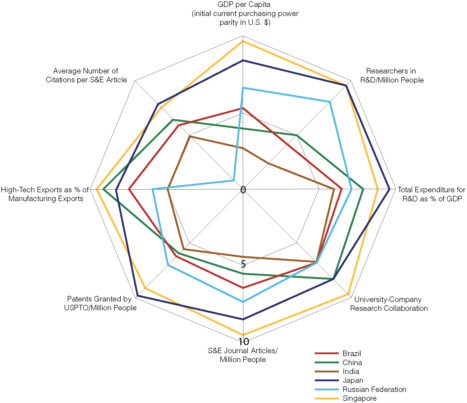
FIGURE S-1 Comparison of supply and output indicators in JBRICS countries using the Knowledge Assessment Methodology. SOURCE: World Bank. 2009. Knowledge for Development (K4D) Website: Custom Scorecards (KAM 2009). Tool available at http://info.worldbank.org/etools/kam2/KAM_page3.asp?default=1. Last accessed June 14, 2010.
each country’s S&T innovation environment and especially to predicting its future change. The cultural contexts of Brazil, India, Japan, and Russia have slowed their S&T innovation developments and will continue to do so in the near to mid terms. No single set of common indicators was found by the committee to provide a complete assessment of progress toward goals for all countries.
One of the better indicators of a country’s ability to achieve its S&T innovation goals is its ability to effect the requisite cultural changes. Among the six countries studied, China and Singapore have demonstrated a high capability to make the needed changes in cultural norms, and Russia has demonstrated the least capability, which will most likely delay or block its ability to achieve its S&T innovation goals. Furthermore, the S&T innovation environments of the more successful countries possess both top-down (i.e., led by government) and bottom-up (i.e., led by individuals and organizations) drivers of change. Among the JBRICS countries, China and Singapore also are the furthest along in this direction, and the likelihood of their continued, substantial progress is therefore high.
The national S&T innovation environment that has been a hallmark of the United States since World War II, and the model for other nations, is evolving into a new, 21st-century, global innovation environment in which R&D talent, financial resources, and manufacturing systems are integrated but geographically dispersed. In this context, the S&T strategy of a country has implications for its military capabilities both through wide-ranging, dual-use technology developments and through priorities given to developing those military capabilities for national use and for sale.
JBRICS investment in military modernization, a priority in China, Russia, India, and Singapore, and less so in Brazil and Japan, has varying implications for U.S. national security. China and India credibly integrate their goals for military modernization into broader, overriding goals for economic development, and their military capabilities are increasing. Russia views increased military strength as a counter to its declining economic, political, and diplomatic stature in the world, which is potentially more troubling. Singapore’s and Brazil’s military goals are consistent with transparent national plans and are not a significant natural security concern for the United States.
On the basis of its findings regarding implications of identified national S&T strategies in the JBRICS countries, the committee makes a number of recommendations to the U.S. government and the intelligence community. Its key recommendations are listed below; additional findings and recommendations are presented in Chapters 3 through 10. The recommendations highlight current observations and suggest that, at a minimum, further tracking of the best indicators be undertaken to verify the countries’ middle- and long-term S&T strategies and achievements.
Key Recommendation. Because a successful global S&T innovation environment portends future prosperity and security for all countries, monitoring the transformation from a national to a global S&T innovation environment should be undertaken on a regular basis for the United States and all countries of interest. Because this transformation can take place before a national S&T environment is fully developed, monitoring should be conducted independent of a country’s current achievement. (Recommendation 10-1)
Key Recommendation. The transfer of intellectual property by multinational corporations into domestic companies through S&T activities should be monitored in key countries, particularly India and China. The United States could join with Japan, and possibly the European Union, to establish a united front against such practices. (Recommendation 10-2)
Key Recommendation. The United States should assess its own preparation for, and transformation to, a successful global S&T innovation environment to ensure that it remains in a preeminent S&T position for continued prosperity and national security. Specific areas for assessment should include global exchanges in education and R&D talent, international as well as national recruitment of R&D talent, multinational corporate collaborations, and public policies that facilitate or restrain the leadership of the United States in global S&T innovation. (Recommendation 10-3)
Key Recommendation. For each country of interest, the United States should identify country-specific measures of S&T innovation environments, including nontraditional indicators that are appropriate for targeted technologies
and developments. The United States should monitor each country’s capacity to facilitate the cultural changes needed to achieve its global S&T innovation environment. These indicators are especially important for predicting future changes in S&T innovation environments. (Recommendation 10-4)
Key Recommendation. The most successful global S&T innovation environments will recruit S&T talent into attractive positions with excellent facilities and research support. The United States should track the quality and availability of research facilities and research support as a significant indicator of any country’s attractiveness to the world’s S&T talent. (Recommendation 10-5)
Key Recommendation. The United States should continue to gauge the efficiency of research, measured by the effective uses of research talent and research facilities, which portends the future of a county’s innovation environment. Efficiency ultimately guides the use of research talent and facilities. For instance, the monitoring of non-research responsibilities of scientists (such as administration and proposal writing) and the quality of research infrastructure could be incorporated into measures of efficiency. Highly efficient S&T systems support the most attractive research careers for talented S&T contributors. (Recommendation 10-6)
Key Recommendation. The U.S. government should assess, as a matter of urgency, the national security implications of the continuing global S&T revolution and the global dispersion of R&D. It should evaluate the impact of the decline in U.S. academic competitiveness at the primary and secondary levels, as pointed out in the 2007 report Rising Above the Gathering Storm, especially with regard to the sciences. Equally important, the assessment should seek mechanisms for sustainable U.S. government collaboration with the international community to uncover and exploit potential scientific and technological breakthroughs, wherever they occur, and to contain whatever threats they may portend. (Recommendation 9-1)


