National Academy of Sciences | 150 Year Anniversary

Questions? Call 800-624-6242

| Items in cart [0]

The National Academies Press

PAPERBACK
price:$28.75
add to cart

Rights & Permissions

topleft topright

U.S.-Iran Engagement in Science, Engineering, and Health (2000-2009): Opportunities, Constraints, and Impacts (2010)
Development, Security, and Cooperation (DSC)

Citation Manager

Schweitzer, Glenn E.. "Appendix H: Selected Statistics: Human Development, Research, and Communications in Iran." U.S.-Iran Engagement in Science, Engineering, and Health (2000-2009): Opportunities, Constraints, and Impacts. Washington, DC: The National Academies Press, 2010.

Please select a format:

BibTeX EndNote RefMan


Page
93
bottomleft bottomright

The following HTML text is provided to enhance online readability. Many aspects of typography translate only awkwardly to HTML. Please use the page image as the authoritative form to ensure accuracy.


U.S.-Iran Engagement in Science, Engineering, and Health (2000-2009): Opportunities, Constraints, and Impacts

Appendix H
Selected Statistics: Human Development, Research, and Communications in Iran

Human Development

Adult Literacy Rate (1995-2005)

82.4 %

Youth Literacy Rate (1995-2005) age 15-24

97.4 %

Population Undernourished (2002-2004)

4.0 %

Population Using Improved Water Sources (2002-2004)

94.0 %

Public Expenditure on Education (2002-2005), % of GDP

4.7 %

Public Expenditure on Education (2002-2005), % of budget

22.8 %

Public Expenditure on Health (2004) % of GDP

3.2 %

Electrification Rate

97.0 %

Unemployment (1996-2005)

11.5 %

Employment in industry (30%), agriculture (25%), services (45%)

SOURCE: U.N.D.P. Human Development Report, 2007/2008

Research

R&D at Universities

Research Centers Associated with Universities: 165

Public Universities that Conduct Research: 53

Private Universities that Conduct Research: 23

Page
93

Below are the first 10 and last 10 pages of uncorrected machine-read text (when available) of this chapter, followed by the top 30 algorithmically extracted key phrases from the chapter as a whole.
Intended to provide our own search engines and external engines with highly rich, chapter-representative searchable text on the opening pages of each chapter. Because it is UNCORRECTED material, please consider the following text as a useful but insufficient proxy for the authoritative book pages.

Do not use for reproduction, copying, pasting, or reading; exclusively for search engines.

OCR for page 93
U.S.-Iran Engagement in Science, Engineering, and Health (2000-2009): Opportunities, Constraints, and Impacts Appendix H Selected Statistics: Human Development, Research, and Communications in Iran Human Development Adult Literacy Rate (1995-2005) 82.4 % Youth Literacy Rate (1995-2005) age 15-24 97.4 % Population Undernourished (2002-2004) 4.0 % Population Using Improved Water Sources (2002-2004) 94.0 % Public Expenditure on Education (2002-2005), % of GDP 4.7 % Public Expenditure on Education (2002-2005), % of budget 22.8 % Public Expenditure on Health (2004) % of GDP 3.2 % Electrification Rate 97.0 % Unemployment (1996-2005) 11.5 % Employment in industry (30%), agriculture (25%), services (45%) SOURCE: U.N.D.P. Human Development Report, 2007/2008 Research R&D at Universities Research Centers Associated with Universities: 165 Public Universities that Conduct Research: 53 Private Universities that Conduct Research: 23

OCR for page 94
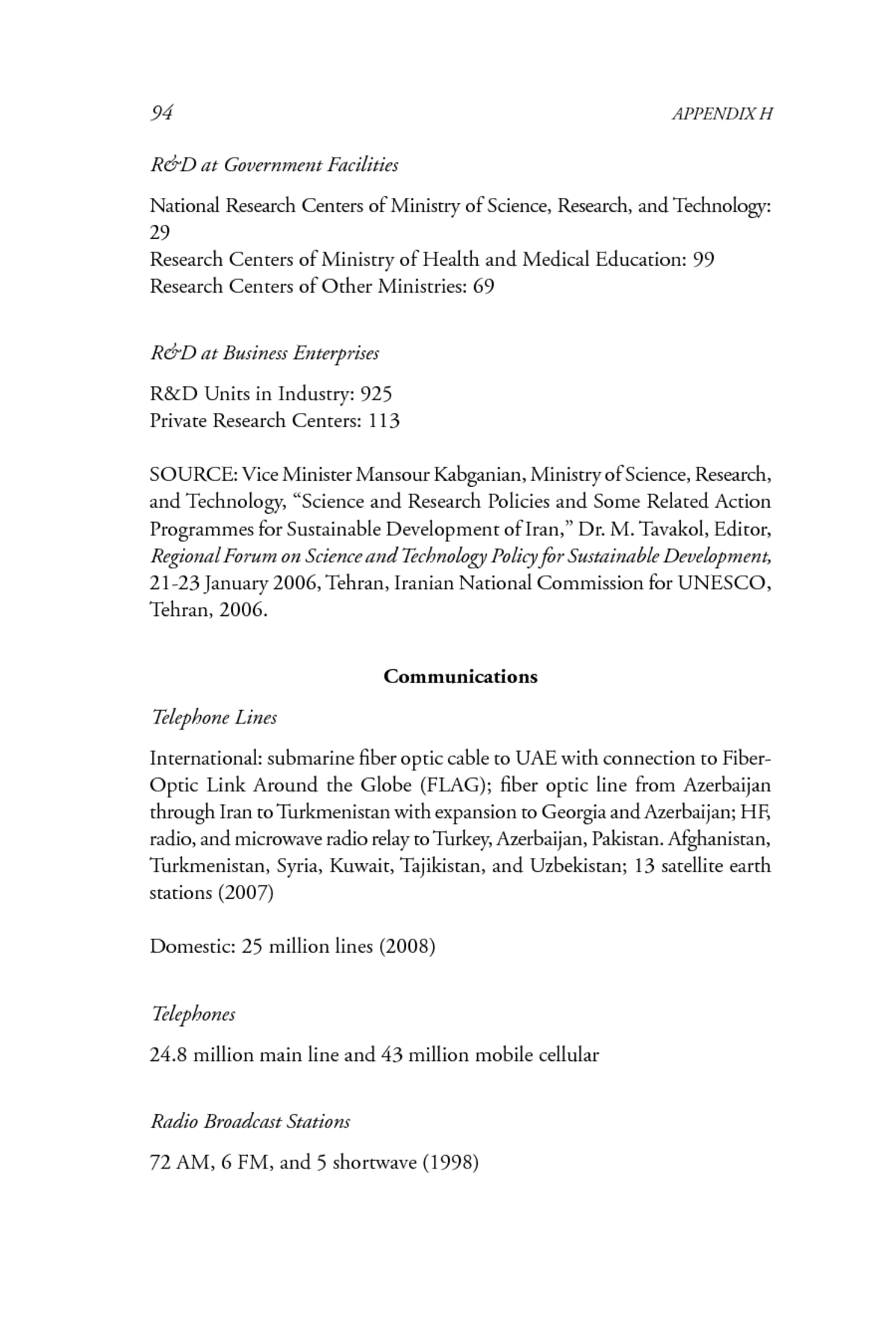
U.S.-Iran Engagement in Science, Engineering, and Health (2000-2009): Opportunities, Constraints, and Impacts R&D at Government Facilities National Research Centers of Ministry of Science, Research, and Technology: 29 Research Centers of Ministry of Health and Medical Education: 99 Research Centers of Other Ministries: 69 R&D at Business Enterprises R&D Units in Industry: 925 Private Research Centers: 113 SOURCE: Vice Minister Mansour Kabganian, Ministry of Science, Research, and Technology, “Science and Research Policies and Some Related Action Programmes for Sustainable Development of Iran,” Dr. M. Tavakol, Editor, Regional Forum on Science and Technology Policy for Sustainable Development, 21-23 January 2006, Tehran, Iranian National Commission for UNESCO, Tehran, 2006. Communications Telephone Lines International: submarine fiber optic cable to UAE with connection to Fiber-Optic Link Around the Globe (FLAG); fiber optic line from Azerbaijan through Iran to Turkmenistan with expansion to Georgia and Azerbaijan; HF, radio, and microwave radio relay to Turkey, Azerbaijan, Pakistan. Afghanistan, Turkmenistan, Syria, Kuwait, Tajikistan, and Uzbekistan; 13 satellite earth stations (2007) Domestic: 25 million lines (2008) Telephones 24.8 million main line and 43 million mobile cellular Radio Broadcast Stations 72 AM, 6 FM, and 5 shortwave (1998)

OCR for page 95
U.S.-Iran Engagement in Science, Engineering, and Health (2000-2009): Opportunities, Constraints, and Impacts Television Broadcast Stations 29 plus 450 repeaters (1997) Internet Hosts: 5.3 million (2006) Users: 23 million (2008) SOURCE: World Fact Book 2010: http://cia.gov/library/publications/the-world-factbook/geos/ir.html

OCR for page 96
U.S.-Iran Engagement in Science, Engineering, and Health (2000-2009): Opportunities, Constraints, and Impacts This page intentionally left blank.