
Suggested Citation:"Appendix I: Statistics on Higher Education in Iran." National Research Council. 2010. U.S.-Iran Engagement in Science, Engineering, and Health (2000-2009): Opportunities, Constraints, and Impacts. Washington, DC: The National Academies Press. doi: 10.17226/12921.
×
Appendix I
Statistics on Higher Education in Iran
These data include university students at all levels—candidates for associate, bachelor, master, and doctoral degrees—but do not include medical students. Students included in this dataset are enrolled in universities that are accredited by the Ministry of Science, Research, and Technology. It has been estimated by an American scholar that more than 90 percent of Iranian universities have such accreditation. Azad University, with several hundred units throughout the country and an enrollment between 1 and 1.5 million students, is clearly not included in the data.
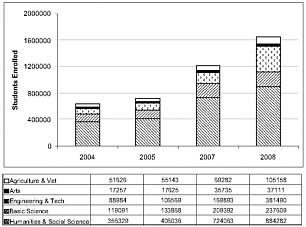
SOURCE: Ministry of Science, Research, and Technology’s Institute for Research and Planning in Higher Education: www.irphe.ir.
Suggested Citation:"Appendix I: Statistics on Higher Education in Iran." National Research Council. 2010. U.S.-Iran Engagement in Science, Engineering, and Health (2000-2009): Opportunities, Constraints, and Impacts. Washington, DC: The National Academies Press. doi: 10.17226/12921.
×
Suggested Citation:"Appendix I: Statistics on Higher Education in Iran." National Research Council. 2010. U.S.-Iran Engagement in Science, Engineering, and Health (2000-2009): Opportunities, Constraints, and Impacts. Washington, DC: The National Academies Press. doi: 10.17226/12921.
×

Suggested Citation:"Appendix I: Statistics on Higher Education in Iran." National Research Council. 2010. U.S.-Iran Engagement in Science, Engineering, and Health (2000-2009): Opportunities, Constraints, and Impacts. Washington, DC: The National Academies Press. doi: 10.17226/12921.
×

