
PANEL IV
THE UNIVERSITY CONNECTION
Moderator: Robert Samors Association of Public and Land-Grant Universities
Mr. Samors reminded the participants that the National Association of State Universities and Land-Grant Colleges—well known as NASULGC—had just changed its name about a month previously to the Association of Public and Land-Grant Universities (APLU). The APLU’s members included 215 public research universities, 76 land-grant colleges, and 24 institutions. “Our goal,” he said, “is to help them become the best possible partners in regional economic growth and development.”
The APLU has three primary areas of activity:
- to design better metrics for evaluating how institutions contribute to “innovation ecologies”;
- to develop tools institutions can use to assess and improve participation in regional economic development; and
- to make available the capabilities of major research universities in distressed areas, rural or urban, to help maximize their potential, in partnership with government and industry.
Luis M. Proenza University of Akron
Dr. Proenza opened with a summation of the effort to optimize innovation in Akron, Ohio: “It’s really about relevance, connectivity, and productivity—making do with relatively little to come to significant outcomes.”
He began with a nighttime satellite photograph showing clusters of light around metropolitan areas that he said represented 87 percent of the nation’s economic activity. These cluster also held 80 percent of the colleges and universities, he said, and illustrated an important feature of clustering: there were no visible boundaries between populated regions. “Often the sub-elements of clusters extend through these regions across political boundaries and into other states.” He said that greater Akron
held four million people, and that northeast Ohio, counting Cleveland, represented the fifth largest market in the United States. He listed 11 industrial clusters in the region, including polymers and advanced materials, a particular local strength.
Dr. Proenza began working to strengthen the Akron economic and educational cluster around the year 2000, soon after assuming the presidency. The region faced significant challenges. First was its image as part of the Rust Belt. Then there were a local aversion to risk and a lack of investment capital. The university itself was losing enrollment and overshadowed by the state’s two dominant institutions, Ohio State University and Case Western University.
Beginning with the Underutilized Assets
The university focused on what it saw as opportunities, beginning with underutilized assets and the greater flexibility of the new economic environment. Akron, like cities anywhere, could take advantage of globalization and its message that any region could compete with any other—given sufficient innovation resources.
“We began,” said Dr. Proenza, “with the realization that the university was nearing its 130th birthday. It was founded as Buchtel College in 1870, in the same decade and city as four major tire companies.” The college opened the first rubber chemistry program in 1909, and, along with the tire companies, developed what is today the “largest polymer program in the world.”
Akron also formed its own research foundation in 2001 to build on its historical record of research. “This record is very complex and comprehensive,” he said. “A university’s impact on its region through its own technology and outreach is far broader than we’d recognized.” The university began by looking at local knowledge assets. Many companies were downsizing and could no longer manage their technical libraries. Some of them donated their libraries to the university, which would manage them at much lower cost. They took advantage of available space to work more actively on industry research projects. The Ohio Research Foundation was developed expressly to offer university services to other institutions.
Transforming the University and the Region
More broadly, the university began to transform itself and the region in fundamental ways. It found that 7,000 of its 23,000 students were not living on campus because housing had been neglected for so long. The neighborhood around the campus had little vitality. In response, the university launched an initiative that resulted in a virtual rebuilding of the campus and improvements to a 40-block area around it. Results included 15 new buildings, 17 major additions, 36 acres of new space, 30,000 new trees and bushes, new walkways, plazas, terraces, and
gardens. It built new residence halls and broadened its efforts into a University Park Alliance that reached beyond campus into the city itself. “The goal is to make the whole area a nice place to live, learn, work, shop, and play,” said Dr. Proenza. Summa Health System joined the university as a development partner, and the Knight Foundation provided critical seed money. To date, the effort has mobilized some $500 million, and confirmed results include 920 new jobs, 80 new housing units, $52 million in civic investments, and $300+ million in private investments. The University Park now includes more than 1,000 acres, and a new 30,000-seat football stadium is scheduled to be ready for the 2009-2010 season.
National Recognition
As the decade progressed, the University of Akron began receiving national recognition. In 2007, it was ranked seventh in the nation in licensing revenue among universities that do not have a medical school—and first in the nation when results were normalized to total research expenditures.1 By the end of 2008, the university’s technology and invention portfolio included more than 450 active and pending patents. The university had generated nearly 30 start-up companies and hosted 115 active industry-sponsored research projects.
In 2007, the university bought two buildings adjacent to the campus to create the Akron Innovation Campus, which now houses 17 tenants. One organizational innovation is the creation of University of Akron Research Fellows, retired or active entrepreneurs and student interns who volunteer their time helping various small firms and individuals around the university. They may participate in small-firm formation and development, advice on technologies, and facilitate networking. “This saves the community about $4 million-$5 million a year,” said Dr. Proenza. “Anything they do adds value to the community.”
The ARCHAngels were formed, a regional network of investors that hosts financing events and supplements other more established intermediaries. The group has presented 45 companies to investors at quarterly events since November 2005, and 22 of them have reported total follow-on funding of $36 million.
At the request of Proctor & Gamble, headquartered in Cincinnati, the university also started a series of Open Innovation Seminars. Their purpose was to promote outreach and networking among companies—to transform corporate culture from an inward-looking, isolated model to one of open innovation in which firms are receptive to the ideas of partners. Its motto is “proudly invented elsewhere.”
________________
1Association of University Technology Managers (AUTM), February 2009.
A Bioinnovation Institute
Another initiative, he said, is an example of “the thing that doesn’t occur to you until it’s obvious.” That thing was named the Bioinnovation Institute, and grew out of existing local strength in polymers. “The human body,” he said, “when you take away the water and the calcium, is basically polymeric stuff. So the concept of biomaterials becomes an exceptional opportunity to deepen the relationship between materials science and biomedicine. We asked the three major hospitals in Akron, as well as a regional public medical school, to join in forming this new entity. They agreed, and it was catalyzed by another grant from the Knight Foundation. This initiative is dedicated to making Akron the #1 biomaterials and orthopedic research program in the world.”
Among the lessons learned during this experience, he emphasized the following:
- Assemble weak assets to create new strengths.
- Assemble “guerrilla” (volunteer) entrepreneurial talent at no cost.
- Be open to unusual partnerships (such as a university without a medical school teaming with three hospitals).
- Recognize that the university and the city must be close partners.
A Role That Is Still Evolving
He noted that the role of the university in economy development had been evolving since 1862, when the Morrill Land Grant Act specified a role for universities that taught applied agriculture and the mechanical arts. “This role is still evolving,” he said, “toward a much expanded sense of relevance and connectivity for every university discipline.” In the 21st century, he said, the university had become central to the knowledge-conceptual economy. It had also become a convener, developer of applications, and anchor for clusters of innovation.
He closed by endorsing five elements of a new university strategy, which he said were adapted from the Department of Commerce’s report on Strengthening America’s Communities:
- Public purpose, tied to enhancing the health of regional economies.
- Workforce development, fully integrated into parallel strategies at the national, state, and regional levels.
- Interconnected communities, with critical economic mass.
- A competitive strategy for all regions, and the collaborations to act on it.
- Public-private-university partnerships, with a system of compacts or incentives to remove barriers and promote cooperation.
The South Carolina Innovation Ecosystem
David McNamara South Carolina Research Authority
Mr. McNamara said that South Carolina, a small and traditionally rural state, had come only recently to emphasize the importance of economic development based on innovation clusters. A beginning step was taken by the state legislature in 2002 when it funded the Endowed Chairs Act to attract high-quality academic researchers. The legislature followed this in 2003 with the Research Infrastructure Act to provide the facilities and equipment for academic research. In 2005, Mr. McNamara was hired, with a straightforward mandate: focus on the knowledge being produced by the three research universities—the University of South Carolina, the Medical University of South Carolina, and Clemson University—and build an innovation system to commercialize that knowledge.
For this purpose, the 2005 Innovation Centers Act was passed and created SC Launch,2 under the umbrella of the South Carolina Research Authority (SCRA). SC Launch is funded not by the state but out of competitive federal contracts with mission agencies. He began to rally support for innovation clusters around each of the research universities, and to flesh out the details of his mission:
- Help create startups.
- Provide support for applied research and commercialization.
- Promote knowledge-based industries and research facilities.
- Focus SC Launch client efforts on new scientific and technological advances.
- Foster dialogue between university and industry.
- Assist the universities to increase research capabilities.
The SCRA hired Michael Porter to help produce a five-year plan for the clusters, and created another entity, the New Carolina Council on Competitiveness to focus specifically on those clusters. SC Launch focused on technology sectors that had good commercialization potential and some strength in the state—primarily advanced materials and fibers, alternative energy, automotive technology, energy and chemicals, life sciences/ biotechnology, and related information technology and software.
_______________________
2The website is <http://SCLaunch.org>.
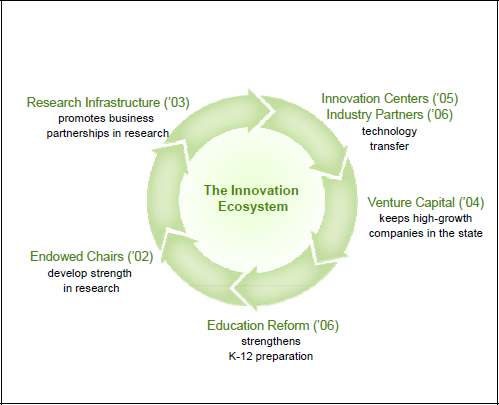
FIGURE 5 The innovation ecosystem.
SOURCE: David McNamara, Presentation at June 3, 2009, National Academies Symposium on “Growing Innovation Clusters for American Prosperity.”
The group received some seed funding and began to develop criteria for firms desiring to join the program. These firms had to have:
- Their base in South Carolina, or a commitment to moving there.
- High potential to create jobs and pay attractive wages.
- Intellectual property that was protected or capable of being protected.
- Linkage to SC research universities (preferred).
Using Leverage to Start Companies
SC Launch, with a budget of only about $6 million, had helped start about 130 companies start in the last three years, he said. “We have to use a lot of leverage. We raise money donated by taxpayers, and give them a tax credit. We have to work with every other entity in the state. The good news about being small is that we can get all the legislators and economic development people we need in one room when a company wants to come to town.” SC Launch offers not only seed funding, but
also up-front counseling and access to resources, including training, seminars, networking, access to investors, and coaching.
Despite the organization’s youth, said Mr. McNamara, it had brought to the state about $65 million in follow-on funding secured by launch companies. “The average salary in our companies is $77,000,” he said, “in a state where per capita income is between $38,000 and $50,000, depending on region.” It has attracted 130 members to its Circle of Innovation, which provides resource partners who want to participate and people who can contribute. In 2008, SC Launch received a national award for “Achievement in Building Knowledge-Based Economies” from the State Science & Technology Institute (SSTI).
Of the companies helped by SC Launch, several sectors dominated. Of the 130 companies, 26 were in the engineering and chemicals sector, 27 in information technology, and 44 in life sciences, biotechnology, and biomedicine. The automotive cluster, he said, was small but successful and growing rapidly, with research facilities supported by BMW, Toyota, Timken, a motor sport center at Clemson, and a hydrogen fuel cell program. He concluded that while SC Launch was not charged explicitly with the mission of forming clusters, “they seem to be forming on their own.”
Dr. Penhoet noted at the outset that California, home of Silicon Valley, had had no state program to form or support innovation clusters. “They’re all home grown,” he said, “most of them derived from the very powerful universities.”
Instead, he said, the state has inherited natural assets that originally drew people to the region, including:
- Geography.
- Climate.
- Natural resources.
- Large population (about 10 percent of the country).
These assets had been used and transformed over the years into created assets, including:
- Top universities, which had themselves been a major driver of innovation, especially in biotechnology and information technology.
- Research centers, including leading national laboratories.
- Talented people.
- An entrepreneurial culture.
- Networks of people in different sectors.
- Vibrant downtowns.
He emphasized the entrepreneurial culture of California. “Talented people live everywhere,” he said, “but for innovation, you need people with the courage to start a new business, and an environment that supports this. The attitude is important. You might say that entrepreneurial people are cocky, confident that they can do it.”
The Role of State Government
At the same time, he said, entrepreneurial people depend on many features and actions of state government. The state government is a partner in this process in several ways:
- Government is a major investor in human capital, from elementary to doctoral levels.
- It is the major provider of physical infrastructure, including roads, bridges, highways, ports, and local transit.
- Government often has jurisdiction or regulatory control over business activities. This control can either hamper or expedite business choices. “People worry a lot about macro issues,” he said, “but often your success comes down to whether you can get a permit from the local sewage agency.”
- Increasingly, government directly funds research and development.
The state government can play a central role in creating a climate for entrepreneurial activity, he said, by following some common-sense guidelines. These may include:
- Put all the pieces together. Make R&D investments part of a coordinated innovation strategy.
- Make the right bets. Each region has its own strengths, and a regional strategy should build on them. “You do have to choose winners,” he affirmed. “But this is not the same as creating them. People often ask how to build a biotech industry, as though there is a secret formula. They fail to understand that what is required is the fertile ground to plant the seed.” He said that Germany had tried to build a biotech industry in the former East Germany by placing a center in a region that needs economic help. “That simply doesn’t work,” he said. “You can’t just build some facilities and bring in some people because you think an area needs economic development. There has to be a reason to think the business will thrive where you put it.”
- Innovate for the real world—globally and locally. Research must be relevant to industry and the community. “We’ve witnessed a disconnect between ownership and economy activities,” he said. “We talk about GM and Chrysler being American companies, but
-
many countries own those companies. The New York Stock Exchange is 25 percent owned by foreign entities. The issue is not so much ownership as where you actually locate economic activity.”
- Invest in collaboration. Innovation needs partners from universities, industry, and government.
- Listen to the smart people. “There are hard decisions in this process, and you will need the best advice. Too many groups have tried to act in isolation.”
- Be consistent while embracing change. Innovation needs both flexibility and sustained effort.
- Make sure you get what you want, but be patient. It will take time to accomplish long-term goals, but measuring short-term gains is critical to getting there.3
California, he noted, is by no means absent from efforts to transform knowledge into commercial products and firms. It has created a number of large innovation funds that support both partnerships and focused research. These include:
- University of California Discovery Grants (1996). The state invested money in UC to be spent only on projects with private partners that have an outcome associated with that funding. The objective of the program is to support activities that are relevant to society and have a chance of creating a new business. It resembles the SBIR program in offering seed grants to move projects out of the laboratory into early-stage development. The University of California budgets about $15 million for the program, while industry has contributed about $20 million in a variety of areas, including electronics manufacturing ($13 million), digital media ($7 million), and multidisciplinary research in the three categories of energy and environment, health and wellness, and nanotechnologies ($2M).
- California Institutes for Science and Innovation (2000). These four institutes were launched by Gov. Gray Davis within the UC system. The institutes, in information technology, nanotechnology and biomedicine, were distributed throughout state and have received a total state investment of $400 million, equally distributed among the four centers.4 These have generated an additional $800 million in funds from the federal government and private sector, bringing the
_______________________
3Adapted from the National Governors’ Association, Innovation America, Washington, DC: National Governors’ Association, 2007.
4These centers are (1) The California Institute for Quantitative Biosciences at UCSF, UCB and UCSC, The California Institute for Telecommunications and Information Technology, at UCSD and UCI, The California Nanosystems Institute at UCLA and UCSB, and the Center for Information Technology Research in the Interest of Society at UCB, UCD, UCM, and UCSC.
-
total investment to about $1.2 billion. The program has been a major driver of growth.
- Proposition 71 (2004). Voters approved Prop 71 to establish the California Institute of Regenerative Medicine, which regulates and funds stem cell research. The measure was paid for by issuing $3 billion in state general obligation bonds, the first time a state has raised that much money for a specific kind of research. This was passed at a time when the federal government did not support stem cell research.
- Climate Change Institute (Proposed, 2009). Funding in excess of $300 million has been proposed to initiate an R&D program.
Some Features of Propositions
Dr. Penhoet added several comments on Proposition 71. It actually had two explicit goals. One was to find cures for disease using stem cells as a therapy or tool. The second was to enhance California’s competitive position as the world’s leading biotech region. The funding had indeed built up the most robust stem cell program in the world, he said, attracting numerous scientists from within and outside the United States. “So it has had a positive effect.”
At the same time, he noted that Proposition 71 had raised a knotty political issue. “The Proposition was good for us [in biotechnology], but bad for the state.” The Proposition specified funding by general obligation bonds, effectively embedding the obligation in the state constitution. “This means that the legislature can’t cut the budget,” he said. “This is one of California’s problems as it tries to deal with the current financial crisis. Many such things are not under the control of the legislature, so in difficult times it has limited ability to adjust the budget.”
Clusters Have Few Rules
Dr. Penhoet offered a comment on cluster formation, illustrating that there are few firm rules about participation. While first-rank universities are almost always associated with successful innovation activity, he said, this is not always true; nor is it true that leading technology companies depend on cluster membership. In California, for example, the biotech industry is concentrated largely in two places, San Francisco and San Diego. Yet the largest independent biotech company, AMGEN, is located in Thousand Oaks, outside Los Angeles. This company is isolated geographically, is not associated with any university, and has not spawned a cluster of smaller startups, as Genentech and other leading firms have done. He drew no conclusion from this anomaly, other than to reiterate the lack of any formula for successful innovation.
Discussion
Mr. Samors asked the panelists to summarize the key elements needed to create productive partnerships. Dr. Proenza placed proper incentives at the top of his list. Mr. McNamara commented that different technology firms regard the language and opportunities of commercialization in different ways. For example, he said that many firms considered licensing and commercialization to be synonymous. Also, he noted that many investigators are reluctant to file their discoveries because of the time this takes away from their research. Finally, he said, some researchers had no interest in commercializing under any circumstances. “We have to win their trust and walk the floor and encourage them to file that discovery.”
Dr. Muir of the University of Florida noted that many of the disclosures received by her Technology Licensing Office cross disciplines. “The collaborations are occurring,” she said, “but they are occurring because they happen around a particular goal or problem to be solved.”
Mr. Milbergs asked a question “about headhunting.” Washington State had hired two global research leaders, in biofuels and nanophotonics, in hopes that they would attract federal funds, build partnerships, and help create emerging new industry clusters. He asked whether such recruitments have this potential. Dr. Proenza affirmed that many states had a similar “eminent scholars programs,” and that most are successful. “If the person has stamina, interest, and perhaps an emerging entrepreneurial track record, the prospects for generating funding are there.” Dr. Penhoet said such people are difficult to find—especially those with “good science and reasonable business skills. My own experience is that it is a recipe for disaster to hire scientists who don’t understand business, or business people who don’t appreciate science. You’ll ride off a cliff together unless the communication skills are very good.” Mr. McNamara said that he had difficulty enticing good entrepreneurs to a new program, and he was studying the use of an incentive plan offering several years of salary or income.


