
Appendix I
Glossary of Selected Terms1
*Acoustical holography—An inspection method using the phase interference between sound waves from an object and a reference signal to obtain an image of reflections in the test object.
*Action level—The cumulative work-shift noise dose at which a hearing conservation program is mandated by the Occupational Safety and Health Administration (OSHA). An 8-hour time-weighted average of 85 dB measured with A-weighting and slow response or the equivalent, a dose of 50 percent. See hearing conservation program.
*Active control—Reducing sound and secondary sources of excitation to cancel, or at least reduce, the response of a system to prime noise sources; also to suppress self-excitation oscillations of an unstable system.
†Ambient noise—All-encompassing sound at a given place, usually a composite of sounds from many sources near and far.
*Annoyance—A person’s internal response to a noise. Annoyance is quantifiable (1) psychologically by subjective rating or (2) technically by a physical noise descriptor, for example, the equivalent continuous A-weighted sound pressure level  . For a given person, the correlation coefficient between descriptor and related ratings usually does not exceed 0.5 due to the influence of other factors in determining annoyance. See equivalent continuous A-weighted sound pressure.
†Background noise—Total noise from all sources of interference in a system used for the production, detection, measurement, or recording of a signal, independent of the presence of the signal.
NOTES:
1. Ambient sound detected, measured, or recorded with the signal is part of the background noise.
2. Interference resulting from primary electric power supplies (commonly described as a hum when heard separately) is included in the definition of background noise.
†Day average sound level—Time-average sound level between 0700 and 2200 hours. Unit, decibel (dB); abbreviation, DL; symbol, Ld.
NOTE: Day average sound level in decibels is related to the corresponding day sound exposure level, LEd, according to

where 54,000 is the number of seconds in a 15-hour day.
†Day-night average sound level—Twenty-four-hour average sound level for a given day, after addition of 10 decibels to levels from midnight to 0700 hours and from 2200 hours (10 p.m.) to midnight. Unit, decibel (dB); abbreviation, DNL; symbol, Ldn.
NOTES:
1. Day-night average sound level in decibels is related to the corresponding day-night sound exposure level, LEdn, according to

where 86,400 is the number of seconds in a 24-hour day.
2. A frequency weighting is understood, unless another frequency weighting is specified explicitly.
†Decibel—Unit of level when the base of the logarithm is the tenth root of 10 and the quantities concerned are proportional to power. Unit symbol, dB.
NOTE: Examples of quantities that qualify are power (in any form), sound pressure squared, particle velocity squared, sound intensity, sound-energy density, and voltage squared. Thus, the decibel is a unit of sound-pressure-squared level; in common practice, however, called sound pressure level, unless an ambiguity results from so doing.
†Effective perceived noise level—Level of the time integral of the antilogarithm of one-tenth of tone-corrected perceived noise level over the duration of an aircraft flyover, the reference duration being 10 seconds. Unit, decibel (dB); abbreviation, EPNL; symbol,  .
.
NOTE: The integral is usually approximated by summation, over the top 10 decibels of an aircraft noise signal of the antilogarithms of one-tenth of tone-corrected perceived noise level at successive 0.5 second intervals.
†Equivalent continuous sound level—Ten times the logarithm to the base 10 of the ratio of time-mean-square instantaneous A-weighted sound pressure, during a stated time interval T, to the square of the standard reference sound pressure. Unit, decibel (dB); respective abbreviations, TAV and TEQ; respective symbols, LAT and LAeqT.
NOTES:
1. A frequency weighting other than the standard A-weighting may be employed if specified explicitly. A frequency weighting that is essentially constant between limits specified by a manufacturer is called “flat.”
2. In symbols, time-average (time-interval equivalent continuous) A-weighted sound level in decibels is
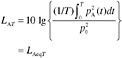
where pA2 is the squared instantaneous A-weighted sound pressure signal, a function of elapsed time t; in gases reference sound pressure p0 = 20 μPa; T is a stated time interval.
3. In principle, the sound pressure signal is not exponentially time weighted, either before or after squaring.
*Frequency weighting—Modification of the spectrum of an acoustical signal by means of an analog or digital filter having one of the standardized response characteristics known as A, B, C, etc., defined in IEC 61672-1. The A-weighting filter is the one most commonly used. See weighting network.
*Hearing conservation program—A system to identify noise-exposed workers and monitor their exposure and audiometric function.
*Hearing loss—Increase in the threshold of audibility due to disease, injury, age, or exposure to intense noise. Conductive hearing loss: Hearing loss caused either by blockage of the external ear or by disease or damage in the middle ear, so that the signal amplitude reaching the inner ear is reduced. Noise-induced hearing loss (NIHL): Cumulative hearing loss associated with repeated exposure to noise. Sensorineural hearing loss: Hearing loss due to a lesion or disorder of the inner ear or of the auditory nervous system. Nonoccupational hearing loss: Hearing loss caused by exposure outside of the occupational environment.
*Hertz (Hz)—A unit of frequency measurement representing cycles per second.
†Muffler—Duct designed to reduce the level of sound. The sound-reducing mechanisms may be either absorptive, reactive, or a combination of both.
*Newton (N)—A unit of force. The force of one Newton accelerates a 1 kg mass at 1 m/s2.
*Noise dose—(1) According to the definition given by Occupational Safety and Health Administration (OSHA), noise dose is the ratio, expressed as a percentage of (a) the time integral, over a stated time or event, of the 0.6 power of the measured “S” (slow) exponential time-averaged, squared A-weighted sound pressure and (b) the product of the criterion duration (8 hours) and the 0.6 power of the squared sound pressure corresponding to the criterion sound pressure level (90 dB). (2) According to the definition given by OSHA, noise dose is the percentage of actual exposure relative to the amount of allowable exposure, and for which 100 percent and above represents exposures that are hazardous. The noise dose is calculated using:

where Ci is the total time of exposure at a specified noise level, and Ti is the exposure time at which noise for this level becomes hazardous.
†Noise—(a) Undesired sound, by extension is any unwarranted disturbance in a useful frequency band, such as undesired electric waves in a transmission channel or device. (b) Erratic, intermittent, or statistically random oscillation.
NOTES:
1. If ambiguity exists as to the nature of the noise, a term such as “acoustic noise” or “electric noise” should be used.
2. Since definitions 3.25 (a) and (b) are not mutually exclusive, it is usually necessary to depend on context for the distinction.
*Noise-induced hearing loss—See hearing loss.
†Noise-induced permanent threshold shift—Permanent hearing loss resulting from noise exposure. Abbreviation: NIPTS.
†Noise-induced temporary threshold shift—Temporary hearing loss resulting from noise exposure. Abbreviation: NITTS.
*Octave band—A frequency band with upper and lower frequency limits in the ratio of 2. See one-third octave band.
*One-third octave band—A frequency band with upper and lower frequency limits in the ratio of 21/3.
*One-third octave filter—A filter with upper and lower passband limits in the ratio of 21/3 centered at one of the preferred frequencies given in ISO 266. Should meet the attenuation characteristics of IEC 61260 and ANSI S1.11–1986.
*Pascal (Pa)—unit of pressure corresponding to a force of 1 Newton acting uniformly on an area of 1 square meter. 1 Pa = 1 N/m2.
†Perceived noise level—Frequency-weighted sound pressure level obtained by a stated procedure that combines the sound pressure levels in the 24 one-third octave bands with midband frequencies from 50 to 10 kHz. Unit, decibel (dB); abbreviation, PNL; symbol, LPN.
NOTE: Procedures for computing perceived noise level are stated in Federal Aviation Regulation Part 36, Noise Standards: Aircraft Type and Airworthiness Certification, Appendix B, and in International Civil Aviation Organization Annex 16, Volume 1, Aircraft Noise, 3rd ed., July 1993.
†Perceived noisiness—Prescribed function of sound pressure levels in the 24 one-third octave bands with nominal midband frequencies from 50 to 10 kHz used in the calculation of perceived noise level. Unit, noy; abbreviation, n.
NOTE: The prescribed function is given in Federal Aviation Regulation Part 36, Noise Standards: Aircraft Type and Airworthiness Certification, Appendix B, and in International Civil Aviation Organization Annex 16, Volume 1, Aircraft Noise, 3rd ed., July 1993.
*Permissible exposure level (PEL)—Regulatory limit of sound exposure. The OSHA (Occupational Safety and Health Administration) PEL is a noise dose of 1.0 based on an 8-hour A-weighted sound exposure level at 90 dB with a 5-dB exchange rate. European PEL is generally an 8-hour A-weighted sound exposure level at 85 dB with a 3-dB exchange rate.
†Phon—Unit of loudness, judged or calculated.
*Radiation efficiency; radiation factor—The ratio of the sound power radiated by a vibrating surface, with a given time-mean-square velocity, to the sound power, which would be emitted as a plane wave by the same vibrating surface with the same vibration velocity. The radiation factor is given by the following equation:

where Ps is the airborne sound power emitted by the vibrating surface, ρc is the characteristic impedance of air, Ss is the area of the vibrating surface, and  is the squared rms value of the vibratory velocity averaged over the area Ss. Unit; none; symbol, σ. See sound power.
*Single-event sound pressure level—Time-integrated sound pressure level of an isolated single sound event of specified duration T (or specified measurement time T) normalized to T0 = 1 s. It is given by the formula:
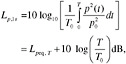
where p(t) is the instantaneous sound pressure, p0 is the reference sound pressure, and Lpeq.T is the equivalent continuous sound pressure level. Unit, decibel (dB); symbol: Lp,1s.
†Sound exposure—Time integral of squared instantaneous frequency-weighted sound pressure over a stated time interval or event. Unit, pascal-squared second; symbol, E.
NOTES:
1. If frequency weighting is not specified, A-frequency weighting is understood. If other than A-frequency weighting is used, such as C-frequency weighting, an appropriate subscript should be added to the symbol (e.g., EC).
2. Duration of integration is implicitly included in the time integral and need not be reported explicitly. For the sound exposure measured over a specified time interval, such as 1 hour, a 15-hour day, or a 9-hour night, the duration should be indicated by the abbreviation or letter symbol, for example 1-hour sound exposure (1HSE or E1h) for a particular hour; day sound exposure (DSE or Ed) from 0700 to 2200 hours; and night sound exposure (NSE or En) from 0000 to 0700 hours plus from 2200 to 2400 hours.
3. Day-night sound exposure (DNSE or Edn) for a 24-hour day is the sum of the day sound exposure and 10 times the night sound exposure.
4. Unless otherwise stated, the normal unit for sound exposure is the pascal-squared second.
†Sound exposure level—Ten times the logarithm to the base 10 of the ratio of a given time integral of squared instantaneous A-weighted sound pressure, over a stated time interval or event, to the product of the squared reference sound pressure of 20 micropascals and reference duration of 1 second. The frequency weighting and reference sound exposure may be otherwise if stated explicitly. Unit, decibel (dB); abbreviation, ASEL; symbol, LAE.
NOTE: In symbols, (A-weighted) sound exposure level is
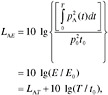
where  is the squared instantaneous A-weighted sound pressure, a function of time t; for gases p0 = 20 μPa; t0 = 1 s; E is sound exposure;
  is reference sound exposure.
†Sound intensity—Average rate of sound energy transmitted in a specified direction at a point through a unit area normal to this direction at the point considered. Unit, watt-per square meter (W/m2); symbol, l.
NOTES:
1. Sound intensity in the specified direction is given by the expression

where
T = time, which should be long compared with the reciprocal of the lowest frequency of interest;
p = instantaneous sound pressure;
v = component of instantaneous particle velocity in the specified direction; and
t = time.
2. In the case of a free plane or spherical wave having time-mean-square pressure p2, velocity of propagation c, in a medium of density p, the intensity in the direction of propagation is given by

†Sound-level meter—Device used to measure sound pressure level with a standardized frequency weighting and indicated exponential time weighting for measurements of sound level, or without time weighting for measurements of time-average sound pressure level or sound exposure level.
†Sound power—Sound energy radiated by a source per unit of time. Unit, watt (W), symbols, P or W.
†Sound power level—Ten times the logarithm to the base 10 of the ratio of a given sound power in a stated frequency band, to the reference power of 1 picowatt (1 pW). Unit, decibel (dB), abbreviation PWL; symbols, LP or LW.
†Sound pressure—Root-mean-square instantaneous sound pressure at a point during a given time interval. Unit, pascal (Pa).
NOTE: In the case of periodic sound pressures, the interval is an integral number of periods or an interval that is long compared to a period. In the case of nonperiodic sound pressures, the interval should be long enough to make the measured sound pressures essentially independent of small changes in the duration of the interval.
†Sound pressure level—(a) Ten times the logarithm to the base 10 of the ratio of the time-mean-square pressure of a sound, in a stated frequency band, to the square of the reference sound pressure band, to the square of the reference
sound pressure in gases of 20 μPa. Unit, decibel (dB); abbreviation, SPL; symbol, LP. (b) For sound in media other than gases, unless otherwise specified, reference sound pressure is one micropascal (1 μPa).
NOTE: A sound pressure level with reference to a pressure of 1 μPa is numerically 10 lg(202/12) = 26 decibels greater than the sound pressure level for the same sound pressure but with reference to 20 μPa.
†Speech interference level—One-fourth of the sum of the band sound pressure levels for octave bands with nominal midband frequencies of 500, 1,000, 2,000, and 4,000 Hz. Unit, decibel; abbreviation, SIL; symbol, LSI.
*Tire/road noise—Unwanted sound generated by the interaction between a rolling tire and the surface on which it is rolling. Also known as tire/pavement noise.
†Time-average sound level—See description for equivalent continuous sound level.
*Turbulence—A fluid mechanical phenomenon that causes fluctuation in the local sound speed relevant to sound generation in turbo machines (pumps, compressors, fans, and turbines), pumping and air-conditioning systems, or propagation from jets and through the atmosphere.
*Weighting network—Electronic filter in a sound-level meter that approximates, under defined conditions, the frequency response of the human ear. The A-weighting network is most commonly used. See frequency weighting.
Please note: No rights are granted to use content that appears in the work with credit to another source.


