
2
Diverging Trends in Life Expectancy at Age 50: A Look at Causes of Death
Dana A. Glei, France Meslé, and Jacques Vallin
This study focuses on three main questions: (1) Why did mortality decline slow among women (but not men) after 1980 in the United States? (2) Can slowing in Danish and Dutch trends be explained by similar sources? (3) Why did Denmark and more recently the Netherlands resume progress but the United States has not? To begin to answer these questions, we explore which ages and which causes of death contributed to disparities across the 10 study countries. We mainly used the Human Mortality Database (HMD) (2009) for age-specific mortality data and the World Health Organization (WHO) database (World Health Organization, 2009) for causes of death; additional data were obtained from national sources to complete or update these two international databases. Throughout our analyses, we focus particular attention on several outliers: countries in which levels of life expectancy at age 50 (e50) in 2006 among women are lowest (Denmark, the Netherlands, and the United States) and highest (France and Japan).
The chapter is organized in several sections. First, we investigate age group contributions to gains in e50 during the periods 1955-1980 and 1980-2004. Second, we explore trends in mortality rates by cause of death. Third, we determine the contribution of cause groups to the gains in e50. Fourth, we examine the age and cause-specific components of recent progress in Denmark and the Netherlands compared with the United States. Fifth, we present more in-depth analyses comparing several of the outliers (i.e., France, Japan, the Netherlands, and United States). The paper concludes with a review of the main findings with respect to our research questions and a discussion of the implications.
INTRODUCTION
Before focusing in-depth analysis on a small number of high-income countries, we begin by showing the 35 richest countries in terms of life expectancy at age 50 relative to gross domestic product (GDP) per capita. We then proceed to the main analysis, which is based on 10 countries selected by the committee as the most relevant for understanding the position of the United States.
In 2005, among the richest countries, we see a clear relation between e50 (both sexes) and the GDP per capita (Figure 2-1, right graph) (R2 = 0.60), which contrasts with the situation observed in 1960 (Figure 2-1, left graph) (R2 = 0.05). In between, major changes occurred in the field of public health. Until the middle of the 20th century, life expectancy was still strongly dependent on the fight against infectious diseases (even above age 50), which mainly relied on antibiotics and vaccines without much link to the GDP per capita, at least among rich countries. On the contrary, by 2005, e50 depends mostly on the success of the fight against degenerative diseases, including circulatory diseases.
Figure 2-1 shows some geographic clustering: among these countries at the top of the world income distribution, the group of countries in the lower left corner (lowest e50 and lowest GDP per capita) includes Russia and most of the countries in Central and Eastern Europe, and the countries in the rest of the world are clustered in the top half of the graph (with higher e50 and generally higher GDP per capita). However, the general correlation between GDP per capita and e50 appears to be rather strong.1 Yet under the diagonal on Figure 2-1, there are a few outliers: e50 in Denmark (DNK), Ireland (IRL), Russia (RUS), Singapore (SGP), and even more so Norway (NOR) and the United States (USA), are lower than one might expect given their income level. Specific explanations could certainly be given for each of these exceptions, but it seems that at least three of them were enriched rather suddenly in recent years, perhaps without sufficient time to realize the health benefits (Ireland, Norway, and Singapore). Denmark is well known for having encountered difficulties controlling some human-made diseases like tobacco-related conditions, and Russia is not a surprise at all but typical of the excess adult mortality in Eastern Europe. Above all, the United States is the most striking because e50 lags many other countries despite much higher levels of income, without any clear explanation. Indeed, when excluding the six exceptional cases, the correlation is even stronger (R2 = 0.75).
When looking at the trends in e50 over the period since 1955 among the 10 study countries, the strikingly unfavorable position of the United States
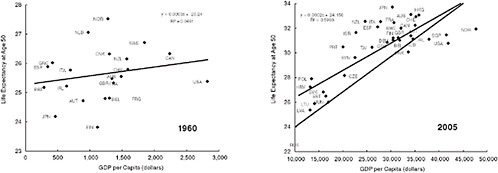
FIGURE 2-1 GDP per capita and life expectancy at age 50 in the richest countries in 1960 and 2005, both sexes.
NOTES: Countries are designated by the standard United Nations country codes (see http://unstats.un.org/unsd/methods/m49/m49alpha.htm); see the complete list below.
We define the richest countries to be those in which GDP per capita was more than 10,000 purchasing power parity dollars in 2005, excluding those in which population size is less than 1 million (i.e., Bahrain, Botswana, Brunei, Cyprus, Equatorial Guinea, Gabon, Iceland, Kuwait, Luxembourg, Macao, Malta, Oman, Qatar) or in which mortality data quality is questionable (i.e., Argentina, Chile, Malaysia, Mexico, Saudi Arabia, South Korea). In total, 35 countries are considered for the year 2005: Australia (AUS), Austria (AUT), Belgium (BEL), Canada (CAN), Croatia (HRV), Czech Republic (CZE), Denmark (DNK), Estonia (EST), Finland (FIN), France (FRA), Germany (DEU), Greece (GRC), Hong Kong (HKG), Hungary (HUN), Ireland (IRL), Israel (ISR), Italy (ITA), Japan (JPN), Latvia (LVA), Lithuania (LTU), the Netherlands (NLD), New Zealand (NZL), Norway (NOR), Poland (POL), Portugal (PRT), Russia (RUS), Singapore (SGP), Slovak Republic (SVK), Slovenia (SVN), Spain (ESP), Sweden (SWE), Switzerland (CHE), Taiwan (TAI), United Kingdom (GBR), United States (USA). For 1960, we include the same countries subject to data availability (except Germany, which is replaced by West Germany, FRG).
SOURCE: Drawn from data on Gross Domestic Product per capita from the World Bank (1976, 2008); estimates of life expectancy at age 50 from Human Mortality Database (2009 [accessed January 2009]).
appears to result from different patterns by sex (see Figures 2-2 and 2-3). Trends for U.S. men are quite similar to those of most other countries (with the exception of Denmark). It is true that U.S. men have consistently ranked among the three or four lowest positions in terms of e50, but their position does not appear to have deteriorated over the past five decades.
In contrast, trends for women have strongly diverged since 1980. Until around that year, e50 among U.S. women stayed solidly in the middle of the group following a trend similar to the others with the exception of Japan, which started out way behind but made faster gains than the other countries throughout the period. Around 1980, the pace of gains in e50 slowed among women in the United States, along with Denmark and the Netherlands, while continuing at a faster pace among other countries.2 Between 1980 and 2006, women in these three countries gained only 2.0-2.4 years in e50, whereas women in most of the other countries gained 4 or more years (see Table 2-1). Yet Danish women resumed progress after the mid-1990s, and in very recent years Dutch women also began making faster gains. During the past 26 years, gains in e50 among U.S. women (2.4 years) were about half of those in Australia, France, and Italy (4.5-5.2 years) and less than 40 percent that of Japan (6.3 years). Not only is U.S. longevity (among both sexes combined) shorter than expected given its GDP per capita (Figure 2-1), but women appear to have fallen further behind over the last quarter of a century.
AGE GROUP CONTRIBUTIONS TO GAINS IN E50
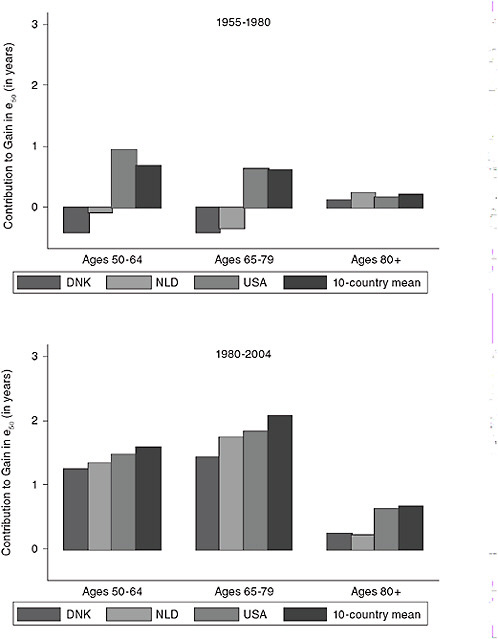
Figure 2-4 shows the contributions by age group to female gains in e50 during the periods 1955-1980 and 1980-2004 for Denmark, the Nether-lands, and the United States compared with the 10-country mean. Detailed results for all countries are provided in Annex Tables 2A-1 and 2A-2.
Among women in the United States as well as the Netherlands and Denmark, the pace of mortality decline at ages 65-79 slowed considerably in recent years: that is, they made smaller gains in 1980-2004 compared with 1955-1980. Such a slowdown is not evident among the other countries (except Canada). In the same way, at the oldest ages (80+), the pace of mortality decline decreased somewhat in Denmark, the Netherlands, and the United States while it increased dramatically in most other countries (again, with the exception of Canada). For example, among women in France and Japan, ages 80 and older contributed 0.6-0.8 years to gains in e50 during the period 1955-1980 (Table 2A-1), whereas the contribution grew to 1.7-2.7
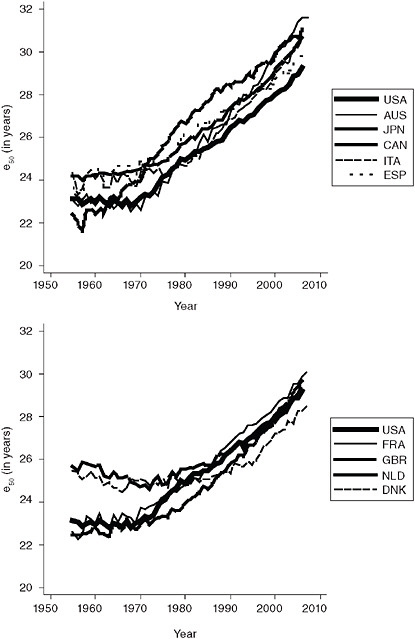
FIGURE 2-2 Annual trends in e50 by sex among 10 selected countries, men, 1955-2007.
NOTES: The United States is shown relative to the other countries (listed in rank order by level of e50 in 2006). AUS = Australia, CAN = Canada, DNK = Denmark, ESP = Spain, FRA = France, GBR = United Kingdom, ITA = Italy, JPN = Japan, NLD = the Netherlands, USA = United States.
SOURCE: Data from Human Mortality Database (2009 [accessed November 2009]).
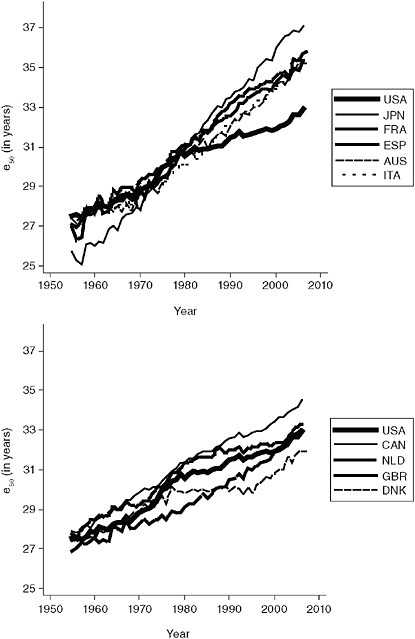
FIGURE 2-3 Annual trends in e50 by sex among 10 selected countries, women, 1955-2007.
NOTES: The United States is shown relative to the other countries (listed in rank order by level of e50 in 2006). AUS = Australia, CAN = Canada, DNK = Denmark, ESP = Spain, FRA = France, GBR = United Kingdom, ITA = Italy, JPN = Japan, NLD = the Netherlands, USA = United States.
SOURCE: Data from Human Mortality Database (2009 [accessed November 2009]).
TABLE 2-1 Life Expectancy at Age 50 (e50) and Gains in e50, Selected Countries, 1955-2006
|
|
1955 |
1980 |
2006 |
Gain in e50 |
|||||
|
|
e50 |
Rank |
e50 |
Rank |
e50 |
Rank |
1955-1980 |
1980-2006 |
Total (1955-2006) |
|
Women |
|||||||||
|
AUS |
27.4 |
5 |
30.7 |
6 |
35.3 |
4 |
3.3 |
4.6 |
7.9 |
|
CAN |
27.9 |
1 |
31.3 |
1 |
34.5 |
6 |
3.5 |
3.2 |
6.7 |
|
DNK |
27.4 |
4 |
29.8 |
9 |
31.9 |
10 |
2.4 |
2.1 |
4.5 |
|
FRA |
27.1 |
6 |
31.1 |
3 |
35.7 |
2 |
4.0 |
4.5 |
8.6 |
|
ITA |
27.1 |
7 |
30.0 |
8 |
35.2 |
5 |
2.9 |
5.2 |
8.1 |
|
JPN |
25.7 |
10 |
30.8 |
5 |
37.1 |
1 |
5.1 |
6.3 |
11.4 |
|
NLD |
27.7 |
2 |
31.3 |
2 |
33.3 |
7 |
3.6 |
2.0 |
5.6 |
|
ESP |
27.0 |
8 |
31.0 |
4 |
35.4 |
3 |
4.0 |
4.4 |
8.4 |
|
GBR |
26.9 |
9 |
29.1 |
10 |
33.1 |
8 |
2.2 |
4.0 |
6.2 |
|
USA |
27.5 |
3 |
30.6 |
7 |
33.0 |
9 |
3.0 |
2.4 |
5.4 |
|
Meana (all countries) |
27.2 |
|
30.6 |
|
34.5 |
|
3.4 |
3.9 |
7.3 |
|
Excluding USA, DNK, and NLD |
27.0 |
|
30.6 |
|
35.2 |
|
3.6 |
4.6 |
8.2 |
|
Compositeb (all countries) |
27.0 |
|
30.5 |
|
34.5 |
|
3.5 |
4.0 |
7.5 |
|
Excluding USA, DNK, and NLD |
26.8 |
|
30.5 |
|
35.6 |
|
3.7 |
5.1 |
8.8 |
|
Men |
|||||||||
|
AUS |
23.0 |
7 |
25.0 |
5 |
31.5 |
1 |
1.9 |
6.6 |
8.5 |
|
CAN |
24.2 |
4 |
25.7 |
3 |
30.7 |
3 |
1.5 |
5.0 |
6.5 |
|
DNK |
25.4 |
2 |
24.8 |
8 |
28.2 |
10 |
–0.7 |
3.5 |
2.8 |
|
FRA |
22.6 |
8 |
24.8 |
7 |
29.9 |
6 |
2.2 |
5.1 |
7.3 |
|
ITA |
24.3 |
3 |
24.7 |
9 |
30.6 |
4 |
0.3 |
5.9 |
6.2 |
|
JPN |
22.4 |
10 |
26.6 |
1 |
31.0 |
2 |
4.2 |
4.4 |
8.6 |
|
NLD |
25.7 |
1 |
25.5 |
4 |
29.4 |
8 |
–0.2 |
4.0 |
3.8 |
|
ESP |
23.7 |
5 |
26.2 |
2 |
29.9 |
5 |
2.5 |
3.7 |
6.2 |
|
GBR |
22.5 |
9 |
23.9 |
10 |
29.7 |
7 |
1.5 |
5.7 |
7.2 |
|
USA |
23.1 |
6 |
24.9 |
6 |
29.2 |
9 |
1.8 |
4.3 |
6.1 |
|
Meana (all countries) |
23.7 |
|
25.2 |
|
30.0 |
|
1.5 |
4.8 |
6.3 |
|
Excluding USA, DNK, and NLD |
23.2 |
|
25.3 |
|
30.5 |
|
2.0 |
5.2 |
7.2 |
|
Compositeb (all countries) |
23.1 |
|
25.1 |
|
30.0 |
|
2.0 |
4.8 |
6.8 |
|
Excluding USA, DNK, and NLD |
23.0 |
|
25.3 |
|
30.5 |
|
2.3 |
5.2 |
7.5 |
|
aBased on the simple mean across countries. bData for various countries are aggregated before calculating death rates; thus, the results represent a weighted mean. NOTE: AUS = Australia, CAN = Canada, DNK = Denmark, ESP = Spain, FRA = France, GBR = United Kingdom, ITA = Italy, JPN = Japan, NLD = the Netherlands, USA = United States. SOURCE: Data from the Human Mortality Database, 2009 (accessed November 6, 2009). |
|||||||||
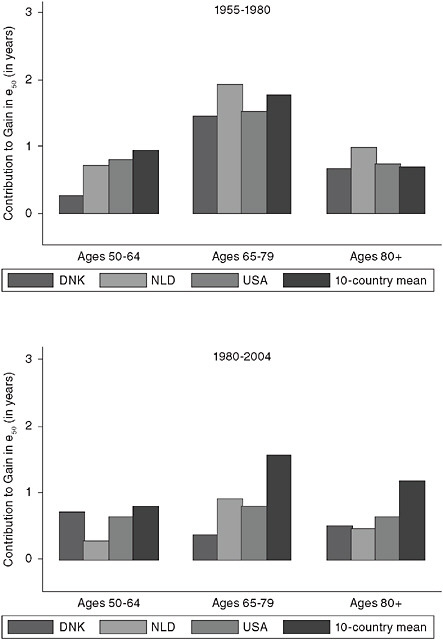
years during the period 1980-2004 (Table 2A-2). Thus, ages 65 and older account for the vast majority of the difference between the three laggards (Denmark, the Netherlands, United States) and the other countries: ages 65-79 because progress slowed in the former, but not the latter, and ages 80+ because the pace of mortality decline increased among the latter but not the former.
Figure 2-5 presents the corresponding results for men, who generally made faster gains in recent years across the age range in all countries. For Denmark, the Netherlands, and the United States during the period 1980-2004, the biggest sex difference occurs below age 80. For example, among these three countries, ages 50-79 contributed 2.6-3.3 years to gains in e50 for males during the period 1980-2004, whereas the corresponding contribution for women was only 1.1-1.4 years (Table 2A-3).
CAUSE-OF-DEATH DATA
Comparative analysis of cause-of-death trends is complicated by issues of variation in coding practice. There are two main problems: (1) accuracy of diagnosing cause of death and (2) changes in the classification system. Both can create artificial variation in cause-of-death statistics across time and place. (See the Annex for a more detailed discussion of these potential problems.) The intercountry disparities in ill-defined coding shown in Table 2A-3 could explain some of the disparities in other causes. Similarly, a shift in coding over time from ill-defined to other causes could create an artificial increase in the latter (or at least attenuate the true level of decline). Therefore, to improve comparability of the results across time and place, we have redistributed ill-defined deaths proportionately to all other cause groups. We made no other adjustments to the WHO cause-of-death data.
Trends in Mortality Rates by Cause of Death
Figures 2-6 and 2-7 show trends since 1980 in the age-standardized mortality rate (among women and men above age 50) for nine main groups of causes. One factor that might explain the slowed progress among women in the laggard countries is increased levels of smoking. Thus, we have isolated two groups of causes that are strongly associated with smoking: lung cancer and respiratory diseases.3 If the smoking hypothesis has merit, then
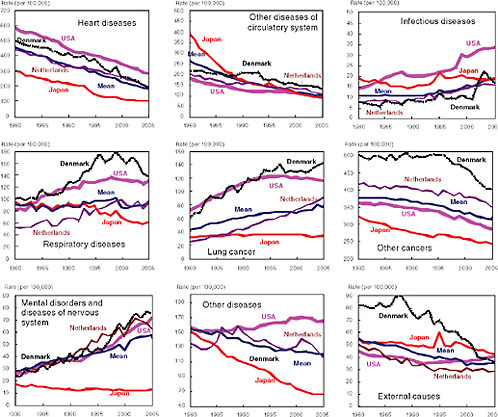
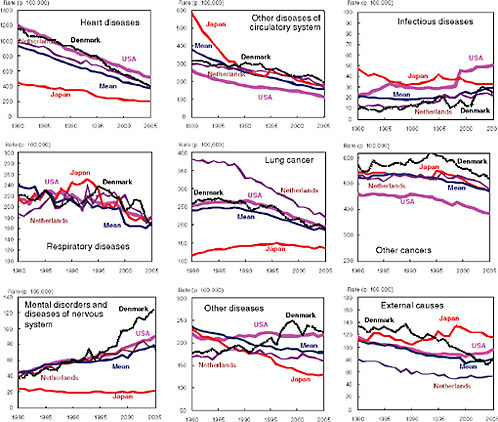
one would expect the mortality patterns for these two groups to parallel the divergence between women in the study countries. Of course, many smoking-related deaths are due to other causes. For example, research suggests that among men, 22 percent of deaths due to ischemic heart disease (IHD) are attributable to smoking. However, because IHD is one of the most common causes of death, it comprises a large number of smoking-related deaths—nearly as many as from lung cancer (Royal College of Physicians of London, 2000).
Heart diseases follow parallel trends: the United States shows the highest mortality but declines as quickly as in Denmark, Japan, the Netherlands, and the 10-country average (see Figure 2-6). Thus, heart diseases are not responsible for the diverging mortality trends among women. In contrast, women in the United States as well as the Netherlands and Denmark lost their initial advantage in terms of other circulatory diseases. Japan caught up very fast, and all four countries currently share similar levels. This is an important source of divergence. Men followed the same general pattern (see Figure 2-7).
Another shared cause of divergence among women relates to recent trends in both respiratory diseases and lung cancer. A sizeable mortality increase is observed for these two groups of causes in Denmark, the Netherlands, and the United States, whereas the 10-country mean remains more stable and trends in Japan are stable (lung cancer) or declining (respiratory diseases). Yet “other cancers” appear to follow parallel trends and thus cannot account for any diverging trends in mortality. The story is different among men. Respiratory diseases and other cancers generally follow parallel trends across countries, while lung cancer rates appear to have converged somewhat.
Prior to 2002, Denmark, the Netherlands, and the United States also shared a sharp increase in mortality due to mental disorders and diseases of the nervous system, which may have also contributed to divergence, since the corresponding increase was less pronounced for the 10-country mean and totally absent in Japan. This pattern appears to be similar in both sexes. This group of causes also clearly contributed to the recent progress among Dutch women, among whom mortality from these causes declined since 2002 while continuing to increase for their U.S. counterparts.
Finally, “other diseases” are also an important common source of divergence for Denmark, the Netherlands, and the United States (through 2002). Mortality for this mixed group of causes increased slightly in the United States and Denmark and remained relatively stable in the Netherlands, while it declined steadily for the 10-country average and even more rapidly in Japan. This group of diseases also appears to contribute to the 2002 reversal of Dutch mortality trends.
Cause-of-Death Contributions to Gains in Life Expectancy at e50
Figures 2-8 and 2-9 show the contributions by cause of death to gains in e50 during the periods 1955-1980 and 1980-2004 for Denmark, the Netherlands, and the United States compared with the 10-country mean. We have grouped causes into seven categories.4 Results for all countries and for more detailed causes appear in Annex Tables 2A-5 and 2A-6.
Among women, lung cancer mortality had a negative effect on e50 in both periods for these 10 countries on average, but especially for Denmark, the United States, and, in the later period, the Netherlands. Women in these three countries also fared worse against respiratory diseases: the 10-country mean contribution was positive in both periods, but the effect was negative in Denmark, the United States, and, since 1980, the Netherlands. Notably, although women in these countries experienced bigger losses from lung cancer since 1980, they generally fared as well or better against nonlung cancers.
Other causes have also begun to have a negative impact in many countries since 1980 (see Figure 2-9). Mortality due to mental disorders and diseases of the nervous system increased in virtually all countries between 1980 and 2004, but the biggest losses were observed among women in Canada, Denmark, the Netherlands, Spain, and the United States (see Table 2A-6). Also, since 1980, the mixed category of “other diseases” played a negative role for U.S. women and Danes of both sexes, whereas the 10-country mean was positive (see Figure 2-9).
Conversely, on the positive side, the reduction of heart disease mortality played an important role in all countries since 1980, no less so in the United States than in Japan, for example (see Table 2A-6). Nonetheless, progress against mortality from other circulatory diseases was much weaker in Denmark, the Netherlands, and the United States compared with the 10-country mean.
Within the Denmark, the Netherlands, and the United States since 1980, the most notable sex differences are for lung cancer and respiratory diseases: whereas these causes had a negative effect on e50 among women, the effect was positive for men (see Figure 2-9). Women in these countries also had somewhat bigger losses from mental disorders and diseases of the nervous system than their male compatriots. Although men made better progress than women against heart diseases, women did at least as well as men against other circulatory diseases and nonlung cancers.
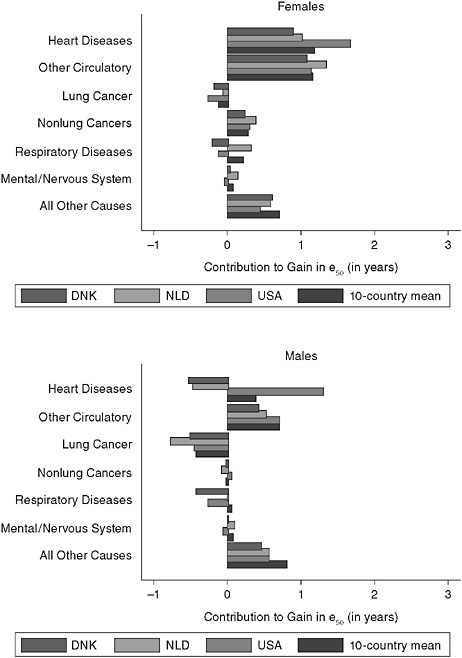
FIGURE 2-8 Contributions by cause of death to gain in e50, 1955-1980.
NOTES: Deaths from ill-defined causes have been redistributed proportionately to all other categories. DNK = Denmark, NLD = the Netherlands, USA = United States.
SOURCES: Calculations by authors based on data from the Human Mortality Database and the World Health Organization Mortality Database.
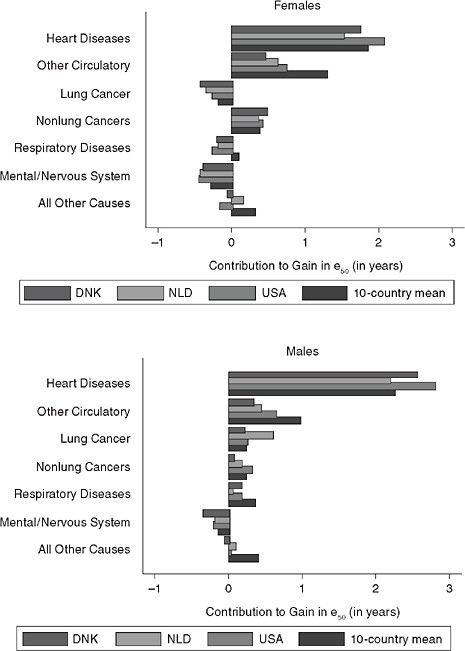
FIGURE 2-9 Contributions by cause of death to gain in e50, 1980-2004.
NOTES: Deaths from ill-defined causes have been redistributed proportionately to all other categories. DNK = Denmark, NLD = the Netherlands, USA = United States.
SOURCES: Calculations by authors based on data from the Human Morality Database and the World Health Organization Mortality Database.
Recent Progress in Denmark and the Netherlands
Danish women resumed progress after the mid-1990s. Between 1980 and 1995, women in the United States made bigger gains in e50 than their Danish counterparts (1.1 versus 0.0 year, respectively). In contrast, since 1995 the Danes have fared better (2.1 years versus 1.0 in the United States). The recent progress among women in Denmark is evident for most causes except mental and nervous system diseases. In the 10-year period from 1995 to 2005, Danish women made greater gains than in the previous 15 years for heart diseases, other circulatory diseases, and other cancers and replaced losses with gains for other smoking-related cancers, breast cancer, respiratory diseases, and “all other causes” (see Figure 2-10). Whereas during the earlier period (1980-1995) U.S. women made bigger gains from heart diseases, other circulatory diseases, and breast cancer than their Danish counterparts, in the most recent period (1995-2005), women fared better in Denmark than in the United States against these same causes as well as other cancers and “all other causes.”
Starting around 2002, women in the Netherlands also began to make faster gains in e50. Whereas Dutch women did worse than their U.S. counterparts during the period 1980-2002 (1.0 versus 1.5 years gained, respectively), they did somewhat better during the period 2002-2005 (0.8 versus 0.5). Notably, women’s e50 in the Netherlands increased by almost as much during the 4 years since 2002 as in the 22-year period from 1980 to 2002.
Compared with Denmark, recent gains in the Netherlands are of quite different origin. Since 2002, this country fared no better than the United States for heart diseases (see Figure 2-11). Dutch women also continued to exhibit losses due to lung cancer, other smoking-related cancers, and respiratory diseases, whereas their U.S. counterparts made small gains since 2002. Nonetheless, the Netherlands made bigger gains than the United States against several of the same causes that contributed to Denmark’s recent advantage: other circulatory diseases, breast cancer, other cancers, and “all other causes.” Unlike Denmark, they also began to convert their earlier losses for mental and nervous system diseases into gains, while the United States continued to make losses.
Compared with the United States, Denmark and the Netherlands appear to be two different cases. Figure 2-12 shows that age-specific contributions to female gains in e50 since 1980 were quite different in Denmark compared with the Netherlands and the United States. During the period in which gains in e50 were lagging (1980-1995), Denmark exhibited important losses at ages 60-74 while the Netherlands and the United States were still making progress at these ages. Conversely, when Denmark resumed gains in e50 after 1995, this progress was largely due to mortality decline at the same adult ages, whereas gains in the Netherlands and United States tended to
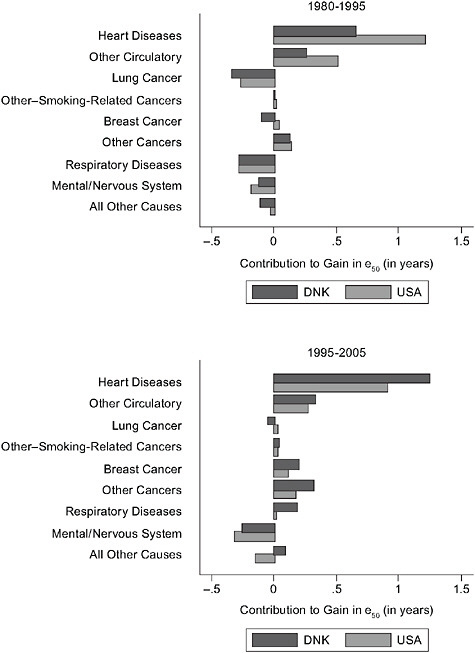
FIGURE 2-10 Cause-of-death contributions to female gains in e50 since 1980, Denmark and the United States.
NOTES: Deaths from ill-defined causes have been redistributed proportionately to all other categories. DNK = Denmark, USA = United States.
SOURCE: Calculations by authors based on data from the Human Mortality Database and the World Health Organization Mortality Database.
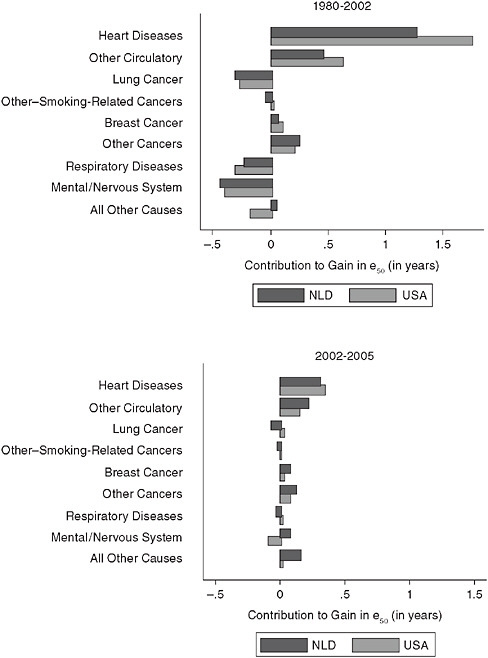
FIGURE 2-11 Cause-of-death contributions to female gains in e50 since 1980, the Netherlands and the United States.
NOTES: Deaths from ill-defined causes have been redistributed proportionately to all other categories. NLD = the Netherlands, USA = United States.
SOURCES: Calculations by authors based on data from the Human Mortality Database and the World Health Organization Mortality Database.
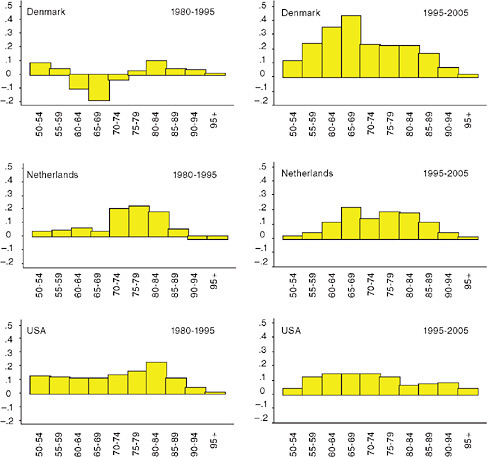
FIGURE 2-12 Age components of female gains in e50 since 1980, Denmark, the Netherlands, and the United States.
SOURCES: Calculations by authors based on data from the Human Mortality Database and the World Health Organization Mortality Database.
be distributed more evenly across all older ages. Further analyses among ages 60-74 during the period 1980-1995 (data not shown) indicate that Denmark suffered much bigger losses than the Netherlands and the United States due to smoking-related cancers, breast cancer, respiratory diseases, and digestive diseases. These same causes also appear to be the main source of the reversal since 1995: Denmark succeeded in converting losses into gains at ages 60-74 as mortality from these causes began to decline. Compared with the Netherlands and the United States, Denmark was late to join the cardiovascular revolution and the fight against “man-made diseases”5
but is now completing this main step of the health transition (Vallin and Meslé, 2004). The current lagging of the Netherlands and the United States, compared with leaders like France and Japan, could be more related to a third step of the health transition, pertaining to the ability to fight old-age pathologies (Meslé and Vallin, 2006). For that reason, it is interesting to focus on a comparison of the United States with France, Japan, and the Netherlands.
A SPECIAL FOCUS ON RECENT TRENDS IN U.S. FEMALE MORTALITY COMPARED WITH FRANCE, JAPAN, AND THE NETHERLANDS
We further explore the age and cause-specific contributions to changes in life expectancy at old ages among women in four countries: two laggards, the Netherlands and the United States, and two leaders, France and Japan. We concentrate here on ages above 65, which accounted for the vast majority of divergence among women (see Figure 2-4). We also tried to take into account some more detailed causes, such as mental disorders, which were subsumed within a broader category above (mental disorders and nervous system diseases).6 These more detailed analyses build on previous work focusing on the same four countries between 1984 and 2000 (see Meslé and Vallin, 2006), updated here through 2005.
Figure 2-13 displays the impact on life expectancy at age 65 (e65) of mortality changes for age groups 65-69, … 90-94, 95+. The left panel displays gains for the entire period 1984-2005, and the right panel shows two graphs for 1984-2002 and 2002-2005, respectively. From 1984 to 2005, both the Netherlands and the United States gained less than 1.3 years of female life expectancy at age 65, whereas France gained 3.3 years and Japan gained 4.5 years. In every age group, French and Japanese gains are higher than those in the Netherlands and the United States, although they are closer at ages 65-69. At ages 90 and older, the United States fared worse than France and Japan, but the Netherlands did the worst, making no gain at the oldest ages. Interestingly, Japan was the only country that achieved notable gains at the oldest ages (95+).
|
6 |
Since ICD-9, Alzheimer’s disease (AD) has been included with diseases of the nervous system. For 2002 and 2005, during which all four countries were using the International Classification of Diseases, version 10 (ICD-10), we have included deaths due to AD with mental disorders. However, we do not have sufficiently detailed data to identify AD deaths in 1984, when these countries were using ICD-9. Consequently, some of the apparent increase in mortality due to mental disorders implied by Figures 2-14 and 2-15 may be a statistical artifact resulting from the fact that deaths coded to AD are included with mental disorders in 2002 and 2005 but not in 1984. In 1984, AD deaths remain in the residual category of “other diseases.” However, such an artifact cannot impact results much, because at the time AD was rarely registered as a primary cause of death. |
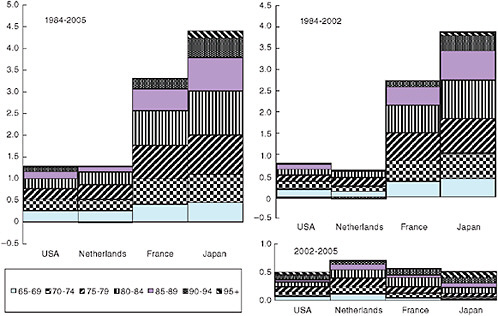
FIGURE 2-13 Age contributions to gains in e65 among women in the United States, the Netherlands, France, and Japan in two recent periods, 1984-2002 and 2002-2005.
SOURCES: Calculations by authors based on data from the Human Mortality Database; the World Health Organization Mortality Database; National Center for Health Statistics (1987, Table 8.5); Vallin and Meslé (1988, 1998); Institut National d’Études Démographiques (see http://www-causfra.ined.fr [accessed January 2009]); electronic files from CepiDc INSERM; Statistics and Information Department (1984, Tables 1 and 2); Statistics Netherlands (1984; data provided by Fanny Janssen of the University of Groningen); and Meslé and Vallin (2006).
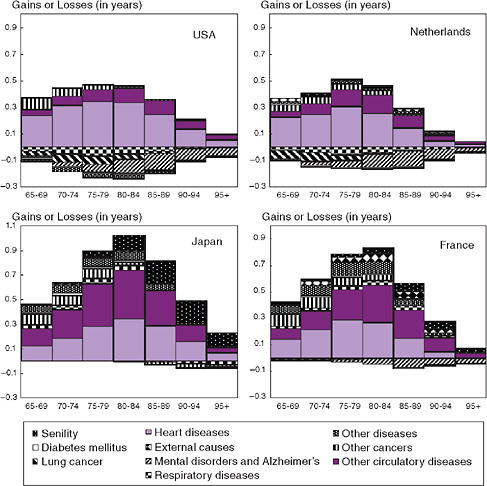
FIGURE 2-14 Age and cause contributions to gains in e65 among women in the United States, the Netherlands, France, and Japan, 1984-2005.
NOTES: Deaths due to Alzheimer’s disease are included with mental disorders for 2005 but not in 1984. Thus, the losses attributed to this category are probably slightly overstated (see also footnote 7). Senility is separated from other ill-defined causes, which were redistributed proportionately to the other cause groups.
SOURCES: Calculations by authors based on data from the Human Mortality Database; the World Health Organization Mortality Database; National Center for Health Statistics (1987, Table 8.5); Vallin and Meslé (1988, 1998); Institut National d’Études Démographiques (see http://www-causfra.ined.fr [accessed January 2009]); electronic files from CepiDc INSERM; Statistics and Information Department (1984, Tables 1 and 2); Statistics Netherlands (1984; data provided by Fanny Janssen of the University of Groningen); and Meslé and Vallin (2006).
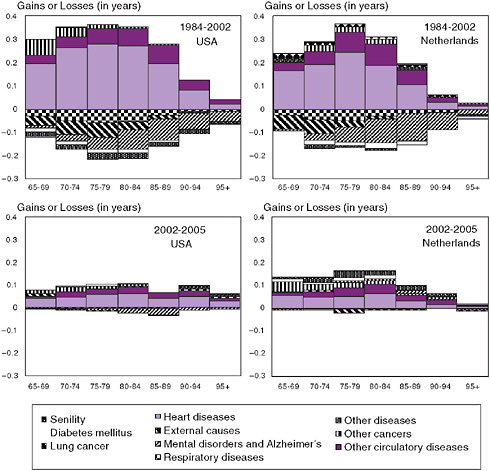
FIGURE 2-15 Age and cause contributions to gains in e65 among women in the United States and the Netherlands in two recent periods, 1984-2002 and 2002-2005.
NOTES: Deaths due to Alzheimer’s disease are included with mental disorders for 2005 but not in 1984. Thus, the losses attributed to this category are probably slightly overstated (see also footnote 7). Senility is separated from other ill-defined causes, which were redistributed proportionately to the other cause groups.
SOURCES: Calculations by authors based on data from the Human Mortality Database; the World Health Organization Mortality Database; National Center for Health Statistics (1987, Table 8.5); Vallin and Meslé (1988, 1998); Institut National d’Études Démographiques (see http://www-causfra.ined.fr [accessed January 2009]); electronic files from CepiDc INSERM; Statistics and Information Department (1984, Tables 1 and 2); Statistics Netherlands (1984; data provided by Fanny Janssen of the University of Groningen); and Meslé and Vallin (2006).
When dividing the period into two subperiods to take into account the positive changes observed in the Netherlands since 2002, the disadvantaged position of that country for the period 1984-2002 is even more obvious. During that period, Dutch women gained even less than their U.S. counterparts, in particular because of the very tiny gain at ages 85-89 and increased mortality at ages 90-94.
Conversely, from 2002 to 2005, women in the Netherlands made bigger gains in e65 than the other three. Japan’s only advantage during this short recent period was a larger contribution at age 90+, especially at the oldest ages (95+). Interestingly, the United States also demonstrated a non-negligible impact of mortality decline at ages 95+.
Figure 2-14 displays the respective impact of cause- and age-specific mortality changes over the entire 1984-2005 period in each of the four countries, and Figure 2-15 compares the United States and the Netherlands for the two subperiods. From 1984 to 2005, once again, gains in France and especially Japan are very impressive when compared with both the United States and the Netherlands, where smaller gains are offset by sizeable losses. But the differential impact of causes by age is even more remarkable.
First, whereas in France and Japan, very few age groups exhibit the negative effect of some causes, the impact of which is also very small, the United States and the Netherlands are hit by mortality increases for several causes across all age groups accumulating into substantial losses. The greatest negative impact is due to mental disorders (including AD). At age 85-89, for example, mortality increase for that cause is responsible for about 0.2 years of life expectancy loss at age 65 in both the United States and the Netherlands. Similar losses of 0.1 to 0.2 years are observed for all age groups from 75 to 95, whereas France shows smaller losses and Japan displays no losses from this cause. Total losses due to that cause are half a year in the United States and 0.4 year in the Netherlands, but only 0.2 in France and and even smaller (but positive) in Japan. Admittedly, these intercountry differences may be affected by variations in coding practice.7
Respiratory diseases are the second source of losses to e65 in the United States and the Netherlands, whereas they contributed some gains in France and Japan. In total, they reduced e65 among U.S. and Dutch women by 0.2 year, opposed to an increase of 0.1 in Japan and France.
Almost as important as respiratory diseases, lung cancer is the third source of losses in the United States and the Netherlands (−0.2 year in both
cases), while having virtually no effect in France and Japan. The difference between losses caused by lung cancer and mental disorders observed in the United States and the Netherlands is that the lung cancer impact comes mainly from ages 65-84, whereas that of mental disorders comes mainly from the oldest ages (especially 80+). The negative effects of respiratory diseases are more concentrated in the intermediate ages (70-84).
The second difference between the United States and the Netherlands on one hand, and France and Japan on the other, is that for the former two countries, most gains are due to the decline of heart diseases, while France and Japan enjoyed greater declines in mortality from other diseases of the circulatory system.
Senility also makes an important contribution to gains in e65 for France and especially Japan, but not for the United States or the Netherlands because they rarely use this International Classification of Diseases (ICD) code as an underlying cause. Redistributing senility proportionately, as we do for the other ill-defined causes, would mainly increase the positive impact of declines in cardiovascular mortality for France and Japan while being neutral in the two other countries. Yet such redistribution would be inappropriate, because senility is much more related to mental disorders than any other cause (Meslé, 2006). Thus, a more appropriate redistribution of senility would create a positive impact for mental disorders in Japan and change its negative effect into a positive one in France.
Furthermore, France and Japan differ substantially from the Netherlands and the United States in terms of the positive effects of other causes. Compared with the latter two countries, the former benefit from greater reductions in diabetes (especially Japan) and in causes that are here grouped as “other diseases.” The latter group contributes an additional 0.4 year of female life expectancy at age 65 in France and more than 0.3 in Japan versus 0.1 in the Netherlands and −0.1 in the United States.
The great similarity observed between the United States and the Netherlands when considering the whole period 1984-2005 must be nuanced by taking into account the very recent change observed in the Netherlands. Figure 2-15 compares two subperiods (1984-2002 and 2002-2005). In spite of the great difference in length between these two periods, the comparison enlightens some features that could be important for the future.
Naturally, the upper part of Figure 2-15 is largely similar to Figure 2-14 for the two countries, but some notable details appear when comparing the two periods. First, the negative effect of lung cancer, quite important in the first period, almost vanished in the second one. From that point of view, the United States did even better than the Netherlands since 2002: lung cancer had a negative effect only in the latter country. Second, the negative effect of diabetes, quite visible in the first period, disappears in the United States and becomes positive in the Netherlands. But the most important fact is
that the large negative effect of mental disorders, which was even greater for the Netherlands than the United States during the first period, disappears in the Netherlands during the second period but remains negative in the United States. In general, a greater diversity of causes accounts for Dutch gains since 2002, unlike the relatively monotonous (cardiovascular) source of progress in the United States.
Two main conclusions can be drawn from this special focus on four countries. First, for about 20 years the United States and the Netherlands encountered very similar difficulties in terms of cause patterns and trends in mortality and it would be very useful to know if some common facts in social development and public health were involved, or if the same results occurred from quite different causes. Second, if the Netherlands resumed progress within the past 4 years, it is because they were more successful in fighting diseases like mental disorders, diabetes, and “other diseases.” Third, it must be underlined that the United States also achieved some important success in the recent period by eliminating several negative effects (especially from lung cancer, infectious and respiratory diseases, and diabetes), which gives some hope for the future. It remains to be seen whether those former negative effects can be converted into positive effects in the future.
DISCUSSION
In this chapter, we explore which age groups and which causes of death account for the post-1980 slowdown in mortality decline among women in Denmark, the Netherlands, and the United States. The results suggest that compared with the earlier period (1955-1980), these countries made smaller gains at ages 65-79 in particular and slower progress against all causes except heart diseases and nonlung cancers.
Since 1980, women in these three countries made smaller gains in e50 than their counterparts in other countries. These differences appear to stem from smaller gains at ages 65 and older, especially at the oldest ones (75+), and weaker progress against other circulatory diseases, respiratory diseases, lung cancer, and the residual category of other remaining causes. In contrast, they generally fared as well as other countries against heart diseases and nonlung cancers.
Interestingly, women in Denmark, the Netherlands, and the United States also made much smaller post-1980 gains in e50 than their male compatriots. This female disadvantage results from smaller gains at ages below 80 and less progress against lung cancer, respiratory diseases, heart diseases, and mental disorders, and diseases of the nervous system. Yet within these three countries, women fared as well or better than their male counterparts against other circulatory diseases and nonlung cancers, especially those less affected by smoking.
The common denominator for all of these comparisons is that since 1980 women in Denmark, the Netherlands, and the United States have exhibited bigger increases in mortality due to lung cancer and respiratory diseases compared with the earlier period (1955-1980), compared with their counterparts in other countries, and compared with their male compatriots. While this analysis identifies cause-of-death categories that underlie the mortality trends, we can only speculate about the causal factors that explain these differences. Based on the evidence presented here, the most obvious explanation for the slowing of mortality decline among women in Denmark, the Netherlands, and the United States is smoking, which is strongly correlated with lung cancer and such respiratory diseases as chronic obstructive pulmonary disease. Moreover, the fact that the differences in mortality decline occur not only between countries but also between men and women within the same country suggests that the main explanation pertains to factors that may differ by sex in the same social environment. There are clear sex differences in smoking patterns, with declines in smoking occurring earlier among men than among women (Forey et al., 2007).
However, when using more detailed causes of death among four countries, other important features appear. First, when mental disorders, including Alzheimer’s disease, are isolated from other diseases of the nervous system, this category is an important source of contrast between the United States and the Netherlands on one hand and France and Japan on the other. That difference is reinforced when isolating senility. If this specific category is proportionally redistributed among “true” causes of death (as for other ill-defined causes), the greatest part is attributed to cardiovascular causes. Actually, we would argue that a greater proportion should be attributed to mental disorders (Meslé, 2006). Because reductions in senility are a bigger contributor to gains in France and Japan compared with the United States and the Netherlands, we may underestimate the true contrast between these countries in terms of mental disorders.
A secondary goal we posed at the outset was to investigate why women in Denmark and more recently the Netherlands have resumed progress while U.S. women have not. In fact, Denmark and the Netherlands are quite different cases in terms of timing and cause-of-death patterns. The stagnation of Danish life expectancy started much earlier and also ended earlier (1995 instead of 2002). And in terms of causes of death, after 1960, Denmark was more comparable to Eastern European countries than to Western ones in showing difficulty in overcoming the “age of degenerative diseases and man-made diseases” described by Omran (1971). This country was late entering the “cardiovascular revolution” (Vallin and Meslé, 2001, 2004). Actually, Denmark fully entered this step of the health transition in 1995. Its trajectory is hardly comparable to that of the United States, which entered it as soon as the late 1960s, like most Western countries.
The comparison between the Netherlands and the United States is much more informative, since the two countries followed quite similar cause-of-death trends and patterns until the early 2000s. Yet we must rely on a very short period to appreciate the causes of the recent Dutch reversal. Nevertheless, some features appear that may have consequences for the future. Indeed, the United States also made some progress in very recent years for lung cancer and diabetes. In fact, it did even better than the Netherlands in terms of lung cancer. The somewhat greater success of the Netherlands in terms of overall gains in female life expectancy at old ages mainly relies on two facts: (1) changes in mortality from mental disorders turned from important losses into significant gains and (2) it made greater gains than the United States against some other causes of death, including diabetes.
Admittedly, this study is not without limitations. Although mortality data tend to be more reliable than other kinds of data (e.g., estimates of morbidity based on clinical diagnoses, self-reports of health status), there can still be data quality problems, such as incomplete coverage and age misreporting. In particular, previous studies suggest problems of age exaggeration in the historical data for the United States (Coale and Kisker, 1986, 1990; Elo and Preston, 1994; Preston, Elo, and Stewart, 1999). Thus, estimates of life expectancy at the oldest ages may have been overestimated in previous years, and the apparent slowing of mortality decline among women in the United States could actually be a statistical artifact resulting from improvements in data quality. Yet it seems unlikely that such a problem would affect women but not men; moreover, it would not explain the similar slowing of mortality decline among women in Denmark and the Netherlands, where data quality is very high (Meslé and Vallin, 2006). The Social Security Administration (SSA) in the United States provides alternative estimates of mortality and life expectancy; for ages 65 and older, it uses estimates based on Medicare data. Its estimates of mortality at the oldest ages (90+) tend to be higher than those given in the HMD (U.S. Social Security Administration, 2009). Nonetheless, the SSA estimates for e50 in 1955, 1980, and 2004 would suggest that the slowing of gains in e50 among U.S. women were even worse than the HMD data would suggest, especially for the period 1980-2004.
The comparability of cause-of-death data may also be comprised by variation in coding practice across time and place. We noted such a problem for AD (see the Annex). By combining mental disorders with diseases of the nervous system, we eliminated most of the discontinuities at changes in the ICD. Nonetheless, it is unclear whether the increase in mortality from this group of causes observed during 1980-2004 among virtually all countries is real or whether it is simply an artifact of changes in coding practice over time (Meslé and Vallin, 2006). A more precise comparison was made by focusing on four countries (France, Japan, the Netherlands,
the United States) in which we could isolate mental disorders (including Alzheimer’s disease for the most recent period covered by ICD-10). Nonetheless, some difficulty remains regarding how to handle senility. If we accept the idea that this ICD code should be disproportionately attributed to “mental disorders,” it could widen the gap in mental disorders among these four countries (i.e., France and Japan would have greater gains against these causes). We think that proportional redistribution of senility underestimates the role played by mental disorders, but we do not know by how much. Furthermore, given evidence of shifts in coding for respiratory diseases, it is possible that we have overestimated the contribution of this category to post-1980 gains in Canada, France, and the United Kingdom (see the Annex). Nonetheless, we observed notable gains from respiratory diseases among women in several other countries that contrast with the losses found among women in Denmark, the Netherlands, and the United States.
In sum, the evidence presented here is consistent with the hypothesis that smoking was an important factor accounting for the slowing of mortality decline among women in these three countries. If so, when smoking ceases to rise, then the rate of mortality decline may return to normal; if smoking declines, then it may begin to catch up. Yet we see little evidence that recent progress among women in Denmark and the Netherlands is due to declines in smoking. Still, the lag between smoking behavior and its health consequences means the full benefits of a decline in smoking will not be realized until several decades later. Moreover, countries in which smoking continues to increase among women may in future years reveal the negative effects and perhaps a slowing of mortality decline. Nonetheless, smoking is probably not the only cause of divergence between the United States or the Netherlands and the other countries. More detailed analyses suggest that mental disorders could also be playing a role. Since 2002, e50 among Dutch women resumed a steady increase, in part because they succeeded in replacing losses with gains in the field of mental disorders and other smaller causes of death.
ACKNOWLEDGMENTS
This project received financial support from the National Institute on Aging (grant R01 AG11552) and from Institut National d’Études Démographiques (INED research project no. P-05-3-7). We thank Sam Preston, Eileen Crimmins, and Johan Mackenbach for their comments and suggestions regarding this paper.
REFERENCES
Anderson, R.N., Miniño, A.M., Hoyert, D.L., and Rosenberg, H.M. (2001). Comparability of Cause of Death Between ICD-9 and ICD-10: Preliminary Estimates. (National Vital Statistics Reports, vol. 49, no. 2.) Hyattsville, MD: National Center for Health Statistics.
Armstrong, D.L., Wing, S.B., and Tyroler, H.A. (1995). United States mortality from ill-defined causes, 1968-1988: Potential effects on heart disease mortality trends. International Journal of Epidemiology, 24(3), 522-527.
Coale, A.J., and Kisker, E.E. (1986). Mortality crossovers: Reality or bad data? Population Studies, 49, 389-401.
Coale, A.J., and Kisker, E.E. (1990). Defects in data on old-age mortality in the United States. Asian and Pacific Population Forum, 4(1), 1-31.
Elo, I.T., and Preston, S.H. (1994). Estimating African-American mortality from inaccurate data. Demography, 31(3), 427-458.
Forey, B., Hamling, J., Hamling, J., and Lee, P. (2007). International Smoking Statistics, Web Edition: A Collection of Worldwide Historical Data. Comparisons Between Countries. Sutton, England: P. N. Lee Statistics and Computing Ltd.
Human Mortality Database. (2009). University of California, Berkeley (USA), and Max Planck Institute for Demographic Research (Germany). Available http://www.mortality.org [accessed November 2009].
Janssen, F., and Kunst, A.E. (2004). ICD coding changes and discontinuities in trends in cause-specific mortality in six European countries, 1950-99. Bulletin of the World Health Organization, 82(12), 904-913.
Mathers, C.D., Fat, D.M., Inoue, M., Rao, C., and Lopez, A.D. (2005). Counting the dead and what they died from: An assessment of the global status of cause of death data. Bulletin of the World Health Organization, 83(3), 171-177.
Meslé, F. (2006). Causes of death among the oldest-old: Validity and comparability. In J. Robine, E.M. Crimmins, S. Horiuchi, and Y. Zheng (Eds.), Human Longevity, Individual Life Duration, and the Growth of the Oldest-Old Population (pp. 191-214). Dordrecht, The Netherlands: Springer.
Meslé, F., and Vallin, J. (2006). Diverging trends in female old-age mortality: The United States and the Netherlands versus France and Japan. Population and Development Review, 31(1), 123-145.
National Center for Health Statistics. (1987). Vital Statistics of the United States 1984. (Volume II, Mortality, Part B.) Hyattsville, MD: U.S. Department of Health and Human Services, Public Health Service.
Office of Population Censuses and Surveys. (1995). Mortality Statistics: Causes 1993/1994. London, England: Author.
Omran, A.R. (1971). The epidemiological transition: A theory of the epidemiology of population change. Milbank Memorial Fund Quarterly, 49(4), 509-538.
Pollard, J.H. (1988). On the decomposition of changes in expectation of life and differentials in life expectancy. Demography, 25(2), 265-276.
Preston, S.H., Elo, I.T., and Stewart, Q. (1999). Effects of age misreporting on mortality estimates at older ages. Population Studies, 53(2), 165-177.
Royal College of Physicians of London. (2000). Nicotine Addiction in Britain. London, England: Author.
Statistics and Information Department. (1984). Vital Statistics 1984 Japan. (Volume 3.) Tokyo, Japan: Ministry of Health and Welfare.
Statistics Canada. (2005). Comparability of ICD-10 and ICD-9 for Mortality Statistics in Canada. (Catalogue No. 84-548-XIE, Bridge-Coding Studies.) Ottawa: Minister of Industry.
Statistics Netherland. (1984). Deaths by Cause of Death [in Dutch]. Voorburg/Heerlen: Author.
U.S. Department of Health and Human Services. (1989). Reducing the Health Consequences of Smoking: 25 Years of Progress. A Report of the Surgeon General. (DHHS Publication CDC 89-8411.) Rockville, MD: Centers for Disease Control and Prevention, Center for Chronic Disease Prevention and Health Promotion, Office on Smoking and Health.
U.S. Social Security Administration. (2009). United States Life Table Functions and Actuarial Functions at 2.9 Percent Interest Based on the Alternative 2 Mortality Probabilities Used in the 2008 Trustees Report. Unpublished manuscript.
Vallin, J., and Meslé, F. (1988). Les Causes de Décès en France de 1925 à 1978. Paris: Institut National d’Études Démographiques.
Vallin, J., and Meslé, F. (1998). Comment suivre l’évolution de la mortalité par cause malgré les discontinuities de la statistique. Le cas de la France de 1925 à 1993. In G. Pavillon (Ed.), Enjeux des Classifications Internationales en Santé (pp. 113-156). Paris: Éditions INSERM.
Vallin, J., and Meslé, F. (2001). Trends in mortality in Europe since 1950: Age-, sex- and cause-specific mortality. In J. Vallin, F. Meslé, and T. Valkonen (Eds.), Trends in Mortality and Differential Mortality (pp. 131-186). Strasbourg, France: Council of Europe.
Vallin, J., and Meslé, F. (2004). Convergences and divergences in mortality. A new approach to health transition. Demographic Research, Special Collection, 2(Article 2), 12-44. World Bank. (1976). World Tables 1976. Washington, DC: Author.
World Bank. (2008). 2008 World Development Indicators. Washington, DC: Author.
World Health Organization. (2009). Detailed Data Files of the WHO Mortality Database. Available http://www.who.int/whosis/mort/download/en/index.htm [accessed December 2009].
ANNEX 2A
Detailed Age Group Contributions to Gains in e50
The decomposition by age group uses death rates from the HMD (2009). We use the Pollard (1988) method to decompose the gains in e50 into the contributions by age (see Tables 2A-1 and 2A-2).
Variation in Coding Practice Across Time and Place
Coding to Ill-Defined and Other Nonspecific Causes
One indicator that is often used as a measure of the overall reliability and accuracy of cause-specific mortality data is the proportion of death coded to ill-defined categories (Armstrong, Wing, and Tyroler, 1995). As shown in Table 2A-3, this proportion varies considerably across the 10 study countries. Among deaths at ages 50 and older in 1955, the percentage of ill-defined ranged from 19 percent in France and Spain and 16 percent in Japan to less than 2 percent in Australia, Canada, Denmark, and the United States. In most countries, the category termed “senility” comprises the majority of these ill-defined causes, but it varies across countries. In Italy, Japan, and the United Kingdom, more than 85 percent of ill-defined deaths at ages 50 and older in 1955 were coded to senility, whereas the corresponding percentages were 27-48 percent in France, the Netherlands, Spain, and the United States.
Over time, the percentage of ill-defined declined in most countries; by 2004, ill-defined had fallen to 3 percent in Japan and Spain and 6 percent in France. In half of these countries (Australia, Canada, Italy, Japan, and the Netherlands), most of this decline resulted from decreased use of the code for senility. The most extreme example is Japan, for which senility coding declined from 13.5 percent in 1955 to 2.5 percent in 2004. Denmark was the only study country for which ill-defined coding actually increased since 1955; all of the increase occurred in other ill-defined causes.
In addition to the ill-defined codes included in the ICD chapter entitled “Symptoms, Signs, and Ill-defined Conditions,” there are nonspecific codes included in other ICD chapters. Called “garbage codes,” these include cardiovascular categories lacking diagnostic meaning (e.g., “cardiac arrest,” “heart failure”), cancers coded to secondary or unspecified sites, and injuries with undetermined intent (Mathers et al., 2005). In 2004, garbage coding comprised an even larger proportion of deaths than ill-defined causes. For example, in the Netherlands, nearly one-tenth of all deaths were coded to these other nonspecific codes, mostly cardiovascular (Table 2A-3). Overall, nonspecific causes—including both ill-defined and garbage codes—are currently used most commonly in France (15 percent), the Netherlands (14
TABLE 2A-1 Age Group Contributions to Gains in e50, 1955-1980
percent), Denmark (13 percent), and Spain (11 percent) and least often in Australia (5 percent) and Canada (6 percent).
Although high levels of garbage coding may reflect inappropriate use of these codes (Mathers et al., 2005), they have less effect on our results than coding to ill-defined causes. For the decomposition analyses, garbage
|
JPN |
NLD |
USA |
Meana |
Compositeb |
Excluding DNK, NLD, and USA |
|
|
Meana |
Compositeb |
|||||
|
2.0 |
0.7 |
0.8 |
0.9 |
1.0 |
1.1 |
1.2 |
|
0.6 |
0.2 |
0.2 |
0.2 |
0.3 |
0.3 |
0.3 |
|
0.7 |
0.2 |
0.3 |
0.3 |
0.3 |
0.3 |
0.4 |
|
0.8 |
0.3 |
0.3 |
0.4 |
0.4 |
0.5 |
0.5 |
|
2.5 |
1.9 |
1.5 |
1.8 |
1.8 |
1.8 |
1.9 |
|
0.9 |
0.5 |
0.4 |
0.6 |
0.5 |
0.6 |
0.6 |
|
0.9 |
0.7 |
0.5 |
0.6 |
0.6 |
0.6 |
0.7 |
|
0.7 |
0.7 |
0.6 |
0.6 |
0.6 |
0.6 |
0.6 |
|
0.6 |
1.0 |
0.7 |
0.7 |
0.7 |
0.7 |
0.6 |
|
0.4 |
0.5 |
0.4 |
0.4 |
0.4 |
0.4 |
0.4 |
|
0.2 |
0.3 |
0.2 |
0.2 |
0.2 |
0.2 |
0.2 |
|
0.0 |
0.1 |
0.1 |
0.1 |
0.1 |
0.1 |
0.1 |
|
5.1 |
3.6 |
3.0 |
3.4 |
3.5 |
3.6 |
3.7 |
|
2.0 |
−0.1 |
1.0 |
0.7 |
1.0 |
0.9 |
1.1 |
|
0.5 |
0.0 |
0.3 |
0.2 |
0.3 |
0.2 |
0.3 |
|
0.7 |
0.0 |
0.3 |
0.2 |
0.3 |
0.3 |
0.4 |
|
0.8 |
−0.1 |
0.3 |
0.2 |
0.4 |
0.4 |
0.4 |
|
1.9 |
−0.3 |
0.6 |
0.6 |
0.8 |
0.9 |
1.0 |
|
0.8 |
−0.2 |
0.3 |
0.2 |
0.3 |
0.3 |
0.4 |
|
0.7 |
−0.2 |
0.2 |
0.2 |
0.3 |
0.3 |
0.3 |
|
0.4 |
0.0 |
0.2 |
0.2 |
0.2 |
0.2 |
0.3 |
|
0.3 |
0.2 |
0.2 |
0.2 |
0.2 |
0.2 |
0.2 |
|
0.2 |
0.1 |
0.1 |
0.1 |
0.1 |
0.1 |
0.1 |
|
0.1 |
0.1 |
0.1 |
0.1 |
0.1 |
0.1 |
0.1 |
|
0.0 |
0.0 |
0.0 |
0.0 |
0.0 |
0.0 |
0.0 |
|
4.2 |
−0.2 |
1.8 |
1.5 |
2.0 |
2.0 |
2.3 |
codes are grouped with their respective chapters (e.g., the category for heart diseases includes such nonspecific codes as “cardiac arrest” and “heart failure”). In contrast, if deaths due to heart disease were inappropriately coded to ill-defined causes, then our results would understate the true level of heart disease.
TABLE 2A-2 Age Group Contributions to Gains in e50, 1980-2004
Discontinuities at the Time of Changes in the Classification System
Changes in the system of classification can create discontinuities in historical trends, both at the time of change from one ICD version to the next, but also within an ICD version, because of changes in the implementation of coding rules. Given that different countries adopt a new ICD version at varying times, these transitions also contribute to variation across countries.
|
JPN |
NLD |
USA |
Meana |
Compositeb |
Excluding DNK, NLD, and USA |
|
|
Meana |
Compositeb |
|||||
|
0.8 |
0.3 |
0.6 |
0.8 |
0.8 |
0.9 |
0.9 |
|
0.2 |
0.0 |
0.2 |
0.2 |
0.2 |
0.2 |
0.2 |
|
0.2 |
0.1 |
0.2 |
0.3 |
0.3 |
0.3 |
0.3 |
|
0.4 |
0.2 |
0.2 |
0.3 |
0.4 |
0.4 |
0.4 |
|
2.6 |
0.9 |
0.8 |
1.6 |
1.7 |
1.9 |
2.2 |
|
0.6 |
0.2 |
0.3 |
0.4 |
0.4 |
0.5 |
0.6 |
|
0.9 |
0.3 |
0.3 |
0.6 |
0.6 |
0.7 |
0.7 |
|
1.1 |
0.4 |
0.3 |
0.7 |
0.7 |
0.9 |
0.9 |
|
2.7 |
0.5 |
0.6 |
1.2 |
1.3 |
1.4 |
1.7 |
|
1.2 |
0.3 |
0.3 |
0.6 |
0.6 |
0.8 |
0.8 |
|
0.9 |
0.2 |
0.2 |
0.4 |
0.4 |
0.6 |
0.6 |
|
0.7 |
0.0 |
0.1 |
0.2 |
0.2 |
0.3 |
0.3 |
|
6.1 |
1.6 |
2.1 |
3.7 |
3.7 |
4.3 |
4.8 |
|
0.9 |
1.4 |
1.5 |
1.6 |
1.5 |
1.7 |
1.6 |
|
0.3 |
0.3 |
0.4 |
0.4 |
0.4 |
0.4 |
0.4 |
|
0.3 |
0.4 |
0.5 |
0.5 |
0.5 |
0.6 |
0.5 |
|
0.4 |
0.6 |
0.6 |
0.7 |
0.6 |
0.7 |
0.6 |
|
2.1 |
1.8 |
1.8 |
2.1 |
2.2 |
2.3 |
2.3 |
|
0.6 |
0.7 |
0.7 |
0.7 |
0.8 |
0.8 |
0.8 |
|
0.7 |
0.6 |
0.7 |
0.7 |
0.8 |
0.8 |
0.8 |
|
0.8 |
0.5 |
0.5 |
0.6 |
0.6 |
0.7 |
0.7 |
|
1.1 |
0.2 |
0.6 |
0.7 |
0.8 |
0.8 |
0.9 |
|
0.6 |
0.2 |
0.4 |
0.4 |
0.4 |
0.5 |
0.5 |
|
0.4 |
0.0 |
0.2 |
0.2 |
0.2 |
0.3 |
0.3 |
|
0.2 |
0.0 |
0.1 |
0.1 |
0.1 |
0.1 |
0.1 |
|
4.1 |
3.3 |
3.9 |
4.4 |
4.4 |
4.7 |
4.8 |
Some countries have conducted comparability (i.e., “bridge-coding”) studies to assess the impact of ICD revisions. Specifically, deaths for a given year are dual-coded using successive revisions of the ICD and a comparability ratio is calculated based on the number of deaths classified to a specific cause using the new ICD divided by the corresponding number using the old ICD. Even for the most recent revision, bridge-coding studies
TABLE 2A-3 Nonspecific Coding Among Deaths at Age 50 and Older by Country, 1955-2004*
|
|
AUS |
CAN |
DNK |
ESP |
FRA |
GBR |
ITA |
JPN |
NLD |
USA |
|
|
|
|
|
|
|
|
|
|
|
|
|
1955 |
1.7 |
1.5 |
1.2 |
18.9 |
19.0 |
2.1 |
8.4 |
15.7 |
5.2 |
1.1 |
|
1980 |
0.2 |
0.9 |
3.7 |
3.7 |
5.8 |
0.2 |
2.8 |
5.3 |
4.2 |
1.1 |
|
2004* |
0.4 |
0.9 |
4.7 |
2.8 |
6.1 |
2.1 |
1.7 |
3.1 |
4.4 |
1.0 |
|
% Senilitya |
|
|
|
|
|
|
|
|
|
|
|
1955 |
1.4 |
0.8 |
0.9 |
7.6 |
8.9 |
2.0 |
7.4 |
13.5 |
2.5 |
0.3 |
|
1980 |
0.1 |
0.1 |
0.3 |
2.3 |
2.1 |
0.2 |
2.5 |
5.2 |
0.9 |
0.1 |
|
2004* |
0.1 |
0.2 |
0.7 |
0.8 |
1.1 |
1.9 |
1.0 |
2.5 |
1.1 |
0.2 |
|
% Other ill-definedb |
|
|
|
|
|
|
|
|
|
|
|
1955 |
0.3 |
0.7 |
0.3 |
11.3 |
10.1 |
0.1 |
1.0 |
2.1 |
2.7 |
0.8 |
|
1980 |
0.1 |
0.7 |
3.5 |
1.4 |
3.7 |
0.0 |
0.3 |
0.1 |
3.4 |
1.0 |
|
2004* |
0.4 |
0.7 |
3.9 |
1.9 |
5.0 |
0.2 |
0.7 |
0.6 |
3.3 |
0.8 |
|
% Other nonspecific, 2004* |
4.7 |
5.5 |
8.2 |
8.6 |
8.8 |
5.0 |
8.1 |
6.7 |
9.9 |
5.8 |
|
Cardiovascularc |
2.6 |
3.3 |
5.9 |
6.9 |
6.1 |
2.3 |
6.7 |
6.2 |
8.0 |
4.3 |
|
Cancersd |
2.2 |
2.1 |
2.1 |
1.7 |
2.7 |
2.5 |
1.4 |
0.4 |
1.9 |
1.4 |
|
Injuriese |
0.0 |
0.1 |
0.1 |
0.0 |
0.0 |
0.1 |
0.0 |
0.1 |
0.0 |
0.1 |
|
% All nonspecific, 2004* |
5.2 |
6.4 |
12.8 |
11.4 |
15.0 |
7.0 |
9.8 |
9.9 |
14.2 |
6.8 |
|
NOTE: AUS = Australia, CAN = Canada, DNK = Denmark, ESP = Spain, FRA = France, GBR = United Kingdom, ITA = Italy, JPN = Japan, NLD = the Netherlands, USA = United States. *Based on data from 2003 for Italy. aIncludes ICD-7/ICD-8 code 794, ICD-9 code 797, and ICD-10 code R54. bIncludes all other causes included in the ICD chapter entitled “symptoms, signs, and ill-defined conditions.” cIncludes ICD-10 codes I46, I47.2, I49.0, I50, I51.4-I51.6, I51.9, and I70.9. dIncludes ICD-10 codes Y10-Y34 and Y87.2. eIncludes ICD-10 codes C76, C80, and C97. SOURCE: Calculations by authors based on data from the World Health Organization Mortality Database. |
||||||||||
are available only for a select number of countries (e.g., Canada, England and Wales, France, Italy, Sweden, the United States). For earlier revisions, such comparability studies are rarely available (exceptions are the United States, England and Wales).
The most recent revision (to ICD-10) created more substantial changes than past revisions because of a large increase in the number of codes (from approximately 5,000 to 8,000), changes in coding rules, and conceptual revisions (Anderson et al., 2001; Mathers et al., 2005). For example, one cause that created a big discontinuity was Alzheimer’s disease (AD). Bridge-coding studies from both the United States and Canada suggested
that deaths coded to this cause increased by more than 50 percent as a result of the change to ICD-10 (Anderson et al., 2001; Statistics Canada, 2005). Prior to ICD-9, AD was not coded separately; it was probably included with senile or presenile dementia in the chapter for mental disorders. Starting with ICD-9, diseases of the nervous system include a code for AD (331.0), but the huge increase in AD with the change to ICD-10 resulted mostly from deaths coded as presenile dementia (290.1) in ICD-9 (Anderson et al., 2001). Given the big changes in coding practice for this disease, we have grouped mental disorders with diseases of the nervous system in order to better capture AD and minimize discontinuities.
Among the 10 study countries, Denmark was the first to adopt ICD-10 (1994; it skipped over ICD-9 entirely), whereas Italy was the last (2003). In 1955, all 10 countries were using ICD-7. By 1980, Denmark was still using ICD-8 but the others had adopted ICD-9. In 2004, all study countries were using ICD-10.
Looking at the country-level trends for the cause of death groups examined in this chapter (see Table 2A-4 for a detailed list by ICD codes), there are a few apparent discontinuities at the transitions from one ICD version to the next. For example, in Spain at the transition from ICD-7 to ICD-8 in 1968, there is a big jump in heart disease as a proportion of all deaths at ages 50 and older mirrored by a decrease in the proportion due to ill-defined causes (see Figure 2A-1). Yet even after redistributing ill-defined causes proportionately to the other categories, a substantial disruption remains in the trend for heart disease. Thus, for Spain during the period 1955-1980, we may underestimate the contribution of heart disease to gains in e50.
In Japan, there was a drop in heart disease mortality at the change to ICD-10 (in 1995); it is mirrored by an increase in other circulatory diseases (see Figure 2A-2). These discontinuities suggest that the change to ICD-10 may have caused coding shift from heart disease to other circulatory diseases in Japan. Thus, for Japan during the period 1980-2004, we may over-estimate the contribution of heart disease to gains in e50 and understate the role of other circulatory diseases.
For respiratory diseases, many countries exhibit an increase in mortality rates at the transition to ICD-8. Canada, France, and the United Kingdom also show a sudden drop in respiratory diseases at the change to ICD-10. The most extreme of these discontinuities occurs in the United Kingdom (see Figure 2A-3). The jump in respiratory diseases at ICD-8 could be partly because we were not able to include hay fever, asthma, and pneumonia of the newborn for the period covered by ICD-7; they are instead grouped with the residual category “all else” (see Table 2A-2). Consequently, for the period 1955-1980, the gains in e50 attributable to respiratory diseases may be downwardly biased for many countries. At the transition to ICD-10, the drop in respiratory diseases in the United Kingdom is reflected by an increase
TABLE 2A-4 Cause-of-Death Groupings for ICD-7 Through ICD-10
|
Cause Groupings |
ICD-7 |
ICD-8 |
ICD-9 |
ICD-10 |
|
1) Heart diseases |
400-447 |
390-429 |
390-429 |
I00-I51 |
|
2) Other circulatory diseases |
330-334, 450-468 |
430-458 |
430-459 |
I60-I99, G45.8, G45.9 |
|
3) Lung cancer |
162, 163 |
162 |
162 |
C33, C34 |
|
4) Other smoking-related cancersa |
|
|
|
|
|
a) Cancer of the esophagus |
150 |
150 |
150 |
C15 |
|
b) Cancer of the lip/oral cavity/pharynx |
140-148 |
140-149 |
140-149 |
C00-C14 |
|
c) Cancer of the larynx |
161 |
161 |
161 |
C32 |
|
d) Cancer of the pancreas |
157 |
157 |
157 |
C25 |
|
e) Cancer of the bladder |
181 |
188 |
188 |
C67 |
|
f) Cancer of the kidney(s) |
180 |
189 |
189 |
C64-C66, C68 |
|
5a) Breast cancer (for women) |
170 |
174 |
174, 175 |
C50 |
|
5b) Prostate cancer (for men) |
177 |
185 |
185 |
C61 |
|
6) All other cancers |
151-156, 158-160,164-165, 171-176, 178, 179, 190-239 |
151-156, 158-160, 163, 170-173, 180-184, 186, 187, 190-239 |
151-156, 158-160, 163-165, 170-173, 179-184, 186, 187, 190-239 |
C16-C24, C26, C30-C31, C37-C49, C51-C60, C62, C63, C69-C97, D00-D48 |
|
7) Respiratory diseasesb |
470-527 |
460-519 |
460-519 |
J00-J98, U04 |
|
8) Mental disorders; diseases of the nervous system and sense organs |
300-326, 340-398c |
290-389 |
290-389 |
F01-F99, G00-G45.4,G45-H93 |
|
a) Mental disorders |
300-326 |
290-315 |
290-319 |
F01-F99 |
|
b) Alzheimer’s disease |
G30 |
|||
|
c) Other diseases of the nervous system |
340-398 |
320-389 |
320-389 |
G00-G26, G31-G45.4,G47-H93 |
|
9) Ill-defined causes |
780-795 |
780-796 |
780-799 |
R00-R99 |
|
a) Senility |
794 |
794 |
797 |
R54 |
|
b) Other ill-defined |
780-793, 795 |
780-793, 795-796 |
780-796, 798-799 |
R00-R53, R55-R99 |
|
10) Other remaining causes |
|
|
|
|
|
a) External causes |
E800-E999 |
E800-E999 |
E800-E999 |
V01-Y89 |
|
b) Infectious diseases |
001-138, 600,690-698 |
000-136, 590, 680-686 |
001-139, 279.5, 279.6d, 590, 680-686 |
A00-B99, N10-N12, N13.6, N15, L00-L08 |
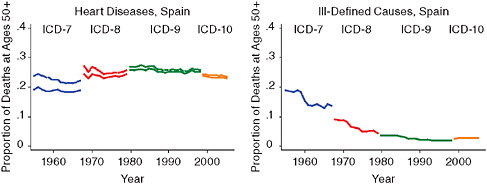
FIGURE 2A-1 Proportion of deaths due to heart disease and ill-defined causes, Spain.
NOTES: Solid line = unadjusted proportion; dashed line = adjusted proportion after redistributing ill-defined causes.
SOURCE: Calculations by authors based on data from the World Health Organization Mortality Database.
in mental disorders and diseases of the nervous system (Figure 2A-3). We see a similar pattern for Canada and France (not shown). Thus, for the period 1980-2004, we may overestimate the decline in respiratory diseases among these three countries. Within ICD-9, the United Kingdom also exhibits a curious drop in respiratory diseases in 1984 and a later increase in 1993, which is mirrored by a “hump” in mental disorders and diseases of the nervous system. A similar (albeit somewhat smaller) hump is apparent in other remaining causes (not shown). During the period 1984-1992, England and
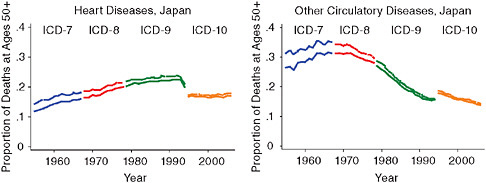
FIGURE 2A-2 Proportion of deaths due to heart and other circulatory diseases, Japan.
NOTES: Solid line = unadjusted proportion; dashed line = adjusted proportion after redistributing ill-defined causes.
SOURCE: Calculations by authors based on data from the World Health Organization Mortality Database.
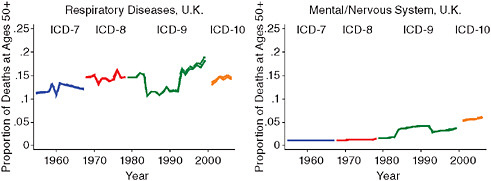
FIGURE 2A-3 Proportion of deaths due to respiratory diseases and mental/nervous system, United Kingdom.
NOTES: Solid line = unadjusted proportion; dashed line = adjusted proportion after redistributing ill-defined causes.
SOURCE: Calculations by authors based on data from the World Health Organization Mortality Database.
Wales broadened coding rule 3, and as a result contributing causes of death were more frequently coded as the underlying cause of death (Janssen and Kunst, 2004; Office of Population Censuses and Surveys, 1995).
Detailed Cause of Death Contributions to Gains in e50
For the decomposition by cause of death, we extracted death counts by sex, age group, and cause of death from the WHO Mortality Database (World Health Organization, 2009). Data were available through 2003 for Italy and through 2004 for all other countries. In most cases, the WHO data are given by the following age groups: 0, 1-4, 5-9, … 80-84, 85+. For the most recent year, more detailed data at the oldest ages (85-89, 90-94, 95+) are available for all countries except Canada. All-cause death rates and exposure estimates come from the HMD (2009). To obtain cause-specific death rates, we apply the distribution of death counts by cause based on the WHO data to the all-cause death rates from the HMD. In cases in which the WHO data are available only to ages 85+, we apply the distribution by cause for deaths at age 85+ to the all-cause death rates at ages 85-89, 90-94, and 95+. We use the Pollard (1988) method to decompose the gains in e50 into the contributions by cause of death. The contribution of ill-defined causes is shown separately here (see Tables 2A-5 and 2A-6), but for Figures 2-6 to 2-11 (in the main text) we have redistributed ill-defined deaths proportionately to all other cause groups before decomposing the gains in e50 by cause group.
TABLE 2A-5 Cause-of-Death Contributions to Gains in e50, 1955-1980
|
GBR |
ITA |
JPN |
NLD |
USA |
Meana |
Compositeb |
Excluding DNK, NLD, and USA |
|
|
Meana |
Compositeb |
|||||||
|
1.9 |
1.7 |
1.4 |
2.2 |
2.7 |
2.0 |
2.1 |
1.8 |
1.7 |
|
1.1 |
1.0 |
0.0 |
0.9 |
1.6 |
1.0 |
1.1 |
0.9 |
0.8 |
|
0.8 |
0.7 |
1.4 |
1.2 |
1.1 |
1.0 |
1.0 |
0.9 |
0.9 |
|
−0.2 |
0.0 |
0.1 |
0.3 |
0.0 |
0.1 |
0.1 |
0.0 |
0.1 |
|
−0.2 |
−0.1 |
−0.1 |
−0.1 |
−0.3 |
−0.1 |
−0.2 |
−0.1 |
−0.1 |
|
0.0 |
−0.1 |
−0.1 |
−0.1 |
0.0 |
0.0 |
0.0 |
0.0 |
0.0 |
|
−0.1 |
−0.1 |
0.0 |
−0.1 |
0.0 |
−0.1 |
0.0 |
−0.1 |
−0.1 |
|
0.2 |
0.2 |
0.3 |
0.5 |
0.3 |
0.3 |
0.3 |
0.3 |
0.3 |
|
−0.1 |
0.3 |
0.1 |
0.3 |
−0.1 |
0.1 |
0.1 |
0.2 |
0.2 |
|
0.0 |
0.1 |
0.1 |
0.1 |
−0.1 |
0.1 |
0.0 |
0.1 |
0.1 |
|
0.2 |
0.6 |
1.7 |
0.2 |
0.0 |
0.6 |
0.7 |
0.9 |
1.0 |
|
0.3 |
0.2 |
1.7 |
0.5 |
0.4 |
0.6 |
0.5 |
0.6 |
0.6 |
|
0.1 |
−0.1 |
0.0 |
0.0 |
0.2 |
0.0 |
0.1 |
0.0 |
0.0 |
|
0.1 |
0.1 |
0.4 |
0.1 |
0.1 |
0.1 |
0.1 |
0.2 |
0.2 |
|
0.0 |
−0.1 |
−0.1 |
0.2 |
0.1 |
0.0 |
0.0 |
0.0 |
0.0 |
|
0.0 |
0.1 |
0.8 |
0.1 |
0.1 |
0.2 |
0.2 |
0.2 |
0.2 |
|
0.0 |
0.1 |
0.3 |
0.1 |
0.1 |
0.1 |
0.1 |
0.1 |
0.1 |
|
0.1 |
0.1 |
0.2 |
0.1 |
0.0 |
0.1 |
0.1 |
0.1 |
0.1 |
|
2.2 |
2.9 |
5.1 |
3.6 |
3.0 |
3.4 |
3.5 |
3.6 |
3.7 |
|
0.6 |
0.3 |
1.3 |
0.0 |
1.9 |
0.9 |
1.3 |
0.9 |
0.9 |
|
0.2 |
−0.1 |
0.0 |
−0.5 |
1.3 |
0.3 |
0.7 |
0.4 |
0.3 |
|
0.4 |
0.4 |
1.3 |
0.5 |
0.7 |
0.6 |
0.6 |
0.6 |
0.6 |
|
−0.1 |
−0.9 |
−0.3 |
−0.8 |
−0.4 |
−0.5 |
−0.4 |
−0.5 |
−0.4 |
|
−0.2 |
−0.6 |
−0.3 |
−0.7 |
−0.5 |
−0.4 |
−0.4 |
−0.4 |
−0.3 |
|
0.0 |
−0.2 |
−0.1 |
−0.2 |
0.0 |
−0.1 |
−0.1 |
−0.1 |
−0.1 |
|
0.0 |
0.0 |
0.0 |
0.0 |
0.0 |
0.0 |
0.0 |
0.0 |
0.0 |
|
0.1 |
0.0 |
0.1 |
0.1 |
0.1 |
0.1 |
0.1 |
0.0 |
0.1 |
|
0.3 |
0.0 |
0.0 |
0.0 |
−0.3 |
0.0 |
0.0 |
0.1 |
0.1 |
|
0.0 |
0.1 |
0.1 |
0.1 |
−0.1 |
0.0 |
0.0 |
0.1 |
0.1 |
|
0.1 |
0.4 |
1.2 |
0.1 |
0.0 |
0.4 |
0.4 |
0.6 |
0.7 |
|
0.6 |
0.4 |
1.9 |
0.5 |
0.5 |
0.7 |
0.7 |
0.8 |
0.8 |
|
0.1 |
0.0 |
0.1 |
0.1 |
0.2 |
0.1 |
0.1 |
0.1 |
0.1 |
|
0.2 |
0.3 |
0.6 |
0.1 |
0.2 |
0.3 |
0.3 |
0.3 |
0.4 |
|
0.0 |
−0.1 |
0.0 |
0.0 |
0.0 |
0.0 |
0.0 |
0.0 |
0.0 |
|
0.1 |
−0.1 |
0.7 |
0.1 |
0.1 |
0.1 |
0.1 |
0.1 |
0.2 |
|
0.2 |
0.1 |
0.2 |
0.2 |
0.1 |
0.2 |
0.2 |
0.2 |
0.2 |
|
0.1 |
0.1 |
0.3 |
0.1 |
0.0 |
0.1 |
0.1 |
0.1 |
0.1 |
|
1.5 |
0.3 |
4.2 |
−0.2 |
1.8 |
1.5 |
2.0 |
2.0 |
2.2 |
TABLE 2A-6 Cause of Death Contributions to Gains in e50, 1980-2004*
|
GBR |
ITA |
JPN |
NLD |
USA |
Meana |
Compositeb |
Excluding DNK, NLD, and USA |
|
|
Meana |
Compositeb |
|||||||
|
3.0 |
3.1 |
4.1 |
2.0 |
2.8 |
3.0 |
3.1 |
3.3 |
3.4 |
|
2.0 |
1.8 |
1.7 |
1.5 |
2.0 |
1.8 |
1.9 |
1.8 |
1.8 |
|
1.0 |
1.3 |
2.4 |
0.6 |
0.7 |
1.2 |
1.2 |
1.5 |
1.6 |
|
0.3 |
0.2 |
0.4 |
0.0 |
0.1 |
0.2 |
0.3 |
0.2 |
0.4 |
|
−0.1 |
−0.1 |
0.0 |
−0.3 |
−0.3 |
−0.2 |
−0.1 |
−0.1 |
−0.1 |
|
0.0 |
0.0 |
0.0 |
−0.1 |
0.0 |
0.0 |
0.0 |
0.0 |
0.0 |
|
0.2 |
0.0 |
−0.1 |
0.1 |
0.1 |
0.1 |
0.1 |
0.0 |
0.1 |
|
0.2 |
0.3 |
0.5 |
0.3 |
0.3 |
0.3 |
0.3 |
0.3 |
0.4 |
|
0.5 |
0.3 |
0.2 |
−0.2 |
−0.3 |
0.1 |
0.1 |
0.2 |
0.3 |
|
−0.2 |
−0.2 |
0.0 |
−0.4 |
−0.4 |
−0.3 |
−0.3 |
−0.2 |
−0.1 |
|
−0.1 |
0.2 |
0.8 |
0.1 |
0.0 |
0.2 |
0.1 |
0.2 |
0.2 |
|
0.1 |
0.5 |
0.7 |
0.1 |
−0.1 |
0.3 |
0.3 |
0.4 |
0.5 |
|
0.1 |
0.2 |
0.1 |
0.2 |
0.0 |
0.1 |
0.1 |
0.2 |
0.2 |
|
0.0 |
0.0 |
0.0 |
0.0 |
−0.1 |
0.0 |
−0.1 |
0.0 |
0.0 |
|
0.0 |
0.2 |
0.1 |
−0.1 |
−0.1 |
0.0 |
0.0 |
0.1 |
0.1 |
|
−0.1 |
0.3 |
0.3 |
0.0 |
0.1 |
0.1 |
0.2 |
0.2 |
0.2 |
|
0.0 |
0.0 |
0.1 |
0.0 |
−0.1 |
0.0 |
0.0 |
0.0 |
0.0 |
|
0.0 |
−0.1 |
0.1 |
0.0 |
|
0.0 |
0.0 |
0.0 |
0.0 |
|
3.6 |
4.1 |
6.1 |
1.6 |
2.1 |
3.4 |
3.6 |
4.1 |
4.7 |
|
3.7 |
2.9 |
3.0 |
2.5 |
3.4 |
3.1 |
3.2 |
3.2 |
3.1 |
|
2.9 |
1.8 |
1.2 |
2.1 |
2.8 |
2.2 |
2.3 |
2.1 |
1.9 |
|
0.8 |
1.1 |
1.8 |
0.4 |
0.6 |
0.9 |
1.0 |
1.1 |
1.2 |
|
0.7 |
0.5 |
0.2 |
0.7 |
0.5 |
0.4 |
0.5 |
0.4 |
0.4 |
|
0.6 |
0.2 |
−0.1 |
0.6 |
0.3 |
0.2 |
0.2 |
0.2 |
0.2 |
|
0.0 |
0.2 |
−0.1 |
0.0 |
0.1 |
0.1 |
0.1 |
0.1 |
0.1 |
|
0.0 |
0.0 |
−0.1 |
0.0 |
0.1 |
0.0 |
0.0 |
0.0 |
0.0 |
|
0.1 |
0.1 |
0.4 |
0.2 |
0.2 |
0.1 |
0.2 |
0.1 |
0.2 |
|
0.9 |
0.5 |
0.1 |
0.0 |
0.2 |
0.3 |
0.3 |
0.4 |
0.4 |
|
−0.1 |
−0.1 |
0.0 |
−0.2 |
−0.2 |
−0.1 |
−0.1 |
−0.1 |
−0.1 |
|
0.0 |
0.1 |
0.3 |
0.2 |
0.1 |
0.1 |
0.1 |
0.1 |
0.1 |
|
0.1 |
0.9 |
0.5 |
0.1 |
0.0 |
0.4 |
0.4 |
0.5 |
0.6 |
|
0.1 |
0.2 |
0.0 |
0.1 |
0.1 |
0.2 |
0.1 |
0.2 |
0.1 |
|
0.0 |
0.0 |
0.1 |
0.0 |
−0.1 |
0.0 |
0.0 |
0.0 |
0.0 |
|
0.0 |
0.1 |
0.0 |
−0.1 |
−0.1 |
0.0 |
0.0 |
0.0 |
0.0 |
|
−0.1 |
0.6 |
0.4 |
0.0 |
0.2 |
0.2 |
0.3 |
0.3 |
0.4 |
|
0.1 |
0.1 |
0.1 |
0.1 |
0.0 |
0.0 |
0.0 |
0.1 |
0.1 |
|
0.0 |
−0.1 |
0.0 |
0.0 |
0.0 |
0.0 |
0.0 |
0.0 |
0.0 |
|
5.2 |
4.8 |
4.1 |
3.3 |
4.0 |
4.3 |
4.4 |
4.6 |
4.7 |
TABLE 2A-7 Age Group Contributions to Gap in e50 in 2004
Current Gap in e50: The United States Versus Other High-Income Countries
For the tables in this Annex, the gap in e50 is defined as:  .
.
For example, among women, the gap of 4.3 for Japan indicates that, on average, women in Japan can expect to live 4.3 years longer after age 50 than their U.S. counterparts (see Table 2A-7).
|
JPN |
NLD |
Meana |
Compositeb |
Excluding DNK and NLD |
|
|
Meana |
Compositeb |
||||
|
1.1 |
0.4 |
0.7 |
0.9 |
0.8 |
0.9 |
|
0.3 |
0.1 |
0.2 |
0.2 |
0.2 |
0.2 |
|
0.4 |
0.1 |
0.2 |
0.3 |
0.3 |
0.3 |
|
0.5 |
0.2 |
0.3 |
0.4 |
0.4 |
0.4 |
|
2.0 |
0.5 |
0.9 |
0.9 |
1.2 |
1.4 |
|
0.6 |
0.2 |
0.3 |
0.3 |
0.5 |
0.5 |
|
0.7 |
0.2 |
0.3 |
0.3 |
0.5 |
0.5 |
|
0.7 |
0.1 |
0.2 |
0.3 |
0.4 |
0.4 |
|
1.1 |
−0.6 |
0.0 |
0.2 |
0.2 |
0.3 |
|
0.6 |
−0.1 |
0.1 |
0.2 |
0.2 |
0.3 |
|
0.3 |
−0.2 |
0.0 |
0.0 |
0.1 |
0.1 |
|
0.3 |
−0.2 |
−0.1 |
0.0 |
0.0 |
0.0 |
|
4.3 |
0.3 |
1.6 |
1.9 |
2.2 |
2.6 |
|
0.9 |
0.7 |
0.7 |
0.7 |
0.8 |
0.8 |
|
0.3 |
0.3 |
0.2 |
0.3 |
0.3 |
0.3 |
|
0.3 |
0.2 |
0.2 |
0.2 |
0.2 |
0.2 |
|
0.3 |
0.2 |
0.2 |
0.3 |
0.3 |
0.3 |
|
0.9 |
−0.2 |
0.3 |
0.5 |
0.5 |
0.6 |
|
0.4 |
0.1 |
0.2 |
0.3 |
0.3 |
0.3 |
|
0.3 |
−0.1 |
0.1 |
0.2 |
0.2 |
0.2 |
|
0.2 |
−0.2 |
0.0 |
0.1 |
0.1 |
0.1 |
|
0.1 |
−0.6 |
−0.2 |
−0.1 |
−0.1 |
−0.1 |
|
0.1 |
−0.3 |
−0.1 |
0.0 |
0.0 |
0.0 |
|
0.0 |
−0.2 |
−0.1 |
−0.1 |
−0.1 |
−0.1 |
|
0.0 |
−0.1 |
−0.1 |
−0.1 |
−0.1 |
−0.1 |
|
1.9 |
−0.1 |
0.8 |
1.1 |
1.2 |
1.2 |
TABLE 2A-8 Cause-of-Death Contributions to Gap in e50 in 2004*
|
GBR |
ITA |
JPN |
NLD |
Meana |
Compositeb |
Excluding DNK and NLD |
|
|
Meana |
Compositeb |
||||||
|
0.1 |
0.1 |
1.8 |
0.4 |
0.7 |
1.0 |
0.9 |
1.0 |
|
0.6 |
0.4 |
1.9 |
0.6 |
0.9 |
1.1 |
1.0 |
1.1 |
|
−0.5 |
−0.3 |
−0.1 |
−0.2 |
−0.2 |
−0.1 |
−0.1 |
−0.1 |
|
−0.2 |
0.3 |
0.8 |
−0.3 |
0.1 |
0.4 |
0.3 |
0.4 |
|
0.2 |
0.5 |
0.6 |
0.2 |
0.3 |
0.4 |
0.4 |
0.5 |
|
−0.1 |
0.0 |
0.1 |
−0.1 |
0.0 |
0.0 |
0.0 |
0.0 |
|
−0.1 |
0.0 |
0.3 |
−0.1 |
0.0 |
0.1 |
0.0 |
0.1 |
|
−0.2 |
−0.3 |
−0.1 |
−0.3 |
−0.2 |
−0.1 |
−0.1 |
−0.1 |
|
−0.2 |
0.6 |
0.3 |
0.2 |
0.3 |
0.3 |
0.3 |
0.3 |
|
0.1 |
0.3 |
0.8 |
−0.1 |
0.2 |
0.3 |
0.2 |
0.3 |
|
−0.1 |
0.0 |
−0.2 |
−0.3 |
−0.2 |
−0.1 |
−0.1 |
−0.1 |
|
0.4 |
0.4 |
0.8 |
0.3 |
0.4 |
0.5 |
0.5 |
0.5 |
|
0.1 |
0.0 |
0.0 |
0.0 |
0.0 |
0.0 |
0.0 |
0.0 |
|
0.1 |
0.2 |
0.1 |
0.1 |
0.1 |
0.1 |
0.1 |
0.1 |
|
0.2 |
0.0 |
0.3 |
0.1 |
0.1 |
0.2 |
0.1 |
0.2 |
|
−0.2 |
0.0 |
0.1 |
−0.1 |
0.0 |
0.0 |
0.0 |
0.0 |
|
0.1 |
0.1 |
0.1 |
0.1 |
0.1 |
0.1 |
0.1 |
0.1 |
|
0.1 |
0.1 |
0.2 |
0.1 |
0.0 |
0.1 |
0.1 |
0.1 |
|
0.1 |
1.6 |
4.3 |
0.3 |
1.5 |
2.4 |
2.1 |
2.5 |
|
−0.1 |
0.3 |
1.5 |
0.3 |
0.7 |
0.9 |
0.8 |
0.9 |
|
0.4 |
0.6 |
1.9 |
0.6 |
0.9 |
1.1 |
1.0 |
1.2 |
|
−0.4 |
−0.4 |
−0.4 |
−0.3 |
−0.2 |
−0.3 |
−0.2 |
−0.3 |
|
−0.2 |
−0.6 |
−0.3 |
−0.6 |
−0.4 |
−0.4 |
−0.3 |
−0.4 |
|
0.2 |
0.0 |
0.3 |
−0.1 |
0.1 |
0.1 |
0.1 |
0.1 |
|
−0.1 |
−0.1 |
0.0 |
−0.1 |
−0.1 |
−0.1 |
−0.1 |
−0.1 |
|
−0.1 |
0.0 |
0.1 |
−0.1 |
0.0 |
0.0 |
0.0 |
0.0 |
|
−0.2 |
−0.5 |
−0.6 |
−0.2 |
−0.3 |
−0.4 |
−0.4 |
−0.4 |
|
−0.2 |
0.3 |
−0.2 |
0.0 |
0.1 |
0.0 |
0.1 |
0.0 |
|
0.1 |
0.2 |
0.4 |
0.0 |
0.1 |
0.2 |
0.1 |
0.2 |
|
0.0 |
0.0 |
−0.1 |
−0.3 |
−0.1 |
−0.1 |
−0.1 |
−0.1 |
|
0.7 |
0.5 |
0.4 |
0.5 |
0.4 |
0.4 |
0.4 |
0.4 |
|
0.2 |
0.1 |
−0.1 |
0.2 |
0.1 |
0.0 |
0.1 |
0.0 |
|
0.2 |
0.2 |
0.1 |
0.1 |
0.1 |
0.1 |
0.1 |
0.1 |
|
0.2 |
0.1 |
0.2 |
0.1 |
0.1 |
0.2 |
0.1 |
0.2 |
|
−0.1 |
0.0 |
0.0 |
0.0 |
0.0 |
0.0 |
0.0 |
0.0 |
|
0.1 |
0.1 |
0.1 |
0.1 |
0.1 |
0.1 |
0.1 |
0.1 |
|
0.1 |
0.1 |
0.1 |
0.1 |
0.0 |
0.1 |
0.0 |
0.1 |
|
0.3 |
0.6 |
1.9 |
−0.1 |
0.7 |
1.0 |
1.1 |
1.1 |


