
7
The Contribution of Physical Activity to Divergent Trends in Longevity
Andrew Steptoe and Anna Wikman
Physical activity is fundamental to the maintenance of physical health, mobility, independent living, and the quality of life of older people. Sustained physical activity in the elderly is likely to minimize health and social care costs, reduce the risk of falls and fractures, and enhance cognition and positive well-being either directly or indirectly, through promoting social participation. The extent to which differences in physical activity contribute to variations in health and life expectancy across countries is poorly understood.
One reason is that there are limits to the validity of the standard questionnaire measures of physical activity used in studies of older people. These measures can be somewhat insensitive to variations in light and moderate activity, and there may be differences in interpretation of activity intensity items. In addition, there may be incomplete recall among older participants, particularly with respect to the timing and duration of activities across days of the week. Objective assessments using accelerometers or pedometers are being used more frequently, but they have yet to be applied to nationally representative samples in comparative studies. These factors conspire against definite conclusions at this point in time concerning the contribution of physical activity to differences in longevity across countries. There are, however, pointers toward the relevance of physical activity to cross-country variations in health and well-being.
The purpose of this chapter is to review the current evidence concerning physical activity and highlight issues for future research. We begin with a brief overview of the benefits of physical activity at older ages for physical and mental health and cognitive functioning. The scientific literature is
large, so we draw on two recent comprehensive reports that have reviewed this work, namely the 2008 report of the Physical Activity Guidelines Advisory Committee (2008) and the position stand on physical activity for older adults from the American College of Sports Medicine (Chodzko-Zajko et al., 2009). A particular difficulty of studying the health benefits of physical activity at older ages is establishing an incontrovertible level of proof. Intervention studies with disease outcomes are rare, so much of the evidence is based on observational studies or short-term interventions with intermediate health endpoints. Nevertheless, the weight of the data indicates that physical activity is associated both with an enhanced life span and good health and functioning at older ages.
Any discussion of the contribution of physical activity to divergent trends in longevity across countries depends on accurate assessment. The second section of the chapter therefore addresses the strengths and limitations of self-report and objective measures and suggests ways in which self-report assessments might be improved. Third, we review the current literature concerning physical activity levels in developed countries in relation to longevity. A key issue in these cross-country comparisons is whether countries should be judged in terms of the proportion of their population attaining recommended levels of physical activity, or the proportion that is sedentary and does no activity at all. Population rates of physical activity and sedentary behavior do not have a simple reciprocal relationship, and country rankings vary depending on which measure is used. While monitoring adherence to physical activity guidelines is valuable for public health promotion, many of the adverse effects of being inactive are likely to occur at the lower end of the activity/inactivity distribution. The timing of important relationships is also poorly understood. Is it the current level of physical activity or sedentary behavior among older adults that is important, or the levels of activity that were present in the country when these individuals were in middle age?
BENEFITS OF PHYSICAL ACTIVITY AT OLDER AGES
Regular physical activity is thought to be among the most important lifestyle factors for the maintenance of health and prevention of premature disease and mortality. Across developed regions of the world, inactivity ranks alongside tobacco, alcohol, and adiposity as a leading cause of reduced healthy life expectancy (Ezzati et al., 2003). An analysis of the Nurses’ Health Study estimated that the population attributable risk (PAR) for physical inactivity was 16.5 percent of deaths from any cause, 27.7 percent of cardiovascular deaths, and 9.3 percent of cancer deaths (van Dam et al., 2008). In the INTERHEART study of myocardial infarction in 52 countries, the PAR for inactivity was 12.2 percent across all regions of the
world and was as strong as 24-38 percent in Western Europe and North America (Yusuf et al., 2004). Globally, the World Health Organization recently estimated that inactivity is responsible for around 5.5 percent of deaths (World Health Organization, 2009). Many types of physical activity appear to be protective, including leisure-time physical activity, walking, and active commuting (Hamer and Chida, 2008; Landi et al., 2008; Manson et al., 2002). Physical activity is also relevant to the secondary prevention of physical disease and is a major component of most programs of cardiac or respiratory rehabilitation.
Physical inactivity contributes to many specific health and function problems in old age. Table 7-1 outlines some of the positive health benefits of regular physical activity for older adults. For example, physical activity is a key component of many programs to reduce risk of falls through improving strength, balance, and confidence. Falls are an important cause of morbidity in older populations; more than a third of people age 65 and over fall every year, and many falls result in fractures, soft tissue injury, or head injury (Tinetti, 2003). A recent longitudinal population study in Australia showed that physical activity was associated with a substantially reduced risk of falls over a 3-5 year period, independent of age, education,
TABLE 7-1 Health Benefits of Regular Physical Activity for Older Adults
|
How Physical Activity Can Improve Physical Functioning |
How Physical Activity Can Improve Mental Functioning |
How Physical Activity Can Be Beneficial at Older Ages in General |
|
|
|
body weight, eyesight problems, chronic conditions, and other covariates (Heesch, Byles, and Brown, 2008).
The Physical Activity Guidelines Advisory Committee concluded that there is a dose-response relationship with fracture risk, so greater physical activity results in greater risk reduction. The MacArthur Studies of Successful Aging have demonstrated that deterioration in objectively defined physical functioning over a 2.5-year period was attenuated in more physically active individuals, both with and without chronic health problems (Seeman and Chen, 2002). Another longitudinal study found that regular activity was associated with reduced risk of the development of impairments in activities of daily living in both normal and overweight participants, independent of covariates (Bruce, Fries, and Hubert, 2008), and favorable effects on physical function appear to be maintained into very old age (Yates et al., 2008).
Physical activity is also associated with improved prognosis of chronic obstructive lung disease, in particular improvements in health-related quality of life and functional exercise capacity (Langer et al., 2009). The effects of regular physical activity on the biological systems noted in Table 7-1 have been observed both in observational and intervention trials (Kelley and Kelley, 2006, 2007). Physical activity also appears to help maintain cognitive function in old age (Hamer and Chida, 2009), as well as promoting emotional well-being and quality of life (Martin et al., 2009; Steptoe, 2006).
Most longitudinal observational studies do not begin with populations that are completely free of subclinical or early-stage illness or risk factors. Exercise in middle and old age is more common among people who have been active in their early lives (Chakravarty et al., 2008). This makes it difficult to be confident whether physical activity really precedes illness, or whether early presymptomatic illness or risk factors lead to reduced physical activity. Nonetheless, some studies have shown that changes in levels of physical activity in middle-aged and older people are associated with changes in risk factors, functional independence, and mortality (Byberg et al., 2001, 2009; Stessman et al., 2009).
Table 7-2 summarizes the conclusions drawn by the 2008 Physical Activity Guidelines Advisory Committee about the role of physical activity in major diseases that contribute to longevity in developed countries. The evidence is strong in most cases for an inverse relationship between regular physical activity and reduced risk of cardiovascular and metabolic diseases, with graded effects in many cases. The associations with cancer vary by the site of malignancy, with the strongest evidence for colorectal and breast cancer. Potentially, therefore, it is plausible that physical activity is a modifiable risk factor for diseases of old age that could contribute to international variations in longevity.
TABLE 7-2 Physical Activity and Major Health Conditions of Older Age
|
Health Condition |
Committee Conclusion |
Reviews and Meta-analyses |
|
Cardiovascular disease |
A strong inverse relationship between habitual physical activity and coronary heart disease and cardiovascular disease morbidity and mortality. Sedentary behavior is an independent risk factor for middle-aged and older men and women, with those reporting moderate activity having a 20 percent lower risk and those reporting higher activity having approximately a 30 percent lower risk than least active persons. Physical activity is also protective for stroke. |
Sofi et al. (2008); Wendel-Vos et al. (2004) |
|
Metabolic syndrome |
There is an inverse dose-response association between level of activity and risk of metabolic syndrome. Many studies indicate that a goal of 150 minutes per week of moderate intensity activity is desirable. |
Orozco et al. (2008) |
|
Type 2 diabetes |
Randomized controlled trials and observational studies indicate that 150 minutes per week of moderate intensity physical activity will help prevent type 2 diabetes. |
Orozco et al. (2008) |
|
Cancers |
People who carry out aerobic physical activity for about 3 to 4 hours per week at moderate or greater intensity have an average 30 percent reduction in colon cancer risk and a 20 to 40 percent lower risk of breast cancer, compared with sedentary individuals. Compared with sedentary people, available epidemiological data suggest that active people show reductions of approximately 20, 30, and 20 percent in risk of lung, endometrial, and ovarian cancers, respectively. |
Friedenreich and Cust (2008); Wolin et al. (2009) |
|
Cognitive function/dementia |
Prospective cohort studies support the conclusion that physical activity delays the incidence of dementia and the onset of age-related cognitive decline. |
Hamer and Chida (2009) |
|
SOURCE: Adapted from 2008 Physical Activity Guidelines Advisory Committee. |
||
RECOMMENDED LEVELS OF ACTIVITY IN OLDER ADULTS
There are some variations in government and authoritative agency recommendations about the levels of physical activity that should be achieved, and older adults may have physical problems that limit their capacity to attain high levels of activity. The U.S. 2008 physical activity guidelines for older adults are summarized in Box 7-1 (U.S. Department of Health and Human Services, 2008). The first guideline—that people should carry out any activity rather than none, since even modest exercise is better than none
|
BOX 7-1 2008 Physical Activity Guidelines for Older Adults
SOURCE: Adapted from the 2008 Physical Activity Guidelines for Americans. |
at all—is potentially relevant to international trends, since health problems associated with physical activity are likely to be most prominent among the sedentary population, not those who are moderately versus highly active.
The current recommendation is for 150 minutes per week of aerobic activity of moderate intensity in episodes of at least 10 minutes. This is equivalent to around 20 minutes per day, ideally spread throughout the week. Muscle-strengthening activity is also recommended, with older adults being advised to carry out exercises that help maintain balance. The proportion of the population that fulfills these criteria in the United States and Western Europe is not as high as is desirable, as detailed later in this chapter. But there are two immediate implications of the guidelines that are relevant to the theme of this chapter. First, providing a complete assessment of the
different activity components in population studies is difficult. While it may be possible to gauge the amount of aerobic activity, measures of muscle-strengthening activities and balance exercises are less well developed, and it is not clear whether the different elements can be integrated into a single score of physical activity. Second, the guidelines use the terms moderate-intensity and vigorous-intensity activity. These are open to interpretation, and there may be variation among individuals and among countries in how different types of activity are perceived.
MEASUREMENT OF PHYSICAL ACTIVITY
The issue of accurate measurement is of course fundamental to analyses of the contribution of physical activity to divergent trends in longevity. Most population studies are based on self-report of physical activity. A number of standardized measures have been developed, such as the Paffenbarger Physical Activity Questionnaire and the Minnesota Leisure Time Physical Activity Questionnaire. Questionnaires designed specifically for older men and women have also been devised, including the Yale Physical Activity Survey for Older Adults, the Physical Activity Scale for the Elderly (PASE), and the Community Health Activity Model Program for Seniors (CHAMPS) scale. Cross-national studies need to take account of the different forms of activity in different cultures: bicycling for transport is very common in the Netherlands, gardening is popular in the United Kingdom, and some countries show wide seasonal variations in activity because of their climates. Instruments have therefore been developed specifically for international comparison work, such as the International Physical Activity Questionnaire (IPAQ) and the European Prospective Investigation into Cancer (EPIC) measure. The applied research measurement resource of the National Cancer Institute lists the details of more than 100 physical activity questionnaires, together with many validation studies (see http://appliedresearch.cancer.gov/tools/paq/reflist.html [accessed June 8, 2010]). Nevertheless, there are limitations to the accuracy of all self-report measures (Shephard, 2003), and agreement with gold standard measures, such as doubly labeled water (a measure of metabolic rate based on the speed of elimination of heavy isotopes), is modest (Westerterp, 2009).
Some of the limitations of self-report measures are common to all ages, but there are particular problems in older adults, and these are exacerbated in cross-national studies (see Table 7-3). Responses to questionnaires may not be accurate because of incomplete recall and impaired cognitive ability; in older age groups, many activities are of light or moderate intensity and occur as part of everyday life, so they may be missed. Questionnaires typically provide crude summary indices of physical activity, so they may provide little information about the pattern of activity across the day and
TABLE 7-3 Adherence to Physical Activity Recommendations
|
Proportion (standard error) based on objective assessment of activity |
|||
|
Age |
Men % (SE) |
Women % (SE) |
Total % (SE) |
|
16-19 |
7.1 (1.0) |
4.1 (1.0) |
5.6 (0.8) |
|
20-59 |
3.8 (0.4) |
3.2 (0.3) |
3.5 (0.3) |
|
60+ |
2.5 (0.4) |
2.3 (0.5) |
2.4 (0.4) |
|
SOURCE: Adapted from NHANES 2003-2004 (Troiano et al., 2008). |
|||
through the week. Much of older people’s activity is not done in designated exercise periods, so the frequency of activity is less easy to gauge than in younger groups. Some questionnaires suffer from floor effects, are based only on the assessment of designated leisure-time activities rather than all types of activity, or do not even include the low-intensity activities that are common in the older population (Shephard, 2003). In addition, disability can have an influence on the interpretation of items concerning activity intensity, with disabled individuals rating particular activities as more intense than nondisabled people (Rikli, 2000). This means that comparisons between people with very different levels of physical function and frailty groups may be compromised. Finally, there may be important cultural differences across countries in what constitutes exercise, vigorous exercise in particular.
Objective measurement of physical activity is therefore desirable. Several types of measure are available, including doubly labeled water and heart rate monitoring, but the most useful objective method for population studies is motion sensing using accelerometers (Westerterp, 2009). Accelerometers are robust, lightweight devices that can be worn for several days without discomfort. Because the information is time-stamped, patterns of activity through the day can be determined. Useful information about the amount of time people spend inactive or at relatively low levels of activity can also be obtained. Pedometers are also an option, particularly for older people for whom walking is a primary mode of activity. Pedometers are simple to use, inexpensive, and very practical for older age samples. Recordings correlate well with accelerometers, but they do not capture the intensity of activity or the pattern of activity over time (Harris et al., 2009b). There are also specific devices, such as the activPAL™ physical activity logge, that are designed specifically for monitoring leg activity (Busse, van Deursen, and Wiles, 2009).
The importance of the pattern of activity over the day is illustrated in Figure 7-1, which compares activity counts averaged over 7 days recorded from 163 community-dwelling older men and women in England (age 76
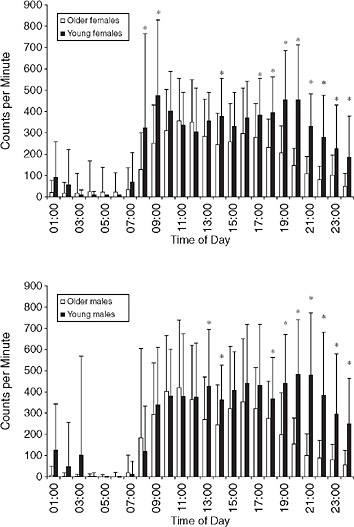
FIGURE 7-1 Weekday hourly mean accelerometer counts per minute for older and younger women (upper panel) and men (lower panel).
NOTE: The asterisks indicate significant age differences.
SOURCE: Davis and Fox (2007). Permission to reprint obtained from Springer-Verlag 2006, and M.G. Davis and K.R. Fox. Exercise, Nutrition, and Health Sciences, School of Applied and Community Health, Centre for Sport, Exercise & Health, University of Bristol, Tyndall Avenue, Bristol, BS8 1TP, UK.
on average) with 45 young adults age 27 (Davis and Fox, 2007). Distinct patterns of activity are apparent, with comparable activity in the morning in the older group, but markedly less activity in older than younger participants in the evening. Overall counts were around one-third lower in the older group, which also engaged in much less high-intensity activity.
There are particular issues in using accelerometers with older people that should not be ignored. They do not, of course, provide information about the type of activity being carried out. Changes in body composition and declines in basal metabolic rate mean that algorithms designed to convert accelerometer counts into units of energy expenditure need to be interpreted with caution. The assessment of people with chronic physical disability may be problematic, with different positioning of devices around the waist or wrist being necessary. Finally, accelerometers are relatively expensive and labor-intensive to analyze, so they may not prove the ultimate solution to general survey work unless these practical and economic issues are resolved. An iterative process involving conjoint assessment of objective and self-report measures may help improve subjective measures.
Two other approaches to measuring physical activity are relevant in studies of older populations. The first is the assessment of cardiorespiratory fitness. Fitness can be measured through a number of standard protocols using treadmills, step tests, and bicycle ergometers (American College of Sports Medicine, 2005). Cardiorespiratory fitness is moderately correlated with activity questionnaire measures, although the two are not interchangeable and may have independent effects on health (Chase et al., 2009; Wei et al., 2000). Second, measuring walking speed can provide a simple yet useful method of measuring health-relevant physical activity capacity in the elderly. One recent study demonstrated that slow walking speed over 6 meters in older people was strongly associated with an increased risk of cardiovascular mortality (Dumurgier et al., 2009); those with a walking speed in the lower third of the distribution had about a threefold increased risk of cardiovascular death, but no increased risk of mortality from cancer or other causes of death. In an analysis of apparently healthy older participants in the Whitehall II cohort, we demonstrated that speed on a very short (8 ft) walk was associated with greater subclinical coronary atherosclerosis (Hamer et al., in press).
DISCREPANCIES BETWEEN SELF-REPORT AND OBJECTIVE MEASURES
Ratings on self-report measures of physical activity are moderately correlated with objective measures using accelerometers and pedometers (Friedenreich et al., 2006; Hagstromer, Oja, and Sjöström, 2006). Studies of older adults have shown correlations of .34 to .49 for accelerometers and .36 to .56 for pedometers (Harris et al., 2009b; Stel et al., 2004; Washburn and Ficker, 1999). Of greater concern are discrepancies in the absolute levels of physical activity reported, since these are relevant both for public policy and for understanding associations with longevity.
The largest representative study to date is the National Health and
Nutrition Examination Survey (NHANES) 2003-2004, which involved collection of 7 days of accelerometry from 7,176 individuals (Troiano et al., 2008). Data for 4 or more days were obtained from 4,867 participants. There was a marked decline in activity counts with age, falling from mean counts per minute of 423.6 and 327.2 for men and women ages 20-29, to 256.7 and 251.2 for men and women ages 60-69. The proportion of individuals of different ages whose activity attained the recommended levels is detailed in Table 7-3. The criterion was 30 or more minutes of moderate or vigorous activity at least 5 days per week, a somewhat less stringent threshold than that shown in Box 7-1, since activity in this analysis did not have to be accumulated in bouts of at least 10 minutes. Nevertheless, it is apparent that the proportion of individuals in the population who are adherent is very small, even among adolescents, and only about 1 in 40 for participants age 60 and older.
The proportion of the population apparently complying with national recommendations is much smaller with objective than self-report measures. Figures from the Behavioral Risk Factor Surveillance System (see http://www.cdc.gov/brfss/ [accessed June 8, 2010]) indicate that, in 2005, 48.8 percent of adults in the United States reported 30 or more minutes of moderate physical activity on 5 or more days of the week, or vigorous activity of at least 20 minutes duration on 3 or more days. According to the Healthy People 2010 Database (see http://wonder.cdc.gov/data2010/ [accessed June 8, 2010]), only 14 percent of people ages 65-74 fulfill criteria for being sufficiently active.
The NHANES findings are reproduced elsewhere. A smaller accelerometer study of men and women age 65 or older in the United Kingdom showed that only 2.5 percent achieved the recommended amount of 150 minutes per week in bouts of at least 10 minutes (Harris et al., 2009a). A Swedish population study across a wider age range (ages 18-69) found that 57 percent accumulated at least 30 minutes daily, although if these had to be obtained through bouts of 10 minutes or more, the proportion fell to 1 percent (Hagstromer, Oja, and Sjöström, 2007). Equally worrying from the public health perspective is the high incidence of sedentary behavior, as defined by low activity counts on accelerometers. Analysis of the NHANES 2003-2004 data indicates that individuals aged 60-69 years spent an average 8.41 hours (more than 60 percent of their time) per day in sedentary behavior (Matthews et al., 2008). Interestingly, this is somewhat higher than the average of 7.52 hours per day recorded for Swedish men and women ages 65-79, although the sample was small (Hagstromer, Oja, and Sjöström, 2007).
The data collected using objective measures therefore shows marked differences from self-report in terms of the amount of activity achieved and very poor adherence to national recommendations. One possible ex-
planation is that people overestimate their physical activity and misclassify their activities as involving more energy expenditure than they actually do. Sedentary behavior is often defined in self-report studies in terms of the amount of time spent in inactive pursuits, such as watching TV or using a computer; the accelerometer studies indicate that such measures capture only a small proportion of the time spent without moving in a typical day. It is also possible that accelerometers fail to assess some types of activity accurately, leading to underestimation. Accelerometers are taken off when people are swimming, and they are relatively poor at monitoring such activities as cycling. Important though these activities are, they probably contribute a modest amount to overall physical activity in population studies. In addition, static activities involving complex movements may be underestimated using accelerometers (Matthews, 2005). Another issue that is being actively investigated is whether the cut points used to define sufficient objective activity in these accelerometer studies are correct for the general population.
It should also be pointed out that the guidelines for physical activity have been based predominantly on self-report measures in the population. If these do overestimate actual activity, yet are derived from evidence that these self-report levels are protective, it is possible that, in reality, a lower amount of activity is required for health benefit. Nonetheless, there is clearly scope for improving self-report measures. One useful avenue may be to develop physical activity vignettes that could be used to anchor self-report measures. Vignette questions could describe the activity of a hypothetical person and then ask the respondent to evaluate the exercise of that person. Such a method could help identify systematic variations in the interpretation of activity levels by age or disability level.
INTERNATIONAL DIFFERENCES IN PHYSICAL ACTIVITY
Estimation of the contribution of physical activity to cross-national differences in longevity has to be based on robust estimates of activity in different countries. The previous sections of this chapter indicate that international comparisons are difficult to make. There are no cross-national studies using objective measures, and a key priority for future research is a comparison of objectively assessed activity in representative samples of older adults from different countries, using the same study and measurement protocol. Although there are numerous self-report studies across the developed world, comparisons are difficult to make with different self-report measures, since a common metric is not present. The most reliable comparisons are therefore in cross-national studies in which the same measure has been used on similar sectors of the population in each nation. Another consideration is deciding what aggregate measure of activity is most relevant for longevity; the options include the average levels of physical activity in
the population, the proportion who are active above a defined threshold, the levels of sedentary behavior, or (for older people) such indicators as the amount of time spent walking.
Table 7-4 summarizes data from a number of international studies of moderate or vigorous self-reported physical activity. The studies vary in the criterion adopted for assessing moderate or vigorous activity, as well as in the age range tested and sample size. European countries are overrepresented in these studies compared with developed countries in the Americas, Asia, and Australasia, partly because many investigations were focused primarily on the European Union. However, the International Prevalence Study (IPS) of physical activity used the IPAQ to assess activity across 20 countries (Bauman et al., 2009). The IPAQ measures the frequency, duration, and intensity of activity over the last 7 days. Respondents are asked to include all physical activity at work, during transportation, at home, and during leisure time. The criterion presented in the table is the proportion
TABLE 7-4 Ranking of Levels of Moderate or Intense Physical Activity Across Countries
who carried out either moderate activity, measured as 3 days of vigorous activity of at least 20 minutes per day, 5 days of moderate-intensity activity or walking of ≥ 30 minutes per day, or 5 days of combinations that achieve ≥ 600 MET-minutes (metabolic equivalent of task) per week; or high activity, measured as 3 days of vigorous activity that accumulated at least 1,500 MET-minutes per week or ≥ 5 days of any combination achieving at least 3,000 MET-minutes per week. The proportion of respondents ages 40-65 attaining this criterion ranged from more than 85 percent in the Czech Republic and New Zealand to 51.5 percent in Belgium. The IPAQ was also used in the Eurobarometer study in 2002 with a broadly comparable threshold, although in this case a wider age range was included (Sjöström et al., 2006). This again identified low prevalence estimates in Belgium, as well as in France and Sweden.
Physical activity was assessed as part of the EPIC study in a large sample of men and women ages 50-64 (Haftenberger et al., 2002). A short validated questionnaire was administered, and Table 7-4 shows results for total recreational activity for the largest center included in each country. The highest levels were recorded in the Netherlands, the United Kingdom, and Germany, whereas Sweden again ranked low, along with Italy. Finally, an earlier European Union study showed a different profile of responses, with citizens of Northern European countries being more active than those from southern countries like Greece and Spain (Martinez-Gonzalez et al., 2001).
Discussion of the factors driving cross-national differences in physical activity is beyond the scope of this chapter. But issues that are relevant might include variations in cultural factors and attitudes to outdoor pursuits, climate, infrastructure for active commuting, habits (such as the frequent use of bicycles in the Netherlands), exercise facilities, availability of green spaces, and physical activity promotion practices.
CROSS-NATIONAL DIFFERENCES IN PHYSICAL ACTIVITY AND HEALTH
It is apparent from this brief summary of cross-national studies of physical activity that analyses of the contributions of physical activity to differences in longevity can be made only very tentatively. Since the ranking of countries in terms of physical activity is at best moderately consistent across studies, analyses of relationships with health outcomes must be carried out cautiously. In the analyses described in this section, we decided to use data from the Health and Retirement Study (HRS) in the United States, the Survey of Health, Ageing and Retirement in Europe (SHARE), and the English Longitudinal Study of Ageing (ELSA). The reason is that all three employed a similar measure of physical activity in a large population sample of men
and women age 50 or older. We analyzed data from Wave 2 of SHARE (2004-2007) from 14 European countries (see http://www.share-project.org/ [accessed June 8, 2010]), Wave 2 of ELSA (see http://www.ifs.org.uk/elsa/ [accessed June 8, 2010]), and the 2004 HRS (see http://hrsonline.isr.umich.edu/[accessed June 8, 2010]). Participants were asked about the frequency of vigorous physical activity (cycling, digging, running or jogging, swimming, etc.), moderate activities (dancing, gardening, walking at a moderate pace, etc.), and lightly energetic activities (home repairs, laundry, vacuuming) over the past week.
Figure 7-2 summarizes the proportion of respondents in each country who were vigorously or moderately active at least once a week. Values range from a high of 83.2 percent in Sweden to a low of 56 percent in Poland, with the United States (69.3 percent) and England (74.7 percent) appearing in the middle of the distribution. A second measure was derived to assess inactivity. This was the proportion of individuals who had not been vigorously or moderately active at all over the past week (responses of “hardly ever or never”). Broadly, the profile of countries is the reciprocal of that for vigorous or moderate activity (see Figure 7-3), albeit with exceptions.
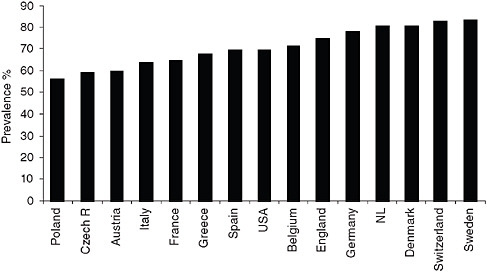
FIGURE 7-2 Proportion of adults age 50 or older who report being moderately or vigorously physically active at least once per week.
NOTE: NL = the Netherlands.
SOURCES: Analyses conducted by the authors based on microdata from Survey of Health, Ageing and Retirement in Europe (SHARE) (see http://www.share-project.org/ [accessed June 22, 2010]) Wave 2, English Longitudinal Study of Ageing (ELSA) (see http://www.ifs.org.uk/elsa/ [accessed June 22, 2010]) Wave 2, and Health and Retirement Study 2004 (see http://hrsonline.isr.umich.edu/ [accessed June 2010]).
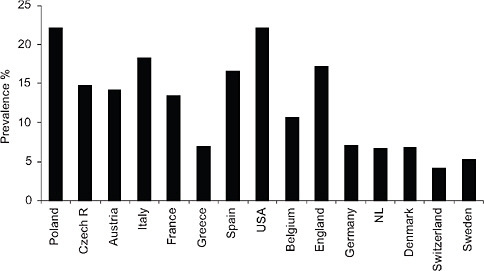
FIGURE 7-3 Proportion of adults age 50 or older who report no moderate or vigorous physical activity.
NOTE: NL = the Netherlands.
SOURCES: Analyses conducted by the authors based on microdata from Survey of Health, Ageing and Retirement in Europe (SHARE) (see http://www.share-project.org/ [accessed June 2010]) Wave 2, English Longitudinal Study of Ageing (ELSA) (see http://www.ifs.org.uk/elsa/ [accessed June 2010]) Wave 2, and Health and Retirement Study 2004 (see http://hrsonline.isr.umich.edu/ [accessed June 2010]).
It is notable that the United States had the highest proportion of inactive respondents (22 percent, matching Poland) and that a relatively large number were also inactive in England (17.1 percent).
In the first set of analyses, we regressed physical activity measures onto the proportion of respondents in each country who rated their own health as only fair or poor, rather than excellent, very good, or good. Significant effects were observed for both men and women, not only for the proportion of individuals who were vigorously or moderately active at least once a week, but also for the proportion who were inactive. Figure 7-4 summarizes results averaged across men and women. In the top panel, it is evident that countries with a higher proportion of individuals who are physically active have a lower prevalence of fair or poor self-rated health (β = −0.866, 95% C.I. −1.399 to −0.333, p = 0.004). Conversely, a high prevalence of inactivity is positively associated with fair or poor self-rated health (β = 1.223, C.I. 0.400 to 2.046, p = 0.007). It should be emphasized that this relationship may not be causal; it could be that poor self-rated health due to physical illness, disability, or mental health problems influences ability or willingness to undertake exercise, or that a third factor affects both self-rated health and physical activity.
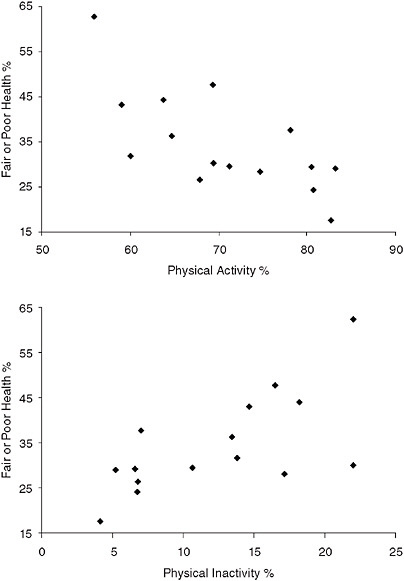
FIGURE 7-4 Scatterplot of the association between fair or poor self-rated health and the proportion of respondents in each country who are vigorously or moderately active at least once a week (upper panel), and the proportion who are inactive (lower panel).
NOTE: Each point represents one country.
SOURCES: Analyses conducted by the authors based on microdata from Survey of Health, Ageing and Retirement in Europe (SHARE) (see http://www.share-project.org/ [accessed June 2010]) Wave 2, English Longitudinal Study of Ageing (ELSA) (see http://www.ifs.org.uk/elsa/ [accessed June 2010]) Wave 2, and Health and Retirement Study 2004 (see http://hrsonline.isr.umich.edu/ [accessed June 2010]).
In addition to analyzing self-rated health, we also assessed associations between reported levels of diabetes and physical activity across countries. Diabetes was selected because of evidence that self-report levels correspond closely with objectively defined diabetes in older adults, at least in England (Pierce et al., 2009). An interesting association between inactivity and the prevalence of diabetes across countries emerged from these analyses (β = 0.320, C.I. 0.065 to 0.574, p = 0.018). As can be seen in Figure 7-5, countries in which a higher proportion of respondents were inactive also had a higher prevalence of diabetes. It should, however, be noted that the prevalence of undetected diabetes may vary across countries and that the impact of these variations on the relationship found in the figure is difficult to estimate.
The measures of both activity and health were derived from the same data sets in these analyses, so their generalizability is uncertain. In order to provide some external validation, a final set of analyses was carried out in which the aggregate estimates of physical activity and inactivity from HRS, ELSA, and SHARE were regressed onto life expectancy at age 50
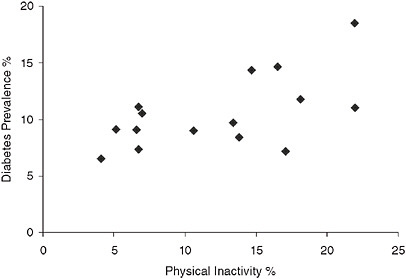
FIGURE 7-5 Scatterplot of the association between self-reported diabetes and the proportion of respondents in each country who are inactive.
NOTE: Each point represents one country.
SOURCES: Analyses conducted by the authors based on microdata from Survey of Health, Ageing and Retirement in Europe (SHARE) (see http://www.share-project.org/ [accessed June 22, 2010]) Wave 2, English Longitudinal Study of Ageing (ELSA) (see http://www.ifs.org.uk/elsa/ [accessed June 2010]) Wave 2, and Health and Retirement Study 2004 (see http://hrsonline.isr.umich.edu/ [accessed June 2010]).
(2004 figures) extracted from the Human Mortality Database (http://www. mortality.org/ [accessed June 8, 2010]). A significant association was observed for life expectancy in men and the proportion reporting vigorous or moderate activity (β = 0.12, 95% C.I. 0.015 to 0.226, p = 0.029), and this is plotted in Figure 7-6. Countries with a higher proportion of vigorously or moderately active men age 50 or older had a greater life expectancy at age 50. The association was strongly influenced by results from the Czech Republic, which had the lowest life expectancy and relatively low prevalence of physically active men. When this country was removed from the analysis, the effect was no longer significant (p = 0.079) although still positive. As can be seen from Figure 7-6, there are also anomalies, such as one country (Denmark) with high activity and relatively low life expectancy, and another (Italy) with low reported activity and high life expectancy. These are bivariate analyses that do not control for other factors, such as smoking or body mass, that might coaggregate with low physical activity. But bearing in mind the likely imprecision of the measure of physical activity, the association is interesting. There was no significant relationship between physical activity
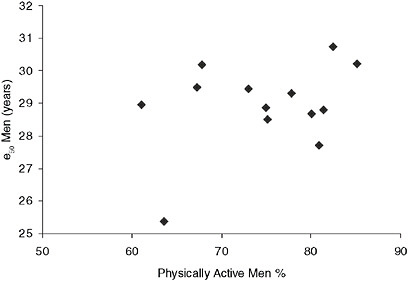
FIGURE 7-6 Scatterplot of the association between life expectancy at age 50 (2004 estimates) in men and the proportion of respondents in each country who are vigorously or moderately active at least once a week.
NOTE: Each point represents one country.
SOURCES: Analyses conducted by the authors based on microdata from Survey of Health, Ageing and Retirement in Europe (SHARE) (see http://www.share-project.org/ [accessed June 2010]) Wave 2, English Longitudinal Study of Ageing (ELSA) (see http://www.ifs.org.uk/elsa/ [accessed June 2010]) Wave 2, and Health and Retirement Study 2004 (see http://hrsonline.isr.umich.edu/ [accessed June 2010]).
and life expectancy among women. The reasons are not clear but could be related to different causes of death or to differences in the suitability of the physical activity measures for men and women.
CONCLUSIONS
The results of the analyses described in the previous section are consistent with the notion that physical activity contributes to cross-national variations in health, but provide only very preliminary evidence. First, the assessments of physical activity were self-reports, and, as argued earlier, these measures are limited. Second, the data from HRS, ELSA, and SHARE are cross-sectional and cannot be interpreted causally; poor self-rated health or the presence of diabetes or other physical or mental health problems may reduce people’s activity levels, rather than activity contributing to these health states. Third, the analyses were bivariate and did not control for health behaviors or other factors that may cluster with activity and contribute to morbidity. Fourth, the time course of possible effects of regular physical activity on health outcomes was not considered, and it would be very interesting to track trends in activity over time in relation to changes in longevity. Nonetheless, what these analyses do suggest is that the associations observed among individuals in physical activity and health are reproduced at the ecological level across countries. It is plausible, therefore, that variations in physical activity and in sedentary behavior make a contribution to divergent trends in longevity across nations. Cross-national comparisons of objectively measured physical activity will greatly advance knowledge in this area, as will more sophisticated multivariate analyses of time trends in the activity of people in different countries.
ACKNOWLEDGMENTS
Andrew Steptoe is supported by the British Heart Foundation. We are grateful to Mark Hamer for his comments on earlier drafts of this chapter.
REFERENCES
American College of Sports Medicine. (2005). ACSM’s Guidelines for Exercise Testing and Prescription, (7th ed.). New York: Lippincott Williams and Wilkins.
Bauman, A., Bull, F., Chey, T., Craig, C.L., Ainsworth, B.E., Sallis, J.F., Bowles, H.R., Hagstromer, M., Sjöström, M., and Pratt, M. (2009). The International Prevalence Study on Physical Activity: Results from 20 countries. Journal of Behavioral Nutrition and Physical Activity, 6, 21.
Bruce, B., Fries, J.F., and Hubert, H. (2008). Regular vigorous physical activity and disability development in healthy overweight and normal-weight seniors: a 13-year study. American Journal of Public Health, 98, 1294-1299.
Busse, M.E., van Deursen, R.W., and Wiles, C.M. (2009). Real-life step and activity measurement: Reliability and validity. Journal of Medical Engineering & Technology, 33, 33-41.
Byberg, L., Zethelius, B., McKeigue, P.M., and Lithell, H.O. (2001). Changes in physical activity are associated with changes in metabolic cardiovascular risk factors. Diabetologia, 44, 2134-2139.
Byberg, L., Melhus, H., Gedeborg, R., Sundstrom, J., Ahlbom, A., Zethelius, B., Berglund, L.G., Wolk, A., and Michaelsson, K. (2009). Total mortality after changes in leisure time physical activity in 50-year-old men: 35-year follow-up of population-based cohort. British Journal of Sports Medicine, 43, 482.
Chakravarty, E.F., Hubert, H.B., Lingala, V.B., and Fries, J.F. (2008). Reduced disability and mortality among aging runners: A 21-year longitudinal study. Archives of Internal Medicine, 168, 1638-1646.
Chase, N.L., Sui, X., Lee, D.C., and Blair, S.N. (2009). The association of cardiorespiratory fitness and physical activity with incidence of hypertension in men. American Journal of Hypertension, 22, 417-424.
Chodzko-Zajko, W.J., Proctor, D.N., Fiatarone Singh, M.A., Minson, C.T., Nigg, C.R., Salem, G.J., and Skinner, J.S. (2009). American College of Sports Medicine position stand: Exercise and physical activity for older adults. Medicine and Science in Sports and Exercise, 41, 1510-1530.
Davis, M.G., and Fox, K.R. (2007). Physical activity patterns assessed by accelerometry in older people. European Journal of Applied Physiology, 100, 581-589.
Dumurgier, J., Elbaz, A., Ducimetière, P., Tavernier, B., Alpèrovitch, A., and Tzourio, C. (2009). Slow walking speed and cardiovascular death in well functioning older adults: Prospective cohort study. British Medical Journal, 339, b4460.
English Longitudinal Study of Ageing. (2010). English Longitudinal Study of Ageing (ELSA) Wave 2. Available http://www.ifs.org.uk/elsa/ [accessed June 2010].
Ezzati, M., Hoorn, S.V., Rodgers, A., Lopez, A.D., Mathers, C.D., and Murray, C.J. (2003). Estimates of global and regional potential health gains from reducing multiple major risk factors. Lancet, 362, 271-280.
Friedenreich, C.M., and Cust, A.E. (2008). Physical activity and breast cancer risk: Impact of timing, type and dose of activity and population subgroup effects. British Journal of Sports Medicine, 42, 636-647.
Friedenreich, C.M., Courneya, K.S., Neilson, H.K., Matthews, C.E., Willis, G., Irwin, M., Troiano, R., and Ballard-Barbash, R. (2006). Reliability and validity of the Past Year Total Physical Activity Questionnaire. American Journal of Epidemiology, 163, 959-970.
Haftenberger, M., Schuit, A.J., Tormo, M.J., Boeing, H., Wareham, N., Bueno-de-Mesquita, H.B., Kumle, M., Hjartaker, A., Chirlaque, M.D., Ardanaz, E., Andren, C., Lindahl, B., Peeters, P.H., Allen, N.E., Overvad, K., Tjonneland, A., Clavel-Chapelon, F., Linseisen, J., Bergmann, M.M., Trichopoulou, A., Lagiou, P., Salvini, S., Panico, S., Riboli, E., Ferrari, P., and Slimani, N. (2002). Physical activity of subjects aged 50-64 years involved in the European Prospective Investigation into Cancer and Nutrition (EPIC). Public Health Nutrition, 5, 1163-1176.
Hagstromer, M., Oja, P., and Sjöström, M. (2006). The International Physical Activity Questionnaire (IPAQ): A study of concurrent and construct validity. Public Health Nutrition, 9, 755-762.
Hagstromer, M., Oja, P., and Sjöström, M. (2007). Physical activity and inactivity in an adult population assessed by accelerometry. Medicine and Science in Sports and Exercise, 39, 1502-1508.
Hamer, M., and Chida, Y. (2008). Active commuting and cardiovascular risk: A meta-analytic review. Preventive Medicine, 46, 9-13.
Hamer, M., and Chida, Y. (2009). Physical activity and risk of neurodegenerative disease: A systematic review of prospective evidence. Psychological Medicine, 39, 3-11.
Hamer, M., Kivimaki, M., Yerramasu, A., Lahiri, A., Deanfield, J.E., Marmot, M.G., and Steptoe, A. (in press). Walking speed and subclinical atherosclerosis in healthy older adults: The Whitehall II Study. Submitted to Heart.
Harris, T.J., Owen, C.G., Victor, C.R., Adams, R., and Cook, D.G. (2009a). What factors are associated with physical activity in older people, assessed objectively by accelerometry? British Journal of Sports Medicine, 43, 442-450.
Harris, T.J., Owen, C.G., Victor, C.R., Adams, R., Ekelund, U., and Cook, D.G. (2009b). A comparison of questionnaire, accelerometer, and pedometer: Measures in older people. Medicine and Science in Sports and Exercise, 41, 1392-1402.
Health and Retirement Study. (2004). Health and Retirement Study (HRS). Available: http://hrsonline.isr.umich.edu/ [accessed June 2010].
Heesch, K.C., Byles, J.E., and Brown, W.J. (2008). Prospective association between physical activity and falls in community-dwelling older women. Journal of Epidemiology and Community Health, 62, 421-426.
Kelley, G.A., and Kelley, K.S. (2006). Effects of aerobic exercise on C-reactive protein, body composition, and maximum oxygen consumption in adults: A meta-analysis of randomized controlled trials. Metabolism, 55, 1500-1507.
Kelley, G.A., and Kelley, K.S. (2007). Effects of aerobic exercise on lipids and lipoproteins in adults with type 2 diabetes: A meta-analysis of randomized-controlled trials. Public Health, 121, 643-655.
Landi, F., Russo, A., Cesari, M., Pahor, M., Liperoti, R., Danese, P., Bernabei, R., and Onder, G. (2008). Walking one hour or more per day prevented mortality among older persons: Results from ilSIRENTE study. Preventive Medicine, 47(4), 422-426.
Langer, D., Hendriks, E.J.M., Burtin, C., Probst, V., van der Schans, C.P., Paterson, W.J., Verhoef-de Wijk, M.C.E., Straver, R.V.M., Klaassen, M., Troosters, T., Decramer, M., Ninane, V., Delguste, P., Muris, J., Gosselink, R. (2009). A clinical practice guideline for physiotherapists treating patients with chronic obstructive pulmonary disease based on a systematic review of available evidence. Clinical Rehabilitation, 23, 445-462.
Manson, J.E., Greenland, P., LaCroix, A.Z., Stefanick, M.L., Mouton, C.P., Oberman, A., Perri, M.G., Sheps, D.S., Pettinger, M.B., and Siscovick, D.S. (2002). Walking compared with vigorous exercise for the prevention of cardiovascular events in women. New England Journal of Medicine, 347, 716-725.
Martin, C.K., Church, T.S., Thompson, A.M., Earnest, C.P., and Blair, S.N. (2009). Exercise dose and quality of life: A randomized controlled trial. Archives of Internal Medicine, 169, 269-278.
Martinez-Gonzalez, M.A., Varo, J.J., Santos, J.L., De Irala, J., Gibney, M., Kearney, J., and Martinez, J.A. (2001). Prevalence of physical activity during leisure time in the European Union. Medicine and Science in Sports and Exercise, 33, 1142-1146.
Matthews, C.E. (2005). Calibration of accelerometer output for adults. Medicine and Science in Sports and Exercise, 37, S512-S522.
Matthews, C.E., Chen, K.Y., Freedson, P.S., Buchowski, M.S., Beech, B.M., Pate, R.R., and Troiano, R.P. (2008). Amount of time spent in sedentary behaviors in the United States, 2003-2004. American Journal of Epidemiology, 167, 875-881.
Orozco, L.J., Buchleitner, A.M., Gimenez-Perez, G., Roque, I.F.M., Richter, B., and Mauricio, D. (2008). Exercise or exercise and diet for preventing type 2 diabetes mellitus. Cochrane Database of Systematic Reviews, CD003054.
Physical Activity Guidelines Advisory Committee. (2008). Physical Activity Guidelines Advisory Committee Report, 2008. Washington, DC: U.S. Department of Health and Human Services.
Pierce, M.B., Zaninotto, P., Steel, N., and Mindell, J. (2009). Undiagnosed diabetes: Data from the English Longitudinal Study of Ageing. Diabetic Medicine, 26, 679-685.
Rikli, R.E. (2000). Reliability, validity, and methodological issues in assessing physical activity in older adults. Research Quarterly for Exercise & Sport, 71, S89-S96.
Seeman, T., and Chen, X. (2002). Risk and protective factors for physical functioning in older adults with and without chronic conditions: MacArthur Studies of Successful Aging. Journals of Gerontology Series B: Psychological Sciences and Social Sciences, 57, S135-S144.
Shephard, R.J. (2003). Limits to the measurement of habitual physical activity by questionnaires. British Journal of Sports Medicine, 37, 197-206.
Sjöström, M., Oja, P., Hagstromer, M., Smith, B.J., and Bauman, A. (2006). Health-enhancing physical activity across European Union countries: The Eurobarometer study. Journal of Public Health, 14, 291-300.
Sofi, F., Capalbo, A., Cesari, F., Abbate, R., and Gensini, G.F. (2008). Physical activity during leisure time and primary prevention of coronary heart disease: An updated meta-analysis of cohort studies. European Journal of Cardiovascular Prevention & Rehabilitation, 15, 247-257.
Stel, V.S., Smit, J.H., Pluijm, S.M., Visser, M., Deeg, D.J., and Lips, P. (2004). Comparison of the LASA Physical Activity Questionnaire with a 7-day diary and pedometer. Journal of Clinical Epidemiology, 57, 252-258.
Steptoe, A. (2006). Depression and physical activity. In A. Steptoe (Ed.), Depression and Physical Illness (pp. 348-368). Cambridge: Cambridge University Press.
Stessman, J., Hammerman-Rozenberg, R., Cohen, A., Ein-Mor, E., and Jacobs, J.M. (2009). Physical activity, function, and longevity among the very old. Archives of Internal Medicine, 169, 1476-1483.
Survey of Health, Ageing and Retirement in Europe. (2010). SHARE—Survey of Health, Ageing and Retirement in Europe. Available: http://www.share-project.org/ [accessed June 2010].
Tinetti, M.E. (2003). Clinical practice. preventing falls in elderly persons. New England Journal of Medicine, 348, 42-49.
Troiano, R.P., Berrigan, D., Dodd, K.W., Masse, L.C., Tilert, T., and McDowell, M. (2008). Physical activity in the United States measured by accelerometer. Medicine and Science in Sports and Exercise, 40, 181-188.
U.S. Department of Health and Human Services. (2008). 2008 Physical Activity Guidelines for Americans. Washington, DC: Author. Available: http://www.health.gov/paguidelines [accessed June 2010].
van Dam, R.M., Li, T., Spiegelman, D., Franco, O.H., and Hu, F.B. (2008). Combined impact of lifestyle factors on mortality: Prospective cohort study in US women. British Medical Journal, 337, a1440.
Washburn, R.A., and Ficker, J.L. (1999). Physical Activity Scale for the Elderly (PASE): The relationship with activity measured by a portable accelerometer. Journal of Sports Medicine and Physical Fitness, 39, 336-340.
Wei, M., Gibbons, L.W., Kampert, J.B., Nichaman, M.Z., and Blair, S.N. (2000). Low cardiorespiratory fitness and physical inactivity as predictors of mortality in men with type 2 diabetes. Annals of Internal Medicine, 132, 605-611.
Wendel-Vos, G.C., Schuit, A.J., Feskens, E.J., Boshuizen, H.C., Verschuren, W.M., Saris, W.H., and Kromhout, D. (2004). Physical activity and stroke: A meta-analysis of observational data. International Journal of Epidemiology, 33, 787-798.
Westerterp, K.R. (2009). Assessment of physical activity: A critical appraisal. European Journal of Applied Physiology, 105, 823-828.
Wolin, K.Y., Yan, Y., Colditz, G.A., and Lee, I.M. (2009). Physical activity and colon cancer prevention: A meta-analysis. British Journal of Cancer, 100, 611-616.
World Health Organization. (2009). Global Health Risks: Mortality and Burden of Disease Attributable to Selected Major Risks. Geneva, Switzerland: Author.
Yates, L.B., Djousse, L., Kurth, T., Buring, J.E., and Gaziano, J.M. (2008). Exceptional longevity in men: Modifiable factors associated with survival and function to age 90 years. Archives of Internal Medicine, 168, 284-290.
Yusuf, S., Hawken, S., Ounpuu, S., Dans, T., Avezum, A., Lanas, F., McQueen, M., Budaj, A., Pais, P., Varigos, J., and Lisheng, L. (2004). Effect of potentially modifiable risk factors associated with myocardial infarction in 52 countries (the INTERHEART study): Case-control study. Lancet, 364, 937-952.


