
4
Astronomy in Society
Astronomy offers a high return on investment for the United States, attracting young people to science and technology careers and providing the kind of education and training that can help solve major societal challenges involving science and technology. Because astronomy enjoys broad public appeal as an accessible science, it also plays a role in K-12 science, technology, engineering, and mathematics (STEM) education1 and encourages science literacy in the population as a whole. Many of the breakthroughs being made in our understanding of the universe involve close connections with other scientific fields, developments in which also find increasing application in our everyday lives. At the same time, an enthusiastic and vibrant amateur community continues to play an important role in the advancement of the field in specific areas (e.g., variable stars; discovery of comets, supernovae, and microlensing events) (see Figure 4.1).
Practitioners of astronomy and astrophysics pursue research in the United States in a wide variety of venues, including public and private universities and observatories; national observatories, centers, and laboratories; industry; and museums and planetariums. There is a recognized need to encourage underrepresented groups to participate in the profession. Recent growth in the number of Ph.D. astronomers
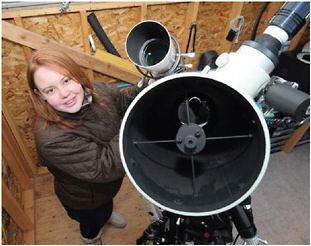
FIGURE 4.1 In 2008, 14-year-old Caroline Moore became the youngest amateur astronomer to discover a supernova, SN2008ha in the constellation Pegasus. She was a featured guest of President Obama at the October 2009 White House Star Party. SOURCE: Robert E. Moore, Deer Pond Observatory.
has been driven by the exciting opportunities in the field. Although the research enterprise itself may not be able to offer permanent positions to all qualified new entrants to the field, training in U.S. astronomy and astrophysics programs affords the ability to pursue many valuable career paths.
BENEFITS OF ASTRONOMY TO THE NATION
Astronomy Engages the Public in Science
Astronomy stirs the public imagination and the human spirit. Indeed, the results of modern astronomical research are already deeply ingrained in our culture, and terms like “light-year,” “big bang,” and “black hole” have joined the vernacular. The astronomy aisle of any fully stocked bookstore includes large, beautiful picture books of the cosmos as well as technical books about the advancing frontier—written by working astronomers, writers educated as astronomers, and journalists. About once per week on average, national television broadcasts an interview with a professional astronomer, a rate that increases dramatically during the semiannual meetings of the American Astronomical Society (AAS). The steady stream of discoveries from space missions and ground-based telescopes generates hundreds of press stories per year and has made some facilities, such as the Hubble Space Telescope (HST), into international icons.
A single astronomical image can play a large role in our cultural life. The Eagle Nebula, framed by HST, is an inspiring work of art (Figure 4.2). The iconic Apollo 8 photograph of Earth rising over the lunar landscape, showing its blue oceans, dry land, and clouds floating alone in the cosmic void with no national boundaries visible (Figure 4.3), testifies to the unity of mankind far more effectively than any political speech—and in delivering that message emphasizes a value to society that may be beyond measure.
Astronomy on television has come a long way since the 1980 PBS premier of Carl Sagan’s ground-breaking multipart documentary Cosmos. Many cable channels offer copious programming on a large variety of astronomical topics, and the big-three networks occasionally offer specials on the universe, too. Another barometer of the public’s curiosity about the cosmos is the popularity of IMAX-format films on space science, as well as the number of big-budget Hollywood movies whose plotlines derive directly or indirectly from space themes (including 5 of the top 10 grossing movies of all time in the United States). The Internet also plays a pervasive role in bringing astronomy to the public, attracting worldwide audiences on websites such as Galaxy Zoo (http://www.galaxyzoo.org) and others that feature astronomical events such as NASA missions. Astronomy applications are now available for most mobile devices, and even social networking technology plays a role, e.g., by enabling tweets from the Spitzer NASA Infrared Processing and Analysis Center (http://twitter.com/cool_cosmos).
Public interest in astronomy has caught the attention of corporate giants as well, which see commercial value in and synergy with what astronomers do. The Microsoft World Wide Telescope, a corporate version of previously underfunded efforts of astronomers to coordinate the world’s public-domain cosmic imagery and make it available in one resource, allows people on home PCs to explore the cosmos as if they were at the helm of the finest ground- and space-based telescopes. And Google’s interest in maps now extends to the universe, as seen in Google Earth, Google Sky, Google Moon, and Google Mars. These nascent corporate efforts to connect people with the broader universe offer yet another indication of the breadth and depth of influence that discovery of the cosmos enjoys in our culture.
Astronomers, too, have seized opportunities to be innovators in public outreach. New approaches to promoting public engagement in science include “citizen science,” bringing astronomy to wide audiences via large databases available on the Internet and enabling amateur scientists to participate actively in the analysis of astronomical data2 (Figure 4.4). The continued growth of astronomical data sets will allow further opportunities for public involvement over the coming decade.
|
2 |
Galaxy Zoo is one project that enables online users to classify galaxies from Sloan Digital Sky Survey images; to date more than 230,000 registered users have analyzed data, and a few have produced unique new discoveries (see Figure 4.4). The success of Galaxy Zoo has inspired the creation |
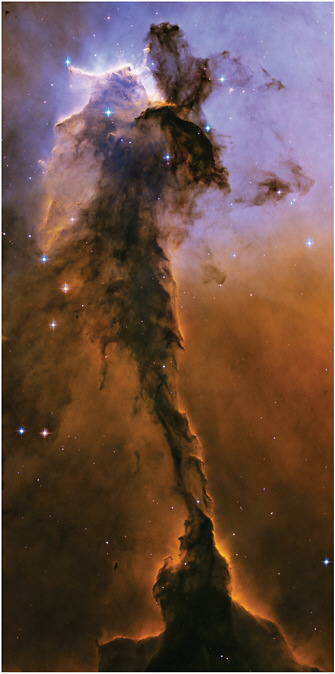
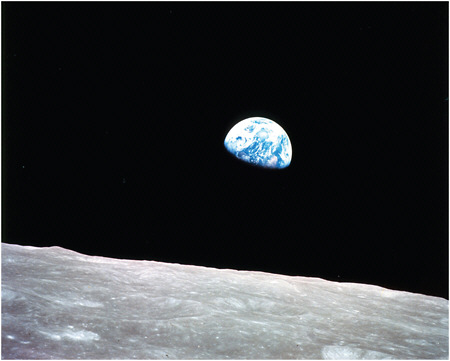
FIGURE 4.3 Earthrise from the Moon, as seen by the Apollo 8 crew. SOURCE: NASA.
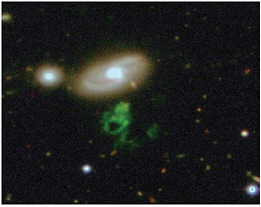
FIGURE 4.4 Image of a new large and diffuse extragalactic object, Voorwerp, which is thought to be a gas cloud illuminated by a nearby active galactic nucleus discovered by Galaxy Zoo citizen scientist Hanny van Arkel. SOURCE: Dan Smith (Liverpool John Moores) and Peter Herbert (University of Hertfordshire). Image obtained using the Isaac Newton Telescope, Roque de los Muchachos, La Palma.
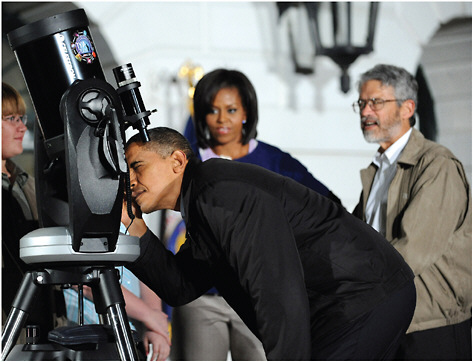
FIGURE 4.5 President Barack Obama and First Lady Michelle Obama take part in the “star party” on the White House lawn in October 2009. SOURCE: Tim Sloan/AFP/Getty Images.
The recently concluded International Year of Astronomy (IYA) 2009, initiated by the International Astronomical Union and UNESCO, and endorsed by the United Nations and the U.S. Congress, was a global effort involving nearly 150 countries participating in astronomy activities on all scales, from local to international. The U.S. effort involved tens of thousands of people. The year-long enterprise had several focus projects, including the production and distribution of well over 100,000 telescopes designed to reproduce the seeing power that Galileo had when he first turned his telescope skyward;3 more than 1,000 public observing events in 70 countries; and the generation of special IYA websites by NASA and similar international organizations. The U.S. effort culminated on October 7, 2009, when President Obama hosted a star party for local school children on the White House lawn (Figure 4.5).
The federal government provides significant support for many of these informal education and outreach activities. For 15 years, NASA has devoted roughly 1 percent of the cost of major missions to education and public outreach and has created imaginative websites and activities involving the use of astronomical data for students, teachers, and the public. NSF supports astronomy education and public outreach through budget allocations at its observatories and technology centers, as well as through its Directorate for Education and Human Resources and specific grants programs, especially those for young people such as the CAREER and astronomy and astrophysics postdoctoral fellow awards. NSF Astronomy Division data indicate that more than 6 percent of research grant funding is devoted to education and special activities.
The funding for education and public outreach by NASA increased dramatically from 1996 to 2004 but has leveled off in the past half decade (Figure 4.6). For an even better return on the federal investment in education and public outreach, a more rigorous program of assessment is needed of outcomes and efficacy across
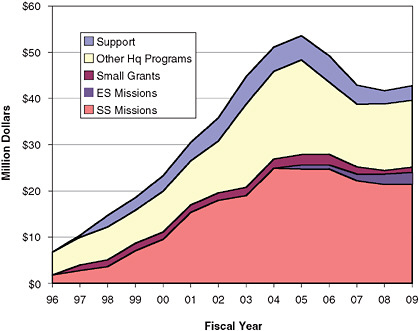
FIGURE 4.6 Total budget for NASA Earth and space science education and public outreach from 1996 to 2009. The numbers include support for all NASA education and public outreach activities, including astronomy, Earth sciences, space science, and other disciplines. NOTE: Support, directorate personnel support and other support costs; ES, Earth sciences; SS, space sciences. SOURCE: NASA Science Mission Directorate.
the entire spectrum of astronomical education and public outreach activities,4 especially the many less formal outreach activities.5 The committee believes that NASA’s important investments in informal education and public outreach at the current level of 1 percent of each mission’s cost should be continued.
Engagement with Astronomy Improves Science Literacy and Proficiency
As has been documented in several recent high-profile reports,6 the United States is ill-prepared for the economic and technical challenges of the 21st century. In particular, there is an urgent need to develop knowledge-based resources throughout society and to increase the number of teachers and students in STEM disciplines. For example, Jon Miller, in his paper entitled “Civic Scientific Literacy across the Life Cycle,” states that only 30 percent of the U.S. population is scientifically literate.7 Furthermore, the National Science Board estimates that more than a third of Americans do not understand that Earth orbits the Sun and that two-thirds are unaware of the big bang origin of the universe;8 and a study performed by the California Academy of the Sciences found that nearly half of American adults do not know the approximate percentage of Earth’s surface that is covered with water and that fewer than 1 percent know what fraction of that water is fresh.9 National science tests administered to schoolchildren show proficiency in science dropping from 33 percent in grades 4 through 8 to only 18 percent by grade 12.10 For the United States to remain scientifically and technologically competitive, science literacy and proficiency must become an urgent national priority.11
|
4 |
National Research Council, NASA’s Elementary and Secondary Education Program: Review and Critique, The National Academies Press, Washington, D.C., 2008. |
|
5 |
As highlighted in National Research Council, Learning Science in Informal Environments: People, Places, and Pursuits (P. Bell, B. Lewenstein, A.W. Shouse, and M.A. Feder, eds.), The National Academies Press, Washington, D.C., 2009. |
|
6 |
See, e.g., NAS, NAE, IOM, Rising Above the Gathering Storm, 2007, at http://www.nap.edu/catalog.php?record_id=11463; and Norman Augustine, Is America Falling Off the Flat Earth? 2007, at http://books.nap.edu/openbook.php?record_id=12021. |
|
7 |
Jon D. Miller, “Civic Scientific Literacy across the Life Cycle,” a paper presented at the annual meeting of the American Association for the Advancement of Science, San Francisco, California, February 17, 2007. |
|
8 |
National Science Board, Science and Engineering Indicators 2006, National Science Foundation, Arlington, Va., available at http://www.nsf.gov/statistics/seind06/pdf/volume1.pdf. |
|
9 |
See California Academy of Sciences, “American Adults Flunk Basic Science: National Survey Shows Only One-in-Five Adults Can Answer Three Science Questions Correctly,” press release, 2009, available at http://www.calacademy.org/newsroom/releases/2009/scientific_literacy.php. |
|
10 |
National Center for Education Statistics, The Nation’s Report Card: Science 2000, NCES 2003-453, U.S. Department of Education, Washington, D.C., 2003. |
|
11 |
NAS, NAE, IOM, Rising Above the Gathering Storm, 2007. |
Addressing the current deficiencies will require that teachers be engaged to improve the science attainment of U.S. students and also that research scientists find new ways to make the science enterprise more accessible and inviting to young people. Because of its broad public appeal and its many ties to other branches of science and technology, astronomy can contribute in uniquely powerful ways. Public interest in astronomy translates to opportunities to educate and influence future scientists, engineers, teachers, policy makers, and the public at large, through informal education or formally, in the classroom. Also relevant to enhancing understanding of science are the connections that astrophysical research has today with many other areas of STEM: geology (planets), aerospace engineering (space missions), biology (the search for life in the cosmos), chemistry (molecules in the interstellar medium), high-performance computing (data management and computational astrophysics), mechanical engineering (innovative design of telescopes and observatories), electrical engineering and advanced optics (sensor physics and adaptive optics), computer science (massive data sets and analysis), nuclear physics (matter at ultra-high density), particle physics (the study of the big bang and cosmic origins, dark matter), and even medicine (many of the most sensitive and therefore least invasive cameras for examining the body contain detectors originally developed for astronomy, and adaptive optics tools for high-resolution imaging developed for astronomy are now being applied to ultra-precise imaging of the living human retina).
Astronomy Inspires in the Classroom and Beyond
The engagement of astronomers in education at the K-12 and college levels is considerable. Undergraduate astronomy courses in colleges and universities serve 250,000 students annually, representing about 10 percent of all undergraduates nationwide. Among them are about 15 percent of future K-12 teachers, for whom introductory astronomy is often their only science course.12
Astronomy education itself is now recognized as an important area of research, and education specialists (Ph.D.-holding astronomers with additional education degrees and credentials) are being hired in major research university departments, as well as in smaller teaching-oriented college physics and astronomy departments, to develop and test new approaches to teaching that break down conceptual barriers to understanding. A result of this focus on learning has been a steady increase in interactive teaching, which produces measurable learning gains over traditional lecture course formats.
The emergence of astronomy education during the past decade has precipitated establishment of the Astronomy Education Review (http://aer.aip.org), which produces peer-reviewed articles on education research. In addition, the Astronomical Society of the Pacific and the AAS have played increasing roles in bringing together education specialists and college teachers alike.
At the precollege level, exposure to astronomy is largely through informal education and public outreach. Ongoing activities across the country include K-12 educational programs in schools, public astronomy evenings at colleges and universities, and activities coupled to NASA field centers and mission-related science institutes, NSF observatory and technology centers, and public or privately operated museums and planetariums. Efforts such as summer astronomy camps, after-school science activities, and community K-12 programs draw children into science at early ages. Public outreach activities such as lecture evenings, open houses, and star parties held at universities, observatories, and science conferences—and even at the White House (see Figure 4.5)—communicate the latest research developments and convey the excitement of the subject and the wonder of the night sky. The public outreach is impressive: in 2008, the 349 science centers and museums and 1,401 planetariums in the United States served 60.3 million people through onsite and online visits.13
Partnerships between professional research astronomers and professional educators at all levels build an important bridge between the classroom-based and informal education and outreach components of this effort. They can lead to particularly rewarding experiences by bringing first-hand knowledge of astronomical discovery directly to children.14 In addition to the goal of improving national science literacy and proficiency in general, informal astronomy education and outreach activities may also be effective in attracting more minorities and girls into the sciences or science policy, which could help achieve demographic parity at more advanced career stages (Figure 4.7).
Astronomy Serves as a Gateway to New Technology
The long history of astronomy’s contributions to society, and to the larger arena of science and technology, includes such modern examples as extension of the capability for developing experiments in X-ray astronomy for NASA in the 1960s to the manufacture of X-ray inspection systems for airports, military bases, and border
|
13 |
Association of Science and Technology Centers (ASTC), 2008 ASTC Sourcebook of Statistics & Analysis, February 2009, available at http://www.astc.org/pubs/source_book08.htm. |
|
14 |
For example, Project ASTRO, sponsored by the Astronomical Society of the Pacific, has more than 500 educator-astronomer partnerships nationwide that reach more than 20,000 students annually. |
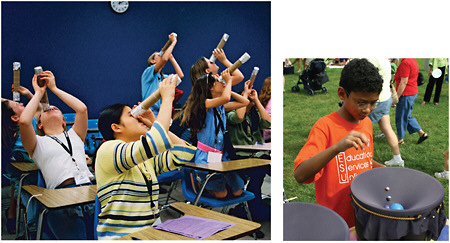
FIGURE 4.7 The interest of young girls and members of underrepresented minority groups in science can be cultivated through the public appeal of astronomy programs such as Sally Ride Science Festival Hands-on Workshops (left, experimentation with basic telescope concepts) and the Astronomical Society of the Pacific’s Project Astro (right, appreciating black hole physics). SOURCE: Left—Courtesy of Sally Ride Science 2010 and Toni di Martino. Right—Courtesy of the Astronomical Society of the Pacific.
authorities. In addition to the applications mentioned above, image-processing techniques developed by astronomers are now in wide use in arthroscopic surgery, industrial applications, and even in tracking endangered animals. Scheduling software developed for the Hubble Space Telescope has now been adapted to optimize semiconductor manufacture and to manage patient flow in hospitals.
Astronomy and the America COMPETES Act
As the examples discussed above make clear, astronomy and astrophysics can make major contributions in all three areas highlighted in the America COMPETES Act:
-
To strengthen research investment and to foster innovation and frontier research. Astronomical research is transformative at the most fundamental level, exploring areas as far-reaching as the origin of the universe, the search for Earth-like planets in other solar systems, and the understanding of fundamental physical principles. Astronomy and astrophysics are drivers for innovation in technology, especially in optical systems, detectors, and data processing. Many of these tech-
-
nologies have found applications in the health sciences and national security. The major facilities and missions recommended in this survey will open new windows on the universe and will forge partnerships with both the private sector and international partners.
-
To strengthen educational opportunities in science, technology, engineering, and mathematics (and critical foreign languages). Astronomy has broad public appeal and vibrant ties to other branches of science and technology, strengths that enable the field to contribute to STEM education in uniquely powerful ways. As is mentioned above, college-level introductory astronomy courses are often the only science class taken by future K-12 teachers. Astronomical observatories and NASA missions have strong programs in informal science education, which can be a gateway to the sciences and have the potential to attract more minorities and women to the sciences and engineering.
-
To develop a workforce for the 21st century. Astronomy can play a central role in raising U.S. science literacy at all levels from kindergarten through university and across the general public as well. College-level introductory astronomy courses play a central role in teaching the scientific method. The depth and sophistication of engineering analysis required for today’s new astronomical facilities and missions provide a unique opportunity for interns and young professionals to strengthen their skills.
CONCLUSION: Astronomical research continues to offer significant benefits to the nation beyond astronomical discoveries. These benefits include its role in capturing the public’s attention and thereby promoting general science literacy and proficiency, its service as a gateway to science, technology, engineering, and mathematics careers, and a number of important and often unexpected technological spin-offs. The field of astronomy and astrophysics deserves inclusion in initiatives to enhance basic research, such as the America COMPETES Act.
Astronomy Addresses the Challenges of the 21st Century
The examples above show that astronomy contributes in unexpected ways to national agendas that extend far beyond the study of the universe itself. In science and technology today, two of the most important challenges are the impact of global climate change and the search for clean, sustainable, carbon-free sources of energy. In his address to the National Academy of Sciences in April 2009, President Obama issued a call to action, exhorting the United States to muster its collective expertise and energy to assume international leadership in addressing these challenges.
Astronomy has already played a major role in our understanding of global climate and climate change. The first understanding of the planet-wide greenhouse
effect came from studies of Venus, whose surface temperature exceeds 800 degrees Fahrenheit because of a thick atmosphere of carbon dioxide. The first understanding of rapid global climate change came from computer models of the effects of nuclear war, and of catastrophic asteroid impacts that led to a mass extinction 60 million years ago. One of the best ways to investigate the complex problem of how Earth’s climate responds to stress is to study the geological record of changes induced by periodic changes in Earth’s orbit over the past few million years. A better understanding of the Sun is also critical to modeling and understanding climate change. Over the past few decades, as computational power has increased, our fundamental understanding of how the Sun works has been improving dramatically.
One of the most ambitious efforts to solve the nation’s energy problems involves the development of controlled nuclear fusion. Nuclear fusion was first understood early in the last century by astronomers seeking the energy source of the stars, and since then there has been a close and fertile collaboration between astrophysicists trying to understand the behavior of plasmas in astrophysical systems and fusion researchers working to control plasmas in the laboratory; indeed, the U.S. fusion program was started by the same astronomer, Lyman Spitzer, Jr., who first proposed the concept of a space telescope.
Astronomers can bring to these initiatives their relevant experience, capabilities, and expertise in the atmospheres of planets and stars, radiative transfer, fluid dynamics, nuclear physics, plasma physics, electronics, detectors, remote sensing, numerical simulation of complex systems, and data handling, as well as one of their most important skills—the ability to draw reliable inferences from incomplete observations as opposed to controlled experiments.
CONCLUSION: Astronomy is a pure science, driven by human curiosity. Nevertheless, the techniques and models developed in the process of conducting astronomical research often have broad utility. Advances in understanding of the Sun and of the climates of other planets help illuminate critical issues and inform thinking about climate change here on Earth. The impact of recent discoveries and the many new opportunities that they have created have led to great interest in astronomy.
Astronomers and Public Policy
One of the more important communication challenges for science as a whole and astronomy in particular is in the area of public policy. Given that the practical outcomes of scientific investigations often play a key role in our economic prosperity and quality of life, and as scientific projects grow in size and complexity, it is important and useful for scientists and people with technical backgrounds to be engaged in the public policy process and to understand constraints in the funding of research.
Suitably skilled scientists can play important roles in government. Astronomers in particular can take greater advantage of the opportunities for engagement in public policy issues and advocacy for astronomy provided by the American Association for the Advancement of Science (AAAS), the AAS, and the American Physical Society (APS), as well as opportunities to participate in congressional visits, to hold congressional fellowships, to serve on advisory committees to the federal agencies, and to serve as rotators or staff members at the federal agencies and other national research infrastructure organizations. There is a need to educate and expose graduate students and postdoctoral scholars to issues of public policy and related processes. Astronomers serving in such positions would facilitate a better dialog between policy makers and working scientists and would help inform decisions about astronomy funding. Astronomy departments should be receptive to astronomers desiring to participate in the governmental process through such service.
RECOMMENDATION: The astronomical community should encourage and support astronomers’ commitment to serve in science service and science policy positions, on a rotator, fellowship, or permanent basis, at the relevant funding agencies—NSF, NASA, DOE—in Congress, at the Office of Management and Budget, or at the Office of Science and Technology Policy.
ASTRONOMERS
Demography
Revolutionary discoveries and new scientific opportunities have made astronomy and astrophysics a rapidly growing field of research. It is attracting scientists from other fields (e.g., high-energy physics), creating interfaces with other fields (e.g., astrobiology), and evolving in style (e.g., becoming more collaborative and more digital, and using more complex facilities). Table 4.1 and Figures 4.8, 4.9, and 4.10 detail how the field is changing. Conducting astronomical research increasingly requires detailed knowledge across many subfields of physics as well as knowledge of statistics and computational methods. In addition, with the increasing complexity of astronomy and astrophysics projects, both in space and on the ground, has come a greater need for expertise in areas such as instrumentation, project management, data handling and analysis, astronautics, and public communication—a development requiring broader training. Even as the field has become more vibrant and exciting, this time of change in astronomy has also induced some stress in the profession, particularly with regard to the careers of young scientists.
The number of astronomers is rising. The total membership of the AAS in all categories increased from 4,200 in 1984 to 7,700 in 2009, a growth of more than 80 percent in 25 years (roughly one-third of this growth is in graduate student mem-
TABLE 4.1 AAS Member Affiliation by Discipline, Field, and Location (percentage) for 1989, 1997, and 2009
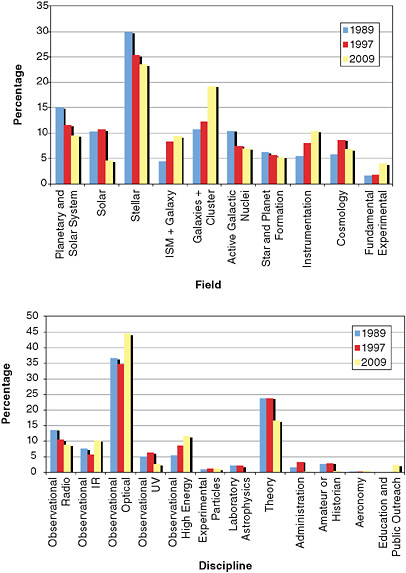
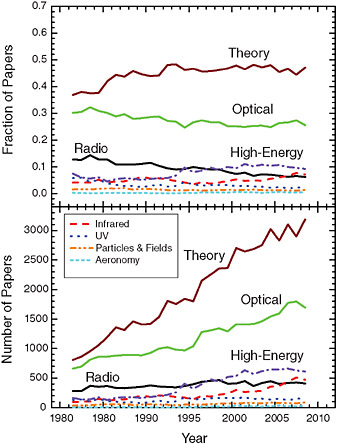
FIGURE 4.9 Papers published in journals on the FFAR list (National Research Council, Federal Funding of Astronomical Research, National Academy Press, Washington, D.C., 2000), 1981 to 2009. Top: Papers in specific disciplines as a fraction of all papers published. Bottom: Absolute number of papers published per year. Disciplines were assigned by Bayesian classification on the basis of title, abstract, and keyword text extracted from the Astrophysical Data System. The reported fractions are annual averages.
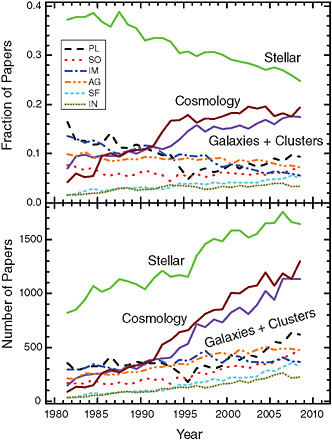
FIGURE 4.10 Papers published in journals on the FFAR list (National Research Council, Federal Funding of Astronomical Research, National Academy Press, Washington, D.C., 2000), by field. Top: Papers in specific fields as a fraction of all papers published. Bottom: Absolute number of papers published. Fields were assigned by Bayesian classification on the basis of title, abstract, and keyword text extracted from the Astrophysical Data System. NOTE: PL, planetary and solar system; SO, solar; IM, interstellar medium and the galaxy; AG, active galactic nuclei; SF, star and planet formation; and IN, instrumentation. The reported fractions are annual averages.
bers), while the U.S. population at large has increased by only 30 percent over that period. The total number of professional astronomers is estimated to be even larger, around 9,000 based on the decadal survey’s own data gathering on demographics (Figure 4.11), since there are many more members of the American Geophysical Union (AGU), the APS, and the Optical Society of America who work in subfields like extrasolar and solar system planetary science, cosmology, and instrumentation who are not members of the AAS.
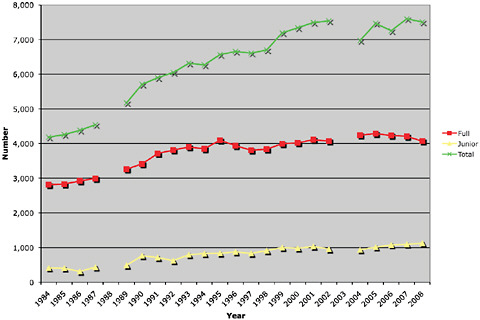
FIGURE 4.11 American Astronomical Society membership (U.S. and international) from 1984 through 2009. Data for 2009 are based on a sample taken in March 2009, and numbers were expected to increase. Associate members and division or international affiliates are not shown separately. The total number of members increased by 33 percent from 1990 to 2006 (junior members increased by 43 percent and full members by 23 percent); census data (U.S. Bureau of the Census, online reports) indicate that the U.S. population increased by 20 percent in the same period. SOURCE: Data from the American Astronomical Society.
About 44 percent of AAS members in 2009 were affiliated with research universities, and 34 percent were affiliated with national observatories, laboratories, and other federally funded research and development centers (see Table 4.1). The fractions in different work sectors have not varied much over the past 20 years except at 4-year colleges, where the fraction of astronomers has almost doubled (to 15 percent), reflecting the growing importance of introductory astronomy as a gateway science course and as a popular course for non-science majors to fulfill a science requirement.
The annual number of astronomy Ph.D.s awarded in the United States has been fairly constant at about 200 over the past decade, compared with approximately 1,400 in physics and 4,000 in the physical sciences overall. However, increasing numbers of astronomers are receiving their degrees from physics departments. The fraction of astronomy Ph.D.s awarded in the United States to non-U.S. citizens has risen from about one-quarter to more than one-third over the past decade, still
slightly behind the fraction for physical sciences overall. Although many foreign astronomers are expected to repatriate, the globalization of research, discussed above, ensures that many are likely to continue to contribute to the U.S. astronomical enterprise.
About 70 percent of the astronomy Ph.D. holders who remain in the United States after obtaining their degrees hold fixed-term postdoctoral positions before gaining long-term employment (Figure 4.12). Some postdoctoral positions are prize fellowships supported either by agencies (e.g., NASA’s Einstein, Hubble, and Sagan fellows; NSF’s Jansky fellows through NRAO and astronomy and astrophysics postdoctoral fellows) or by private donations to individual universities. These highly competitive fellowships allow independent research programs in a large range of subfields. Other postdoctoral positions are tied to a specific sponsored research grant or project. It is quite common for astronomers to hold two or three successive postdoctoral positions of 2 to 3 years each, so that many astronomers are in their mid- to late-30s before finding long-term employment. One consequence of this delay is the added difficulties for family life, which can also compound the problem of attracting women to the field.
Data from the AAS Job Register indicate that the number of postdoctoral positions advertised every year has doubled over the last decade, whereas the number of advertised tenure-track positions and long-term research or support positions15 has decreased slightly. Some of these positions are taken by foreign applicants, and some U.S. postdoctoral scholars take up employment elsewhere. Overall, the production rate of astronomy Ph.D.s exceeds the current rate of long-term astronomy faculty opportunities by a factor of at least three, which is a point of great concern to young astronomers (Figure 4.13). Recently this problem has become much more acute because of a decrease in the number of faculty openings due to hiring freezes and postponements of retirement for economic reasons. However, from the data shown in Table 4.1 plus an understanding of the diverse set of job functions held by those at research universities, it can be inferred that traditional teaching faculty positions are less than half of the permanent positions held by AAS members.
Astronomy is an incredibly exciting field that is attracting some of the best and brightest technically able young people. They are a precious resource for the nation, and it is important to optimize and broaden the benefits to the nation that their talents bring. Young people trained in astronomical research have a high degree of competence in disciplines with applicability beyond just astronomy and astrophysics. As a group, they are also energetic, hard-working, and highly motivated, and the fraction of their time that can be devoted to research is higher than at earlier and later career stages.
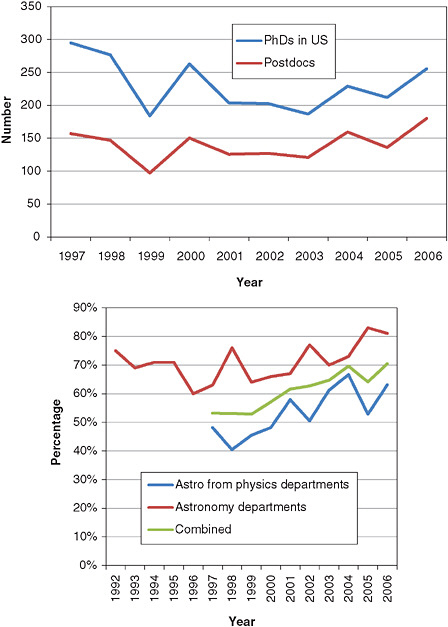
FIGURE 4.12 Number (top) and fraction (bottom) of postdoctoral positions taken by astronomy and astrophysics Ph.D. recipients who remained in the United States, 1997 to 2006. The data include Ph.D.s from astronomy departments and Ph.D.s from physics departments who reported the following specialties: (1) astrophysics; (2) atmospheric, space, and cosmic-ray physics; and (3) relativity and gravitation. SOURCE: Initial Employment Survey, Statistical Research Center, American Institute of Physics.
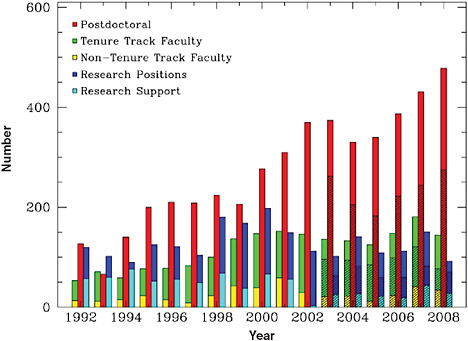
FIGURE 4.13 Number of postdoctoral (red), faculty (green/yellow), and research (blue/cyan) positions advertised from 1992 to 2008. Shading indicates the number of positions in each category at U.S.-based institutions after such data became available in 2003. The faculty category is divided into tenure track (green) and non-tenure track (yellow) positions; the research category is divided into research (blue) and support (cyan) positions. Data from the American Astronomical Society.
Although training in astronomy for astronomers is valuable, in practice at least 20 percent of astronomers leave the profession for other careers following the Ph.D., the postdoctoral, and even the faculty/research position level. Careers outside astronomy and astrophysics are available that make use of the technical expertise gained through an astronomy education, and astronomers are demonstrably employable in a large variety of professions, such as computer science, data systems, image processing, detector technology, and medical technology, as well as other physical sciences.
Implications for Employment and Training
Training in astronomy research is good preparation for a wide range of careers. Experience in finding innovative solutions to new problems and familiarity with cutting-edge techniques and tools have very broad appeal to employers, and an
astronomer’s education is rarely wasted. Nonetheless, the recent rapid growth in the postdoctoral pool of temporary positions suggests an increased need for advising and mentoring regarding broad career choices, not just in academia but also across the education and research enterprise, including careers beyond astronomy. Indeed, there is a strong and urgent need for career mentoring at all stages, from undergraduate to junior faculty member. In addition, it is important to introduce courses into astronomy curricula that can open doors to new careers. These courses could involve computer science, engineering, project management, public policy, or pedagogy, for example, possibly taken in other departments.
Often, academic mentors emphasize academic careers for their students at the expense of discussing and supporting a broader range of career opportunities. The committee believes that doctoral training in astronomy prepares an individual for a variety of rewarding and important STEM careers and that the astronomy community needs to recognize alternate career paths more clearly.
Professional training should accommodate the range of career paths taken by graduate and postdoctoral alumni, giving attention to (1) the full range of activities in academic faculty work, including teaching, advising, and performing institutional and national service; (2) the non-research skills needed by all researchers, including communicating to the non-specialist and the public at large, writing and administering grants, and project management; (3) necessary high-level training in communication and in the increasingly important areas of computation and instrumentation; and (4) career options both within and outside academia. Some of these goals could be achieved through professional master’s programs in astronomy with a particular focus. Partnership opportunities with government, industry, media resources, and museums could help broaden astronomy-related experiences through internships in areas such as public policy, computation and instrumentation, pedagogy, science outreach, and communications.
RECOMMENDATION: The American Astronomical Society and the American Physical Society, alongside the nation’s astronomy and astrophysics departments, should make both undergraduate and graduate students aware of the wide variety of rewarding career opportunities enabled by their education, and be supportive of students’ career decisions that go beyond academia. These groups should work with the federal agencies to gather and disseminate demographic data on astronomers in the workforce to inform students’ career decisions.
Underrepresented Minorities in Astronomy
Black Americans, Hispanic Americans, and Native Americans constitute 27 percent of the U.S. population. By all measures they are seriously underrepresented among
professional astronomers. For example, this cohort accounts for only 4 percent of astronomy Ph.D.s awarded in the United States and 3 percent of faculty members, and yet even these small fractions represent growth. To achieve parity would require increasing the annual rate of minority Ph.D.s in astronomy from around 5 percent to a sustained value of about 40 percent over a period of 30 years.16
There are many reasons that improving these abysmal statistics should be a matter of the highest priority. First, failing to tap into such a large fraction of the population is hurting the country through not accessing a large human resource, and this is a statement applicable also to science in general. Second, because of the prominent position of astronomy in the public eye, the absence of minority role models sends a strongly negative message to young people considering careers in science and engineering. The Committee on the Status of Minorities in Astronomy of the AAS works as both a focus and an information dissemination group for these important issues and as a support and mentoring group for minority members of the AAS.
There have been many well-intentioned and thoughtful programs over the past decades to increase minority representation in astronomy and other scientific fields, but they have not yet succeeded in achieving the goal of equal representation in the Ph.D. scientific workforce. There has been some success in increasing the number of minorities who obtain bachelor’s degrees in science and engineering, to about 18,500 in 2007.17 However, minority groups remain underrepresented at the master’s and Ph.D. levels and in the professional workforce in these fields. This underrepresentation might be overcome by creating programs to bridge minority undergraduates from physics, computer science, and engineering into master’s programs that would allow them to enter the astronomical workforce directly or to move on to a Ph.D. Given the increasing numbers of minority undergraduates in physics, computer science, and engineering and the current workforce needs in astronomical computation and instrumentation, recruitment into astronomy and astrophysics careers and Ph.D. programs could be pursued.
|
16 |
D. Nelson and L. Lopez, The diversity of tenure track astronomy faculty, Spectrum, American Astronomical Committee on the Status of Minorities in Astronomy, June 2004, available at http://csma.aas.org/spectrum.html; the AIP Academic Workforce Survey and the AIP Statistical Research Center (see http://www.aip.org/statistics/). For comparison, AIP data for 2007 indicate that 5,402 U.S. citizens received Ph.D.s and that 13 percent were awarded to members of minorities (http://www.aip.org/statistics/trends/highlite/edphysund/table8.htm; accessed July 7, 2010) and of the 653 physics Ph.D.s awarded to U.S. citizens, 13 percent were awarded to members of minorities (http://www.aip.org/statistics/trends/highlite/edphysgrad/table6.htm; accessed July 7, 2010). In 2007, across all disciplines, including non-science disciplines, the number of faculty positions held by African Americans or Hispanic Americans was about 11 percent, and about 5 percent in physics disciplines (http://www.aip.org/statistics/trends/highlite/awf08/table1a.htm; accessed July 7, 2010). |
|
17 |
One way to accomplish such a transition would be to encourage strategic partnerships18 with minority-serving institutions (MSIs) including historically black colleges, as well as with the National Society of Black Physicists and the National Society of Hispanic Physicists. A related path would be to encourage graduate programs to recruit their master’s and Ph.D. candidates at MSIs.
Role models are important in any field and have been particularly crucial in improving the number of women astronomers. Using the Harlow Shapley Visiting Lectureship Program19 proactively to target students in MSIs, and rebuilding NASA’s Minority University Research and Education Program20 to engage STEM students in mission-related work, are two approaches that have provided role models to minorities. Finally, the committee suggests that the federal agencies establish a competitive program of summer programs and leaves of absence for teachers from MSIs with a proven record of educating minority scientists, to participate in research at national facilities and research universities. Programs like this, if thoughtfully managed, would provide a bridge for minority students from a bachelor’s to an advanced degree. It is important that the success of such programs be monitored and that rigorous metrics for success be established at the outset, providing an opportunity for longitudinal tracking of minority students and learning how to improve programs through their experience.
CONCLUSION: Little progress has been made in increasing the number of minorities in astronomy. Agencies, astronomy departments, and the community as a whole need to refocus their efforts toward attracting members of underrepresented minorities to the field.
The following are some approaches that can be adopted to help in attracting members of minorities to astronomy and in retaining them in the field:
-
Targeted mentoring programs;
-
Partnerships of community colleges and minority-serving institutions with research universities and with national centers and laboratories;
|
18 |
Promising examples of programs along these lines have been established at the University of Washington, at Columbia University, and in a partnership between Vanderbilt University and Fisk University. |
|
19 |
The Harlow Shapley Visiting Lectureship Program of the American Astronomical Society is a program of 2-day visits by professional astronomers who bring the excitement of modern astronomy and astrophysics to colleges of all types. See http://aas.org/shapley. |
|
20 |
NASA’s Minority University Research and Education Program (MUREP) engages underrepresented populations through a wide variety of initiatives. Multiyear grants are awarded to assist minority institution faculty and students in research of pertinent missions. See http://www.nasa.gov/offices/education/programs/national/murep/home/index.html. |
-
Expanded funding for programs that ease the transition of individuals across critical junctures in the pipeline—high school to college, community college to university, undergraduate to graduate school;
-
Funding for master’s-to-Ph.D. programs;
-
Cross-disciplinary training as an on-ramp to astronomy and astrophysics careers; and
-
Family-friendly policies.
Women in Astronomy
Historically, women were once as underrepresented in professional astronomy as minorities are today, especially as faculty members. Now, there is ongoing progress toward parity, although still shortfalls relative to the general population. The fraction of astronomy graduate students that are women has increased from a quarter to a third over the past decade, and the fraction gaining Ph.D.s and occupying assistant and associate professor positions is also a quarter. However, only 11 percent of full professors are women, fortunately a proportion that is likely to improve as more women advance up the ranks. The Committee on the Status of Women in Astronomy of the AAS works both as a focus group on these important issues and as a support and mentoring group for female members of the AAS across professional ranks.
The arguments for seeking gender equality parallel those for increasing the involvement of underrepresented minorities as professionals in the field. Interestingly, the NSF Research Experiences for Undergraduates (REU) program has achieved a participation rate for women of nearly 50 percent in astronomy summer research assistantships. To increase the number of women in the field, some schools have also taken the promising approach of identifying undergraduate women for master’s programs that act as a bridge into the profession. The efficacy of these programs should be monitored, and if they prove to be successful such programs should be supported more widely. In addition, two identified pressure points for women can be addressed. The first is that in middle school, girls frequently lose interest in mathematics and science,21 and astronomy can play a role in keeping young women interested in science through high school. After-school programs and camps supported by NSF, in particular, need to be assessed for their effectiveness in drawing girls into science. The second pressure point arises when professional and family obligations conflict and women, in particular, find their pursuit of an academic career derailed. Targeted mentoring programs and family-friendly education and employment policies can help to attract and retain women in astronomy. Practical steps that have been proposed include allowing parental
leave, assisting with childcare, assisting with spousal employment, and allowing delay of the tenure clock.22
CONCLUSION: The gender gap in astronomy has diminished significantly, although women still occupy only a small percentage of the most senior positions. Astronomy departments and the community as a whole need to continue work to promote gender equity at all levels.


