
6
Preparing for Tomorrow
Whereas Chapter 5 focuses on core elements of the national astronomy enterprise that are supported across federal agencies, this chapter looks at major current and near-term agency-specific activities and also offers recommendations on agency strategy for future facilities development. These agency-specific facilities, missions, and projects often involve partnerships, as discussed in Chapter 3, which may be international, interagency, or public-private in nature. Support of astronomy in the United States extends beyond federal government funding and includes support provided by several state governments for ground-based astronomy and observatories, usually through state universities, as well as private support for both operational and proposed ground-based telescopes.
OPERATING AND UPCOMING PROJECTS, MISSIONS, AND FACILITIES
Department of Energy
The increasing involvement of the Department of Energy (DOE) Office of High Energy Physics (OHEP) in particle astrophysics and cosmology is driven by the deepening scientific connection between OHEP’s fundamental physics program and astrophysics. A 2008 report from DOE’s High Energy Physics Advisory Panel (HEPAP) described the cosmic frontier as one of three interconnected core areas of particle physics (along with the energy frontier and the intensity
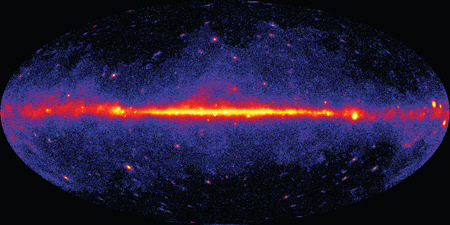
FIGURE 6.1 All-sky map as observed by the Fermi Gamma-ray Space Telescope. The bright band of gamma rays comes from unresolved sources associated with our Milky Way galaxy. Roughly 700 point sources that can be identified with known objects are seen, as are another 600 unidentified sources, including many relativistic jets associated with other galaxies. SOURCE: NASA/DOE/International Fermi Large Area Telescope Collaboration.
frontier).1 Several national laboratories and the university community are involved in a program with a budget of roughly $80 million in FY2009 (out of a total OHEP budget of about $800 million) and in some scenarios this amount is projected to increase to $160 million by the end of the decade. In 2009, HEPAP’s Particle Astrophysics Scientific Assessment Panel (PASAG) was charged with recommending a prioritized program in particle astrophysics for DOE. The PASAG report is discussed further in Chapter 7.2
DOE is currently supporting a number of important astrophysics projects—including Auger-South, the Ultra High Energy Cosmic Ray Observatory in Argentina, the Very High Energy Gamma Ray Telescope (VERITAS) in Arizona, the Large Area Telescope (LAT) onboard the Fermi Gamma-ray Space Telescope (Figure 6.1), sev-
|
1 |
U.S. Department of Energy, U.S. Particle Physics: Scientific Opportunities, A Strategic Plan for the Next Ten Years, Report of the Particle Physics Project Prioritization Panel, Office of High Energy Physics, U.S. Department of Energy, May 29, 2008, available at http://www.er.doe.gov/hep/panels/reports/hepap_reports.shtml. |
|
2 |
U.S. Department of Energy, Report of the HEPAP Particle Astrophysics Scientific Assessment Group (PASAG), October 23, 2009, available at http://www.er.doe.gov/hep/panels/reports/hepap_reports.shtml. |
eral dark energy projects including the Baryon Oscillations Spectroscopic Survey on the Apache Point Observatory 2.5-meter telescope, and a new Dark Energy Camera to be installed on the 4-meter Blanco Telescope at the Cerro Tololo Inter-American Observatory in Chile, small but pioneering efforts on CMB research, and R&D for upcoming projects. Many of these investments are collaborative with either NASA or NSF (NSF-AST and NSF-PHY). In addition, DOE supports a vibrant program of underground dark matter direct-detection experiments and related research and development as part of the cosmic frontier core area. DOE also continues to provide adaptive optics (AO) expertise for instruments on ground-based telescopes. High-energy-density facilities of its National Nuclear Security Administration and laboratory experiments growing out of the Fusion Energy Sciences program play an increasing role in laboratory astrophysics.
National Aeronautics and Space Administration
NASA successfully operates a fleet of nine space telescopes at present and collaborates on several foreign missions (Box 6.1). The annual operating astrophysics budget is roughly $1 billion. All major astrophysics projects are managed by NASA centers,3 whereas smaller Explorer-class spacecraft experiments can be led by university-based teams. What is striking about the past decade is that nearly all space astrophysics missions have surpassed expectations, both in the technical performance achieved and in the scientific discoveries made. This remarkable accomplishment is one in which the nation can take great pride. Two European space missions with significant U.S. participation, Herschel, a far-infrared telescope, and Planck, a cosmic microwave background experiment, have been launched recently and appear to be working very well. X-ray telescopes led by Japan (Suzaku) and Europe (XMM-Newton) are also producing exciting results and have significant U.S. participation and contributions.
The largest space telescope currently under construction is the James Webb Space Telescope (JWST; Figure 6.2). It was the top large space mission recommended as a result of the 2001 decadal survey4 and is a successor to both the Hubble Space Telescope and the Spitzer Space Telescope. It is scheduled for launch in 2014. The ambition (the cost exceeds $5 billion) and challenge (the mirror is 2.5 times the diameter of the Hubble mirror) represented by JWST have led to delay in the remaining space astrophysics program proposed in the 2001 decadal survey. JWST
|
3 |
Typically one of the following: Ames Research Center, Goddard Space Flight Center, or Jet Propulsion Laboratory. |
|
4 |
National Research Council, Astronomy and Astrophysics in the New Millennium, The National Academies Press, Washington, D.C., 2001. Available at http://www.nap.edu/catalog.php?record_id=9839. |
|
BOX 6.1 Space Telescopes Operated by NASA or with U.S. Participation (and operating spectral bands) Great Observatories Chandra (X-ray) Hubble (infrared, optical, ultraviolet) Spitzer (infrared) Mid-size Telescopes Fermi (gamma ray) Kepler (optical) Explorers GALEX (ultraviolet) RXTE (X-ray) Swift (X-ray) WISE (infrared) Foreign Telescopes with U.S. Participation Herschel (infrared) INTEGRAL (gamma ray) Planck (radio) Suzaku (X-ray) XMM-Newton (X-ray) |
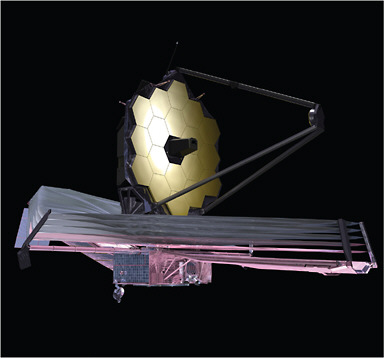
FIGURE 6.2 Artist’s drawing of the James Webb Space Telescope. SOURCE: NASA.
will be operated for 5 years, with enough fuel to allow an extension to 10 years. A second infrared telescope, SOFIA, operates out of a Boeing 747 airplane and is due to begin full operations in 2 years. The only other U.S.-led space astrophysics missions currently under construction are the Explorer X-ray missions NuSTAR (to be launched in 2012) and GEMS (scheduled for 2014). There is significant U.S. participation via the Explorer program in the Japanese-led X-ray telescope Astro-H, scheduled for launch in 2014.
NASA also has a balloon program and a suborbital rocket program. Both are highly effective in terms of the scientific results they produce and the fast turnaround they allow, with typically less than 3 years between concept development and flight.5
NASA also operates the Infrared Telescope Facility (IRTF) in Hawaii and participates as a one-sixth partner in the W.M. Keck Observatory, also in Hawaii. These NASA programs recognize the importance of optical-infrared data from ground-based telescopes in planning and preparing for, and in interpreting the results from, its space missions—in astrophysics at gamma-ray through mid-infrared wavelengths and in planetary science from numerous in situ locations around the solar system.
NASA holds regular senior reviews to decide which missions to terminate, and it is anticipated that every one of its currently orbiting space telescopes, including Hubble (which needs an expensive de-orbiting mission), will cease operations before the end of the decade. SOFIA, which has operations costs of $70 million per year, will be subject to a senior review after 5 years of operations. Thus, with the possible exception of JWST and SOFIA, none of the missions operating or started today are expected to be operational at the end of the decade.
Summarizing the cost and the frequency of appearance of new capabilities, Figure 6.3 shows NASA missions operating during the past two decades and expected during 2010-2020. The chart illustrates the shift from a mix of mission sizes in the 1990s, to no flagships but a number of smaller missions launched in 2000-2010, to one or possibly two flagships and many fewer smaller missions projected for 2010-2020. Part of this evolution is a result of growing mission complexity. However, the percentage of the NASA Astrophysics Division budget being spent on large missions has been relatively constant for most of the past two decades. The overall lack of mission opportunities is due to the combination of a decrease in the available budget and the increase in expenditures on missions currently operating. The number of missions in operation is large compared to the past several decades.
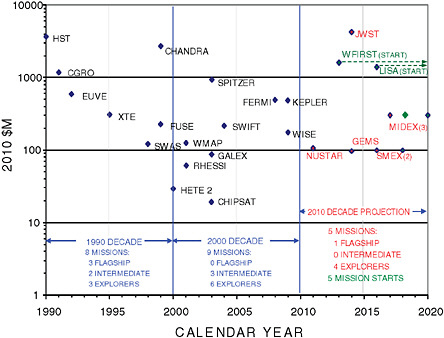
FIGURE 6.3 NASA Science Mission Directorate/Astrophysics Science Division mission cost over time, including future projections, 1990 to 2020. Red diamonds correspond to the year of launch; green diamonds indicate a project start (though not necessarily launched within the decade). Flagship missions are those that are not cost constrained at selection, whereas intermediate and Explorer-class missions are so designated by their cost.
National Science Foundation
The NSF Division of Astronomical Sciences (NSF-AST) supports versatile facility suites in gamma-ray astronomy, optical and infrared astronomy, millimeter and submillimeter astronomy, radio astronomy, and solar astronomy (Box 6.2). The ground-based optical and infrared (OIR) telescopes operate from 0.3 to 20 micrometers and include facilities for both night-time astronomy and for day-time solar studies. The ground-based radio telescopes operate at submillimeter to centimeter wavelengths. For all of these facilities the observing time is competed, typically through bi-annual or tri-annual proposal processes. About $250 million of the roughly $300 million total astronomy and astrophysics expenditures flows through NSF-AST. The remainder is associated with NSF’s Division of Physics (NSF-PHY; including particle and nuclear astrophysics), Division of Atmospheric and Geospace Sciences (NSF-AGS), and Office of Polar Programs (NSF-OPP).
|
BOX 6.2 Major U.S. Public Ground-Based Telescopes Radio Arecibo CARMA CSO EVLA GBT VLBA Solar Dunn GONG McMath-Pierce Gamma Ray VERITAS Optical and Infrared Blanco (optical) Mayall (optical) SOAR (optical) WIYN (optical) IRTF (infrared) (also NASA) Gemini N (optical and infrared) Gemini S (optical and infrared) Keck (optical and infrared) (also NASA) |
Substantial facility investments include LIGO and IceCube, which may yield astronomical discoveries this decade.
The NSF-AST-supported radio observatories have been judged as world-leading, on the basis of both their technical performance and the desire of radio astronomers worldwide to use them. Radio telescopes operated by the National Radio Astronomy Observatory (NRAO) include the Expanded Very Large Array (EVLA), the Green Bank Telescope (GBT), and the Very Long Baseline Array (VLBA); the National Astronomy and Ionosphere Center (NAIC) operates Arecibo observatories. These centimeter-wavelength facilities provide the highest-resolution and largest-collecting-area instruments in the world. Following the recommendations of the 2006 NSF-AST senior review,6 funding for Arecibo ($8 million per year) and for NRAO’s VLBA, both still unique facilities, is being ramped down to optimize the program and to release funds for operating new facilities. The soon-to-be-commissioned (in 2013) $1 billion Atacama Large Millimeter/submillimeter Array (ALMA) is an international collaboration involving partners in North America, Europe, and East Asia, with Chile as the host country (Figure 6.4). In addition to these nationally managed facilities, NSF-AST funds operations and development at the university-based CARMA, ATA, and CSO ($8 million per year combined through the URO program), and NSF-OPP funds SPT ($2.5 million per year), which together at
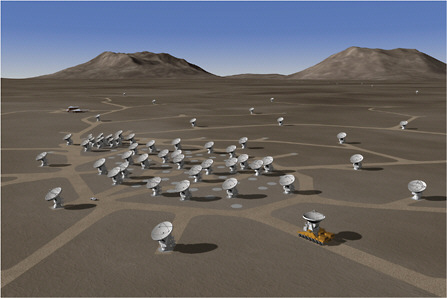
FIGURE 6.4 Artist’s conception of the ALMA array with roads, in the extended configuration. SOURCE: ALMA (ESO/NAOJ/NRAO).
$10 million can be compared to NRAO funding ($67 million per year). The small facilities provide unique scientific capabilities, training, and technical development, particularly for millimeter and submillimeter observations.
The NSF-AST-supported ground-based OIR facilities include the National Optical Astronomy Observatory (NOAO)-operated optical telescopes at Kitt Peak in Arizona and Cerro Tololo in Chile that are 4 meters (Mayall and Blanco) or smaller in diameter and are aging in terms of infrastructure. They also include a half share with international partners—the United Kingdom, Canada, Chile, Australia, Brazil, and Argentina—in each of the 8-meter northern (Mauna Kea) and southern (Cerro Pachon) Gemini telescopes (Figure 6.5). The Blanco and Mayall telescopes are being refurbished, partly in connection with DOE-supported dark energy projects. Gemini-North features an operational laser guide star AO system, and there is the promise within a few years of multi-conjugate AO at Gemini-South to produce high-resolution images over a wide field of view. However, as discussed in the NSF-AST senior review and elsewhere, the Gemini Observatory has been slow in providing the community with the world-class instruments that it needs to carry out its research program and has incurred operations costs that are larger than were anticipated. The challenges arose partly because of a then-multinational management structure and partially because of the early choice of a queue-based observing mode.
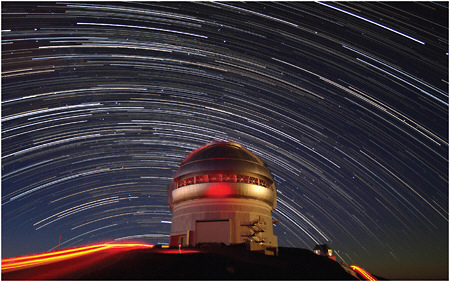
FIGURE 6.5 Gemini-North with southern star trails. SOURCE: Gemini Observatory/AURA.
NSF-AST also supports instrumentation on private observatories through its Telescope System Instrumentation Program (TSIP) ($4 million per year) program and ReSTAR ($3 million per year)-based expenditures. Small in comparison to the investments in NOAO plus Gemini ($43 million per year), these development funds provide access for the community to both unique and workhorse scientific capabilities that complement those available on the NSF-run facilities.
The Advanced Technologies and Instrumentation (ATI) and Major Research Instrumentation (MRI) programs provide technology development and instrumentation support for radio, optical and infrared, and solar facilities.
In solar astronomy, the Advanced Technology Solar Telescope (ATST) on Haleakala in Maui, Hawaii, received an American Recovery and Reinvestment Act commitment for about half of ATST’s roughly $300 million construction cost, and the project has formally started. Managed within NSF-AST, ATST’s other construction costs will come from NSF’s Major Research Equipment and Facilities Construction (MREFC) program. A world-leading facility, with an off-axis 4-meter mirror and an optical design optimized to eliminate scattered sunlight, ATST will operate with the most advanced solar AO system in the world, making possible, for example, a direct comparison of the magnetic structures that accompany solar granulation with the predictions of the latest computational models (Figure 6.6).
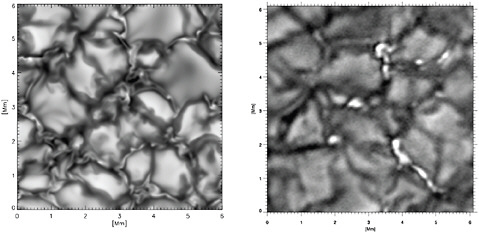
FIGURE 6.6 Magnified view of solar convective and magnetic structures. Left: Computer simulation of convection on the solar surface, together with emergent magnetic fields (twisted structure surrounding each granule). Right: Adaptive optics image of solar convection using the National Solar Observatory’s Dunn Solar telescope. White threads map out the emergent magnetic field surrounding each granule. ATST will have sufficient spatial resolution to quantitatively test these simulations against a statistically significant sample of solar data. SOURCE: Left—A. Vögler, S. Shelyag, M. Schüssler, F. Cattaneo, T. Emonet, and T. Linde, Simulations of magneto-convection in the solar photosphere, Astronomy and Astrophysics 429:335-351, 2005, © ESO, reproduced with permission. Right—Thomas Rimmele, National Solar Observatory.
It will allow study of intense solar magnetism on the fine and complex scales that are likely to be present in nearly all stars, but which can finally be resolved with the 0.05-arcsecond spatial resolution that ATST will provide. NSF-AST also operates the National Solar Observatory (NSO) and its suite of smaller solar telescopes located at multiple sites.
Summarizing the activity scale and the frequency between the appearance of new flagship capabilities among NSF-AST facilities, during the 1990s the optical Gemini facilities were built, during the 2000s the Expanded Very Large Array and the ALMA radio facilities were constructed with ALMA slated for completion early next decade, and the 2010s will witness construction and operation of the solar facility ATST. Although construction money has come recently from the NSF MREFC line, operations for and development of these new flagships fall to NSF-AST—as do these costs for the existing optical, radio, and solar facilities mentioned above. The increasing scale and complexity of astronomical machinery brings increasing operations and development needs.
Within NSF-AST, resource allocations are approximately 56 percent for current facility operations, 10 percent for instrumentation, and 7 percent for future facili-
ties and advanced technology development. According to information provided by the Astro2010 Infrastructure Study Groups, 23 percent is spent on individual investigator grants in support of research. Approximately 61 percent of the funding for facilities goes to national and university-based radio, 33 percent to national and university-based optical, and 6 percent to solar telescopes. In the committee’s view this allocation of resources is unbalanced: existing facilities are not being exploited efficiently because not enough is invested in modern instrumentation and in supporting the investigators who produce the science from these facilities and, furthermore, not enough is invested in the future through advanced technology development. Unless the budget increases, the only way to render balance is to close operating facilities, and the mechanism for doing this is senior reviews.
CONCLUSION: Maintaining an appropriate balance in NSF’s astronomy and astrophysics research portfolio and, by extension, balance in the health and scientific effectiveness of the NSF facilities requires a vigorous periodic senior review.
Senior reviews are major endeavors and should be undertaken very seriously. They should be seen as a means for ensuring good stewardship of the NSF program.
RECOMMENDATION: NSF-Astronomy should complete its next senior review before the mid-decade independent review that is recommended elsewhere in this report, so as to determine which, if any, facilities NSF-AST should cease to support in order to release funds for (1) the construction and ongoing operation of new telescopes and instruments and (2) the science analysis needed to capitalize on the results from existing and future facilities.
TOWARD FUTURE PROJECTS, MISSIONS, AND FACILITIES
Department of Energy
As discussed above and in earlier chapters, the connection between astronomy and physics has strengthened considerably over the past decade. There is strong mutual interest in the two communities in dark energy, dark matter physics of the very early universe, gravitation, CMB, gamma-ray astrophysics, and cosmic-ray physics. University physicists and national laboratories have already collaborated productively with scientists from more traditional astronomical backgrounds on highly successful ventures. The strength of these collaborations at the working level has derived from the complementary perspectives on the science and the different technical skills and experience contributed by these two communities—
complementarity that has turned out to be crucial. For example, astronomers collectively understand about building telescopes, crafting practical observing programs, and launching spacecraft, while physicists have contributed unique capabilities in detectors, electronics, and data handling.
Future progress will be enabled by DOE’s current support for development of the Joint Dark Energy Mission (JDEM) in space, the Large Synoptic Survey Telescope (LSST) camera, and CMB science efforts. The committee recommends in Chapter 7 continuing steps consistent with the DOE mission that take advantage of present day physics-astrophysics science synergies.
National Aeronautics and Space Administration
Based on the recommendations of the 2001 decadal survey, AANM,7 beyond that for James Webb Space Telescope, NASA is currently supporting development of a Space Interferometry Mission (SIM) and technology for a future Terrestrial Planet Finder. Following publication of a 2003 NRC report8 there has also been significant activity toward JDEM in possible partnership with DOE and/or ESA.
The sustained success of NASA’s astrophysics program rests on its effective leveraging of activities ranging from large flagship missions to smaller more focused Explorer missions, down to the suborbital, data analysis, theory, technology development, and laboratory astrophysics programs. This diversified portfolio maximizes scientific exploitation of the missions, paves the way toward future missions, and maintains and develops the expertise that will enable the United States to keep its world leadership in space astronomy. Prudent investment in the core supporting activities also has proven to minimize risk and reduce the end-to-end costs of major missions, by addressing critical design issues before missions enter their construction phases.
In the course of formulating recommendations that include large, medium, and small missions, as well as targeted augmentations to some of the core supporting activities, the committee considered broader issues of balance between a range of elements across the NASA program: between larger and smaller missions; between NASA-led and international-partner-led missions; between university-led and NASA-center-led missions; between mission-enabling and mission-supporting activities (technology development, Suborbital program, theory, ground-based observing) and the missions themselves; between mission construction/operation and data archiving and analysis; and between extended mission support for operating
missions versus funding of new missions. During its deliberations the committee attended to the general principle of balance in developing its recommended prioritization of projects within the NASA Astrophysics Division program during the coming decade.
In terms of mission size balance, the committee values the impressive science value per dollar achieved with a healthy Explorer program, so much so that an enhancement to the Explorer program is its second-ranked large space project recommendation in Chapter 7. Likewise, the committee recommends strong support for the suborbital and balloon programs. Apart from providing a high science return, these smaller-scale activities provide opportunities for university-led projects, which in turn train future instrumentalists and leaders in space astrophysics and maintain a strong skill base outside the NASA centers. They also provide testbeds for future technologies and vital science inputs for planning future larger missions. These same considerations motivate the committee’s recommendations for maintaining or enhancing the support for non-mission specific technology development.
As discussed in Chapter 3, international collaborations are becoming a major factor in current and future missions. Nearly all of the large space-based projects recommended in Chapter 7 have some international element. International collaborations can carry administrative, technical (e.g., ITAR), and even political burdens. Overall, however, the committee views this evolution as a means of maximizing science and minimizing redundancy in an era of tight funding.
A final important balance element is between support for the development and operation of missions and the support for the archiving, analysis, and scientific interpretation of the data realized from the missions, including theoretical and computational modeling. Although these activities add up to a minor fraction of total mission costs, funds are often re-appropriated from these categories when costs overrun in other components of the NASA SMD budget. These vital elements of NASA Astrophysics Division funding must be protected from overruns elsewhere.
National Science Foundation
Based on the recommendations of the 2001 decadal survey, AANM, NSF is currently supporting development of LSST and technology related to a Giant Segmented Mirror Telescope (GSMT), Square Kilometer Array (SKA), and Frequency Agile Solar Radiotelescope (FASR). A desire for healthy balance between future facilities, current facilities, and core activities such as those described in Chapter 5 led the committee to consider evolution in the existing optical and infrared; radio, millimeter, and submillimeter; and solar observatory telescope systems in U.S. ground-based astronomy.
A Future Optical and Infrared System
Whatever new telescopes NSF decides to support in the decade to come, a guiding principle in planning a future optical and infrared (OIR) system of telescopes is maintaining an appropriate balance between major national facilities and a vibrant university-based program, as well as ample provision for the longer-term future. This future is certain to include larger and ever-more capable telescopes.
AANM developed the concept of treating the federally supported and independent OIR observatories in the United States as an integrated system, and advocated this concept as a means to increase community access to large-aperture telescopes through the TSIP. During the past decade there have been several reviews of the OIR system, including the 2006 NSF-AST senior review and the subsequent NOAO-led ALTAIR and ReSTAR committee reports9 that addressed community needs for large and small telescopes, respectively. Together these studies identify a series of critical needs that must be balanced to optimize the overall OIR system. The most important of these include:
-
Development of future large telescope facilities, specifically LSST and GSMT, including a federal leveraging of private funding so as to ensure open access to a share of time on these facilities and to their data archives. Currently, around 5 percent of the NSF-AST OIR facilities, instrumentation, and development budget is allocated to future activities.
-
Support of the NOAO and Gemini public observatories, providing open community access to telescopes with aperture up to 8 meters, and coordination of current and future OIR facilities and instrumentation initiatives. Currently, this accounts for around 80 percent of NSF-AST OIR funding.
-
Investment in new and upgraded instrumentation for privately operated telescopes, to enhance the scientific potential of these facilities and to provide public access to a share of the observing time—via TSIP, ReSTAR, MRI and ATI, and a mid-scale instrumentation program—currently around 15 percent of funds.
These reports also concluded, and this committee concurs, that following the current unbalanced funding path and investing relatively little in future large projects will further diminish the U.S. presence in international OIR astronomy. The challenge is to achieve a better balance that will enable significant federal participation in LSST and GSMT, while retaining sufficient access to smaller telescopes in private or public hands, to carry out a balanced science program with benefit for both the public and private sectors. After considering various options,
|
9 |
ReSTAR report, available at http://www.noao.edu/system/restar/files/ReSTAR_final_14jan08.pdf. Accessed May 2010. ALTAIR report, available at http://www.noao.edu/system/altair/. Accessed August 2010. |
the committee found that the scientific output of the OIR system would be optimized by re-allocating support to provide more for instrumentation on the newer telescopes that enable production of the majority of high-impact science papers.10 If administered through the TSIP and ReSTAR funding rules, in the case of private facilities, such investments would provide increased public access to these existing telescopes.
CONCLUSION: Optimizing the long-term science return from the whole of the U.S. optical and infrared system requires a readjusting of the balance of the NSF-Astronomy program of support in three areas: (1) publicly operated national observatories—the combined National Optical Astronomy Observatory and Gemini facilities that currently dominate spending; (2) private-public partnerships—such as support for instrumentation at and upgrades of privately operated observatories; and (3) investment in future facilities.
Among the newer OIR facilities are the two Gemini telescopes, which can be appropriately instrumented to provide the spectroscopic and near-infrared imaging capabilities that are critical to reap the scientific harvest from ALMA, JWST, and the future LSST. They can also provide some of the 8- to 10-meter-class telescope capability that is needed to fulfill the major scientific initiatives of Astro2010 in exoplanets, dark energy, and early galaxy studies. The Gemini telescopes are now equipped with multiobject spectrographs, integral field spectroscopy capability, and both near- and mid-infrared detectors, with a multi-conjugate adaptive optics capability imminent on Gemini-South; they are now poised to deliver the scientific impact they promise. However, despite its high science potential, the Gemini program does not, in practice, satisfy the requirements of the U.S. astronomical community. The ALTAIR report noted general community dissatisfaction with the current instrument suite, the queue observing mode, and the governance of the observatory. The Panel on Optical and Infrared Astronomy from the Ground found that the Gemini complex management structure created to facilitate international operation prevents the U.S. National Gemini Office from serving as an effective advocate for U.S. interests at a level commensurate with its partnership share. Furthermore, as noted by the 2006 NSF-AST senior review, as well as internal Gemini Observatory reviews, Gemini operations costs are higher than those at other comparable U.S. facilities. The committee concluded that the Gemini
program as currently configured is not serving the needs of the U.S. astronomical community well. The level of future investment in Gemini will presumably be assessable following the next senior review.
The Gemini international partnership agreement is currently under renegotiation, and the United Kingdom, which holds a 25 percent stake, has announced its intent to withdraw from the consortium in 2012. This change presents an opportunity for the remaining partners to restructure the governance, simplify the management, and improve the responsiveness of Gemini. The goals are streamlined operations and decreased operating costs.11 The savings should be applied to offset the loss of the UK contribution while increasing the U.S. share of observing time. In addition, the Gemini partnership might consider the advantages of stronger scientific coordination with major U.S. science programs. This approach would also provide a good rationale for increasing the U.S. share of Gemini while increasing the scientific output. The committee recognized that unless a new partner is found, some increased cost for Gemini is likely, but it believes that any additional cost should not be in proportion to the added U.S. share of observing time.
NOAO has a valuable role within the OIR system. It provides merit-based access to the small telescopes under NOAO management, it administers TSIP and ReSTAR-based funds for access to a broader range of apertures and instruments, and it serves as a community advocate and facilitator for LSST and GSMT. NOAO could be called on to play a greater role in leading the OIR system, so long as it involves all relevant parties. Actions taken in response to the 2001 decadal survey and the 2006 NSF-AST senior review have led to greater attention to stakeholders in the ground-based community.
However, despite having much better relations with the user community, NOAO’s future is not without controversy. As OIR astronomy moves into the 20- to 40-meter-class telescope era, the relevance of the current NOAO facilities will diminish further, along with the level of support that can be justified. Any specific direction on how to find economies within the NOAO budget falls outside the charge of this report and will, presumably, be part of the next NSF-AST senior review. However, the committee notes some options, including consolidation of part or all of the staff and management of NOAO and Gemini; closure or privatization of some of the telescopes; closure or privatization of one of the sites; and a gradual transition in the staffing and staff responsibilities toward an operations-focused model. At the same time, NOAO could also assume a larger role in managing the federal interest in Gemini, LSST, and GSMT. Now is the time for
NSF to re-evaluate the OIR system and NOAO’s role in it under cost-constrained conditions. Advice from an independent commission including both astronomers and specialists in systems management is one way to address this issue.
RECOMMENDATION: To exploit the opportunity for improved partnership between federal, private, and international components of the optical and infrared system, NSF should explore the feasibility of restructuring the management and operations of Gemini and acquiring an increased share of the observing time. It should consider consolidating the National Optical Astronomy Observatory and Gemini under a single operational structure, both to maximize cost-effectiveness and to be more responsive to the needs of the U.S. astronomical community.
A Future Radio, Millimeter, and Submillimeter System
The ground radio, millimeter, and submillimeter (RMS) telescope system has three crucial elements:
-
World-class facilities using an efficient suite of telescopes based on mature technologies,
-
Unique and important observing capabilities and the development of new technologies and techniques through university-operated observatories, and
-
Specialized principal-investigator-led experiments and surveys that tackle key science challenges and develop new technologies.
The RMS system is funded primarily by NSF. In considering its future, it must find a balance between several competing elements in order to optimize the science delivery at a time of seriously constrained funding. A guiding principle is maintenance of an appropriate balance between major national facilities and a vibrant university-based program. A second principle is provision for the long-term future through a staged program leading toward major participation in all three components of the international Square Kilometer Array, which has enormous scientific potential and enthusiastic support around the globe.
At present, approximately two-thirds ($67 million) of the NSF-AST RMS budget is devoted to NRAO to operate and develop the (E)VLA, Green Bank, and ALMA facilities. The remaining one-third ($33 million) is devoted to future facilities development, technology development, and university-operated observatories and experiments.
While the strength of the RMS system rests on maintaining the balance of the national observatories, university-operated observatories, principal-investigatorled experiments, and technology development, a fundamental problem is the
funding pressure that new facilities place on the existing program. The report of the Astro2010 Panel on Radio, Millimeter, and Submillimeter Astronomy from the Ground cites the many new demands on this budget that are likely to arise over the coming decade, including full operations support for ALMA, upgrades to ALMA and other NRAO facilities, technology development for SKA, and increased support of the University Radio Observatory (URO) program. The introduction of new capabilities will require withdrawal of NSF support for some existing facilities. Reprioritization has happened historically under the URO program,12 and Arecibo and the VLBA, although both still productive and unique in sensitivity and in spatial resolution, respectively, had their funding reduced following the 2006 NSF-AST senior review. Additional savings will surely be needed, and the proper venue for making facility-by-facility funding choices is the senior review process.
CONCLUSION: The future opportunities, worldwide, in radio, millimeter, and submillimeter astronomy are considerable, but U.S. participation in projects such as the Square Kilometer Array is possible only with either a significant increase in NSF-AST funding or continuing closure of additional unique and highly productive facilities.
The committee’s recommendations in Chapter 7 address the balance within RMS astronomy through endorsements of medium-scale facilities and funds for technology development.
A Future Solar Observatory System
The NSF-supported National Solar Observatory (NSO; within NSF-AST) and High Altitude Observatory (HAO; within NSF-AGS) are joined by a number of public/private solar observatories, namely Big Bear Solar Observatory (operated by the New Jersey Institute of Technology), Meese Solar Observatory (University of Hawaii), Mt. Wilson Observatory (Carnegie Institution of Washington/Mount Wilson Institute), San Fernando Observatory (California State University, Northridge), and Wilcox Solar Observatory (Stanford University). The funding streams for the independent solar observatories are fragile and have been influenced by significant reductions in the funding for them by the Office of Naval Research and the Air Force Office of Scientific Research. These facilities have good collaborative arrangements with NSO and HAO in the development of instrumentation, in scheduling observing campaigns, and in exchange of personnel, and they
are particularly valuable in the training of young scientists, thereby functioning as an informal solar observatory system.
The national ground-based solar facilities will be transformed once the Advanced Technology Solar Telescope is completed and becomes operational in 2017. ATST is being built within NSO but has very active participation by HAO and many other university partners. It is likely that the headquarters of NSO will be relocated to enable closer university participation with its scientists and in the training of young researchers. Other solar telescopes operated by NSO in Arizona (McMath-Pierce on Kitt Peak) and in New Mexico (Dunn on Sacramento Peak) are planned for closure to free up resources. ATST operations will require, beyond that amount, an additional $3 million per year for NSO.
Solar observations at radio and millimeter wavelengths continue to be complementary to the optical-infrared programs and the extensive probing at optical and UV wavelengths from spacecraft like the highly successful SOHO, TRACE, STEREO and the recently launched Solar Dynamics Observatory (SDO). Long-wavelength observations elucidate plasma properties in regions of magnetic field reconnection both on the solar disk and off the limb, in the extended corona and its wind streams, and by imaging coronal mass ejections. These observations are being carried out with NRAO facilities such as the VLA and the Green Bank Solar Radio Burst Spectrometer, along with the Owens Valley Solar Array operated by the New Jersey Institute of Technology. Once operational, ALMA will be capable of probing the lower solar atmosphere, including emissions from the most energetic electrons and protons produced in solar flares. With three arrays of steerable antennas and the ability to rapidly sample a broad range of frequencies, the proposed FASR would yield the most direct means of measuring and imaging coronal magnetic fields, the physics of solar flares, and drivers of space weather. FASR would be built by a consortium. The wide field of view afforded by FASR of evolving plasma structures and of associated magnetic fields would be an important complement to the high resolution but localized observations enabled with ATST. FASR was ranked highly by the 2001 survey AANM13 and also by the NRC’s 2003 solar and space physics survey.14
As described above, the bulk of the grant funding for solar scientists within NSF comes from AGS, while the facilities funding is split between AGS and AST. This unusual dual division support arrangement for ground-based solar work
has been noted15 and differs from the organization of space-based solar physics.16 Solar physics will change rapidly over the next 5 years as ATST is constructed and deployed and as older facilities are closed. In addition, the field is likely to expand in areas that directly involve solar effects on Earth. A future solar observatory telescope system would benefit from NSF’s adoption of a unified approach incorporating how at least two of its divisions develop and support a coordinated ground-based solar physics program.
RECOMMENDATION: NSF should work with the solar, heliospheric, stellar, planetary, and geospace communities to determine the best path to an effective and balanced ground-based solar astronomy program that maintains multidisciplinary ties. Such coordination will be essential in developing funding models for the long-term operation of major solar facilities such as the Advanced Technology Solar Telescope and the Frequency-Agile Solar Radiotelescope, and in the development of next-generation instrumentation for them along with the funding of associated theory, modeling, and simulation science.


