
7
Realizing the Opportunities
The preceding chapters of this report present a compelling science program (Chapter 2) and outline the relationship of the federal program to the larger astronomy and astrophysics enterprise (Chapters 3 and 4). They also discuss workforce development and other core activities, the changes in the base program that are prerequisites for substantial new initiatives, and the need to keep existing facilities in balance with the development of new ones (Chapters 5 and 6). This chapter describes the committee’s recommended program. After outlining the process followed in carrying out the Astro2010 survey, this chapter discusses how addressing the three major objectives of the recommended science program requires a particular suite of activities. Next, it argues that this same suite addresses the larger science program outlined in Chapter 2. The recommended activities are then described in more detail as elements of the integrated program for the decade recommended to the three agencies that commissioned this report.
PROCESS
Prioritization Criteria
The approach taken by this survey has been to develop a logical program for the decade 2012-2021 that is firmly aimed at realizing identified science priorities and opportunities, especially the key science objectives established below. The recommended program is rooted in the existing research enterprise and is based in
part on the availability of new technology that will inspire and enable astronomy and astrophysics in the decade to come. Furthermore, in the development of its recommendations the committee considered the challenges and constraints of the current federal budget environment along with its own independent and critical evaluation of proposed activities. The need for balance across the program was carefully considered.
The committee adopted four major criteria as the basis for prioritization of activities:
-
Maximizing the scientific contribution and return identified by the survey process (see Chapter 2);
-
Building on the current astronomy and astrophysics enterprise (see Chapters 3, 4, 5, and 6);
-
Balancing activities that can be completed in the 2012-2021 decade against making investments for the next decade; and
-
Optimizing the science return under highly constrained budget guidelines by assessing activity readiness, technical risk, schedule risk, cost risk, and opportunities for collaboration.
Program Prioritization
The science case developed by the committee in Chapter 2 served as a principal component of the evaluation of proposed activities that was undertaken by this survey. It was drawn from the questions and discovery areas identified by the five Science Frontiers Panels (SFPs) appointed by the National Research Council (NRC) to assist the committee, namely:
-
Cosmology and Fundamental Physics,
-
The Galactic Neighborhood,
-
Galaxies Across Cosmic Time,
-
Planetary Systems and Star Formation, and
-
Stars and Stellar Evolution.
The charge to and principal findings of the SFPs are summarized in Appendix A. The individual SFP reports describe in more detail the science priorities.1 The work of these panels formed the foundation for the prioritization process.
The prioritization process included projects not yet started from the preceding decadal survey, Astronomy and Astrophysics in the New Millennium (AANM).2 The rationale for their review stems from a need to ensure that these research activities are still up to date technologically, that the science questions they tackle remain compelling and a high priority, and that their cost and schedule are still commensurate with the science return. Given the multidecade timescales required for development of major facilities from concept to construction to operation, it should not be surprising that many of these projects have evolved in technical and/or scientific scope since AANM, further motivating their reconsideration.
Because of the need for significant technical expertise in developing a prioritized program from a wide array of candidate ongoing and proposed activities, four Program Prioritization Panels (PPPs) were also established by the NRC to assist the committee in studying technical and programmatic issues within the following areas:
-
Electromagnetic Observations from Space (EOS)—activities funded largely by NASA, some with a DOE component;
-
Optical and Infrared Astronomy from the Ground (OIR)—activities funded largely by NSF and private entities, some with a DOE component;
-
Particle Astrophysics and Gravitation (PAG)—activities funded by NASA, NSF, and DOE; and
-
Radio, Millimeter, and Submillimeter Astronomy from the Ground (RMS)—activities funded largely by NSF with some private components.
The charge to the PPPs and their principal recommendations for new activities are summarized in Appendix B. The PPPs started with the SFPs’ conclusions on the highest-priority science and then developed a program to address this science optimally. The panels also referred to pertinent NRC reports, as well as reports from the astronomy community. The individual PPP reports contain these and other non-facility recommendations spanning a range of scales.3 Each panel was charged to consider only the potential program within its designated subdiscipline. By design this approach results in a combined program that is too large to be implemented in any reasonable budget scenario. It thus fell to the survey committee to synthesize the panel recommendations with additional consideration for the issues discussed in Chapters 3, 4, 5, and 6, and thereby develop a merged implementable program for the entire astronomy and astrophysics enterprise.
Cost, Risk, and Technical Readiness Evaluation
As an early step in the survey process (Figure 7.1), the committee issued a request for information to the astronomy and astrophysics community to solicit input on possible future research activities. More than 100 responses proposed significant construction or programmatic activities. Following an initial analysis by the PPPs, the survey committee requested further and more detailed information from a set of activity teams, which was subjected to a novel cost appraisal and technical evaluation (CATE) process (see Appendix C for a detailed discussion of this process). The objective of the CATE process was to judge the readiness, technical risk, and schedule risk for the proposed projects, and then to construct associated cost and schedule estimates. The CATE process was conducted by a private contractor (the Aerospace Corporation) that was hired by the NRC to assist the committee in executing this element of its charge.
Throughout the course of the survey, the committee and the PPPs remained engaged with the contractor to ensure that the contractor understood the key aspects of the proposed activities and the key points of analysis required by the panels and the committee. All elements of a project required to produce an initial science result were included in the assessment. The assessment was intended to include technical development and construction costs, as well as operating costs for a nominal 5-year mission or project execution, but not research costs needed to exploit the
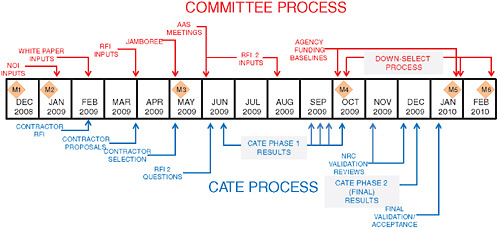
FIGURE 7.1 Time line showing the sequence of the Astro2010 survey’s activities and its cost appraisal and technical evaluation (CATE) process. The six committee meetings—including the “Jamboree” meeting involving all four Program Prioritization Panels, the Infrastructure Study Group chairs, the Science Frontiers Panel chairs, and the survey committee—held at key process milestones are indicated by the orange diamonds.
science optimally. For some activities a clear path emerged to deployment from this analysis, while for others it became equally clear that certain milestones would have to be met before the activity could proceed to full implementation. For still other activities, the scientific and technical landscapes were found to be shifting too rapidly for the survey to make a definitive recommendation now, and so a strategy for addressing the science and/or retiring the technical risk is recommended.
Budgets
A prime task of this survey was to construct a program that is innovative and exciting yet also realistic and balanced in terms of the range and scale of federally supported activities. The committee chose for convenience and clarity to exhibit budgets in the form of unencumbered FY2010 dollars available for new initiatives, and it started by considering the agency-projected budgets.
National Aeronautics and Space Administration (NASA)
Although the NASA Astrophysics Division’s annual budget has been as high as $1.7 billion in the past,4 it is currently approximately $1.1 billion and projected to remain flat in real-year dollars through 2015, according to the President’s FY2011 budget, and to remain flat thereafter according to NASA input to the committee. This implies a decrease in purchasing power over the decade at the rate of inflation. The committee concluded that this budget outlook allows very little in the way of new initiatives until mid-decade, by which time the James Webb Space Telescope (JWST) should be launched and opportunities for new funding wedges will open up. The committee also considered, as a basis for recommending a program, a more optimistic scenario in which the budget is flat over the decade in FY2010 dollars.
National Science Foundation (NSF)
Although the overall NSF budget is promised to “double,” or increase by 7 percent each year for 10 years in real dollars, the agency input to the committee was that the Division of Astronomical Sciences (NSF-AST) portion of the budget would remain flat over the decade in FY2010 dollars (requiring approximately 3 percent growth per year in real-year dollars).5
|
4 |
Given here in FY2010 dollars; this was during the time of peak expenditure on the James Webb Space Telescope (from Paul Hertz, Chief Scientist, Science Mission Directorate, NASA, “Presentation to the Board on Physics and Astronomy,” April 26, 2006, Washington, D.C., available at http://sites.nationalacademies.org/BPA/BPA_052067. |
|
5 |
Note that the NSF-AST budget did benefit from a one-time injection of $86 million in American Recovery and Reinvestment Act stimulus money in FY2009. |
In this case, once existing obligations are honored and operations at the Atacama Large Millimeter/submillimeter Array (ALMA) and the Advanced Technology Solar Telescope (ATST) rise to the planned full levels by 2017, the committee found that the only way there can be any significant new initiative is through very large reductions in the funding for existing facilities and budget lines. Accordingly, the committee considered a more optimistic scenario that it believes to be justified given the success and promise of the NSF-AST program. In this scenario, NSF-AST participates fully in the aforementioned doubling of the NSF overall budget, and so its purchasing power would grow at 4 percent per year for 10 years. This scenario was used by the committee as a basis for building its recommended program.
In considering large ground-based construction projects, the committee assumed that the Major Research Equipment and Facilities (MREFC) line would be appropriate for new NSF-AST-supported projects to compete for—once ALMA is largely completed in 2012, and noting that $150 million of ATST funding is still planned to be drawn from the line until 2017. The committee also noted that in practice, an important limitation on the construction of new facilities under MREFC is the capacity of the NSF-AST budget to provide appropriate running costs, including operations, science, and upgrades, once construction is completed.
Department of Energy (DOE)
In seeking guidance on possible budget scenarios for activities that might be funded by DOE, some in partnership with the NSF Division of Physics (NSF-PHY), the committee looked to the 2009 report from the High Energy Physics Advisory Panel (HEPAP) and its Particle Astrophysics Scientific Assessment Group (PASAG) that reexamined current and proposed U.S. research capabilities in particle astrophysics under four budgetary scenarios.6 The committee first adopted the more optimistic HEPAP-PASAG scenario, Scenario C, under which there is also a budget doubling as the basis for developing its program. It then considered the HEPAP-PASAG Scenario A, in which the total budget is constant in FY2010 dollars.7
|
6 |
U.S. Department of Energy, Report of the HEPAP Particle Astrophysics Scientific Assessment Group (PASAG), October 23, 2009, available at http://www.er.doe.gov/hep/files/pdfs/PASAG_Report.pdf. |
|
7 |
The HEPAP-PASAG report concluded that after allowance for a direct-detection dark matter program—which is not within the purview of this survey—Scenario A did not provide enough resources to support major hardware contributions to either LSST or JDEM (U.S. Department of Energy, Report of the HEPAP Particle Astrophysics Scientific Assessment Group (PASAG), 2009. |
SCIENCE OBJECTIVES FOR THE DECADE
The compelling science promise outlined in this report offers opportunities for making discoveries—both anticipated and unanticipated—for which the next decade will be remembered. The ingenuity and means are at hand to address the most promising and urgent scientific questions raised by the SFPs and summarized in Chapter 2, albeit on various timescales. The committee concluded that the way to optimize and consolidate the science return with the resources available is to focus on three broad science objectives for the decade—targets that capture the current excitement and scientific readiness of the field, and are motivated by the technical readiness of the instruments and telescopes required to pursue the science. These targets—Cosmic Dawn: Searching for the First Stars, Galaxies, and Black Holes; New Worlds: Seeking Nearby, Habitable Planets; and the Physics of the Universe: Understanding Scientific Principles—are the drivers of the priority rankings of new activities and programs identified below. However, they form only part of the much broader scientific agenda that is required for a healthy program.
Cosmic Dawn: Searching for the First Stars, Galaxies, and Black Holes
Astronomers are on the threshold of finding the root of our cosmic origins by revealing the very first objects to form in the history of the universe. This step will conclude a quest that is akin to that of an anthropologist in search of our most ancient human ancestors. The foundations for this breakthrough are already in place with the current construction of ALMA, which will detect the cold gas and the tiny grains of dust associated with the first large bursts of star formation, and JWST, which will provide unparalleled sensitivity to light emitted by the first galaxies and pinpoint the formation sites of the first stars. This powerful synergy between JWST and ALMA applies not only to these first objects in the universe, but also to the generations of stars that followed them. The emergence of the universe from its “dark ages,” before the first stars ignited, and the buildup of galaxies like our own from the first primordial seeds will be recorded. A staged development program is proposed beginning with the Hydrogen Epoch of Reionization Array-I (HERA-1) telescopes that are already under construction. The reionization of the primordial hydrogen by these first stars will be constrained by detections of cool gas from the dark ages with the first generation of HERA experiments. Much of what has already been learned has been informed by the results of theoretical investigations and sophisticated numerical simulations, and these are likely to play an increasingly important role in planning and interpreting future observations.
However, completing the record of galaxy formation, and understanding the composition and nature of these faint distant early galaxies, will require a new generation of large ground-based telescopes. A number of activities proposed to
this survey would address this goal. For example, a submillimeter survey telescope such as CCAT (formerly the Cornell-Caltech Atacama Telescope) would be capable of identifying the dusty young galaxies that ALMA plans to study in detail. The 20- to 40-meter optical telescopes, known collectively as Giant Segmented Mirror Telescopes (GSMTs), that are planned for construction over the coming decade would render within spectroscopic reach the most distant objects imaged by JWST. A GSMT would allow scientists to determine the mass of the first galaxies and to follow the buildup of the first heavy elements made inside stars. As well as discovering how infant galaxies grow, astronomers would also understand how they shine and affect their surroundings through outflows of gas and ultraviolet radiation.
A major challenge to JWST and GSMT is to understand how and why the birth rate of stars grew, peaked when the universe was a few billion years old, and has now declined to only a few percent of its peak value. The star-formation history of the universe can also be tracked by gamma-ray observations made with the proposed Atmospheric Čerenkov Telescope Array (ACTA): as high-energy gamma rays from the distant universe are converted into electrons and positrons, they can indicate how much star formation there has been along the way.
The era when the strong ultraviolet radiation from the first stars ionizes the surrounding hydrogen atoms into protons and electrons is known as the epoch of reionization, which can be studied directly using sensitive radio telescopes. These should determine when reionization occurred, and they would inform the design of a proposed new telescope that would measure how the cavities of ionized hydrogen created by the light from the first generations of stars, galaxies, and black holes expand into the surrounding gas. In the long term, realization of the full potential of this approach would require in the following decade a detailed mapping of the transition in the early universe from protogalactic lumps of gas and dark matter into the first objects, a goal of the proposed worldwide effort to construct the low-frequency Square Kilometer Array (SKA-low) as discussed in the subsection “Radio, Millimeter, and Submillimeter” under “OIR and RMS on the Ground” in Chapter 3. Studies of the intergalactic medium, which accounts for most of the baryons in the universe, at more recent times could be transformed by an advanced UV-optical space telescope to succeed the Hubble Space Telescope (HST), equipped with a high-resolution UV spectrograph.
Galaxies are composed not just of stars orbiting dense concentrations of dark matter. They also contain gas and central, massive black holes. When the gas flows rapidly onto a central black hole, it radiates powerfully and a quasar is formed. Meanwhile the black hole rapidly puts on weight. It is already known from observations that these black holes can grow very soon after the galaxies form. However, the manner in which this happens is still a mystery. These accreting black holes can be seen back to the earliest times using the proposed space-based Wide-Field Infrared
Survey Telescope (WFIRST) and the International X-ray Observatory (IXO), and the masses of the black holes can be measured using a GSMT.
Simulations show that the first galaxies were likely relatively small and that the giant galaxies observed today grew by successive mergers. Observations of mergers should be possible using JWST, ALMA, WFIRST, and GSMT. As galaxies merge it is likely that their black holes merge as well. The proposed Laser Interferometer Space Antenna (LISA) mission will search for the signatures of these processes by scanning the skies for the bursts of gravitational waves produced during these early mergers when the black holes are relatively small. (LISA will not be sensitive to the mergers of more massive black holes.) An important part of the strategy is to search for associated flashes of electromagnetic radiation that are expected as part of these events. The proposed Large Synoptic Survey Telescope (LSST) will be ideally suited to this task and, working with a GSMT, should make it possible to pinpoint and date the sites of black hole merger events.
In summary, this survey committee recommends improving understanding of the history of the universe by observing how the first galaxies and black holes form and grow. To do so requires that current capabilities be supplemented with the priority ground- and space-based activities identified in this survey; see Box 7.1.
New Worlds: Seeking Nearby, Habitable Planets
The search for exoplanets is one of the most exciting subjects in all of astronomy, and one of the most dynamic, with major new results emerging even as this report was being written. As described in Chapter 2, an unexpectedly wide variety of types and arrangements of planets have been identified—even a few systems with some resemblance to our solar system. What has not been found yet is an Earth-like planet, that is, a terrestrial body with an atmosphere, signs of water and oxygen, and the potential to harbor life. This survey is recommending a program to explore the diversity and properties of planetary systems around other stars, and to prepare for the long-term goal of discovering and investigating nearby, habitable planets. This program is likely to be informed by theoretical calculations and numerical simulations.
Locating another Earth-like planet that is close enough for detailed study is a major challenge, requiring many steps and choices along the way. The optimum strategy depends strongly on the fraction of stars with Earth-like planets orbiting them. If the fraction is close to 100 percent, then astronomers will not need to look far to find an Earth-like planet, but if Earth-like planets are rare, then a much larger search extending to more distant stars will be necessary. With this information in hand, ambitious planning can begin to find, image, and study the atmospheres of those Earth-like planets that are closest to our own. Equally important to the characterization of an Earth-like planet is to understand such planets as a class.
|
BOX 7.1 Implementing a Cosmic Dawn Science Plan
NOTE: ALMA, Atacama Large Millimeter/submillimeter Array; CCAT, formerly the Cornell-Caltech Atacama Telescope; GSMT, Giant Segmented Mirror Telescope; HERA, Hydrogen Epoch of Reionization Array; IXO, International X-ray Observatory; JWST, James Webb Space Telescope; LISA, Laser Interferometer Space Antenna; and WFIRST, Wide-Field Infrared Survey Telescope. |
Although our own solar system has four such terrestrial bodies, the frequency of formation of terrestrial planets, mass distributions as a function of stellar mass, and orbital arrangements are not understood. Generating a census of Earth-like or terrestrial planets is the essential first step toward determining whether our own home world is a commonplace or rare outcome of planet formation.
We have various complementary means of building up a census of Earth-like planets. The ground-based radial velocity and transit surveys are most sensitive to large planets with small orbits, as is the Kepler satellite, although it should be capable of detecting Earth-size planets out to almost Earth-like orbits. Together these techniques will determine the probability of planets with certain orbital characteristics around different types of stars. To complete the planetary census, it will be necessary to use techniques that are sensitive to Earth-mass planets on large orbits. One such technique is called gravitational microlensing, whereby the pres-
ence of planets is inferred8 through the tiny deflections that they impose on passing light rays from background stars. A survey for such events is one of the two main tasks of the proposed WFIRST satellite. Because microlensing is sensitive to planets of all masses having orbits larger than about half of Earth’s, WFIRST would be able to complement and complete the statistical task underway with Kepler, resulting in an unbiased survey of the properties of distant planetary systems. The results from this survey will constrain theoretical models of the formation of planetary systems, enabling extrapolation of current understanding to systems that will still remain below the threshold of detectability.
However, in addition to determining just the planetary statistics, a critical element of the committee’s exoplanet strategy is to continue to build the inventory of planetary systems around specific nearby stars. Therefore, this survey strongly supports a vigorous program of exoplanet science that takes advantage of the observational capabilities that can be achieved from the ground and in space.
The first task on the ground is to improve the precision radial velocity method by which the majority of the close to 500 known exoplanets have been discovered. The measured velocity amplitude of a star depends on the ratio of the planetary to the stellar mass, and on the distance from the star, with a Jupiter-mass body at 5 times the Earth-Sun distance from a Sun-like star producing a 12-meter-per-second signal and an Earth at the Earth-Sun location just a 6-centimeter-per-second signal. Improving the velocity precision will allow researchers to measure the masses of smaller planets orbiting nearby stars. Using existing large ground-based or new dedicated mid-size ground-based telescopes equipped with a new generation of high-resolution spectrometers in the optical and near-infrared, a velocity goal of 10 to 20 centimeters per second is realistic. This could allow detection of bodies twice or three times the mass of Earth around stars the mass of the Sun, and truly Earth-mass planets around stars a factor of two or three less massive than the Sun. The radial velocity technique is also of high value when paired with complementary techniques. For example, transits can determine planet sizes and, in combination with the mass found from another technique, yield clues regarding the bulk planetary compositions—just as we know that Earth is mostly rock and iron from its mass and size and a calculation of the average density. Improved precision astrometry and interferometric techniques that are sensitive to planets at larger separations could not only detect new Jupiter-class planets but also study known planetary systems in combination with radial velocity methods so as to resolve the ambiguity regarding true mass as distinct from the inferred minimum mass.
Success with endeavors to determine the solar neighborhood planetary census will be very important because knowing that Earth-mass planets exist around nearby stars will give much higher confidence that a future space mission to
investigate the atmospheres of extrasolar planets like Earth will succeed. A critical step along the way is a better understanding of the dusty disks surrounding stars, analogous to zodiacal dust found near Earth. Reflected diffuse exozodiacal light from these disks can make detection of the faint light from small Earth-like planets difficult. It is, therefore, important to quantify the prevalence and character of these dusty “debris” disks, and the period 2010-2015 will see the completion of ground-based mid-infrared interferometric instrumentation designed to study these phenomena.
It is also important to understand planetary systems in the process of formation to enrich and complement observations of the mature exoplanets. ALMA will revolutionize the imaging of protoplanetary disks at millimeter and submillimeter wavelengths and reveal important clues to the formation and evolution of their constituent planets. JWST and ground-based infrared telescopes equipped with adaptive optics to remove the twinkling due to Earth’s atmosphere will provide spatially resolved multiwavelength images and spectra of light scattered from these disks with spatial resolution comparable to that of ALMA.
JWST, with its superb mid-infrared capability, will also use imaging and spectroscopy transit techniques to study the atmospheres of exoplanets, a science capability that has been amply demonstrated by the currently operating Spitzer Space Telescope. JWST will be a premier tool for studying planets orbiting stars that are smaller and cooler than the Sun. Also promising are improved techniques on the ground for direct imaging of planets using adaptive optics. New instrumentation is required as well as significant amounts of observing time (for example, on the Gemini telescopes and the privately operated facilities accessible through NSF’s Telescope System Instrumentation Program). The proposed GSMTs could also play a crucial role in direct imaging studies with instruments suitably designed for this type of work.
In addition, enhancements to NASA Suborbital and Explorer programs could provide testbeds for the development of occulter techniques such as the use of star shades and coronagraphy, which are both immature, and technology development of astrometry and interferometry from space, so as to set the stage for an ambitious direct-detection mission in the 2020s. The scientific contributions and technology development in these various areas are described in detail elsewhere.9
The culmination of the quest for nearby, habitable planets is a dedicated space mission. The committee concluded that it is too early to determine what the design
|
9 |
ExoPlanet Task Force of the Astronomy and Astrophysics Advisory Committee, Worlds Beyond: A Strategy for the Detection and Characterization of Exoplanets, National Science Foundation, Washington, D.C., 2008, available at http://www.nsf.gov/mps/ast/exoptf.jsp; Jet Propulsion Laboratory, Exoplanet Community Report (P.R. Lawson, W.A. Traub, and S.C. Unwin, eds.), JPL Publication 09-3, Pasadena, Calif., 2009. |
of that space mission should be, or even which planet-detection techniques should be employed.10 It is not even clear whether searches are best carried out at infrared, optical, or even ultraviolet wavelengths. This choice awaits the results of the observational studies just described, alongside a vigorous and adaptive program of theoretical and laboratory astrophysics investigations that will inform scientists about the diversity of exoplanet atmospheres. Although the case is compelling for technology development for a future space mission beginning early, its emphasis may shift as new discoveries from the ground and space materialize. If progress is sufficiently rapid by mid-decade, then a decadal survey implementation advisory committee (as discussed in Chapter 3) could determine whether a more aggressive program of technology development should be undertaken, possibly including steps toward a technology down-select and a focus on key elements. Either way, decisions on significant, mission-specific funding of a major space mission should be deferred until the 2020 decadal survey, by which time the scientific path forward should be well determined.
In summary, exoplanet astronomy is one of the most rapidly developing and unpredictable fields in modern astronomy. Both the statistical investigations of Kepler and WFIRST, and the location of specific, nearby, potentially habitable Earth-like planets under a strong yet flexible program of ground-based research, are recommended. This combined approach will allow new techniques to be devised and surprising discoveries to be made during the coming decade; see Box 7.2.
The Physics of the Universe: Understanding Scientific Principles
Astronomy has made many contributions to our understanding of basic physics and chemistry, ranging from Newton’s laws of gravitation to the discovery of helium, from providing much of the impetus for understanding nuclear physics to discovering new types of molecules unique to interstellar environments. Perhaps the best-developed recent example has come from high-precision tests of the theory
|
BOX 7.2 Implementing a New Worlds Science Plan
NOTE: ALMA, Atacama Large Millimeter/submillimeter Array; CCAT, formerly the Cornell-Caltech Atacama Telescope; IXO, International X-ray Observatory; JWST, James Webb Space Telescope; Kepler; and WFIRST, Wide-Field Infrared Survey Telescope. |
of gravity encompassed by Einstein’s theory of general relativity. However, these tests have been restricted to the situations where gravity is weak, and the strong field expression of the theory still remains to be tested. The discovery of dark energy and dark matter and the amassed evidence that is at least consistent with the predictions of the theory of inflation present two more examples where carefully controlled astronomical measurements contribute to current understanding of fundamental physics. Here the committee highlights these three topics, mindful of a range of other such opportunities, mentioned below.
The standard model of cosmology developed in the 1980s and 1990s has been amply confirmed over the past decade by observations of the cosmic microwave
background (CMB) using ultrasensitive radio telescopes on the ground, balloons, and spacecraft. With a combination of these and other observations, astrophysicists have shown that the geometry of space is approximately flat, that the age of the universe is 13.7 billion years, and that there is nearly five times as much matter in a dark, invisible form as in normal matter that can turn into visible stars. The past decade also saw strong affirmation of the remarkable discovery that the expansion of the universe is accelerating.
We can now say that there is a ubiquitous and ethereal substance called dark energy that is expanding the fabric of space between the galaxies at ever faster speeds and that accounts for 75 percent of the mass-energy of the universe today. The effects are so tiny on the scale of an experiment on Earth that the only way forward is to use the universe at large as a giant laboratory.
Two complementary approaches to understanding dark energy have been considered by this survey: one on the ground and the other in space. On the ground, the proposed LSST would provide optical imaging of brighter galaxies over half the sky every few days. It would build up measurements of galaxy images that are distorted by (weak) gravitational lensing and detect many relatively nearby super-novae. From space, the proposed WFIRST would produce near-infrared images of fainter galaxies over smaller areas and observe distant supernovae. It would also provide near-infrared spectroscopy for sensitive baryon acoustic oscillation measurements. What has become clear over the past few years is that instead of just considering dark energy in different regimes, LSST and WFIRST will actually be quite synergistic, and observations from one are essential to interpreting the results of the other. In particular, by working together, they would provide the powerful color information needed for redshift11 estimation. The properties of dark energy would be inferred from the measurement of both its effects on the expansion rate and its effects on the growth of structure (the pattern of galaxies and galaxy clusters in the universe). In doing so it should be possible to measure deviations from a cosmological constant12 larger than about a percent. Massively multiplexed spectrographs in intermediate-class and large-aperture ground-based telescopes would also play an important role.
Second, and most remarkably, it is now possible to contemplate observing the earliest moments of the universe. Another source of gravitational radiation may be the most intriguing of all. The patterns in the CMB are theoretically consistent with what could have been laid down during the first instants after the big bang during an
epoch of rapid expansion, called inflation. The recently launched Plancksatellite will produce higher-resolution, all-sky CMB temperature and polarization maps at many frequencies. Complementary observations from the ground will look at patches of the sky with fine angular resolution. These experiments will be able to compare the temperature fluctuations on a range of scales, from those so small that they will grow into only a small group of galaxies today, to the largest-scale fluctuations observable on the whole sky, which will allow scientists to see if the fluctuations are truly random or instead non-Gaussian, as some theories suggest. However, the most ambitious goal of all is to try to detect a particular pattern in the polarization—called B-modes—that is caused by very long wavelength gravitational radiation that would be created at the time of inflation. The B-modes are a window allowing us to peer far back beyond the screen of the CMB into the period of inflation.
The convincing detection of B-mode polarization in the CMB produced in the epoch of reionization would represent a watershed discovery. The strength of the associated fluctuations, now constrained to less than 20 percent, should be measurable by upcoming telescopes at a level as low as 20 times weaker than the current limit. If these fingerprints of inflation are detected, then a decadal survey implementation advisory committee (DSIAC) (as discussed in Chapter 3) could determine whether a technology development program should be initiated with a view to flying a space microwave background mission during the following decade that would be capable of improving the accuracy by a further factor of 10 and elucidating the physical conditions at the end of inflation.
Third, an inescapable consequence of general relativity is the existence of black holes. Once mere conjectures, black holes are now known to be very common. They are found at the centers of normal galaxies like our own Milky Way and as companions to normal stars transferring mass to their neighbors through winds. Gas close to a black hole radiates X-rays prodigiously and offers a quantitative observational test of relativistic theory that would be possible to conduct with the proposed sensitive International X-ray Observatory, IXO. Another general property of black holes is that they create jets of hot plasmas that move at speeds very close to that of light and create intense beams of radiation from the longest radio wavelengths to the highest gamma-ray energies. The proposed Advanced Čerenkov Telescope Array (ACTA) will use high-energy gamma-ray observations to probe the properties of black holes.13
General relativity also predicts the existence of gravitational waves, which travel at the speed of light. Our understanding of gravity waves has improved recently to include solving the relevant equations when gravity is strong, thanks to theoretical breakthroughs in numerical relativity. Astrophysicists now have the ability, in principle, to calculate the complete waveforms that should be observed from most types of powerful sources. To date, the effects of gravitational radiation have been observed only indirectly using sensitive measurements of spinning magnetized neutron stars, or pulsars, when they have orbiting stellar companions. These measurements are consistent with the theory, but the goal of detecting gravitational waves directly has not yet been met.
The first of these ripples in space-time likely to be detected will probably arise from the death spiral of a binary neutron star. Sustained international investments over the last 20 years would culminate with the mid-decade completion of the advanced Laser Interferometer Gravitational Wave Observatory (LIGO), which should make regular detections of this and many other types of sources at relatively short wavelengths.
However, the ultimate goal is to measure the full gravitational waveform for direct comparison with theoretical expectations. To accomplish this, measurements are needed at longer wavelengths to test the theory by means of sustained observations of merging black holes. This is the primary purpose of LISA, from which the signals will be of such high quality that the full gravitational waveform can be measured. A key recent development has been the solution of the theoretical problem of calculating the signals that should be seen from merging black holes. The results will test current understanding of general relativity and provide accurate measurements of the spin and mass of the merging black holes. These are vital parameters for understanding the origins and growth of the most massive black holes in the universe. We should also witness the capture of stars by massive black holes with signals of such long duration and fidelity that the space-time of the black hole can be directly mapped.
In summary, this survey recommends supplementing the current ability to use the universe as a giant cosmic laboratory to study dark energy, inflation, and black holes. Success in this endeavor would provide critical constraints on the laws of physics and the behavior of the universe that would inform efforts to realize a unification of gravity and quantum mechanics through string theory or other approaches; see Box 7.3.
THE LARGER SCIENCE PROGRAM
The three primary science objectives played a large role in motivating the difficult prioritization choices the committee had to make. They represent goals against which progress and prospects for individual facilities can be assessed over
|
BOX 7.3 Implementing the Physics of the Universe Science Plan
NOTE: ACTA, Atmospheric CČerenkov Telescope Array; GSMT, Giant Segmented Mirror Telescope; IXO, International X-ray Observatory; LISA, Laser Interferometer Space Antenna; LSST, Large Synoptic Survey Telescope; and WFIRST, Wide-Field Infrared Survey Telescope. |
the coming decade. However, there is much other science outlined in Chapter 2 that is also important and timely. The program of activities proposed as a result of Astro2010 also advances this larger research program, cast here as in Chapter 2 in terms of cross-cutting themes in astronomy and astrophysics research.
Discovery
Anticipating research results in a rapidly changing field is demonstrably hard, and comparisons between expectations and actual scientific results are both humbling and exhilarating. For example, when the Keck Observatory, the Hubble Space Telescope, and the Spitzer Space Telescope were designed astronomers had no evidence that there were planets around nearby stars or that gamma-ray bursts were at cosmological distances. These observatories, both independently and when used together to study the same objects, have been invaluable in advancing knowledge in unpredictable directions. Astronomy is still as much based on discovery as it is on predetermined measurements.
The committee emphasizes that its recommended activities have the capacity to find the unexpected and the versatility to engage in follow-up observations. For example, WFIRST and LSST as recommended here would open up the time domain to reveal remarkable surprises and enable the creation of massive databases that will be mined for decades. It would be unprecedented in the history of astronomy if the gravitational radiation window being opened up by LISA does not reveal new, enigmatic sources. Most of the observing time on GSMT, IXO, and ACTA would not be allocated according to a preordained strategy; rather, individuals and teams would compete for time to explore new scientific approaches and pursue recent discoveries. The broadly based and balanced suite of facilities that are recommended is flexible and resilient enough to make and exploit the many unanticipated and thrilling discoveries that are sure to come during the coming decade. Many of the most fundamental advances in astronomy and astrophysics have resulted from theoretical discoveries that could not have been anticipated in any planning exercise—the theory of inflation is one example—but the recommended Theoretical and Computational Network program and augmentations in individual investigator grants programs at NSF and NASA will help to enable such discoveries.
Origins
Understanding the dramatic evolution of galaxies over cosmic time through observations is a key part of the committee’s recommended science program. Following the growth of cosmic structure and learning empirically how the dark and luminous matter are connected is a major science goal for GSMT, which, with its superb spectroscopic reach, would be able to measure redshifts and thus infer distances all the way from our local neighborhood to the epoch of reionization and monitor the buildup of mass and the rise and fall of star formation at visual wavelengths. Meanwhile CCAT would provide the submillimeter perspective on the history of star formation over cosmic time. (See Figure 7.2 for an illustration of the complementarity.) The “fossil record” of how our Milky Way galaxy was assembled can be traced by studying resolved stellar populations with LSST and JWST, and by using the adaptive optics capability on GSMT. GSMT would also be able to perform exquisite spectroscopy of the most ancient, nearby stars. In the next decade, large-scale numerical simulations of the formation and evolution of galaxies should achieve the spatial resolution and physical realism necessary to interpret these observations successfully and to tell the story of how our galaxy was born.
Our understanding of star formation under a wide variety of physical conditions will benefit from extensive surveys of the giant molecular clouds within which stars form. ALMA will and CCAT would be major tools for this exploration.
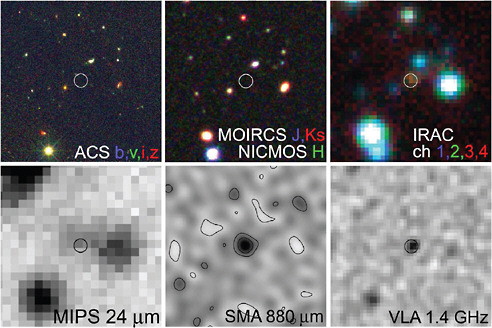
FIGURE 7.2 Multiwavelength images of high-redshift source GOODS 850-5 showing the complementarity of multiwavelength data and the promise of a future GSMT/JWST/CCAT/ALMA combination for studies of early galaxies. SOURCE: W.-H. Wang, A.J. Barger, and L.L. Cowie, Ultradeep near-infrared observations of Goods 850-5, Astrophysical Journal 690:319, 2009. Reproduced by permission of AAS.
Complementary studies of the young stars spawned in these molecular regions will require infrared surveys with high angular resolution both in our galaxy and in the neighboring galaxies the Magellanic Clouds, using JWST in space and GSMT equipped with adaptive optics on the ground.
Since solar flares create many cosmic rays that can cause mutations of genetic material, understanding these flares is important for understanding the chances of a planet being habitable. Flares on the more numerous low-mass, cool stars may preclude some forms of life on orbiting planets already known and to be discovered. Studying flares from the Sun using optical techniques with ATST—and at radio frequencies by using the proposed Mid-Scale Innovations Program candidate, the Frequency Agile Solar Radiotelescope (FASR)—as well as studying stellar flares in far-off planetary systems using the proposed IXO, could advance our understanding of planetary habitability.
Understanding the Cosmic Order
The critical constituents of galaxies—dark matter, stars, gas, dust, and super-massive black holes—are strongly coupled to one another. The program recommended here will allow major progress in our understanding of this cosmic order. Large multiobject spectroscopic surveys with new instruments would measure the stellar populations and the internal motions of thousands of distant galaxies in a single observation. High-angular-resolution optical and near-infrared integral-field-unit spectrographs on intermediate-class and large-aperture ground-based telescopes would trace in detail the internal velocity fields of galaxies. Meanwhile, while JWST will provide observations on the assembly of galaxies over cosmic time, IXO would obtain X-ray observations of the warm and hot gas in the dark matter halos that surround galaxies.
High-mass stars embedded in dense gas within galaxies can be inventoried with CCAT and studied in detail with ALMA. These stars are thought to be the main agents for injecting mass and energy into the interstellar medium and for driving galactic outflows. They do this through powerful stellar winds and supernova explosions, both of which are also responsible for accelerating cosmic rays and amplifying magnetic fields. The proposed ACTA facility will advance understanding of the mechanisms involved. The cycling of gas from galaxies to the surrounding intergalactic medium and back again could also be studied with a GSMT telescope, using high-resolution optical spectra to study gas absorption lines highlighted by background quasars along many sight-lines, but a future UV space mission will be needed for a complete inventory. This program of observations will move the subject of galaxy evolution from one dominated largely by surveys to one of integrated measurements of the buildup of dark matter, gas, stars, metals, and structure over cosmic time. These observations will lay the foundation for the ultimate aim of a complete ab initio theory of galaxy formation and evolution.
Understanding of the structure and evolution of stars is the foundation on which the knowledge of galaxies and the rest of the universe is built. ATST will provide tools for the study of solar (and hence stellar) rotation and magnetic fields. The time-domain information obtained from LSST would provide an unprecedented view of magnetic activity in other stars. LSST would also yield a large sample of Type Ia supernovae that could be followed up immediately by a GSMT in order to identify the progenitor stars and better understand the physical processes involved in their explosions. Likewise LSST would detect many Type II supernovae and find new types of rare or faint outcomes of massive-star evolution that have never been seen before. Key properties of compact stellar remnants such as neutron stars will be measured in new radio pulsar surveys that are less biased against detecting the fastest-rotating pulsars.
The study of the circumstellar disks out of which planets form will benefit greatly from the high spatial resolution of GSMT, fitted with high-contrast instrumentation so that the faint disks do not get lost in the glare of their parent stars, and there is complementary coverage of wavelengths with JWST and ALMA. Resonant structures and gaps within a disk that may be caused by gravitational perturbations due to planets will be imaged in optical, infrared, and submillimeter radiation, allowing a complete picture of the structure and composition of these disks to be derived.
Frontiers of Knowledge
The hunt is on to elucidate the nature of dark matter first identified by astronomers more than 70 years ago. If it comprises supersymmetric particles, then there are hopes that they will be seen directly at particle accelerators like the Tevatron and the Large Hadron Collider (LHC). They may also be seen directly at one of the many different types of underground detectors being built. However, it is also possible that they will be identified indirectly by the gamma rays that are produced through annihilation or decay processes in distant dark matter concentrations. A new ACTA would be roughly 10 times more sensitive than existing facilities and able to further constrain the nature of dark matter. ACTA could also check that the highest-energy photons do, indeed, travel at the speed of light.
Another potential contribution to fundamental physics will come from microwave background observations using future CMB telescopes combined with probes of structure formation, which can provide an upper limit to the sum of the masses of the three flavors of neutrino with higher sensitivity than can be done with ongoing laboratory experiments. More detailed information may also emerge on the individual particle masses.
A third possible contribution is to nuclear physics. Neutron stars can be thought of as giant atomic nuclei, and understanding how their radii change with the mass is of fundamental importance for nuclear physics and complements what is being learned from collisions of heavy ions. These astronomical measurements are becoming possible using radio and X-ray telescopes.
Turning to chemistry, with the advent of ALMA and CCAT in particular, an explosion in the variety of detected interstellar and circumstellar molecules is expected. A better understanding of the chemistry of these molecules will provide new information about stellar evolution and galaxy formation and evolution.
RECOMMENDED PROGRAM OF ACTIVITIES
On the basis of the input from the community, the priority science identified by the SFPs, the prioritized conclusions of the PPPs, and the results of the indepen-
dent cost appraisal and technical evaluation process, the committee developed the ranked program described below for ground-based and spaced-based astronomy in the United States. In each category, the discussion proceeds with ranked large and ranked medium priorities followed by unranked smaller priorities. A large space activity is one with total cost estimated to exceed $1 billion; a medium space activity is one with total cost estimated to range from $0.3 billion to $1 billion. A large ground-based activity is one with total cost of construction and acquisition of capital assets estimated to exceed the threshold for the NSF’s MREFC program (currently $135 million in FY2010 for projects from the Directorate for Mathematical and Physical Sciences); a medium ground-based activity is an initiative for which the total cost would fit into the Mid-Scale Innovations Program range, $4 million to $135 million as defined by this committee. The committee has not ranked the core-sustaining activities described in Chapter 5 except in the sense that it has recommended funding augmentations to some relative to the current levels of support. The committee’s priorities have varying degrees of relevance to DOE, NASA, and NSF, given that some projects are envisioned as being supported by more than one agency.
Recommendations for New Space Activities—Large Projects
Priority 1 (Large, Space). Wide-Field Infrared Survey Telescope (WFIRST)
WFIRST14 is a wide-field-of-view near-infrared imaging and low-resolution spectroscopy observatory that will tackle two of the most fundamental questions in astrophysics: Why is the expansion rate of the universe accelerating? And are there other solar systems like ours, with worlds like Earth? In addition, WFIRST’s surveys will address issues central to understanding how galaxies, stars, and black holes evolve. WFIRST will carry out a powerful extrasolar planet search by monitoring a large sample of stars in the central bulge of the Milky Way for small deviations in brightness due to microlensing by intervening solar systems. This census, combined with that made by the Kepler mission, will determine how common Earth-like planets are over a wide range of orbital parameters. To measure the properties of dark energy, WFIRST will employ three different techniques: it will image about 2 billion galaxies and carry out a detailed study of weak lensing that will provide distance and rate-of-growth information; it will measure spectra of about 200 million galaxies in order to monitor distances and expansion rate using
baryon acoustic oscillations; and finally, it will detect about 2,000 distant supernova explosions, which can be used to measure distances. WFIRST provides the space-unique measurements that, combined with those from LSST (the committee’s highest-priority ground-based project), are essential to advance understanding of the cause of cosmic acceleration. In addition, WFIRST will survey large areas of sky to address a broad range of Astro2010 science questions raised to advance understanding of phenomenon ranging from the assembly of galaxies to the structure of the Milky Way. WFIRST will also offer a guest investigator program supporting both key projects and archival studies to address a broad range of astrophysical research topics.
WFIRST is a 1.5-meter telescope that will orbit the second Lagrange point (L2), 1.5 million kilometers from Earth. It will image the sky at near-infrared wavelengths and perform low-resolution infrared spectroscopy. The spacecraft hardware that was used as a template for studying WFIRST was one of two JDEM proposals submitted to the committee—the JDEM-Omega proposal (Figure 7.3). This was used as a basis for the cost appraisal and technical evaluation. Undoubt-
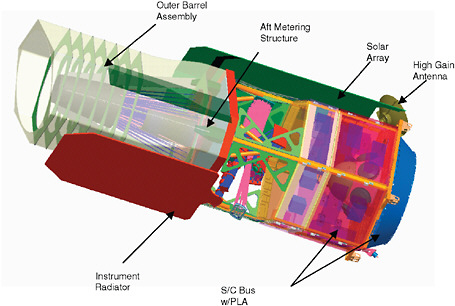
FIGURE 7.3 An infrared telescope with a three-mirror design, WFIRST will have HgCdTe detectors with 144 megapixels in total and angular resolution of 200 milliarcseconds. The sensitivity should be about 200 nJy or 26th magnitude, enabling shape measurements and photometric redshifts to a depth of 100,000 galaxies per square degree over half the sky. Spectroscopy will be achieved with a grism or prism and will rely mainly on measurement of the “H alpha” line of hydrogen out to a redshift of about 1.8. SOURCE: JDEM Project, NASA-GSFC.
edly, design improvements are possible, but its capabilities are essentially identical to those envisaged for WFIRST.
In a 5-year baseline mission, its observations would emphasize the planet census and dark energy measurements, while accommodating a competed general investigator program for additional surveys that would exploit WFIRST’s unique capabilities using the same observation modes. The powerful astronomical survey data collected during all of the large-area surveys would be utilized to address a broader range of science through a funded investigator program. An extended mission, subject to the usual senior review process, could both improve the statistical results for the main science drivers and broaden the general investigator program.
The independent cost and readiness assessment found that WFIRST is based on mature technologies and has relatively low technological risk. The three primary challenges identified—achieving the image quality over the focal plane necessary for studies of weak lensing, providing adequate telemetry bandwidth from L2, and designing a focal plane that would jointly optimize the exoplanet and dark energy science—do not present high risk. At the 70 percent confidence level the appraised cost is $1.6 billion, with a time from project start to launch of 82 months. The enhanced observing plan relative to JDEM, to include both microlensed planet and dark energy surveys, is not expected to be a serious cost or schedule driver. The additional cost of a guest investigator program was not included in the cost and risk assessment. The committee considers the general investigator program to be an essential element of the mission, but firmly believes it should not drive the mission hardware design or implementation cost. NASA should consider creative ways to enable the most flexible possible general investigator program consistent with the current spacecraft and instrument suite.
WFIRST employs the JDEM-Omega design, conceived and developed in a collaboration between DOE and NASA. Other versions of a JDEM mission have been endorsed in two previous NRC reports.15 Much progress has been made in defining the scientific objectives, and a variety of mission concepts have been discussed and compared. This continuing interagency collaboration on the proposed WFIRST is important both scientifically and technically. In addition, the committee is aware that plans are now underway in Europe for a similar mission, Euclid, which has many of the same scientific goals as WFIRST. Euclid is also in its definition phase and is competing with PLATO and Solar Probe for one of the two M-class launch slots of the European Space Agency’s (ESA’s) Cosmic Vision program, now scheduled for 2017 and 2018. There have been discussions between the U.S. agencies and ESA about mounting a joint mission, which could be a positive development if it
leads to timely execution of a program that fully supports all of the key science goals of WFIRST (planet microlensing, dark energy science, and guest observer investigations) and leads to savings overall. It is expected that the United States will play a leading role in this top-priority mission.
WFIRST addresses fundamental and pressing scientific questions and contributes to a broad range of astrophysics. It complements the proposed ground-based program in two key science areas: dark energy science and the study of exoplanets. It is an integral part of coordinated and synergistic programs in fields in which the United States has the leading role. It also presents opportunities for interagency and perhaps international collaboration that will tap complementary experience and skills. It also presents relatively low technical and cost risk, making it feasible to complete within the decade, even in a constrained budgetary environment. For these reasons it is the top-priority recommendation for a space-based initiative. A 2013 new start should enable launch in 2020.
Priority 2 (Large, Space). Explorer Program
The Explorer program’s Small Explorer (SMEX) and Medium-scale Explorer (MIDEX) missions, developed and launched on few-year timescales, enable rapid response to new discoveries and provide platforms for targeted investigations essential to the breadth of NASA’s astrophysics program. From the WMAP MIDEX measurements of the age and content of the universe accomplished through its mapping of the cosmic microwave background (see Figures 2.4 and 2.5 in Chapter 2), to the GALEX SMEX contributions to understanding of the evolution of galaxies, Explorers are on the forefront of scientific discovery (Figure 7.4). With multiple missions launched per decade for a cost substantially less than that of a single flagship mission, the Explorer program is unique in the world for its versatility and scientific return for the investment. The Explorer program also offers highly leveraged Missions of Opportunity (MoOs), which enable U.S. scientists to make scientific and hardware contributions to non-NASA missions, and which provide a mechanism to develop large suborbital experiments.
The frequent opportunity to deploy SMEX (currently $160 million) and MIDEX (currently $300 million) experiments on timescales significantly less than a decade has enabled the United States to seize scientific opportunities, exploit new technologies and techniques, and involve university groups, including students and postdoctoral scholars, in significant development roles. As described in Chapter 5, this capability is essential to training the next generation of scientists and engineers. However, the program’s original intent to deploy an astrophysics SMEX and a MIDEX mission every other year is not being met, given that the launch rate has fallen dramatically to just two per decade. The Announcements of Opportunity
(AOs) have been so infrequent that the ability to partner with foreign missions has been compromised, and resources have been insufficient to select suborbital platforms, which can be critical to advancing key science goals.
The committee therefore recommends, as its second priority in the large category of space-based projects, that NASA should support the selection of two new astrophysics MIDEX missions, two new astrophysics SMEX missions, and at least four astrophysics MoOs over the coming decade. AOs should be released on a predictable basis as close to annually as possible, to facilitate Missions of Opportunity. Further, the committee encourages inclusion of suborbital payload selections, if they offer compelling scientific returns. To accommodate this plan, an annual budget increase would be required for the astrophysics portion of the program from its current average value of about $40 million per year to a steady value of roughly $100 million by 2015. The placement of this recommendation in the large category reflects the decade’s total cost of the program including the augmentation and the committee’s view that expanding the Explorer program is essential to maintaining the breadth and vitality of NASA’s astrophysics program. This is especially true in an era where budgetary constraints limit the number of flagship missions that can be started.
Priority 3 (Large, Space). Laser Interferometer Space Antenna (LISA)
LISA is a gravity wave observatory that would open an entirely new window in the universe (Figure 7.5). Using ripples in the fabric of space-time caused by the motion of the densest objects in the universe, LISA will detect the mergers of black holes with masses ranging from 10,000 to 10 million solar masses at cosmological distances, and will make a census of compact binary systems throughout the Milky Way. LISA’s measurements of black hole mass and spin will be important for understanding the significance of mergers in the building of galaxies. LISA also is expected to detect signals from stellar-mass compact stellar remnants as they orbit and fall into massive black holes. Detection of such objects would provide exquisitely precise tests of Einstein’s theory of gravity. There may also be waves from unanticipated or exotic sources, such as backgrounds produced during the earliest moments of the universe or cusps associated with cosmic strings.
Using three “drag-free” spacecraft launched into an equilateral triangular configuration in an Earth-trailing orbit, LISA would explore the low-frequency (0.1 to 100-mHz) portion of the gravitational wave spectrum, observable only in space, to achieve its scientific objectives. The sides of the triangle are 5 million kilometers, and the “laser-connected” spacecraft would measure their separations to an accuracy enabling detection of tens of picometers relative motions induced by passing gravitational waves. The mission lifetime is planned as 5 years.
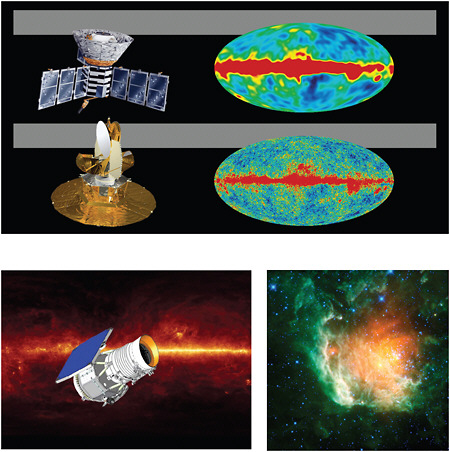
FIGURE 7.4 Science accomplishments from competitively selected astrophysics Explorer SMEX and MIDEX missions launched since 2000. In addition the Explorer program supported a Mission of Opportunity (MoO) contribution to Suzaku and will launch two new SMEX X-ray missions, NuSTAR and GEMS, in 2012 and 2014, respectively. A MoO contribution of an X-ray spectrometer to the Japanese Astro-H is planned for 2014. SOURCE (paired images, clockwise from upper left): (1) WMAP MIDEX—NASA/WMAP Science Team; (2) Swift MIDEX—Orbital Sciences Corporation; NASA E/PO, Sonoma State University, and Aurore Simonnet; (3) GALEX SMEX—NASA/JPL-Caltech; and (4) WISE MIDEX—NASA/JPL-Caltech/WISE Team; NASA/JPL-Caltech.
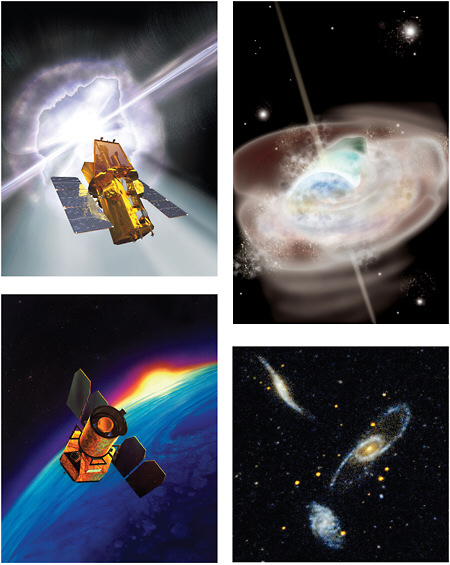
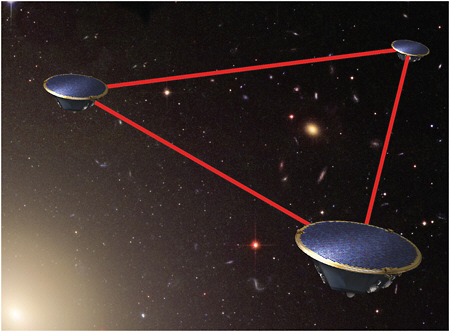
FIGURE 7.5 LISA comprises three spacecraft in an Earth-trailing orbit. It will be sensitive to waves with periods in the range of 10 seconds to 10 hours. The strain sensitivity is designed to be about 10–20 Hz–1/2. The laser system is a 40-milliwatt Nd:YAG operating at a wavelength of 1 micron. SOURCE: NASA.
LISA has been studied for more than 20 years and was recommended by the 2001 decadal survey of astronomy and astrophysics and also by two other NRC reports.16 It is a partnership between ESA and NASA that relies on the expertise of both agencies and scientific communities. The ESA portion of the mission is competing for the L-class slot of the Cosmic Vision program; the down-select process is beginning now (the other competitors in this class are IXO, see below, and the Europa Jupiter System Mission (EJSM), an outer-planets mission), with launch currently scheduled for the end of the decade. In the committee’s independent cost and readiness analysis, the NASA 50 percent portion of the project cost is estimated to be $1.5 billion (at 70 percent confidence), with time to completion
of about 9.5 years. The remaining technical risk was rated as medium if the currently identified main technical risks—involving micro-Newton thrusters, drag-free control, and a gravitational reference system—are all retired by a successful LISA Pathfinder mission, now scheduled for launch in 2012. The largest remaining technical challenge for the mission is identified as the successful deployment and operation of all three antennas.
In recommending LISA for continued development, the committee identified two key decision points. First, the LPF mission must be successful. Second, ESA must assign LISA it highest priority as an L-class mission. If either of these conditions is not satisfied, the committee recommends that a DSIAC be tasked to review the status of LISA mid-decade, in consultation with ESA, and to reconsider LISA’s prioritization relative to other opportunities. Overall the recommendation and prioritization for LISA reflect its compelling science case and the relative level of technical readiness. Assuming a successful LISA Pathfinder, a 2016 new start should enable launch in the middle of the next decade.
Priority 4 (Large, Space). International X-ray Observatory (IXO)
IXO is a versatile large-area, high-spectral-resolution X-ray observatory (Figure 7.6). X-ray observations probe the hottest regions of the universe, where temperatures reach tens of millions Kelvin. Studying the hot component of the universe is central to understanding how galaxies and larger-scale structures form and how energy and matter cycle through galaxies and the circumgalactic medium, and to probing the observable matter closest to black holes and neutron stars. Hot gas
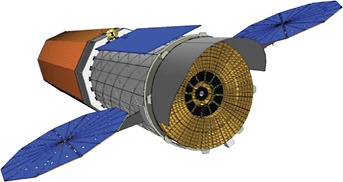
FIGURE 7.6 IXO contains a grazing incidence X-ray telescope with a 20-meter focal length and an effective area of around 3 square meters at 1 keV. The angular resolution from 0.3 to 7 keV is about 5 arcseconds, and a combination of dispersive and non-dispersive spectrometers provides excellent energy resolution over this energy range. SOURCE: NASA
constitutes the majority of ordinary matter in clusters of galaxies. Large-aperture, Large-aperture, time-resolved, high-resolution X-ray spectroscopy is required for future progress on all of these fronts, and this is what IXO can deliver.
The IXO mission, a collaboration among NASA, ESA, and JAXA, will revolutionize X-ray astronomy with its large-aperture, energy-resolving imager. IXO is a relatively young mission concept that resulted from the merger of two longstanding proposals, ESA’s XEUS mission and NASA’s Constellation-X mission (which was recommended by AANM). At the heart of IXO is a 3-square-meter-aperture, lightweight focusing X-ray mirror with 5-arcsecond angular resolution. The key component of the IXO focal plane is an X-ray microcalorimeter spectrometer—a 40 × 40 array of transition-edge sensors covering several arcminutes of sky that measure X-ray energy with an accuracy of roughly 1 part per 1,000 (depending on energy). It will be launched to Lagrange point L2.
The independent cost and readiness analysis indicates a total appraised project cost of $5.0 billion (at 70 percent confidence), and the estimated time to completion is about 9.5 years. The survey’s independent analysis concluded that the technical risk is medium high. Areas of particular concern include the challenge of successfully manufacturing the large-aperture mirror and achieving an angular resolution of 5 arcseconds. Uncertainties in total mass combined with a low-mass margin could require a larger, more expensive launch vehicle. In addition, several of the secondary instrument components are technologically immature (technology readiness level 3 or 4). Retiring this risk will require a substantial directed technology development program, estimated to cost about $200 million.
The path forward has two key decision points. The first relates to technical readiness. For IXO to be ready for a mission start, technology readiness must have progressed to the point that a down-select for the mirror technology can be made and cost uncertainties are reduced. The committee considers that in the current budget climate, allowing any major mission to exceed $2 billion in total cost to NASA would unacceptably imbalance NASA’s astrophysics program. If the technology development program has not been successful in bringing cost estimates below this level, the committee recommends that descope options be considered to ensure that NASA costs remain below $2 billion.
The second decision point relates to ESA’s choice for its next L-class mission slot. Since both IXO and LISA are close to 50-50 partnerships with ESA, the phasing of their development must be decided jointly. If LISA is selected for the first L-class launch slot, the investment in IXO this decade, although still substantial, can be limited to technology development sufficient to bring IXO to a technology readiness level of 5 or greater by 2020. This ordering would be consistent with the committee’s priorities. However, if IXO is selected for the first L-class launch, NASA should request that a decadal survey implementation advisory committee review the IXO case and examine progress in the mission design and readiness. If the
review is favorable, NASA should be prepared to invest immediately in technology development at a high level, and work with the project to define the partnership agreements.
On the basis of the above considerations, a budget of $4 million per year is recommended in the first several years of the decade to allow for risk reduction and mission definition, with an increase in the last half of the decade to a level of $20 million to $30 million per year, the minimum the committee estimates is necessary to develop critical technologies and prepare IXO to be mature and ready for consideration by the next decadal survey for a start soon thereafter. Descopes should be considered to ensure that the cost to NASA remains below $2 billion but reviewed to ensure that the baseline science requirements are still achieved. Investing 10 percent of NASA’s eventual cost is consistent with the committee’s other recommendations regarding mission-specific technology development. PriorPrior to a start, NASA, in coordination with ESA and JAXA, should ensure that IXO’s principal risks are retired, including a down-select of the critical mirror technology, with sufficient maturation to demonstrate the performance, mass, and cost.
The ranking of IXO as the fourth-priority large space mission reflects the technical, cost, and programmatic uncertainties associated with the project at the current time. However, many high-priority science questions require an X-ray observatory on this scale, continuing the great advances made by Chandra and XMM-Newton. Furthermore, the science of IXO is quite complementary to that of LISA. The committee therefore recommends that NASA begin by mid-decade an aggressive program to mature the mission and develop the technology so that this high-priority science mission can be realized.
Recommendations for New Space Activities—Medium Projects
Priority 1 (Medium, Space). New Worlds Technology Development Program for a 2020 Decade Mission to Image Habitable Rocky Planets
One of the fastest growing and most exciting fields in astrophysics is the study of planets beyond our solar system. The ultimate goal is to image rocky planets that lie in the habitable zone of nearby stars—at a distance from their star where water can exist in liquid form—and to characterize their atmospheres. Detecting signatures of biotic activity is within reach in the next 20 years if we lay the foundations this decade for a dedicated space mission in the next.
Achieving this ultimate goal requires two main necessary precursor activities. The first is to understand the demographics of other planetary systems, in particular to determine over a wide range of orbital distances what fraction of systems contain Earth-like planets. To this end, the committee recommends, as discussed earlier in this chapter, combined exploitation of the current Kepler mission, development
and flight of the first-priority large mission WFIRST, and a vigorous ground-based research program. The second need is to characterize the level of zodiacal light present so as to determine, in a statistical sense if not for individual prime targets, at what level starlight scattered from dust will hamper planet detection. Nulling interferometers on NASA-supported ground-based telescopes (for example, Keck, and the Large Binocular Telescope) and/or on suborbital, SMEX, or MIDEX platforms could be used to constrain zodiacal light levels. A range of measurement techniques must be strongly supported to ensure that the detections extend to the relevant Earth-Sun distance range17 for a sufficient sample of systems. After these essential measurements are made, the need for a dedicated target finder can be determined and the approach for a space-imaging mission will be clear. The programs above will enable the optimal technologies to be selected and developed.
For the direct-detection mission itself, candidate starlight suppression techniques (for example, interferometry, coronagraphy, or star shades) should be developed to a level such that mission definition for a space-based planet imaging and spectroscopy mission could start late in the decade in preparation for a mission start early in the 2020 decade. The committee envisions that this program can be implemented at moderate funding levels early in this decade, but that it will require augmentation over current support levels for all of these activities. From the above considerations, a budget of $4 million per year is recommended in the first several years of the decade, in addition to the generally available technology development funds. If the scientific groundwork has been laid and the design requirements for an imaging mission have become clear by the second half of this decade, a technology down-select should be made. Furthermore, mission development should be supported at an appropriate level for the mission design and scope to be well understood. Initiating this activity will require significantly greater resource levels than the early-decade mission-enabling activities described above. It is currently difficult to anticipate the developments that could justify initiating this mission-specific development program, and the committee therefore recommends that a decadal survey implementation advisory committee be convened mid-decade to review progress both scientifically and technically to determine the way forward, and in particular whether an increased level of support associated with mission-specific technology development should commence. In this case a notional decadal budget of $100 million is proposed. However, the level of late-decade investment required is uncertain, and the appropriate level must be determined by a decadal survey implementation advisory
committee review. It could range between the notional budget used here up to a significant (perhaps on the order $200 million) mission-specific technology program starting mid-decade.
The committee’s proposed program is designed to allow a habitable-exoplanet imaging mission to be well formulated in time for consideration by the 2020 decadal survey.
Priority 2 (Medium, Space). Technology Development for a 2020 Decade Mission to Probe the Epoch of Inflation
Detecting the B-mode polarization pattern on the cosmic microwave background impressed by gravitational waves produced during the first few moments of the universe both would provide strong evidence for the theory of inflation that is so crucial to our understanding of how structures form, and would open a new window on exotic physics in the early universe in regimes not accessible even to the most powerful particle accelerators on Earth. Progress in measuring both the polarization and the fine-scale anisotropy of the cosmic microwave background radiation is proceeding rapidly with ground-based telescopes in Antarctica and Chile and space-based instruments.
The recommended enhanced Suborbital program, as described below, as well as Missions of Opportunity made possible by an augmented Explorer program, will provide opportunities for substantive balloon experiments to probe the polarization signal to faint levels. NASA through the APRA program, as described below, should augment support for CMB technology development at a modest level. If the combined space and ground-based program is successful in making a positive detection of B-modes from the epoch of inflation, it is further recommended that NASA should then embark on an enhanced program of technology development, with a view to preparing a mature proposal for a dedicated space mission to study inflation through CMB observations for consideration by the 2020 decadal survey. If this observational goal is not met, then the suborbital programs and the broad technology development programs should continue to be supported at the same early-decade level with the goal of further improving detection limits.
In summary, significant progress on CMB studies, including the understanding of foregrounds, is certain given the successful operation of Planck and the suborbital and ground-based facilities that are currently operating or will come on line soon. A successful detection of B-modes from inflation could trigger a mid-decade shift in focus toward preparing to map them over the entire sky. In this case a notional decadal budget of $60 million is proposed. However, the level of late-decade investment required is uncertain, and the appropriate level should be studied by a decadal survey implementation advisory committee review. It could range between
the notional budget used here up to a significant (perhaps on the order of $200 million) mission-specific technology program starting mid-decade.18
Recommendations for New Space Activities—Small Projects
Most small missions and contributions to non-NASA programs can be competed within the Explorer program and are best handled there through the peer-review process. However, one time-critical opportunity with compelling scientific return—the Space Infrared Telescope for Cosmology and Astrophysics (SPICA) mission—exceeds the scale allowed by Explorer MoOs, and the committee recommends that NASA proceed with contributions to its development as described below. The committee considered it along with the competed investigator programs that are also described below, and does not rank any of these small-scale opportunities.
U.S. Contribution to the JAXA-ESA SPICA Mission
The tremendous success of the Spitzer Space Telescope has spurred the development of a yet-more-powerful mid- and far-infrared mission, the Japanese-led SPICA mission. It addresses many of this report’s identified science goals, especially understanding the birth of galaxies, stars, and planets as well as the cycling of matter through our own interstellar medium and dusty gas in nearby galaxies. SPICA will have a cooled 3.5-meter aperture and operate at wavelengths from 5 to 210 microns. The planned launch date is 2018.
The committee recommends that the United States should join this project by contributing infrared instrumentation, which would exploit unique U.S. expertise and detector experience. The committee received a proposal from a project called BLISS which provided one possible way to meet this opportunity and was rated highly by the survey’s Program Prioritization Panel on Electromagnetiic Observations from Space. NASA has recently issued a call for proposals for science investigation concept studies that will elicit more ideas. Such participation would provide cost-effective access to an advanced facility for the U.S. research community and full participation in the science teams. Because JAXA and ESA are currently moving ahead, joining SPICA is time-sensitive, and so the committee urges NASA to work with JAXA to determine the optimal phasing of an Announcement of Opportunity for contributions. A notional budget of $150 million, including operations over the decade, is recommended.
Small Additions and Augmentations to NASA’s Core Research Programs
As discussed in Chapter 5, NASA’s core research programs—such as support for individual investigator grants, data management, theoretical studies, and innovative technology development—are fundamental to mission development and essential for scientific progress. They provide the foundation for new ideas that stretch the imagination, and they lay the groundwork for nearer-term Explorer programs as well as far-future vision missions. They provide the means to interpret the results from currently operating missions. Maintaining these core activities, even in the face of cost overruns from major missions, has high priority and is the most effective way to maintain balance in the research program.19
To support the new scientific opportunities of the coming decade, and to lay the foundations for future missions for 2020 and beyond, the committee recommends several augmentations to core activities, as well as some new programs of small scale. These are unranked and listed in alphabetical order. Programs that are not mentioned are assumed to proceed with existing budget profiles, subject to senior review recommendations, although the committee emphasizes the importance of many small elements of the core research programs described in Chapter 5.
Astrophysics Theory Program
New investments in the Astrophysics Theory Program (ATP) will be amply repaid in the form of new mission concepts and enhanced scientific return from existing missions. A $35 million augmentation or 25 percent is recommended.
Definition of a Future Ultraviolet-Optical Space Capability
Following the fourth servicing mission, the Hubble Space Telescope (HST) is now more capable than ever before and is enabling spectacular science, including observation at ultraviolet wavelengths. No more servicing missions are planned, and NASA intends to deorbit HST robotically at the end of the decade. The committee endorses this decision. Meanwhile, the results from FUSE, GALEX, and the HST’s Cosmic Origins Spectrograph now show that as much could be learned about the universe at ultraviolet wavelengths as motivated the proposal and development of JWST for observations at infrared wavelengths. Topics that are central
to the survey’s committee’s proposed science program include understanding the history of the intergalactic medium and its cycling in and out of galaxies as well as the evolution of normal stars and galaxies.
Key advances could be made with a telescope with a 4-meter-diameter aperture with large field of view and fitted with high-efficiency UV and optical cameras/spectrographs operating at shorter wavelengths than HST. This is a compelling vision that requires further technology development. The committee highly recommends a modest program of technology development to begin mission trade-off studies, in particular those contrasting coronagraph and star-shade approaches, and to invest in essential technologies such as detectors, coatings, and optics, to prepare for a mission to be considered by the 2020 decadal survey. A notional budget of $40 million for the decade is recommended.
Intermediate Technology Development
As described in Chapter 5, a technology development gap has emerged between “Blue Skies” investigations and mission-specific development. The gap is formally associated with NASA’s technology readiness levels 3 through 5. Research and analysis (R&A) funding in this program has fallen in recent years. The committee recommends that funding for such medium-term technology development be augmented at the level of $2 million per year starting early in the decade, ramping up to an augmentation of $15 million per year by 2021.
Laboratory Astrophysics
As described in Chapter 5, support and infrastructure for laboratory astrophysics are eroding both in the National Laboratories and in universities. Yet the current Herschel mission, the next decade’s JWST and ALMA, and the future IXO will provide unprecedented spectroscopic sensitivity and resolution, enabling new quantitative diagnostics of the interstellar medium, star-forming regions, and hot plasmas in a wide variety of astrophysical contexts. With these improvements in spectroscopic capabilities in the submillimeter, infrared, and X-ray regions, extracting quantitative information will in many cases become limited by available knowledge of atomic and molecular transition data and cross sections. Further, detailed understanding of magnetized plasmas, the formation of molecules, and complex chemical reactions at a level that can only be obtained experimentally is of central importance to interpreting data from these missions.
It is recommended that NASA, in coordination with DOE, assess the level of funding available for laboratory astrophysics through the APRA program relative to the requirements of its current and future spectroscopic missions. Funding through APRA that is aimed at mission-enabling laboratory astrophysics should be
augmented at a level recommended by this scientific assessment. While the costs of obtaining the data that will be needed in the coming decade are difficult to estimate, an increase of 25 percent over the current budget, or a notional budget increment of $20 million over the decade, may be required.
Suborbital Program
NASA-supported balloon and rocket experiments, known collectively as the Suborbital program, enable science, develop technology, and provide an invaluable training ground (Figure 7.7). Many highly successful Explorer missions, such as GALEX and WMAP, were preceded by balloon-borne observations and technology demonstrations.
FIGURE 7.7 Launch of the balloon-borne instrument ARCADE (Absolute Radiometer for Cosmology, Astrophysics, and Diffuse Emission) in 2009. SOURCE: NASA/GSFC/JPL/UCSB.
Recent efforts by NASA management have halted the long erosion of the core Suborbital and R&A programs, out of which balloon and rocket payload development is funded.20 However, additional resources are needed to support the high-priority science areas identified by this survey. NASA should investigate and, if practical and affordable, implement the orbital sounding rocket capability described by NASA’s Astrophysics Sounding Rocket Assessment Team, which would provide a few thousand times more observing time than normal sounding rocket flights, greatly increasing the science that can be accomplished from rockets. The priority in the balloon program should be to increase the launch rate and develop new payloads. The ultralong-duration balloon (ULDB) program is attractive, because it provides about a factor-of-three more observing time than Antarctic long-duration balloons (LDBs) as well as mid-latitude long-duration flights, but it is expensive. One of this survey’s priority science areas, the CMB, along with related dark matter and cosmic-ray detection experiments, has primary requirements for frequent access and increased total observing. If it is more cost-effective per observing day to expand the LDB program and improve its facilities and recovery reliability, then this should have the highest priority.
To increase the launch rate by about 25 percent, it is recommended that the R&A program be augmented by $5 million per year to accommodate the selection of additional balloon and rocket payloads. In addition, $10 million per year will be needed to support the additional launches and improvements in infrastructure.
Theory and Computation Networks
As described in Chapter 5, as observational capabilities advance, the theoretical efforts required to anticipate, understand, and interpret data become more complex. The scientific programs recommended by Astro2010 in many cases require large coordinated theory and computational efforts. These are of a scale inconsistent with the funding levels of the individual investigator grants currently supported by NASA’s Astrophysics Theory Program. Examples of particular urgency include cosmological simulations of large-scale structure formation, modeling of galactic flows and feedback, and the general relativistic simulations of physical processes associated with the mergers of neutron stars.
A NASA annual funding level of $5 million, capable of supporting about eight networks, is recommended. The level of funding should be driven by the quality and relevance to NASA’s missions of proposals received in response to competitive peer review. The networks should be funded in addition to maintaining a healthy Astrophysics Theory Program, not at its expense.
Recommendations for New Ground-Based Activities—Large Projects
Priority 1 (Large, Ground). Large Synoptic Survey Telescope (LSST)
The Large Synoptic Survey Telescope (LSST) would employ the most ambitious optical sky survey approach yet and would revolutionize investigations of transient phenomena. It would address the pressing and fundamental question of why the expansion rate of the universe is accelerating, and would tackle a broad range of priority science questions ranging from understanding the structure of our galaxy to elucidating the physics of stars. LSST (Figure 7.8) opens a new window on the time-variable universe and therefore promises discoveries yet to be imagined. LSST’s observations repeatedly cover large areas of sky following a preordained and optimized sequence to create a data set that addresses a majority of SFP-identified questions.
LSST’s dark energy program centers on using weak gravitational lensing to constrain the rate of growth of large-scale structure, as well as detecting supernova explosions. For these studies LSST’s data are an essential complement to the near-infrared measurements performed by WFIRST from space. LSST’s data set would permit both real-time investigations for studying variable objects and a vast archive that will be mined far into the future. In time-domain studies, LSST’s specific goals include mapping of near-Earth objects (as mandated by Congress), supernovae, gamma-ray bursts, variable stars, and high-energy transients. Its archival science will include mapping the Milky Way and the distant universe, creating an accurate photometric and astrometric data set, studying stellar kinematics, and performing a census of the solar neighborhood. It is also seen as a prime discovery engine.
LSST is proposed as an 8.4-meter telescope to be sited in Chile. It is specially designed to produce excellent images over a very wide 3.5-degree field of view. It will image the sky repeatedly in six colors in the visible band (0.3 to 1.0 micrometer). Over its lifetime of 10 years, it will observe each region of the sky 1,000 separate times. The 1,000 separate images will be used to make a “cosmic movie” to search for objects that move or whose brightness varies. By adding these images, it will also produce a very deep map of roughly half of the entire sky. LSST will produce a calibrated data set and analysis tools for the astronomy and astrophysics community. It will also facilitate the creation, by researchers outside the project, of additional science products that may be incorporated into the LSST data system. The data will be open access with no proprietary period for U.S. and Chilean astronomers; other non-U.S. partners that join will be expected to contribute to the cost of operations. LSST was conceived as a joint NSF-DOE project, with the latter taking responsibility for the camera. It has benefited from private donations and has acquired international partners. The combined primary-tertiary mirror has been cast and the grinding has begun.
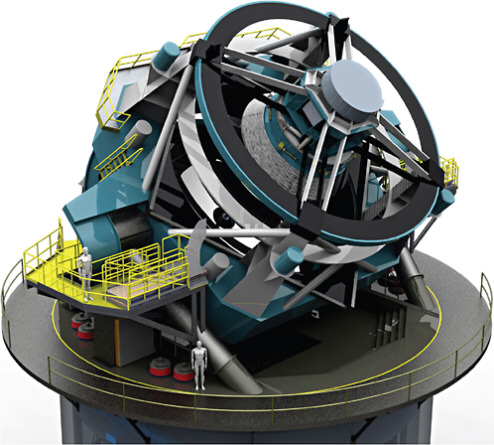
FIGURE 7.8 LSST has a three-mirror design with the primary and tertiary mirror combined and cast from a single blank. Preliminary grinding is already underway, and the secondary mirror has also been cast. An important figure of merit for a survey telescope is the etendue, which is the product of the field of view and the area. This is 320 m2 degree2 for LSST. The 3 GPx camera will read out in less than 2 seconds every 15 seconds, and more than 100 petabytes of data will be accumulated over the 10-year project lifetime. The limiting magnitude in a single visit is r = 24.5. The camera pixel scale is roughly 0.2 arcsecond, and the median seeing at the site is roughly 0.67 arcsecond. SOURCE: LSST Corporation.
The technical risk of LSST as determined by the survey’s cost appraisal and technical evaluation (CATE) process was rated as medium low. The committee did identify additional risk with establishing data management and archiving software environments adequate to achieving the science goals and engaging the astronomical community. The appraised construction cost is $465 million with a time to
completion of 112 months. The committee recommends that LSST be started as soon as possible, with, as proposed by the project, two-thirds of the construction costs borne by NSF through its MREFC line and a quarter by DOE using Major Item of Equipment (MIE) funds. The estimated operations cost is $42 million per year over its 10-year lifetime, of which roughly $28 million is proposed to be borne by the U.S. agencies—the committee recommends two-thirds of the federal share of operations costs be borne by NSF and one-third by DOE. It is recommended that any extended mission should only happen following a successful senior review. By its very nature LSST will stimulate a large number of follow-up studies, especially of a spectroscopic character. The planning and administration of an optimized plan for follow-up studies within the public-private optical-infrared system could be carried out by the National Optical Astronomy Observatory.
The top rank of LSST is a result of its capacity to address so many of the identified science goals and its advanced state of technical readiness.
Priority 2 (Large, Ground). Mid-Scale Innovations Program
Science and technology are evolving rapidly. Each decade, new discoveries open new opportunities, and scientists and engineers find novel and innovative approaches to designing instruments. Although there are regularly competed opportunities on timescales shorter than a decade for moderate-scale missions in space, on the ground there is no program that can compete and select mid-scale projects based on scientific merit and technical readiness as instruments mature and science advances. The committee was impressed by the large number of white-paper submissions for mid-scale ground-based projects that offer compelling science and novel technical approaches but that cannot be evaluated without a proper scientific and technical peer review.
The committee recommends, as its second-highest priority, a competed program, based on NASA’s highly successful Explorer model, that would enable moderate-scale projects to be frequently selected through peer review. Like the Explorer program, a mid-scale instrumentation and facility program at NSF—a program that the committee calls the Mid-Scale Innovations Program—would provide first-class science at moderate cost and would address the need to involve and train students in experiment design and instrumentation.
The need for such a program is driven by the fact that NSF-AST does not have a formal mechanism for competing proposals in the price range between the Major Research Instrumentation (MRI) program (less than $4 million) and the MREFC line (greater than $135 million in FY2010). It does accept unsolicited proposals in the mid-scale category, several of which have been funded, but without the head-to-head competitive peer review that ensures that the highest-priority needs are met. The committee therefore recommends the establishment of a competed Mid-Scale
Innovations Program for instrumentation and facilities in order to capitalize on a large variety of exciting science opportunities over the upcoming decade.
The program should issue roughly annual calls for proposals in two categories: (1) conceptual and preliminary design activities and (2) detailed design and construction projects. Important elements of the program include standard peer review and selection criteria with special attention to scientific merit, relevance to community-established strategic goals and roadmaps, project management, and planning for both operations and data archiving funding. Operations and data archiving could be proposed, but not necessarily fully funded, by the program. A periodic review of ongoing projects with clearly stated procedures for funding continuation or termination is recommended. Co-funding of mid-scale projects from non-NSF sources would be allowed but not required. The Mid-Scale Innovations Program funding line should be established at a level that enables the selection of a minimum of seven such projects spanning a range of scales over the decade—a rate that provides regular opportunities and accomplishes a broad range of science.
Of the 29 proposals for ground-based mid-scale projects submitted as white papers to the survey, a subset was considered compelling by the committee. Although it is not appropriate for the committee to rank concepts for a competed line, it lists in Table 7.1 the activities it found compelling. The indicated cost categories are based on submitted descriptions and not on any independent committee review. Appendix D provides additional background information on these projects. Other examples may be found in the PPP reports. Many similar instrument and small-facility concepts will undoubtedly emerge over the decade. It is important that the Mid-Scale Innovations Program maintain a balance between large and small projects. Indeed, such a program in NSF-AST could take on some of the larger Advanced Technologies and Instrumentation (ATI) projects, so that ATI would emphasize advanced technology development together with instrumentation below ~$2 million.
The recommended Mid-Scale Innovations Program is aimed primarily at instrumentation and facilities in order to be consistent with the goals of the program at NSF’s Directorate for Mathematical and Physical Sciences (NSF-MPS) and with the recommendations of the National Science Board (NSB)21 and NRC reports, but proposals for other types of initiatives in this cost range could be considered for funding if they present an especially compelling scientific case.
To support the committee’s recommendation, almost $400 million would be needed in this line over the decade, in addition to the funds needed to complete
TABLE 7.1 Projects Thought Compelling for the Mid-Scale Innovations Program (in alphabetical order)
|
Project Name |
Science Goal |
Cost Rangea |
|
Big Baryon Oscillation Spectroscopic Survey |
Determine the cause of the acceleration of the universe. |
Upper |
|
Cosmic Microwave Background Measurements |
Detect the signature of inflation and probe exotic physics in the earliest moments of the universe. |
Middle |
|
Exoplanet Initiatives |
Develop radial velocity surveys and spectrometers to determine the properties of extrasolar planets; understand extrazodiacal light levels. |
Middle and Lower |
|
Frequency Agile Solar Radiotelescope |
Understand the Sun’s atmosphere. |
Upper |
|
High-Altitude Water Čerenkov Experiment |
Map the high-energy (>1 TeV) gamma-ray sky. |
Lower |
|
Hydrogen Epoch of Reionization Array |
Determine how the universe is ionized after the formation of the first stars. |
Upper |
|
Next Generation Adaptive Optics Systems |
Enable near-infrared and visible wavelength imaging and spectroscopy at spatial resolution better than that of HST to address a broad science program from exoplanet studies to galaxy formation. |
Middle and Upper |
|
North American Nanohertz Observatory for Gravitational Waves |
Detect gravitational waves from the early universe through pulsar timing. |
Upper |
|
a Upper: $40 million to $100 million, middle: $12 million to $40 million, lower: <$12 million where costs are total project costs. |
||
similar projects already started. The committee recommends funding of this program at a level that builds up to $40 million per year by mid-decade (additional funds over the decade would fall between $93 million and $200 million). The current level of funding for mid-scale projects in NSF-AST, which occurs on an ad hoc basis, is estimated at roughly $18 million per year, including some technology, design, and development work for LSST, GSMT, and SKA.
The principal rationale for the committee’s ranking of the Mid-Scale Innovations Program is the compelling number of highly promising projects with costs between the MRI and MREFC boundaries, plus the diversity and timeliness of the science that they could achieve. There are advantages to putting this program at the NSF-MPS level where it would serve all the divisions, and also those to putting it at the NSF-AST level.
Priority 3 (Large, Ground). Participation in a Giant Segmented Mirror Telescope (GSMT)
Large telescopes in the 8- to 10-meter class have revolutionized the world of optical and near-infrared astronomy. Newly developed adaptive optics systems, which remove image distortions caused by the atmosphere, have made them even more powerful. Astronomers are poised to take the next major step—adaptive optics telescopes with 3 times the diameter, 10 times the optical collecting area, and up to 80 times the near-infrared sensitivity compared to existing telescopes. These Giant Segmented Mirror Telescopes (GSMTs) will be essential to understanding the distant galaxies discovered by JWST and to obtaining spectra of the faint transients found by LSST, and they will be transformative for a broad range of science aimed at understanding targets ranging from stars and exoplanets to black holes. Although they will function as observatories, they are integral parts of each of the survey’s target science areas as explained in Chapters 1 and 2. Operating in the optical and infrared (at 0.3 to 2.5 microns), the GSMTs excel at high-spectral- and high-spatial-resolution spectroscopy and will have a relationship to JWST similar to that of the 8- to 10-meter-class telescopes to HST.22
With every enormous leap in sensitivity come new discoveries we cannot anticipate, but the broad impact the GSMTs will have on the survey’s identified science questions is clear. The very first galaxies in the universe that will be found by JWST will require GSMTs for follow-up so as to determine their internal dynamical properties by studying the bulk motions of stars in a way that complements the gas observations of ALMA. GSMTs would also monitor how the chemical elements are built up. Their superb spatial resolution and astrometric capabilities would enable them to follow the orbits of individual stars around the several-million-solar-mass black hole in the center of our Milky Way galaxy so as to obtain precision measurements of fundamental galactic parameters. Direct imaging of exoplanet systems using the advanced adaptive optics cameras on these telescopes would also be an exciting area of study, given that GSMTs will have the highest angular resolution in the visible through infrared of any existing or planned facility, ground or space. They would also be able to study the reflected infrared emission of planets in the habitable zone. The ability of a GSMT to perform direct spectroscopy on very faint galaxies would be crucial in efforts to elucidate the properties of dark matter and merging black holes. These telescopes would transform understanding of stellar astronomy by taking high-dispersion spectra of local stars, mapping the flow of gas into and out of massive galaxies during their formative stage, and studying the formation of protoplanetary systems.
As discussed in Chapter 3, there are three projects underway in the world to construct and operate a new generation of extremely large telescopes with diameters in the range of 23 to 42 meters (Figure 7.9). The Giant Magellan Telescope (GMT) is composed of seven 8.4-meter mirrors and has an aperture equivalent to a single 23-meter mirror; it will be sited at the Las Campanas Observatory (Chile). The GMT design builds on the success of the two 6.5-meter Magellan Telescopes. The Thirty-Meter Telescope (TMT) is composed of almost 500 1.44-meter segments, has an aperture equivalent to a single mirror 30 meters in diameter, and will be sited at Mauna Kea (Hawaii). It builds on the success of the two 10-meter Keck Telescopes. The European Extremely Large Telescope (E-ELT) has a segmented mirror design with an aperture equivalent to a single mirror 42 meters in diameter. Its recommended site is at Cerro Armazones in Chile. The project is led by the European Southern Observatory (ESO) and has a mirror segment design similar to that of TMT.
The committee concluded that more than one GSMT will be required in the world to fully exploit the identified science opportunities. The reasons are that there are advantages to having capability in two hemispheres, or two in the same hemisphere with different instrument capabilities requiring different optimizations of telescope design, and that so many new scientific problems can be addressed that any credible number of GSMTs is likely to be oversubscribed. It is imperative that at least one of the U.S.-led telescope projects have U.S. federal investment. Such a federal role will leverage the very significant U.S. private investment, will maximize the potential for the project’s success, will help to optimize the U.S. scientific return on other federal investments (ALMA, JWST, and LSST), and will position the NSF for leadership in future large-telescope projects beyond GSMT. Since both GMT and TMT are already international public-private partnerships, federal involvement with either one is consistent with the international collaboration strategy that is a recurring theme in this survey and would ensure U.S. leadership in one international large telescope. Such leadership would further another important strategy advocated in this report: cooperation with other countries so as to develop complementary capabilities that will maximize the science output. In the case of GSMT this means coordination with ESO on technology development and instrument selection to create a global system of GSMTs with optimal complementary and scientific reach. The committee notes that public time on a GSMT would, in principle, be subject to the open skies policy in effect for all federally supported U.S. telescopes. It is the committee’s hope that a result would be corresponding reciprocal access to major optical-infrared telescopes abroad.
The committee reviewed a technical risk assessment and sensitivity analysis of the anticipated cost and schedule for GMT and TMT that indicated the risk is medium to medium high. A cost sensitivity study based only on the telescope optics and instruments concluded that the construction costs of GMT and TMT would be $1.1 billion and $1.4 billion, respectively (at a 70 percent confidence
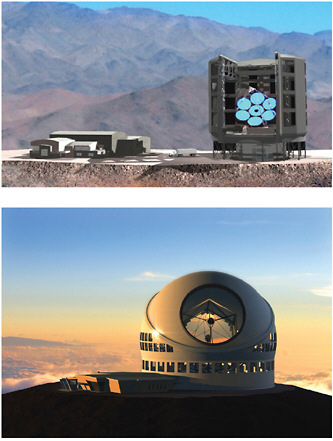
FIGURE 7.9 The two U.S. Giant Segmented Mirror Telescope projects. Upper: The Giant Magellan Telescope is a 25-meter-class telescope comprising seven 8.4-meter subapertures, one of which is already undergoing polishing. Laser tomography will provide adaptive optics correction in small fields over much of the sky, and correction for ground-level seeing will be incorporated over large fields. The baseline project includes an initial suite of three to four instruments to be selected in 2011 from eight concepts currently in development. Artist’s rendering of GMT and support facilities at Las Campanas, Chile. SOURCE: Courtesy of GMTO; image by Todd Mason/Mason Productions. Lower: The Thirty Meter Telescope primary mirror comprises 492 hexagonal segments with active control and a 30-meter-effective-diameter aperture. An on-axis segment has been cast and polished, and an off-axis segment is currently undergoing polishing. Nine instruments are planned for the first decade of operations, of which three are planned for first light. Most of these instruments operate in conjunction with sophisticated adaptive optics systems. SOURCE: TMT Observatory Corporation.
level). Assuming the current status of the projects, the dates for full operations of the two telescopes (defined as including three instruments and the adaptive optics system) were estimated as spring 2024 for GMT, and between summer 2025 and summer 2030 for TMT depending on assumptions about segment manufacture and delivery. The telescope projects estimated their annual operations costs (including facility and instrument upgrades) as being $36 million for GMT and $55 million for TMT. Although the committee did not analyze these estimates in detail, they are far below the usual rule of thumb for large projects (10 percent of construction costs per year); should the projects go forward, their operations costs will need to be scrutinized in considerable detail. The committee did not evaluate the cost estimate or risks for the E-ELT, but the ESO estimate is 1 billion with a start of operations in 2018.
The two U.S.-led projects, GMT and TMT, are in fairly advanced states of design. GMT has already cast one of its six off-axis mirrors, which is currently being polished. TMT has cast, polished, and mounted an on-axis segment and is in the process of polishing an off-axis segment. Furthermore, through a combination of private and international partnerships, both projects have made considerable progress on their financing. The question, now, is whether or not the federal government can afford to become a partner in one of these projects and, if so, which one. The arguments for federal partnership are strong. First, the science case for a GSMT is highly compelling, and a federal share will ensure access to observing time for all U.S. astronomers, not just those associated with partner institutions.23 This is a principle that is similar to the Telescope System Instrumentation Program (TSIP) program philosophy that has been so successfully implemented with respect to existing privately operated telescopes. Second, partnership can greatly enhance and improve these projects by bringing a much larger experience base and resources to them. This will be particularly important during the operations phase when funds to run the telescopes must be found and new and expensive instruments will need to be constructed.
In the committee’s judgment, due to the severe budget limitations, a federal partnership in a GSMT will be limited to a minority role with one project. For the construction phase, a potential MREFC funding wedge opens up in the second half of the decade (after ALMA, ATST, and LSST have passed their peak funding) that would allow for a federal share in a GSMT to be supported by the MREFC line by the end of this decade. For the operations phase, in the optimistic budget-
doubling funding scenario, some funding could be available by the last few years of the decade; in the flat budget scenario, few if any operations funds would be available in this decade.
However, the GSMT projects are at a pivotal point where some form of commitment from the U.S. government at this time will encourage additional collaboration and is crucial to having the projects go forward at all. Owing to the highly compelling science case for this class of telescope, the committee recommends immediate selection by NSF of one of the two U.S.-led GSMT projects for a future federal investment that will secure a significant public partnership role in the development, the operation, and telescope access. This action should facilitate access to and optimize the benefit of the largest ground-based telescopes for the entire U.S. community, by leveraging the significant private and international investments in this frontier endeavor. The committee further recommends as a goal that access should be sought at the level of at least a 25 percent share. This share could be secured through whatever combination of construction (that is, MREFC), operating funds, and instrumentation support is most favorable.
The committee believes that access to a GSMT will, as opportunities opened by large telescopes have in the past, transform U.S. astronomy by means of its broad and powerful scientific reach, and that federal investment in a GSMT is vital for the United States to be competitive in ground-based optical astronomy over the next two decades. These are the main reasons for its strong recommendation by the survey. The third-place ranking reflects the committee’s charge, which required the prioritization to be informed not only by scientific potential but also by the technical readiness of the components and the system, the sources of risk, and the appraisal of the costs. LSST and several of the concatenation of candidates for the Mid-Scale Innovations Program were deemed to be ahead of GSMT in these areas.
Priority 4 (Large, Ground). Participation in an Atmospheric Čerenkov Telescope Array (ACTA)
The last decade has seen the coming of age of very high energy (TeV) astronomy. Very high energy gamma-ray photons are observed from cosmic sources through the flashes of Čerenkov light that they create in Earth’s atmosphere. These events can be observed by large telescopes on the ground on moonless and cloudless nights, and the directions and the energies of individual photons measured. After a long U.S.-led period of development of this technique which yielded the discovery of a handful of sources, the field has taken off. The European facilities, HESS in Namibia and MAGIC in the Canary Islands, together, now, with the U.S. facility VERITAS in Arizona, have discovered 100 sources. These include active galactic nuclei, pulsars, supernova remnants, and binary stars. Astrophysicists have learned much about particle acceleration and can now rule out some models of
fundamental physics as well as constrain the properties of putative dark matter particles. Further progress is now dependent on building a larger facility exploiting new detector technology and a larger field of view so that the known sources can be studied in more detail and the number of sources can be increased by an order of magnitude (Figure 7.10).
Both the U.S. and the European communities are developing concepts for a next-generation array of ground-based telescopes with an effective area of roughly 1 square kilometer. The U.S. version of this facility (AGIS, the Advanced Gamma-ray Imaging System) was evaluated by the survey and the total cost, estimated to exceed $400 million, was considered too expensive to be entertained, despite technical risk being medium low. The European Čerenkov Telescope Array (CTA) is in a more advanced stage, and there is advantage in sharing the costs and operations in a Europe-U.S. collaboration. The committee recommends that the U.S. AGIS project join CTA for collaboration on a proposal that will combine the best features of both existing projects. Funding availability is likely to permit U.S. participation only as a minor partner, but the promise of this field is so high that continued involvement is strongly recommended. U.S. funding should be shared among DOE, NSF-AST, and NSF-PHY, as happened with VERITAS, and a notional $100 million spread between the agencies over the decade is recommended. Given the large project cost uncertainties, the current lack of a unified project plan, the project ranking, and the likely budget constraints in the coming decade, it will be necessary for the agencies to work quickly with the AGIS/CTA group to define a scope of U.S. involvement that is both significant and realistic.
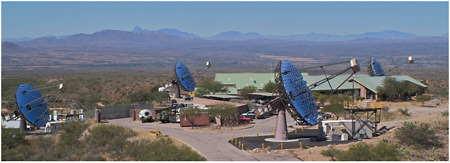
FIGURE 7.10 ACTA would be, like the pictured VERITAS (Very Energetic Radiation Imaging Telescope Array System), an array of Čerenkov telescopes used to detect very high energy (TeV) gamma rays emanating from astrophysical sources. The proposed ACTA telescope would be a larger-scale international version of this facility and similar ones located in Namibia and the Canary Islands that would increase the sensitivity by roughly an order of magnitude. SOURCE: Image courtesy of Steve Criswell, SAO.
The recommendation for ongoing U.S. involvement in TeV astronomy is based largely on the demonstrated recent accomplishments of this field and the prospect of building fairly quickly a much more capable facility to address a broad range of astronomy and physics questions over the next decade.
Recommendation for New Ground-Based Activities—Medium Project
Only one medium project is called out, because it is ranked most highly. Other projects in this category should be submitted to the Mid-Scale Innovations Program for competitive review.
Priority 1 (Medium, Ground). CCAT
CCAT (formerly the Cornell-Caltech Atacama Telescope) would be a 25-meter telescope operating in survey mode over wavelengths from 200 microns to 2 millimeters (Figure 7.11). CCAT is enabled by recent, dramatic advances in the ability to build millimeter-wave cameras with more than an order of magnitude more spatial elements than previously possible. This technical advance will enable a powerful submillimeter and millimeter telescope that can perform sensitive imaging surveys of large fields. ALMA, operating over the same band, is scheduled to begin full operations in 2014 and will produce high-resolution images and spectra of faint, and in some cases distant, sources. However, ALMA has a small field of view and is therefore inefficiently used to find the sources that it studies. CCAT will therefore be an essential complement to ALMA. It would excel as a sensitive survey facility, both for imaging and multiobject spectroscopy, with a field of view 200 times larger than that of ALMA. With a broad scientific agenda, CCAT will enable studies of the evolution of galaxies across cosmic time, the formation of clusters of galaxies, the formation of stars in the Milky Way, the formation and evolution of planets, and the nature of objects in the outer solar system.
The committee estimates a total development and construction cost of $140 million and an estimated start of operations in 2020.24 The technical risk was assessed as medium. It is recommended that NSF plan to fund $37 million of the construction cost. This funding amount, as well as a potential NSF contribution to operations at the requested level of $7.5 million, is contingent on an arrangement being negotiated that allows broad U.S. astronomical community access to survey products and competed observing time on a facility that should significantly enhance the U.S. scientific productivity of ALMA.
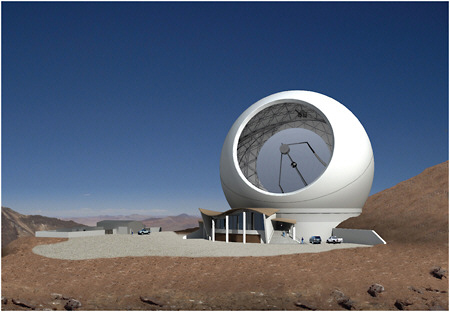
FIGURE 7.11 CCAT is a 25-meter telescope located at 18,500 feet elevation close to ALMA in Chile. The mirror surface has active control. CCAT will operate from 0.3 to 1.4 millimeters (with a goal of 0.2 to 3.5 mm) with a 10- to 20-arcminute field of view and diffraction-limited angular resolution of 10 × (wavelength in millimeters) arcsecond. Highly sensitive bolometer arrays with more than 10,000 sensors using superconducting transition edge sensor technology are envisaged. The flux sensitivity is limited by source confusion to around 1 mJy. SOURCE: M3 Engineering/CCAT/Caltech.
CCAT is called out to progress promptly to the next step in its development because of its strong science case, its importance to ALMA, and its readiness.
Small Additions and Augmentations to NSF’s Core Research Program
As discussed in Chapters 5 and 6, several changes to NSF’s core research program in ground-based astronomy are recommended. Collected here is an unranked list of the five components for which increases in funding are deemed most needed. Programs that are not mentioned are assumed to proceed with existing budgets, subject to senior review recommendations, although the committee emphasizes the importance of many small elements of the core research programs described in Chapter 5.
Advanced Technologies and Instrumentation
Competed instrumentation and technology development are supported, including computing at astronomical facilities in support of the research program, as described in Chapter 5. The current level of funding is roughly $10 million per year, and the survey’s proposal is to increase this to $15 million per year to accommodate key opportunities including, especially, advanced technology in adaptive optics development and radio instrumentation.
Astronomy and Astrophysics Research Grants Program
Competed individual investigator grants, as described in Chapter 5, provide critical support for astronomers to conduct the research for which the observatories and instruments are built. The current funding level has fluctuated, especially because of the welcome injection of ARRA funding, but the rough baseline is $46 million per year. An increase of $8 million for a total of $54 million per year is recommended. This increment should include the support of new opportunities in Laboratory Astrophysics.
Gemini Augmentation
An international partnership supports operations and instrumentation at the two international Gemini telescopes. As described in Chapter 6, the imminent withdrawal of the United Kingdom from the partnership will require that additional support be provided by the remaining partners. Set against this need is a desire to operate the telescopes more efficiently and achieve significant savings in operations costs. An augmentation of $2 million to the annual budget is recommended subject to the results of NSF’s exploring a restructuring of the management and operations of Gemini and acquiring an increased share of the observing time, as discussed in Chapter 6.
Telescope System Instrument Program
The TSIP trades competed support of telescope instrumentation on privately operated telescopes for competed observing time open to the entire U.S. astronomical community. As described in Chapter 6, this is a vital component of the OIR system that was instituted following advice presented in the 2001 decadal survey. It is currently supporting new telescope instrumentation at an average rate of roughly $2 million to $3 million per year and an increment to $5 million per year is recommended.
Theory and Computation Networks
A new competed program coordinated with a similar program proposed to NASA, Theory and Computation Networks will, as described in Chapter 5, support coordinated theoretical and computational attacks on selected key projects that feature prominently in the science program and are judged ripe for such attention. An NSF annual funding level of $2.5 million is recommended.
RECOMMENDATIONS FOR THE AGENCIES
The committee used a sandchart tool as an existence proof that its recommended phased program for each agency—NASA, DOE, and NSF—would fit within the suggested and envisioned decadal budget. It is recognized that budgets may indeed shift as the decade proceeds, relative to the committee’s assumptions. Therefore, the charts are perceived as most useful for conveying the committee’s intended staging of the different activities it has recommended.
NASA Astrophysics
The recommended program for NASA has been constrained to fit within an Astrophysics Division budget for the decade that is flat in FY2010 dollars. In round numbers, $3.7 billion is available for new initiatives and augmentations to existing programs within the 2012-2021 budget submissions. As indicated by the example shown in Figure 7.12, it is possible to accommodate the recommended program within the profile, launching WFIRST by the end of the decade; enhancing the Explorer program; getting a good start on LISA; carrying out the IXO, New Worlds, and Inflation Probe technology development programs; making essential augmentations to the core research program; and contributing to SPICA. Of course, there are many contingencies. For example, if LISA fails to satisfy either of the conditions specified by the survey committee, or if WFIRST, as recommended here, becomes a collaborative mission, it could be possible to accelerate IXO.
The committee was charged by NASA to consider a more conservative budget projection based on an extrapolation of the President’s FY2011 budget submission that projects roughly $700 million less funding, or $3.0 billion available over the decade. In the event that insufficient funds are available to carry out the recommended program, the first priority is to develop, launch, and operate WFIRST and to implement the Explorer program and core research program recommended augmentations. The second priority is to pursue the New Worlds Technology Development Program, as recommended, to mid-decade review by a decadal survey implementation advisory committee (as discussed in Chapter 3), to start LISA as soon as possible subject to the conditions discussed above, and to invest in IXO
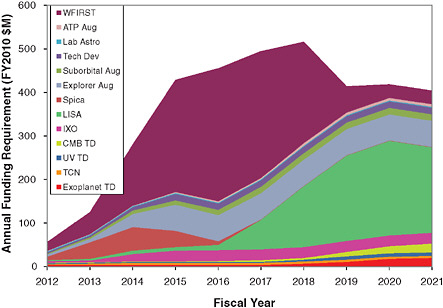
FIGURE 7.12 Astro2010-recommended program for NASA—example phasing. This sandchart is the outcome of a committee exercise carried out in FY2010 dollars to show that the phased program recommended would fit within the budget constraints adopted by the committee in developing its recommendations. The profiles and budget costs will vary on a project-by-project and program-by-program basis and should not be taken as representing a literal recommended program. The sandcharts are presented here to show, as an existence proof, that within a budget that is flat for the decade in FY2010 dollars the Astro2010-recommended new initiatives and program augmentations are implementable within NASA SMD spending limits.
technology development as recommended. The third priority is to pursue the CMB Technology Development Program, as recommended, to mid-decade review by a decadal survey implementation advisory committee. It is unfortunate that this reduced budget scenario would not permit participation in the JAXA-SPICA mission unless that mission’s development phase is delayed.
NSF Astronomy
The proposed program for NSF has been constrained to fit within an NSF-AST budget doubling scenario, in which $500 million becomes available by 2021 for new activities and the annual NSF-AST budget rises to $325 million. As the example presented in Figure 7.13 shows, it is possible to fund early operations for LSST beginning in 2016, build up the Mid-Scale Innovations Program augmentation,
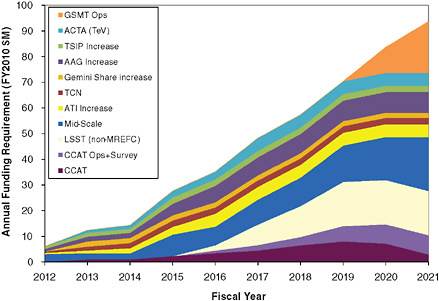
FIGURE 7.13 Astro2010-recommended program for NSF—example phasing. This sandchart is the outcome of a committee exercise carried out in FY2010 dollars to show that the phased program recommended would fit within the budget constraints adopted by the committee in developing its recommendations. The profiles and budget costs will vary on a project-by-project and program-by-program basis and should not be taken as representing a literal recommended program. The sand-charts are presented here to show, as an existence proof, that within a “doubling” budget over the decade the Astro2010-recommended new initiatives and program augmentations are implementable within NSF-AST spending limits.
complete CCAT, augment the core research program, and collaborate on ACTA. The timescale for starting to operate GSMT is quite uncertain, but this option can also be accommodated toward the end of the decade. As regards the sequencing of LSST and GSMT, in this and the two budget scenarios that follow, it is assumed that LSST would enter the MREFC process as soon as the budgets would allow and that GSMT would follow.
In the event that the realized budget is closer to an extrapolation of the president’s FY2011 budget, that is, between the optimistic budget-doubling and the pessimistic flat-budget scenarios, the order of priority is to phase in the recommended core research program augmentations and the Mid-Scale Innovations Program together and at as fast a rate as the budget will allow, noting that the recommended Gemini augmentation is time-critical. LSST would receive an MREFC start and require NSF-AST operations funding beginning in 2016. NSF-AST sup-
port for GSMT operations and ACTA collaboration both would be delayed until funding becomes available.
If the realized budget is truly flat in FY2010 dollars, the implication is that, given the obligation to provide operational costs for the forthcoming ALMA and ATST, there is no possibility of implementing any of the recommended program this decade—without achieving significant savings through enacting the recommendations of the first 2006 senior review process and/or implementing a second more drastic senior review before mid-decade. Because the termination of programs takes time to implement in practice, it will be difficult to accrue significant new savings before the end of the decade. Thus, in practice, very few new activities could be started within NSF-AST.
DOE High Energy Physics
A program fitted under the DOE budget doubling scenario means that roughly $40 million per year would be available by the end of the decade, after due allowance for an underground dark matter detection program as recommended by HEPAP-PASAG. As indicated by the example shown in Figure 7.14, this amount will be sufficient to allow participation in LSST, WFIRST, and ACTA as well as some of the smaller astrophysical initiatives recommended by HEPAP-PASAG under Scenario C. In addition, a $2 million per year Theory and Computation Networks program is recommended.
However, if the budget is lower, the HEPAP-PASAG recommended investment in dark matter detection will be reduced and the available funds will decrease to $15 million under Scenario A. DOE is a minor partner in the two largest projects that the survey committee has recommended—LSST and WFIRST—and it is likely that the phasing will involve choices by NSF and NASA, respectively. Other considerations being equal, the recommended priority order is to collaborate first on LSST because DOE will have a larger fractional participation in that project, and its technical contribution is thought to be relatively more critical. ACTA, Theory and Computation Networks, and the smaller initiatives have lower priority.
EPILOGUE
This is an extraordinary time in astronomy. The scientific opportunities are without precedent—finding and characterizing other planets like Earth, tracing the history of the cosmos from the time of inflation to our own galaxy and solar system today, detecting the collisions of black holes across the universe, and testing the implications of Einstein’s theories a century after they were formulated. The tools are becoming available to make giant strides toward deciphering the mysteries of the two primary components of the cosmos—dark energy and dark matter—and
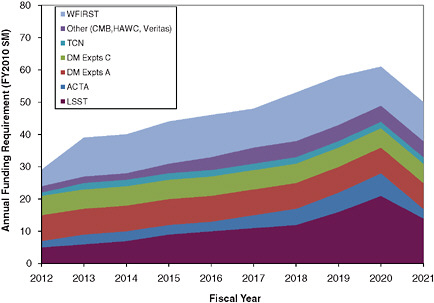
FIGURE 7.14 Astro2010-recommended program for DOE—example phasing. This sandchart is the outcome of a committee exercise carried out in FY2010 dollars to show that the phased program recommended would fit within the budget constraints adopted by the committee in developing its recommendations. The profiles and budget costs will vary on a project-by-project and program-by-program basis and should not be taken as representing a literal recommended program. The sandcharts are presented here to show, as an existence proof, that within a “doubling” budget over the decade the Astro2010-recommended new initiatives and program augmentations are implementable within DOE High Energy Physics spending limits.
toward discovering the prevalence of life in the universe. The discoveries that will be made will profoundly change our view of the cosmos and our place within it.
Astronomy, ever young, is vibrant and currently growing by attracting enthusiastic and skilled newcomers from other fields—particle physics, biology, chemistry, computer science, and nuclear physics—and traditional astronomers’ professional horizons are enlarged by learning from them. This is truly a privileged time to be an astronomer.
Changes are apparent now in the way research is being done. It is more ambitious. And it is also more collaborative and more international, which enlarges the realm of what is achievable. This context complicates the task of preparing a strategic vision and necessitates a new fiscal, technical, and temporal realism at a time of constrained economic resources in the United States that will inevitably lead to a smaller fraction of the global research effort supported by the federal government.
The committee has been strategic in its thinking, crafting a program that optimizes the scientific return, building on previous public investment in astrophysics while making difficult choices in laying a foundation for the next decade.
The committee notes the unprecedented level of effort and involvement in this survey by the astronomical community, with hundreds of astronomers and astrophysicists attending town hall meetings, contributing white papers, and serving on panels. The vision put forth in this report is a shared vision.


