
2
On the Threshold
A confluence of stunning discoveries, technological advances, and powerful ideas has made this a remarkable time in astronomy and astrophysics. The discovery of dark energy and exoplanets, the development of new digital detectors across the electromagnetic spectrum, dramatic advances in computing power, and big ideas from particle physics have us poised for major leaps in our comprehension of the universe and our place within it.
Over the next decade we will be able to trace our origins, from the quantum fluctuations that seeded galaxies in the infant universe, to the origin of atoms and dark matter, to the first stars and galaxies, and to the formation of planetary systems like ours. We are also primed to understand how the most exotic objects in the universe work, including supermassive black holes and neutron stars, as well as to figure out how planetary systems form, how common are planets in the habitable zone around stars, and how to find evidence for life elsewhere.
During the decade we will push the frontiers of basic knowledge, using the universe as a laboratory to identify the exotic dark matter and understand the even more mysterious dark energy, probe the basic properties of neutrinos and determine how they shaped the universe, and test whether or not Einstein’s theory of gravity fully describes black holes. Although astronomy is the oldest science, it is constantly being reborn, and we can anticipate great surprises from all the new tools that are becoming available such as opening up time-domain astronomy and the exploration of the universe with gravitational waves.
In what follows the committee casts the compelling questions for the next decade and beyond in four thematic areas: discovery, origins, understanding the
cosmic order, and frontiers of knowledge. These questions resulted from the careful surveying of the current state of research in astronomy and astrophysics done by Astro2010’s five Science Frontiers Panels (SFPs), later synthesized by the committee.1 An assessment of the readiness of the astronomy and astrophysics enterprise to answer these questions led directly to the science program described in later chapters.
DISCOVERY
New technologies, observing strategies, theories, and computations open vistas on the universe and provide opportunities for transformational comprehension, i.e., discovery.
Science frontier discovery areas:
-
Identification and characterization of nearby habitable exoplanets,
-
Gravitational wave astronomy,
-
Time-domain astronomy,
-
Astrometry,2 and
-
The epoch of reionization.
Scientific progress often follows predictable paths. Through keen insight and diligent pursuit, questions are asked and answered, and knowledge is recorded. But many of the most revolutionary discoveries in science are made when a new way of perceiving or thinking about the universe evaporates the fog that had obscured our view and reveals an unimagined cosmic landscape all around us. The history of astronomy is replete with these revelatory moments. This capacity of the universe to astonish us was certainly evident during the past decade. Here the committee lists just a few of the most far-reaching examples.
The surprising discovery in 1998 that the expansion of the universe is accelerating rather than slowing, due to the repulsive gravity of dark energy, has changed the way we think about the evolution and destiny of the universe and has challenged our understanding of physics at the most fundamental level. In the coming decade, an optimized and coordinated set of facilities on the ground and in space will test whether the simplest hypothesis—dark energy is the quantum energy of
|
1 |
The charge to the SFPs and their findings are summarized in Appendix A. Their reports are contained in the present report’s companion volume, National Research Council, Panel Reports—New Worlds, New Horizons in Astronomy and Astrophysics, The National Academies Press, Washington, D.C., 2011. |
|
2 |
Astrometry is the measurement of the motions of stars. |
the vacuum—is the correct explanation or if something more exotic is needed, as must be the case for the inflationary epoch, an earlier period of acceleration. It is even possible that a modification of Einstein’s general relativity will be needed. Either way, the implications for both astronomy and physics are profound.
Telescopes are time machines: because light travels across the cosmos at a finite speed, the most distant objects probe the furthest back in time. The 13.7-billion-year-old cosmic microwave background is seen in the millimeter band. The latest record holder (early 2010) for the most distant object is a gamma-ray burst that occurred 13.1 billion years ago when the universe was 0.6 billion years old. It was detected by a NASA Explorer program satellite called Swift, and its distance was measured by follow-up observations from telescopes on the ground. In the coming decade, powerful new observatories on the ground and in space will allow us to push back to still earlier times and glimpse the end of the cosmic dark ages signaled by the formation of the first-ever luminous sources in the universe—the first generation of stars.
Closer to home, the past decade has seen the discovery of well over 400 planets orbiting nearby stars. Although the existence of extrasolar planets had long been anticipated, the astonishing discovery is that the planets and their orbits seem to be nothing like our own. In the coming decade, new facilities on the ground and in space will enable us to detect potentially life-bearing planets similar to Earth.
Looking forward, the most promising areas for revolutionary discoveries are highlighted in the following subsections. This is indeed a special time in history. The unexpected can be expected with confidence.
The Discovery of Habitable Planets
We are rapidly building our knowledge of nearby analogs to our own solar system’s planets, most recently with the launch of NASA’s Kepler mission. The salient feature of the planetary menagerie of which we are currently aware is its diversity—in every measureable sense—of the properties of the planets as well as the properties of the stars around which they orbit. We are also improving our understanding of the planet formation process, and ALMA is expected to unveil the birthing of new worlds.
Until now detection methods have only been able to discover massive planets rivaling the giants in our solar system (Figure 2.1 upper) or larger objects (Figure 2.1 lower). The most profound discovery in the coming decade may be the detection of potentially habitable Earth-like planets orbiting other stars. To find evidence that life exists beyond our Earth is a longstanding dream of humanity, and it is now coming within our reach.
The search for life around other stars is a multi-stage process. Although JWST may be able to take the first steps, more complex and specialized instrumentation
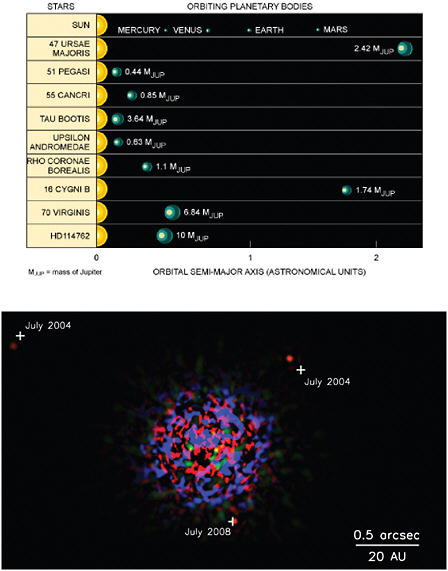
FIGURE 2.1 Upper: Montage of some of the first extrasolar systems discovered using the radial velocity technique, compared with our inner solar system. SOURCE: Geoff Marcy, University of California, Berkeley, and Paul Butler, Carnegie Institution for Science. Lower: Adaptive optics image obtained at the Gemini and Keck Observatories of three planetary-mass objects orbiting the nearby A star HR 8799. The bright light from the star has been subtracted to enable the faint objects to be seen. A dust disk lies just outside the orbits of the three planets, just as in our solar system the Kuiper belt lies outside the orbit of Neptune at 30 AU. SOURCE: National Research Council of Canada–Herzberg Institute of Astrophysics, C. Marois and Keck Observatory.
is also needed, requiring a longer-term program. First, the frequency with which Earth-size planets occur in zones around stars where liquids such as water are stable on planetary surfaces must be measured (see Box 2.1). Stars will then be targeted that are sufficiently close to Earth that the light of the companion planets can be separated from the glare of the parent star and studied in great detail; this will allow us to find signatures of molecules that indicate a potentially habitable environment. Here, the opportunities are suddenly bountiful, as we have understood over this past decade that, for example, stars much lower in mass than our Sun may have orbiting habitable planets that are much easier to spot. Thus, the plan for the coming decade is to perform the necessary target reconnaissance surveys to inform next-generation mission designs while simultaneously completing the technology development to bring the goals within reach. This decade of dedicated preparatory work is needed so that, one day, parents and children can gaze at the sky and know that a place somewhat like home exists around “THAT” star, where life might be gaining a toehold somewhere along the long and precarious evolutionary process that led, on Earth, to humankind. And perhaps it is staring back at us!
A Bold New Frontier: Gravitational Radiation
In the coming decade, a radically new window on the cosmos will open, with the potential to reveal signals of phenomena ranging from the processes that shaped the earliest era of the universe to the collisions and mergers of black holes in the more recent history of the universe. Einstein’s theory of relativity tells us that space and time are inextricably linked to form space-time (Figure 2.2). Space-time is malleable: its shape is determined by the distribution of mass and energy in the universe. Massive bodies ripple space-time as they move, creating gravitational waves that propagate through the cosmos at the speed of light, unimpeded by even the densest material. The direct detection of gravitational waves requires measurements at a level of exquisite precision and sensitivity that is just now within our reach.
The daunting challenges associated with building kilometer-size detectors whose distortion by passing gravitational waves can be measured to less than one-thousandth the radius of a single proton have been overcome. By mid-decade a worldwide array of ground-based detectors such as Advanced LIGO will be operating. Like electromagnetic waves, gravitational waves span a spectrum, with more massive objects typically radiating at longer wavelengths. These ground-based experiments will probe the short-wavelength part of the spectrum, enabling us to observe the mergers of neutron stars and possibly to see the collapse of a stellar core in the fiery furnace of a supernova explosion.
However, even more promising are signals in a completely different part of the gravitational wave spectrum, at longer wavelengths, predicted to result from mergers of massive black holes during the build-up of galaxies. Detecting these
|
BOX 2.1 Other Worlds Around Other Stars The detection and study of exoplanets—planets orbiting other stars—is expanding into the realm of Earth-like planets, less than 15 years after the discovery of the very first planet orbiting a star like the Sun. More than 400 planets are known, most discovered by the ground-based Doppler spectroscopic technique, in which telescopes look for a slight variation in radial velocity in stars like the Sun, and in smaller stars. An operating “transit” telescope in space today is capable of detecting planets the size of our own and smaller (Figure 2.1.1). NASA’s Kepler mission, launched March 6, 2009, observes more than 100,000 stars in the “Orion arm” of our Milky Way galaxy for a telltale dip in their light output which, if regular and repeatable, represents the passage or transit of a planet in front of the star. A French and European Space Agency precursor to Kepler, called COROT, has during its 2½ years of observations already detected planets as small as about 1.7 times the diameter of Earth. With these missions in operation, we will know in the next 5 years just how common Earth-size planets located on short orbits close to their stars might be in our galactic neighborhood. 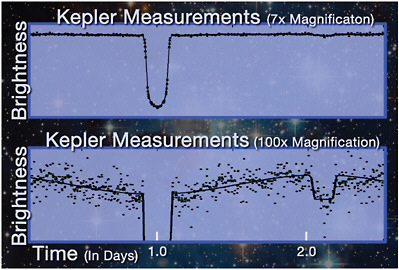 FIGURE 2.1.1 Kepler measurements of the light from HAT-P-7. The larger dip is that due to a planet about 1.4 times the radius of Jupiter transiting in front of the star, reducing the light of the star by about 0.7 percent. Such a drop has been observed from ground-based telescopes. However, the smaller drop, about 0.013 percent of the light of the star, is seen by Kepler as the planet itself passes behind the star—hence Kepler is directly detecting the light of the planet itself. Such accuracy and precision are beyond ground-based telescopes and are sufficient to detect an Earth-size planet in transit across Sun-like stars. SOURCE: NASA press release and W.J. Borucki, D. Koch, J. Jenkins, D. Sasselov, R. Gilliland, N. Batalha, D.W. Latham, D. Caldwell, G. Basri, T. Brown, J. Christensen-Dalsgaard, et al., Kepler’s optical phase curve of the Exoplanet HAT-P-7b, Science 325:709, 2009. |
|
Meanwhile, exoplanets ranging in size from Jupiter to Neptune are being studied from ground- and space-based observatories, revealing exotic weather systems and strange chemical patterns that differ from those in our solar system (Figure 2.1.2). On HD189733b, in a close circular orbit around its star, day-night temperatures are so extreme that supersonic winds may flow around the Jupiter-size planet. The Spitzer infrared space telescope has measured the light from a number of Jupiter-class exoplanets, hence determining atmospheric compositions. HD80606b, a giant planet observed by Spitzer, has an elliptical orbit that brings it alternately close to and far from its parent star so that its atmospheric temperatures change by many hundreds of degrees Celsius over 6 hours. Data on planet sizes, when combined with ground-based measurements of the planetary masses, yield densities. Many of these planets are less dense than gaseous Jupiter, whereas others are much denser, indicating a range of interior compositions and structures. Spitzer has the capability to see planets less than twice the diameter of Earth transiting the smallest stars, or M dwarfs, and its successor the James Webb Space Telescope will be even more sensitive when launched in 2015. The era of study of the properties of rocky planets around other stars, cousins of Earth, is underway. 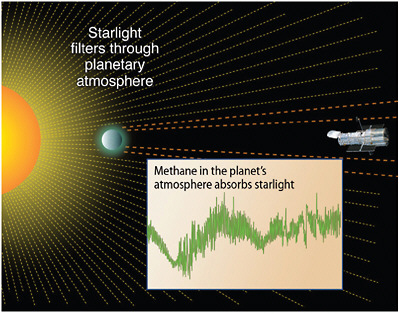 FIGURE 2.1.2 Spectrum (data points) of the exoplanet HD 189733b taken with the Hubble Space Telescope NICMOS instrument, compared with two model atmospheric compositions. The better fit with methane constitutes the first evidence for an organic molecule in an exoplanet, in this case one about the size and mass of Jupiter orbiting very close to its parent star. SOURCE: Inset adapted from M.R. Swain, G. Vasisht, and G. Tinetti, The presence of methane in the atmosphere of an extrasolar planet, Nature 452:329-331, 2008. |
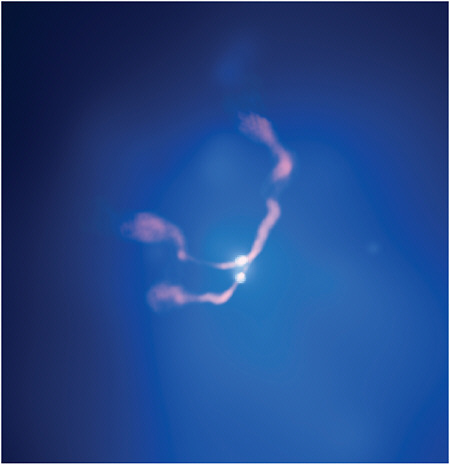
FIGURE 2.2 The source 3C 75, shown here in X-rays (blue) and radio waves (pink), is a rare example of two galaxies caught in the act of merging. Not only do their stars merge, but their central black holes—each producing a pair of jets containing gas moving outward at a speed close to that of light—also will do likewise in perhaps a few hundred million years. Many similar mergers involving smaller black holes in the nuclei of younger galaxies are thought to have taken place. When black holes coalesce, they create intense bursts of gravitational radiation. SOURCE: X-ray—NASA/CXC/AIfA/D. Hudson and T. Reiprich et al. Radio—NRAO/VLA/NRL.
signals will require deploying a space-based observatory with detectors separated by millions of kilometers to achieve the required sensitivity. Detection of these mergers would provide direct measurements of the masses and spins of supermassive black holes and the geometry of the universe on its largest scales. Powerful tests of our understanding of how black holes and galaxies form and evolve will be possible. We are on the verge of a new era of discovery in gravitational wave astronomy.
In addition, gravitational waves could have been created by exotic processes occurring in the young universe and would have been propagating freely to us ever since. Several speculative sources such as cosmic strings and abrupt changes in the form that the contents of the universe assumed—phase changes, like the change from water to ice—have been suggested, but the truth is that we do not quite know what to expect. A possible way to see if there are any measurable signals with wavelengths of roughly light-years employs very precise radio measurements of naturally occurring cosmic “clocks” called pulsars.3 Spread across the sky, the separations between these cosmic clocks will change as a long-wavelength gravitational wave passes by, potentially measurably changing the arrival times of their radio pulses.
Opening the Time Domain: Making Cosmic Movies
By eye, the universe appears static apart from the twinkling of starlight caused by Earth’s atmosphere. In fact, it is a place where dramatic things happen on timescales we can observe—from a tiny fraction of a second to days to centuries. Stars in all stages of life rotate, pulsate, and undergo activity cycles while many flare, accrete, lose mass, and erupt, and some die in violent explosions. Binary neutron stars and black holes merge, emitting, in addition to bursts of radiation, gravity waves. Supermassive black holes in the centers of galaxies swallow mass episodically and erupt in energetic outbursts. Some objects travel rapidly enough for us to measure their motion across the sky.
Our targeted studies of variations in the brightness and position of different objects indicate that we have only just begun to explore lively variations in the cosmos. If we study the temporal behavior of the sky in systematic ways and over wide ranges of the electromagnetic spectrum, we are sure to discover new and unexpected phenomena. In the highest-energy portion of the electromagnetic spectrum, where the universe shows its greatest variability, the value of viewing large areas of the sky repeatedly on short timescales has been amply demonstrated by the breakthrough capabilities of the Fermi Gamma-ray Space Telescope. The impact of such surveys will be broad and deep, and the committee gives just a few illustrative examples of what the future holds.
In our own solar system, new temporal surveys will discover and characterize a vast population of relic objects in the outer reaches of the solar system. These Kuiper belt objects, of which Pluto is the nearest large example, are the icy residue left over from the formation of our solar system about 4.5 billion years ago. As such, they are the fossil record of events that we can otherwise only theorize about.
Moving farther away, monitoring the apparent motions of large samples of stars offers a three-dimensional view of the structure of the Milky Way that is unobtainable by other means. In this decade, precision space-based measurements with the European mission GAIA will map out the structure of the Milky Way in exquisite detail, enabling us to complete our understanding of the formation of our galactic neighborhood. Direct geometric measurements of distances to the galactic center, to major regions of star formation in the Milky Way, to nearby galaxies, and, most importantly, to galaxies at cosmological distances are possible using precision radio astronomy.
Stars can end their lives with dramatic explosions of astounding observational variety. A particular class, Type Ia supernovae, results from the sudden thermonuclear conflagration of a white dwarf (a dense object with the mass of the Sun and the radius of Earth) and produces a quantifiable amount of visible energy that can be used to map out the geometry of the universe. It remains a theoretical challenge to explain the empirical relation between peak brightness and duration that is used in these critical cosmological studies. Alternatively, supernova explosions of the Type II variety, which are due to the collapse of a single massive star that has exhausted its nuclear fuel, create many of the elements heavier than helium and sometimes produce gamma-ray bursts—intense flashes of gamma rays lasting only seconds (Figure 2.3). Again, we do not understand the mechanisms at
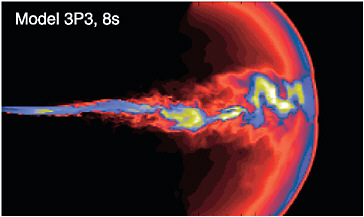
FIGURE 2.3 Numerical simulation of a gamma-ray burst showing a jet propagating out through a collapsing, massive star. Many gamma-ray bursts are associated with the supernova explosions of massive stars. The powerful bursts of gamma rays are produced by hot gas moving outward through the collapsing star at close to the speed of light. The most distant discrete source that has been observed thus far in the universe is a gamma-ray burst. SOURCE: W. Zhang, S.E. Woosley, and A. Heger, The propagation and eruption of relativistic jets from the stellar progenitors of gamma-ray bursts, Astrophysical Journal 608:365-377, 2004. Reproduced by permission of AAS.
work. The correct answers are quite likely to surprise us. Time-domain surveys of the sensitivity and scope envisioned in the coming decade will increase by orders of magnitude the number and character of stellar explosions that we can study, allowing us to connect variations in the host galaxies and progenitors to the energy and characteristics of the explosions. Supernovae are critical markers both for mapping out the cosmos and for understanding the formation of heavy elements that are found in all of us, and so these studies are essential for understanding our origins.
By surveying large areas of the sky repeatedly, once every few days, we anticipate the discovery of the wholly unanticipated. Endpoints of stellar evolution we have yet to imagine, and the behavior of ordinary stars outside our experience, could be discoveries that cause us to dramatically revise our cosmic understanding. Exotic objects and events never before anticipated may be revealed. The full realization of time-domain studies is one of the most promising discovery areas of the decade. Advanced gravitational wave detectors will open up a new window on the transient universe, including the last stages of binary neutron star and black hole mergers. Studying electromagnetic counterparts of gravity wave bursts will help illuminate the nature of the sources.
Giving Meaning to the Data: Cyber-Discovery
The powerful surveys described above will produce about a petabyte (1 million gigabytes) of data—roughly as much data as the total that astronomers have ever handled—every week. The data must be quickly sifted so that interesting phenomena can be identified rapidly for further study at other wavelengths. Interesting phenomena could also be discovered by cross-correlating surveys at different wavelengths. Vast numbers of images must be accurately calibrated and stored so that they can be easily accessed to look for motion or unusual behavior on all timescales. As daunting as it sounds, the technology and software that enable the accessing and searching of these enormous databases are improving all the time and will enable astronomers to search the sky systematically for rare and unexpected phenomena. This is a new window on the universe that is opening thanks to the computer revolution.
Another way in which computers will enable discovery in the coming decade is through increasingly sophisticated numerical simulations of the complex physical systems that are at the heart of much of astrophysics. The merging of two black holes, the growth of disks and the planets that form within them, the origin of large-scale structures that span the cosmos, and the formation of galaxies from the cosmic web are examples. Such simulations have great potential for discovery because they can illuminate the unanticipated behavior that can emerge from the interactions of matter and radiation based on the known physical laws. Through
computer modeling, we understand the deep implications of our very detailed observational data and formulate new theories to stimulate further observations.
Discovery Through the Power of Mathematics, Physics, and the Imagination
Finally, it is important to remember that many of the most far-reaching and revolutionary discoveries in astronomy were not solely the direct result of observations with telescopes or numerical simulations with computers. Rather, they also sprang from the imagination of inspired theorists thinking in deep and original ways about how to understand the data, and making testable predictions about new ideas. Examples range from the prediction that the chemical elements heavier than hydrogen and helium must have been created inside nuclear furnaces in the cores of stars, to the idea that the infant universe underwent a period of extremely rapid expansion called inflation, to the prediction of exotic objects like black holes, neutron stars, and white dwarfs, and the prediction that planets are a typical byproduct of normal star formation.
In the coming decade, major challenges loom that require the development of fundamental new theories. Observations and computer simulations are necessary components, but to complete the path from discovery to understanding, theorists will need to freely exercise their imaginations.
ORIGINS
Study of the origin and evolution of astronomical objects including planets, stars, galaxies, and the universe itself can elucidate our origins.
Science frontier questions related to origins:
-
How did the universe begin?
-
What were the first objects to light up the universe, and when did they do it?
-
How do cosmic structures form and evolve?
-
What are the connections between dark and luminous matter?
-
What is the fossil record of galaxy assembly from the first stars to the present?
-
How do stars form?
-
How do circumstellar disks evolve and form planetary systems?
Astronomical science is the study of origins. Where did we come from as an intelligent species on a single planet in a vast cosmos? How did the cosmos itself begin, and how did the first stars and the structures of star clusters, galaxies,
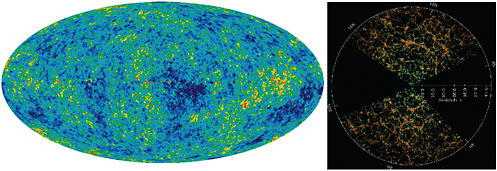
FIGURE 2.4 Left: Image of the tiny fluctuations in temperature—roughly 10 parts per million—of the cosmic microwave background as observed by the WMAP satellite. The radiation that is observed was emitted when the universe was roughly 400,000 years old. The red regions are warmer and the blue regions colder. A careful analysis of these data shows that there is a preferred angular scale of 1 degree—about the size of the Moon—called the first acoustic peak in the dark matter density containing roughly 100,000 galaxies like our Milky Way galaxy. SOURCE: NASA/Wilkinson Microwave Anisotropy Probe Science Team. Right: The same feature can be seen in the distribution of galaxies around us today as exhibited by the Sloan Digital Sky Survey in a 2.5-degree-thick slice of the northern equatorial sky where color corresponds to galaxy luminosity. Here it is called a baryon acoustic oscillation. The expansion of the universe by a factor of 1,000 makes the size of the feature about 400 million light-years. Monitoring the growth of this feature as the universe expands is one of the best approaches to understanding the behavior of dark energy. SOURCE: Michael Blanton and Sloan Digital Sky Survey (SDSS) Collaboration, http://www.sdss.org.
and clusters of galaxies arise? Is our universe just one of an infinite number of others—one with properties allowing for life—or is it instead an extraordinarily remarkable and singular thing? How did our galaxy, Sun, and planet Earth form? These questions, expressed in different ways, have profoundly affected human beings across cultures for as long as human thought has been written down or propagated through oral tradition. The remarkable findings of the 20th century were that the universe had a single explosive origin and that the galaxies, stars, and planets we observe not only are common, but also are the evolved expression of structure embedded within the universe since its very beginning (Figure 2.4). These realizations have both scientific and philosophical implications, and they have spawned a multitude of fascinating questions about our origins that we are racing toward answering in the 21st century.
The Origin of the Universe: The Earliest Moments
We know, from observations over the last decade of the microwave background and the early constituents of the universe, that the universe—all matter, space, and
time itself—began 13.7 billion years ago in the big bang, and we are now telling the story of the universe with a confidence that has grown considerably over the last 10 years. We think that, just after the big bang, the universe was totally different from what it is today—none of the elementary particles that we know compose the matter of today were present. The universe was an incredibly dense knot of highly curved space-time. Then came an era of cosmic inflation, during which the universe rapidly expanded by a truly enormous factor (at least a factor of 100 trillion trillion in growth). The laws of quantum mechanics suggest that random fluctuations at the time of inflation would have produced microscopic density variations from place to place, which expanded with the universe to became macroscopic variations today. Remarkably, astrophysicists are able to connect the giant filaments and voids in the great cosmic web of galaxies to the seeds from which they grew. However, just as the cause of the current acceleration is unknown, so also is the underlying detailed physics of inflation still a complete mystery.
About 400,000 years after the big bang, the continued expansion and cooling of the universe had dropped the temperature to about 3,000 degrees, which was cool enough for the first hydrogen atoms to form. This is the epoch of recombination. A fundamental change in the universe occurred at that time when the cosmos went from being filled with a plasma that was opaque to light to being filled with an atomic gas through which light could freely pass. It is this freely streaming radiation that we observe at radio wavelengths as the faint glow known as the cosmic microwave background (CMB). The near uniformity of the CMB observed across the sky and the nature of the minute brightness fluctuations we measure in the CMB are just what is expected if inflation occurred. The CMB is therefore a fantastic signal telling us about the early universe.4
The First Sources of Light and the End of the Cosmic Dark Ages
Following the recombination and the formation of the first atoms, the early universe was a nearly formless primordial soup of dark matter and gas: there were no galaxies, stars, or planets. The background radiation had a temperature that quickly cooled to a temperature below that of the coolest stars and brown dwarfs known today. This was truly the dark ages. However, things began to change when the slightly denser regions left over from inflation began to contract under the relentless pull of gravity. It took a few hundred million years, but eventually these dense regions gave birth to a variety of objects—the first stars, and black holes that glowed through accretion of matter—so that the universe became filled with light (Figure 2.5).
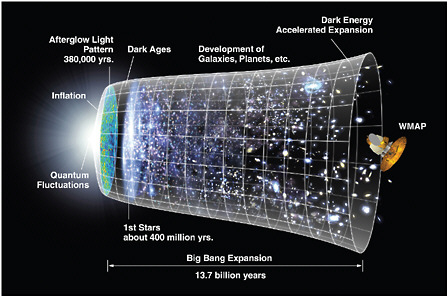
FIGURE 2.5 The cosmic timeline, from inflation to the first stars and galaxies to the current universe. The change in the vertical width represents the change in the rate of the expansion of the universe, from exponential expansion during the epoch of inflation followed by a long period of slowing expansion during which the galaxies and large-scale structures formed through the force of gravity, to a recent acceleration of the expansion over the last roughly billion years due to the mysterious dark energy. SOURCE: NASA Wilkinson Microwave Anisotropy Probe Science Team.
This event signaled the end of the dark ages and the dawn of the universe as we know it today. This first generation of stars—made purely from the big bang’s residue of hydrogen and helium—may have been unusually massive and hot compared to today’s stars like the Sun. Their intense ultraviolet light traveled out into the surrounding universe and struck the atoms there, breaking many of them apart into nuclei and electrons. This key moment in cosmic history is therefore called the epoch of reionization. The characterization of this transition and its spatial structure is being attempted by ground-based radio antennas.
These events lie largely in the realm of theory today, and existing telescopes can barely probe this mysterious era. Over the next decade, we expect this to change. A new window on the cosmos is being opened in several wavelengths: radio astronomers are constructing telescopes that will tell us when and where the first stars in the universe formed by mapping their effect on the primordial hydrogen at the end of the dark ages, and are planning those that will be able to directly observe the primordial hydrogen atoms that permeated the dark ages of the universe (Figure 2.6). Large X-ray telescopes can detect the first massive black
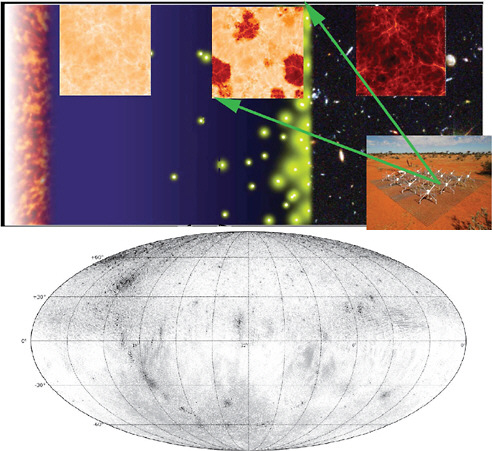
FIGURE 2.6 Top: Schematic of the evolution from left to right of an inflationary universe to recombination to reionization and first star/galaxy formation to today’s Earth-bound telescopes. Overlaid in tiles are predicted 21-cm signals from the Murchison Widefield Array. SOURCE: S. Furlanetto, University of California, Los Angeles; J. Lazio, JPL; and C. Lonsdale, MIT-Haystack. Bottom: The same signals detected at 150 MHz in an all-sky map from the Precision Array to Probe the Epoch of Reionization. SOURCE: A.R. Parsons, D.C. Backer, R.F. Bradley, J.E. Aguirre, E.E. Benoit, C.L. Carilli, G.S. Foster, N.E. Gugliucci, D. Herne, D.C. Jacobs, M.J. Lynch, et al., The precision array for probing the epoch of re-ionization: Eight station results, Astronomical Journal 139(4):1468-1480, 2010.
holes and quasars at very great distances. Although the “first stars” are most likely too faint to observe individually, they should form in the collapsing clumps of gas that are the small building blocks of future galaxies like our Milky Way. ALMA and the EVLA will detect and conduct studies of many of these protogalaxies. JWST should be able to image them as well, while the proposed next generation of giant ground-based optical-infrared telescopes would investigate these first objects in
detail (measure their mass, chemical composition, and ages). There is also growing evidence that many gamma-ray bursts are the explosive deaths of very massive stars and sometimes resulting in the formation of the first generation of black holes with the unusual chemical compositions expected for the first stars (nearly devoid of elements heavier than hydrogen and helium). The study of the coolant deaths of these stars offers another way to learn about the first stars.
The Origin of Galaxies and Large-Scale Structure
The small protogalactic fragments containing the first stars were embedded in halos of dark matter, which formed first and provided most of the total mass. Through their mutual gravitational attraction, these small fragments of gas and dark matter would have fallen slowly toward other such objects, collided, and then merged into larger objects. This process continued over the entire history of the universe: in the densest regions, small objects merged to form medium-size objects that later merged to form large objects (Figure 2.7). Over time even larger
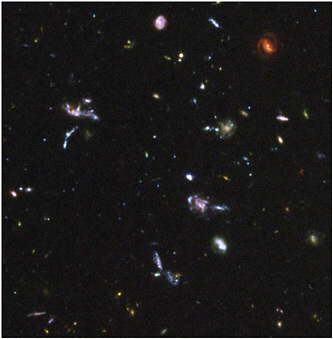
FIGURE 2.7 This enlargement of part of the Hubble Ultra Deep Field shows distant young galaxies in the process of forming; several galaxy mergers and unusual structures are evident. SOURCE: NASA, ESA, S. Beckwith, and the Hubble Ultra Deep Field team.
structures formed: groups and clusters of galaxies, and the filaments that connect these clusters to one another in the vast cosmic web.
Thanks to major surveys of the last decade, we now have a precision map of the cosmic cartography of the present-day local universe that is the result of this process of merging. Over the next decade it will be a high priority to extend such precision mapping over cosmic time: to have, in effect, a 13-billion-year-long movie that traces the buildup of structure since the universe first became transparent to light. This can be done by using radio telescopes to provide more detailed maps of the cosmic microwave background and to detect the atomic hydrogen gas all the way back into the dark ages; large spectroscopic surveys in the visible and near-infrared to trace the distribution of galaxies; gravitational lensing to trace the distribution of the dark matter halos; ultraviolet spectroscopic surveys to map out the warm tenuous gas lying in the vast cosmic filaments; and radio Sunyaev-Zel’dovich effect and X-ray surveys that reveal the distribution of the hot gas found in groups and clusters of galaxies.
Most stars with masses smaller than that of the Sun will live even longer than the current age of the universe. This means that low-mass stars that formed at any time over the history of the universe are still present in galaxies today. Thus, detailed studies of the populations of stars within a galaxy provide a fossil record that traces the history of star formation over the whole course of the galaxy’s evolution. Such studies also trace the buildup of the heavy elements in the galaxy as successive generations of stars formed, converted their light elements into heavier ones, and then exploded, contributing their newly formed heavier elements to their surroundings. This observational approach is currently practical only in the Milky Way and its nearest neighbors. Future generations of optical telescopes in space and large ground-based telescopes will enable us to extend this technique farther afield and study the histories of the full range of galaxies by imaging their stellar populations.
The Origin of Black Holes
In the past decade we have discovered two remarkable things about black holes. The first is that supermassive black holes—objects with masses of a million to billions of times the mass of the Sun—are found in the centers of all galaxies at least as massive as our Milky Way. This means that the formation of black holes is strongly related to the formation of galaxies. The second is that supermassive black holes were already present, and growing rapidly, at a time less than a billion years after the big bang, when the first galaxies were being assembled. This strains our understanding of the early universe: How could such dense and massive objects have formed so rapidly? Which formed first, the black hole or the galaxy around it? Radio observations of star-forming molecular gas in some of the most distant
galaxies suggest that a black hole is present before the formation of a massive galactic halo. ALMA and the EVLA may provide more such examples.
But we cannot answer these questions definitively yet, because we do not have a robust theory for how supermassive black holes form. In the coming decade we expect a major breakthrough in our understanding. A space-based observatory to detect gravitational radiation will allow us to measure the rate at which mergers between less-massive black holes contributed to the formation process. Are the supermassive black holes we can now detect only the tip of the iceberg (the biggest members of a vast unseen population)? Deep imaging surveys in the near-infrared and X-ray, with follow-up spectroscopy with JWST and ground-based extremely large telescopes, will detect and study the growth of the less massive objects through the capture of gas and accompanying emission of electromagnetic radiation. These surveys will also allow us to search for such black holes at even earlier eras: back to the end of the dark ages.
The Origin of Stars and Planets
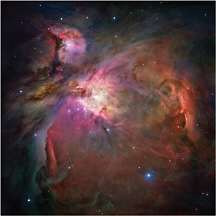
Looking up on a clear night from a dark location, we see that the sky is full of stars. Telescopic observations by Galileo revealed that the Milky Way’s white band traversing high across the summer and fall sky can be resolved into countless stars. Gazing upon the winter constellation of Orion, the sharp eye will note the fuzzy Orion Nebula (see in Box 2.4 Figure 2.4.3) with its nursery of stars born “yesterday” in cosmic time—not long after the first humans walked. Nearby is the famed Pleiades star cluster—formed when dinosaurs still roamed Earth. In contrast, some stars of our galaxy are nearly as old as the universe itself. The story of how successive generations of stars form out of the gas and dust in the interstellar medium in both benign and exotic environments is fundamental to our understanding of, on the larger scale, the galaxies in which stars reside and, on the smaller scale, the planetary systems they might host.
What was it about the Sun’s birth environment or its star formation process that determined the final properties of our solar system versus that of other planetary systems? (See Box 2.2.) How and on what timescale did the solar mass build up, and how much gas and dust were left over for planet formation? How rapidly did the high-energy radiation of young stars disperse their gas disks, ending the phase of major planet formation? Do all environments yield the same mass distribution of stars, and what determines the lower and upper mass limits in the distribution (Figure 2.8)? What is the star formation history of our galaxy in particular, and of galaxies in general? Does star formation regulate itself, or are there external factors at work?
A key aim of studies in the next decade is to understand, through both observations and theory, the process of star formation over cosmic time. Beginning near
|
BOX 2.2 The Origin of Planets After literally centuries of speculation as to how our own planetary system formed, the past two decades of ground- and space-based astronomy have resolved the general question of planetary origin: planets form in the disks of gas, dust, and ice that commonly surround newly born stars (Figure 2.2.1). That such disks are seen around more than 80 percent of the youngest stars in nearby stellar nurseries strongly implies that planets are a frequent outcome of star formation. But the details of how planets form within disks are still being revealed by current astronomical techniques including imaging from Hubble, Spitzer, and the largest ground-based telescopes, plus theoretical studies including computer modeling. Disks start out being dominated by gas—the hydrogen and helium of the primordial cosmos salted with the heavy elements out of which planets and life are composed—and evolve with time into thinner dust-only structures. Although most if not all stars like our Sun may possess disks early in their histories, how many of these turn into planetary systems is not known. Over the past decade facilities such as NASA’s Spitzer Space Telescope and the federally supported CARMA, SMA, and VLA telescopes, and various space- and ground-based coronographic instruments, have advanced our understanding of disk properties and evolution considerably. The next decade of astronomical facilities should have the capability to see the effects of young planets embedded within the disks from whence they arose. Is the typical outcome of planet formation gas-giant worlds with panoplies of satellites, like Jupiter and Saturn, or rocky worlds like Earth with atmospheres and surface liquids stabilized by being suitably near to stable parent stars like the Sun, or some completely different kind of object that is not represented in our solar system? The answer to this question will require a complete census of planetary systems in the nearby portion of our galaxy. By compiling the statistics of planetary sizes, masses, and orbits for a range of planetary systems around stars of different masses, compositions, and ages, it will be possible to gain deep insight into the processes by which worlds such as our own come into being. FIGURE 2.2.1 Images of dust disks around young stars. Top: Image taken with the Hubble Space Telescope of disk around the young, 5-million-year-old star HD141569. SOURCE: NASA, M. Clampin (STScI), H. Ford (JHU), G. Illingworth (UCO/Lick), J. Krist (STScI), D. Ardila (JHU), D. Golimowski (JHU), the ACS Science Team, and ESA. Bottom: Edge-on view of disk around AU Mic, a nearby 10- to 20-million-year-old star. SOURCE: M.P. Fitzgerald, P.G. Kalas, G. Duchêne, C. Pinte, and J.R. Graham, The Au microscopic debris disk: Multiwavelength imaging and modeling, Astrophysical Journal 670:536, 2007. Reproduced by permission of AAS. |
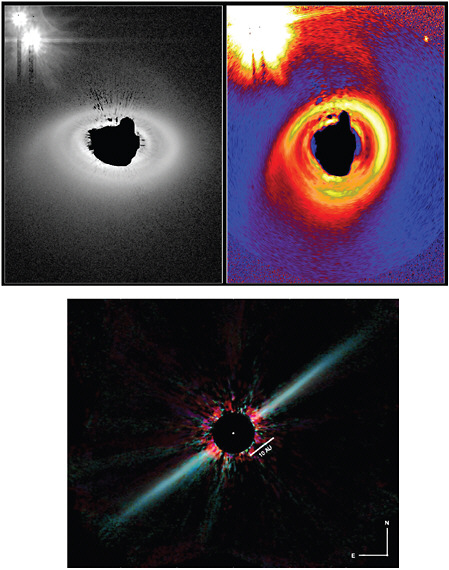
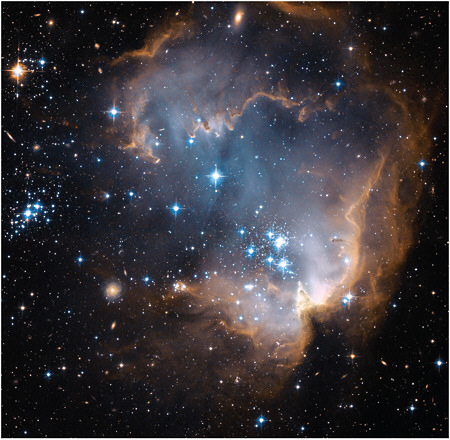
FIGURE 2.8 This Hubble image shows a young (5 million years old) cluster of massive stars eroding the dusty material around them in a region in our neighboring galaxy, the Small Magellanic Cloud. SOURCE: NASA, ESA, and the Hubble Heritage team (STScI/AURA).
home, detailed spectroscopic measurements at short radio wavelengths will track the internal dynamics of the dust-enshrouded molecular clouds that fragment and seed the star-forming cores within a few hundred light-years of our Sun (see Figure 2.2.1 in Box 2.2). Given the importance of high-mass stars to the production and dispersal of heavy elements, understanding their proportion in both the benign and the more extreme star-forming environments is critical to tracking the heavy-element history of the universe.
UNDERSTANDING THE COSMIC ORDER
The combination of basic physical processes can often lead to surprisingly complex results and produce much of the intriguing cosmic order.
Science frontier questions related to understanding the cosmic order:
-
How do baryons cycle in and out of galaxies, and what do they do while they are there?
-
What are the flows of matter and energy in the circumgalactic medium?
-
What controls the mass-energy-chemical cycles within galaxies?
-
How do black holes grow, radiate, and influence their surroundings?
-
How do rotation and magnetic fields affect stars?
-
How do the lives of massive stars end?
-
What are the progenitors of Type Ia supernovae and how do they explode?
-
How diverse are planetary systems?
-
Do habitable worlds exist around other stars, and can we identify the telltale signs of life on an exoplanet?
One of the biggest challenges in the next decade is to understand how the basic building blocks of matter and energy, governed by known physical laws, are responsible for the dazzling array of astronomical phenomena that intrigue and inspire us. Meeting this challenge will require a synthesis of a broad range of evidence and insights drawn from traditionally disparate scientific disciplines.
None of the baryonic components of the cosmos (gas, galaxies, stars, planets, life) exist in isolation. Galaxies grow by cannibalizing smaller neighboring galaxies and by capturing primordial gas clouds flowing in from the vast spaces beyond. This gas, once inside a galaxy, is the raw material for forming new stars. The big bang produced only the simplest and lightest chemical elements, hydrogen and helium. Heavier elements like oxygen and iron have been forged within the nuclear furnaces of stars and violently expelled in supernova explosions, thereby seeding the environment with the material necessary to form planets and support life.
Our goal is to use all the applicable scientific laws to understand the properties and behavior of the cosmos—in short, to find order in complexity.
Galaxies and Black Holes
The observable universe contains more than 100 billion galaxies, including our own Milky Way. Although we commonly think of galaxies as being made of stars and clouds of gas and dust, in fact more than 90 percent of the mass of galaxies
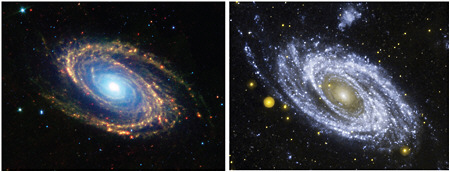
is dark matter, whose nature we do not understand. And at the center of most or all galaxies lies a supermassive black hole. Thus something as common as a galaxy is both exotic and mysterious. The stars in spiral galaxies like ours are arrayed in two main components: a nearly spherical and slowly rotating “bulge” and a thin and rapidly rotating “disk” (which also contains the gas clouds that can be used to form new stars). Galaxies exhibit a bewildering array of shapes and sizes that are determined largely by the mass of the halo of dark matter surrounding them. Besides spirals, there are ellipticals, three-dimensional balls that formed most of their stars early on, and so have no gas/star disks and little star formation today; and irregulars, tiny galaxies with an abundance of gas and plenty of star formation today.
The lives of galaxies are determined by both nature and nurture, that is, by processes internal to the galaxies as well as through the influence of the surrounding environment. The most massive galaxies today would have begun forming in the early universe in the regions of the highest density of dark matter and gas. They later merged with other galaxies of comparable mass (major mergers), scrambling the disks of the merging galaxies into a single nearly spherical bulge component. The collision would also send material raining into the center of the bulge where it could be used to form and grow a supermassive black hole. In contrast, the life story of low-mass galaxies is more sedate. Originating in regions of lower density, they were only slowly supplied with gas, formed their stars gradually over the history of the universe, suffered fewer major mergers, and retained their disk-like form to the present day. These different life stories explain the strong dichotomy in the observed properties of the high- and low-mass galaxies.
Internal processes in galaxies are complex and affect their ability to make new stars. Supernovae from the explosive deaths of short-lived massive stars violently heat the surrounding gas (see Box 2.3). If the rate of such supernova explosions is high enough, they can act together to expel much of the galaxy’s gas supply (see in Box 2.4 Figure 2.4.4). This will have a more severe impact on low-mass galaxies: their gravity is so weak that material can be easily ejected from them. This may explain why dark matter halos with low mass contain so few stars and so little gas today. The role played by the supermassive black hole is instead important for the lives of the most massive galaxies (which contain the most massive black holes). The energy released by the black hole during periods of intense eruptions can prevent new gas from being captured by the galaxy, explaining why the most massive galaxies are no longer forming stars.
Understanding the details of galaxies and their interstellar gas, dust, and stars requires a community of astronomers to study stellar populations, the dynamics of galaxies and clusters, interstellar and intergalactic gas, stars with a range of properties such as high and low metallicities, and stellar streams resulting from tidal interactions of galaxies, as well as studies of the wide range of galaxies around
us, from the smallest dwarf galaxies to the largest spirals and ellipticals. From the analysis of stellar populations, we can study how the Milky Way assembled.
While we have a rather good description of the properties of galaxies in the present-day universe, we have far less information about how these properties have changed over the 13.7-billion-year history of the universe. The galaxies we can observe in detail teach us of the complex interplay among the components of normal and dark matter, constrained by the physical laws of the cosmos. A high priority in the coming decade will be to undertake large and detailed surveys of galaxies as they evolve across the wide interval of cosmic time—to have a movie of the lives of galaxies rather than a snapshot. See Box 2.4.
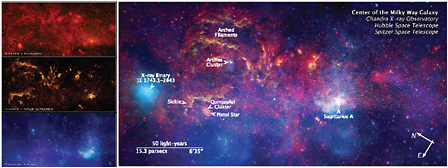
As described above, the lives of galaxies and the supermassive black holes at their centers seem to be inextricably linked. Two of the major goals of the coming decade are to understand the cosmic evolution of black hole ecosystems—the intense interplay between the black holes and their environments—and to figure out how these extremely powerful “engines” function. Black hole masses will be measured by JWST and ground-based optical and radio telescopes. Observations of black holes in the X-ray and gamma-ray regimes offer uniquely powerful insights. For example, the Fermi Gamma-ray Space Telescope as well as the ground-based atmospheric Čerenkov telescopes such as VERITAS are constantly reporting new and powerful variations of emission, in both the energy and the time domains, from large numbers of these systems over the whole sky and from cosmological distances. The Chandra and XMM-Newton X-ray observatories are being used to measure the environmental impact of energy injection from the black hole and also to give us a glimpse of matter as it swirls inexorably inward toward the event horizon at the very edge of the black hole. Future more powerful X-ray observatories will provide detailed maps of these processes, so that we can directly witness the accretion of matter (by which black holes grow) and can also understand the impact they have on the lives of their “host” galaxy.
Stars
Stars are the most observable form of normal matter in the cosmos. They have produced about 90 percent of all the radiant energy emitted since the big bang (with black holes accounting for most of the balance). Through the nuclear reactions that power them, they have taken the primordial hydrogen and helium produced during the big bang, converted this into heavier elements like carbon, oxygen, and iron, and then dispersed this material so that it can be incorporated in subsequent generations of stars and of the planets that accompany them (see in Box 2.4 Figure 2.4.3). Such recycling is proceeding continuously within galaxies like our own.
We now have a mature theory for the structure and evolution of stars. This theory is based on a synthesis of known physical processes (nuclear reactions; the
outward flow of matter, radiation, and energy). We now know that the overall life story of a star depends primarily on its mass and, secondarily, on its chemical composition. The mass of a star has a pronounced effect on the rate at which it consumes its nuclear fuel: the more mass the star contains, the shorter its life will be (it lives fast and dies young), and the more violent and spectacular its death, with explosive heating of the surrounding gas and production of a legacy corpse in the form of a neutron star or black hole.
Yet challenges remain. We know that as stars like the Sun age they lose mass in the form of a relatively steady wind, or more episodically during violent pulsa-
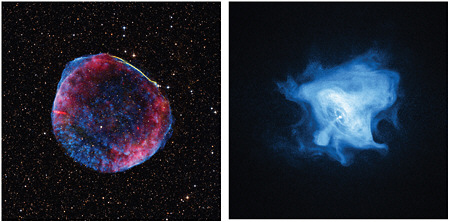
tions and explosive eruptions in the late stages of the star’s life. Indeed, the final end stage of a star’s life depends quite sensitively on the amount of mass it retains following its evolution beyond the hydrogen-burning stage. It will also depend strongly on how rapidly the star is rotating and on the strength and nature of the magnetic fields that it has built.
This has far-reaching implications because the end states of massive stars (supernovae) determine the chemical composition of a galaxy and hence the properties of the subsequent generations of stars and planets. To understand the lives of stars and the role they play in cosmic evolution we must understand the roles of
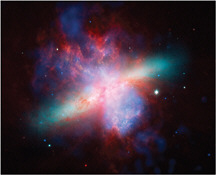
mass loss, rotation, and magnetic fields in stellar evolution. Prospects are bright for the coming decade. All three phenomena can be assessed through high-dispersion spectroscopy. Rotational studies are possible with detailed long-term photometric monitoring. It is now becoming possible to study the structure and strength of magnetic fields on the surfaces of nearby stars, and changes in the magnetic fields can be diagnosed with X rays. At the same time, the major advance provided by the Advanced Technology Solar Telescope (ATST) will be an improved ability to observe and understand the rich array of magnetic activity exhibited by our nearest star, the Sun. Solar radio emission will be observed at high time and wavelength resolution on a continuous basis, providing unique data to combine with that of ATST.
Indeed, following the successful launch and commissioning of the Solar Dynamics Observatory (SDO; Figure 2.9), we are poised to understand the origin of the 11-year solar cycle, which underlies “space climate,” by relating the surface behavior of the Sun to its interior properties, in particular at the tachocline located at 70 percent of the solar radius where the hot gas begins to undergo convective motion. In addition, the high-resolution, all-disk imaging combined with the ability to map the surface magnetic field in three dimensions as it erupts into the solar chromosphere and corona is providing unprecedented understanding of how magnetic fields behave above the solar surface both in the “quiet” Sun and during massive flares associated with active regions. This understanding is of major importance for astrophysics beyond the solar system because the Sun is the best large-scale magnetic field laboratory we have. Meanwhile, ATST will come on line in 2017 and will provide complementary diagnostics for similar science goals to space observatories, specifically high-resolution imaging—it will have the capability of seeing down to 30-kilometer scales—and detailed spectroscopy. It will be able to see the strange ways that magnetic field lines twist and braid themselves as well as how they mediate the flow of energy. Understanding these physical processes is a key step toward explaining how the solar wind—the outflow of gas that blows past Earth and has such a large effect on our atmosphere—is powered.
Stellar seismology is maturing rapidly. Analogous to Earth-based seismology, this technique enables astronomers to probe the deep interior regions of stars using the complex oscillations observed at the star’s surface, much as the tone of a musical instrument reveals its internal construction. In the next decade, the rapidly increasing power of computers will allow us to take the known physical laws that are at play and synthesize them into detailed three-dimensional movies of the life and death of stars.
The life stories of stars can be strikingly changed if the star has a companion star orbiting in close proximity. One of the most dramatic examples of this occurs in a system containing a white dwarf star, which is the burnt-out core of a star like the Sun, with about as much mass as the Sun compressed into an object the
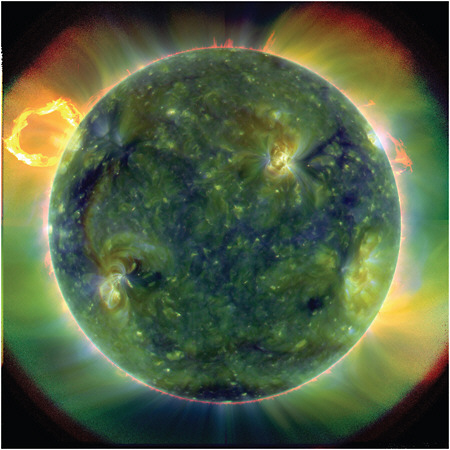
FIGURE 2.9 Solar Dynamics Observatory image of the Sun in the extreme ultraviolet. Different colors indicate different-temperature plasma, with hotter emissions traced from red to blue to green. SOURCE: NASA/SDO/AIA.
size of Earth. Mass transferred onto the white dwarf from its companion star can trigger a runaway thermonuclear instability and explosion, providing a light show that can be seen halfway across the universe. This type of supernova event is also the most important source of iron—from that in Earth’s core to the hemoglobin in our blood—in the universe.
Stars more massive than about 10 times the mass of the Sun end their lives as supernovae when their deep interior has exhausted all energy supplies from nuclear
fusion. Within fractions of a second, this energy crisis triggers a collapse of the innermost solar mass of material to densities so high that the nuclei of atoms are literally “touching.” The rest of the star subsequently collapses onto the newly born neutron star, resulting in ejection of most of the star into the interstellar medium, spreading the products of millions of years of fusion reactions. Sometimes the collapsing material overwhelms the young neutron star, leading to a further collapse to a black hole.
Wide-field sky surveys during the next decade should reveal tens of thousands of these core-collapse supernovae per year and thus a diversity of stellar remnant outcomes much richer than currently known. Remarkable discoveries could occur if we are lucky enough to have a galactic supernova, as the overwhelming number of neutrinos from the young neutron star would provide an exciting probe of the competition between collapse and explosion going on in the inner 20 kilometers of these explosions. Even more remarkable would be to find direct evidence for gravitational wave emission from such a nearby explosion, a possibility for Advanced LIGO. Progress will also occur via continued theoretical and computational efforts, especially as three-dimensional simulations become computationally plausible. Finally, exploding stars leave remnants hypothesized to be the galactic particle accelerators that produce ubiquitous high-energy charged-particle cosmic rays, including those that crash into Earth’s atmosphere, producing telltale radioactive isotopes. X-ray, gamma-ray, and radio observations of these stellar remnants will test this hypothesis and reveal the accelerator dynamics of the stellar ghosts (Figure 2.10).
Planetary Systems
Our Sun is just one of the several hundred billion stars in the Milky Way, and its well-ordered configuration of eight planets just one of the many diverse planetary systems. Although we have studied our solar system with telescopes for 400 years, we have only, in the past two decades, been able to detect planets orbiting other stars and begun to appreciate their astonishing diversity. We have uncovered surprises ranging from Earth-size planets orbiting the compact corpses of burned-out stars to planets termed “hot Jupiters” that are more than 100 times the mass of Earth but that are so close to their stars that they orbit them in just a few days. Models of the formation of planetary systems predict that planets this massive should form at much greater distances; these bodies have forced us to consider processes of “migration” that bring large planets closer to their stars early in their histories.
The details of how planets form within disks are still being revealed by current astronomical techniques, including imaging from Hubble, Spitzer, and the largest ground-based telescopes, plus theoretical studies including computer modeling. Disks start out being dominated by gas—the hydrogen and helium of the pri-
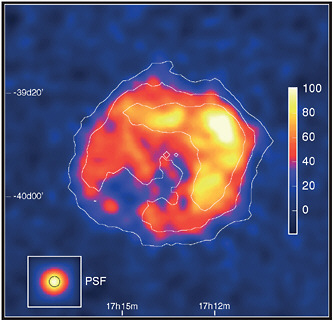
FIGURE 2.10 Supernova remnant RX J1713.7-3946 observed in the highest-energy tera-electron-volt (TeV) gamma rays. Recent observations using atmospheric Čerenkov telescopes have demonstrated that cosmic rays are accelerated to energies in excess of 100 TeV and that the magnetic field is amplified to high strength. Contours are X-ray emission. Supernova explosions like those that left behind this source created and dispersed heavy elements and also accelerated cosmic rays. SOURCE: The HESS Collaboration: F. Aharonian, A.G. Akhperjanian, A.R. Bazer-Bachi, M. Beilicke, W. Benbow, D. Berge, K. Bernlöhr, C. Boisson, O. Bolz, V. Borrel, I. Braun, F. Breitling, et al., A detailed spectral and morphological study of the gamma-ray supernova remnant RX J1713.7-3946 with H.E.S.S. Astronomy and Astrophysics 449(1):223-242, 2006, © ESO, reproduced with permission.
mordial cosmos salted with the heavy elements out of which planets and life are composed—and evolve with time into dusty disks or rings between the newborn planets themselves. While most if not all stars like our Sun may possess disks early in their histories, what fraction of these turn into planetary systems is not known, but the indications are that it is large.
Life
We have only the most rudimentary ideas about what conditions are necessary for and conducive to the formation of life. Even here modern astronomy has a key role to play, by finding and characterizing planets with the features that allow for life around stars other than the Sun. It will require study of individual planets by
directly sensing their light to find the molecular signposts of habitability in the atmospheres and surfaces of these distant bodies.
This last task, possible now for nearby giant planets, is exceedingly difficult for Earth-size bodies with disks 100 times smaller in area than Jupiter’s. The signature of water, together with a suitable orbit around a parent star, would tell us that the medium for life as we know it is likely present as a surface liquid. Methane indicates that organic molecules (the structural building block of life) are present; oxygen with methane would indicate a state of extreme chemical “disequilibrium” that could likely not be maintained in the absence of life.
The most promising signatures of life on planets around other stars are features in the atmospheric spectra of planets around other stars, such as the “red edge” arising from photosynthesis. Less definitive is molecular oxygen, which is locked up in oxidized surface minerals unless continually replenished either by life (as on Earth) or catastrophic loss of surface water followed by photolysis of water in the atmosphere (as on early Venus). The presence of both water and methane in a planetary atmosphere is a more reliable biosignature of water-based organic life than is the presence of one or the other alone. A different approach is to look for signals produced by technologically advanced entities elsewhere in our galaxy.
FRONTIERS OF KNOWLEDGE
New fundamental physics, chemistry, and biology can be revealed by astronomical measurements, experiments, or theory and hence push the frontiers of human knowledge.
Science frontier questions for advancing knowledge:
-
Why is the universe accelerating?
-
What is dark matter?
-
What are the properties of neutrinos?
-
What controls the mass, radius, and spin of compact stellar remnants?
One of the key insights of the past few centuries was the recognition that the same scientific laws that govern the behavior of matter and energy on Earth also govern the behavior of the cosmos: planets, stars, galaxies, and the entire universe. Newton inferred that the same physical forces causing apples to fall to Earth also govern the motions of the Moon around Earth and the planets around the Sun. One hundred and fifty years later it was discovered that chemical elements introduced into laboratory flames produced a unique set of spectral lines, and since many of these lines also appeared in the solar spectrum, it was concluded that the Sun was made of the same chemical elements as found on Earth, or as in the case of helium,
a new one waiting to be discovered. Astronomers feel confident in using the universe as a laboratory to explore natural phenomena that are inaccessible to Earth-based laboratories. The study of how the universe and its constituent objects and phenomena work continues to yield unique insight into fundamental science.
The Nature of Inflation
As described previously, the inflation hypothesis proposes that the universe began to expand exponentially some 10−3 seconds after the big bang. This hypothesis explains why the present universe has almost the same temperature everywhere we look, as measured by the microwave background radiation, over the entire sky. Despite the power of the hypothesis, the mechanism by which inflation happened—its origin—remains a great mystery. Directly confirming inflation and understanding its fundamental underlying mechanism lie at the frontier of particle physics, because inflation probes scales of energy far beyond anything that can be achieved in accelerators on Earth. Inflation is central to astrophysics: the quantum fluctuations present during inflation formed the seeds that grew into the CMB fluctuations and the large-scale structure of the universe we see around us today. Perhaps the most profound reason to understand inflation is that its nature and duration might have spelled the difference between a universe of sufficient vastness to house galaxies, planets, and life, and a “microverse” so small that matter as we know it could not be contained therein. To understand the origin of our macroscopic universe—why we exist—requires understanding inflation.
The last decade was one of stunning progress in our understanding of the first moments of the universe. NSF-supported South Pole and Chilean ground-based work, and NASA’s balloon-based studies and the Wilkinson Microwave Anisotropy Probe Explorer mission, mapped the spatial pattern of temperature fluctuations that occur in the relic cosmic microwave background from the big bang. The state of the young universe during the epoch of inflation, prior to the existence of stars or galaxies, is imprinted as minute fluctuations in the CMB, and the character of these fluctuations is broadly consistent with the theory of inflation. Armed with theoretical advances and complementary balloon-borne and ground-based measurements, we are now ready to move beyond foundational knowledge of the very early universe and apply increasingly more precise measurements of the CMB to new questions. One important test of inflation involves making highly detailed measurements of the structure of the universe by mapping the distribution of hundreds of millions of galaxies. Inflation makes very specific predictions about the spatial distribution of the dark matter halos that host these galaxies.
However, the most exciting quest of all is to hunt for evidence of gravitational waves that are the product of inflation itself. Just as the light we see with our own eyes can be polarized, the CMB radiation may also carry a pattern of polarization—
the so-called B-modes—imprinted by inflationary gravitational waves. Different models of inflation predict distinguishable patterns and levels of polarization, and so the next great quest of CMB research is to detect this polarization, thereby probing the behavior of the particles or fields driving inflation.
Today we stand at a crossroads. If we discover the signature of inflation in the CMB in the next few years, future studies would focus on follow-up precision measurements of that signal. If, on the other hand, the signal is not seen, then we will need to develop different approaches that may ultimately lead us to revise our theoretical models. More detailed measurements of the CMB are a path to exciting future discoveries—fed by both technology development and theoretical inquiry.
The Accelerating Universe
About 12 years ago, the simple picture of a universe decelerating because of gravity began to fall apart. Due in large part to supernova distance measurements, we have since come to realize that instead of decelerating, the expansion of the cosmos is accelerating. Why this is so is an outstanding puzzle in our modern picture of the universe.
The observation that the universe is accelerating is at present consistent with Einstein’s postulate of a cosmological constant or equivalently with the idea that empty space carries energy. It is also consistent with the more general idea that space-time is permeated with gravitationally repulsive dark energy, a mysterious substance that accounts for more than 70 percent of the energy content of the universe. Alternatively, cosmic acceleration could be an indication that Einstein’s theory of gravity—general relativity—must be modified on large scales. In Einstein’s theory, the growth of structure and the expansion of the universe are linked by gravity; in modifications of gravity, that link is altered.5 Understanding the underlying cause of acceleration therefore requires precision measurements of the expansion of the universe with time and of the rate at which cosmic structure grows. Comparing the expansion history of the universe with the history of the growth of structure will in principle enable us to test whether dark energy or modifications of general relativity are responsible for cosmic acceleration.
Fortunately, the supernova distance measurement techniques are advancing dramatically, and a few other independent techniques are being developed that also promise advances in precision measurement of the expansion history, as well as adding measurements of the growth of structure. Knowing how the size of the universe changes with time means that we can now chart the rate at which the universe grew over its long history. By combining all these data we can test whether the
theory of relativity is correct and also determine whether Einstein’s cosmological constant gives an accurate description of the way dark energy determines the fate of our universe.
The Nature of Dark Matter
“Normal” matter—the stuff of which we, Earth, and the stars are made, as well as the more exotic particles created in Earth-bound accelerators or in natural accelerators such as supernova remnants—appears to be only a minority of the matter in the cosmos (Figure 2.11). This discovery through measurements of the rotation rate of galaxies was presaged by work as early as the 1930s in which astronomers noticed that the speeds at which galaxies orbit around the centers of the clusters to which they belong are far higher than needed to counteract the gravitational pull of the stars in those clusters. To keep these clusters from rapidly flying apart, astronomers argued, they must contain far more material than that visible to telescopes. A lot of astronomical detective work ruled out the hypothesis that the invisible mass might simply be unobservable planets and dead stars, and so it became known as a mysterious dark matter.
By now, the evidence for such dark matter in almost all galaxy-size and larger astronomical systems is overwhelming and comes from a wide variety of techniques—among others, gravitational lensing measured by the Hubble Space Telescope and ground-based telescopes, the distribution of hot X-ray-emitting gas

FIGURE 2.11 The current composition of the universe; “normal” (baryonic) matter is less than 5 percent of the total.
measured by the Chandra X-Ray Observatory, and the rotation speed of hydrogen gas disks surrounding galaxies measured by ground-based radio telescopes (Figure 2.12). With improved observations, astronomers have determined precisely how much dark matter there is, and learned that it interacts only with itself and very feebly with familiar matter only through gravity. These normal-matter constituents are small islands in a vast sea of dark matter of some unknown form.
An important clue to the nature of dark matter comes from indirect but powerful arguments based on the formation of the elements and the formation of galaxies. It has been found that only one-sixth of the total matter is in normal “baryonic” form and that the remainder is probably some exotic new elementary particle generated in copious quantities in the big bang but not yet detected by Earth-based particle accelerator experiments. If so, elucidating the nature and properties of the dark matter particle (or particles) will open an entirely new window to our understanding of the fundamental properties of matter.
The hunt for dark matter is the joint domain of elementary particle physics, astrophysics, and astronomy. Circumstances in all arenas are ripe for the detection of dark matter in the coming decade. Some of the most promising candidate dark matter particles predicted by theorists have properties that imply they will be produced anew in experiments at the Large Hadron Collider (LHC), while relic copies from the early universe will be detected at high energy from their self-interactions or decay in space, producing gamma rays and other high-energy particles, and at low energy in experiments at deep-underground laboratories where rare collisions occur between normal atoms and the sea of galactic dark matter particles through which Earth swims. Already, important constraints have been set on the nature of dark matter through the failure to detect it using underground detectors and the Fermi Gamma-ray Space Telescope. This is a great period of interdisciplinary convergence in the quest to understand the nature of dark matter.
The Nature of Neutrinos
Neutrinos (a type of elementary particle) interact very weakly with other matter. Because of this property, even massive bodies such as stars are transparent to neutrinos. The detection of neutrinos produced in the center of the Sun provided a direct confirmation of the nuclear reactions occurring there, and the ~20 neutrinos detected from a supernova explosion in a nearby galaxy in 1987 confirmed that the core of this massive star had collapsed to densities comparable to that of an atomic nucleus (likely forming a neutron star). More remarkably, over the past decade, observations of neutrinos produced by cosmic rays striking Earth’s atmosphere, and more refined detections of solar neutrinos, demonstrated that the three known types of neutrinos can oscillate from one type to another. This discovery implies that the neutrino mass, though small, is non-zero and offers direct proof that the
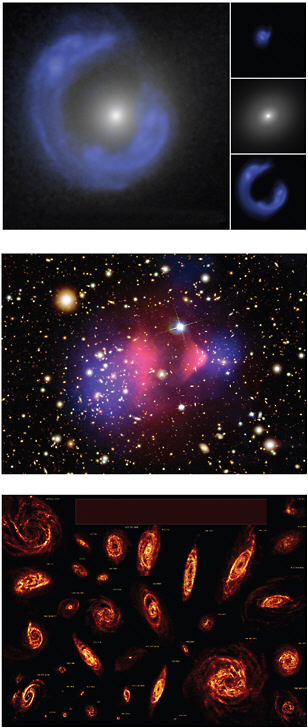
FIGURE 2.12 Upper: Hubble Space Telescope observations of a gravitational lens discovered in the Sloan Digital Sky Survey database by the Sloan Lens ACS Survey. Light from a distant blue galaxy (upper right, top) is deflected by the gravitational field of an intervening elliptical galaxy (upper right, center) to give an image in the form of a nearly complete “Einstein ring” (up per right, lower). By analyzing the combined image (upper left) it is possible to learn about the distribution of dark and luminous matter in the elliptical galaxy as well as create a magnified image of the background source galaxy. SOURCE: A. Bolton for SLACS and NASA/ESA.
Center: The inferred dark matter distribution in the interacting galaxy cluster 1E 0657-56 is shown in blue, compared to the measured hot X-ray-emitting cluster gas in red and the visible light from individual galaxies in the optical image. In this classic example, the dark matter mass dominates the radiating, baryonic mass. SOURCE: X-ray—NASA/CXC/CfA/M. Markevitch et al.; Optical—NASA/STScI, Magellan/University of Arizona/D. Clowe et al.; Lensing map—NASA/STScI, ESO WFI, Magellan/University of Arizona/D. Clowe et al.
Lower: THINGS survey, undertaken at the NRAO’s Very Large Array (VLA), of atomic hydrogen in nearby spiral galaxies, showing complex and extended gas distributions. SOURCE: NRAO/AUI and Fabian Walter, E. Brinks, E. de Blok, F. Bigiel, M. Thornley, and R. Kennicutt.
standard model of particle physics is incomplete. Indeed, astrophysical research has provided much of the evidence for physics beyond the standard model.
Our ability to probe the fundamental properties of neutrinos by using astro-physical measurements will continue in the coming decade. The neutrino oscillation measurements of the past decade probed only the difference in the squares of the neutrino masses, not the absolute masses, and we currently have only upper limits on the actual masses. Neutrinos were produced in abundance in the big bang, and although they constitute only a minor component of the dark matter, they affected the clustering of matter on large scales in a way that depends on their mass. Thus, the determination of the masses of the neutrinos—fundamental input to theories of the very small—may come from observations of the very large. In the coming decade, precise measurements of the structure seen in the CMB combined with measurements of large-scale structure from the next generation of visible/infrared imaging and spectroscopic surveys plus X-ray observations of clusters of galaxies will allow us to measure the neutrino mass or push its upper limit downward by an order of magnitude, and thereby help constrain particle physics models governing the behavior of all mass.
The Nature of Compact Objects and Probes of Relativity
Astronomical observations have verified that general relativity provides an accurate description of gravity on solar system scales, but an unanswered question, and the most challenging test of general relativity, is whether it works in the strong gravity fields around black holes. Current studies using X-ray spectroscopy of gas disks around black holes are consistent with the predictions of general relativity and yield preliminary estimates of the black hole spin. Over the next decade the precision of these tests can be dramatically improved.
Also feasible within the decade is the detection of gravitational waves from mergers of million-solar-mass black holes or low-mass objects captured by more massive ones. Such events produce clean signals that can be used to map space-time with tremendous precision in regions where gravity is very strong. An important theoretical and computational breakthrough in this decade was the ability to compute the merger of two black holes, yielding highly accurate predictions of the gravitational wave emission patterns. Combined with detections of these waves, such computations provide stringent tests of the theory of relativity in regimes not accessible by any other means. Deviations from Einstein’s predictions would cause us to rethink one of the foundational pillars of all of physical science.
Gravitational wave detection would not only test general relativity but also measure the spins and masses of the merging black holes. Furthermore, the discovery and understanding of such merging systems would uniquely probe the conditions at the centers of galaxies and the cosmological history of galaxy formation
and growth. Black holes are common in the centers of galaxies, and our estimates of their abundance, masses, and merger rate are poised for steady improvement in precision through a space-based interferometer that can reach back in time to “hear” the space-time echoes of mergers of supermassive black holes.
Observations with X-ray telescopes provide a complementary probe of the nature of space-time near the event horizon at the edge of a black hole. Such observations allow us to track the motions of material as it swirls “down the drain,” and thereby to measure the spin of the black hole. This is currently possible only for a handful of nearby black holes, but more powerful facilities in the future would enable us to extend these measurements to large samples. Since any black hole can be fully characterized by its mass and spin, this is fundamental information about how black holes work and how they were formed.
Yet another probe of black holes is the jets that are frequently created by massive spinning black holes in active galactic nuclei. Radio telescopes have shown that the emitting gas travels with speeds close to that of light. X-ray and now gamma-ray telescopes are able to trace the emission down to quite close to the black hole itself. Plasma and magnetohydrodynamic physics, which we understand best from solar and solar system studies, play important roles in many astrophysical contexts. It is proposed to combine the results from many types of telescopes operating simultaneously to understand how jets are made and how they shine. This will then lead to a better understanding of how gravity operates around a black hole. Black holes—either spinning massive holes in active galactic nuclei or newly formed stellar ones in gamma-ray bursts—are also suspected to be the source of the ultrahigh-energy cosmic rays that are detected when they hit Earth’s atmosphere. These can have energies as large as that of a well-hit baseball, but despite the great advances in understanding of their properties that have come from the Auger-South facility in Argentina, we still do not know for sure what they are, how they interact with matter, and how they are made.
Only slightly less remarkable than black holes are the neutron stars. It is with respect to neutron stars that the investments over the last decade in ground-based gravitational wave detectors are likely to pay off first, given that frequent detections of merging neutron stars in other galaxies are expected from Advanced LIGO. Formed as the catastrophic collapse of the core of a dying massive star, these amazing objects contain a mass larger than the Sun’s, squeezed into a region the size of a city. The centers of neutron stars contain the densest matter in the universe, even more tightly compressed than the matter inside the nucleus of a single atom. Some neutron stars also have the largest inferred magnetic field strengths in the universe, a thousand trillion times larger than that of Earth.
Studying the properties of neutron stars offers a unique window into the properties of nuclear matter. Measuring neutron star masses and radii yields direct information about the interior composition that can be compared with theoretical
predictions. Studies of young radio pulsars and the remarkable magnetar subclass have revealed that as many as 1 in 10 neutron stars, which have descended from normal stars, are born with magnetic fields that exceed 1014 times that of our Sun. What sets this fraction, and whether or not the birth of these highly magnetic neutron stars visibly alters the supernova event, are being actively investigated. Progress here will depend on large surveys of supernovae as well as continued radio and X-ray pulsar observations. The most rapidly rotating neutron stars appear to spin on their axes about once every 1½ milliseconds, by accreting material from a rapidly rotating disk of matter donated from a companion star. However, ever more sensitive radio pulsar surveys continue to find that the maximum spin rate observed is surprisingly less than the maximum possible value, leading to the speculative suggestion that gravitational wave emission regulates the maximum rate. This hypothesis is testable with Advanced LIGO.
The Chemistry of the Universe
Many astrophysical processes exhibit rich chemical signatures and products. The cycle of matter in our galaxy proceeds from the expulsion of matter into interstellar space from dying stars, where it undergoes chemical transformations and eventual incorporation into diffuse clouds and dense molecular clouds. Well over 140 molecules, rich in organic material, have been detected in the interstellar medium by radio, microwave, and infrared techniques, and this is almost certainly the tip of the interstellar chemical iceberg (Figure 2.13). Thanks to the diverse range of interstellar energy sources and environments to which such molecules are exposed, we have the opportunity with ALMA and SOFIA to study fundamentals of chemistry under conditions we cannot create here on Earth.
ALMA will greatly increase our ability to probe the chemistry of nearby galaxies. On a cosmological scale, the chemistry of the primordial elements hydrogen, helium, and lithium was surprisingly rich and dictated the early-universe interactions between matter and radiation. Molecular hydrogen was possibly crucial in forming the first stars after recombination, and studies of redshifted spectra of neutral atomic hydrogen may provide information concerning molecular hydrogen by observing density inhomogeneities. Observations of molecular spectra can give us unique probes of the density, temperature, and kinematics of regions where stars and planets are formed. Exploration of the chemistry in high-redshift galaxies is a current challenge that, as it is met, will provide us with a picture of the evolution of molecular reactions and species across cosmological time.
Tracing the history of organic molecules through their cycles of formation, modification, destruction, and reformation often on the surfaces of tiny dust grains within molecular clouds to their incorporation in planetary systems is important
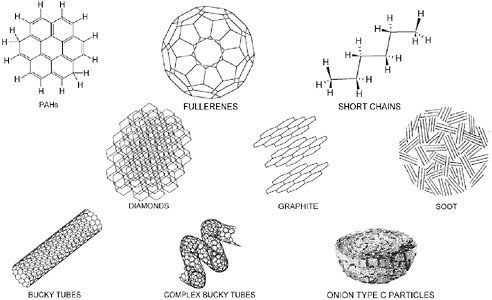
FIGURE 2.13 Some of the many forms that carbon might take in interstellar molecules. SOURCE: P. Ehrenfreund and S.B. Charnley, Organic molecules in the interstellar medium, comets, and meteorites: A voyage from dark clouds to the early Earth, Annual Review of Astronomy and Astrophysics 38:427-483, 2000.
in understanding where and in what form are the raw materials for life with which any given planetary system might be endowed (Figure 2.14).
To what extent does the potential for life change through the galaxy over its history? We do not understand the ultimate levels of complexity achieved by organic chemistry in astrophysical environments, for example, whether complex information-carrying polymers like ribonucleic acid might be produced before planet formation. Study at ever more powerful spectral and spatial resolution of astrophysical environments in which organic molecules occur and evolve is necessary to trace the full potential of organic chemistry to produce molecules of relevance to life, through as much of the galaxy as is possible. Such environments include the interstellar medium, molecular clouds, protoplanetary disks, transition and debris disks, and especially planetary atmospheres. And this, in turn, brings us full circle in our tour of the modern understanding of the cosmos: the exotic phenomena of the earliest moments of the cosmos set the stage for a physical reality in which stars, planets, and life—we—could exist.
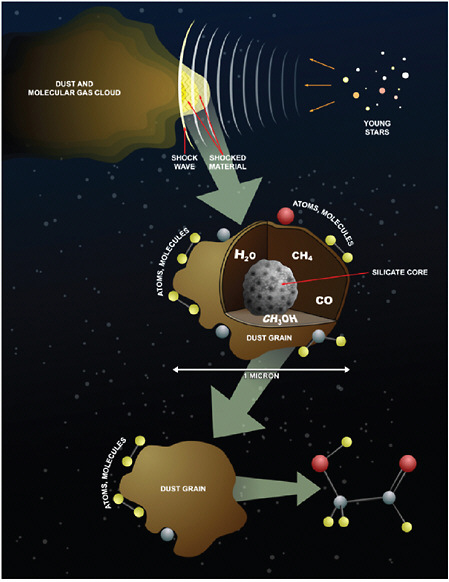
FIGURE 2.14 Shown here is a possible pathway toward making the sugar molecule glycoaldehyde, which was detected by the NRAO Green Bank Telescope in the Sagittarius B2 cloud of gas and dust. Material expelled from the vicinity of forming stars collides with a nearby molecular cloud (such as Sagittarius B2), generating shock waves. The heating associated with the shock allows chemical reactions to occur among atoms and small molecules that are embedded on the surfaces and in the interiors of small grains in the cloud. The resulting larger molecules that are formed, such as glycoaldehyde, are ejected from the grains thanks also to the shock waves, and end up in the surrounding gas where they can be detected. The red atoms are oxygen; the grey, carbon; and the yellow, hydrogen. SOURCE: Bill Saxton, NRAO/AUI/NSF.


