
3
Partnership in Astronomy and Astrophysics: Collaboration, Cooperation, Coordination
Fifty years ago, just before the first decadal survey in astronomy (the Whitford report), astronomy and astrophysics was practiced very differently than it is today. Virtually all telescopes were in private hands and viewed the sky in just the visible part of the spectrum using photographic plates or early photomultiplier tubes to record data; radio astronomy was still a new technique; the great potential of space was only beginning to be discussed. The United States dominated astronomical research. Federal support was small and existed only at NSF; NASA was soon to begin its race to the Moon and consider its first astrophysics missions. The frontiers were large and inviting. Many of the most phenomenal discoveries of the century lay ahead. Neutron stars, black holes, quasars, exoplanets, dark matter, dark energy, and the cosmic microwave background were yet to be found. Astronomy was a somewhat insular field, and its connection to physics, principally through atomic and nuclear physics, was just starting to grow.
Since that time, astronomy has been in a period of revolutionary discovery—from stars and planets to black holes and cosmology—and is poised for dramatic advances in our understanding of the universe and the laws that govern it. There are strong and growing connections to other fields, including physics, computer science, medicine, chemistry, and biology. Few today would refer to astronomy as an island in the world of science.
Advances in technology have propelled much of the change. Digital devices with hundreds of millions of pixels have enabled wide-field images and massively multiplexed spectroscopy at optical and infrared wavelengths. Radio technology has progressed to the point where sensitive, high-resolution images and spectra are
routinely available. A panoply of detectors has provided astronomers with microwave, infrared, ultraviolet, X-ray, gamma-ray, cosmic-ray, neutrino, and gravitational radiation eyes—allowing the universe to be observed in a rich variety of ways. Many of these new windows on the universe were made possible by the ability to place increasingly sophisticated observatories in space—from the pioneering COBE, IRAS, Copernicus, UHURU, SAS-3, and Compton-GRO to WMAP, Spitzer, Hubble, Chandra, Fermi, and Swift today. Over this same period, computing power has increased by 10 orders of magnitude in both processing speed and storage, racing through the petascale, and the exponential growth of digital bandwidth has revolutionized communications and the way science is done. Together, these techniques have provided new views that both solve old puzzles and uncover new surprises.
The sociology of astronomy has also changed. The field is more collaborative, more international, and more interdisciplinary. The style of carrying out research is different. Multi-wavelength approaches are necessary for many important problems. Observational data often come via e-mail or the Web, from space- and ground-based telescopes alike. The secondary use of data from archives, especially surveys, has grown in importance and in some cases even dominates the impact of a facility. In addition, breakthroughs are still made with great, imaginative leaps from our youngest scientific minds.
Because of the strong and important connections of astronomy to other disciplines, federal funding now involves five divisions at NSF—Astronomy (AST), Physics (PHY), Office of Polar Programs (OPP), Atmospheric and Geospace Sciences (AGS), and the Office of Cyberinfrastructure (OCI)—as well as the Astrophysics, Heliophysics, and Planetary Science Divisions at NASA, the Office of High Energy Physics (OHEP) and the Office of Nuclear Physics (ONP) at the Department of Energy, and the Smithsonian Institution. At the same time that federal support has grown and diversified, private funding of large ground-based observatories has increased as well.
Optimizing the federal investment in astronomy must take account of the changing scientific, sociological, and funding landscape. This presents new challenges—from data acquisition and access to interagency and international coordination. This chapter addresses the interfaces between different partners and makes recommendations on how to optimize the federal investment in astronomy at this time of revolutionary discovery about our place in the universe.
INTERNATIONAL PARTNERSHIPS
The Globalization of Astronomy
For much of the 20th century, research in astronomy was dominated by the United States. Today, the globalization that has influenced so many facets of our society is transforming astronomy as well—see Box 3.1. Over the past 50 years astronomy has expanded dramatically in Europe, which has achieved parity with the United States in many areas, as well as in Australia. A similar, more recent expansion in Asia—Japan and China in particular—is likely to influence the future of our subject for decades to come (Figure 3.1). South America also continues to increase its impact on the field, and South Africa is becoming a presence. In this new era it is imperative that planning for the U.S. research enterprise be done in an international context. We all share one sky and similar science agendas, and there are significant gains to be made by increasing international coordination and cooperation. This is a challenging task, because our early leadership means that many U.S. researchers, institutions, funding agencies, and policy makers are unaccustomed to long-range scientific planning with an international perspective.
Astronomy is among the most international of research disciplines, in part because the best ground-based observing sites (e.g., Antarctica, Australia, Chile, Hawaii, southern Africa), and of course space, are not necessarily located in places with the largest human and fiscal assets. Although the U.S. investment in astronomy has grown, that of the rest of the world has grown even faster. While this outcome should be celebrated, it does underscore that it is no longer possible for the United States or any other country to assume that it is an unquestioned leader across the whole field. Given the growing scale, cost, and complexity of major projects and the convergence of national scientific agendas, astronomy is becoming increasingly collaborative and cooperative—essential and desirable features for the field in the 21st century.
As astronomy research has blossomed in recent decades, the complexity has grown proportionately, as has the expense of the facilities necessary to explore the universe. The launch of the Hubble Space Telescope (HST) marked the entry of astronomy into large-scale transformative scientific facilities. A salient feature of the HST and other large space facilities in this class, such as Chandra, Fermi, Herschel, Kepler, Planck, Spitzer, and XMM-Newton, is that many are collaborative with other nations. The same is true of recent large ground-based astronomy and astrophysics facilities such as the NSF-funded Gemini telescopes, LIGO, and IceCube, and the NSF/DOE astrophysics projects Dark Energy Survey (DES), Auger, and VERITAS. The forthcoming flagships of the 2001 decadal survey AANM1—JWST
|
BOX 3.1 The Modern Landscape
|
in space and ALMA on the ground—are also international partnerships. Perhaps the most telling measure of the growing influence of globalization in astronomy projects is the fact that nearly all of this report’s ranked recommended projects have opportunities for contributions—often substantial—by foreign partners.
Managing International Collaboration
Thanks to the growth of astronomy across the globe and the emergence of international partnerships on all scales—from individual scientific collaborations to major multinational projects and sharing of major data sets—science agendas around the globe are converging. At the same time, the growth in the costs and complexity of new telescopes and instruments is pressing the need for expanded international cooperation at all stages, from conceiving and building to using
|
these precious instruments. These pressures are most evident in ground-based facilities. The advantages of such partnerships are manifest: cooperation can reduce unnecessary duplication of facilities and effort, marshals the best technological expertise globally, provides international merit-based use of the facilities, and makes it possible to construct facilities that otherwise would be out of the financial reach of any one nation or region.
Traditional international partnerships, in which two or more national partners collaborate in the construction, operation, and management of a facility, also carry with them inherent disadvantages and overheads. The involvement of multiple organizations inevitably increases the complexity of decision making and management, which translates into a significant overhead in project costs. If government agencies are involved, either as direct partners or as managing agencies for one or more partners, the increase in bureaucratic requirements and the delays in decision
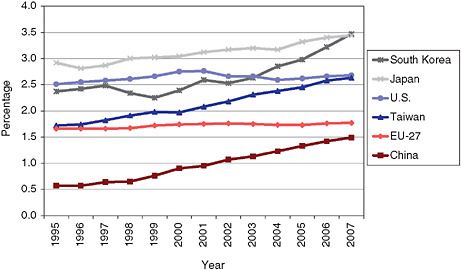
FIGURE 3.1 Illustration of the expansion in overall investment (percent of gross domestic product) in research and development by Asian countries, in contrast to the relatively flat investment over the past decade by the United States and Europe. SOURCE: American Association for the Advancement of Science, R&D Budget and Policy Program. © 2010 AAAS.
making can be even more severe. The presence of additional approval layers can hinder the ability of a project to respond to changes in performance and cost that often occur during the development of a facility. Legal requirements such as the U.S. International Traffic in Arms Regulations (ITAR) can add significant delays and costs. Finally, international commitments can make it much more difficult to terminate or descope projects but can also smooth out funding profiles if partners are able to contribute at different times or rates. Overall, the implied financial stability of government agency involvement can be a double-edged sword.
An alternative approach to partnership is to coordinate access across a suite of facilities. In this model, individual parties build or operate an instrument or facility but access and/or data rights are shared with partner communities. A more limited form of partnership is the sharing of archival data from a facility, even in cases where observing time is restricted. Other arrangements may prove to be just as effective. For example, access to both the northern and southern skies is essential for many areas of astronomy; a partnership could take the form of time swaps on solely owned telescopes in the two hemispheres. Likewise, one international partner might have a unique facility (e.g., the proposed Large Synoptic Survey Telescope), and access to its observing time or data could be traded for access to other unique facilities (e.g., VLT or E-ELT). The key advantage of such arrangements is that
they foster merit-based scientific exploitation of the facilities, while minimizing the cost and administrative overheads that are inherent in a fully shared and managed project. The principle of open skies is compatible with the guiding principle of maximizing future scientific progress. In an increasingly international arena, flexibility will be a key to optimizing the science return from U.S. investments in new facilities.
A prerequisite for a successful partnership is that all parties view the arrangements as being fair and equitable, at least when considered across the sum of shared facilities. For example, under NSF’s open skies policy, access to the U.S. national centimeter-wavelength telescopes (EVLA, GBT, VLBA, and Arecibo), which are the premier facilities in the world at these wavelengths, is allocated without regard to nationality. As a result, overseas investigators make substantial use of those facilities, accounting for typically one-third (for the NRAO telescopes; less for Arecibo) of the allocated observing time. At present, it can be said that U.S. researchers have enjoyed open access to many, though not all, premier international facilities. In addition, private U.S. telescopes do not, as a matter of course, allow open access to the full U.S. community, let alone foreign astronomers. However, the astronomical community does get access to ground-based optical infrared facilities through the Telescope System Instrument Program scheme.
Such imbalances are likely to arise, and when they do, it is incumbent on the agencies and observatory directors to take corrective action. For example, when the fraction of foreign users of a U.S. facility becomes very large, then this can be taken as a sign that the science from that facility is less aligned with U.S. national priorities or that the balance between support of U.S. facilities and the U.S. user community has gotten out of line. Likewise, if a serious asymmetry develops between the United States and foreign facilities, then that is the time to propose reciprocal arrangements that will preserve the principle of open skies. There are two caveats to this approach. For “open skies” and similar arrangements to work, they need to be seen to be symmetrical and fair in terms of scientific opportunity and cost recovery over the long run and averaged over many facilities.
An important goal for the U.S. agencies is to place appropriate value on reciprocity arrangements in providing access to foreign astronomical facilities and data sets for U.S. researchers. To encourage reciprocal arrangements for broad merit-based access to telescopes worldwide, the observing rights and access to survey data, e.g., during validation periods, could be restricted for U.S.-funded facilities to scientists at U.S. institutions, any foreign partners, and other parties with such reciprocity agreements. In any restriction of access to U.S. facilities, care must be taken to address the needs of scientists from countries whose ability to participate in the construction and support of expensive international facilities is limited.
RECOMMENDATION: U.S. investors in astronomy and astrophysics, both public and private, should consider a wide range of approaches to realize participation in international projects and to provide access for the U.S. astronomy and astrophysics community to a larger suite of facilities than can be supported within the United States. These approaches could include not only shared construction and operation costs but also strategic time-sharing and data-sharing agreements. The long-term goal should be to maximize the scientific output from major astronomical facilities throughout the world, a goal that is best achieved through opening access to all astronomers.
International partnership should be regarded as an element of a broader strategy to coordinate construction and support of and access to astronomical facilities worldwide and to build scientific capability around the world.
International Strategic Planning
Beyond the arena of science coordination and shared access to individual facilities, greater international consciousness and coordination in the planning of the future astronomical agenda as a whole are increasingly evident. The European scientific community has initiated international planning on a pan-European scale over the past 5 years, with its ASTRONET2 and ASPERA (Astroparticle ERAnet), and the European Space Agency (ESA) Cosmic Vision exercises. These and similar plans from other communities are loosely modeled after the NRC decadal survey process, but up to now have not interacted to any substantive degree with the planning in the United States or elsewhere. Recognizing the potential value of international coordination and planning, the Organisation for Economic Cooperation and Development (OECD) Global Science Forum and the International Astronomical Union have sponsored workshops and other activities for the planning of future large facilities. The NRC’s Board on International Scientific Organizations also recently held a symposium to bring scientists together with program managers and governmental ministers from around the world to discuss plans for the future.3
Although one might well envisage a time later in this century when the exercise embodied in this Astro2010 activity is carried out by an internationally organized committee under the sponsorship of all member agencies, it is far too soon to
|
2 |
For more information on the ASTRONET survey and its reports, see http://www.astronet-eu.org/. |
|
3 |
The U.S. National Committee for the International Astronomical Union (IAU) worked with the National Research Council’s Board on International Scientific Organizations, Board on Physics and Astronomy, and the Space Studies Board to host the symposium “Beyond the Decade: The Future of International Astronomy. A Celebration of the International Year of Astronomy,” held on October 9, 2009, in Washington, D.C.; see http://sites.nationalacademies.org/PGA/biso/IAU/PGA_053106. |
recommend such a radical transition in planning. So long as the major share of astronomy research in the United States is underwritten by U.S. government agencies, it is clear that the research agenda and project recommendations ought to be determined at the national level. However, as more major projects—including nearly all of the very large scale astronomy and astrophysics projects—are conceived and carried out by international partnerships, an international forum for planning the future of astronomy will become increasingly valuable. In order that such a forum be effective, it will be necessary that it have the full support and participation of senior administrators within the agencies. From even modest beginnings, a foundation could be laid for more substantive cooperation and joint planning in the future and a context provided for interagency negotiations.
RECOMMENDATION: Approximately every 5 years the international science community should come together in a forum to share scientific directions and strategic plans, and to look for opportunities for further collaboration and cooperation, especially on large projects.
PUBLIC-PRIVATE PARTNERSHIPS
In addition to encouraging opportunities for international collaboration and partnership, the Astro2010 Committee also found opportunities within the United States for leveraging federal investments through partnering with privately funded research efforts in astronomy and astrophysics.
Ground-Based Optical and Infrared Astronomy
Most astronomical research in optical and infrared (OIR) astronomy was supported privately in the United States until 1958, when Kitt Peak National Observatory and AURA (Association of Universities for Research in Astronomy) were founded to provide public access to state-of-the-art OIR facilities. In subsequent years, competition between the private and public sectors dominated cooperation. However, the increasing cost of constructing large telescopes and, especially, the long-term cost of operating them, coupled with the desire of astronomers not affiliated with the institutions operating private telescopes to have access to those facilities, eventually led to the growth of public-private partnerships in the United States.
Today it is common to refer to the “OIR system,” a concept envisioned by the 2001 decadal survey of astronomy and astrophysics, AANM, as the union of public and private OIR ground-based facilities that provide open telescope access to the U.S. astronomical community. On the basis of the NSF senior review, the National Optical Astronomy Observatory (NOAO) formed two committees to focus on the OIR system to ensure access for the astronomical community to a
balance over all apertures. Priorities and recommendations for large telescopes were the purview of the Access to Large Telescopes for Astronomical Instruction and Research (ALTAIR) Committee. The Renewing Small Telescopes for Astronomical Research (ReSTAR) Committee achieves a similar goal with respect to smaller telescopes. The reports from ReSTAR and ALTAIR4 provide a roadmap for producing upgraded instrumentation that enables U.S. observatories to maintain international competitiveness, they leverage the considerable private investment in these facilities, and they provide open-access observing time to the U.S. OIR community. Other important system activities include the enabling of OIR technology development, adaptive optics and interferometry, access to data archives for ground-based OIR telescopes, and training of future astronomers.
The NOAO and the international Gemini Observatory are operated via a cooperative agreement between NSF and a research management corporation, AURA. As summarized in Table 3.1, there are numerous ongoing partnerships for the existing U.S. ground-based OIR telescopes larger than 3 meters, including the majority of the largest-aperture (6.5- to 10-meter) OIR telescopes available to the U.S. community. The nature of these partnerships varies greatly, some consisting of universities partnering with NSF, or NASA, some between universities and foreign federal agencies, and others between private and state universities.5
The combination of publicly and privately funded facilities is a feature particular to the U.S. system internationally. Over this same 50-year period, Europe has taken a different path. With the founding of the European Southern Observatory (ESO) and its La Silla Observatory, Europe achieved near parity with the U.S. public observatories in the 1980s. The few other (non-ESO) OIR facilities in Europe still tend to be nationally funded, and there has been a gradual de-emphasis on institutionally operated observatories. Overall, the European model has evolved toward collective public investment in shared major facilities, major investments in new instruments and data systems, and high levels of user support. In the 1990s Europe achieved full parity with the combined public-private U.S. OIR system through the construction of the Paranal Observatory and its four 8-meter VLT telescopes. In some areas, such as high-resolution stellar spectroscopy, integral field spectroscopy, and data archiving, ESO has now established clear international leadership; the United States retains a lead in infrared detectors and high-contrast imaging.
Although the U.S. model is different from that in Europe and elsewhere, it offers some important advantages. Private institutions have attracted large sums of
|
4 |
ReSTAR report, available at http://www.noao.edu/system/restar/files/ReSTAR_final_14jan08.pdf. Accessed May 2010. ALTAIR report, available at http://www.noao.edu/system/altair/. Accessed August 2010. |
|
5 |
The state university funding for astronomy is estimated to be 80 to 90 percent public money and 10 to 20 percent privately raised within the public university. |
TABLE 3.1 Currently Operating OIR Facility Partnerships (>3-meter apertures only)
|
Observatory/Facility |
Private Partners |
Non-Federal/Public Partners |
Federal/Public Partners |
|
Apache Point Observatory |
Astrophysical Research Consortium and private universities |
Public universities |
|
|
Gemini Observatory |
|
International partners |
NSF through AURA |
|
HET |
Stanford University |
University of Texas, Pennsylvania State University, Ludwig Maximilians Universität, and Georg August Universität |
|
|
IRTF |
|
|
NASA and NSF through University of Hawaii |
|
Keck Observatory |
Caltech |
University of California |
NASA |
|
KPNO 4 m and CTIO 4 m |
|
|
NSF through AURA/NOAO |
|
LBT Observatory |
Research Corporation, University of Notre Dame |
University of Arizona, Arizona State University, Northern Arizona University, Ohio State University, University of Minnesota, University of Virginia, and international partners (Germany and Italy) |
|
|
Magellan Observatory |
Carnegie Observatories, Harvard University, MIT |
University of Arizona, University of Michigan |
|
|
MMT Observatory |
|
University of Arizona |
Smithsonian |
|
Palomar Observatory |
Caltech |
Cornell University |
NASA/JPL, NOAO |
|
SALT |
American Museum of Natural History, Dartmouth College, Carnegie Mellon University |
Rutgers University, University of Wisconsin, University of North Carolina, HET partners |
|
|
SOAR Telescope |
Universities |
Federal Republic of Brazil (MCT), University of North Carolina, Michigan State University |
NOAO |
|
WIYN Observatory |
Yale University |
University of Wisconsin, Indiana University |
NOAO |
private capital and philanthropy for telescope projects and thereby offered strong leveraging of available public funding, which has gone to support instrumentation in exchange for public access. It also has allowed scientists to carry out larger, bolder, and riskier investigations than those typically approved by national or international peer review panels for heavily oversubscribed public telescopes. The U.S. privately operated observatories have an operations model that is leaner than the Gemini Observatory and ESO’s VLT, partially due to the provision of fewer user services. But access is restricted to the partner institutions, which may or may not include the federal government. The federally funded, publicly operated national observatories (NOAO and Gemini) provide merit-based access to OIR telescopes for the entire U.S. community and the sole access to large OIR telescopes for nearly half of U.S. astronomers, including students. Among the largest-aperture telescopes, Gemini provides 57 percent of the public-access nights; Keck, 25 percent (through the NASA partnership, with science restricted to that aligned with NASA’s strategic goals); and TSIP participating telescopes (through NOAO time allocation), 18 percent of public access time.
These various public and private elements taken together allow the United States to remain scientifically competitive in OIR astronomy even though greater public resources are being invested overseas. However, the strengths in the OIR system are balanced by serious limitations that have become exacerbated over time and that serve to frustrate and polarize the U.S. OIR community. Several fundamental problems arise repeatedly. First is the financial gulf between the aspirations of the U.S. OIR community and the limited resources of NSF, a problem when considering even minor initiatives, but one that is especially acute when raising public funds for the next generation of large telescopes. Second is the competition for the limited NSF resources between the private observatories, which operate the lion’s share of aperture for a subset of the user community, and the U.S. public observatories, which operate a small portion of the facilities with open access for all. A third problem is the competition between privately funded groups; although such competition has been generally beneficial to science historically, collaboration now seems imperative in order to realize next-generation facilities.
Figure 3.2 shows the effective ownership share in terms of the number of square meters of primary mirror of the world’s largest optical-infrared telescopes and illustrates how the share has evolved over the last two decades. Four categories of owners are shown: U.S. private (blue), U.S. federal (red), Europe (purple), and other (green). The large decrease in the federal share during the era of 8-meter-class telescopes, from 1990 to today, is noteworthy. When one takes into consideration factors such as number of smaller telescopes the comparison becomes less stark, but by any measure the role of the U.S. public sector in this arena has been contracting steadily.
The corresponding breakdown in U.S. federal (NSF) funding is divided be-
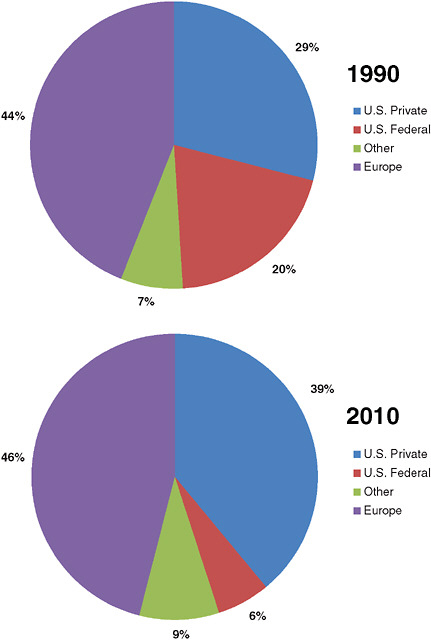
FIGURE 3.2 Distribution of optical and infrared telescope aperture around the world, 1990 and 2010. Colors denote the fraction of telescope primary mirror area held by U.S. private institutions (blue), U.S. federally funded national observatories (red), European-run observatories (purple), and other foreign-led observatories (green). The main change since 1990 has been a sharp decline in the share of telescope aperture available through U.S. public observatories.
tween support for public OIR observatories (NOAO and Gemini) at 81 percent, that for privately held telescopes through instrumentation programs (TSIP) at 14 percent, and design and planning for GSMT, LSST, and other future facilities at 5 percent. ATI and MRI funds allocated to OIR projects are not included in the calculation and are distributed across the pie, albeit unequally, but do not affect the main conclusion. Private observatories receive a small slice of the federal funding even though they comprise the majority of telescope aperture.
Ground-Based Radio, Millimeter, and Submillimeter Astronomy
Radio astronomy was a young and unestablished field when the National Radio Astronomy Observatory (NRAO) was founded in 1956. Unlike the situation in U.S. OIR astronomy, U.S. radio, millimeter, and submillimeter (RMS) astronomy has been primarily federally funded since its inception. However, just as in OIR astronomy, the increasing cost of constructing large RMS telescopes and, especially, the long-term cost of operating them, is now leading to growth of the idea of public-private partnerships.
Although the concept of an RMS system is not widespread, there are limited examples of public-private partnerships in radio astronomy (Table 3.2). NSF partners with universities through the University Radio Observatory (URO) program to operate, instrument, and provide public access to unique radio observatories, currently the Caltech Submillimeter Observatory (CSO), the Combined Array for Research in Millimeter-wave Astronomy (CARMA), and a small amount for the Allen Telescope Array (ATA). The URO program is responsible for training at the student and postdoctoral level many of today’s prominent RMS astronomers as well as the highly skilled technical staff who are needed to build and operate the state-of-the-art receivers and instruments.
NRAO is operated via a cooperative agreement between NSF and a not-for-profit research management corporation, AUI (Associated Universities, Inc.). Its facilities can lay legitimate claim to international leadership in their capabilities, at least for now. The complementary scientific capabilities provided by the national observatory (now including ALMA), the smaller university-operated facilities, and more targeted investments in experiments (e.g., CMB and the epoch of reionization) and technology development should allow the United States to maintain its position of international leadership in radio astronomy for at least another decade. However, significant investments in next-generation facilities by Europe, China, Australia, and South Africa (~$100 million each) are beginning to challenge this leadership.
Currently, the balance of NSF-AST support for RMS activities is approximately 60 to 65 percent for NRAO plus ALMA telescope operations, 15 to 20 percent for university-operated radio observatories, 5 to 10 percent for experiments, and
TABLE 3.2 Currently Operating RMS Facility Partnerships
|
Observatory/Facility |
Private Partners |
Non-Federal/Public Partners |
Federal/Public Partners |
|
ALMA |
|
International partners |
NSF through AUI |
|
Arecibo |
|
|
NSF (AST and AGS) and NASA through Cornell University/NAIC |
|
ARO |
|
University of Arizona and international universities |
|
|
ATA |
SETI Institute |
UC Berkeley |
|
|
CARMA |
Caltech, University of Chicago |
UC Berkeley, University of Illinois, University of Maryland |
NSF |
|
CSO |
Caltech |
University of Texas |
NSF |
|
EVLA, VLBA, GBT |
|
EVLA’s international partners |
NSF through AUI/NRAO |
|
LMT |
|
University of Massachusetts and Mexico |
|
|
SMA |
|
Taiwan |
Smithsonian |
|
SPT |
University of Chicago, Case Western Reserve University |
UC Berkeley, UC Davis, University of Illinois, University of Colorado, and international universities |
NSF-OPP, Smithsonian |
10 percent for technology and future facilities development. The fraction allocated to NRAO plus ALMA will increase when ALMA becomes fully operational in 2014.
PARTNERSHIP OPPORTUNITIES
Many of the papers provided by the community as input to Astro2010 described projects that involve significant partnership—between university groups, between non-federal and federal partners, between federal agencies, and involving international collaborations. Almost all of the proposed large-scale projects ranked most highly by the Astro2010 Program Prioritization Panels involve a significant international collaboration of one form or another. The committee notes in particular LISA (NASA plus ESA) and participation in an international Atmospheric Čerenkov Telescope Array, from the Panel on Particle Astrophysics and Gravitation; WFIRST and IXO (NASA plus ESA), from the Panel on Electromagnetic Observations from Space; CCAT (a U.S.-led project with international university partners) and HERA-II (a U.S.-led project but a pathfinder for the international HERA-III
project, aka Square Kilometer Aray (SKA)-low in the post-2020 timeframe), from the Panel on Radio, Millimeter, and Submillimeter Astronomy from the Ground, which recommended a continuing U.S. role in the development of concepts for the international SKA-mid and SKA-high components; and GSMT (in either version, a privately led project in the United States with significant or perhaps eventually even dominant international participation) and LSST (proposed as a private-public partnership), from the Panel on Optical and Infrared Astronomy from the Ground. Complex equipment is essential for progress in addressing the compelling science opportunities outlined in Chapter 2.
CONCLUSION: Complex and high-cost facilities are essential to major progress in astronomy and astrophysics and typically involve collaboration of multiple nations and/or collaboration of federal and non-federal institutions. These partnerships bring great opportunities for pooling resources and expertise to fulfill scientific goals that are beyond the reach of any single country. However, they also present management challenges and require a new level of strategic planning to bring them to fruition.
OIR and RMS on the Ground
The 14-nation ESO consortium is on track to become the undisputed leader in ground-based OIR astronomy with its planned construction of the 42-meter European Extremely Large Telescope (E-ELT) facility by 2018 and to play a more prominent role in RMS by investing significantly in the SKA. By concentrating most of its resources into a single international partnership, Europe has minimized duplication of capability between facilities, created a major international research center, and established a funding line for construction that is intended to lead from ALMA to E-ELT to SKA. As a large monolithic, multinational institution, ESO inevitably carries a larger overhead than a U.S. private observatory, but it serves as a good example of a successful international partnership.
Optical and Infrared
The United States, in contrast to Europe, is relying on an extension of its private-public model to remain competitive in the era of ELTs. The two major GSMT projects aiming to construct 30-meter-class telescopes, the Thirty Meter Telescope (TMT) and Giant Magellan Telescope (GMT), are organized by private and public U.S. universities and other non-profit institutions. It is notable that many countries around the world (Australia, Canada, China, India, Japan, and Korea) are forming public-private partnerships with these U.S. groups. Although GSMT was endorsed
by the 2001 AANM report, U.S. public participation in either of these projects has yet to be determined.
In Chapters 6 and 7, the committee recommends public participation by the United States in at least one of the GSMT projects, participation that could come in the form of contributions to construction, operations, and/or advanced instrumentation. This would leverage the large private contribution, maintain a leading U.S. role in OIR astronomy, and realize the scientific potential of a 30-meter-class optical-infrared telescope for U.S. astronomers. The benefits of such participation could go beyond making a fraction of the observing time available to the entire community of U.S. astronomers. With a sufficiently early commitment from NSF, the broad U.S. community would have input into GSMT governance and could play an important role in ensuring that the telescope and its instruments will meet the needs of the full U.S. community of users and enhance the development and use of this facility by engaging the enthusiasm and experience of the entire community. This includes NOAO, which presumably would be identified as the public partner, with responsibility for representing the public interests during both the construction and the operation phases.
Rather than view Astro2010’s prioritization as a competition between LSST and GSMT, the Program Prioritization Panel on Optical and Infrared Astronomy from the Ground in its report stresses the synergy of these two projects. Each would be greatly enhanced by the existence of the other, and the omission of either would be a significant loss of scientific capability. The combination of wide-area photometric surveys and large-aperture spectroscopy has a long, productive history in OIR astronomy: interesting sources identified in the wide-field survey are studied in detail with the larger telescope. The panel concluded that a crucial goal for ground-based OIR astronomy in the coming decade should be to realize the potential of the combination of these facilities, as linchpins for an enlarged and more capable U.S. ground-based OIR system. Furthermore, the synergies with U.S.-led space missions are significant.
Radio, Millimeter, and Submillimeter
The next generation of radio telescopes beyond ALMA will exploit phased-array technology and a new generation of fast digital correlators to make possible radio telescope arrays with thousands of linked antennas, with collecting areas approaching a square kilometer, and extending up to thousands of kilometers. Retrofitting existing telescopes with focal plane arrays will enable (and already has enabled) gains of orders of magnitude in mapping speed. The most ambitious of these projects, the SKA, was co-ranked as the highest-priority large facility (with the E-ELT) for the
coming decade in the European ASTRONET decadal survey,6 and it has strong additional support from Australia and South Africa, the candidate sites for the SKA.
The SKA project encompasses the development of the next-generation radio capability to operate in the meter-to-centimeter wavelength range. SKA technology development was a key part of the RMS program endorsed by the AANM report; significant NSF funding ($12 million) became available only in 2007. As noted in the report of the AUI Committee on the Future of U.S. Radio Astronomy7 and as defined in the report of the Astro2010 Panel on Radio, Millimeter, and Sub-millimeter Astronomy from the Ground, the SKA concept is likely to be fulfilled by separate facilities delivering huge increases in collecting area via different technical approaches appropriate to three separate wavelength ranges, referred to as SKA-low (1- to 3-meter wavelength), SKA-mid (3- to 100-centimeter wavelength), and SKA-high (0.6- to 3.0-centimeter wavelength). Concept and technology development for the SKA is being undertaken by the international SKA consortium, which includes some 55 institutions in 19 countries. Many of the areas of technology development recommended in the RMS report are crucial steps along the road to achievement of the SKA.
The dramatic increase in scientific capability promised by SKA is directly reflected in the scope, complexity, and technical challenge of SKA concept development. At the present time, the detailed path to construction of any of the three SKA facilities is not clear. However, continued steady development of technology will lead to the next generation of radio facilities.
The HERA program, a project that was highly ranked by the RMS-PPP and included by the committee in its list of compelling cases for a competed mid-scale program at NSF, provides a development pathway for the SKA-low facility. Progress on development of the SKA-mid pathfinder instruments—the Allen Telescope Array in the United States, the MeerKAT in South Africa, and the ASKAP in Australia—and in new instruments and new observing modes on the existing facilities operated by NRAO and the National Astronomy and Ionosphere Center will provide crucial insight into the optimal path toward a full SKA-mid. It is natural for the United States to build on its long, successful heritage with the EVLA, GBT, and VLBA in further developing the capabilities leading toward the SKA-high. It is primarily through technology development that the United States can remain an active partner in the concept development of the next-generation meter-to-centimeter wavelength radio facilities through the international SKA collaboration.
|
6 |
ASTRONET, The ASTRONET Infrastructure Roadmap, Draft Report, May 5, 2008, available at http://www.astronet-eu.org/IMG/pdf/Astronet_Infrastructure_Roadmap.pdf. |
|
7 |
Associated Universities, Inc., Future Prospects for U.S. Radio, Millimeter, and Submillimeter Astronomy: Report of the Committee on the Future of U.S. Radio Astronomy, revised February 2009, available at http://www.aui.edu/pr.php?id=20081003. |
Particle Astrophysics and Gravitation
Design efforts in the United States and in Europe for the next-generation TeV Čerenkov telescope, AGIS and CTA, respectively, are underway and follow a recent worldwide explosion of activity in gamma-ray astrophysics, with the U.S.-led Fermi Gamma-ray Space Telescope (FGST) in space and a host of TeV Čerenkov telescopes on the ground (VERITAS, HESS, MAGIC, Milagro, CANGAROO, and HEGRA). The proposed new instruments would increase sensitivity and field of view by an order of magnitude. Because the two designs have similarities and complementarity (including the location of VERITAS and HESS in different hemispheres), opportunities for collaboration exist and discussions are underway. This is yet another example in which common scientific interests, current capability, and design complementarity make collaboration not only a means of reducing cost to each partner, but also a way of creating a more capable observatory.
Space Observatories
The Laser Interferometer Space Antenna (LISA) and the International X-ray Observatory (IXO) are two transformational missions where the convergence of scientific goals, complementarity of expertise, and the desire to produce more science per dollar has made partnering essential. LISA is a relatively mature NASA/ESA collaboration, while IXO is the result of a more recent merger of the U.S. Con-X and the ESA XEUS missions, with JAXA as an additional partner. NASA will consider Astro2010 advice on the relative rankings of LISA and IXO, and in Europe the two are competing for the first L(arge)-class launch slot (scheduled for 2020) against the Europa Jupiter System Mission (EJSM) (an outer planets mission) in the ESA Cosmic Vision program, whose down-select process is beginning in 2010. From the U.S. perspective, the committee would like to see both LISA and IXO go forward, and an implementation plan for NASA is given in Chapter 7. ESA, on the other hand, may choose a different prioritization, or choose to go with EJSM.
Even more complex is the potential partnering between NASA, DOE, and ESA on a dark energy mission. Because of the common interests in the science of dark energy, as well as complementary technical capabilities, NASA and DOE have been planning for the Joint Dark Energy Mission (JDEM) since 2003. Euclid is a European mission concept aimed at cosmology and dark energy, which is competing for one of two M(edium)-class launch slots, with a decision expected in late 2011 and launches scheduled for 2018 and 2019. The overlap in goals and scope between the proposed U.S. and European missions is significant, and there is potentially a grand partnering arrangement involving NASA, DOE, and ESA if the expanded scientific priorities set by Astro2010 for such a mission can be aligned among the partners, and assuming that the arrangement is consistent with the United States
playing a clear leadership role. However, reconciling the outcome and timing of three different decision-making processes is a challenge.
AGENCY PARTNERSHIPS AND INTERFACES
Revolutionary discoveries in astronomy over the past two decades have broadened the field and created new interfaces with other areas of science—particle physics (the birth and early evolution of the universe, cosmic rays, dark matter, and dark energy), nuclear physics (the origin of the chemical elements and neutron star structure), gravitational physics (black holes and gravitational waves), planetary science (the solar system and exoplanets), computer science (analysis of large data sets), and soon biology (life in the universe). Today, astronomical research involves not only astronomers, but also scientists from many other fields, especially physics. Thus there are more funding agencies involved, which necessitates careful handling of the complex interfaces between them.
Currently the NASA Astrophysics Division budget within the Science Mission Directorate is roughly $1.1 billion per year (including construction of major facilities); NSF-AST within the Directorate for Mathematical and Physical Sciences (MPS) is $250 million per year. Funding from NSF-OPP and NSF-PHY is about $10 million and $20 million, respectively, with an additional $30 million per year going to operations for the Advanced LIGO. DOE OHEP within the Office of Science funds particle astrophysics at a level of about $100 million per year. Whereas NSF-AST funds investigator-driven research broadly in the astrophysical sciences and NASA’s Astrophysics Division funds space-mission-driven astrophysics research broadly defined, the interests of DOE’s OHEP and NSF-PHY and NSF-OPP are more focused. With so many agencies involved, coordination is critical to obtaining optimal value, in terms of both scientific return and cost-effectiveness. Understanding the different missions and cultures of the funding agencies is a prerequisite to optimizing investment.
-
DOE Office of High Energy Physics. DOE is a mission agency, and OHEP’s mission is to seek a fundamental understanding of matter, energy, space, and time, which resonates strongly with much of the research at the frontier of astrophysics. The bulk of the program consists of the construction and operation of high-energy particle accelerators and the support of the scientists who use them. OHEP’s interest in particle astrophysics has been spurred by the recognition that dark matter is likely to be a new form of matter, that dark energy may be a new fundamental field, and that the universe may well be the best laboratory for making progress in testing ideas about the unification of the forces and particles of nature. The
-
recent report8 of the Particle Astrophysics Scientific Assessment Group (PASAG) to the High Energy Physics Advisory Panel (HEPAP), which advises DOE and NSF, defined priorities for high-energy physics funding of astrophysics projects. Three broad criteria were laid out: (1) importance of the science and discovery potential consistent with the fundamental physics mission of OHEP; (2) necessity of OHEP expertise and/or technology to enable important projects and to make unique, high-impact contributions (e.g., silicon detectors and electronics on the Fermi Gamma-ray Space Telescope, or data acquisition and processing on the Sloan Digital Sky Survey, or CMB research); and (3) programmatic issues of balance and the international context. PASAG recommended that these criteria be used, in descending order of importance, to prioritize the large number of opportunities in astrophysical research to be funded.
-
NSF Physics Division and Office of Polar Programs. NSF-PHY funds investigator-driven research across all areas of physics, including nuclear, particle, atomic, biological, gravitational, plasma, and theoretical physics. Nuclear and particle astrophysics science falls within the NSF-PHY portfolio, and there is a specific program for it. NSF-OPP is the steward for U.S. science in Antarctica, and it funds (or co-funds) a variety of astrophysics projects at the South Pole (e.g., CMB experiments, the IceCube neutrino detector, and the 10-meter South Pole Telescope). Through the MREFC process, NSF-PHY has made a large investment in the construction and operation of the LIGO facility, and, in this decade, the Advanced LIGO detectors.
-
NSF Atmospheric and Geospace Sciences Division. NSF-AGS (formerly NSF-ATM) is part of the Geosciences (GEO) Directorate and provides the bulk of the grant funding for solar scientists. Additionally, for solar astronomy NSF-AGS supports the High Altitude Observatory of the National Center for Atmospheric Research. NSF-AGS is concerned mostly with the effects of the Sun on our terrestrial environment, whereas NSF-AST, which supports solar astronomy through operation of NSO, views the Sun as a star that can be studied in great detail due to its unusual proximity.
Currently there are a number of areas of astrophysical research where the interests of more than one of these agencies converge. The synergies and complementarity between the agency capabilities are important. As examples, instruments developed on NSF-funded ground- and balloon-based instruments have been flown by NASA in space (on WMAP and now on Planck). NASA’s long-duration balloon program depends on the support of NSF’s McMurdo station in Antarctica,
|
8 |
U.S. Department of Energy, Report of the HEPAP Particle Astrophysics Scientific Assessment Group (PASAG), October 23, 2009, available at http://www.er.doe.gov/hep/panels/reports/hepap_reports.html. |
and NASA satellites and downlink stations are critical for communication and transfer of astronomical data from NSF’s South Pole research station. NSF radio observatories are used for the telemetry of spacecraft data. DOE physicists were essential for the successful design, construction, and operation of the Large Area Telescope on FGST, and the Dark Energy Camera is receiving both DOE and NSF funding and will be a facility instrument on an NSF-supported telescope. Scientists from all three agencies contribute special expertise in detector fabrication and data acquisition to many successful partnerships. Although funding by multiple agencies adds complexity, it also adds significant value. Each of the agencies brings special technical strengths and experts as well as unique research communities. Provided that the efforts of the different agencies are effectively coordinated, there are significant benefits to science and to the nation in collaboration, as has been demonstrated in many successful joint ventures.
Coordination between the agencies is facilitated by a variety of mechanisms and currently takes place at several levels. The agencies have program managers who meet both formally and informally to coordinate at the agency level, sometimes facilitated by OSTP. In addition, a number of standing FACA advisory committees provide expert community advice. These include the High Energy Physics Advisory Panel, for the DOE’s OHEP and NSF-PHY; the Mathematical and Physical Sciences Advisory Committee (MPSAC), for NSF-AST and NSF-PHY; the Astrophysics Subcommittee of the NASA Advisory Council’s Science Committee, for the NASA Astrophysics Division; and the Astronomy and Astrophysics Advisory Committee (AAAC), which advises NSF, NASA, and DOE. All of these FACA committees can effectively provide, and have provided, the agencies with advice on issues requiring rapid action. Some of the advice is agency specific, with one FACA committee reporting to one agency. Some of the advice crosses agency boundaries and requires the formation of an ad hoc task force.
While all of these committees play valuable roles, modifications to the advisory structure could improve the coordination between the agencies and in many instances improve the effectiveness of agency-specific advice. Over the past 10 years the advisory structure at NASA has been reorganized several times. The most recent reorganization of the NASA Advisory Council and its subcommittees appears to have effectively addressed the issue of shortening the conduit between the advisory body and the science managers for whom the advice is intended (as recommended by the NRC’s NAPA report9). NSF-PHY and NSF-AST receive only informal input from MPSAC, an advisory committee to NSF’s entire Directorate for Mathematical and Physical Sciences whose effectiveness could be improved. While MPSAC facilitates cross-division strategic coordination, NSF-AST will continue to need tactical
advice from the community, which it currently receives through its Committee of Visitors and senior review processes. The survey committee urges MPS to find mechanisms to provide NSF-AST with a more robust means of expert community input. Finally, the charges to the NRC Committee on Astronomy and Astrophysics and the AAAC have evolved over the past decade to the point of considerable overlap, which is addressed separately below.
INTERAGENCY TACTICAL ADVICE
The AAAC was created by Congress in 2002 to advise Congress, OSTP, NASA, and NSF (and also, by an amendment in 2005, DOE) on matters of interagency coordination as well as on the health of the astronomical enterprise generally. Because many of the critical elements of the core research program (described in Chapter 5) within this national enterprise cut across agency boundaries, optimizing the program as a whole requires looking across agencies. The AAAC can play a key role in providing continuing advice to DOE, NASA, and NSF on funding across the three agencies in the areas of:
-
Support of individual and group grants funding, including the balance between grants programs, mission/facility operations, and the design and development of new missions/facilities;
-
Overall support of theoretical and computational astrophysics;
-
Data archiving and dissemination, and funding for data analysis software, including the optimal infrastructure for the curation of archival space- and ground-based data from federally supported missions/facilities;
-
Laboratory astrophysics; and
-
Technology development.
Last but not least, the AAAC can be tasked to provide timely, ad hoc advice on pressing cross-agency matters; it has in the past provided essential white papers on exoplanets, dark energy, and CMB polarization using a task force approach.
STEWARDSHIP OF THE DECADAL SURVEY
The decadal survey is a strategic document built on 2 years of work involving a significant fraction of the community. The strategy laid out is based on the best information available at the time on scientific, technical, and fiscal issues, using reasonable assumptions about the future. However, astronomy is a highly progressive activity, and important scientific discoveries, technical advances, and changes in budgets and international plans will require revisiting parts of the strategy over the next decade. Moreover, this report identifies in Chapter 7 a number of decision
points at which the need for critical expert community input can already be anticipated. It also is likely that a mid-decade review of progress and of issues related to international standing and partnerships—to generate recommendations for possible mid-course corrections—would be valuable. The committee believes that the existing standing agency and interagency committees—including the AAAC—are not well suited or constituted to provide the necessary strategic advice, given that they were constituted primarily to give rapid feedback on tactical matters brought to them by the agencies. This important function should remain their province.
The survey committee believes that there will be a continuing need for regular assessments of the progress made toward the implementation of the Astro2010 proposed program, and a need for a mid-decade assessment that would include an analysis of whether any of the contingencies described in this report have been encountered and make recommendations for appropriate action as discussed below.
RECOMMENDATION: NASA, NSF, and DOE should on a regular basis request advice from an independent standing committee constituted to monitor progress toward reaching the goals recommended in the 2010 decadal survey of astronomy and astrophysics, and to provide strategic advice to the agencies over the decade of implementation. Such a decadal survey implementation advisory committee (DSIAC) should be charged to produce annual reports to the agencies, the Office of Management and Budget, and the Office of Science and Technology Policy, as well as a mid-decade review of the progress made. The implementation advisory committee should be independent of the agencies and the agency advisory committees in its membership, management, and operation.
The survey committee believes that the role of a decadal survey implementation advisory committee will be all the more critical in the decade to come, in part because of the technical decision points that have been flagged, in part because of the many partnerships (agency, public/private, and international) that are involved with most of the highly ranked projects, and in part because of potentially rapid changes in the scientific landscape (particularly in the exoplanet and CMB fields). The role of international partners in particular, with their own priorities, agency priorities, and decision processes, demands a more agile and adaptive follow-through on the Astro2010 decadal recommendations than can be accommodated by a 10-year review cycle.


