
6
Meeting the Need for Better Data on the Health Care Workforce
|
Key Message #4: Effective workforce planning and policy making require better data collection and an improved information infrastructure. Planning for fundamental, wide-ranging changes in the preparation and deployment of the nursing workforce will require comprehensive data on the numbers and types of professionals currently available and required to meet future needs. Such data are needed across the health professions if a fundamental transformation of the health care system is to be achieved. Major gaps exist in currently available workforce data. Filling these gaps should be a priority for the National Health Workforce Commission and other structures and resources authorized under the Affordable Care Act. |
Chapters 3 through 5 have argued for the need to transform the nursing profession to achieve the vision of a reformed health care system set forth in Chapter 1. Achieving this vision, however, will also require a balance of skills and perspectives among physicians, nurses, and other health professionals. Yet data are lacking on the numbers and types of health professionals currently employed, where they are employed, and in what roles. Understanding of the impact of bundled payments, medical homes, accountable care organizations, health information technology, comparative effectiveness, patient engagement,
and safety, as well as the growing diversification of the American population, will not be complete without information on and analysis of the contributions of the various types of health professionals that will be needed. For cost-effectiveness comparisons, for example, different team configurations, continuing education and on-the-job training programs, incentives, and workflow arrangements—all of which affect the efficient use of the health care workforce—must be evaluated. Having these data is a vital first step in the development of accurate models for projecting workforce capacity. Those projections in turn are needed to inform the transformation of nursing practice and education argued for in Chapters 3 and 4, respectively.
Awareness of impending shortages of nurses, primary care physicians, geriatricians, and dentists and in many of the allied health professions has led to a growing consensus among policy makers that strengthening the health care workforce in the United States is an urgent need. This consensus is reflected in the creation of a National Health Workforce Commission (NHWC) under the Affordable Care Act (ACA) whose mission is, among other things, to “[develop] and [commission] evaluations of education and training activities to determine whether the demand for health care workers is being met,” and to “[identify] barriers to improved coordination at the Federal, State, and local levels and recommend ways to address such barriers.”1 The ACA also authorizes a National Center for Workforce Analysis, as well as state and regional workforce centers, and provides funding for workforce data collection and studies. The committee believes these initiatives will prove most successful if they analyze workforce needs across the professions—as the Department of Veterans Affairs did in the 1990s (see Chapter 3)—rather than focusing on one profession at a time. Furthermore, national trend data are not granular enough by themselves to permit accurate projections of regional needs.
This chapter addresses key message #4 set forth in Chapter 1: Effective workforce planning and policy making require better data collection and an improved information infrastructure. The chapter first provides a closer look at what is known about the workforce in two areas of urgent need: primary care providers and nurses. It then examines gaps in currently available workforce data. The third section describes the experience of one regional workforce plan in Texas that aims to maintain the right numbers and types of nurses to meet its needs. The final section presents the committee’s conclusions about the need for better data on the health care workforce.
CURRENT ESTIMATES OF PRIMARY CARE PROVIDERS AND NURSES
Primary Care Projections
The United States has nearly 400,000 primary care providers (Bodenheimer and Pham, 2010). As noted in Chapter 3, physicians account for 287,000 of these providers, nurse practitioners for 83,000, and physician assistants for 23,000 (HRSA, 2008; Steinwald, 2008). While the numbers of nurse practitioners and physician assistants are steadily increasing, the number of medical students and residents entering primary care has declined in recent years (Naylor and Kurtzman, 2010). In fact, a 2008 survey of medical students found only 2 percent planned careers in general internal medicine, a common entry point into primary care (Hauer et al., 2008).
There is a great deal of geographic variation in where primary care providers work. About 65 million Americans live in areas that are officially identified as primary care shortage areas according to the Health Resources and Services Administration (HRSA) (Rieselbach et al., 2010). For example, while one in five U.S. residents live in rural areas, only one in ten physicians practice in those areas (Bodenheimer and Pham, 2010). A 2006 survey of all 846 federally funded community health centers (CHCs) by Rosenblatt and colleagues (2006) found that 46 percent of direct care providers in rural CHCs were nonphysician clinicians, including nurse practitioners, nurse midwives, and physician assistants; in urban clinics, the figure was 38.9 percent. The contingent of physicians was heavily dependent on international medical graduates and loan forgiveness programs. Even so, the vacancies for physicians totaled 428 full-time equivalents (FTEs), while those for nurses totaled 376 FTEs (Rosenblatt et al., 2006). Expansion of programs that encourage health care providers to practice primary care, especially those from underrepresented and culturally diverse backgrounds, will be needed to keep pace with the demand for community-based care. For further discussion of variation in the geographic distribution of primary care providers, see the section on expanding access to primary care in Chapter 3.
In 2008, the Government Accountability Office determined that there were few projections of the future need for primary care providers, and those that existed were substantially limited (Steinwald, 2008). Arguably, it is simpler to project the future supply of health professionals than to project future demand for their services. It is difficult to predict, for example, the pattern of increased demand for primary care after full implementation of the ACA adds 32 million newly insured people to the health care system. Will there be a short, marked spike in demand, or will the surge be of longer duration that leaves more time to adapt? Given that there are more than 6,000 health professions primary care shortage areas nationwide (HRSA, 2010), the question remains of whether grow-
ing demand for primary care can best be met by an increased number of providers or by better distribution of existing providers.
Nursing Workforce Projections
Trend data consistently point to a substantial shortfall in the numbers of nurses in the near future. HRSA has calculated a shortfall of as many as 1 million FTEs by 2020 (HRSA, 2004). However, that projection is almost certainly too high because it depends on extrapolating today’s unsustainable growth rates for health care to the future. A more conservative estimate from 2009 suggests a shortage of 260,000 registered nurses (RNs) by 2025; by comparison, the last nursing shortage peaked in 2001 with a vacancy rate of 126,000 FTEs (Buerhaus et al., 2009). Yet this more conservative projection is almost certainly too low because the new law is “highly likely to increase demand for health care services and hence for nurses” (RWJF, 2010). Figure 6-1 shows a forecast of supply and demand for FTE RNs, 2009–2030. or a more detailed examination of the projected nursing shortage based on the numbers and composition of the workforce,
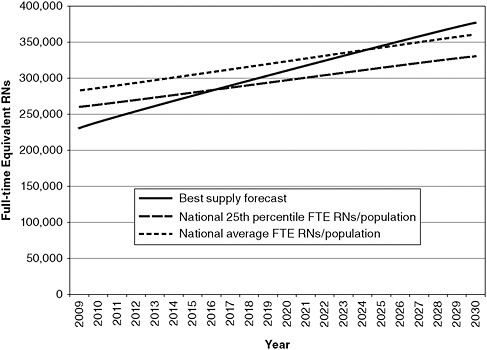
FIGURE 6-1 Forecast supply of and demand for full-time equivalent (FTE) RNs, 2009–2030
SOURCE: Spetz, 2009. Reprinted with permission from Joanne Spetz. Copyright 2009 by the author.
the effects of health reform on the demand for RNs, and the degree to which the RN workforce measures up to this anticipated demand, see Appendix F (on CD-ROM).
The urgency of the situation is masked by current economic conditions. Nursing shortages have historically eased somewhat during difficult economic times, and the past few years of financial turmoil have been no exception (Buerhaus et al., 2009). Nursing is seen as a stable profession—a rare point of security in an unsettled economy. A closer look at the data, however, shows that during the past two recessions, more than three-quarters of the increase in the employment of RNs is accounted for by women and men over age 50, and there are currently more than 900,000 nurses over age 50 in the workforce (BLS, 2009). Meanwhile, the trend from 2001 to 2008 among middle-aged RNs was actually negative, with 24,000 fewer nurses aged 35 to 49. In a hopeful sign for the future, the number of nurses under age 35 increased by 74,000. In terms of absolute numbers, however, the cohorts of younger nurses are still vastly outnumbered by their older Baby Boom colleagues. In other words, the past practice of dependence on a steady supply of older nurses to fill the gaps in the health care system will eventually fail as a strategy (Buerhaus et al., 2009).
Additionally, a 2008 review by Aiken and Cheung (2008) explains in detail why international migration will no longer be as effective in plugging gaps in the nursing workforce of the United States as it has in the past. Since 1990, recurring shortages have been addressed by a marked increase in the recruitment of nurses from other countries, and the United States is now the major importer of RNs in the world. Figure 6-2 compares trends in new licenses between U.S.- and foreign-educated RNs from 2002 to 2008. Although exact figures are difficult to come by, foreign recruitment has resulted in the addition of tens of thousands of RNs each year. However, the numbers are insufficient to meet the projected demand for hundreds of thousands of nurses in the coming years. U.S. immigration policy would have to substantially favor nursing over all other professional categories, and the migration would exacerbate the current global nursing shortage to politically untenable levels (Aiken and Cheung, 2008).
GAPS IN CURRENT WORKFORCE DATA
As the committee considered how best to inform health care workforce policy and development, it realized it could not answer several basic questions about the workforce numbers and composition that will be needed by 2025. How many primary care providers does the nation require to deliver on its promise of more accessible, quality health care? What are the various proportions of physicians, nurses, physician assistants, and other providers that can be used to meet that need? What is the current educational capacity to meet the need, and how quickly can it be ramped up? Yet the Robert Wood Johnson Foundation Nursing Research Network, when consulted by the committee, suggested that these pro-
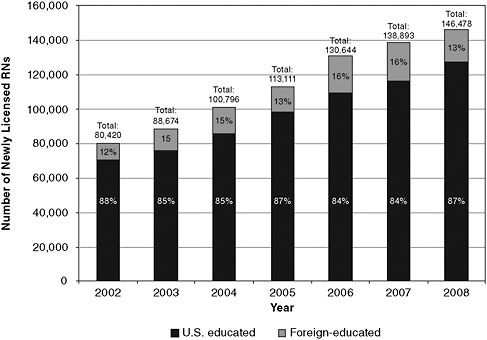
FIGURE 6-2 Trends in new licenses, U.S.- and foreign-educated RNs, 2002–2008
SOURCE: NCSBN, 2010.
jections could be reliably generated within 5 years if better national and regional data were collected to support workforce prediction models.2
Research on the health care workforce to inform policy deliberations is fragmented and dominated by historical debates over what numbers of a particular health profession are needed and the extent (if at all) to which government should be involved in influencing the supply of and demand for health professionals. The methods used to develop projection models are notoriously deficient and focus on single professions, typically assuming the continuation of current practice and utilization patterns. Projection models do not allow policy makers to test and evaluate the impact of different policy scenarios on supply and demand estimates; whether and how health outcomes are associated with various health professions;
and whether interprofessional team–based care is more efficient, lowers costs, and leads to safer care and improved patient outcomes.
In a paper prepared for the committee, Julie Sochalski and Jonathan Weiner emphasize the importance of collecting data that allow for flexible workforce projections. Meeting the need for adequate numbers of RNs “to support health care delivery reform will require a wholesale paradigm shift in the framework and context used to prepare and deploy the RN workforce and to forecast future requirements” (Sochalski and Weiner, 2010).
The Robert Wood Johnson Foundation Nursing Research Network assessed for the committee the quantity and quality of workforce data across health professions and suggested three key areas of need:
-
Core data sets on health care workforce supply and demand—Researchers should develop and routinely update core data sets that facilitate analysis of the supply, demand, and distribution of the health care workforce across health professions. To this end, technical assistance and partnerships with licensure boards, educational organizations, and professional associations at the national, state, and local levels will be necessary.
-
Surveillance of health care workforce market conditions—Researchers should develop a workforce surplus/shortage surveillance system that provides regular and frequent data (e.g., every 6–12 months) on key workforce indicators. This system would employ surveillance methods similar to those of other economic monitoring systems designed to track trends and provide early warning of changes in the marketplace. The development of such a system will require partnerships with public and private employers and organizations.
-
Health care workforce effectiveness research—Researchers should develop data and support research to evaluate the impact of new models of care delivery on the health care workforce and the impact of workforce configurations on health care costs, quality, and access. This effort should include coordination with other federal agencies to ensure that key data elements are incorporated into federal surveys, claims data, and clinical data. Research should include evaluation of strategies for increasing the efficient education, preparation, and distribution of the health care workforce. Finally, workforce research needs to be included in federal pilot and demonstration projects involving payment innovation, introduction of new technologies, team-based care models, and other advances.
A major barrier to more strategic health care workforce planning efforts is insufficient basic data on the activities performed by health professionals. While claims data can yield information on the services provided by physicians
and some allied health professionals, the efforts of other health professionals—including nurses—is invisible in most federal data sets.
As discussed above, the ACA authorizes the NHWC. It also authorizes a National Center for Workforce Analysis, as well as state and regional workforce centers, and provides funding for workforce data collection and studies. A priority for these new structures and resources should be systematic monitoring of health care workforce shortages and surpluses, review of the data and methods needed to predict future workforce needs, and coordination of the collection of data relating to the health care workforce in federal surveys and in the private sector. These three functions must be actively assumed by the federal government to build the necessary capacity for workforce planning in the United States. The NHWC has the potential to build a robust workforce data infrastructure and a high-level analytic capacity.
HRSA’s Bureau of Primary Care and Bureau of Health Professions conduct some monitoring—primarily for nurses, primary care clinicians, mental health professionals, dentists, and pharmacists—for purposes of designating health professional shortage areas/facilities and medically underserved areas/populations and informing funding decisions to support clinician training. Thus, HRSA is well positioned to assume leadership in directing resources needed to build a data infrastructure to support health care workforce research.
One currently available resource for examining the role of providers in primary care is the National Provider Indicator (NPI). While the NPI is a mechanism for tracking billing services, this data source at the Centers for Medicare and Medicaid Services (CMS) could be thought of as an opportunity to collect workforce data and conduct research on those nurses who bill for services, primarily nurse practitioners. The committee believes the NPI presents a unique opportunity to track and measure nurse practitioners with regard to their practice, such as where they are located, how many are billing patients, what kinds of patients they are seeing, and what services they are providing. These data would be a significant contribution to the supply data currently being collected, adding to the knowledge base about practice partnerships, utilization of services, and primary care shortages. The committee encourages CMS to make these data available in a useful way to workforce researchers and others who might contribute to this knowledge base.
The NHWC needs to develop predictions for a range of assumptions about future delivery systems and patterns, including the future workforce supply across the professions (see Figure 6-3 for factors to consider) and the demand for services that can be provided by more than one profession or specialty (see Figure 6-4 for factors to consider). The following example illustrates the complexity of developing workforce projections and the depth of the data needs with respect to a single profession, as well as the innovative solutions the Gulf Coast region of Texas found for meeting its nursing needs. The committee commends this example to the NHWC while encouraging it to extend this innovation by looking at workforce needs across professions.
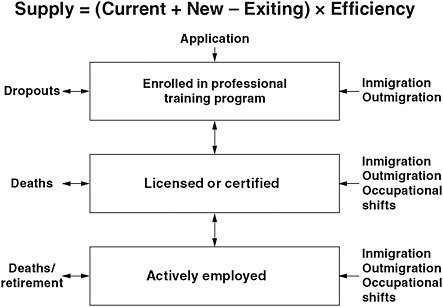
FIGURE 6-3 Factors to consider when assessing the health care workforce supply.
SOURCE: HRSA, 2000. Adapted from Figure 3, page 84. Reprinted with permission from Jean Moore, Center for Health Workforce Studies, University of Albany.
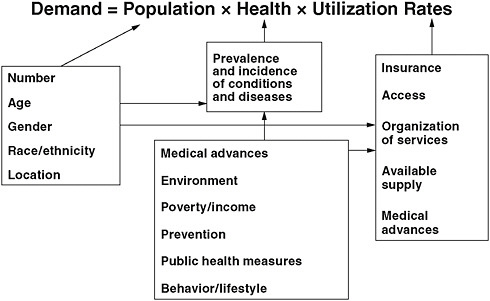
FIGURE 6-4 Factors to consider when assessing health care workforce demand.
SOURCE: Salsberg, 2009.
GULF COAST HEALTH SERVICES STEERING COMMITTEE
In the 1990s, a group of CEOs of Houston-area businesses and philanthropic groups formed the Gulf Coast Health Services Steering Committee (GCHSSC)3 to address a local nursing shortage. This partnership brings together executives from area hospitals, health care systems, and academic institutions. The group was determined to work together to develop regional solutions to workforce challenges that affected the 13 counties of the greater Houston area. One of the four initial areas of focus for the GCHSSC was building educational capacity to accommodate more nursing students. The other three focus areas addressed legislation and regulations, advancing health careers, and improving the work environment where nurses practice. Building educational capacity remains a central focus of the GCHSSC to this day. Thanks to its efforts, more than $30 million was infused into Houston area nursing schools from 2001 to 2008.4
Use of Data
One of the first things the GCHSSC’s educational capacity work group decided to do was to start tracking the numbers of enrollments, graduates, and qualified applicants who are turned away from nursing schools in the greater Houston area. The GCHSSC quickly concluded that nursing schools were graduating the bulk of their students at the wrong time. Nearly all students graduated in May and took their licensing exam shortly thereafter. Yet this is the time that hospitals—still the major employers of nurses in the Houston area—have their lowest number of inpatient admissions; the highest number of inpatient admissions typically occurs in January and February. The GCHSSC therefore approached the nursing schools about implementing rolling admissions so that entry-level nurses would graduate in the fall, winter, and spring. Results thus far are promising. The GCHSSC projects that the spring surge in graduates will nearly disappear in the next 2 years.
Increased Student Enrollment
The various initiatives undertaken by the GCHSSC have resulted in a 73 percent increase in student enrollment in Houston prelicensure nursing programs, from 2,211 in fall 1998 to 3,829 in fall 2008. Several schools are opening branch campuses and offering online programs to further increase the pool of eligible students. With an eye toward increasing both the numbers and diversity of the nursing student body, the University of Houston has launched a nursing program in Victoria, Texas, a city located about 120 miles outside of Houston. Victoria has a population of 60,000, approximately 45 percent of which is Hispanic (U.S.
Census Bureau, 2010). Meanwhile, the University of Texas at Austin has developed an online nursing program that partners with health care institutions and enrolls students from across the state. The GCHSSC is identifying which institutions from the Gulf Coast area have joined with this online program so they can participate in developing a workforce plan for the region.
Faculty Shortage
The GCHSSC is addressing the local nursing faculty shortage in several ways. Nursing schools in three major area universities—the University of Texas Health Science Center at Houston, the University of Texas Medical Branch at Galveston, and the Houston campus of Texas Woman’s University—have launched accelerated master’s of science in nursing (MSN) programs. In tracking the employment of these MSN graduates, however, the GCHSSC has concluded that most will be working in hospitals and not taking teaching positions. It is easy to understand why. Local hospitals pay RNs with an MSN degree 40 to 60 percent higher salaries than MSN-credentialed professors receive. The GCHSSC is working to address this problem.
Meanwhile, the George Foundation, a local philanthropic organization, is helping the University of Texas School of Nursing at Houston launch an accelerated PhD nursing program. Starting in fall 2010, a cohort of 10 MSN-prepared nurses will begin the program with the aim of completing their degree in 3 years. All students will receive an annual stipend of $60,000, allowing them to attend full time. In return, the new PhDs must teach for at least 3 years at the University of Texas School of Nursing at Houston or in any other nursing education program in the Gulf Coast region. This program is similar to programs in New Jersey and California that are funded by the Robert Wood Johnson Foundation and the Gordon and Betty Moore Foundation, respectively.5
CONCLUSION
Taking into account the need to transform the way health care is delivered in the United States and the observations and goals outlined in Chapters 3 through 5, policy makers must have reliable, sufficiently granular data on workforce supply and demand, both present and future, across the health professions. In the context of this report, such data are essential for determining what changes are needed in nursing practice and education to advance the vision for health care set forth in Chapter 1. Major gaps exist in currently available data on the health care workforce. A priority for the NHWC and other structures and resources authorized under the ACA should be systematic monitoring of the supply of health care workers, review of the data and methods needed to develop accurate predictions of future workforce needs, and coordination of the collection of data on the health
care workforce. The building of an infrastructure for the collection and analysis of workforce data is a crucial need if the overarching goal of a transformed health care system is to be realized.
REFERENCES
Aiken, L., and R. Cheung. 2008. Nurse workforce challenges in the United States: Implications for policy. OECD Health Working Paper No. 35. Available from http://www.oecd.org/dataoecd/34/9/41431864.pdf.
BLS (Bureau of Labor Statistics). 2009. Employment projections: Replacement needs. http://www.bls.gov/emp/ep_table_110.htm (accessed September 10, 2010).
Bodenheimer, T., and H. H. Pham. 2010. Primary care: Current problems and proposed solutions. Health Affairs 29(5):799-805.
Buerhaus, P. I., D. I. Auerbach, and D. O. Staiger. 2009. The recent surge in nurse employment: Causes and implications. Health Affairs 28(4):w657-668.
Hauer, K. E., S. J. Durning, W. N. Kernan, M. J. Fagan, M. Mintz, P. S. O’Sullivan, M. Battistone, T. DeFer, M. Elnicki, H. Harrell, S. Reddy, C. K. Boscardin, and M. D. Schwartz. 2008. Factors associated with medical students’ career choices regarding internal medicine. JAMA 300(10):1154-1164.
HRSA (Health Resources and Services Administration). 2000. HRSA state health workforce data resource guide. Rockville, MD: HRSA.
HRSA. 2004. What is behind HRSA’s projected supply, demand, and shortage of registered nurses? Rockville, MD: HRSA.
HRSA. 2008. The physician workforce. Rockville, MD: HRSA.
HRSA. 2010. Shortage designation: HPSAs, MUAs & MUPs. http://bhpr.hrsa.gov/shortage/ (accessed September 10, 2010).
Naylor, M. D., and E. T. Kurtzman. 2010. The role of nurse practitioners in reinventing primary care. Health Affairs 29(5):893-899.
NCSBN (National Council of State Boards of Nursing). 2010. Nurse licensure and NCLEX examination statistics. https://www.ncsbn.org/1236.htm (accessed August 20, 2010).
Rieselbach, R. E., B. J. Crouse, and J. G. Frohna. 2010. Teaching primary care in community health centers: Addressing the workforce crisis for the underserved. Annals of Internal Medicine 152:118-122.
Rosenblatt, R. A., C. H. Andrilla, T. Curtin, and L. G. Hart. 2006. Shortages of medical personnel at community health centers: Implications for planned expansion. JAMA 295(9):1042-1049.
RWJF (Robert Wood Johnson Foundation). 2010. Expanding America’s capacity to educate nurses: Diverse, state-level partnerships are creating promising models and results. Charting Nursing’s Future April (13):1-8.
Salsberg, E. 2009. State of the national physician workforce. Paper presented at Annual Meeting of the Association of American Medical Colleges, Boston, MA.
Sochalski, J., and J. Weiner. 2010 (unpublished). Health care system reform and the nursing workforce: Matching nursing practice and skills to future needs, not past demands. University of Pennsylvania School of Nursing.
Spetz, J. 2009. Forecasts of the registered nurse workforce in California. San Francisco, CA: UCSF.
Steinwald, B. 2008. Primary care professionals: Recent supply trends, projections, and valuation of services. Washington, DC: GAO.
U.S. Census Bureau. 2010. Fact sheet: Victoria city, Texas. http://factfinder.census.gov/servlet/ACSSAFFFacts?_event=&geo_id=16000US4875428&_geoContext=01000US%7C04000US48%7C16000US4875428&_street=&_county=Victoria&_cityTown=Victoria&_state=04000US48&_zip=&_lang=en&_sse=on&ActiveGeoDiv=&_useEV=&pctxt=fph&pgsl=160&_submenuId=factsheet_1&ds_name=ACS_2008_3YR_SAFF&_ci_nbr=null&qr_name=null®=null%3Anull&_keyword=&_industry= (accessed September 28, 2010).


