D
APRN Consensus Model1
|
1 |
Reprinted with permission from Kathy Apple, NCSBN, from https://www.ncsbn.org/Consensus_Model_for_APRN_Regulation_July_2008.pdf (accessed December 9, 2010). |
Consensus Model for APRN Regulation: Licensure, Accreditation, Certification & Education
July 7, 2008
Completed through the work of the APRN Consensus Work Group & the National Council of State Boards of Nursing APRN Advisory Committee
The APRN Consensus Work Group and the APRN Joint Dialogue Group members would like to recognize the significant contribution to the development of this report made by Jean Johnson, PhD, RN-C, FAAN, Senior Associate Dean, Health Sciences, George Washington School of Medicine and Health Sciences. Consensus could not have been reached without her experienced and dedicated facilitation of these two national, multi-organizational groups.
LIST OF ENDORSING ORGANIZATIONS
This Final Report of the APRN Consensus Work Group and the National Council of State Boards of Nursing APRN Advisory Committee has been disseminated to participating organizations. The names of endorsing organizations will be added periodically.
The following organizations have endorsed the Consensus Model for APRN Regulation: Licensure, Accreditation, Certification, and Education (July 2008).
(Posted December 2010)
N = 48
Academy of Medical-Surgical Nurses (AMSN)
Accreditation Commission for Midwifery Education (ACME)
American Academy of Nurse Practitioners (AANP)
American Academy of Nurse Practitioners Certification Program
American Association of Colleges of Nursing (AACN)
American Association of Critical-Care Nurses (AACN)
American Association of Critical-Care Nurses Certification Corporation
American Association of Legal Nurse Consultants (AALNC)
American Association of Nurse Anesthetists (AANA)
American Board of Nursing Specialties (ABNS)
American College of Nurse-Midwives (ACNM)
American College of Nurse Practitioners (ACNP)
American Holistic Nurses Association (AHNA)
American Midwifery Certification Board (AMCB)
American Nurses Association (ANA)
American Nurses Credentialing Center (ANCC)
American Psychiatric Nurses Association (APNA)
Arkansas State Board of Nursing
Association of Faculties of Pediatric Nurse Practitioners (AFPNP)
Association of Women’s Health, Obstetric, and Neonatal Nurses (AWHONN)
Commission on Collegiate Nursing Education (CCNE)
Council on Accreditation of Nurse Anesthesia Educational Programs (COA)
Dermatology Nurses Association (DNA)
Dermatology Nursing Certification Board (DNCB)
Emergency Nurses Association (ENA)
Gerontological Advanced Practice Nurses Association (GAPNA)
Hospice and Palliative Nurses Association (HPNA)
The International Society of Psychiatric Nurses (ISPN)
National Association of Clinical Nurse Specialists (NACNS)
National Association of Neonatal Nurses (NANN)
National Association of Orthopedic Nurses (NAON)
National Association of Pediatric Nurse Practitioners (NAPNAP)
National Board for Certification of Hospice and Palliative Nurses (NBCHPN)
National Board on Certification & Recertification of Nurse Anesthetists (NBCRNA)
National Certification Corporation (NCC)
National Council of State Boards of Nursing (NCSBN)
National Gerontological Nursing Association (NGNA)
National League for Nursing (NLN)
National League for Nursing Accrediting Commission, Inc. (NLNAC)
National Organization of Nurse Practitioner Faculties (NONPF)
Nurse Practitioners in Women’s Health (NPWH)
Nurses Organization of Veterans Affairs (NOVA)
Oncology Nursing Certification Corporation (ONCC)
Oncology Nursing Society (ONS)
Orthopedic Nurses Certification Board (ONCB)
Pediatric Nursing Certification Board (PNCB)
Wound, Ostomy and Continence Nurses Society (WOCN)
Wound, Ostomy and Continence Nursing Certification Board (WOCNCB)
INTRODUCTION
Advanced Practice Registered Nurses (APRNs) have expanded in numbers and capabilities over the past several decades with APRNs being highly valued and an integral part of the health care system. Because of the importance of APRNs in caring for the current and future health needs of patients, the education, accreditation, certification and licensure of APRNs need to be effectively aligned in order to continue to ensure patient safety while expanding patient access to APRNs.
APRNs include certified registered nurse anesthetists, certified nurse-midwives, clinical nurse specialists and certified nurse practitioners. Each has a unique history and context, but shares the commonality of being APRNs. While education, accreditation, and certification are necessary components of an overall approach to preparing an APRN for practice, the licensing boards-governed by state regulations and statutes-are the final arbiters of who is recognized to practice within a given state. Currently, there is no uniform model of regulation of APRNs across the states. Each state independently determines the APRN legal scope of practice, the roles that are recognized, the criteria for entry-into advanced practice and the certification examinations accepted for entry-level competence assessment. This has created a significant barrier for APRNs to easily move from state to state and has decreased access to care for patients.
Many nurses with advanced graduate nursing preparation practice in roles and specialties (e.g., informatics, public health, education, or administration) that are essential to advance the health of the public but do not focus on direct care to individuals and, therefore, their practice does not require regulatory recognition beyond the Registered Nurse license granted by state boards of nursing. Like the four current APRN roles, practice in these other advanced specialty nursing roles requires specialized knowledge and skills acquired through graduate-level education. Although extremely important to the nursing profession and to the delivery of safe, high quality patient care, these other advanced, graduate nursing roles, which do not focus on direct patient care, are not roles for Advanced Practice Registered Nurses (APRN) and are not the subject or focus of the Regulatory Model presented in this paper.
The model for APRN regulation is the product of substantial work conducted by the Advanced Practice Nursing Consensus Work Group and the National Council of State Boards of Nursing (NCSBN) APRN Committee. While these groups began work independent of each other, they came together through representatives of each group participating in what was labeled the APRN Joint Dialogue Group. The outcome of this work has been unanimous agreement on most of the recommendations included in this document. In a few instances, when agreement was not unanimous a 66 percent majority was used to determine the final recommendation. However, extensive dialogue and transparency in the decision-making process is reflected in each recommendation. The background
of each group can be found on pages 13-16 and individual and organizational participants in each group in Appendices C-H.
This document defines APRN practice, describes the APRN regulatory model, identifies the titles to be used, defines specialty, describes the emergence of new roles and population foci, and presents strategies for implementation.
Overview of APRN Model of Regulation
The APRN Model of Regulation described will be the model of the future. It is recognized that current regulation of APRNs does not reflect all of the components described in this paper and will evolve incrementally over time. A proposed timeline for implementation is presented at the end of the paper.
In this APRN model of regulation there are four roles: certified registered nurse anesthetist (CRNA), certified nurse-midwife (CNM), clinical nurse specialist (CNS), and certified nurse practitioner (CNP). These four roles are given the title of advanced practice registered nurse (APRN). APRNs are educated in one of the four roles and in at least one of six population foci: family/individual across the lifespan, adult-gerontology, pediatrics, neonatal, women’s health/gender-related or psych/mental health. APRN education programs, including degree-granting and post-graduate education programs2, are accredited. APRN education consists of a broad-based education, including three separate graduate-level courses in advanced physiology/pathophysiology, health assessment and pharmacology as well as appropriate clinical experiences. All developing APRN education programs or tracks go through a pre-approval, pre-accreditation, or accreditation process prior to admitting students. APRN education programs must be housed within graduate programs that are nationally accredited3 and their graduates must be eligible for national certification used for state licensure.
Individuals who have the appropriate education will sit for a certification examination to assess national competencies of the APRN core, role and at least one population focus area of practice for regulatory purposes. APRN certification programs will be accredited by a national certification accrediting body4. APRN certification programs will require a continued competency mechanism.
Individuals will be licensed as independent practitioners for practice at
the level of one of the four APRN roles within at least one of the six identified population foci. Education, certification, and licensure of an individual must be congruent in terms of role and population foci. APRNs may specialize but they cannot be licensed solely within a specialty area. In addition, specialties can provide depth in one’s practice within the established population foci. Education and assessment strategies for specialty areas will be developed by the nursing profession, i.e., nursing organizations and special interest groups. Education for a specialty can occur concurrently with APRN education required for licensure or through post-graduate education. Competence at the specialty level will not be assessed or regulated by boards of nursing but rather by the professional organizations.
In addition, a mechanism that enhances the communication and transparency among APRN licensure, accreditation, certification and education bodies (LACE) will be developed and supported.
APRN REGULATORY MODEL
APRN Regulation includes the essential elements: licensure, accreditation, certification and education (LACE).
-
Licensure is the granting of authority to practice.
-
Accreditation is the formal review and approval by a recognized agency of educational degree or certification programs in nursing or nursing-related programs.
-
Certification is the formal recognition of the knowledge, skills, and experience demonstrated by the achievement of standards identified by the profession.
-
Education is the formal preparation of APRNs in graduate degree-granting or post-graduate certificate programs.
The APRN Regulatory Model applies to all elements of LACE. Each of these elements plays an essential part in the implementation of the model.
Definition of Advanced Practice Registered Nurse
Characteristics of the advanced practice registered nurse (APRN) were identified and several definitions of an APRN were considered, including the NCSBN and the American Nurses Association (ANA) definitions, as well as others. The characteristics identified aligned closely with these existing definitions. The definition of an APRN, delineated in this document, includes language that addresses responsibility and accountability for health promotion and the assessment, diagnosis, and management of patient problems, which includes the use and prescription of pharmacologic and non-pharmacologic interventions.
The definition of an Advanced Practice Registered Nurse (APRN) is a nurse:
-
who has completed an accredited graduate-level education program preparing him/her for one of the four recognized APRN roles;
-
who has passed a national certification examination that measures APRN, role and population-focused competencies and who maintains continued competence as evidenced by recertification in the role and population through the national certification program;
-
who has acquired advanced clinical knowledge and skills preparing him/her to provide direct care to patients, as well as a component of indirect care; however, the defining factor for all APRNs is that a significant component of the education and practice focuses on direct care of individuals;
-
whose practice builds on the competencies of registered nurses (RNs) by demonstrating a greater depth and breadth of knowledge, a greater synthesis of data, increased complexity of skills and interventions, and greater role autonomy;
-
who is educationally prepared to assume responsibility and accountability for health promotion and/or maintenance as well as the assessment, diagnosis, and management of patient problems, which includes the use and prescription of pharmacologic and non-pharmacologic interventions;
-
who has clinical experience of sufficient depth and breadth to reflect the intended license; and
-
who has obtained a license to practice as an APRN in one of the four APRN roles: certified registered nurse anesthetist (CRNA), certified nurse-midwife (CNM), clinical nurse specialist (CNS), or certified nurse practitioner (CNP).
Advanced practice registered nurses are licensed independent practitioners who are expected to practice within standards established or recognized by a licensing body. Each APRN is accountable to patients, the nursing profession, and the licensing board to comply with the requirements of the state nurse practice act and the quality of advanced nursing care rendered; for recognizing limits of knowledge and experience, planning for the management of situations beyond the APRN’s expertise; and for consulting with or referring patients to other health care providers as appropriate.
All APRNs are educationally prepared to provide a scope of services across the health wellness-illness continuum to at least one population focus as defined by nationally recognized role and population-focused competencies; however, the emphasis and implementation within each APRN role varies. The services or care provided by APRNs is not defined or limited by setting but rather by patient care
needs. The continuum encompasses the range of health states from homeostasis (or wellness) to a disruption in the state of health in which basic needs are not met or maintained (illness), with health problems of varying acuity occurring along the continuum that must be prevented or resolved to maintain wellness or an optimal level of functioning (WHO, 2006). Although all APRNs are educationally prepared to provide care to patients across the health wellness-illness continuum, the emphasis and how implemented within each APRN role varies.
The Certified Registered Nurse Anesthetist
The Certified Registered Nurse Anesthetist is prepared to provide the full spectrum of patients’ anesthesia care and anesthesia-related care for individuals across the lifespan, whose health status may range from healthy through all recognized levels of acuity, including persons with immediate, severe, or life-threatening illnesses or injury. This care is provided in diverse settings, including hospital surgical suites and obstetrical delivery rooms; critical access hospitals; acute care; pain management centers; ambulatory surgical centers; and the offices of dentists, podiatrists, ophthalmologists, and plastic surgeons.
The Certified Nurse-Midwife
The certified nurse-midwife provides a full range of primary health care services to women throughout the lifespan, including gynecologic care, family planning services, preconception care, prenatal and postpartum care, childbirth, and care of the newborn. The practice includes treating the male partner of their female clients for sexually transmitted disease and reproductive health. This care is provided in diverse settings, which may include home, hospital, birth center, and a variety of ambulatory care settings including private offices and community and public health clinics.
The Clinical Nurse Specialist
The CNS has a unique APRN role to integrate care across the continuum and through three spheres of influence: patient, nurse, system. The three spheres are overlapping and interrelated but each sphere possesses a distinctive focus. In each of the spheres of influence, the primary goal of the CNS is continuous improvement of patient outcomes and nursing care. Key elements of CNS practice are to create environments through mentoring and system changes that empower nurses to develop caring, evidence-based practices to alleviate patient distress, facilitate ethical decision-making, and respond to diversity. The CNS is responsible and accountable for diagnosis and treatment of health/illness states, disease management, health promotion, and prevention of illness and risk behaviors among individuals, families, groups, and communities.
The Certified Nurse Practitioner
For the certified nurse practitioner (CNP), care along the wellness-illness continuum is a dynamic process in which direct primary and acute care is provided across settings. CNPs are members of the health delivery system, practicing autonomously in areas as diverse as family practice, pediatrics, internal medicine, geriatrics, and women’s health care. CNPs are prepared to diagnose and treat patients with undifferentiated symptoms as well as those with established diagnoses. Both primary and acute care CNPs provide initial, ongoing, and comprehensive care, includes taking comprehensive histories, providing physical examinations and other health assessment and screening activities, and diagnosing, treating, and managing patients with acute and chronic illnesses and diseases. This includes ordering, performing, supervising, and interpreting laboratory and imaging studies; prescribing medication and durable medical equipment; and making appropriate referrals for patients and families. Clinical CNP care includes health promotion, disease prevention, health education, and counseling as well as the diagnosis and management of acute and chronic diseases. Certified nurse practitioners are prepared to practice as primary care CNPs and acute care CNPs, which have separate national consensus-based competencies and separate certification processes.
Titling
The title Advanced Practice Registered Nurse (APRN) is the licensing title to be used for the subset of nurses prepared with advanced, graduate-level nursing knowledge to provide direct patient care in four roles: certified registered nurse anesthetist, certified nurse-midwife, clinical nurse specialist, and certified nurse practitioner.5 This title, APRN, is a legally protected title. Licensure and scope of practice are based on graduate education in one of the four roles and in a defined population.
Verification of licensure, whether hard copy or electronic, will indicate the role and population for which the APRN has been licensed.
At a minimum, an individual must legally represent themselves, including in a legal signature, as an APRN and by the role. He/she may indicate the population as well. No one, except those who are licensed to practice as an APRN, may use the APRN title or any of the APRN role titles. An individual also may add the specialty title in which they are professionally recognized in addition to the legal title of APRN and role.
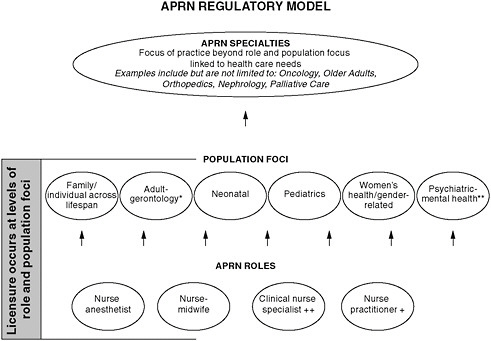
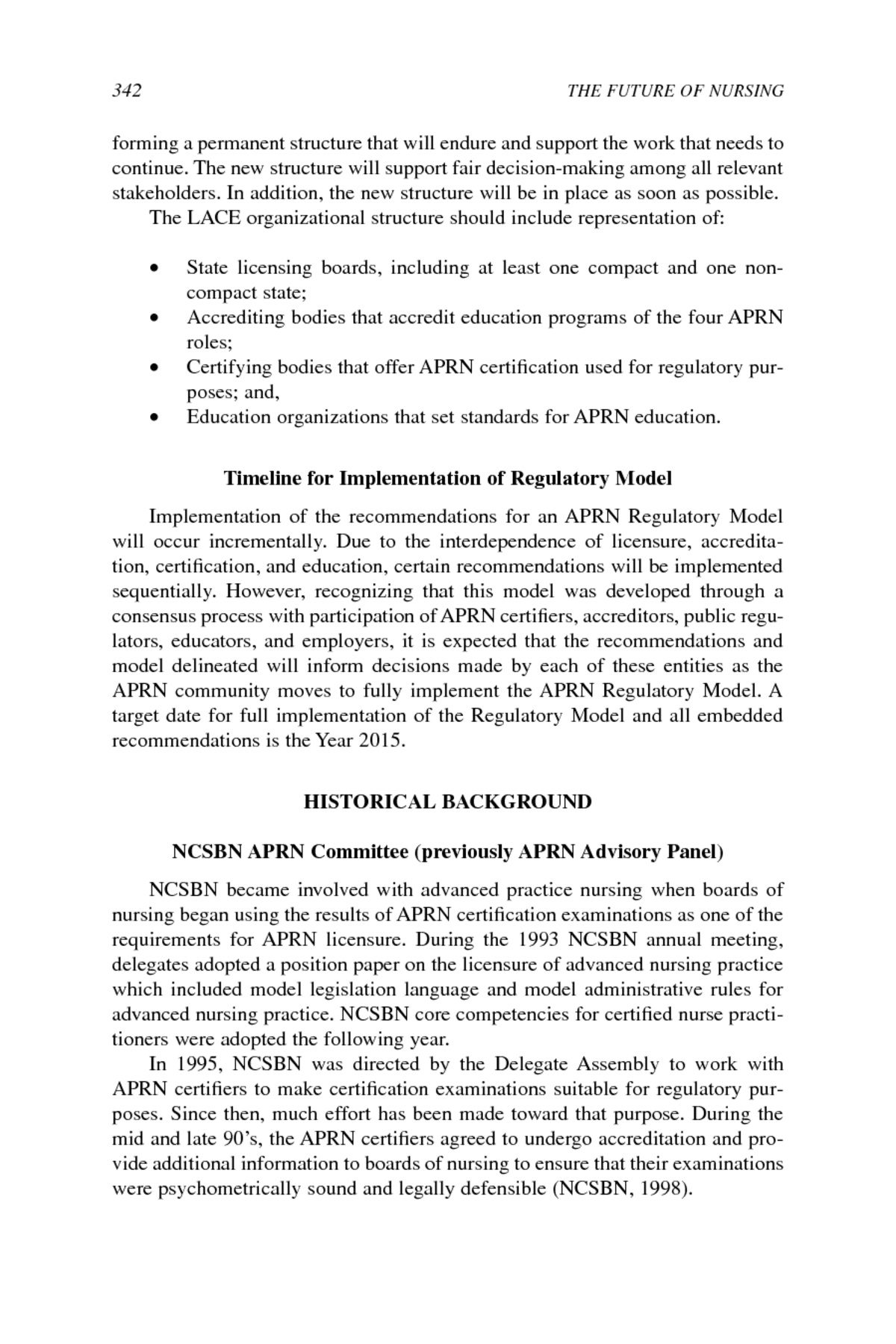
FIGURE D-1 APRN Regulatory Model
Under this APRN Regulatory Model, there are four roles: certified registered nurse anesthetist (CRNA), certified nurse-midwife (CNM), clinical nurse specialist (CNS), and certified nurse practitioner (CNP). These four roles are given the title of advanced practice registered nurse (APRN). APRNs are educated in one of the four roles and in at least one of six population foci: family/individual across the lifespan, adult-gerontology, neonatal, pediatrics, women’s health/gender-related or psych/mental health. Individuals will be licensed as independent practitioners for practice at the level of one of the four APRN roles within at least one of the six identified population foci. Education, certification, and licensure of an individual must be congruent in terms of role and population foci. APRNs may specialize but they can not be licensed solely within a specialty area. Specialties can provide depth in one’s practice within the established population foci.
NOTES:
* The population focus, adult-gerontology, encompasses the young adult to the older adult, including the frail elderly. APRNs educated and certified in the adult-gerontology population are educated and certified across both areas of practice and will be titled Adult-Gerontology CNP or CNS. In addition, all APRNs in any of the four roles providing care to the adult population, e.g., family or gender specific, must be prepared to meet the growing needs of the older adult population. Therefore, the education program should include didactic and clinical education experiences necessary to prepare APRNs with these enhanced skills and knowledge.
** The population focus, psychiatric/mental health, encompasses education and practice across the lifespan.
+The certified nurse practitioner (CNP) is prepared with the acute care CNP competencies and/or the primary care CNP competencies. At this point in time the acute care and
primary care CNP delineation applies only to the pediatric and adult-gerontology CNP population foci. Scope of practice of the primary care or acute care CNP is not setting specific but is based on patient care needs. Programs may prepare individuals across both the primary care and acute care CNP competencies. If programs prepare graduates across both sets of roles, the graduate must be prepared with the consensus-based competencies for both roles and must successfully obtain certification in both the acute and the primary care CNP roles. CNP certification in the acute care or primary care roles must match the educational preparation for CNPs in these roles.
++ The Clinical Nurse Specialist (CNS) is educated and assessed through national certification processes across the continuum from wellness through acute care.
Broad-Based APRN Education
For entry into APRN practice and for regulatory purposes, APRN education must:
-
be formal education with a graduate degree or post-graduate certificate (either post-master’s or post-doctoral) that is awarded by an academic institution and accredited by a nursing or nursing-related accrediting organization recognized by the U.S. Department of Education (USDE) and/or the Council for Higher Education Accreditation (CHEA);
-
be awarded pre-approval, pre-accreditation, or accreditation status prior to admitting students;
-
be comprehensive and at the graduate level;
-
prepare the graduate to practice in one of the four identified APRN roles;
-
prepare the graduate with the core competencies for one of the APRN roles across at least one of the six population foci;
-
include at a minimum, three separate comprehensive graduate-level courses (the APRN Core) in:
-
Advanced physiology/pathophysiology, including general principles that apply across the lifespan;
-
Advanced health assessment, which includes assessment of all human systems, advanced assessment techniques, concepts and approaches; and
-
Advanced pharmacology, which includes pharmacodynamics, pharmacokinetics and pharmacotherapeutics of all broad categories of agents.
-
-
Additional content, specific to the role and population, in these three APRN core areas should be integrated throughout the other role and population didactic and clinical courses;
-
Provide a basic understanding of the principles for decision making in the identified role;
-
Prepare the graduate to assume responsibility and accountability for health promotion and/or maintenance as well as the assessment, diagnosis, and management of patient problems, which includes the use and prescription of pharmacologic and non-pharmacologic interventions; and
-
Ensure clinical and didactic coursework is comprehensive and sufficient to prepare the graduate to practice in the APRN role and population focus.
Preparation in a specialty area of practice is optional but if included must build on the APRN role/population-focus competencies. Clinical and didactic coursework must be comprehensive and sufficient to prepare the graduate to obtain certification for licensure in and to practice in the APRN role and population focus.
As part of the accreditation process, all APRN education programs must undergo a pre-approval, pre-accreditation, or accreditation process prior to admitting students. The purpose of the pre-approval process is twofold: 1) to ensure that students graduating from the program will be able to meet the education criteria necessary for national certification in the role and population-focus and if successfully certified, are eligible for licensure to practice in the APRN role/population-focus; and 2) to ensure that programs will meet all educational standards prior to starting the program. The pre-approval, pre-accreditation or accreditation processes may vary across APRN roles.
APRN Specialties
Preparation in a specialty area of practice is optional, but if included must build on the APRN role/population-focused competencies. Specialty practice represents a much more focused area of preparation and practice than does the APRN role/population focus level. Specialty practice may focus on specific patient populations beyond those identified or health care needs such as oncology, palliative care, substance abuse, or nephrology. The criteria for defining an APRN specialty is built upon the ANA (2004) Criteria for Recognition as a Nursing Specialty (see Appendix B). APRN specialty education and practice build upon and are in addition to the education and practice of the APRN role and population focus. For example, a family CNP could specialize in elder care or nephrology; an Adult-Gerontology CNS could specialize in palliative care; a CRNA could specialize in pain management; or a CNM could specialize in care of the post-menopausal woman. State licensing boards will not regulate the APRN at the level of specialties in this APRN Regulatory Model. Professional certification in the specialty area of practice is strongly recommended.
An APRN specialty
-
preparation cannot replace educational preparation in the role or one of the six population foci;
-
preparation can not expand one’s scope of practice beyond the role or population focus
-
addresses a subset of the population-focus;
-
title may not be used in lieu of the licensing title, which includes the role or role/population; and
-
is developed, recognized, and monitored by the profession.
New specialties emerge based on health needs of the population. APRN specialties develop to provide added value to the role practice as well as providing flexibility within the profession to meet these emerging needs of patients. Specialties also may cross several or all APRN roles. A specialty evolves out of an APRN role/population focus and indicates that an APRN has additional knowledge and expertise in a more discrete area of specialty practice. Competency in the specialty areas could be acquired either by educational preparation or experience and assessed in a variety of ways through professional credentialing mechanisms (e.g., portfolios, examinations, etc.).
Education programs may concurrently prepare individuals in a specialty providing they meet all of the other requirements for APRN education programs, including preparation in the APRN core, role, and population core competencies. In addition, for licensure purposes, one exam must assess the APRN core, role, and population-focused competencies. For example, a nurse anesthetist would write one certification examination, which tests the APRN core, CRNA role, and population-focused competencies, administered by the Council on Certification for Nurse Anesthetist; or a primary care family nurse practitioner would write one certification examination, which tests the APRN core, CNP role, and family population-focused competencies, administered by ANCC or AANP. Specialty competencies must be assessed separately. In summary, education programs preparing individuals with this additional knowledge in a specialty, if used for entry into advanced practice registered nursing and for regulatory purposes, must also prepare individuals in one of the four nationally recognized APRN roles and in one of the six population foci. Individuals must be recognized and credentialed in one of the four APRN roles within at least one population foci. APRNs are licensed at the role/population focus level and not at the specialty level. However, if not intended for entry-level preparation in one of the four roles/population foci and not for regulatory purposes, education programs, using a variety of formats and methodologies, may provide licensed APRNs with the additional knowledge, skills, and abilities, to become professionally certified in the specialty area of APRN practice.
Emergence of New APRN Roles and Population-Foci
As nursing practice evolves and health care needs of the population change, new APRN roles or population-foci may evolve over time. An APRN role would encompass a unique or significantly differentiated set of competencies from any of the other APRN roles. In addition, the scope of practice within the role or population focus is not entirely subsumed within one of the other roles. Careful consideration of new APRN roles or population-foci is in the best interest of the profession.
For licensure, there must be clear guidance for national recognition of a new APRN role or population-focus. A new role or population focus should be discussed and vetted through the national licensure, accreditation, certification, education communication structure: LACE. An essential part of being recognized as a role or population-focus is that educational standards and practice competencies must exist, be consistent, and must be nationally recognized by the profession. Characteristics of the process to be used to develop nationally recognized core competencies, and education and practice standards for a newly emerging role or population-focus are:
-
national in scope
-
inclusive
-
transparent
-
accountable
-
initiated by nursing
-
consistent with national standards for licensure, accreditation, certification and education
-
evidence-based
-
consistent with regulatory principles.
To be recognized, an APRN role must meet the following criteria:
-
nationally recognized education standards and core competencies for programs preparing individuals in the role;
-
education programs, including graduate degree granting (master’s, doctoral) and post-graduate certificate programs, are accredited by a nursing or nursing-related accrediting organization that is recognized by the U.S. Department of Education (USDE) and/or the Council for Higher Education Accreditation (CHEA); and
-
professional nursing certification program that is psychometrically sound, legally defensible, and which meets nationally recognized accreditation standards for certification programs.6
IMPLEMENTATION STRATEGIES FOR APRN REGULATORY MODEL
In order to accomplish the above model, the four prongs of regulation: licensure, accreditation, certification, and education (LACE) must work together. Expectations for licensure, accreditation, certification, and education are listed below:
Foundational Requirements for Licensure
Boards of nursing will:
-
license APRNs in the categories of Certified Registered Nurse Anesthetist, Certified Nurse-Midwife, Clinical Nurse Specialist or Certified Nurse Practitioner within a specific population focus;
-
be solely responsible for licensing Advanced Practice Registered Nurses7;
-
only license graduates of accredited graduate programs that prepare graduates with the APRN core, role and population competencies;
-
require successful completion of a national certification examination that assesses APRN core, role and population competencies for APRN licensure.
-
not issue a temporary license;
-
only license an APRN when education and certification are congruent;
-
license APRNs as independent practitioners with no regulatory requirements for collaboration, direction or supervision;
-
allow for mutual recognition of advanced practice registered nursing through the APRN Compact;
-
have at least one APRN representative position on the board and utilize an APRN advisory committee that includes representatives of all four APRN roles; and,
-
institute a grandfathering8 clause that will exempt those APRNs already practicing in the state from new eligibility requirements.
FIGURE D-2 Relationship Among Educational Competencies, Licensure, & Certification in the Role/Population Foci and Education and Credentialing in a Specialty
NOTES:
*Certification for specialty may include exam, portfolio, peer review, etc.
**Certification for licensure will be psychometrically sound and legally defensible examination by an accredited certifying program.
Foundational Requirements for Accreditation of Education Programs
Accreditors will:
-
be responsible for evaluating APRN education programs including graduate degree-granting and post-graduate certificate programs;9
-
through their established accreditation standards and process, assess APRN education programs in light of the APRN core, role core, and population core competencies;
-
assess developing APRN education programs and tracks by reviewing them using established accreditation standards and granting pre-approval, pre-accreditation, or accreditation prior to student enrollment;
-
include an APRN on the visiting team when an APRN program/track is being reviewed; and
-
monitor APRN educational programs throughout the accreditation period by reviewing them using established accreditation standards and processes.
Foundational Requirements for Certification
Certification programs providing APRN certification used for licensure will:
-
follow established certification testing and psychometrically sound, legally defensible standards for APRN examinations for licensure (see appendix A for the NCSBN Criteria for APRN Certification Programs);
-
assess the APRN core and role competencies across at least one population focus of practice;
-
assess specialty competencies, if appropriate, separately from the APRN core, role and population-focused competencies;
-
be accredited by a national certification accreditation body;10
-
enforce congruence (role and population focus) between the education program and the type of certification examination;
-
provide a mechanism to ensure ongoing competence and maintenance of certification;
-
participate in ongoing relationships which make their processes transparent to boards of nursing;
-
participate in a mutually agreeable mechanism to ensure communication with boards of nursing and schools of nursing.
Foundational Requirements for Education
APRN education programs/tracks leading to APRN licensure, including graduate degree-granting and post-graduate certificate programs will:
-
follow established educational standards and ensure attainment of the APRN core, role core and population core competencies;11,12
-
be accredited by a nursing accrediting organization that is recognized by the U.S. Department of Education (USDE) and/or the Council for Higher Education Accreditation (CHEA);13
-
be pre-approved, pre-accredited, or accredited prior to the acceptance of students, including all developing APRN education programs and tracks;
-
ensure that graduates of the program are eligible for national certification and state licensure; and
-
ensure that official documentation (e.g., transcript) specifies the role and population focus of the graduate.
Communication Strategies
A formal communication mechanism, LACE, which includes those regulatory organizations that represent APRN licensure, accreditation, certification, and education entities would be created. The purpose of LACE would be to provide a formal, ongoing communication mechanism that provides for transparent and aligned communication among the identified entities. The collaborative efforts between the APRN Consensus Group and the NCSBN APRN Advisory Panel, through the APRN Joint Dialogue Group have illustrated the ongoing level of communication necessary among these groups to ensure that all APRN stakeholders are involved. Several strategies including equal representation on an integrated board with face-to-face meetings, audio and teleconferencing, pass-protected access to agency web sites, and regular reporting mechanisms have been recommended. These strategies will build trust and enhance information sharing. Examples of issues to be addressed by the group would be: guaranteeing appropriate representation of APRN roles among accreditation site visitors, documentation of program completion by education institutions, notification of examination outcomes to educators and regulators, notification of disciplinary action toward licensees by boards of nursing.
Creating the LACE Structure and Processes
Several principles should guide the formulation of a structure including: 1) all four entities of LACE should have representation; 2) the total should allow effective discussion of and response to issues and; 3) the structure should not be duplicative of existing structures such as the Alliance for APRN Credentialing. Consideration should be given to evolving the existing Alliance structure to meet the needs of LACE. Guidance from an organizational consultant will be useful in
forming a permanent structure that will endure and support the work that needs to continue. The new structure will support fair decision-making among all relevant stakeholders. In addition, the new structure will be in place as soon as possible.
The LACE organizational structure should include representation of:
-
State licensing boards, including at least one compact and one non-compact state;
-
Accrediting bodies that accredit education programs of the four APRN roles;
-
Certifying bodies that offer APRN certification used for regulatory purposes; and,
-
Education organizations that set standards for APRN education.
Timeline for Implementation of Regulatory Model
Implementation of the recommendations for an APRN Regulatory Model will occur incrementally. Due to the interdependence of licensure, accreditation, certification, and education, certain recommendations will be implemented sequentially. However, recognizing that this model was developed through a consensus process with participation of APRN certifiers, accreditors, public regulators, educators, and employers, it is expected that the recommendations and model delineated will inform decisions made by each of these entities as the APRN community moves to fully implement the APRN Regulatory Model. A target date for full implementation of the Regulatory Model and all embedded recommendations is the Year 2015.
HISTORICAL BACKGROUND
NCSBN APRN Committee (previously APRN Advisory Panel)
NCSBN became involved with advanced practice nursing when boards of nursing began using the results of APRN certification examinations as one of the requirements for APRN licensure. During the 1993 NCSBN annual meeting, delegates adopted a position paper on the licensure of advanced nursing practice which included model legislation language and model administrative rules for advanced nursing practice. NCSBN core competencies for certified nurse practitioners were adopted the following year.
In 1995, NCSBN was directed by the Delegate Assembly to work with APRN certifiers to make certification examinations suitable for regulatory purposes. Since then, much effort has been made toward that purpose. During the mid and late 90’s, the APRN certifiers agreed to undergo accreditation and provide additional information to boards of nursing to ensure that their examinations were psychometrically sound and legally defensible (NCSBN, 1998).
During the early 2000s, the APRN Advisory Panel developed criteria for ARPN certification programs and for accreditations agencies. In January 2002, the board of directors approved the criteria and process for a new review process for APRN certification programs. The criteria represented required elements of certification programs that would result in a legally defensible examination suitable for the regulation of advanced practice nurses. Subsequently, the APRN Advisory Panel has worked with certification programs to improve the legal defensibility of APRN certification examinations and to promote communication with all APRN stakeholders regarding APRN regulatory issues such as with the establishment of the annual NCSBN APRN Roundtable in the mid 1990’s. In 2002, the Advisory Panel also developed a position paper describing APRN regulatory issues of concern.
In 2003, the APRN Advisory Panel began a draft APRN vision paper in an attempt to resolve APRN regulatory concerns such as the proliferation of APRN subspecialty areas. The purpose of the APRN Vision Paper was to provide direction to boards of nursing regarding APRN regulation for the next 8-10 years by identifying an ideal future APRN regulatory model. Eight recommendations were made. The draft vision paper was completed in 2006. After reviewing the draft APRN vision paper at their February 2006 board meeting, the board of directors directed that the paper be disseminated to boards of nursing and APRN stakeholders for feedback. The Vision paper also was discussed during the 2006 APRN Roundtable. The large response from boards of nursing and APRN stakeholders was varied. The APRN Advisory Panel spent the remaining part of 2006, reviewing and discussing the feedback with APRN stakeholders. (See Appendix C for the list of APRN Advisory Panel members who worked on the draft APRN Vision Paper and Appendix D for the list of organizations represented at the 2006 APRN Roundtable where the draft vision paper was presented.)
APRN Consensus Group
In March 2004, the American Association of Colleges of Nursing (AACN) and the National Organization of Nurse Practitioner Faculties (NONPF) submitted a proposal to the Alliance for Nursing Accreditation, now named Alliance for APRN Credentialing14 (hereafter referred to as “the APRN Alliance”) to establish a process to develop a consensus15 statement on the credentialing of advanced
practice nurses (APNs).16 The APRN Alliance17, created in 1997, was convened by AACN to regularly discuss issues related to nursing education, practice, and credentialing. A number of differing views on how APN practice is defined, what constitutes specialization versus subspecialization, and the appropriate credentialing requirements that would authorize practice had emerged over the past several years.
An invitation to participate in a national APN consensus process was sent to 50 organizations that were identified as having an interest in advanced practice nursing (see Appendix F). Thirty-two organizations participated in the APN Consensus Conference in Washington, D.C. June 2004. The focus of the one-day meeting was to initiate an in-depth examination of issues related to APN definition, specialization, sub-specialization, and regulation, which includes accreditation, education, certification, and licensure18. Based on recommendations generated in the June 2004 APN Consensus Conference, the Alliance formed a smaller work group made up of designees from 23 organizations with broad representation of APN certification, licensure, education, accreditation, and practice. The charge to the work group was to develop a statement that addresses the issues, delineated during the APN Consensus Conference with the goal of envisioning a future model for APNs. The Alliance APN Consensus Work Group (hereafter referred to as “the Work Group”) convened for 16 days of intensive discussion between October 2004 and July 2007 (see Appendix H for a list of organizations represented on the APN Work Group).
In December 2004, the American Nurses Association (ANA) and AACN co-hosted an APN stakeholder meeting to address those issues identified at the June 2004 APN Consensus meeting. Attendees agreed to ask the APN Work Group to continue to craft a consensus statement that would include recommendations regarding APN regulation, specialization, and subspecialization. It also was agreed that organizations in attendance who had not participated in the June 2004 APN Consensus meeting would be included in the APN Consensus Group and that this
larger group would reconvene at a future date to discuss the recommendations of the APN Work Group.
Following the December 2004 APN Consensus meeting, the Work Group continued to work diligently to reach consensus on the issues surrounding APRN education, practice, accreditation, certification, and licensure, and to create a future consensus-based model for APRN regulation. Subsequent APRN Consensus Group meetings were held in September 2005 and June 2006. All organizations who participated in the APRN Consensus Group are listed in Appendix G.
APRN Joint Dialogue Group
In April, 2006, the APRN Advisory Panel met with the APRN Consensus Work Group to discuss APRN issues described in the NCSBN draft vision paper. The APRN Consensus Work Group requested and was provided with feedback from the APRN Advisory Panel regarding the APRN Consensus Group Report. Both groups agreed to continue to dialogue.
As the APRN Advisory Panel and APRN Consensus Work Group continued their work in parallel fashion, concerns regarding the need for each group’s work not to conflict with the other were expressed. A subgroup of seven people from the APRN Consensus Work Group and seven individuals from the APRN Advisory Panel were convened in January, 2007. The group called itself the APRN Joint Dialogue Group (see Appendix E) and the agenda consisted of discussing areas of agreement and disagreement between the two groups. The goal of the subgroup meetings was anticipated to be two papers that did not conflict, but rather complemented each other. However, as the APRN Joint Dialogue Group continued to meet, much progress was made regarding areas of agreement; it was determined that rather than two papers being disseminated, one joint paper would be developed, which reflected the work of both groups. This document is the product of the work of the APRN Joint Dialogue Group and through the consensus-based work of the APRN Consensus Work Group and the NCSBN APRN Advisory Committee.
Assumptions Underlying the Work of the Joint Dialogue Group
The consensus-based recommendations that have emerged from the extensive dialogue and consensus-based processes delineated in this report are based on the following assumptions:
-
Recommendations must address current issues facing the advanced practice registered nurse (APRN) community but should be future oriented.
-
The ultimate goal of licensure, accreditation, certification, and education is to promote patient safety and public protection.
-
The recognition that this document was developed with the participation of APRN certifiers, accreditors, public regulators, educators, and employers. The intention is that the document will allow for informed decisions made by each of these entities as they address APRN issues.
CONCLUSION
The recommendations offered in this paper present an APRN regulatory model as a collaborative effort among APRN educators, accreditors, certifiers, and licensure bodies. The essential elements of APRN regulation are identified as licensure, accreditation, certification, and education. The recommendations reflect a need and desire to collaborate among regulatory bodies to achieve a sound model and continued communication with the goal of increasing the clarity and uniformity of APRN regulation.
The goals of the consensus processes were to:
-
strive for harmony and common understanding in the APRN regulatory community that would continue to promote quality APRN education and practice;
-
develop a vision for APRN regulation, including education, accreditation, certification, and licensure;
-
establish a set of standards that protect the public, improve mobility, and improve access to safe, quality APRN care; and
-
produce a written statement that reflects consensus on APRN regulatory issues.
In summary, this report includes: a definition of the APRN Regulatory Model, including a definition of the Advanced Practice Registered Nurse; a definition of broad-based APRN education; a model for regulation that ensures APRN education and certification as a valid and reliable process, that is based on nationally recognized and accepted standards; uniform recommendations for licensing bodies across states; a process and characteristics for recognizing a new APRN role; and a definition of an APRN specialty that allows for the profession to meet future patient and nursing needs.
The work of the Joint Dialogue Group in conjunction with all organizations representing APRN licensure, accreditation, certification, and education to advance a regulatory model is an ongoing collaborative process that is fluid and dynamic. As health care evolves and new standards and needs emerge, the APRN Regulatory Model will advance accordingly to allow APRNs to care for patients in a safe environment to the full potential of their nursing knowledge and skill.
REFERENCES
American Association of Colleges of Nursing. (1996). The Essentials of Master’s Education for Advanced Practice Nursing Education. Washington, DC: Author.
American Association of Colleges of Nursing. (2004). Position Statement on the Practice Doctorate in Nursing. Washington, DC: Author. Accessed at http://www.aacn.nche.edu/DNP/DNPPositionStatement.htm.
American Association of Colleges of Nursing. (2006). The Essentials of Doctoral Education for Advanced Nursing Practice. Washington, DC: Author.
American College of Nurse-Midwives (2002). Core Competencies for Basic Midwifery Practice. Accessed at http://www.midwife.org/display.cfm?id=137.
American Educational Research Association, American Psychological Association and National Council on Measurement in Education (2002). “Professional and Occupational Licensure and Certification: Standards for Educational and Psychological Testing, Washington, DC: American Psychological Association, Inc.
American Nurses Association. (2004). Nursing: Scope and Standards of Practice. Washington, DC: Author.
Association of Women’s Health, Obstetric and Neonatal Nurses & National Association of Nurse Practitioners Women’s Health (2002). The Women’s Health Nurse Practitioner: Guidelines for Practice and Education, 5th edition. Washington, DC: Author.
Atkinson, Dale J. (2000). Legal issues in Licensure Policy. In Schoon, Craig, & Smith I. Lion (eds.) The Licensure and Certification Mission: Legal, Social, and Political Foundations. Professional Examination Service. New York.
Bauer, Jeffrey. (1998). Not What the Doctor Ordered: How to End the Medical Monopoly in the Pursuit of Managed Care 2nd ed. McGraw-Hill Companies: New York.
Citizen Advocacy Center (2004). Maintaining and Improving Health Professional Competence; Roadway to Continuing Competency Assurance.
Council on Accreditation of Nurse Anesthesia Educational Programs. (2004). Standards for Accreditation of Nurse Anesthesia Educational Programs. Chicago: Author.
Finocchio, L.J., Dower, C.M., Blick N.T., Gragnola, C.M., & The Taskforce on Health Care Workforce Regulation. (1998). Strengthening Consumer Protection: Priorities for Health Care Workforce Regulation. San Francisco, CA: Pew Health Professions Commission.
Hamric, Ann B. & Hanson, Charlene (2003). Educating Advanced Practice Nurses for Practice Reality. Journal of Professional Nursing, 19, No 5 (September-October) 262-268.
Hanson, C. & Hamric, Ann. (2003). Reflections on the continuing Evolution of Advanced Practice Nursing. Nursing Outlook. 51. No. 5 (September/October) 203-211.
Institute of Medicine (2003). Health Professions Education: A Bridge to Quality. Board on Health Care Services.
Kaplan, Louise, & Brown, Marie-Annette (2004). Prescriptive Authority and Barriers to NP Practice. The Nurse Practitioner, 29, No. 33, 28-35.
Marion, Lucy, et al. (2003). The Practice Doctorate in Nursing: Future or Fringe. Topics in Advanced Practice Nursing eJournal 3(2).2003 @ 2003 Medscape.
National Association of Clinical Nurse Specialists (2003). Statement on Clinical Nurse Specialist Practice.
National Council of State Boards of Nursing (1993). Regulation of Advanced Practice Nursing: 1993 National Council of State Boards of Nursing Position Paper. Chicago: Author.
National Council of State Boards of Nursing (1997). The National Council of State Boards of Nursing Position Paper on Approval and Accreditation: Definition and Usage. Chicago: Author.
National Council of State Boards of Nursing (1998). Using Nurse Practitioner Certification for State Nursing Regulation: A Historical Perspective. Chicago: Author.
National Council of State Boards of Nursing (2001). Advanced Practice Registered Nurse Compact. Chicago: Author.
National Council of State Boards of Nursing (2002). Regulation of Advanced Practice Nursing: 2002 National Council of State Boards of Nursing Position Paper. Chicago: Author.
National Council of State Boards of Nursing (2002). Uniform Advanced Practice Registered Nurse Licensure/Authority to Practice Requirements. Chicago: Author.
National Council of State Boards of Nursing. (2002). Regulation of Advanced Practice Nursing. Printed from http://www.ncsbn.org. Chicago, IL: Author.
National Organization of Nurse Practitioner Faculties. (2000). Domains and Competencies of Nurse Practitioner Practice. Washington, DC: Author.
National Panel for Acute Care Nurse Practitioner Competencies. (2004). Acute Care Nurse Practitioner Competencies. Washington, DC: NONPF
National Panel for Psychiatric-Mental Health NP Competencies. (2003). Psychiatric-Mental Health Nurse Practitioner Competencies. Washington, DC: NONPF
National Task Force on Quality Nurse Practitioner Education. (2002). Criteria for Evaluation of Nurse Practitioner Programs. Washington, DC: NONPF
Pew Health Professions Commission (1995). Critical Challenges: Revitalizing The Health Professions for the Twenty-First Century. National Academies Press, Washington, D.C.
Safriet, Barbara J. “Health Care Dollars & Regulatory Sense: The Role of Advanced Practice Nursing”, Yale Journal on Regulation, Vol., No. 2, 447.
World Health Organization. (2006). WHO Health Promotion Glossary: new terms. Health Promotion International Advance Access. Oxford University Press: Author. Can be accessed at http://www.who.int/healthpromotion/about/HP%20Glossay%20in%20HPI.pdf.
APPENDIX A
NCSBN Criteria for Evaluating Certification Programs
|
Criteria |
Elaboration |
|
I. The program is national in the scope of its credentialing. |
|
|
II. Conditions for taking the examination are consistent with acceptable standards of the testing community. |
|
|
Criteria |
Elaboration |
|
III. Educational requirements are consistent with the requirements of the advanced practice specialty. |
|
|
IV. The standard methodologies used are acceptable to the testing community such as incumbent job analysis study, logical job analysis studies. |
|
|
V. The examination represents entry-level practice in the advanced nursing practice category. |
|
|
Criteria |
Elaboration |
|
VI. The examination represents the knowledge, skills, and abilities essential for the delivery of safe and effective advanced nursing care to the clients. |
|
|
VII. Examination items are reviewed for content validity, cultural bias, and correct scoring using an established mechanism, both before use and periodically. |
|
|
VIII. Examinations are evaluated for psychometric performance. |
A. Reference groups used for comparative analysis are defined. |
|
IX. The passing standard is established using acceptable psychometric methods, and is re-evaluated periodically. |
A. Passing standard is criterion-referenced. |
|
X. Examination security is maintained through established procedures. |
|
|
Criteria |
Elaboration |
|
XI. Certification is issued based upon passing the examination and meeting all other certification requirements. |
|
|
XII. A retake policy is in place. |
|
|
XIII. Certification maintenance program, which includes review of qualifications and continued competence, is in place. |
|
|
XIV. Mechanisms are in place for communication to boards of nursing for timely verification of an individual’s certification status, changes in certification status, and changes in the certification program, including qualifications, test plan and scope of practice. |
|
|
Criteria |
Elaboration |
|
XV. An evaluation process is in place to provide quality assurance in its certification program. |
|
|
Revised 11-6-01 |
|
APPENDIX B
American Nurses AssociationCongress on Nursing Practice and Economics2004Recognition as a Nursing Specialty
The process of recognizing an area of practice as a nursing specialty allows the profession to formally identify subset areas of focused practice. A clear description of that nursing practice assists the larger community of nurses, healthcare consumers, and others to gain familiarity and understanding of the nursing specialty. Therefore, the document requesting ANA recognition must clearly and fully address each of the fourteen specialty recognition criteria. The inclusion of additional materials to support the discussion and promote understanding of the criteria is acceptable. A scope of practice statement must accompany the submission requesting recognition as a nursing specialty.
Criteria for Recognition as a Nursing Specialty
The following criteria are used by the Congress on Nursing Practice and Economics in the review and decision-making processes to recognize an area of practice as a nursing specialty:
A nursing specialty:
-
Defines itself as nursing.
-
Adheres to the overall licensure requirements of the profession.
-
Subscribes to the overall purposes and functions of nursing.
-
Is clearly defined.
-
Is practiced nationally or internationally.
-
Includes a substantial number of nurses who devote most of their practice to the specialty.
-
Can identify a need and demand for itself.
-
Has a well derived knowledge base particular to the practice of the nursing specialty.
-
Is concerned with phenomena of the discipline of nursing.
-
Defines competencies for the area of nursing specialty practice.
-
Has existing mechanisms for supporting, reviewing and disseminating research to support its knowledge base.
-
Has defined educational criteria for specialty preparation or graduate degree.
-
Has continuing education programs or continuing competence mechanisms for nurses in the specialty.
-
Is organized and represented by a national specialty association or branch of a parent organization.
APPENDIX C
NCSBN APRN Committee Members, 2003-2008
2003
-
Katherine Thomas, Executive Director, Texas Board of Nurse Examiners
-
Patty Brown, Board Staff, Kansas State Board of Nursing
-
Kim Powell, Board President, Montana Board of Nursing
-
Charlene Hanson, Consultant
-
Georgia Manning, Arkansas State Board of Nursing
-
Deborah Bohannon-Johnson, Board President, North Dakota Board of Nursing
-
Jane Garvin, Board President, Maryland Board of Nursing
-
Janet Younger, Board President, Virginia Board of Nursing
-
Nancy Chornick, NCSBN
2004
-
Katherine Thomas, Executive Director, Texas Board of Nurse Examiners
-
Patty Brown, Board Staff, Kansas State Board of Nursing
-
Kim Powell, Board President, Montana Board of Nursing
-
Charlene Hanson, Consultant
-
Janet Younger, Board President, Virginia Board of Nursing
-
Polly Johnson, Board Representative, North Carolina Board of Nursing
-
Laura Poe, Member, Utah State Board of Nursing
-
Georgia Manning, Arkansas State Board of Nursing
-
Jane Garvin RN, Board President, Maryland Board of Nursing
-
Ann Forbes, Board Staff, North Carolina Board of Nursing
-
Nancy Chornick, NCSBN
2005
-
Katherine Thomas, Executive Director, Texas Board of Nurse Examiners
-
Patty Brown, Board Staff, Kansas State Board of Nursing
-
Charlene Hanson, Consultant
-
Janet Younger, Board President, Virginia Board of Nursing
-
Polly Johnson, Board Representative, North Carolina Board of Nursing
-
Laura Poe, Member, Utah State Board of Nursing
-
Marcia Hobbs, Board Member, Kentucky Board of Nursing
-
Randall Hudspeth, Board Member, Idaho Board of Nursing
-
Ann Forbes, Board Staff, North Carolina Board of Nursing
-
Cristiana Rosa, Board Member, Rhode Island Board of Nurse
-
Kim Powell, Board President, Montana Board of Nursing
-
Nancy Chornick, NCSBN
2006
-
Katherine Thomas, Executive Director, Texas Board of Nurse Examiners
-
Patty Brown, Board Staff, Kansas State Board of Nursing
-
Charlene Hanson, Consultant
-
Janet Younger, Board President, Virginia Board of Nursing
-
Marcia Hobbs, Board Member, Kentucky Board of Nursing
-
Laura Poe, Member, Utah State Board of Nursing
-
Randall Hudspeth, Board Member, Idaho Board of Nursing
-
Cristiana Rosa, Board Member, Rhode Island Board of Nurse
-
James Luther Raper, Board Member, Alabama Board of Nursing
-
Linda Rice, Board Member, Vermont Board of Nursing
-
Cathy Williamson, Board Member, Mississippi Board of Nursing
-
Ann Forbes, Board Staff, North Carolina Board of Nursing
-
Polly Johnson, Board Representative, North Carolina Board of Nursing
-
Sheila N. Kaiser, Board Vice-Chair, Massachusetts Board of Registration in Nursing
-
Nancy Chornick, NCSBN
2007
-
Faith Fields, Board Liaison, Arkansas State Board of Nursing
-
Katherine Thomas, Executive Director, Texas Board of Nurse Examiners
-
Ann L. O’Sullivan, Board Member, Pennsylvania Board of Nursing
-
Patty Brown, Board Staff, Kansas State Board of Nursing
-
Charlene Hanson, Consultant
-
Laura Poe, Member, Utah State Board of Nursing
-
John C. Preston, Board Member, Tennessee Board of Nursing
-
Randall Hudspeth, Board Member, Idaho Board of Nursing
-
Cristiana Rosa, Board Member, Rhode Island Board of Nurse
-
James Luther Raper, Board Member, Alabama Board of Nursing
-
Linda Rice, Board Member, Vermont Board of Nursing
-
Cathy Williamson, Board Member, Mississippi Board of Nursing
-
Janet Younger, Board President, Virginia Board of Nursing
-
Marcia Hobbs, Board Member, Kentucky Board of Nursing
-
Nancy Chornick, NCSBN
2008
-
Doreen K. Begley, Board Member, Nevada State Board of Nursing
-
Ann L. O’Sullivan, Board Member, Pennsylvania Board of Nursing
-
Patty Brown, Board Staff, Kansas State Board of Nursing
-
Charlene Hanson, Consultant
-
Laura Poe, Member, Utah State Board of Nursing
-
John C. Preston, Board Member, Tennessee Board of Nursing
-
Randall Hudspeth, Board Member, Idaho Board of Nursing
-
Cristiana Rosa, Board Member, Rhode Island Board of Nurse
-
James Luther Raper, Board Member, Alabama Board of Nursing
-
Linda Rice, Board Member, Vermont Board of Nursing
-
Cathy Williamson, Board Member, Mississippi Board of Nursing
-
Tracy Klein, Member Staff, Oregon State Board of Nursing
-
Darlene Byrd, Board Member, Arkansas State Board of Nursing
-
Nancy Chornick, NCSBN
APPENDIX D
2006 NCSBN APRN Roundtable Organization Attendance List
Alabama Board of Nursing
American Academy of Nurse Practitioners
American Academy of Nurse Practitioners National Certification Program, Inc
American Association of Colleges of Nursing
American Association of Critical-Care Nurses
American Association of Nurse Anesthetists
American Association of Psychiatric Nurses
American Board of Nursing Specialties
American College of Nurse-Midwives
American College of Nurse Practitioners
American Holistic Nurses’ Certification Corporation
American Midwifery Certification Board
American Nurses Association
American Nurses Credentialing Center
American Organization of Nurses Executives
Association of Women’s Health, Obstetric and Neonatal Nurses
Board of Certification for Emergency Nursing
Council on Accreditation of Nurse Anesthesia Educational Programs
Emergency Nurses Association
George Washington School of Medicine
Idaho Board of Nursing
Kansas Board of Nursing
Kentucky Board of Nursing
Massachusetts Board of Nursing
Mississippi Board of Nursing
National Association of Clinical Nurse Specialists
National Association of Nurse Practitioners in Women’s Health
National Association of Pediatric Nurse Practitioners
National Board for Certification of Hospice & Palliative Nurses
National Certification Corporation for the Obstetric, Gynecologic and Neonatal Nursing Specialties
National League for Nursing Accrediting Commission
North Carolina Board of Nursing
Oncology Nursing Certification Corporation
Pediatric Nursing Certification Board
Rhode Island Board of Nursing
Texas Board of Nurse Examiners
Utah Board of Nursing
Vermont Board of Nursing
Wound, Ostomy and Continence Nursing Certification Board
2007 APRN Roundtable Attendance List
ABNS Accreditation Council
Alabama Board of Nursing
American Academy of Nurse Practitioners
American Academy of Nurse Practitioners National Certification Program, Inc
American Association of Colleges of Nursing
American Association of Critical-Care Nurses
American Association of Nurse Anesthetists
American College of Nurse-Midwives
American College of Nurse Practitioners
American Midwifery Certification Board
American Nurses Credentialing Center - Certification Services
American Organization of Nurse Executives
Arkansas State Board of Nursing
Association of Women’s Health, Obstetric and Neonatal Nurses
Board of Certification for Emergency Nursing
Colorado Board of Nursing
Commission on Collegiate Nursing Education
Council on Accreditation of Nurse Anesthesia Educational Programs
Council on Certification of Nurse Anesthetists and Council on Recertification of Nurse Anesthetists
Emergency Nurses Association
Idaho Board of Nursing
Illinois State Board of Nursing
Kansas Board of Nursing
Kentucky Board of Nursing
Loyola University Chicago Niehoff School of Nursing
Minnesota Board of Nursing
Mississippi Board of Nursing
National Association of Clinical Nurse Specialists
National Association of Pediatric Nurse Practitioners
National Certification Corporation for the Obstetric, Gynecologic and Neonatal Nursing Specialties
National League for Nursing Accrediting Commission
National Organization of Nurse Practitioner Faculties
Oncology Nursing Certification Corporation
Pediatric Nursing Certification Board
Pennsylvania Board of Nursing
APPENDIX E
APRN Joint Dialogue GroupOrganizations represented at the Joint Dialogue Group Meetings
American Academy of Nurse Practitioners Certification Program
American Association of Colleges of Nursing
American Association of Nurse Anesthetists
American College of Nurse-Midwives
American Nurses Association
American Organization of Nurse Executives
Compact Administrators
National Association of Clinical Nurse Specialists
National Council of State Boards of Nursing
National League for Nursing Accrediting Commission
National Organization of Nurse Practitioner Faculties
NCSBN APRN Advisory Committee Representatives (5)
APPENDIX F
Organizations invited to APN Consensus ConferenceJune 2004
Accreditation Commission for Midwifery Education
American Academy of Nurse Practitioners
American Academy of Nurse Practitioners Certification Program
American Academy of Nursing
American Association of Critical Care Nurses
American Association of Critical Care Nurses Certification Program
American Association of Nurse Anesthetists
American Association of Occupational Health Nurses
American Board of Nursing Specialties
American College of Nurse-Midwives
American College of Nurse Practitioners
American Nurses Association
American Nurses Credentialing Center
American Organization of Nurse Executives
American Psychiatric Nurses Association
Association of Faculties of Pediatric Nurse Practitioners
Association of Rehabilitation Nurses
Association of Women’s Health, Obstetric and Neonatal Nurses
Certification Board Perioperative Nursing
Commission on Collegiate Nursing Education
Council on Accreditation of Nurse Anesthesia Educational Programs
Division of Nursing, DHHS, HRSA
Emergency Nurses Association
Hospice and Palliative Nurses Association
International Nurses Society on Addictions
International Society of Psychiatric-Mental Health Nurses
NANDA International
National Association of Clinical Nurse Specialists
National Association of Neonatal Nurses
National Association of Nurse Practitioners in Women’s Health
National Association of Nurse Practitioners in Women’s Health, Council on Accreditation
National Association of Pediatric Nurse Practitioners
National Association of School Nurses
National Board for Certification of Hospice and Palliative Nurses
National Certification Corporation for the Obstetric, Gynecologic and Neonatal Nursing Specialties
National Conference of Gerontological Nurse Practitioners
National Council of State Boards of Nursing
National Gerontological Nursing Association
National League for Nursing
National League for Nursing Accrediting Commission
National Organization of Nurse Practitioner Faculties
Nurse Licensure Compact Administrators/State of Utah Department of Commerce/Division of Occupational & Professional Licensing
Nurses Organization of Veterans Affairs
Oncology Nursing Certification Corporation
Oncology Nursing Society
Pediatric Nursing Certification Board
Sigma Theta Tau, International
Society of Pediatric Nurses
Wound Ostomy & Continence Nurses Society
Wound Ostomy Continence Nursing Certification Board
APPENDIX G
Organizations participating in APRN consensus process
Academy of Medical-Surgical Nurses
Accreditation Commission for Midwifery Education
American Academy of Nurse Practitioners
American Academy of Nurse Practitioners Certification Program
American Association of Colleges of Nursing
American Association of Critical Care Nurses Certification
American Association of Neuroscience Nurses
American Association of Nurse Anesthetists
American Association of Occupational Health Nurses
American Board for Occupational Health Nurses
American Board of Nursing Specialties
American College of Nurse-Midwives
American College of Nurse-Midwives Division of Accreditation
American College of Nurse Practitioners
American Holistic Nurses Association
American Nephrology Nurses Association
American Nurses Association
American Nurses Credentialing Center
American Organization of Nurse Executives
American Psychiatric Nurses Association
American Society for Pain Management Nursing
American Society of PeriAnesthesia Nurses
Association of Community Health Nursing Educators
Association of Faculties of Pediatric Nurse Practitioners
Association of Nurses in AIDS Care
Association of PeriOperative Registered Nurses
Association of Rehabilitation Nurses
Association of State and Territorial Directors of nursing
Association of Women’s Health, Obstetric and Neonatal Nurses
Board of Certification for Emergency Nursing
Commission on Collegiate Nursing Education
Commission on Graduates of Foreign Nursing Schools
Council on Accreditation of Nurse Anesthesia Educational Programs
Department of Health
Dermatology Nurses Association
District of Columbia Board of Nursing
Division of Nursing, DHHS, HRSA
Emergency Nurses Association
George Washington University
Health Resources and Services Administration
Infusion Nurses Society
International Nurses Society on Addictions
International Society of Psychiatric-Mental Health Nurses
Kentucky Board of Nursing
National Association of Clinical Nurse Specialists
National Association of Neonatal Nurses
National Association of Nurse Practitioners in Women’s Health, Council on Accreditation
National Association of Orthopedic Nurses
National Association of Pediatric Nurse Practitioners
National Association of School of Nurses
National Certification Corporation for the Obstetric, Gynecologic, and Neonatal Nursing Specialties
National Conference of Gerontological Nurse Practitioners
National Council of State Boards of Nursing
National League for Nursing
National League for Nursing Accrediting Commission
National Organization of Nurse Practitioner Faculties
Nephrology Nursing Certification Commission
North American Nursing Diagnosis Association International
Nurses Organization of Veterans Affairs
Oncology Nursing Certification Corporation
Oncology Nursing Society
Pediatric Nursing Certification Board
Pennsylvania State Board of Nursing
Public Health Nursing Section of the American Public Health Association.
Rehabilitation Nursing Certification Board
Society for Vascular Nursing
Texas Nurses Association
Texas State Board of Nursing
Utah State Board of Nursing
Women’s Health, Obstetric & Neonatal Nurses
Wound, Ostomy, & Continence Nurses Society
Wound, Ostomy, & Continence Nursing Certification
APPENDIX H
APRN Consensus Process Work GroupOrganizations Represented at the Work Group Meetings
Jan Towers, American Academy of Nurse Practitioners Certification Program
Joan Stanley, American Association of Colleges of Nursing
Carol Hartigan, American Association of Critical Care Nurses Certification Corporation
Leo LeBel, American Association of Nurse Anesthetists
Bonnie Niebuhr, American Board of Nursing Specialties
Peter Johnson & Elaine Germano, American College of Nurse-Midwives
Mary Jean Schumann, American Nurses Association
Mary Smolenski, American Nurses Credentialing Center
M.T. Meadows, American Organization of Nurse Executives
Edna Hamera & Sandra Talley, American Psychiatric Nurses Association
Elizabeth Hawkins-Walsh, Association of Faculties of Pediatric Nurse Practitioners
Jennifer Butlin, Commission on Collegiate Nursing Education
Laura Poe, APRN Compact Administrators
Betty Horton, Council on Accreditation of Nurse Anesthesia Educational Programs
Kelly Goudreau, National Association of Clinical Nurse Specialists
Fran Way, National Association of Nurse Practitioners in Women’s Health, Council on Accreditation
Mimi Bennett, National Certification Corporation for the Obstetric, Gynecologic, and Neonatal Nursing Specialties
Kathy Apple, National Council of State Boards of Nursing
Grace Newsome & Sharon Tanner, National League for Nursing Accrediting Commission
Kitty Werner & Ann O’Sullivan, National Organization of Nurse Practitioner Faculties
Cyndi Miller-Murphy, Oncology Nursing Certification Corporation
Janet Wyatt, Pediatric Nursing Certification Board
Carol Calianno, Wound, Ostomy and Continence Nursing Certification Board
Irene Sandvold, DHHS, HRSA, Division of Nursing (observer)
ADDENDUM
Example of a National Consensus-Building Process to Develop Nationally Recognized Education Standards and Role/Specialty Competencies
The national consensus-based process described here was originally designed, with funding by the Department of Health and Human Services, Health Resources and Services Administration, Bureau of Health Professions, Division of Nursing, to develop and validate national consensus-based primary care nurse practitioner competencies in five specialty areas. The process was developed with consultation from a nationally recognized expert in higher education assessment. The process subsequently has been used and validated for the development of similar sets of competencies for other areas of nursing practice, including competencies for mass casualty education for all nurses and competencies for acute care nurse practitioners and psych/mental health nurse practitioners.
This process for developing nationally recognized educational standards, nationally recognized role competencies and nationally recognized specialty competencies is an iterative, step-wise process. The steps are:
Step 1: At the request of the organization(s) representing the role or specialty, a neutral group or groups convenes and facilitates a national panel of all stakeholder organizations as defined in step 2.
Step 2: To ensure broad representation, invitations to participate should be extended to one representative of each of the recognized nursing accrediting organizations, certifiers within the role and specialty, groups whose primary mission is graduate education and who have established educational criteria for the identified role and specialty, and groups with competencies and standards for education programs that prepare individuals in the role and specialty.
Step 3: Organizational representatives serving on the national consensus panel bring and share role delineation studies, competencies for practice and education, scopes and standards of practice, and standards for education programs.
Step 4: Agreement is reached among the panel members
Step 5: Panel members take the draft to their individual boards for feedback.
Step 6: That feedback is returned to the panel. This is an iterative process until agreement is reached.
Step 7: Validation is sought from a larger group of stakeholders including organizations and individuals. This is known as the Validation Panel.
Step 8: Feedback from the Validation Panel is returned to National Panel to prepare the final document.
Step 9: Final document is sent to boards represented on the National Panel and the Validation Panel for endorsement.
The final document demonstrates national consensus through consideration of broad input from key stakeholders. The document is then widely disseminated.