
1
Introduction
The disposal of the chemical weapons stockpile has been a major undertaking of the Army under a 1985 mandate from Congress (Public Law 99-145). This stockpile contained approximately 30,000 tons of chemical nerve agents GB or VX, and several forms of mustard agent. These agents were contained in about 3 million munitions of various types, as well as in bulk storage containers.
There were nine chemical stockpile storage sites at the start of the program. Eight were located in the continental United States and one was on Johnston Atoll in the Pacific Ocean southwest of Hawaii. By Act of Congress, no stockpile was to be relocated (Public Law 103-337). Consequently, nine chemical agent disposal facilities were to be built contiguous to the stockpile storage sites. The locations, types, and percentage of stockpiled agent, and the range of munitions and containers that were stored at each of these stockpile sites, are shown in Figure 1-1.
Since 1984, the National Research Council (NRC) has provided scientific and technical guidance to the Army on important aspects of the stockpile disposal plans and programs with an overarching goal of safe and expeditious implementation of stockpile destruction. This guidance has taken the form of approximately 50 reports to date.
Initially, incineration (combustion) was selected as the destruction process of choice. But in the early 1990s, Congress required the Army to evaluate alternative, noncombustion technologies and utilize them if they were as safe and cost-effective as incineration (Public Law 102-484). At that time, all but four of the disposal facilities were either constructed or in design, with one facility, the Johnston Atoll Chemical Agent Disposal System (JACADS), in operation.1
Two basic processes are used in the disposal program: incineration and chemical neutralization. Five facilities employed incineration: Johnston Atoll Chemical Agent Disposal System (JACADS), Tooele (Utah) Chemical Agent Disposal Facility (TOCDF), Anniston (Alabama) Chemical Agent Disposal Facility (ANCDF), Umatilla (Oregon) Chemical Agent Disposal Facility (UMCDF), and Pine Bluff (Arkansas) Chemical Agent Disposal Facility (PBCDF). These all had a mix of agent and weapons in the related stockpile. The two storage sites at Newport Chemical Depot (Indiana), and at the Edgewood Chemical Activity at the Aberdeen Proving Ground, Maryland, stored nerve agent VX and mustard agent, respectively. The agent was stored only in bulk ton containers at these sites. The disposal facilities constructed at these two sites—namely, the Newport Chemical Agent Disposal Facility (NECDF) and the Aberdeen Chemical Agent Disposal Facility (ABCDF)—used chemical neutralization. The final two facilities, at Pueblo (Colorado) and Blue Grass (Kentucky), are under design and construction. To destroy the agent and meet the international Chemical Weapons Convention treaty requirement for complete destruction of the agent and first-stage degradation products, neutralization followed
|
1 |
The Johnston Atoll Chemical Agent Disposal System (JACADS), the U.S. Army’s first full-scale chemical weapons disposal facility, completed its mission in 2000. Available online at http://www.cma.army.mil/johnston.aspx. |
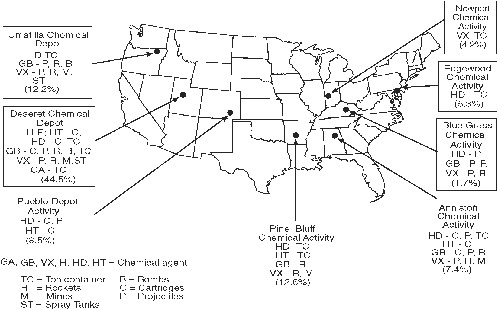
FIGURE 1-1 Location and original size (percentage of original chemical agent stockpile) of eight continental U.S. storage sites. SOURCE: OTA, 1992.
by biodegradation will be used in the case of Pueblo, and neutralization followed by supercritical water oxidation in the case of Blue Grass.
FACILITIES COVERED IN THIS REPORT
This report focuses on the four incineration or “baseline” facilities that are operating, as well as the Chemical Agent Munitions Disposal System (CAMDS). Located at Deseret Chemical Depot (DCD) in Utah, CAMDS was a pilot facility for testing destruction processes and equipment. Not included in the study are ABCDF and the NECDF. These relatively small facilities have both completed their mission and have already been dismantled. Regulatory closure of ABCDF and NECDF has been completed. The destruction facilities for the Pueblo, Colorado, and Blue Grass, Kentucky, sites will be full-scale pilot plants. Their facility and process designs are completed, and the facilities are currently under construction under the auspices of a separate DoD program, the Assembled Chemical Weapons Alternatives (ACWA) program. These facilities likewise are not addressed in this study.
The four baseline incineration facilities in the continental United States—TOCDF, ANCDF, UMCDF, and PBCDF—are nearing the end of their missions. They will then go into closure operations in order to prepare the facility sites for future use. This report addresses the issues and challenges that should be focused on during the planning and the conducting of closure operations for these facilities. The TOCDF was the first of these facilities to begin agent disposal operations in August 1996. At the time this study was initiated, it was thought that it would be the first of these facilities to close. The Army initially intended to use the closure plans for TOCDF as the programmatic closure plans and the basis for closure plans for the other three facilities. That no longer appears to be the case. It appears now that PBCDF will be the first of the four facilities to undergo closure, with ANCDF most likely to be the second facility closed. The committee with the concurrence of the Army’s Chemical Materials Agency (CMA), therefore, examined the available information for all four baseline facilities and CAMDS and discussed closure plans with representatives from each of these facilities.
Whereas each facility has unique characteristics and issues, many of the issues and challenges for closure will be the same for all of them.2 Thus, this report addresses the general challenges while also considering the specific issues related to each facility. Throughout this report, CAMDS is addressed as part of the baseline group of facilities.
The CAMDS facility, a research and development pilot facility colocated with TOCDF at the Deseret Chemical Depot, has been undergoing closure operations for some time. Closure operations at CAMDS were initially undertaken under a separate contract that has been terminated. Responsibility for the closure of CAMDS and the requisite operations transferred to the operating contractor for TOCDF. The Committee to Review and Assess Closure Plans for the Tooele Chemical Agent Disposal Facility and the Chemical Agent Munitions Disposal System (CMA Closure Committee) previously addressed the CAMDS closure (see Appendix A for this committee’s initial letter report). In this current report, CAMDS is considered a part of TOCDF.
JACADS CLOSURE
CMA currently provides managerial leadership and oversight of the chemical stockpile disposal activities. A predecessor organization of the CMA, the Program Manager for Chemical Demilitarization (PMCD), had requested the NRC to undertake a study of the closure of JACADS. This request culminated in the issuance of the report Closure and Johnston Atoll Chemical Agent Disposal System (NRC, 2002). That study was undertaken before any closure activities were begun at JACADS. It examined the planning for closure and closure operations from late 1999 through early 2001. The report reviewed planning but did not review or assess actual demolition activities because no such activities had been undertaken before the report was finalized.
The JACADS report provided the Army with 19 recommendations to help in closure planning and operations. These covered decision making and project planning, personnel retention, acquisition strategy and procurement, cost control, monitoring, security, safety, and public involvement (NRC, 2002). The CMA Closure Committee has reviewed the report for applicability to the closure of the other baseline incineration facilities, and it has included these considerations in the development of and recommendations in this report to the extent that this information is applicable to the current facilities’ closure situations The 19 recommendations are still applicable. The lessons learned as a result of the JACADS closure operations are of equal import and provide valuable insights that are incorporated in this report and are being incorporated into the Army’s closure planning activities.
COMMITTEE LETTER REPORT
A team of the committee undertook a preliminary evaluation of the program closure planning for the facilities using TOCDF and CAMDS closure planning documents and presentations from October to December 2009. The report of that evaluation (Appendix A) provided a set of key parameters for successful closure against which development and subsequent execution of closure plans can be evaluated. These parameters are part of the basis of the present report, which examines the closure planning process and configurations for each of the four baseline incineration chemical agent disposal facilities. The preliminary report addresses the CAMDS closure, which is ongoing. The findings of the preliminary report are incorporated into the current full report.
STATEMENT OF TASK
The CMA Closure Committee was given the following statement of task:
The NRC will form a committee to provide two reports. The first is an interim report assessing the following:
-
Examine the current closure plans for TOCDF and CAMDS and make recommendations as required.
-
Recommend key parameters to assess an integrated approach to common closure requirements.
-
Assess planning for compliance with unique regulatory requirements of the State of Utah towards closure of the two chemical disposal facilities.
Following the issuance of the interim TOCDF-CAMDS closure report, the National Research Council will issue a comprehensive report as follows:
-
Update the 2002 NRC report Closure and Johnston Atoll Chemical Agent Disposal System, as required.
-
Using the key parameters to assess an integrated approach to common closure requirements (as recommended in the interim TOCDF-CAMDS closure report), determine applicable lessons learned from the closure of JACADS, ABCDF, and the ongoing closure of NECDF for potential use during incineration facility closure.
As described previously, at the time the committee commenced its study activities, it became apparent to the members, and was acknowledged by CMA, that closure planning for TOCDF—and to a lesser extent CAMDS—had not evolved to a point that would allow for detailed evaluation of those plans either for those facilities or as models for the other sites. Therefore, the committee examined closure documents that were available from all four incineration facilities as well as applicable documents from ABCDF and NECDF. As a result, the committee’s focus, with the concurrence of the CMA Program Manager, considered each of the four facilities, particularly those that would be closing before TOCDF.
THE COMMITTEE’S APPROACH
The committee focused its attention primarily on the approach to closure planning by the Army and, where available, on the closure plans for those chemical agent disposal facilities that were currently expected to be the first to close and whose closure planning was the furthest evolved. These are PBCDF and ANCDF. At the time this report was prepared, it was anticipated that PBCDF would be the first facility to begin closure operations, followed by ANCDF and then, depending on the situation at the time, by either UMCDF or TOCDF. A summary of available and planned closure documents for the facilities is found in Chapter 2.
STRUCTURE OF THE REPORT
This chapter summarizes the history of the Army’s chemical stockpile disposal program and chemical agent disposal facilities. The first full-scale facility, JACADS, operated from 1986 until its closure in 2001. Four second-generation facilities—TOCDF, ANCDF, UMCDF, and PBCDF, constructed from 1989 through 2005—are in various states of preparation for closure in the 2013–2015 time frame.
In Chapter 2, the committee examines the overall closure planning for the four baseline incineration chemical agent disposal facilities, including facility decommissioning and closure objectives, regulatory drivers, and expectations for future use. A brief discussion of the status of the planning for each of the four facilities is also presented, as is a summary of the available and planned closure documents for each facility. It should be noted here that, as is discussed in more detail throughout the report, all four facilities present different challenges because the closure goals are in some ways different for each facility.
In Chapter 3, the committee identifies a series of key parameters along with associated metrics for overall management of the current and upcoming closures. These parameters and metrics are differentiated into program- and project-level considerations and activities. It is left to the Army and its contractors to develop a similar set of parameters and metrics applicable to work at the task level. The relevance of using leading indicators is discussed in view of the transition from disposal operations to the new types of activities being undertaken as deconstruction becomes the central activity.
Chapter 4 examines the Army’s lessons learned process as it pertains to closure operations. The chapter also discusses the Army’s use of a more recent but key management tool, the eRoom. The lessons learned program has, by the nature of activities to date, emphasized operations and must for the next several years place equal emphasis on closure planning and eventually closure execution. The contractor-operated eRoom is an invaluable tool for viewing and obtaining detailed plans and documents. Provided that accessibility is properly structured, it can be a valuable aid in the closure planning process as well as being a useful tool for reviewing similar documents for consistency between sites.
Chapter 5 examines regulatory issues and constraints including general and site-specific Resource Conservation and Recovery Act (RCRA) closure requirements, programmatic constraints, and installation-specific constraints. These constraints are often facility specific and if not properly managed can be very time-consuming and costly.
Chapter 6 examines the monitoring and analytical challenges that will be new and different from those experienced during the disposal operations phase of the facility. The role of the usual RCRA extractive analysis testing of waste and the difficulty in using that traditional methodology is discussed. The use of vapor screening as a monitoring tool that will be protective of workers and the general public while allowing for efficient deconstruction, or mass demolition, is evaluated
in detail. The committee concerned itself primarily with the waste materials that have been or could have been in contact with agent during the life of the facility. Material not in those categories is discussed in an earlier report on secondary waste (NRC, 2008). Waste of a general industrial or commercial nature can be managed as such waste materials are routinely handled. Therefore, the committee considered that it could not contribute additional advice regarding their management.
Throughout the report, findings and recommendations follow the relevant discussion.
REFERENCES
OTA (Office of Technology Assessment). 1992. Disposal of Chemical Weapons: An Analysis of Alternatives to Incineration. Washington, D.C.: U.S. Government Printing Office.
NRC (National Research Council). 2002. Closure and Johnston Atoll Chemical Agent Disposal System. Washington, D.C.: The National Academies Press.
NRC. 2008. Review of Secondary Waste Disposal Planning for the Blue Grass and Pueblo Chemical Agent Destruction Pilot Plants. Washington, D.C.: The National Academies Press.


