
5
Propylene Oxide1
Acute Exposure Guideline Levels
PREFACE
Under the authority of the Federal Advisory Committee Act (FACA) P.L. 92-463 of 1972, the National Advisory Committee for Acute Exposure Guideline Levels for Hazardous Substances (NAC/AEGL Committee) has been established to identify, review, and interpret relevant toxicologic and other scientific data and develop AEGLs for high-priority, acutely toxic chemicals.AEGLs represent threshold exposure limits for the general public and are applicable to emergency exposure periods ranging from 10 minutes (min) to 8 hours (h). Three levels— AEGL-1, AEGL-2, and AEGL-3—are developed for each of five exposure periods (10 and 30 min and 1, 4, and 8 h) and are distinguished by varying degrees of severity of toxic effects. The three AEGLs have been defined as follows:
AEGL-1 is the airborne concentration (expressed as parts per million [ppm] or milligrams per cubic meter [mg/m3]) of a substance above which it is predicted that the general population, including susceptible individuals, could experience notable discomfort, irritation, or certain asymptomatic, nonsensory effects. However, the effects are not disabling and are transient and reversible upon cessation of exposure.
AEGL-2 is the airborne concentration (expressed as ppm or mg/m3) of a substance above which it is predicted that the general population, including susceptible individuals, could experience irreversible or other serious, long-lasting adverse health effects, or an impaired ability to escape.
AEGL-3 is the airborne concentration (expressed as ppm or mg/m3) of a substance above which it is predicted that the general population, including susceptible individuals, could experience life-threatening health effects or death.
Airborne concentrations below the AEGL-1 represent exposure levels that could produce mild and progressively increasing but transient and nondisabling odor, taste, and sensory irritation or certain asymptomatic, nonsensory effects. With increasing airborne concentrations above each AEGL, there is a progressive increase in the likelihood of occurrence and the severity of effects described for each corresponding AEGL. Although the AEGLs represent threshold levels for the general public, including susceptible subpopulations, such as infants, children, the elderly, persons with asthma, and those with other illnesses, it is recognized that individuals, subject to idiosyncratic responses, could experience the effects described at concentrations below the corresponding AEGL.
SUMMARY
Propylene oxide is an extremely flammable, highly volatile, colorless liquid. Its odor has been described as sweet and alcoholic, and it has reported odor thresholds ranging from 10 to 200 ppm (Jacobson et al. 1956; Hellman and Small 1974; Amoore and Hautala 1983). The primary industrial uses of propylene oxide include in the production of polyurethane foams and resins, propylene glycol, functional fluids (such as hydraulic fluids, heat transfer fluids, and lubricants), and propylene oxide–based surfactants. It is also used as a food fumigant, soil sterilizer, and acid scavenger.
Data addressing inhalation toxicity of propylene oxide in humans were limited to one case report, general environmental work surveys, and molecular biomonitoring studies. Studies addressing lethal and nonlethal inhalation toxicity of propylene oxide in animals were available in monkeys, dogs, rats, mice, and guinea pigs. General signs of toxicity after acute exposure to propylene oxide vapor included nasal discharge, lacrimation, salivation, gasping, lethargy and hypoactivity, weakness, and incoordination. Repeated exposures resulted in similar but generally reversible signs of toxicity. Much of the toxicologic evidence suggests that propylene oxide reacts at the site of entry. Therefore, inhalation of propylene oxide results in respiratory tract irritation, eventually leading to death. Possible neurotoxic effects have also been observed in rodents and dogs after inhalation exposure to higher concentrations of propylene oxide.
Propylene oxide is a direct alkylating agent that covalently binds to DNA and proteins. Consequently, it has tested positive in a number of in vitro tests but has produced equivocal results in in vivo test systems. Data addressing the po-
tential carcinogenicity of propylene oxide in animals is considered adequate for establishing propylene oxide as a carcinogen in experimental animals.
The AEGL-1 is based on a workplace survey that measured exposure concentrations of 380 ppm for 177 min, 525 ppm for 121 min, 392 ppm for 135 min, and 460 ppm for 116 min in the breathing zone of three workers during drumming operations (CMA 1998). Strong odor and irritation were noted in the survey. The nature of the irritation was not provided, but occasional eye irritation was noted as the reason for the monitoring program. Because the effects were considered mild irritation, the AEGL values would be set equal across time. Therefore, the four exposure concentrations can be averaged, resulting in a point of departure of 440 ppm. A total uncertainty factor and modifying factor of 6 is applied. An interspecies uncertainty factor was not needed, because the data were from human exposures. An intraspecies uncertainty factor of 3 was applied, because irritation is a point-of-contact effect and is not expected to vary greatly among individuals. A modifying factor of 2 is applied, because the defined effects are above an AEGL-1 (undefined irritation) but below an AEGL-2 end point.
No human data were available for deriving an AEGL-2. When considering animal data for deriving an AEGL-2, dyspnea in mice was the most sensitive end point consistent with the AEGL-2 definition, and mice were the most sensitive to the toxic effects of propylene oxide vapor. Therefore, the AEGL-2 values are based on data from the NTP (1985) study in which mice exposed to 387 ppm for 4 h exhibited dyspnea. Although a no-effect level was not established for dyspnea at this concentration, no other adverse effects were noted. In addition, compared with other studies investigating propylene oxide toxicity in mice, the NTP study reported toxic effects occurring at much lower concentrations than were observed in other studies. An interspecies uncertainty factor of 1 was applied, because mice are the most sensitive laboratory species in terms of the lethal effects of propylene oxide as well as clinical signs of toxicity, and available data indicate that mice are equally or slightly more sensitive than humans in the manifestation of clinical signs. The NTP (1985) study reported toxic effects at much lower concentrations than those observed in other studies. An intraspecies uncertainty factor of 3 was applied because the mechanism of toxicity— irritation—is a point-of-contact effect and is not expected to vary greatly among individuals. Therefore, a total uncertainty factor of 3 was applied.
Although the mechanism of action appears to be a direct irritant effect, it is not appropriate to set the values equally across time, because the irritation is no longer considered mild but is part of the continuum of respiratory tract irritation leading to death. The experimentally derived exposure value was therefore scaled to AEGL timeframes using the concentration-time relationship given by the equation Cn × t = k, where C is concentration, t is time, k is a constant, and n is 1.7 as calculated with the rat lethality data reported by Rowe et al. (1956) (ten Berge et al. 1986). The 10-min value was set equal to the 30-min value because of the uncertainty in extrapolating from the exposure duration of 4 h to 10 min.
The AEGL-3 derivation is based on the calculated 4-h BMCL05 (benchmark concentration, 95% lower confidence limit at the 5% response rate) of 1,161 ppm, the lowest BMCL05 value in rats (NTP 1985). Lethality data in the dog, a nonobligate nose breather, support use of the BMCL05 value in the rat, but the dog values should not be used as the basis for the AEGL-3 derivation because two of three animals in the high-dose group died before they were removed from the exposure chamber. Mouse data were not used because the mouse is overly sensitive to propylene oxide compared with the other species tested. The BMCL05 values in mice are 282 and 673 ppm (Jacobson et al. 1956; NTP 1985), compared with 1,161 to 3,328 ppm in rats (Jacobson et al. 1956; Shell Oil Co. 1977; NTP 1985) and 1,117 ppm in dogs (Jacobson et al. 1956). Other data demonstrating that the mouse BMCL05 values are unreasonably low include the studies in which only minimal effects were noted in monkeys exposed to 300 ppm for 6 h/day, 5 days/week, for 2 years (Sprinz et al. 1982; Lynch et al. 1983; Setzer et al. 1997), or to 457 ppm for 7 h/day for 154 days (Rowe et al. 1956), and the highest documented human exposure of 1,520 ppm for 171 min, which caused irritation that was not severe enough for the worker to cease working (CMA 1998). These data support the 4-h BMCL05 of 1,161 ppm in rats as a reasonable point of departure. An intraspecies uncertainty factor of 3 was applied, because the mechanism of toxicity—irritation—is a point-of-contact effect and is not expected to vary greatly among individuals. An interspecies uncertainty factor of 1 was applied because of the supporting data in dogs (similar 4-h BMCL05) and monkeys (2-year studies, which produced minimal effects). The 4-h AEGL-3 value using a total uncertainty factor of 3 is 387 ppm, which is conservative compared with the 300- or 457-ppm chronic exposure in monkeys producing minimal effects. Therefore, a total uncertainty factor of 3 was considered reasonable.
As for the AEGL-2 derivation, the point of departure for the AEGL-3 derivation was scaled to AEGL timeframes using the concentration-time relationship given by the equation Cn × t = k, where C is concentration, t is time, k is a constant, and n is 1.7 as calculated with the rat lethality data reported by Rowe et al. (1956) (ten Berge et al. 1986). The value was extrapolated across time, because the irritation is no longer considered mild; rather, the concentration represents the threshold for lethality. The 10-min value was set equal to the 30-min value because of the uncertainty in extrapolating from the exposure duration of 4 h to 10 min.
A level of distinct odor awareness (LOA) for propylene oxide of 21 ppm was derived on the basis of the odor detection threshold from the study of Hellman and Small (1974). The LOA represents the concentration above which it is predicted that more than half the exposed population will experience at least a distinct odor intensity; about 10% of the population will experience a strong odor intensity. The LOA should help chemical emergency responders in assessing public awareness of the exposure due to odor perception.A quantitative carcinogenicity assessment for a single exposure to propylene oxide is not considered appropriate. Data indicate that propylene oxide is a threshold carcinogen
that depends on increased cell proliferation and hyperplasia at the target site and would require repeated exposure to produce tumorigenesis. Therefore, a onetime exposure even to high concentrations of propylene oxide is not expected to result in tumor development. This conclusion is supported by the Sellakumar et al. (1987) study in which no tumors were observed when 12-week-old male Sprague-Dawley rats were exposed to propylene oxide at 433 or 864 ppm for 30 days or to 1,724 ppm for 8 days (exposures were for 6 h/day, 5 days/week) and allowed to die naturally.
The derived AEGL values are listed in Table 5-1.
1.
INTRODUCTION
Propylene oxide is an extremely flammable, highly volatile, colorless liquid, with a boiling point of 35ºC (Meylan et al. 1986; Budavari et al. 1996). The chemical has a high vapor pressure and limited solubility in water but is miscible with a number of organic solvents (ARCO 1983; Budavari et al. 1996). The odor of propylene oxide has been described as sweet and alcoholic, and it has reported odor thresholds ranging from 10 to 200 ppm (Jacobson et al. 1956; Hellman and Small 1974). The physicochemical data on propylene oxide are presented in Table 5-2.
TABLE 5-1 Summary of AEGL Values for Propylene Oxide
|
Classification |
10 min |
30 min |
1 h |
4 h |
8 h |
End Point (Reference) |
|
AEGL-1 (Nondisabling) |
73 ppm (170 mg/m3) |
73 ppm (170 mg/m3) |
73 ppm (170 mg/m3) |
73 ppm (170 mg/m3) |
73 ppm (170 mg/m3) |
Humans: strong odor and irritation noted in monitoring study; average of four exposure concentrations and durations:380 ppm for 177 min, 525 ppm for 121 min, 392 ppm for 135 min, 460 ppm for 116 min (CMA 1998) |
|
AEGL-2 (Disabling) |
440 ppm (1,000 mg/m3) |
440 ppm (1,000 mg/m3) |
290 ppm (690 mg/m3) |
130 ppm (310 mg/m3) |
86 ppm (200 mg/m3) |
Dyspnea in mice at 387 ppm for 4 h (NTP 1985) |
|
AEGL-3 (Lethality) |
1,300 ppm (3,100 mg/m3) |
1,300 ppm (3,100 mg/m3) |
870 ppm (2,100 mg/m3) |
390 ppm (930 mg/m3) |
260 ppm (620 mg/m3) |
Calculated 4-h BMCL05 of 1,161 ppm in rats (NTP 1985) |
|
Abbreviation: BMCL05, benchmark concentration, 95% lower confidence limit with 5% response. |
||||||
Propylene oxide is produced primarily by one of two processes: from direct oxidation of propylene with air or oxygen or via the intermediate propylene chlorohydrin (Gardiner et al. 1993). The largest use of propylene oxide is in production of polyurethane foams and resins, followed by its use in production of propylene glycol resulting from its hydrolysis. Other common applications include its use in manufacturing functional fluids (such as hydraulic fluids, heat transfer fluids, and lubricants) and propylene oxide–based surfactants, and its use as a food fumigant and acid scavenger (ARCO 1983). The Chemical Economics Handbook (SRI International 1995) has estimated that 3,575 to 3,650 million pounds of propylene oxide were produced in the United States in 1998. Worldwide annual capacity for propylene oxide production was estimated at 8.8 billion pounds on Jan. 1, 1994 (SRI International 1995).
Data addressing the toxicity of propylene oxide in humans were limited to one case report, general environmental health surveys, and molecular biomonitoring studies. Studies addressing lethal and nonlethal toxicity of propylene oxide in several species of experimental animals were available.
TABLE 5-2 Chemical and Physical Data for Propylene Oxide
|
Parameter |
Value |
Reference |
|
Chemical name |
Propylene oxide |
|
|
Synonyms |
1,2-Epoxypropane, methyloxidrane, propene oxide, 1,2-propylene oxide |
ACGIH 1996 |
|
CAS registry number |
75-56-9 |
|
|
Molecular formula |
C3H6O |
|
|
Molecular weight |
58.08 |
Budavari et al. 1996 |
|
Physical state |
Liquid |
Budavari et al. 1996 |
|
Color |
Colorless |
Budavari et al. 1996 |
|
Melting and boiling points |
−112.13ºC and 34.23ºC |
Budavari et al. 1996 |
|
Solubility |
40.5% by wt in water at 20ºC; 59% by wt in water at 25ºC |
Budavari et al. 1996; Gardiner et al. 1993 |
|
Specific gravity |
0.8304 at 20ºC; 0.826 at 25ºC |
Gardiner et al. 1993 |
|
Density (water = 1) |
2.0 |
Gardiner et al. 1993 |
|
Vapor pressure |
445 torr at 20ºC |
ACGIH 1996 |
|
Conversion factors |
1 ppm = 2.376 mg/m3 at 25ºC 1 mg/m3 = 0.421 ppm |
Gardiner et al. 1993 |
2.
HUMAN TOXICITY DATA
2.1.
Acute Lethality
No data were found in the literature regarding lethality in humans after acute exposure to propylene oxide.
2.2.
Nonlethal Toxicity
2.2.1.
Odor Threshold
Reported ranges of odor threshold vary widely. In one study, 14 subjects found the odor of propylene oxide to be “sweet, alcoholic, and like natural gas, ether, or benzene” (Jacobson et al. 1956). By using an osmoscope, median detectable concentrations were computed by the time-percent effect method of Litchfield, and the median detectable odor concentration was calculated to be 200 ppm (95% confidence interval [C.I.]: 114 to 353 ppm). Amoore and Hautala (1983) reported an odor threshold of 44 ppm; Hellman and Small (1974) reported a threshold of 10 ppm for odor detection and 35 ppm for odor recognition. Subjects classified the odor as neutral to pleasant. The American Industrial Hygiene Association (AIHA 1989) and the Environmental Protection Agency (EPA) (1992) have critiqued studies with odor threshold data, and both have classified the studies by Jacobson et al. (200 ppm) and Hellman and Small (10 and 35 ppm) as acceptable.
2.2.2.
Case Reports
One case report of acute exposure was reported in the Russian literature (Beliaev et al. 1971). A 43-year-old male worker was accidentally exposed to propylene oxide vapor for 10 to 15 min while cleaning up a spill. The exposure concentration was exceedingly high, 1,400 to 1,500 milligrams per liter (mg/L) (590,000 ppm), evoking doubt about the accuracy of the measurement. Shortly after exposure, he developed eye and lung irritation, burning behind the sternum, and restlessness. Headache, general weakness, and diarrhea followed 1.5 h later, and within 2 h he was cyanotic and had collapsed. He was given oxygen and antihistamines and was treated for shock. He regained consciousness but remained weak, had diarrhea, and vomited periodically. His pulse and blood pressure returned to normal 2 h later, and he was discharged from the hospital in satisfactory condition after 10 days.
2.2.3.
Workplace Exposures
An environmental health survey in 1949 measured propylene oxide levels over drums being filled with polypropylene glycol (1% to 8% free propylene
oxide content) (CMA 1998). Two 30-min samples contained propylene oxide at 348 and 913 ppm (vol/vol). Another sample collected for 12 min over the opening to a polypropylene glycol mixing tank during purging contained 28 ppm. Workers complained of eye irritation after 2 weeks of steady operation. No fatalities in the 23 potentially exposed workers occurred within 5 months of the sampling.
In 1968, air sampling was conducted in the breathing zone of three workers during typical drumming operations of propylene oxide (CMA 1998). The sampling was conducted to evaluate the effectiveness of local exhaust ventilation in response to worker complaints of occasional eye irritation. Samples were taken starting 5 min after overhead heater fans were turned on (providing additional ventilation) or starting 5 min after the overhead heater fans were off (when worker complaints were typically noted). Air samples were collected in airtight Saran® bags and analyzed by vapor-phase chromatography. Results of the sampling are presented in Table 5-3.
TABLE 5-3 Summary Results of Personal Exposure Monitoring for Propylene Oxide During Typical Drumming Operations
|
Sample Number |
Description of Samples (taken in breathing zone of operators during drumming of propylene oxide) |
Personnel Monitored |
Sampling Duration (min) |
TWA for Monitoring Period (ppm) |
|
1 |
Sampling initiated 5 min after overhead heater fan turned on, heater fan on for duration of monitoring |
Drumming operator 1 |
177 |
380 |
|
2 |
Sampling initiated 5 min after overhead heater fan turned off, heater fan off for duration of monitoring |
Drumming operator 1 |
171 |
1520 |
|
3 |
Sampling initiated 5 min after overhead heater fan turned off, heater fan off for duration of monitoring |
Drumming operator 2 |
124 |
1310 |
|
4 |
Sampling initiated 5 min after overhead heater fan turned off, heater fan off for duration of monitoring |
Drumming operator 2 |
121 |
525 |
|
5 |
Sampling initiated 5 min after overhead heater fan turned on, heater fan on for duration of monitoring |
Drumming operator 3 |
135 |
392 |
|
6 |
Sampling initiated 5 min after overhead heater fan turned on, heater fan on for duration of monitoring |
Drumming operator 3 |
116 |
460 |
|
Abbreviation: TWA, time-weighted average. Source: CMA 1998. |
||||
Exposures were 1,520 ppm (vol/vol) for 171 min, 1,310 ppm for 124 min, and 525 ppm for 121 min with the overhead heater fan turned off and 380 ppm for 177 min, 392 ppm for 135 min, and 460 ppm for 116 min with the overhead heater fan turned on (CMA 1998). The industrial hygienist was in the drumming booth during the monitoring periods and stated that “the odor was quite strong during the sampling; however, the irritation was not intolerable.” Other observations noted by the hygienist included the following: “odor was quite obvious but not objectionable”; “pronounced odor, nonobjectionable”; and “general area in drumming room, about 10 feet from drumming station, odor was detectable but faint.” No fatalities in the 30 potentially exposed workers (including the hygienist) occurred within 5 months of sampling, indicating that the measured exposures to propylene oxide were not fatal.
Background propylene oxide concentrations were measured over three 8-h shifts in a plant in 1975 to perform baseline routine annual monitoring (CMA 1998). The concentration of the samples in ambient air ranged from none detected (<0.1 ppm) to 31.8 ppm (vol/vol). Propylene oxide concentrations were also measured in the breathing zones of workers using Sipin personal sampler pumps over the 8-h work periods. Measured concentrations ranged from 13.2 to 31.8 ppm as 8-h time-weighted averages (TWAs) measured over the 3-day sampling period (see Table 5-4). No worker complaints were noted in the report.
2.3.
Developmental and Reproductive Toxicity
No human developmental and reproductive toxicity data on propylene oxide were found in the literature.
2.4.
Genotoxicity
Unscheduled DNA synthesis after in vitro challenge with the carcinogen N-acetoxy-2-acetylaminofluorene was measured in lymphocytes of 23 process workers exposed to propylene oxide (Pero et al. 1982). The control population consisted of workers in a nearby mechanical industry factory. Five of the most exposed workers had an estimated TWA of 0.6 to 12 ppm during 5 working days, and some workers had short exposures to concentrations as high as 1,000 ppm. Exposed workers showed a decreased capacity for unscheduled DNA synthesis, a step in the enzymatic repair of DNA lesions. Osterman-Golkar et al. (1984) reported a good correlation between the estimated exposures of eight workers to propylene oxide vapor and hemoglobin adduction at the N-(2-hydroxypropyl)histidine residues. Workers exposed to the highest estimated concentration of approximately 10 ppm for 25% to 75% of their work time had adduct levels in the range of 4.5 to 13 nanomoles (nmol) per gram (g) of hemoglobin. Pero et al. (1985) also found a significant increase in the alkylation of histidine residues of hemoglobin in relation to propylene oxide exposure and a significant decrease in proficiency of DNA repair as measured by unscheduled
DNA synthesis. Linear regression of the hemoglobin adducts versus DNA repair proficiency revealed a significant correlation (r = −0.64; p < 0.03).
Cytogenetic monitoring studies measuring chromosomal aberrations were carried out on groups of employees of the Shell petrochemical company (de Jong et al. 1988). From 1976 to 1981, these employees were potentially exposed to a number of genotoxic chemicals, including propylene oxide, with exposures occurring well below the occupational exposure limits. One group under investigation was limited in its exposure to propylene oxide alone, and the average air concentration of propylene oxide in the plant where the group worked was 0.042 ppm (geometric mean; range <0.042 to 2.74 ppm). The authors concluded that no correlation could be made between increased chromosomal aberrations and work exposure to low levels of propylene oxide or to any of the other genotoxic chemicals under investigation.
Högstedt et al. (1990) measured cytogenic end points in the blood of 20 male individuals exposed to propylene oxide for 1 to 20 years in a plant that produced alkylated starch. Average concentrations of propylene oxide measured in the breathing zones during 2- to 4-h measuring periods ranged from 0.33 to 11.4 ppm, with a peak concentration of 56 ppm measured during a shorter 20-min sampling period. Micronulei and chromosomal aberrations were measured; however, there was no control group with which to compare the results. A correlation was observed between measured propylene oxide air concentrations and the presence of the hemoglobin adduct hydroxypropylvaline in the exposed workers.
TABLE 5-4 Summary Results of Personal Exposure Monitoring
|
Job Classification |
Number of Persons Monitored |
Number of Samples |
Propylene Oxide |
||
|
Concentration Range (ppm) |
Mean Job Class Concentrationa (ppm) |
||||
|
Mean |
95% UCL |
||||
|
Maintenance personnel |
5 |
8 |
14.9-18.9 |
17.4 |
18.30 |
|
Laboratory personnel |
2 |
2 |
30.2-31.8 |
31.0 |
36.05 |
|
Engineer |
1 |
1 |
30.2 |
30.2 |
N/A |
|
Foreman |
2 |
4 |
16.1-23.8 |
20.58 |
24.49 |
|
Operator |
6 |
11 |
13.2-23.3 |
18.69 |
20.31 |
|
aCalculated arithmetic mean and 95% upper confidence level (UCL) for the associated job class. Job classes were identified and monitored by homogenous exposure groups rather than job titles. Abbreviation: UCL, 95% upper confidence level; N/A, not applicable. Source: CMA 1998. |
|||||
2.5.
Carcinogenicity
Data on the potential carcinogenicity of propylene oxide in humans are limited and no definitive conclusions can be drawn. A retrospective cohort study of alkylene oxide–exposed workers conducted by Thiess et al. (1982) and a mortality study by Egedahl et al. (1989) did not find increased mortality from cancer or any other cause, but the studies were confounded by exposure to multiple alkene oxides as well as other chemicals. A nested case-control study investigating cancer incidences in workers ever exposed to propylene oxide versus never exposed did not result in significant associations of specific cancers with exposure (Ott et al. 1989).
2.6.
Summary
Available data on human exposure to propylene oxide were limited. Odor detection threshold values for propylene oxide ranged from 10 to 200 ppm. The only case report of an occupational exposure was of a male worker accidentally exposed to a high concentration of propylene oxide for 10 to 15 min. Symptoms of exposure included eye and lung irritation, burning sensation in the chest, restlessness, headache, general weakness, diarrhea, and vomiting. The worker reportedly recovered. Other workplace exposure information was reported in environmental health surveys. Measured exposure concentrations of propylene oxide were as high as 1,520 ppm for 171 min with no reports of fatality. A strong odor and undefined irritation were noted at this concentration. In another report, 8-h TWAs measured over a 3-day sampling period indicated propylene oxide exposures ranging from 13.2 to 31.8 ppm. Ambient air concentrations of propylene oxide ranged from none detected to 41.8 ppm. The report noted no worker complaints.Molecular biomonitoring studies of workers exposed to low concentrations of propylene oxide have revealed a good correlation between hemoglobin adduction, decreased proficiency for DNA repair, and estimated exposure to propylene oxide. Cytogenetic studies have not found a significant correlation between in vivo propylene oxide exposure and micronuclei or chromosomal aberrations. Data on the potential carcinogenicity of propylene oxide in humans are limited and no definitive conclusions can be drawn.
3.
ANIMAL TOXICITY DATA
3.1.
Acute Lethality
3.1.1.
Dogs
Jacobson et al. (1956) exposed groups of three male beagle dogs to measured propylene oxide vapor concentrations of 1,363, 2,005, 2,030, or 2,481 ppm for 4 h. Animals were exposed in constant-flow gassing chambers with a capac-
ity of 0.4 m3. The propylene oxide vapor was generated by passing a stream of nitrogen through the liquid. Chamber air was sampled by drawing chamber air through a series of bubblers (the first containing a solution of calcium chloride with water [CaCl2·2H2O] in 0.1 N hydrochloric acid [HCl], and the second containing water to trap any acid). Chamber concentrations were calculated from the results of titration of the HCl that had not reacted with propylene oxide in the bubblers with a standard sodium hydroxide solution. The dogs were observed for signs of toxicity and mortality for 14 days. Signs of toxicity in the animals included lacrimation, salivation and nasal discharge, vomiting, and death. At least one dog in each group exposed to 2,005 ppm or higher exhibited motor weakness after exposure. Congestion of the tracheal mucosa and lungs, spotty alveolar edema, marked perivascular and peribronchial edema, and focal areas of subepithelial edema and necrobiosis of bronchiolar epithelium were noted during postmortem examination in the dogs exposed to 2,030 and 2,481 ppm. Some exposed animals also had subpleural hemorrhage. Incidences of subendocardial ecchymoses were considered a secondary effect of the anoxia. Mortality occurred in all groups exposed to 2,005 ppm or higher (see Table 5-5). Death occurred within 24 h of exposure. The authors did not calculate an LC50 (concentration with 50% lethality) value for dogs because of inadequate data (two of three dogs in the 2,481-ppm group were dead when they were removed from the chamber; the third dog probably would have died soon and was therefore killed immediately). If one conducts a probit analysis of the data, a 4-h LC50 value of 1,941 ppm is obtained.
3.1.2.
Rats
Jacobson et al. (1956) exposed groups of 10, white male rats (strain not given) to measured conentrations of propylene oxide vapor at 945, 1,329, 2,684, 3,448, 4,490, or 5,254 ppm for 4 h. Animals were exposed in constant-flow gassing chambers of 0.4-m3 capacity. The propylene oxide vapor was generated by passing a stream of nitrogen through the liquid. Chamber air was sampled by drawing chamber air through a series of bubblers (the first containing a solution of CaCl2·2H2O in 0.1 N HCl, and the second containing water to trap any acid). Chamber concentrations were calculated from the results of titrating the HCl that had not reacted with propylene oxide in the bubblers with a standard sodium hydroxide solution. The rats were observed for 14 days for signs of toxicity and mortality. Signs of toxicity in exposed rats included frequent movement and preening, clear nasal discharge, lacrimation, salivation, gasping that increased in intensity during exposure, and death. The only pathologic change revealed during postmortem examination was a distended stomach in exposed rats. Mortality occurred in rats exposed to 3,448 ppm or higher (see Table 5-6). Death occurred by day 6. The calculated 4-h LC50 was 4,000 ppm (9,486 mg/m3; Bliss-Finney method) (95% C.I. 3,550 to 4,470 ppm).
TABLE 5-5 Mortality of Male Dogs Exposed to Propylene Oxide Vapor for 4 Hours
|
Concentration |
Mortality (%) |
|
|
ppm |
mg/m3 |
|
|
1,363 |
3,230 |
0/3 (0) |
|
2,005 |
4,750 |
1/3 (33) |
|
2,030 |
4,810 |
2/3 (67) |
|
2,481 |
5,880 |
3/3 (100) |
|
Source: Jacobson et al. 1956. Reprinted with permission; copyright 1956, American Medical Association. |
||
TABLE 5-6 Mortality of Male Rats Exposed to Propylene Oxide Vapor for 4 Hours
|
Concentration |
Mortality (%) [day of death] |
|
|
ppm |
mg/m3 |
|
|
945 |
2,240 |
0/10 (0) |
|
1,329 |
3,150 |
0/10 (0) |
|
2,684 |
6,360 |
0/10 (0) |
|
3,448 |
8,170 |
3/10 (30) [1,a 1, 3] |
|
4,490 |
10,640 |
7/10 (70) [1, 1, 1, 2, 2, 2, 5] |
|
5,254 |
12,450 |
|
|
aDeath within the first hour postexposure. Source: Jacobson et al. 1956. Reprinted with permission; copyright 1956, American Medical Association. |
||
Groups of female albino rats were exposed to nominal air concentrations of propylene oxide vapor at 2,000, 4,000, 8,000, or 16,000 ppm for various times (see Table 5-7) and were then observed for 14 days for signs of toxicity and mortality (Rowe et al. 1956; methods reported by Spencer et al. 1951). Measured concentrations ranged from 64% to 110% of nominal, averaging 87% of nominal concentrations (actual measured concentrations of the individual exposure concentrations not provided). During the exposure, animals exhibited eye and nasal irritation, difficulty breathing, drowsiness, weakness, and occasionally some incoordination. The severity of the signs increased with concentration and duration of exposure. Some rats continued to experience wheezing after the exposure, and three of those with respiratory difficulty developed pneumonia. The surviving animals generally exhibited weight loss, but they recovered within 14 days. Mortality occurred in most groups exposed to 4,000 ppm and higher, and death typically occurred during the exposure or within 24 h after exposure. Mortality data are presented in Table 5-7.
TABLE 5-7 Mortality of Female Albino Rats Exposed to Propylene Oxide Vapor
|
Concentration (ppm) |
Duration (h) |
Mortality (%) |
|
2,000 |
7.0 |
0/10 (0) |
|
4,000 |
7.0 |
10/10 (100) |
|
4.0 |
4/10 (40) |
|
|
2.0 |
4/10 (40) |
|
|
1.0 |
0/5 (0) |
|
|
8,000 |
2.0 |
10/10 (100) |
|
1.0 |
5/10 (50) |
|
|
0.5 |
2/10 (20) |
|
|
0.25 |
0/10 (0) |
|
|
16,000 |
0.5 |
10/10 (100) |
|
0.25 |
0/15 (0) |
|
|
Source: Rowe et al. 1956. Reprinted with permission; copyright 1956, American Medical Association. |
||
Exposure to propylene oxide vapor for 4 h at a concentration of 4,000 ppm killed 6/6 Sherman rats and 4/6 albino rats (time to death not reported) (Smyth et al. 1948; Weil et al. 1963; also reported by Smyth et al. 1969; methods described by Smyth et al. 1962). These studies do not mention controls, and the authors stated that the concentrations were not precise but rather were estimates. In another experiment, liquid propylene oxide was placed in a shallow tray in a sealed container for at least 24 h. Six albino rats were then introduced into the chamber for 5 min. This exposure killed all six rats.
In an acute inhalation exposure study by NTP (1985), groups of five Fischer 344 (F344)/N rats of each sex were exposed to air containing measured concentrations of propylene oxide vapor at 0, 1,277, 2,970, 3,794, or 3,900 ppm for 4 h. Propylene oxide vapor was generated by vaporizing propylene oxide at room temperature followed by dilution with air. Propylene oxide chamber air concentrations were measured 8 to 12 times per exposure period with a gas chromatograph. After exposure, animals were observed for 14 days for signs of toxicity and mortality. Mortality and toxic effects (red nasal discharge and dyspnea) occurred in all groups exposed to 2,970 ppm or higher (Table 5-8). There were no gross pathologic changes in any of the treated animals. NTP did not report an LC50 value. A probit analysis of the data predicts a 4-h LC50 of 3,205 ppm (both sexes combined).
TABLE 5-8 Mortality of F344/N Rats Exposed to Propylene Oxide for 4 Hours
|
Mortality (%) [day of death] |
|||
|
Concentration (ppm) |
Males |
Females |
Other Effects |
|
1,277 |
0/5 (0) |
0/5 (0) |
None observed |
|
2,970 |
1/5 (20) [3] |
2/5 (40) [1, 2] |
Dyspnea, red nasal discharge |
|
3,794 |
4/5 (80) [1, 3, 4, 5] |
4/5 (80) [1, 1, 3,5] |
Dyspnea, red nasal discharge |
|
3,900 |
3/5 (60) [1, 2, 2] |
3/5 (60) [1, 1, 2] |
Dyspnea, red nasal discharge |
|
Source: NTP 1985. |
|||
Groups of four male and four female Wistar rats were exposed to measured concentrations of propylene oxide vapor at 3,000, 3,450, 4,050, 4,280, 4,500, 5,260, or 5,970 ppm for 4 h (Shell Oil Company 1977). Animals were exposed in dynamic, cylindrical glass exposure chambers. Test chamber air was drawn from the mixing chamber exit through an infrared gas analyzer for concentration verification and then returned to the exposure chamber inlet manifold. After exposure, animals were observed for toxicity signs and mortality for 14 days. During the exposure, all animals exhibited signs of toxicity, including excessive lacrimation and eye irritation, sedation, piloerection, mucous discharge (frequently bloodstained) from the nose and mouth, and respiratory difficulty that continued for several hours after exposure. The time to onset of these signs was concentration related. Rats surviving the 14-day observation period appeared normal; however, necropsy was not performed on any of the animals. Mortality generally occurred during or within the first 24 h after exposure (mortality data are presented in Table 5-9). Propylene oxide exhibited a steep concentration-response curve for mortality: no deaths were observed at 3,450 ppm but all animals died at 5,260 ppm (slope factor of 32.2). The calculated 4-h LC50 value (both sexes combined) was 4,197 ppm (95% C.I.: 3,902 to 4,394 ppm).
In a repeated-exposure study, groups of three male and three female Wistar rats were exposed 6 h/day to air containing measured propylene oxide vapor concentrations of 0 or 997 ppm for 10 days or 1,940 ppm for 9 days (Shell Oil Company 1977). Signs of toxicity in exposed animals were similar to but less severe than those observed in an acute exposure (described above) and included excessive lacrimation and eye irritation, sedation, piloerection, mucous discharge (frequently bloodstained) from the nose and mouth, and respiratory difficulty that continued for several hours after exposure. The toxicity signs in the repeated-exposure study, however, disappeared after day 3 of exposure, except for lethargy, which developed and progressed in the 1,940-ppm group. None of the rats in the 1,940-ppm group would have survived to day 10 of exposure, and they were therefore necropsied after exposure day 9. Macroscopic examination revealed subcutaneous edema of the face, anal region, and feet and distended urinary bladders in females; however, no histologic changes in the tissues were noted. No macroscopic changes were noted in the 997-ppm group, and male rats had decreased kidney and heart weights that were not accompanied by histopa-
thologic changes. Microscopic examination of the lungs of animals in the 997-and 1,940-ppm groups revealed concentration-related necrosis and inflammation of the respiratory epithelium from the nasal cavity to the major bronchi, accompanied by epithelial proliferation and focal hyperplasia and metaplasia.
Rowe et al. (1956) exposed male and female albino rats to various concentrations of propylene oxide for 7 h/day, 5 days/week. Ten male rats exposed to 457 ppm 79 times and 10 female rats exposed to 457 ppm 138 times experienced eye and respiratory irritation, slight alveolar hemorrhage, and pulmonary edema. Although the authors stated that there was an increase in mortality due to pneumonia, they did not reveal the incidence.
3.1.3.
Mice
Jacobson et al. (1956) exposed groups of 10, white female mice (strain not given) to measured concentrations of propylene oxide vapor at 945, 1,329, 1,755, 2,684, 3,448, 4,490, or 5,254 ppm for 4 h. The propylene oxide vapor was generated by passing a stream of nitrogen through the liquid. Chamber air was sampled by drawing it through a series of bubblers (the first containing a solution of CaCl2·2H2O in 0.1 N HCl and the second containing water to trap any acid). Chamber concentrations were calculated from the results of titrating the HCl that had not reacted with propylene oxide in the bubblers with a standard sodium hydroxide solution. Animals were observed for signs of toxicity and mortality for the next 14 days. Signs of toxicity in exposed mice were similar to those observed in exposed rats (see Section 3.1.2) and included frequent movement and preening, clear nasal discharge, lacrimation, salivation, gasping that increased in intensity during exposure, and death. As in rats, the only pathologic change in mice was a distended stomach. Mortality occurred in all exposed groups (see Table 5-10). The calculated 4-h LC50 was 1,740 ppm (4,126 mg/m3; Bliss-Finney method) (95% C.I. 1,380 to 2,120 ppm).
TABLE 5-9 Mortality of Wistar Rats Exposed to Propylene Oxide for 4 Hours
|
Concentration (ppm) |
Mortality (%) [day of death] |
||
|
Males |
Females |
Total |
|
|
3,000 |
0/4 |
0/4 |
0/8 |
|
3,450 |
0/4 |
0/4 |
0/8 |
|
4,050 |
0/4 |
3/4 (75) [1, 2, 2] |
3/8 (38) |
|
4,280 |
2/4 (50) [2, 6] |
2/4 (50) [1, 2] |
4/8 (50) |
|
4,500 |
3/4 (75) [1, 1, 7] |
4/4 (100) [1, 1, 1, 1] |
7/8 (88) |
|
5,260 |
4/4 (100) [1, 1, 1, 2] |
4/4 (100) [1, 1, 1, 1] |
8/8 (100) |
|
5,970 |
4/4 (100) [1, 1, 2, 3] |
4/4 (100) [1, 1, 1, 1] |
8/8 (100) |
|
Source: Shell Oil Company 1977. |
|||
TABLE 5-10 Mortality of Female Mice Exposed to Propylene Oxide Vapor for 4 Hours
|
Concentration |
||
|
ppm |
mg/m3 |
Mortality (%) [Day of death] |
|
945 |
2,240 |
2/11 (18) [1, 1a] |
|
1,329 |
3,150 |
1/10 (10) [1a] |
|
1,755 |
4,160 |
5/10 (50) [1,1,1,1,3] |
|
2,684 |
6,360 |
9/10 (90) [1, 1, 1, 1, 1, 1, 1, 6, 13] |
|
3,448 |
8,170 |
10/10 (100) [1, 1, 1, 1, 1, 1, 1, 1, 1, 1] |
|
4,490 |
10,640 |
10/10 (100) [1, 1, 1, 1, 1, 1, 1, 1, 1, 2] |
|
5,254 |
12,450 |
9/10 (90) [1, 1, 1, 1, 1, 1, 1, 1, 1] |
|
aDeath after first hour postexposure; other deaths on day 1 occurred within 1 h postexposure. Source: Jacobson et al. 1956. Reprinted with permission; copyright 1956, American Medical Association. |
||
In an acute inhalation exposure study by NTP (1985), groups of five B6C3F1 mice of each sex were exposed to air containing measured concentrations of propylene oxide vapor—generated by vaporizing propylene oxide at room temperature followed by dilution with air—at 0, 387, 859, 1,102, 1,277, or 2,970 ppm for 4 h. Propylene oxide chamber air concentrations were measured 8 to 12 times per exposure period with a gas chromatograph. After exposure, the animals were observed for 14 days for signs of toxicity and mortality. All exposed mice exhibited dyspnea, mice exposed to 1,227 and 2,970 ppm exhibited sedation, and the highest concentration group also exhibited lacrimation. No pathologic changes were observed at necropsy. Mortality data are presented in Table 5-11. Although one female mouse died in the 387-ppm group, the mortality did not appear to be treatment related. No females died at the next higher concentration (859 ppm), and almost all other mice in the study that died from propylene oxide exposure died on the first day (one mouse died on day 2), whereas the 387-ppm mouse died on test day 6. NTP (1985) also conducted a 2-and 13-week study in B6C3F1 mice; therefore, the data from the 4-h exposure study could be further evaluated by placing the results in context with the other studies. No mortalities occurred in mice (five animals per sex per concentration) exposed to propylene oxide at 0, 20, 47, 99, 196, or 487 ppm for 6 h/day, 5 days/week, for 2 weeks. Mice in the 196- and 487-ppm groups exhibited dyspnea, and the highest exposure groups were hypoactive. No mortalities occurred in mice (10 animals per sex per concentration) exposed to propylene oxide at 0, 31, 63, 125, 250, or 500 ppm for 6 h/day, 5 days/week, for 13 weeks except for one male mouse in the 125-ppm group on day 14. In this repeat-exposure study, the 500-ppm groups had lower body weights than controls, but gross or microscopic pathologic evaluation did not reveal any compound-related effects. Signs
TABLE 5-11 Mortality of B6C3F1 Mice Exposed to Propylene Oxide for 4 Hours
|
Concentration (ppm) |
Mortality (%) [day of death] |
Other Effects |
|
|
Males |
Females |
||
|
387 |
0/5 (0) |
1/5 (20) [6] |
Dyspnea |
|
859 |
0/5 (0) |
0/5 (0) |
Dyspnea |
|
1,102 |
2/5 (40) [1, 1] |
4/5 (80) [1, 1, 1, 2] |
Dyspnea |
|
1,277 |
2/5 (40) [1, 1] |
5/5 (100) [1, 1, 1, 1, 1] |
Dyspnea, sedation |
|
2,970 |
5/5 (100) [1, 1, 1, 1, 1,] |
5/5 (100) [1, 1, 1, 1, 1] |
Dyspnea, sedation, lacrimation |
|
Source: NTP 1985. |
|||
of toxicity were not stated, so it is unclear whether any were noted or simply were not reported. On the basis of the overall experimental results discussed above, the one death in the female group exposed to 387 ppm for 4 h did not appear to be related to exposure. The calculated 4-h LC50 for both sexes combined was 1,160 ppm (using probit analysis of the acute exposure data, excluding the death in the 387-ppm group).
3.1.4
Guinea Pigs
Rowe et al. (1956) exposed groups of female guinea pigs to nominal air concentrations of propylene oxide vapor at 2,000, 4,000, 8,000, or 16,000 ppm for various times (see Table 5-12). Measured concentrations ranged from 64% to 110% of nominal, averaging 87% of nominal concentrations (actual measured concentrations of the individual exposure concentrations not provided). The animals were observed for signs of toxicity and mortality for 14 days after exposure. During the exposure, animals exhibited eye and nasal irritation, difficulty breathing, drowsiness, weakness, and occasionally some incoordination. The severity of the signs increased with concentration and duration of exposure. The surviving animals generally exhibited weight loss but recovered within 14 days. Death typically occurred during or within 24 h after exposure. Mortality data are presented in Table 5-12.
3.2.
Nonlethal Toxicity
3.2.1.
Nonhuman Primates
To investigate the potential neuropathologic effects of propylene oxide, male monkeys (two per group) were exposed to propylene oxide at 0, 100, or 300 ppm for 6 h/day, 5 days/week, for 24 months and were sacrificed at the termination of exposure (Sprinz et al. 1982). The only observable differences noted
between treated and control monkeys were signs of axonal dystrophy in the medulla oblongata of the brain. Setzer et al. (1997) found no neurophysiologic or neuropathologic changes in groups of 12 cynomolgus monkeys exposed to propylene oxide vapor at 0, 100, or 300 ppm for 7 h/day, 5 days/week, for 24 months.
One female rhesus monkey exposed 154 times to 457 ppm, two female rhesus monkeys exposed 154 times to 195 ppm, and two female rhesus monkeys exposed 154 times to 102 ppm for 7 h/day, 5 days/week, showed no adverse effects (Rowe et al. 1956).
3.2.2.
Dogs
As discussed in Section 3.1.1., no deaths were observed in three male beagle dogs exposed to propylene oxide vapor at 1,363 ppm for 4 h (Jacobson et al. 1956). Signs of toxicity in the animals included lacrimation, salivation, and nasal discharge.
3.2.3.
Rats
No mortalities occurred in groups of 10 white male rats exposed to measured concentrations of propylene oxide vapor at 945, 1,329, or 2,684 ppm for 4 h (see Section 3.1.2; Table 5-5; Jacobson et al. 1956). Signs of toxicity in exposed rats included frequent movement and preening, clear nasal discharge, lacrimation, salivation, and gasping that increased in intensity during exposure. It was stated that the severity of toxic signs increased with increasing concentration.
TABLE 5-12 Mortality of Female Guinea Pigs Exposed to Propylene Oxide Vapor
|
Concentration (ppm) |
Duration (h) |
Mortality (%) |
|
2,000 |
7.0 |
0/5 (0) |
|
4,000 |
7.0 |
2/5 (40) |
|
4.0 |
1/5 (20) |
|
|
2.0 |
0/5 (0) |
|
|
8,000 |
4.0 |
10/10 (100) |
|
2.0 |
1/5 (20) |
|
|
1.0 |
0/10 (0) |
|
|
16,000 |
1.0 |
5/5 (100) |
|
0.5 |
0/5 (0) |
|
|
Source: Rowe et al. 1956. Reprinted with permission; copyright 1956, American Medical Association. |
||
Groups of female albino rats survived exposure to propylene oxide vapor at nominal concentrations of 16,000 ppm for 15 min, 8,000 ppm for 15 min, 4,000 ppm for 1 h, or 2,000 ppm for 7 h (see Section 3.1.2; Table 5-6; Rowe et al. 1956). During the exposures, animals exhibited eye and nasal irritation, difficulty breathing, drowsiness, weakness, and occasionally some incoordination. The severity of the signs increased with concentration and duration of exposure (see Table 5-6 for complete exposure data). Rowe et al. (1956) also exposed groups of five female albino rats to propylene oxide at nominal concentrations of 4,000 ppm for 30 min, 2,000 ppm for 2 h, or 1,000 ppm for 7 h. Twenty-four hours after exposure, animals were killed, organs were weighed, and gross and microscopic evaluation of the tissues was performed. No treatment-related effects were observed.
NTP (1985) conducted a 4-h acute inhalation study in groups of five male and five female F344/N rats (see Section 3.1.2; Table 5-7). No deaths and no treatment-related effects occurred at the lowest propylene oxide exposure concentration of 1,277 ppm.
Groups of four male and four female Wistar rats were exposed to measured concentrations of propylene oxide vapor at 3,000, 3,450, 4,050, 4,280, 4,500, 5,260, or 5,970 ppm for 4 h and then observed for toxicity signs and mortality for 14 days (see Section 3.1.2; Table 5-8; Shell Oil Company 1977). During the exposure, all animals exhibited signs of toxicity, including excessive lacrimation and eye irritation, sedation, piloerection, mucous discharge (frequently bloodstained) from the nose and mouth, and respiratory difficulty that continued for several hours after exposure. The time to onset of these signs was concentration related. No mortalities occurred in male rats exposed to 3,000, 3,450, or 4,050 ppm or in female rats exposed to 3,000 or 3,450 ppm. Rats surviving the 14-day observation period appeared normal; however, necropsy was not performed on any of the animals.
Groups of six white male rats were exposed for 4 h to measured concentrations of propylene oxide vapor at 4.6 or 8.4 ppm (11.0 or 20.0 mg/m3) to determine the threshold for acute effects (Pugaeva et al. 1970). Signs of acute toxicity included impairment of the central nervous system, liver, and hemodynamic functions, with a threshold of 8.4 ppm (20 mg/m3). No further details were provided. The concentrations reported in this study are extremely low compared with other published data. The reason for this discrepancy is not clear.
In a repeat-exposure study, groups of three male and three female Wistar rats survived exposure to propylene oxide vapor at 0 or 997 ppm for 6 h/day for 10 days (see Section 3.1.2; Shell Oil Company 1977). Signs of toxicity in exposed animals included excessive lacrimation and eye irritation, sedation, piloerection, mucous discharge (frequently bloodstained) from the nose and mouth, and respiratory difficulty that continued for several hours after exposure. The toxicity signs disappeared after day 3 of exposure. No macroscopic changes were noted in the 997-ppm group, and male rats had decreased kidney and heart weights that were not accompanied by histopathologic changes. Microscopic
examination of the lungs of animals in the 997-ppm group revealed necrosis and inflammation of the respiratory epithelium from the nasal cavity to the major bronchi, accompanied by epithelial proliferation and focal hyperplasia and metaplasia.
In a repeat-exposure study by NTP (1985), five male and five female F344/N rats were exposed to propylene oxide at 0, 47, 99, 196, 487, or 1,433 ppm for 6 h/day, 5 days/week, for 2 weeks. No deaths occurred in males exposed to 487 ppm or less or in females exposed to 1,433 ppm or less. Toxic signs observed at the highest concentration included dyspnea, hypoactivity, gasping, ataxia, diarrhea, and reduced body weight compared with controls.
No deaths occurred when groups of 10 male and 10 female F344/N rats were exposed to 0, 31, 63, 125, 250, or 500 ppm for 6 h/day, 5 days/week, for 13 weeks (NTP 1985). Rats exposed to propylene oxide at 500 ppm had slightly decreased weight gain. Gross and microscopic pathologic examination did not reveal any compound-related effects, but it was noted that all rats were infected with chronic murine pneumonia.
Rowe et al. (1956) exposed male and female albino rats for 7 h/day, 5 days/week to various measured concentrations of propylene oxide vapor. No signs of toxicity and no exposure-related mortality occurred in rats exposed to 457 ppm for 11 to 13 exposures, 195 ppm for 11 to 14 exposures, or 195 or 102 ppm for 138 exposures. Five rats of each sex exposed 25 to 27 times to 457 ppm developed alveolar hemorrhage and edema and interstitial edema and congestion. Ten male rats exposed to 457 ppm 79 times and 10 female rats exposed to 457 ppm 138 times developed eye and respiratory irritation, slight alveolar hemorrhage, and pulmonary edema.
Groups of 12 male Wistar rats were exposed to propylene oxide at 1,500 ppm or filtered air for 6 h/day, 5 days/week, for 7 weeks (Ohnishi et al. 1988). Rats were sacrificed at the end of the 5- to 7-week exposure or after a recovery period of 7 to 8 weeks after the completion of exposure. Exposed rats had significantly decreased body weight compared with controls and developed ataxia in the hindlimbs, without foot drop or muscular atrophy. Pathologic examination of the exposed rats revealed changes compatible with central-peripheral distal axonopathy.
Five groups of 10 male and 10 female specific pathogen-free–reared rats were exposed to measured concentrations of propylene oxide vapor at 0, 76, 149, 298, or 600 ppm for 6 h/day, 5 days/week, for 13 weeks (Dow Chemical Company 1981). All animals survived to scheduled sacrifice. No changes were noted in the 76-ppm group. Transient restless behavior was noted in the 149-, 298-, and 600-ppm exposure groups during the first 3 days of exposure, and piloerection and salivation occasionally occurred in the 600-ppm group. Males in the 298-ppm group had a slight transitory decrease in body weight gain. Animals exposed to propylene oxide at 600 ppm also exhibited a decreased body weight gain that was more pronounced in males. In addition, histopathologic examination revealed degenerative and hyperplastic changes in the nose, includ-
ing edema in the submucosa and focal atrophy and squamous metaplasia of the olfactory epithelium in animals from the 600-ppm group.
No evidence of neurotoxicity was found in groups of 30 male F344 rats exposed to propylene oxide vapor at 0, 30, 100, or 300 ppm for 6 h/day for 24 weeks (exposures were 5 days/week for the first 14 weeks and 7 days/week thereafter) (Young et al. 1985). End points examined included clinical toxicity signs, hindlimb grip strength, open-field activity test, and histopathologic examination of the central and peripheral nervous systems from 10 control and 10 high-concentration-group rats.
Groups of 40 white rats were exposed to measured propylene oxide concentrations of 4.1, 10.5, or 15.6 ppm (9.7, 25.0, or 37.0 mg/m3) in an exposure chamber for 6 months (Pugaeva et al. 1970). Chronic exposure resulted in changes in brain bioelectric activity, adrenocorticotropic activity in blood, and arterial blood pressure. The threshold for chronic effects was listed as close to 4.1 ppm (9.7 mg/m3). The concentrations reported by this study are extremely low compared with other published data. The reason for the discrepancy is not clear.
Groups of 50 male and 50 female F344/N rats were exposed to propylene oxide at 0, 200, or 400 ppm for 6 h/day, 5 days/week, for 2 years (NTP 1985). Mean body weight of high-dose rats was lower than that of controls. Pathologic evaluation of the nasal cavity revealed dose-related suppurative inflammation of the respiratory epithelium, and increased incidences of epithelial hyperplasia and squamous metaplasia in the high-dose rats.
To investigate the effects of propylene oxide vapor on nasal epithelial cell proliferation, groups of 10 F344 rats were exposed to propylene oxide vapor at 0, 10, 20, 50, 150, or 525 ppm for up to 4 weeks for 6 h/day, 5 days/week (Eldridge et al. 1995). Animals were killed and examined after 1 or 4 weeks of exposure or 1 or 4 weeks postexposure. At 1 week of exposure, cell proliferation as measured by bromodeoxyuridine (BrdU) incorporation was statistically increased in the respiratory epithelium in rats from the 525-ppm exposure group and in the olfactory epithelium in rats from the 50-, 150-, and 525-ppm exposure groups. Half the rats in the 525-ppm exposure group also showed hyperplasia as measured by histologic evaluation in the respiratory epithelium. At 4 weeks of exposure, increased cell proliferation was still observed in the olfactory epithelium in rats from the 150- and 525-ppm exposure groups and in the respiratory epithelium in rats from the 525-ppm exposure group. Olfactory degeneration was also present in 525-ppm group rats (8/9), and hyperplasia of the respiratory epithelium was observed in the 150- and 525-ppm groups. By 1 week postexposure, only rats from the 525-ppm exposure group still had olfactory epithelium degeneration and increased cell proliferation of the respiratory epithelium, both of which regressed to control levels by 4 weeks postexposure.
A later study investigated the effects of propylene oxide vapor on nasal respiratory epithelial and hepatic cell proliferation in groups of six F344 rats exposed to propylene oxide vapor at 0, 5, 25, 50, 300, or 500 ppm for 6 h/day, 5 days/week, for 3 or 20 days (Ríos-Blanco et al. 2003b). Three days before ne-
cropsy, osmotic pumps containing BrdU were implanted in the animals. Animals were killed after cessation of the last exposure and histopathologic examination of the nasal cavity and liver was performed. Cell proliferation was assessed by evaluating BrdU incorporation in the respective tissues. Of six assigned anatomic locations in the nasal passages, only level 1 (immediately posterior to the upper incisor teeth through the naso- and maxilloturbinates; included nasal stratified squamous and respiratory epithelium) and level 5 (posterior to the middle of the first upper molar teeth through the ethmoturbinates; included olfactory epithelium and nasal respiratory epithelium lining the nasopharyngeal meatus) were evaluated. Within level 1, two regions were evaluated for cell proliferation. Region 1 comprised mucociliary epithelium lining the medial septum, dorsal medial meatus, and medial surface of the nasoturbinate; region 2 contained the transitional epithelium lining the lateral surface of the nasoturbinate. The authors noted that level 1 contains the specific region where nasal tumors appeared during the cancer bioassays in F344 rats. Histopathologic lesions were confined to hyperplastic lesions in the nasal respiratory epithelium lining the septum, medial, and dorsal surfaces at level 1 (region 1). The hyperplastic response was associated with mucous secretory cells arranged in mucous cell nests, and the average number of mucous cell nests was statistically increased only in rats exposed to ≥300 ppm for 20 days. No histopathologic abnormalities were noted in rats exposed to ≤50 ppm for 20 days or in any group exposed to propylene oxide for 3 days. Cell proliferation as measured by BrdU incorporation was increased (p < 0.01) in region 1 after exposure to 300 and 500 ppm for 3 or 20 days and in region 2 and in the epithelial lining of the nasopharyngeal meatus after 3 days of exposure to 500 ppm and after 20 days of exposure to 300 and 500 ppm.
3.2.4.
Mice
Five male and five female B6C3F1 mice exposed to measured propylene oxide concentrations of 387 or 859 ppm for 4 h did not show compound-related mortality (see Section 3.1.2; Table 5-10; NTP 1985). The death of one female mouse in the 387-ppm group did not appear to be treatment related. As discussed in Section 3.1.3., no females died at the next higher concentration (859 ppm), whereas 4/5 died at 1,102 ppm. Additionally, almost all other mice that died after propylene oxide exposure died on day 1(one mouse died on day 2), but the 387-ppm mouse died on test day 6. Dyspnea was observed in mice at all doses, but no compound-related effects were observed at gross necropsy.
Groups of five male and five female B6C3F1 mice were exposed to propylene oxide at 0, 20, 47, 99, 196 or 487 ppm for 6 h/day, 5 days/week, for 2 weeks (NTP 1985). No mice died. Mice in the 196- and 487-ppm groups exhibited dyspnea, and those in the highest concentration groups were hypoactive.
Groups of 10 male and 10 female B6C3F1 mice were exposed to propylene oxide at 0, 31, 63, 125, 250, or 500 ppm for 6 h/day, 5 days/week, for 13
weeks (NTP 1985). No mortalities occurred except for one male mouse in the 125-ppm group on day 14. The high-dose groups had lower body weight than controls. Gross or microscopic pathologic evaluation did not reveal any compound-related effects. Signs of toxicity were not stated, so it is unclear whether any were noted or were simply not reported.
In a chronic toxicity and carcinogenicity study, groups of 50 male and 50 female B6C3F1 mice were exposed to propylene oxide at 0, 200, or 400 ppm for 6 h/day, 5 days/week, for 2 years (NTP 1985). High-concentration-group males and females had lower mean body weight (21% and 10% below controls, respectively) and a significantly lower rate of survival compared with controls (58% and 20%, respectively). No treatment-related clinical signs were observed. Exposed mice had an increased incidence of inflammation of the nasal cavity.
Aranyi et al. (1986) exposed female CD1 mice to propylene oxide vapor at 0 or 20 ppm for a single 3-h exposure (135 mice per group) or for five, 3-h exposures (162 mice per group, 3 h/day, 5 days/week). The treated and control mice were then challenged with an aerosol of Streptococcus zooepidemicus pneumonia five or six times to determine whether exposure to propylene oxide altered the mice’s susceptibility to this infection, and the bactericidal activity of the lungs was assessed by measuring pulmonary bactericidal activity to Klebsiella pneumoniae. Exposure to propylene oxide vapor at 20 ppm did not increase the mice’s susceptibility to respiratory infection, nor did it reduce the pulmonary bactericidal activity.
3.2.5.
Guinea Pigs
Groups of female guinea pigs survived exposure to propylene oxide vapor at nominal air concentrations of 16,000 ppm for 30 min, 8,000 ppm for 1 h, 4,000 ppm for 2 h, or 2,000 ppm for 7 h (see Section 3.1.4; Table 5-12; Rowe et al. 1956). Measured concentrations ranged from 64% to 110% of nominal, averaging 87% of nominal concentrations. The animals were observed for signs of toxicity and mortality for 14 days after exposure. During the exposure, animals exhibited eye and nasal irritation, difficulty breathing, drowsiness, weakness, and occasionally some incoordination.
Rowe et al. (1956) conducted several repeated-exposure experiments for 7 h/day, 5 days/week to various measured concentrations of propylene oxide vapor in male and female guinea pigs. No adverse effects were observed in male or female guinea pigs exposed 11 to 13 times to 457 ppm, 11 to 14 or 128 times to 195 ppm, or 128 times to 102 ppm. Guinea pigs (five of each sex) exposed to 457 ppm for 25 to 27 exposures exhibited a moderate depression in growth, and males had moderate alveolar hemorrhage and edema and interstitial edema and congestion. Females had no histopathologic changes. Guinea pigs (eight of each sex) exposed 110 times to 457 ppm had eye and respiratory passage irritation, slightly depressed growth, and increased average lung weight. Females also had
slight alveolar hemorrhage and edema, and males had slight fatty liver degeneration.
3.2.6.
Rabbits
Albino rabbits (one or two of each sex) exposed to propylene oxide vapor 25 to 27 or 154 times at 457 ppm, 154 times at 195 ppm, or 154 times at 102 ppm for 7 h/day, 5 days/week exhibited no adverse effects (Rowe et al. 1956).
3.3.
Developmental and Reproductive Effects
Spermatogenic functions were evaluated in male cynomolgus monkeys after exposure to propylene at 0, 100, or 300 ppm for 7 h/day, 5 days/week, for 24 months (Lynch et al. 1983, abstract). Exposed monkeys had statistically significant decreases in sperm count and sperm motility and an increase in drive range. However, no increases were noted in sperm head abnormalities.
Groups of 25 mated female F344 rats were exposed to propylene oxide vapor at 0, 100, 300, or 500 ppm for 6 h/day during gestation days (GD) 6 to 15 (Harris et al. 1989). Animals were killed on GD 20, and fetuses were removed by cesarean section. Pregnant rats in the 500-ppm group had a significant decrease in body weight accompanied by a significant decrease in food consumption during the exposure period (GD 6 to 15) and during GD 0 to 20. Rats exposed to 300 ppm or less exhibited no signs of maternal toxicity. The only developmental effect was an increased incidence of a seventh cervical rib in fetuses from the 500-ppm group. This fetal variation was believed to be linked to the maternal toxicity observed at that dose.
The potential developmental effects of propylene oxide in rats were investigated in a study by Hackett et al. (1982; also reported by Hardin et al. 1983a). Young adult female Sprague-Dawley rats were exposed to propylene oxide at 500 ppm for either 3 weeks before gestation to GD 16 (43 rats) or on GD 1 to 16 (41 rats) or GD 7 to 16 (44 rats). Control animals (46 rats) were exposed to filtered air. All exposures were conducted for 7 h/day, 5 days/week. Animals received no exposures from GD 17 to 20 and were killed on GD 21. Treated pregnant rats had significantly decreased body weight compared with controls. The minor differences in organ weight in treated groups (decreased absolute liver and spleen weights and increased relative kidney weights) were ascribed to the lower body weight observed in these groups. Although exposure to propylene oxide did not affect the mating performance of the rats, animals exposed during the pregestation period had significantly decreased numbers of corpora lutea per dam, implantations per dam, and live fetuses per litter. Signs of fetal toxicity observed in all exposed groups included a significant decrease in fetal growth (decreased fetal body weight and crown-to-rump length) and an increased incidence of rib dysmorphology (wavy ribs). No major malformations related to exposure were observed.
Hackett at al. (1982; reported by Hardin et al. 1983a) also investigated the potential developmental effects in New Zealand White rabbits after exposure to propylene oxide vapor at 500 ppm. Groups of artificially inseminated female rabbits were assigned to one of three groups. Group 1 (controls, 17 rabbits) was exposed to filtered air during GD 1 to 19, group 2 (11 rabbits) was exposed to filtered air during GD 1 to 6 and to propylene oxide during GD 7 to 19, and group 3 (19 rabbits) was exposed to propylene oxide during GD 1 to 19. All exposures were for 7 h/day, 5 days/week. Animals were not exposed from GD 20 to 29, and they were killed on GD 30. Effects of propylene oxide exposure in rabbits from GD 1 to 19 and 7 to 19 were limited to decreased food consumption on GD 11 to 15 and 16 to 20 and decreased body weight on GD 15. There were no differences in the number of corpora lutea or implantation sites per dam or in the number of resorptions or dead fetuses per litter of treated rabbits compared with controls. There was also no evidence of developmental toxicity.
To assess reproductive toxicity of propylene oxide, groups of 30 male and 30 female F344 rats were exposed to propylene oxide vapor at 0, 30, 100, or 300 ppm for 6 h/day, 5 days/week, for 14 weeks, and the animals were then mated to generate F1 litters (Hayes et al. 1988). Next, 30 male and 30 female weanling pups from each group were exposed to propylene oxide vapor for 17 weeks and then mated to produce F2 litters (sibling mating was avoided). The mean body weights of both F0 and F1 adult male and female rats were significantly decreased in the 300-ppm treatment groups, with males having a more pronounced decrease. Decreased body weight was also noted in the 100-ppm group F0 males and in the 30- and 100-ppm group F1 males. Despite the toxicity observed in the adults, exposure to propylene oxide vapor at up to 300 ppm did not produce any exposure-related changes in reproductive parameters such as mating, conception, survival indices for litters, litter size, and mean pup weight. In addition, gross and histopathologic examination of pups and adults revealed no changes that could be attributed to exposure.
Nasal, respiratory, and developmental toxicities of propylene oxide were examined by exposing groups of 10 male and 10 female Sprague-Dawley rats to propylene oxide vapor by inhalation at a concentration of 0, 125, 500, or 1,000 ppm for 6 h/day, 7 days/week, during a 5- to 6-week period, including premating (2 weeks), mating (2 weeks), and postmating (males; 2 weeks) or gestation (females; GD 0 to 19) (Okuda et al. 2006). The females were allowed to deliver naturally. Dams and pups were killed on postnatal day 4, and males were killed after the postmating period. Effects in males and females exposed to propylene oxide at 1,000 ppm included reduced survival (three males and four females died or were sacrificed moribund; death was from respiratory failure), ataxic gait, reduced body weight starting on day 7 of the premating period that continued throughout the study, inflammation and alveolar macrophage aggregates in the lung, and lesions in the upper and lower respiratory tract—particularly in the respiratory and olfactory mucosa of the nasal cavity (respiratory epithelium showed regeneration with replacement squamous epithelium or that migrated to the cuboidal epithelium; olfactory epithelium exhibited necrosis, atrophy, and
regeneration). Effects in the 500-ppm group included reduced body weight in males and similar nasal cavity and pulmonary histopathologic lesions in males and females, although the incidences and severities of the lesions were reduced compared with those observed at 1,000 ppm. The only effect observed in rats exposed to propylene oxide at 250 ppm was slight atrophy of the olfactory epithelium in the nasal cavity in 5/10 male rats. Reproductive toxicity was also observed at exposure to propylene oxide at 1,000 ppm. Females in the high-concentration group had a decreased fertility index (78% versus 100% for controls): one female did not copulate and two were not pregnant. Although the pregnant females in the 1,000-ppm group had a comparable number of corpora lutea and only a slightly decreased number of implantations (12.1 versus 14.1 for controls), no pup was born to any of the high-concentration group dams. Whether it was the result of early or late intrauterine death was not stated. Males exposed to propylene oxide at 1,000 ppm for 6 weeks had significantly increased incidences of germ cell necrosis in the seminiferous tubule, decreased sperm and debris of spermatic elements in the epididymis, and decreased serum testosterone with a concomitant increase in luteinizing hormone and follicle-stimulating hormone. Reproductive toxicity was not noted in males or females in any of the other exposure groups.
Okuda et al. (2006) conducted an additional inhalation experiment to further examine developmental toxicity. Groups of five pregnant Sprague-Dawley rats were exposed to propylene oxide vapor at 0, 125, 250, 500, 750, or 1,000 ppm for 6 h/day during GD 6 to 19. Dams were sacrificed on GD 20 and pups were delivered by cesarean section. The numbers of live and dead fetuses were recorded, and live fetuses were weighed, sexed, and examined for external, skeletal, and visceral abnormalities. Exposure to 750 and 1,000 ppm resulted in a concentration-related decrease in mean maternal body weight on GD 13 (–9% and –11% of controls, respectively) and GD 20 (–18% and –20%, respectively). Fetal effects observed at 750 and 1,000 ppm included a concentration-related decrease in fetal body weight (~–22% and –26% of controls, respectively) and a reduced number of ossified sacral-caudal vertebrae (6.1 and 5.6, respectively, versus 7.6 for controls). No maternal or developmental effects were observed at propylene oxide exposure concentrations up to 500 ppm.
3.4.
Genotoxicity
3.4.1.
In Vitro
Mutagenicity tests have revealed that propylene oxide is a direct-acting mutagen that causes base-pair substitutions. Short-term in vitro mutagenicity assays of propylene oxide have revealed positive results in Salmonella typhimurium strains TA1535 and TA100 with and without metabolic activation and to Bacillus subtilis and Escherichia coli WP2 uvrA. Propylene oxide also induced forward mutations in Chinese hamster ovary cells. Negative results were
found in S. typhimurium strains TA98, TA1537, and TA1538 and in T2 bacteriophage. Propylene oxide tested positive in a number of cytogenic assays, including inducing chromosomal aberrations in cultured dividing human lymphocytes, a rat epithelial cell line, and cultured rat liver cells; increasing in a dose-dependent manner the amount of chromatid damage and number of chromatid gaps in flask cultured cells; and inducing chromosomal aberrations and sister chromatid exchanges in Chinese hamster ovary cells with and without metabolic activation (reviewed by Giri 1992; IARC 1994; Meylan et al. 1986).
3.4.2.
In Vivo
In vivo genotoxicity studies have given equivocal results. Chromosomal aberrations and sister chromatid exchanges were not found in lymphocytes from male cynomolgus monkeys exposed to air containing propylene oxide at 100 or 300 ppm for 7 h/day, 5 days/week, for 2 years (Lynch et al. 1984b). Male mice gavaged twice with propylene oxide at 100 to mg/kg (mg/kg) of body weight did not show an increased incidence of micronucleated, polychromatic erythrocytes in bone marrow; although two intraperitoneal injections of 300 mg/kg did produce an increase, lower doses did not produce that effect (Bootman et al. 1979). Sex-linked recessive lethal mutations in Drosophila were induced after a 24-h vapor exposure to propylene oxide at 645 ppm. Rat dominant-lethal and mouse sperm-head morphology assays, in which male rats and mice were exposed to propylene oxide vapor at 300 ppm for 7 h/day on 5 consecutive days, did not produce positive results (Hardin et al. 1983b).
3.4.3.
DNA and Hemoglobin Alkylation
Propylene oxide is a direct alkylating agent that covalently binds to DNA and proteins by introducing a 2-hydroxypropyl group. When propylene oxide underwent reaction in vitro with calf thymus DNA at 37ºC for 4 h at pH 7.4 at a concentration of 0.2 millimole (mmol) of propylene oxide per mg of DNA, the order of deoxynucleoside activity was found to be deoxyguanosine (46%) > deoxyadenosine (38%) > deoxycytosine (24%) > deoxythymidine (15%) (Djuric et al. 1986). Solomon et al. (1988) characterized and quantified the 2-hydroxypropyl DNA adducts formed after in vitro incubation of propylene oxide with calf thymus DNA at 37ºC for 10 h at pH 7.0 to 7.5 (100 mmol of propylene oxide per 150 mg of DNA). The adducts were N7-guanine (133 nmol per mg of DNA), N3-adenine (14 nmol per mg of DNA), N3-uridine (13 nmol per mg of DNA), and N6-uridine (1 nmol per mg of DNA).
In an experiment assessing in vivo propylene oxide binding, male CBA mice were injected intraperitoneally with [14C]propylene oxide (Svensson et al. 1991). Three and 10 h after injection, the N7-(2-hydroxypropyl)guanine (7-HPG) adduct was found in DNA from a number of organs, primarily in the liver and spleen (liver > spleen > kidney > testis > lung). DNA adduction in the respiratory
mucosa was assessed in groups of three male F344 rats exposed by nose only to [3H]propylene oxide vapor at 6, 12, 18, 28 , or 46 ppm for ~2 h (until the rats had inhaled ~20 liters of air) (Snyder and Solomon 1993). At 48 ppm, DNA binding was greatest in the nasal mucosa (17 × 106 adducts per base), followed by the trachea (5.8 × 10⁶ adducts per base) and lung (3.3 × 10⁶ adducts per base). The persistence of the adducts after exposure to 19.5 ppm for 2 h was measured and revealed little clearance of the radiolabeled DNA from lungs and trachea over 10 days. The nasal mucosa showed biexponential clearance; the clearance half-lives of the DNA adducts during the rapid and slow phases were 8 h and 5.3 days, respectively. The authors surmised that the rapid phase may be due to depurination of the major adducts (7-HPG and N3-(2-hydroxypropyl)adenine), while the slower phase may represent cell turnover in the rat nose.
Ríos-Blanco et al. (1997) measured guanine adducts in the nasal and hepatic tissue of male F344 rats sampled 7 h or 3 days after exposure to propylene oxide vapor at 0 or 500 ppm for 6 h/day, 5 days/week, for 4 weeks. Guanine adducts were measured by 32P-postlabeling and by gas chromatography–high-resolution mass spectrometry. Distribution of the 7-HPG adduct was nasal respiratory tissue > nasal olfactory tissue > hepatic tissue in both of the exposed groups, with the number of nasal tissue adducts being 21 to 24 times greater than the number of adducts in hepatic tissue. Both respiratory and hepatic tissue exhibited similar disappearance rates for adducts when measured 3 days after exposure ceased. In a later study, Ríos-Blanco et al. (2000) also measured DNA adduction levels (7-HPG adducts) in additional tissues from male F344 rats exposed to propylene oxide at 500 ppm for 4 weeks (6 h/day, 5 days/week). Tissues were again sampled 7 h or 3 days after the end of the last exposure, and 7-HPG was quantified by gas chromatography–high-resolution mass spectrometry. The distribution of 7-HPG adducts was nasal respiratory tissue > nasal olfactory tissue > lung > spleen > liver > testis. The actual amounts of 7-HPG (picomoles per micromole [pmol/μmol] of guanine) at 7 h postexposure were 606.2, 297.5, 69.8, 43.0, 27.5, and 14.2, respectively; at 3 days postexposure they were 393.3, 222.7, 51.5, 26.7, 18.0, and 10.4, respectively. The lungs formed only ~12% of the number of adducts measured in the nasal respiratory epithelium. Similar disappearance rates of the adduct were again noted in all tissues. It appears a similar study was also conducted by Segerbäck et al. (1998) using the identical exposure protocol but quantifying 7-HPG adducts by using the 32P-postlabeling assay. The adduct levels (adducts per 106 nucleotides) at 7 h postexposure were respiratory nasal epithelium (98.1) > olfactory nasal epithelium (58.5) > lung (16.3) > lymphocytes (9.92) ≥ spleen (9.26) > liver (4.64) > testis (2.95). By 3 days postexposure, the adduct levels had generally decreased to approximately one-quarter of the 7-h postexposure values. Segerbäck et al. (1998) concluded that the degree of loss corresponds to the spontaneous rate of depurination for this adduct and suggests a low efficiency of repair for 7-HPG in the rat.
To assess concentration-dependent accumulation of 7-HPG in the nasal respiratory epithelium, lungs, and liver, groups of five male F344 rats were exposed to propylene oxide by inhalation of 0, 5, 25, 50, 300 or 500 ppm for 6
h/day, 5 days/week, for 3 or 20 days (Ríos-Blanco et al. 2003a). 7-HPG was quantified by gas chromatography–high-resolution mass spectrometry. A linear increase in the accumulation of 7-HPG in DNA was observed for all three tissues after exposure to propylene oxide for 3 days and for the nasal respiratory epithelium and lung after 20 days of propylene oxide exposure, while the liver exhibited a sublinear accumulation of 7-HPG after 20 days of propylene oxide exposure. Increased binding was present in nasal respiratory epithelium at the lowest concentration of 5 ppm. Overall, the nasal respiratory epithelium contained the highest concentrations of 7-HPG, with concentrations 6- and 13-fold greater than in lung and liver, respectively.
Propylene oxide reacts with hemoglobin to form histidine, cysteine, and N-terminal valine adducts. In an experiment assessing in vivo propylene oxide binding, male CBA mice were intraperitoneally injected with 0.065, 0.10, or 0.19 mmol of [14C] propylene oxide per kg of body weight (Svensson et al. 1991). Propylene oxide formed hemoglobin adducts at the terminal valine and histidine nitrogens. The N-terminal valine adducts followed a dose-related linear increase. Farmer et al. (1982) reported that the hydroxypropylhistidine adduct of hemoglobin showed a linear concentration response over an inhaled propylene oxide vapor concentration range of 0 to 2,000 ppm in female LAC Porton-derived Wistar rats. Segerbäck et al. (1992, 1994) also found a good correlation between the inhaled and intraperitoneally administered dose of propylene oxide and adduction of hemoglobin at the N-terminal valine in B6C3F1 mice, F344 rats, and beagle dogs. The dose of propylene oxide in blood (as measured by hemoglobin adduction) did not appear to depend on the route of administration, as blood levels were similar whether propylene oxide was administered by injection or by inhalation, and did not vary greatly among species. Alkylation efficiency increased slightly with increasing body weight (the levels of hemoglobin adduction in the dog were 2.9-fold greater than in the mouse); the difference was not large enough to be accounted for by surface area-based extrapolation. To assess concentration-dependent accumulation of N-(2-hydroxypropyl)valine in hemoglobin, groups of male F344 rats were exposed to propylene oxide by inhalation of 0, 5, 25, 50, 300, or 500 ppm for 6 h/day, 5 days/week, for 3 or 20 days (Ríos-Blanco et al. 2000). Animals were killed 5 h after exposure. Accumulation of the N-(2-hydroxypropyl)valine adduct exhibited a linear concentration response in rats exposed to propylene oxide for 3 days, but the response was slightly sublinear in rats exposed to propylene oxide for 20 days.
3.5.
Carcinogenicity
Propylene oxide is classified as a Group 2B carcinogen (possibly carcinogenic to humans) by IARC (1994) and as B2 (probable human carcinogen) by the EPA (1994). These classifications are based on inadequate evidence in humans and sufficient evidence in animals. Propylene oxide appears to cause cancer in animals at the site of contact. Intragastric administration of propylene ox-
ide to Sprague-Dawley rats resulted in tumors of the forestomach, and subcutaneous injections in rats generated sarcomas at the injection site (Walpole 1958; Dunkelberg 1982). Inhalation studies with propylene oxide have demonstrated carcinogenic activity in mice and rats based on nasal cavity tumors. The inhalation carcinogenicity studies are summarized in Table 5-13.
No tumors were observed when 12-week-old male Sprague-Dawley rats were exposed to propylene oxide at 433 or 864 ppm for 30 days or to 1,724 ppm for 8 days (exposures were for 6 h/day, 5 days/week) and allowed to die naturally (Sellakumar et al. 1987).
The NTP (1985; also reported by Renne et al. 1986) reported clear evidence of carcinogenicity of propylene oxide in C57CL/6 × C3H mice exposed to 400 ppm for 6 h/day, 5 days/week, for 103 weeks based on statistically significant increases in the incidence of nasal submucosa hemangiomas and hemangiosarcomas in male and female mice (see Table 5-13). No evidence of carcinogenicity was found at 200 ppm. Nonneoplastic effects of propylene oxide on the nasal turbinates of mice included acute and chronic inflammation (incidence at 0, 200, and 400 ppm; 50 animals per group examined; males: 1, 14, and 38, respectively; females: 0, 14, and 18, respectively), suppurative inflammation (males: 0, 8, and 4, respectively; females: 0, 16, and 23, respectively), and serous inflammation (males: 0, 13, and 2, respectively; females: 2, 6, and 2, respectively). F344/N rats exposed to propylene oxide at 400 ppm had an increased incidence of nasal epithelial papillary adenomas (statistical significance not achieved; see Table 5-19), indicating some evidence of carcinogenicity. No evidence of carcinogenicity was found at 200 ppm. Nonneoplastic effects of propylene oxide on the nasal turbinates of rats included suppurative inflammation (incidence at 0, 200, and 400 ppm; 50 animals per group examined; males: 9, 21, and 38, respectively; females: 3, 5, and 23, respectively), epithelial hyperplasia (males: 0, 1, and 11, respectively; females: 1, 0, and 5, respectively), and squamous metaplasia (males: 1, 3, and 21, respectively; females: 1, 2, and 11, respectively).
Groups of 80 male F344/N rats exposed to propylene oxide vapor at 100 or 300 ppm for 104 weeks had a statistically significant increase in the incidence of adrenal pheochromocytomas and a concentration-dependent increase in nasal epithelial hyperplasia, although the latter was probably influenced by a Mycoplasma pulmonis infection that occurred toward the beginning of the study (Lynch et al. 1984a). Kuper et al. (1988) exposed four groups of 100 Wistar rats of each sex to propylene oxide vapor at 0, 30, 100, or 300 ppm for 28 months. Ten rats per sex per group were killed at 12, 18, and 24 months to provide interim data; the survivors were killed at study termination. Male and female rats from all exposed groups showed degenerative and hyperplastic changes in the nasal mucosa. Although increased incidences of adenocarcinomas and fibroade-nomas of the mammary glands were found in females exposed to 300 ppm, mammary tumors have not been observed in any other animals treated with propylene oxide in other studies.
TABLE 5-13 Inhalation Exposure to Propylene Oxide: Summary of Carcinogenicity Studies
|
Animal Description |
Exposure Protocol |
Tissue and Tumor Type |
Incidencea |
Reference |
||
|
Species and Strain |
Sex |
Number per Group |
Response |
|||
|
Mouse: C57BL/6 × C3H |
M |
50 |
0, 200, 400 ppm 6 h/d, 5 d/wk, 103 wk |
Nasal cavity: Hemangioma Hemangiosarcoma Hemangioma and hemangiosarcoma |
NTP 1985 |
|
|
|
|
|
|
Nasal cavity: Squamous cell carcinoma, papilloma |
0/50, 0/50, 2/50 |
|
|
|
F |
50 |
0, 200, 400 ppm 6 h/d, 5 d/wk, 103 wk |
Nasal cavity: Hemangioma Hemangiosarcoma Hemangioma and hemangiosarcoma |
0/50, 0/50, 3/50 0/50, 0/50, 2/50 0/50, 0/50, 5/50* |
|
|
|
|
|
|
Nasal cavity: Adenocarcinoma |
0/50, 0/50, 2/50 |
|
|
Rat: F344/N |
M |
50 |
0, 200, 400 ppm 6 h/d, 5 d/wk, 103 wk |
Nasal cavity: Papillary adenoma |
0/50, 0/50, 2/50 |
NTP 1985 |
|
|
F |
50 |
0, 200, 400 ppm 6 h/d, 5 d/wk, 103 wk |
Nasal cavity: Papillary adenoma |
0/50, 0/50, 3/50** |
|
|
Rat: F344/N |
M |
80 |
0, 100, 300 ppm 7 h/d, 5 d/wk, 104 wk |
Adrenal glands: Pheochromocytoma |
Lynch et al. 1984a |
|
|
Rat: Wistar |
F |
70 |
0, 30, 100, 300 ppm 6 h/d, 5 d/wk, 124 wk |
Mammary glands: Adenocarcinoma |
3/69, 6/71, 5/69, 8/70* |
Kuper et al. 1988 |
|
|
|
|
|
Mammary glands: Fibroadenoma |
32/69, 30/71, 39/69, 47/70* |
|
|
Rat: Sprague–Dawley |
M |
50 |
0, 435 ppm 6 h/d, 5 d/wk, 30 d; |
No tumors |
N/A |
Sellakumar et al. 1987 |
|
|
|
|
1,740 ppm 6 h/d, 5 d/wk, 8 d |
No tumors |
N/A |
|
|
aIncidence presented in order of exposure groups as shown in “Exposure Protocol” column. *p < 0.05 compared with controls. **p < 0.05 by trend test. Abbreviations: M, male; F, female; N/A, not applicable. |
||||||
3.6.
Summary
Summaries of acute lethality data in laboratory animals are presented in Tables 5-14 and 5-15. Mice were the most likely to die after propylene oxide exposure, followed by dogs and rats. Four-hour inhalation LC50 values for propylene oxide vapor were 1,160 to 1,740 ppm for mice, 1,941 ppm for dogs, and 3,205 to 4,197 ppm for rats. General signs of toxicity after acute exposure to propylene oxide vapor in dogs, rats, mice, and guinea pigs included nasal discharge (clear or bloody), lacrimation, salivation, gasping, lethargy and hypoactivity, weakness, and incoordination (see Table 5-16). Many of these signs increased in severity with increasing concentration and duration of exposure. Necropsy of exposed animals revealed limited findings: pulmonary congestion and edema were found in dogs, but in mice and rats only distended stomachs or no gross pathologic changes were observed. Repeated exposure in rats resulted in similar but generally reversible signs of toxicity. Necropsy revealed pathologic changes in the nasal cavity, including degenerative and hyperplastic effects, concentration-related suppurative inflammation of respiratory epithelium, and metaplasia. Studies assessing the potential neurotoxicity of propylene oxide after chronic exposure reported effects at higher doses in rats but not at lower doses in rats or monkeys. Some of the clinical signs observed in acute and repeated-exposure studies—such as lethargy, hypoactivity, weakness, incoordination, and hindlimb ataxia—are suggestive of nervous system effects.
Propylene oxide vapor exposure in male monkeys resulted in decreased sperm counts and motility, and in male rats it resulted in increased incidences of germ cell necrosis in the seminiferous tubule, decreased sperm and debris of spermatic elements in the epididymis, and decreased serum testosterone levels with a concomitant increase in luteinizing hormone and follicle-stimulating hormone. No reproductive effects were observed in rabbits. Developmental effects were limited to decreased fetal growth and increased incidence of rib dysmorphology or a reduced number of ossified sacral-caudal vertebrae in rats.
Propylene oxide is a direct alkylating agent that covalently binds to DNA and proteins. Consequently, it has generally tested positive for mutagenicity in in vitro tests. Equivocal mutagenicity results have been obtained in in vivo test systems. Data on potential carcinogenicity in animals is considered adequate for establishing propylene oxide as a carcinogen. Exposure to propylene oxide vapor has induced nasal cavity tumors in mice and rats.
4.
SPECIAL CONSIDERATIONS
4. 1.
Metabolism and Disposition
Much of the in vitro metabolism of propylene oxide has been summarized by IARC (1994). The two primary pathways of metabolism appear to be hydrolysis to propylene glycol via epoxide hydrolase (EH) and glutathione conju-
gation by glutathione S-transferase (GST); glutathione conjugation can also occur nonenzymatically. Propylene glycol may be excreted or further metabolized to lactic and pyruvic acids. These metabolic pathways represent detoxification pathways, as propylene oxide is a direct alkylating agent.
Faller et al. (2001) investigated the kinetics of GST and EH in liver and lung cytosolic and microsomal fractions at 37ºC in male B6C3F1 mice, F344 rats, and humans (Table 5-17). The measurement maximum velocity/Michaelis constant indicated microsomal EH in human liver and lung had a greater capacity for propylene oxide metabolism compared with mice and rats, while human lung GST activity was much lower than that of the mouse but greater than that of the rat.
To assess the pharmacokinetics of the chemical, two male Sprague-Dawley rats were exposed to unspecified concentrations of propylene oxide for an unspecified time (Golka et al. 1989; discussed by IARC 1994). Rats exposed to air containing propylene oxide at up to 3,000 ppm did not exhibit saturation kinetics, with 96% of the inhaled propylene oxide being metabolized and only 3% being exhaled unchanged. The transfer rate of propylene oxide from the chamber to the body of one rat (uptake clearance) was calculated as 75 milliliters (mL)/min, representing 64% of alveolar ventilation. Inhaled propylene oxide was rapidly eliminated from the rat. Animals exposed to concentrations greater than 3,000 ppm experienced acute toxic effects (effects not described).
TABLE 5-14 Summary of Propylene Oxide 4-Hour Inhalation LC50 Data in Laboratory Animals
|
Species |
Concentration (ppm) |
LC50 Method of Calculation |
Reference |
|
Dog |
1,941 |
Probit analysis (with caution: 2 of 3 dogs in high-dose group were dead before removal from chamber; calculated for the purpose of this technical document) |
Jacobson et al. 1956 |
|
Rat |
4,000 |
Bliss-Finney method |
Jacobson et al. 1956 |
|
Rat |
3,205 |
Probit analysis (calculated for the purpose of this technical document) |
NTP 1985 |
|
Rat |
4,197 |
Not given |
Shell Oil Co. 1977 |
|
Mouse |
1,740 |
Bliss-Finney method |
Jacobson et al. 1956 |
|
Mouse |
1,160 |
Probit analysis (calculated for the purpose of this technical document) |
NTP 1985 |
|
Abbreviation: LC50, concentration with 50% lethality. |
|||
TABLE 5-15 Summary of Propylene Oxide Acute Lethal Inhalation Data in Laboratory Animals
|
Species |
Concentration (ppm) |
Duration (h) |
Mortality and Other Effects |
Reference |
|
Dog |
2,005 1,363 |
4 |
Lowest concentration causing death (1/3) No mortality |
Jacobson et al. 1956 |
|
Rat |
4,000 |
4 |
Killed 6/6 |
Smyth and Carpenter 1948 |
|
Rat |
4,000 |
4 |
Killed 4/6 |
Weil et al. 1963 |
|
Rat |
3,448 2,684 |
4 |
Lowest concentration causing death (3/10) No mortality |
Jacobson et al. 1956 |
|
Rat |
16,000 |
0.50.25 |
Death (10/10)No mortality (0/10) |
Rowe et al. 1956 |
|
Rat |
8,000 |
0.5 |
Longest duration causing smallest number of deaths (2/10); no mortality at 0.25 h of exposure. |
Rowe et al. 1956 |
|
Rat |
4,000 |
2.0 |
Longest duration causing smallest number of deaths (4/10); no mortality at 1 h exposure |
Rowe et al. 1956 |
|
Rat |
2,970 1,277 |
4 |
Lowest concentration causing death (M, 1/5; F, 2/5) No mortality at 1,277 ppm |
NTP 1985 |
|
Rat (M) |
4,280 4,050 |
4 |
Lowest concentration causing death (2/4) No mortality |
Shell Oil Co. 1977 |
|
Rat (F) |
4,050 3,450 |
4 |
Lowest concentration causing death (3/4) No mortality |
Shell Oil Co. 1977 |
|
Mouse |
945 |
4 |
Lowest concentration causing death (lowest concentration tested) |
Jacobson et al. 1956 |
|
Species |
Concentration (ppm) |
Duration (h) |
Mortality and Other Effects |
Reference |
|
Mouse (M) |
1,102 387 |
4 |
Lowest concentration resulting in death (2/5) No mortality |
NTP 1985 |
|
Mouse (F) |
387 859 1,102 |
4 |
Death not related to exposure in 1/5 No death: 0/5 Death: 4/5 |
NTP 1985 |
|
Guinea pig |
16,000 |
1 0.5 |
Death: 5/5 No death: 0/5 |
Rowe et al. 1956 |
|
Guinea pig |
8,000 |
2 |
Longest duration at this concentration resulting in smallest number of deaths (1/5); no mortality at 1 h of exposure. |
Rowe et al. 1956 |
|
Guinea pig |
4,000 |
4 |
Longest duration at this concentration resulting in smallest number of deaths (1/5); no mortality at 2 h of exposure. |
Rowe et al. 1956 |
|
Abbreviations: M, male; F, female. |
||||
TABLE 5-16 Summary of Propylene Oxide Nonlethal Inhalation Data in Laboratory Animals
|
Species |
Concentration (ppm) |
Duration |
Effects |
References |
|
Monkey |
100 300 |
6 h/d, 5 d/wk for 2 y |
Investigated potential neuropathologic effect; only observable effect signs of axonal dystrophy in medulla oblongata |
Sprinz et al. 1982 |
|
Monkey |
100 300 |
6 h/d, 5 d/wk for 2 y |
No neurophysiologic or neuropathologic changes noted |
Setzer et al. 1997 |
|
Monkey |
100 300 |
7 h/d, 5 d/wk for 2 y |
In vivo genotoxicity: no chromosomal aberrations or sister chromatid exchanges found in lymphocytesSpermatogenic functions: 9 sperm count and sperm motility, increase in drive range; no sperm head abnormalities |
Lynch et al. 1983, 1984b |
|
Monkey |
102 195 457 |
154 times for 7 h/d, 5 d/wk |
No adverse effects |
Rowe et al. 1956 |
|
Dog |
1,363 |
4 h |
Highest concentration causing no mortality Lacrimation, salivation, nasal discharge |
Jacobson et al. 1956 |
|
Rat |
2,684 |
4 h |
Highest concentration causing no mortality Frequent movement and preening, nasal discharge, lacrimation, salivation, gasping |
Jacobson et al. 1956 |
|
Rat |
1,277 |
4 h |
No mortality, no clinical signs or gross pathology changes |
NTP 1985 |
|
Rat (M) |
4,050 |
4 h |
Highest concentration causing no mortality Lacrimation, eye irritation, sedation, piloerection, mucous discharge from nose and mouth, respiratory difficulty |
Shell Oil Co. 1977 |
|
Rat (F) |
3,450 |
4 h |
Highest concentration causing no mortality Lacrimation, eye irritation, sedation, piloerection, mucous discharge from nose and mouth, respiratory difficulty |
Shell Oil Co. 1977 |
|
Rat |
600 |
6 h/d, 5 d/wk |
Transient restless behavior observed only during first 3 days of exposure; occasional salivation and piloerection noted |
Dow Chemical Company 1981 |
|
Mouse (M) |
859 |
4 h |
Highest concentration causing no mortality; dyspnea; no compound-related effects at gross necropsy |
NTP 1985 |
|
Mouse (F) |
387 |
4 h |
1/5 died (not treatment related); dyspnea; no compound-related effects at gross necropsy |
NTP 1985 |
|
|
859 |
4 h |
No mortality; dyspnea; no compound-related effects at gross necropsy |
|
|
Guinea pig |
16,000 8,000 4,000 2,000 |
30 min 1 h 2 h 7 h |
Highest concentrations and longest durations causing no mortality Signs of toxicity in all groups: eye and nasal irritation, breathing difficulty, drowsiness, weakness |
Rowe et al. 1956 |
|
Abbreviations: M, male; F, female. |
||||
TABLE 5-17 In Vitro Metabolism of Propylene Oxide by Subcellular Fractions of Mouse, Rat, and Human Lung and Liver Tissue
|
Tissue |
Species |
Cytosolic Glutathione S-Transferase |
Microsomal Epoxide Hydrolase |
||||
|
Vmax |
Km |
Vmax/Km |
Vmax |
Km |
Vmax/Km |
||
|
Liver |
Mouse |
N/A |
N/A |
33 ± 1.7 |
16 ± 3.0 |
3.7 ± 0.77 |
4.4 ± 1.2 |
|
|
Rat |
N/A |
N/A |
13 ± 0.8 |
13 ± 1.3 |
1.3 ± 0.16 |
9.9 ± 1.6 |
|
|
Human A |
24 ± 1.7 |
1.8 ± 0.16 |
13 ± 1.5 |
80 ± 3.2 |
2.1 ±0.11 |
38 ±2.5 |
|
|
Human B |
21 ± 3.5 |
1.8 ± 0.37 |
12 ± 3.1 |
46 ± 5.6 |
2.5 ± 0.39 |
19 ± 3.8 |
|
Lung |
Mouse |
395 ± 33 |
3.7 ± 0.45 |
106 ± 16 |
7.1 ± 1.6 |
0.84 ± 0.22 |
8.5 ± 2.9 |
|
|
Rat |
N/A |
N/A |
14 ± 1.6 |
N/A |
N/A |
5.5 ±1.4 |
|
|
Human C |
N/A |
N/A |
51 ± 11 |
35 ± 4.2 |
1.1 ± 0.16 |
31 ±5.8 |
|
|
Human D |
62 |
3.0 |
21 ± 14 |
38 ± 9.0 |
0.83 ± 0.23 |
46 ± 17 |
|
Abbreviations: Vmax, maximum velocity; Km, Michaelis constant; N/A, not applicable. Source: Faller et al. 2001. Reprinted with permission; copyright 2001, Toxicology and Applied Pharmacology. |
|||||||
Male F344/N rats exposed by nose only to propylene oxide vapor at 14 ppm for 60 min showed increasing blood propylene oxide concentrations during the first 10 min of exposure, with concentrations leveling off at 3 nanograms per g of blood for the remainder of the exposure (Maples and Dahl 1993). Blood propylene oxide measurements were not made after exposure ceased.
Male Wistar/Lewis rats were exposed to propylene oxide vapor at 80, 143, 217, 283, 625, or 904 ppm for 6 h (Nolan et al. 1980). Low propylene oxide blood concentrations were found in all exposed animals, suggesting that propylene oxide is rapidly absorbed and metabolized by the rat. A disproportionate increase in propylene oxide blood levels after 143 ppm indicated nonlinear kinetics. A concentration-dependent depression of hepatic nonprotein sulfhydryls (NPSH) was observed in exposed animals, indicating that glutathione conjugation was a major detoxification reaction. Levels were maximally depressed in rats exposed to 625 or 904 ppm, while no depression was seen in the 80-ppm group. NPSH measured in the lungs, kidneys, and blood from the 625-ppm group revealed depressed levels in the lungs and kidneys but not in the blood. Ríos-Blanco et al. (1997) reported that rats exposed to propylene oxide exhibited a 60% decrease in NPSH in nasal tissue (further details not provided).
Uptake efficiency of inhaled propylene oxide and the resultant depletion of NPSH in the upper respiratory tract (URT) were investigated in groups of male F344 rats with surgically isolated URTs (Morris et al. 2004). Respiratory
and olfactory nasal NPSH contents were measured in the rats immediately after exposure in a nose-only inhalation chamber for 1 h to propylene oxide at 0, 50, 100, 300, or 500 ppm. Respiratory nasal mucosal NPSH content decreased (p < 0.05) to 70%, 45%, 35%, and 15% of control values, respectively, while decreases in olfactory mucosal NPSH content did not follow a clear concentration response. Uptake efficiency in the URT was assessed during exposure to propylene oxide for 1 h at 0, 25, 50, 100, or 300 ppm at a flow rate of 50 mL/min (about one-half of the predicted minute volume) or 200 mL/min (about twice the predicted minute volume). Uptake efficiency remained stable during exposure and was similar at all concentrations at the same flow rate. Greater uptake efficiency was noted at the lower flow rate of 50 mL/min (~25%) compared with the flow rate of 200 mL/min (~11%), but the delivered dose at each concentration at the flow rate of 200 mL/min was greater than that at a flow rate of 50 mL/min. NPSH content in respiratory nasal mucosa was similar to that already measured. Olfactory mucosal NPSH content again did not differ significantly from the control value. With the results of this investigation, the authors concluded that highly efficient uptake by the rat nose is unlikely, and uptake by the human nose is even less likely because of the simpler structure of the human nose compared with that of the rat. While NPSH depletion was fairly extensive with up to an 85% loss compared with controls, propylene oxide conjugation with GSH represents only a small fraction of the total amount of propylene oxide absorbed. A total of 3,000 to 5,400 nmol was absorbed over the 1-h exposure to propylene oxide, while the NPSH content in the respiratory mucosa is estimated to be ~80 nmol. The steady-state uptake efficiency of propylene oxide in the nose is probably maintained by clearance of propylene oxide by the circulation.
Uptake efficiency of inhaled propylene oxide and the resultant depletion of NPSH in the URT were next investigated in groups of male B6C3F1 mice using the same protocol as that used by Morris et al. (2004) in rats (Morris and Pottenger 2006). The mice with surgically isolated URTs were exposed to propylene oxide in a nose-only inhalation chamber for 1 h at 0, 25, 50, 100, 300, or 500 ppm at a flow rate of 12 mL/min (about one-half of the predicted minute volume) or 50 mL/min (about twice the predicted minute volume). In contrast with the rats, flow rate had no effect on respiratory or nasal olfactory mucosal NPSH levels at each concentration in mice. NPSH levels were significantly depleted at 300 and 500 ppm in respiratory mucosa (51% and 31% of controls, respectively) and olfactory mucosa (63% and 48% of controls, respectively) but were not statistically different at 25, 50, or 100 ppm compared with controls. URT uptake efficiency differed with exposure concentration (the efficiency at 300 ppm and a flow rate of 12 mL/min being 26% of the inspired concentration versus 30% for controls and the efficiency at 300 and 500 ppm and a flow rate of 50 mL/min being 11% and 12%, respectively, versus 16% for controls), suggesting saturation of an uptake pathway.
Groups of male F344N rats were exposed to propylene oxide by three different exposure protocols to investigate the resultant propylene oxide blood con-
centrations and NPSH levels in respiratory nasal mucosa (RNM), lung, blood, and liver (Lee et al. 2005). In one protocol, rats had a single 6-h exposure to propylene oxide at 0, 10, 25, 50, 100, 150, 300, 500, 625, or 750 ppm. In another protocol, they were exposed to propylene oxide at 0, 50 or 100 ppm for 6 h/day for 1 to 5 days. Third, rats were exposed to propylene oxide at 0, 5, 25, 50, 300, or 500 ppm for 6 h/day for 3 days or for 6 h/day, 5 days/week, for 4 weeks. After a single 6-h exposure, blood propylene oxide concentrations increased linearly with the exposure concentration. Daily 6-h exposures for 3 days or 4 weeks (5 days/week) resulted in a linear increase in propylene oxide blood concentration only up to 300 ppm, with a steeper slope observed between exposure concentrations of 300 and 500 ppm. The repeated exposures to propylene oxide at ≤300 ppm resulted in lower propylene oxide blood levels than after a single exposure, suggesting possible induction of metabolic elimination of propylene oxide. Repeated exposure to 500 ppm for 3 days resulted in a similar blood concentration produced by a single exposure, while exposure to 500 ppm for 4 weeks resulted in propylene oxide blood concentrations ~31% higher. The increase in propylene oxide blood levels at 500 ppm is likely the result of glutathione (GSH) depletion in the liver. The time course of blood accumulation of propylene oxide followed first-order kinetics with a t1/2 of 59 min. A similar half-life was observed when propylene oxide was added directly to fresh blood samples (t1/2 of 54 min). NPSH levels in RNM after a single 6-h exposure decreased sharply with increasing propylene oxide exposure concentrations: exposure to propylene oxide at 50 ppm and ≥300 ppm resulted in NPSH levels that were ~43% and ~16% of control values, respectively. The decrease in NPSH levels followed a nonlinear curve similar to a hyperbola. The decreases in lung NPSH levels were more moderate in lung tissue, with the concentration response being almost linear. NPSH levels were ~20% of control values after exposure to propylene oxide at 750 ppm. The liver NPSH levels followed a nonlinear decrease. The loss of NPSH in the liver at lower propylene oxide exposure concentrations was less pronounced than that produced in the RNM but was comparable at higher propylene oxide concentrations (liver NPSH levels with propylene oxide at 300 ppm were ~16% of control values). Repeated exposure to propylene oxide generally did not affect the extent of NPSH depletion in the RNM, lung, or liver. Overall, the RNM tissue exhibited the most severe and most distinct concentration-dependent depletion of NPSH. The authors proposed that the extensive depletion is likely due to the high propylene oxide burden of the nasal mucosa being in direct contact with propylene oxide in the inhaled air and the high GST activity in this tissue.
4.2.
Mechanism of Toxicity
Propylene oxide is a direct alkylating agent that has been shown to alkylate proteins and DNA. In addition, it has irritant properties, such as inducing lacrimation and mucous discharge. Much of the toxicologic evidence suggests
that propylene oxide reacts at the site of entry. Because rodents are obligate nose breathers, upper respiratory tract damage was produced after inhalation exposure to propylene oxide. Acute inhalation exposure in laboratory rodents resulted in dyspnea, gasping, and mucous discharge from the nose and mouth (Jacobson et al. 1956; Shell Oil Company 1977; NTP 1985). Postmortem examinations of these animals either did not reveal any remarkable findings or revealed only a distended stomach, correlating with a gasping attempt to breathe by obligate nose breathers. Findings from repeat inhalation exposure studies in rodents revealed upper respiratory tract lesions, such as rhinitis and squamous metaplasia, hyperplasia, necrosis, and suppurative inflammation of the upper respiratory tract epithelium (Shell Oil Company 1977; Dow Chemical Company 1981; NTP 1985; Kuper et al. 1988; Eldridge et al. 1995). Only one study reported postmortem findings after repeated inhalation exposure to propylene oxide indicative of lower respiratory tract damage (Rowe et al. 1956). Some of the rats and guinea pigs repeatedly exposed to propylene oxide had alveolar hemorrhage and edema and interstitial edema and congestion of the lungs. As would be predicted, respiratory tract damage in dogs (nonobligate nose breathers) after inhalation exposure occurred on more distal parts of the respiratory system. Gross necropsy of dogs exposed to propylene oxide concentrations up to 2,481 ppm for 4 h revealed congestion of the tracheal mucosa and lungs, spotty alveolar edema, marked perivascular and peribronchial edema, and focal areas of subepithelial edema and necrobiosis of bronchiolar epithelium.Toxicity does not appear to be limited to the site of entry, however. Possible neurotoxic effects have been observed in rodents and dogs after inhalation exposure to higher concentrations of propylene oxide. In dogs, motor weakness and vomiting were observed in some animals exposed to 2,005 ppm and greater. Some of the signs noted in rodents exposed to propylene oxide included drowsiness, sedation, weakness, incoordination, hypoactivity, ataxia, diarrhea, and transient restless behavior (Jacobson et al. 1956; Rowe et al. 1956; Shell Oil Company 1977; Dow Chemical Company 1981; NTP 1985; Ohnishi et al. 1988). Rats exposed to propylene oxide at 1,500 ppm for 7 weeks exhibited hindlimb ataxia, and pathologic examination revealed changes compatible with central-peripheral distal axonopathy (Ohnishi et al. 1988). Repeated exposures to lower concentrations of propylene oxide (up to 300 ppm), however, resulted in no or minimal evidence of neurotoxicity in rats or monkeys (Sprinz et al. 1982; Young et al. 1985; Setzer et al. 1997). Possible neurotoxic signs, including restlessness, headache, general weakness, diarrhea, and vomiting, were also reported in the case report of a Russian worker exposed to high concentrations of propylene oxide (Beliaev et al. 1971).Propylene oxide appears to cause cancer in animals at the site of contact. Intragastric administration of propylene oxide to Sprague-Dawley rats resulted in tumors of the forestomach, and subcutaneous injections in rats generated sarcomas at the injection site (Walpole 1958; Dunkelberg 1982). Inhalation studies with propylene oxide have demonstrated carcinogenic activity in mice and rats manifested as nasal cavity tumors (NTP 1985). Specifically, inhalation of propylene oxide at 400 ppm for 2 years produced tumors (submucosa hemangiomas
and hemangiocarcinomas) in the nasal cavity of mice, and an increased incidence of nasal epithelial papillary adenomas indicated some evidence of carcinogenicity in rats (NTP 1985). No evidence of carcinogenicity was found at 200 ppm. Because propylene oxide covalently binds to DNA by introducing a 2-hydroxypropyl group, the mode of action of nasal tumorigenesis in rodents was hypothesized to be the result of direct DNA damage. The primary DNA adduct formed in rats after exposure to propylene oxide is 7-HPG; the highest level was found in nasal tissue—specifically, nasal respiratory tissue (Ríos-Blanco et al. 1997, 2000, 2003a). The accumulation of 7-HPG in nasal respiratory tissue increased linearly with propylene oxide exposure concentrations ranging from 5 to 500 ppm (Ríos-Blanco et al. 2003a). The investigators concluded that adduct accumulation in the nasal respiratory tissue was not sufficient to induce tumor formation as it had a linear concentration response, while nasal tumor formation had a nonlinear concentration response. In contrast, cell proliferation in the nasal respiratory epithelium was nonlinear and correlated better with tumor formation (Eldridge et al. 1995; Ríos-Blanco et al. 2003b). Hyperplastic lesions were present in the same region where nasal tumors developed in the NTP (1985) cancer bioassay in rats. The cell proliferation may be a result of depletion of NPSH (includes GSH) in the respiratory nasal mucosa of rats and mice, the levels of which were depleted to significant levels after exposure to propylene oxide at 300 and 500 ppm (Morris et al. 2004; Lee et al. 2005; Morris and Pottenger 2006). Lee et al. (2005) proposed that depletion of GSH as a cosubstrate for the conjugation reaction with propylene oxide (a detoxification pathway) results in continuous and severe perturbation of GSH in the respiratory nasal mucosa of rodents repeatedly exposed to high concentrations of propylene oxide, which leads to inflammatory lesions and cell proliferation. In conclusion, data indicate that propylene oxide is a threshold carcinogen dependent on increased cell proliferation and hyperplasia at the target site and therefore would require repeated exposure to produce tumorigenesis. This conclusion is supported by the Sellakumar et al. (1987) study in which no tumors were observed when 12-week-old male Sprague-Dawley rats were exposed to propylene oxide at 433 or 864 ppm for 30 days or to 1,724 ppm for 8 days (exposures were for 6 h/day, 5 days/week) and allowed to die naturally.
4.3.
Structure-Activity Relationships,
Propylene oxide is not as toxic as ethylene oxide, a structurally related chemical that also is a direct alkylating agent and undergoes similar biotransformation. According to a comparison of the 4-h LC50 values for the two chemicals, propylene oxide is 2 to 3 times less toxic than ethylene oxide (data are presented in Table 5-18). Ethylene oxide is mutagenic to germ cells as well as somatic cells in species such as rodents, monkeys, and rabbits, and it has been found to be 5 to 10 times more effective than propylene oxide in gene conversion, reverse mutations, and sister chromatid conversion in yeast (Agurell et al.
1991; Gardiner et al. 1993). The two chemicals have about the same potency for inducing in vitro point mutations in bacteria and sister chromatid exchanges in human lymphocytes (Agurell et al. 1991). In vivo, ethylene oxide is more effective than propylene oxide at inducing chromosomal aberrations in humans and sister chromatid exchanges and chromosomal aberrations in monkeys (Lynch et al. 1984b; Högstedt et al. 1990). The number of hemoglobin adducts formed in mice after exposure to propylene oxide has been estimated to be 4 times lower than the number formed by exposure to ethylene oxide (Farooqi et al. 1993). After intraperitoneal injection of each chemical, propylene oxide binding in mouse liver DNA was 1/20th that of ethylene oxide (IARC 1994).
4.4.
Other Relevant Information
4.4.1.
Species Differences
Available data indicate that differences in sensitivity among species generally differ by a factor of 3. The 4-h LC50 values for the different species tested differ at most by a factor of 3.5, with mice being the most sensitive, followed by dogs and then rats. Measured hemoglobin adduct levels after inhalation exposure in rats, mice, and dogs varied at most by a factor of 2.9 (Segerbäck et al. 1992, 1994). Examination of clinical signs revealed that dyspnea was the most sensitive end point and occurred at lower concentrations in mice when compared with rats or when compared with other clinical signs reported in other species including dogs and humans. Data addressing the in vitro metabolism of propylene oxide in human, rat, and mouse lung and liver microsomes indicate that human microsomal EH has a greater capacity for propylene oxide metabolism than the rat and mouse EH. The human lung cytosolic GST activity level appeared to be between that of the mouse and the rat (Faller et al. 2001).
TABLE 5-18 Summary of Calculated 4-Hour LC50 and LC01 Values for Ethylene Oxide and Propylene Oxide
|
Species |
Ethylene Oxide (ppm) |
Propylene Oxide (ppm) |
||||
|
LC50 |
Estimated LC01 |
Reference |
LC50 |
Estimated LC01 |
Reference |
|
|
Dog |
960 |
120 |
Jacobson et al. 1956 |
1,941 |
930 |
Jacobson et al. 1956 |
|
Rat |
1,460 1,741 |
628 922 |
Jacobson et al. 1956 Nachreiner 1991 |
4,000 3,205 |
2,280 1,037 |
Jacobson et al. 1956 NTP 1985 |
|
Mouse |
835 623 |
406 264 |
Jacobson et al. 1956 NTP 1987 |
1,740 1,160a |
624 451a |
Jacobson et al. 1956 NTP 1985 |
|
aProbit analysis excluding the one female mouse death at 387 ppm, based on the assumption that the death was not treatment related. Abbreviations: LC50, concentration with 50% lethality; LC01, concentration with 1% lethality. |
||||||
4.4.2.
Concentration-Exposure Duration Relationship
For mild irritation, AEGL values are set equal across time because mild irritation generally does not vary greatly over time. Evidence indicates that death after propylene oxide inhalation is the result of respiratory tract irritation (see Section. 4.2.). Although the mechanism of action appears to be a direct irritant effect, it is not appropriate to set the values equal across time because the irritation is no longer considered mild but is part of the continuum of respiratory tract irritation leading to lethality. The experimentally derived exposure values are therefore scaled to AEGL timeframes using the concentration-time relationship given by the equation Cn × t = k, where C is concentration, t is time, k is a constant, and n is 1.7 as calculated with the rat lethality data reported by Rowe et al. (1956) (ten Berge et al. 1986) (see Appendix B).
5.
RATIONALE FOR AEGL-1
5.1.
Human Data Relevant to AEGL-1
The reported odor thresholds for propylene oxide in humans range from 10 to 35 ppm (Hellman and Small 1974) to 200 ppm (Jacobson et al. 1956). In an environmental health survey, 8-h TWAs measured over a 3-day sampling period indicated propylene oxide exposures ranging from 13.2 to 31.8 ppm. No worker complaints were noted in the report (CMA 1998). In another workplace survey, measured propylene oxide exposure concentrations in the breathing zone of three workers during drumming operations were 1,520 ppm for 171 min, 1,310 ppm for 124 min, and 525 ppm for 121 min with the local heater fan turned off and 380 ppm for 177 min, 392 ppm for 135 min, and 460 ppm for 116 min with the heater fan turned on (CMA 1998). A strong odor was noted during sampling, but the irritation was “not intolerable” (occasional eye irritation was noted in the report as the reason for the monitoring program). Another survey of propylene oxide concentrations during drumming operations found concentrations of 348 and 913 ppm for 30 min and 28 ppm during purging for 12 min. Eye irritation was reported to occur after 2 weeks of steady work in the drumming operation.
5.2.
Animal Data Relevant to AEGL-1
No animal toxicity data relevant to an AEGL-1 derivation were available.
5.3.
Derivation of AEGL-1
The AEGL-1 derivation is based on the workplace survey that measured exposure concentrations of 380 ppm for 177 min, 525 ppm for 121 min, 392
ppm for 135 min, and 460 ppm for 116 min in the breathing zone of three workers during drumming operations (CMA 1998). Strong odor and irritation were noted in the workplace survey (exact nature of the irritation, other than the strong odor, was not provided, but occasional eye irritation was noted in the report as the reason for the monitoring program). Because the irritant effects are mild, the values would be set equal across time. Therefore, the four exposure concentrations can be averaged together, resulting in a point of departure of 440 ppm. A total uncertainty factor and modifying factor of 6 is applied. An interspecies uncertainty factor was not needed as the data were from human exposures; an intraspecies uncertainty factor of 3 was applied because irritation is a point-of-contact effect and is not expected to vary greatly among individuals; and a modifying factor of 2 is applied because the defined effects are above an AEGL-1 (undefined irritation) but below an AEGL-2 end point. The resultant value of 73 ppm was set equal across time because mild irritation is not expected to vary greatly.
AEGL-1 values are presented in Table 5-19.
6.
RATIONALE FOR AEGL-2
6.1.
Human Data Relevant to AEGL-2
No human data were relevant for derivation of an AEGL-2 value. Workplace exposure data from environmental health surveys reported health effects of irritation that are below the defined AEGL-2 end point (CMA 1998).
6.2.
Animal Data Relevant to AEGL-2
Data relevant to AEGL-2 were available for dogs, rats, mice, and guinea pigs. Dogs exposed to propylene oxide vapor at 1,363 ppm for 4 h exhibited lacrimation, salivation, and nasal discharge (Jacobson et al. 1956). Much of the rat data were from lethality studies in which signs of toxicity were discussed. Generally, the severity of toxic signs increased with increasing concentration and duration, but the severity of each toxic sign at the respective concentrations was not clear. In addition, lethal concentrations were included in the general discussion of the observed toxic signs, which was the case in the following studies by Rowe et al. (1956) and Shell Oil Company (1977). Exposure to 16,000 or 8,000 ppm for 15 min, 4,000 ppm for 1 h, or 2,000 ppm for 7 h resulted in nasal irritation, difficulty breathing, drowsiness, weakness, and occasionally some
TABLE 5-19 AEGL-1 Values for Propylene Oxide
|
Classification |
10 min |
30 min |
1 h |
4 h |
8 h |
|
AEGL-1 |
73 ppm (170 mg/m3) |
73 ppm (170 mg/m3) |
73 ppm (170 mg/m3) |
73 ppm (170 mg/m3) |
73 ppm (170 mg/m3) |
incoordination (Rowe et al. 1956). Wistar rats exposed to 3,000 or 3,450 ppm for 4 h exhibited excessive lacrimation and eye irritation, sedation, piloerection, mucous discharge (frequently bloodstained) from the nose and mouth, and respiratory difficulty (Shell Oil Co. 1977). Jacobson et al. (1956) noted frequent moving and preening, clear nasal discharge, lacrimation, salivation, and gasping in rats during a 4-h exposure to 945, 1,329, or 2,684 ppm. However, the severity of each toxic sign at the respective concentrations was not clear. Rats exposed to 149, 298, or 600 ppm for 6 h/day, 5 days/week, for 13 weeks exhibited transient restless behavior only during the first 3 days of exposure (Dow Chemical Company 1981). The 600-ppm group also exhibited occasional salivation and piloerection. No treatment-related effects were noted in rats exposed to 1,277 ppm for 4 h (NTP 1985); 4,000 ppm for 30 min, 2,000 ppm for 2 h, or 1,000 ppm for 7 h (Rowe et al. 1956); 47, 99, 196, or 487 ppm for 6 h/day, 5 days/week, for 2 weeks (NTP 1985); or 31, 63, 125, or 250 ppm for 6 h/day, 5 days/week, for 13 weeks (NTP 1985). Studies in mice were more limited. Dyspnea was observed in mice exposed for 4 h to propylene oxide vapor at 387 ppm, the lowest concentration tested in the acute study (NTP 1985). No exposure-related effects were observed in this group at necropsy. In a repeat-exposure study in which mice were exposed to propylene oxide vapor at 0, 20, 47, 99, 196, or 487 ppm for 6 h/day, 5 days/week, for 2 weeks, dyspnea was not observed in mice exposed to 98.5 ppm or less (NTP 1985). Mice in the 196- and 487-ppm groups exhibited dyspnea, and the highest exposure groups were also hypoactive. No effects were noted in mice exposed to 31, 63, 125, or 250 ppm for 6 h/day, 5 days/week, for 13 weeks (NTP 1985).
Guinea pigs exposed to 16,000 ppm for 30 min, 8,000 ppm for 1 h, 4,000 ppm for 2 h, or 2,000 ppm for 7 h exhibited eye and nasal irritation, difficulty breathing, drowsiness, weakness, and occasional incoordination (Rowe et al. 1956). As in the rat studies previously discussed, the severity of toxic signs increased with increasing concentration and duration, but the severity of each toxic sign at the respective concentrations was not clear. In addition, lethal concentrations were included in the general discussion of the observed toxic signs.
6.3.
Derivation of AEGL-2
No human data were available for derivation of an AEGL-2. When considering animal data for derivation of an AEGL-2, dyspnea in mice was the most sensitive end point consistent with the AEGL-2 definition, and mice were the most susceptible to the toxic effects of propylene oxide vapor. Therefore, the AEGL-2 values are based on the data from the NTP (1985) study in which mice exposed to 387 ppm for 4 h exhibited dyspnea. Although a no-effect level was not established for dyspnea at this concentration, no other adverse effects were noted. In addition, compared with other studies investigating propylene oxide toxicity in mice, the NTP study reported toxic effects at much lower concentrations than those observed in other studies. An interspecies uncertainty factor of 1
was applied because mice are the most sensitive laboratory species tested both for the lethal effects of propylene oxide and for clinical signs of toxicity, and available data indicate that mice are equally or slightly more sensitive than humans in manifesting clinical signs (see Section 4.4.1.). This NTP (1985) study reported toxic effects at much lower concentrations than those observed in other studies. An intraspecies uncertainty factor of 3 was applied because the mechanism of toxicity, irritation, is a point-of-contact effect and is not expected to vary greatly among individuals. Therefore, a total uncertainty factor of 3 was applied. Although the mechanism of action appears to be a direct irritant effect, it is not appropriate to set the values equal across time because the irritation is no longer considered mild but is part of the continuum of respiratory tract irritation leading to lethality. The experimentally derived exposure value was therefore scaled to AEGL timeframes using the concentration-time relationship given by the equation Cn × t = k, where n was 1.7 as calculated with the rat lethality data reported by Rowe et al. (1956) (ten Berge et al. 1986). The 10-min value was set equal to the 30-min value because of the uncertainty in extrapolating from the exposure duration of 4 h to 10 min.
AEGL-2 values are presented in Table 5-20.
7.
RATIONALE FOR AEGL-3
7.1.
Human Data Relevant to AEGL-3
No reports of human mortality after exposure to propylene oxide were located. In a human workplace report, exposure to propylene oxide at 1,520 ppm for 171 min did not result in mortality in an exposed worker. This exposure concentration represents the highest documented exposure concentration in humans. It was noted during sampling that Athe odor was quite strong during the sampling; however, the irritation was not intolerable (CMA 1998).
7.2.
Animal Data Relevant to AEGL-3
Lethality studies appropriate for an AEGL-3 derivation were available for several species. Using the individual mortality data, the 4-h benchmark concentration with 1% response (BMC01), and BMCL05 values were calculated by a log-probit analysis with EPA Benchmark Dose Software Version 1.4.1b (see Appendix C). When not calculated by the study author, the LC50 was calculated
TABLE 5-20 AEGL-2 Values for Propylene Oxide
|
Classification |
10 min |
30 min |
1 h |
4 h |
8 h |
|
AEGL-2 |
440 ppm (1,000 mg/m3) |
440 ppm (1,000 mg/m3) |
290 ppm (690 mg/m3) |
130 ppm (310 mg/m3) |
86 ppm (200 mg/m3) |
by probit analysis. Table 5-21 summarizes the LC50, BMC01, and BMCL05 values calculated by using lethality data in dogs, rats, and mice. Mice were the most sensitive to propylene oxide exposure, having 4-h LC50 values ranging from 1,160 to 1,740 ppm (Jacobson et al. 1956; NTP 1985). Mice were followed by dogs (4-h LC50 of 1,941 ppm) and then rats (4-h LC50 values ranging from 3,205 to 4,197 ppm) (Jacobson et al. 1956; Shell Oil Company 1977; NTP 1985). The value for dogs should be interpreted with caution because two of three animals in the high-dose group died before they were removed from the exposure chamber.
7.3.
Derivation of AEGL-3
The AEGL-3 derivation is based on the calculated 4-h BMCL05 value of 1,161 ppm, the lowest BMCL05 value in rats (NTP 1985). Lethality data on the dog, a nonobligate nose breather, support the use of the BMCL05 value in the rat, but the dog values should not be used as the basis for the AEGL-3 derivation because two of three animals in the high-dose group died before they were removed from the exposure chamber. Mouse data were not used because the mouse is overly sensitive to propylene oxide compared with the other species tested. The BMCL05 values in mice are 282 and 673 ppm (Jacobson et al. 1956; NTP 1985), compared with 1,161 to 3,328 ppm in rats (Jacobson et al. 1956; and Shell Oil Co. 1977; NTP 1985) and 1,117 ppm in dogs (Jacobson et al. 1956). Other data demonstrating that the mouse BMCL05 values are unreasonably low include the studies in which only minimal effects were noted in monkeys exposed to 300 ppm for 6 h/day, 5 days/week, for 2 years (Sprinz et al. 1982; Lynch et al. 1983; Setzer et al. 1997) or to 457 ppm for 7 h/day for 154 days (Rowe et al. 1956) and the highest documented human exposure of 1,520 ppm
TABLE 5-21 Summary of 4-Hour LC50, BMC01, and BMCL05 Values for Propylene Oxide
|
Species |
LC50 (ppm) |
Calculated BMC01 (ppm) |
Calculated BMCL05 (ppm) |
Reference |
|
Dog |
1,941 |
1,773 |
1,117 |
Jacobson et al. 1956 |
|
Rat |
3,205 4,000 4,197 |
1,845 2,482 3,556 |
1,161 2,254 3,328 |
NTP 1985 Jacobson et al. 1956 Shell Oil Co. 1977 |
|
Mouse |
1,740 1,160a |
113 783a |
282 673a |
Jacobson et al. 1956 NTP 1985 |
|
aData exclude the death of the one animal in the 387-ppm group. Abbreviations: LC50, concentration with 50% lethality; BMC01, benchmark concentration with 1% response; and BMCL05, benchmark concentration, 95% lower confidence limit with 5% response. |
||||
for 171 min, which caused irritation that was not severe enough to cause the worker to cease working (CMA 1998). These data support the 4-h BMCL05 of 1,161 ppm in rats as a reasonable point of departure. An intraspecies uncertainty factor of 3 was applied because the mechanism of toxicity, irritation, is a point-of-contact effect and is not expected to vary greatly among individuals. An interspecies uncertainty factor of 1 was applied because of the supporting data in dogs (similar 4-h BMCL05) and monkeys (2-year studies that produced minimal effects). The 4-h AEGL-3 value using a total uncertainty factor of 3 is 387 ppm, which is conservative compared with the 300- or 457-ppm chronic exposure in monkeys producing minimal effects. Therefore, a total uncertainty factor of 3 was considered reasonable. As for the AEGL-2 derivation, the experimentally derived exposure value for the AEGL-3 derivation was scaled to AEGL time-frames by using the concentration-time relationship given by the equation Cn × t = k, where n was 1.7 as calculated with the rat lethality data reported by Rowe et al. (1956) (ten Berge et al. 1986). The value was extrapolated across time because the irritation is no longer considered mild, and the concentration represents the threshold for lethality. The 10-min value was set equal to the 30-min value because of the uncertainty in extrapolating from the exposure duration of 4 h to 10 min. AEGL-3 values are presented in Table 5-22.
A carcinogenicity assessment was not appropriate for an acute exposure scenario on the basis that the proposed mechanism of carcinogenicity suggests a nonlinear mode of action requiring continued exposure (see Appendix D). Therefore, a one-time exposure even to high concentrations of propylene oxide would not be expected to result in tumor development. This conclusion is supported by the Sellakumar et al. (1987) study in which no tumors were observed when 12-week-old male Sprague-Dawley rats were exposed to propylene oxide at 433 or 864 ppm for 30 days or 1,724 ppm for 8 days (exposures were for 6 h/day, 5 days/week) and allowed to die naturally.
8.
SUMMARY OF AEGLs
8.1.
AEGL Values and Toxicity End Points
The AEGL-1 values are based on the average of four propylene oxide exposure concentrations measured in the breathing zone of three workers (380 ppm for 177 min, 525 ppm for 121 min, 392 ppm for 135 min, or 460 ppm for 116 min) (CMA 1998). A strong odor was noted, but irritation was not intolerable.
TABLE 5-22 AEGL-3 Values for Propylene Oxide
|
Classification |
10 min |
30 min |
1 h |
4 h |
8 h |
|
AEGL-3 |
1,300 ppm (3,100 mg/m3) |
1,300 ppm (3,100 mg/m3) |
870 ppm (2,100 mg/m3) |
390 ppm (930 mg/m3) |
260 ppm (620 mg/m3) |
The AEGL-2 values are based on dyspnea in mice at 387 ppm for 4 h (NTP 1985). Dyspnea is the most sensitive end point, and mice are the most susceptible to it. Although a no-effect level was not established at this concentration, no other effects were noted. This NTP (1985) study reported toxic effects at much lower concentrations than those observed in other studies. The AEGL-3 values are based on the calculated 4-h BMCL05 of 1,161 ppm in rats (NTP 1985). The AEGL values for propylene oxide are summarized in Table 5-23.
A useful way to evaluate the AEGL values in the context of existing empirical data is presented in Figure 5-1. For this plot, toxic responses were placed in severity categories. The severity categories fit into definitions of the AEGL health effects: 0 = no effects; 1= discomfort; 2 = disabling; 3 = lethal, and SL = partially lethal (an experimental concentration at which some animals died and some did not). The effects that place an experimental result in a particular category vary according to the spectrum of data available on a specific chemical and the effects from exposure to that chemical. The concentrations often span a number of orders of magnitude, especially when human data exist. Therefore, the concentration is placed on a logarithmic scale. The graph in Figure 5-1 plots the propylene oxide AEGL values along with the existing acute human and animal toxicity data for propylene oxide in terms of the categories assigned to them. From this plot, one sees that the AEGL-1 values are below any exposure concentration resulting in any effects; the AEGL-2 values are below concentrations that produce discomfort; and the AEGL-3 values are in the range of concentrations that produce discomfort but below concentrations that produce disabling or lethal effects. Therefore, the AEGL values should be protective of human health.
TABLE 5-23 Summary of AEGL Values
|
Classification |
Exposure Duration |
||||
|
10 min |
30 min |
1 h |
4 h |
8 h |
|
|
AEGL-1 (Nondisabling) |
73 ppm (170 mg/m3) |
73 ppm (170 mg/m3) |
73 ppm (170 mg/m3) |
73 ppm (170 mg/m3) |
73 ppm (170 mg/m3) |
|
AEGL-2 (Disabling) |
440 ppm (1,000 mg/m3) |
440 ppm (1,000 mg/m3) |
290 ppm (690 mg/m3) |
130 ppm (310 mg/m3) |
86 ppm (200 mg/m3) |
|
AEGL-3 (Lethal) |
1,300 ppm (3,100 mg/m3) |
1,300 ppm (3,100 mg/m3) |
870 ppm (2,100 mg/m3) |
390 ppm (930 mg/m3) |
260 ppm (620 mg/m3) |
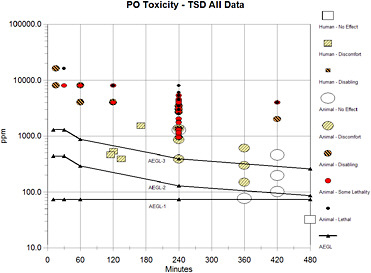
FIGURE 5-1 Category plot of animal toxicity data compared with AEGL values.
8.2.
Comparisons with Other Standards
Standards and guidance levels for workplace and community exposures are listed in Table 5-24. The 30-min AEGL-3 value of 1,300 ppm is greater than the 30-min immediately dangerous to life or health value of 400 ppm. The 8-h AEGL-2 of 86 ppm is below the Occupational Safety and Health Administration time-weighted average of 100 ppm and above the American Conference of Governmental Industrial Hygienists Threshold Limit Value–TWA of 20 ppm. Compared with the emergency response planning guideline (ERPG) values, the 1-h AEGL-1, AEGL-2, and AEGL-3 values are similar to the ERPG-1, ERPG-2, and ERPG-3 values, respectively.
8.3.
Data Adequacy and Research Needs
Limited data consistent with a defined AEGL-2 end point were available. Animal studies reporting clinical signs often did not report the severity of the signs at each respective exposure concentration but rather gave only a general statement. Additional data consistent with a defined AEGL-2 end point in multiple species would be helpful in further defining the AEGL-2 levels. The AEGL-1 derivation would be improved if additional data on the degree of human irritation after exposure to propylene oxide were available. Animal studies reporting the severity of clinical signs at each respective exposure in multiple species would also be beneficial.
TABLE 5-24 Extant Standards and Guidelines for Propylene Oxide
|
Guideline |
Exposure Duration |
||||
|
10 min |
30 min |
1 h |
4 h |
8 h |
|
|
AEGL-1 |
73 ppm |
73 ppm |
73 ppm |
73 ppm |
73 ppm |
|
AEGL-2 |
440 ppm |
440 ppm |
290 ppm |
130 ppm |
86 ppm |
|
AEGL-3 |
1,300 ppm |
1,300 ppm |
870 ppm |
390 ppm |
260 ppm |
|
ERPG-1 (AIHA)a |
|
|
50 ppm |
|
|
|
ERPG-2 (AIHA) |
|
|
250 ppm |
|
|
|
ERPG-3 (AIHA) |
|
|
750 ppm |
|
|
|
IDLH (NIOSH)b |
400 ppm |
|
|
|
|
|
REL-TWA (NIOSH)c |
|
|
|
|
Cancer; lowest feasible concentration |
|
PEL-TWA (OSHA)d |
|
|
|
|
100 ppm [240 mg/m3] |
|
TLV-TWA (ACGIH)e |
|
|
|
|
2 ppm |
|
MAK (Germany)f |
|
|
|
|
Not established: considered carcinogenic to humans |
|
MAC (The Netherlands)g |
|
|
|
|
2.5 ppm [6 mg/m3] |
|
aERPG (emergency response planning guidelines of the American Industrial Hygiene Association) (AIHA 1996): The ERPG-1 is the maximum airborne concentration below which it is believed nearly all individuals could be exposed for up to 1 h without experiencing other than mild, transient adverse health effects or without perceiving a clearly defined objectionable odor. The ERPG-1 for propylene oxide is based on possibility of mild, transient adverse effects without perceiving objectionable odor—repeated 7-h exposures at concentrations as high as 200 ppm were well tolerated by rats, rabbits, guinea pigs, and one monkey (Rowe et al. 1956).The ERPG-2 is the maximum airborne concentration below which it is believed nearly all individuals could be exposed for up to 1 h without experiencing or developing irreversible or other serious health effects or symptoms that could impair an individual’s ability to take protective action. The ERPG-2 for propylene oxide is based on following data: at 250 ppm, the odor should be easily detected, and some irritation - probably minor- might occur; rats repeatedly exposed to 870 ppm did not show increases in adverse health effects or severe irritation (Sellakumar et al. 1987).The ERPG-3 is the maximum airborne concentration below which it is believed nearly all individuals could be exposed for up to 1 h without experiencing or developing life-threatening health effects. The ERPG-3 for propylene oxide is based on the following data: 1/10th the concentration not causing evident systemic toxicity in female guinea pigs exposed for 1 h; 1/3rd the concentration not producing systemic effects in female rats exposed for 2 h; about twice the concentration not causing effects in dogs, other than |
|||||
9.
REFERENCES
ACGIH (American Conference of Governmental Industrial Hygienists). 1996. Documentation of the Threshold Limit Values and Biological Exposure Indices: Propylene Oxide. American Conference of Governmental Industrial Hygienists, Cincinnati, OH.
ACGIH (American Conference of Governmental Industrial Hygienists). 2001. TLV's and BEIs; Threshold Limit Values for Chemical Substances and Physical Agents: Propylene Oxide. American Conference of Governmental Industrial Hygienists, Cincinnati, OH.
Agurell, E., H. Cederberg, L. Ehrenberg, K. Lindahl-Kiessling, U. Rannug, and M. Törnqvist. 1991. Genotoxic effects of ethylene oxide and propylene oxide: A comparative study. Mutat. Res. 250(1-2):229-237.
AIHA (American Industrial Hygiene Association). 1989. Odor Thresholds for Chemicals with Established Occupational Health Standards. American Industrial Hygiene Association, Fairfax, VA.
AIHA (American Industrial Hygiene Association). 1996. The AIHA 1996 Emergency Response Planning Guidelines and Workplace Environmental Exposure Level Guidelines Handbook. AIHA, Fairfax VA.
Amoore, J.E., and E. Hautala. 1983. Odor as an aid to chemical safety: Odor thresholds compared with Threshold Limit Values and volatilities for 214 industrial chemicals in air and water dilution. J. Appl. Toxicol. 3(6):272-290.
Aranyi, C., W.J. O’Shea, J.A. Graham, and F.J. Miller. 1986. The effects of inhalation of organic chemical air contaminants on murine lung host defenses. Fundam. Appl. Toxicol. 6(4):713-720.
ARCO. 1983. Propylene Oxide Technical Bulletin. ARCO Chemical Company, Newton Square, PA. [forwarded by ABERCO Inc].
Beliaev, V.A., A.Y. Politykin, and L.A. Chernysheva. 1971. Acute poisoning with propylene oxide [in Russian]. Gig. Tr. Prof. Zabol. 15(2):48-49.
Bootman, J., D.C. Lodge, and H.E. Whalley. 1979. Mutagenic activity of propylene oxide in bacterial and mammalian systems. Mutat. Res. 67(2):101-112.
Budavari, S., M.J. O'Neil, A. Smith, P.E. Heckelman and J.F. Kinneary, eds. 1996. Propylene oxide. P. 1349 in The Merck Index: An Encyclopedia of Chemicals, Drug, and Biologicals, 12th Ed. Whitehouse Station, NJ: Merck.
CMA (Chemical Manufacturers Association). 1998. Human Experience with Propylene Oxide. Prepared by Chemical Manufacturers Association for National Advisory Committee, (NAC)/AEGLs, October 16, 1998.
de Jong, G., N.J. van Sittert, and A.T. Natarajan. 1988. Cytogenetic monitoring of industrial populations potentially exposed to genotoxic chemicals and of control populations. Mutat. Res. 204(3):451-464.
DFG (Deutsche Forschungsgemeinschaft). 1999. List of MAK and BAT Values, 1999. Maximum Concentrations and Biological Tolerance Values at the Workplace Report No. 35. Weinheim, Federal Republic of Germany: Wiley-VCH.
Djuric, Z., B.H. Hooberman, L. Rosman, and J.E. Sinsheimer. 1986. Reactivity of mutagenic propylene oxides with deoxynucleosides and DNA. Environ. Mutagen. 8(3):369-383.
Dow Chemical Company. 1981. Sub-Chronic (13 Week) Inhalation Toxicity Study of Propylene Oxide in Rats. Dow Chemical, Rotterdam, The Netherlands.
Dunkelberg, H. 1982. Carcinogenicity of ethylene oxide and 1,2-propylene oxide upon intragastric administration to rats. Br. J. Cancer 46(6):924-933.
Egedahl, R.D., G.W. Olsen, E. Coppock, M.L. Young, and I.M. Arnold. 1989. A Historical prospective mortality study of the Sarnia Division of Dow Chemical Canada, Inc., Sarnia, Ontario (1950-1984). Can. J. Public Health 80(6):441-446.
Eldridge, S.R., M.S. Bogdanffy, M.P. Jokinen, and L.S. Andrews. 1995. Effects of propylene oxide on nasal epithelial cell proliferation in F344 rats. Fundam. Appl. Toxicol. 27(1):25-32.
EPA (U.S. Environmental Protection Agency). 1992. Reference Guide to Odor Thresholds for Hazardous Air Pollutants Listed in the Clean Air Act Amendments of 1990. EPA/600/R-92/047. Office of Research and Development, U.S. Environmental Protection Agency, Washington, DC [online]. Available: http://www.epa.gov/ttn/atw/odorguide1992.pdf [accessed May 11, 2010].
EPA (U.S. Environmental Protection Agency). 1994. Propylene Oxide (CASRN 75-56-9). Integrated Risk Information System, U.S. Environmental Protection Agency [online]. Available: http://www.epa.gov/ncea/iris/subst/0403.htm [accessed May 11, 2010]
Faller, T.H., G.A. Csanády, P.E. Kreuzer, C.M. Baur, and J.G. Filser. 2001. Kinetics of propylene oxide metabolism in microsomes and cytosol of different organs from mouse, rat and humans. Toxicol. Appl. Pharmacol. 172(1):62-74.
Farmer, P.B., S.M. Gorf, and E. Bailey. 1982. Determination of hydroxypropylhistidine in haemoglobin as a measure of exposure to propylene oxide using high resolution gas chromatography mass spectrometry. Biomed. Mass. Spectrom. 9(2):69-71.
Farooqi, Z., M. Törnqvist, L. Ehrenberg, and A.T. Natarajan. 1993. Genotoxic effects of ethylene oxide and propylene oxide in mouse bone marrow cells. Mutat. Res. 288(2):223-228.
Gardiner, T.H., J.M. Waechter, and D.E. Stevenson. 1993. Epoxy compounds. Pp 329-433 in Patty’s Industrial Hygiene and Toxicology, 4th Ed., Vol. IIA, Toxicology, G.D. Clayton, and F.E. Clayton, eds. New York: John Wiley and Sons.
Giri, A.K. 1992. Genetic toxicology of propylene oxide and trichloropropylene oxide - a review. Mutat. Res. 277(1):1-9.
Golka, K., H. Peter, B. Denk, and J.G. Filser. 1989. Pharmacokinetics of propylene and its reactive metabolite propylene oxide in Sprague-Dawley rats. Arch. Toxicol. 13(Suppl.):240-242.
Hackett, P.L., M.G. Brown, R.L. Buschbom, M.L. Clark, R.A. Miller, R.L. Music, S.E. Rowe, R.E. Schirmer, and M.R. Sikov. 1982. Teratogenic Study of Ethylene and Propylene Oxide and n-Butyl Acetate. NTIS PB83-258038. Prepared by Battelle Pacific Northwest Labs., Richland, WA, for the National Institute for Occupational Safety and Health, Cincinnati, OH.
Hardin, B.D., R.W. Niemeier, M.R. Sikov, and P.L. Hackett. 1983a. Reproductive-toxicologic assessment of the epoxide ethylene oxide, propylene oxide, butylene oxide, and styrene oxide. Scand. J. Work Environ. Health 9(2 Spec. No):94-102.
Hardin, B.D., R.L. Schuler, P.M. McGinnis, R.W. Niemeier, and R.J. Smith. 1983b. Evaluation of propylene oxide for mutagenic activity in 3 in vivo test systems. Mutat. Res. 117(3-4):337-344.
Harris, S.B., J.L. Schardein, C.E. Ulrich, and S.A. Ridlon. 1989. Inhalation developmental toxicity study of propylene oxide in Fischer 344 rats. Fundam. Appl. Toxicol. 13(2):323-331.
Hayes, W.C., H.D. Kirk, T.S. Gushow, and J.T. Young. 1988. Effect of inhaled propylene oxide on reproductive parameters in Fischer 344 rats. Fundam. Appl. Toxicol. 10(1):82-88.
Hellman, T.M., and F.H. Small. 1974. Characterization of the odor properties of 101 petrochemicals using sensory methods. J. Air Pollut. Control Assoc. 24(10):979-982.
Högstedt, B., E. Bergmark, M. Törnqvist, and S. Osterman-Golkar. 1990. Chromosomal aberrations and micronuclei in lymphocytes in relation to alkylation of hemoglobin in workers exposed to ethylene oxide and propylene oxide. Hereditas 113(2):133-138.
IARC (International Agency for Research on Cancer). 1994. Propylene oxide. Pp. 181-213 in Some Industrial Chemicals, IARC Monographs on the Evaluation of Carcinogenic Risks to Humans Vol. 60. Lyon, France: IARC.
Jacobson, K.H., E.B. Hackley, and L. Feinsilver. 1956. The toxicity of inhaled ethylene oxide and propylene oxide vapors; Acute and chronic toxicity of ethylene oxide and acute toxicity of propylene oxide. A.M.A. Arch. Ind. Health 13(3):237-244.
Kuper, C.F., P.G. Reuzel, V.J. Feron, and H. Verschuuren. 1988. Chronic inhalation toxicity and carcinogenicity study of propylene oxide in Wistar rats. Food. Chem. Toxicol. 26(2):159-167.
Lee, M.S., T.H. Faller, P.E. Kreuzer, W. Kessler, G.A. Csanády, C. Pütz, M.N. Ríos-Blanco, L.H. Pottenger, D. Segerbäck, S. Osterman-Golkar, J.A. Swenberg, and J.G. Filser. 2005. Propylene oxide in blood and soluble nonprotein thiols in nasal mucosa and other tissues of male Fisher 344/N rats exposed to propylene oxide vapors - relevance of glutathione depletion for propylene oxide-induced nasal tumors. Toxicol. Sci. 83(1):177-189.
Lynch, D.W., T.R. Lewis, W.J. Moorman, P.S. Sabharwal, and J.A. Burg. 1983. Toxic and mutagenic effects of ethylene oxide and propylene oxide on spermatogenic functions in cynomolgus monkeys. Toxicologist 3(1):60 [Abstract 237].
Lynch, D.W., T.R. Lewis, W.J. Moorman, J.R. Burg, D.H. Groth, A. Khan, L.J. Ackerman, and B.Y. Cockrell. 1984a. Carcinogenic and toxicologic effects of inhaled ethylene oxide and propylene oxide in F344 rats. Toxicol. Appl. Pharmacol. 76(1):69-84.
Lynch, D.W., T.R. Lewis, W.J. Moorman, J.R. Burg, D.K. Gulati, P. Kaur, and P.S. Sabharwal. 1984b. Sister-chromatid exchanges and chromosome aberrations in lymphocytes from monkey exposed to ethylene oxide and propylene oxide by inhalation. Toxicol. Appl. Pharmacol. 76(1):85-95.
Maples, K.R., and A.R. Dahl. 1993. Levels of epoxides in blood during inhalation of alkenes and alkene oxides. Inhal. Toxicol. 5(1):43-54. Meylan, W., L. Papa, C.T. de Rosa, and J.F. Stara. 1986. Chemical of current interest propylene oxide: Health and environmental effects profile. Toxicol. Ind. Health 2(3):219-260.
Morris, J.B., and L.H. Pottenger. 2006. Nasal NPSH depletion and propylene oxide uptake in the upper respiratory tract of the mouse. Toxicol. Sci. 92:228-234.
Morris, J.B., M.I. Banton, and L.H. Pottenger. 2004. Uptake of inspired propylene oxide in the upper respiratory tract of the F344 rat. Toxicol. Sci. 81(1):216-224.
MSZW (Ministerie van Sociale Zaken en Werkgelegenheid). 2004. Nationale MAC-lijst 2004: 1,2-Epoxypropaan. Den Haag: SDU Uitgevers [online]. Available: http://www.lasrook.net/lasrookNL/maclijst2004.htm [accessed May 7, 2010].
Nachreiner, D.J. 1991. Ethylene Oxide: Acute Vapor Inhalation Toxicity Test in Rats (Four-Hour Test). Project ID 54-76. Bushy Run Research Center, Export, PA.
NIOSH (National Institute for Occupational Safety and Health). 1996. Documentation for Immediately Dangerous to Life or Health Concentrations (IDLH): NIOSH Chemical Listing and Documentation of Revised IDLH Values (as of 3/1/95)-Propylene Oxide. U.S. Department of Health and Human Services, Centers for Disease Control and Prevention, National Institute for Occupational Safety and Health. August 1996 [online]. Available: http://www.cdc.gov/niosh/idlh/75569. html [accessed May 5, 2010].
NIOSH (National Institute for Occupational Safety and Health). 2005. NIOSH Pocket Guide to Chemical Hazards: Propylene Oxide. U.S. Department of Health and Human Services, Centers for Disease Control and Prevention, National Institute for Occupational Safety and Health, Cincinnati, OH. September 2005 [online]. Available: http://www.cdc.gov/niosh/npg/npgd0538.html [accessed May 5, 2010].
Nolan, R.J., F.A. Smith, R.J. Karbowski, and R.R. Miller. 1980. Effects of Single 6-Hour Exposures to Various Concentrations of Propylene Oxide on Liver Non-Protein Sulfhydryls in Male Wistar/Lewis Rats. The Dow Chemical Co., Midland, MI.
NRC (National Research Council). 1993. Guidelines for Developing Community Emergency Exposure Levels for Hazardous Substances. Washington, DC: National Academy Press.
NRC (National Research Council). 2001. Standing Operating Procedures for Developing Acute Exposure Guideline Levels for Hazardous Chemicals. Washington, DC: National Academy Press.
NTP (National Toxicology Program). 1985. Toxicology and Carcinogenesis Studies of Propylene Oxide (CAS No. 75-56-9) in F344/N Rats and B6C3F1 Mice (Inhalation Studies). NTP TR 267. NIH 85-2527. U.S. Department of Health and Human Services, Public Health Service, National Institutes of Health, National Toxicology Program, Research Triangle Park, NC.
NTP (National Toxicology Program). 1987. Toxicology and Carcinogenesis Studies of Ethylene Oxide (CAS No. 75-21-8) in B6C3F1 Mice (Inhalation Studies). NTP TR 326. NIH 88-2582. U.S. Department of Health and Human Services, Public Health
Service, National Institutes of Health, National Toxicology Program, Research Triangle Park, NC.
Ohnishi, A., T. Yamamoto, Y. Murai, Y. Hayashida, H. Hori, and I. Tanaka. 1988. Propylene oxide causes central-peripheral distal axonopathy in rats. Arch. Environ. Health 43(5):353-356.
Okuda, H., T. Takeuchi, H. Senoh, H. Arito, K. Nagano, S. Yamamoto, and T. Matsushima. 2006. Effects of inhalation exposure to propylene oxide on respiratory tract, reproduction and development in rats. J. Occup. Health 48(6):462-473.
Osterman-Golkar, S., E. Bailey, P.B. Farmer, S.M. Gorf, and J.H. Lamb. 1984. Monitoring exposure to propylene oxide through the determination of hemoglobin alkylation. Scand. J. Work Environ. Health 10(2):99-102.
Ott, M.G., M.J. Teta, and H.L. Greenberg. 1989. Lymphatic and hematopoietic tissue cancer in a chemical manufacturing environment. Am. J. Ind. Med. 16(6):631-643.
Pero, R.W., T. Bryngelsson, B. Widegren, B. Högstedt, and H. Welinder. 1982. A reduced capacity for unscheduled DNA synthesis in lymphocytes from individuals exposed to propylene oxide and ethylene oxide. Mutat. Res. 104(1-3):193-200.
Pero, R.W., S. Osterman-Golkar, and B. Högstedt. 1985. Unscheduled DNA synthesis correlated to alkylation of hemoglobin in individuals occupationally exposed to propylene oxide. Cell Biol. Toxicol. 1(4):309-314.
Pugaeva, V.P., S.I. Klochkova, F.D. Mashbits, and R.S. Eizengart. 1970. Experimental data to hygienic standardization of propylene oxide [in Russian]. Gig. Tr. Prof. Zabol. 14(11):55-57.
Renne, R.A., W.E. Giddens, G.A. Boorman, R. Kovatch, J.E. Haseman, and W.J. Clarke. 1986. Nasal cavity neoplasia in F344/N rats and (C57BL/6 × C3H)F1 mice inhaling propylene oxide for up to 2 years. J. Natl. Cancer Inst. 77(2):573-582.
Ríos-Blanco, M.N., K. Plna, T. Faller, W. Kessler, K. Håkansson, P.E. Kreuzer, A. Ranasinghe, J.G. Filser, D. Segerbäck, and J.A. Swenberg. 1997. Propylene oxide: Mutagenesis, carcinogenesis and molecular dose. Mutat. Res. 380(1-2):179-197.
Ríos-Blanco, M.N., T.H. Faller, J. Nakamura, W. Kessler, P.E. Kreuzer, A. Ranasinghe, J.G. Filser, and J.A. Swenberg. 2000. Quantitation of DNA and hemoglobin adducts of apurinic/apyrimidinic sites in tissues of F344 rats exposed to propylene oxide by inhalation. Carcinogenesis 21(11):2011-2018.
Ríos-Blanco, M.N., A. Ranasinghe, M.S. Lee, T. Faller, J.G. Filser, and J.A. Swenberg. 2003a. Molecular dosimetry of N7-(2-hydroxypropyl)guanine in tissues of F344 rats after inhalation exposure to propylene oxide. Carcinogenesis 24:1233-1238.
Ríos-Blanco, M.N., S. Yamaguchi, M. Dhawan-Robl, W. Kessler, R. Schoonhoven, J.G. Filser, and J.A. Swenberg. 2003b. Effects of propylene oxide exposure on rat nasal respiratory cell proliferation. Toxicol. Sci. 75(2):279-288.
Rowe, V.K., R.L. Hollingsworth, F. Oyen, D.D. McCollister, and H.C. Spencer. 1956. Toxicity of propylene oxide determined on experimental animals. A.M.A. Arch. Ind. Health 13(3): 228-236 [Details of methods in Spencer et al. 1951].
Segerbäck, D., R. Nilsson, S. Osterman-Golkar, and B. Molholt. 1992. Human cancer risk assessment of propylene oxide based on determination of tissue dose in experimental animals. Fresen. Environ. Bull. 1:143-150.
Segerbäck, D., S. Osterman-Golkar, B. Molholt, and R. Nilsson. 1994. In vivo tissue dosimetry as a basis for cross-species extrapolation in cancer risk assessment of propylene oxide. Regul. Toxicol. Pharmacol. 20(1 Pt 1):1-14.
Segerbäck, D., K. Plná, T. Faller, P.E. Kreuzer, K. Håkansson, J.G. Filser, and R. Nilsson. 1998. Tissue distribution of DNA adducts in male Fischer rats exposed to 500
ppm of propylene oxide: Quantitative analysis of 7-(2-hydroxypropyl)guanine by 32P-postlabeling. Chem. Biol. Interact. 115(3):229-346.
Sellakumar, A.R., C.A. Snyder, and R.E. Albert. 1987. Inhalation carcinogenesis of various alkylating agents. J. Natl. Cancer Inst. 79(2):285-289.
Setzer, J.V., W.S. Brightwell, J.M. Russo, B.L. Johnson, D.W. Lynch, G. Madden, J.R. Burg, and H. Sprinz. 1997. Neurophysiological and neuropathological evaluation of primates exposed to ethylene oxide and propylene oxide. Toxicol. Ind. Health 12(5):667-682.
Shell Oil Company. 1977. Initial submission: Toxicity Studies on Propylene Oxide: Acute Inhalation Toxicity Study and 10 Day Repeated Exposure Study (Final Report) with Attachment and Cover Letter dated 101491. Doc. No. 88-920000018. Shell Chemical Corporation, Houston, TX.
Smyth, H.F., Jr., and C.P. Carpenter. 1948. Further experience with the range-finding toxicity test in the industrial toxicology laboratory. J. Ind. Hyg. Toxicol. 30(1):63-68.
Smyth, H.F., Jr., C.P. Carpenter, C.S. Weil, U.C. Pozzani, and J.A. Striegel. 1962. Range-finding toxicity data: List VI. Am. Ind. Hyg. Assoc. J. 23:95-107.
Smyth, H.F., Jr., C.P. Carpenter, C.S. Weil, U.C. Pozzani, J.A. Striegel, and J.S. Nycum. 1969. Range-finding toxicity data: List VII. Am. Ind. Hyg. Assoc. J. 30(5):470-476.
Snyder, C.A., and J.J. Solomon. 1993. The extent and persistence of binding to respiratory mucosal DNA by inhaled tritiated propylene oxide. Cancer Lett. 72(3):157-161.
Solomon, J.J., F. Mukai, J. Fedyk, and A. Segal. 1988. Reactions of propylene oxide with 2'-deoxynucleosides and in vitro with calf thymus DNA. Chem. Biol. Interact. 67(3-4):275-294.
Spencer, H.C., V.K. Rowe, E.M. Adams, D.D. McCollister, and D.D. Irish. 1951. Vapor toxicity of ethylene dichloride determined by experiments on laboratory animals. A.M.A. Arch. Ind. Hyg. Occup. Med. 4(5):482-493 [Details of experimental setup in Smyth et al. 1962].
Sprinz, H., H. Matzke, and J. Carter. 1982. Neuropathological Evaluation of Monkeys Exposed to Ethylene and Propylene Oxide. NTIS PB 83-134817. Prepared for National Institute for Occupational Safety and Health, Cincinnati, OH, by Midwest Research Laboratory, Kansas City, MI.
SRI International. 1995. Chemical Economics Handbook: Propylene Oxide. Menlo Park, CA: SRI International.
Svensson, K., K. Olofsson, and S. Osterman-Golkar. 1991. Alkylation of DNA and hemoglobin in the mouse following exposure to propene and propylene oxide. Chem. Biol. Interact. 78(1):55-66.
ten Berge, W.F., A. Zwart, and L.M. Appelman. 1986. Concentration-time mortality response relationship of irritant and systemically acting vapours and gases. J. Hazard. Mater. 13(3): 301-309.
Thiess, A.M., R. Frentzel-Beyme, R. Link, and W.G. Stocker. 1982. Mortality study on employees exposed to alkylene oxides (ethylene oxide/propylene oxide) and their derivatives. Pp. 249-259 in Prevention of Occupational Cancer-International Symposium. Occupational Safety and Health Series No. 46. Geneva: International Labour Office.
Van Doorn, R., M. Ruijten, and T. Van Harreveld. 2002. Guidance for the Application of Odor in Chemical Emergency Response, Version 2.1, August 29, 2002. Presented at the NAC/AEGL Meeting September 2002, Washington, DC.
Walpole, A.L. 1958. Carcinogenic action of alkylating agents. Ann. N.Y. Acad. Sci. 68(3):750-761.Weil, C.S., N. Condra, C. Haun, and J.A. Streigel. 1963. Experimental carcinogenicity and acute toxicity of representative epoxides. Am. Ind. Hyg. Assoc. J. 24:305-325.
Young, J.T., J.L. Mattsson, R.R. Albee, and D.J. Schuetz. 1985. Propylene Oxide: Assessment of Neurotoxic Potential in Male Rats. Report D-1831. The Dow Chemical Company, Midland, MI.
APPENDIX A
DERIVATION OF AEGL VALUES FOR PROPYLENE OXIDE
Derivation of AEGL-1
|
Key study: |
CMA 1998 |
|
Toxicity end point: |
Average of four propylene oxide exposure concentrations (380 ppm for 177 min, 525 ppm for 121 min, 392 ppm for 135 min, and 460 ppm for 116 min) measured in the breathing zone of three workers (average = 440 ppm) |
|
Scaling: |
Values were set equal across time because end point is mild irritation |
|
Uncertainty factors: |
1 for interspecies variability 3 for intraspecies variability |
|
Modifying factor: |
2 |
|
Combined uncertainty factors and modifying factor: |
6 |
|
Calculations: |
C/(uncertainty factor) = 440 ppm/3 = 73 ppm |
|
10-min, 30-min, 1-h, 4-h, 8-h AEGL-1 values set equal across time: |
73 ppm |
Derivation of AEGL-2
|
Key study: |
NTP 1985 |
|
Toxicity end point: |
Dyspnea in mice exposed to 387 ppm for 4 h |
|
Scaling: |
C1.7 × t = k where n of 1.7 was derived from rat lethality data reported by Rowe et al. (1956) using the method of ten Berge et al. (1986) |
|
Uncertainty factors: |
1 for interspecies variability |
|
|
3 for intraspecies variability Combined uncertainty factor of 3 |
|
Modifying factor: |
Not applicable |
|
Calculations: |
[(C/uncertainty factor)]n × t = k [(387 ppm)/3]1.7 × 4 h = 15,490.4 ppm-h |
|
10-min AEGL-2 |
The 10-min value was set equal to the 30-min value of 440 ppm because of the uncertainty in extrapolating from the exposure duration of 4 h to 10 min |
|
30-min AEGL-2 |
Cn × 0.5 h = 15,490.4 ppm-h C1.7 = 30,980.8 ppm C = 438.4 ppm = 440 ppm |
|
1-h AEGL-2 |
Cn × 1 h = 15,490.4 ppm-h C1.7 = 15,490.4 ppm C = 291.6 ppm = 290 ppm |
|
4-h AEGL-2 |
Cn × 4 h = 15,490.4 ppm-h C1.7 = 3,872.6 ppm C = 129.00 ppm = 130 ppm |
|
8-h AEGL-2 |
Cn × 8 hr = 15,490.4 ppm-h C1.7 = 1,936.3 ppm C = 85.8 ppm = 86 ppm |
Derivation of AEGL-3
|
Key study: |
NTP 1985 |
|
Toxicity end point: |
Calculated 4-h BMCL05 of 1,161 ppm using rat lethality data |
|
Scaling: |
C1.7 × t = k where n of 1.7 was derived from rat lethality data reported by Rowe et al. (1956) using the method of ten Berge et al. (1986) |
|
Uncertainty factors: |
1 for interspecies variability 3 for intraspecies variability |
|
Modifying factor: |
None |
|
Calculations: |
(C/[uncertainty factors])n × t = k (1,161 ppm)/31.7 ×4 h = 100,269.4 ppm-h |
|
10-min AEGL-3 |
The 10-min value was set equal to the 30-min value of 1,300 ppm because of the uncertainty in extrapolating from the exposure duration of 4 h to 10 min |
|
30-min AEGL-3 |
Cn × 0.5 h = 100,269.4 ppm-h C1.7 = 200,538.8 ppm C = 1,315.0 ppm = 1,300 ppm |
|
1-h AEGL-3 |
Cn × 1 h = 100,269.4 ppm-h C1.7 = 100,269.4 ppm C = 874.7 ppm = 870 ppm |
|
4-h AEGL-3 |
Cn × 4 h = 100,269.4 ppm-h C1.7 = 25,067.4 ppm C = 387.0 ppm = 390 ppm |
|
8-h AEGL-3 |
Cn × 8 h = 100,269.4 ppm-h C1.7 = 12,533.7 ppm C = 257.4 ppm = 260 ppm |
APPENDIX B
TIME-SCALING CALCULATIONS
Filename:
PO for Log Probit Model
Date: 05 November 2007 Time: 09:30:11
|
Sequence |
Conentration |
|
|
|
|
Number |
ppm |
Minutes |
Exposed |
Responded |
|
1 |
2,000 |
420 |
10 |
0 |
|
2 |
4,000 |
420 |
10 |
10 |
|
3 |
4,000 |
240 |
10 |
4 |
|
4 |
4,000 |
120 |
10 |
4 |
|
5 |
4,000 |
60 |
5 |
0 |
|
6 |
8,000 |
120 |
10 |
10 |
|
7 |
8,000 |
60 |
10 |
5 |
|
8 |
8,000 |
30 |
10 |
2 |
|
9 |
8,000 |
15 |
10 |
0 |
|
10 |
16,000 |
30 |
10 |
10 |
|
11 |
16,000 |
15 |
15 |
0 |
Observations 1 through 11 considered
|
Sequence |
Concentration |
|
|
|
|
Number |
(ppm) |
Minutes |
Exposed |
Responded |
|
1 |
2,000 |
420 |
10 |
0 |
|
2 |
4,000 |
420 |
10 |
10 |
|
3 |
4,000 |
240 |
10 |
4 |
|
4 |
4,000 |
120 |
10 |
4 |
|
5 |
4,000 |
60 |
5 |
0 |
|
6 |
8,000 |
120 |
10 |
10 |
|
7 |
8,000 |
60 |
10 |
5 |
|
8 |
8,000 |
30 |
10 |
2 |
|
9 |
8,000 |
15 |
10 |
0 |
|
10 |
16,000 |
30 |
10 |
10 |
|
11 |
16,000 |
15 |
15 |
0 |
Used probit equation: Y = B0 + B1 × X1 + B2 × X2
X1 = concentration ppm, ln-transformed
X2 = minutes, ln-transformed
Chi square = 26.64
Degrees of freedom = 8
Probability model = 8.17E-04
Ln(likelihood) = –20.39
|
B 0 = –3.9364E+01 |
Student t test = –2.9553 |
|
B 1 = 3.8770E+00 |
Student t test = 3.2821 |
|
B 2 = 2.3053E+00 |
Student t test = 3.3066 |
|
Variance B 0 0 = |
1.7742E+02 |
|
Covariance B 0 1 = |
-1.5682E+01 |
|
Covariance B 0 2 = |
-8.9312E+00 |
|
Variance B 1 1 = |
1.3954E+00 |
|
Covariance B 1 2 = |
7.7204E-01 |
|
Variance B 2 2 = |
4.8607E-01 |
Estimation ratio between regression coefficients of ln(concentration) and ln (minutes)
Point estimate = 1.682
Lower limit (95% confidence limit) = 1.265
Upper limit (95% confidence limit) = 2.099
APPENDIX C
BENCHMARK CALCULATIONS
Benchmark Calculations
The benchmark calculations are based on the study by NTP (1985) using a range of four concentrations in rats. For derivation of 10- and 30-min and 1-, 4-, and 8-h AEGL-3 values, a BMCL05 of 1,161 ppm, derived with the log-probit model, was used.
BMCL05 = 1,161 ppm
BMC01 = 1,845 ppm
Probit Model. (Version: 2.8; Date: 02/20/2007)
Input Data File: C:\BMDS\PO\RATNTP.(d)
Gnuplot Plotting File: C:\BMDS\PO\RATNTP.plt
Fri Nov 02 17:38:56 2007
BMDS model run:
The form of the probability function is
P[response] = background + (1 – background) × CumNorm(intercept + slope × log(dose)), where CumNorm(.) is the cumulative normal distribution function.
Dependent variable = mortality
Independent variable = concentration
Slope parameter is not restricted
Total number of observations = 5
Total number of records with missing values = 0
Maximum number of iterations = 250
Relative function convergence has been set to 1e-008
Parameter convergence has been set to 1e-008
User has chosen the log-transformed model.
Default initial (and specified) parameter values
Background = 0
Intercept = −15.8272
Slope = 1.96437.
Asymptotic correlation matrix of parameter estimates:
|
|
Intercept |
Slope |
|
Intercept |
1 |
−1 |
|
Slope |
−1 |
1 |
|
(The model parameters backgrounds have been estimated at a boundary point or have been specified by the user and do not appear in the correlation matrix.) |
||
Parameter estimates:
|
95.0% Wald Confidence Interval |
||||
|
Variable |
Estimate |
Standard Error |
Lower Confidence Limit |
Upper Confidence Limit |
|
Background |
0 |
NAa |
|
|
|
Intercept |
−31.3034 |
15.5575 |
−61.7955 |
−0.811365 |
|
Slope |
3.85333 |
1.90441 |
0.12075 |
7.58591 |
|
aNA indicates that this parameter has hit a bound implied by some inequality constraint and thus has no standard error. |
||||
Analysis of deviance table:
|
Model |
Log(likelihood) |
No. of Parameters |
Deviance |
Test d.f.a |
p Value |
|
Full model |
–17.8428 |
5 |
|
|
|
|
Fitted model |
–18.5238 |
2 |
1.36197 3 |
3 |
0.7145 |
|
Reduced model |
–32.0518 |
1 |
28.418 |
4 |
<0.000 |
|
ad.f., degrees of freedom. |
|||||
Akaike information criterion: 41.0475
|
Goodness of Fit |
|||||
|
Dose |
Estimated Probability |
Expected |
Observed |
Scaled Size |
Residual |
|
0.0000 |
0.0000 |
0.0000 |
0 |
10 |
0.0000 |
|
1,277.0000 |
0.0001 |
0.0001 |
0 |
10 |
–0.030 |
|
2,970.0000 |
0.3117 |
3.117 |
3 |
10 |
–0.080 |
|
3,794.0000 |
0.6746 |
6.746 |
8 |
10 |
0.847 |
|
3,900.0000 |
0.7118 |
7.118 |
6 |
10 |
–0.781 |
|
Chi square = 1.33, degrees of freedom = 3, p = 0.7211. |
|||||
Benchmark dose computation:
Specified effect = 0.05
Risk type = extra risk
Confidence level = 0.95
BMD = 2201.43
BMDL = 1,160.91
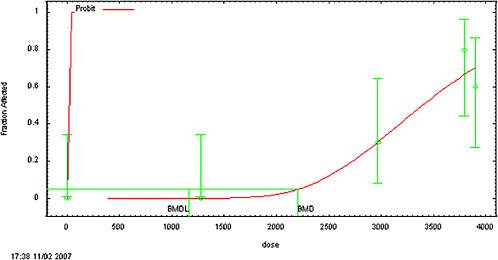
APPENDIX D
CARCINOGENICITY ASSESSMENT
Discussion of Cancer Assessment of Propylene Oxide
Propylene oxide appears to cause cancer in animals at the site of contact. Intragastric administration of propylene oxide to Sprague-Dawley rats resulted in tumors of the forestomach, subcutaneous injections in rats generated sarcomas at the injection site, and inhalation exposure caused nasal cavity tumors in mice and rats (Walpole 1958; Dunkelberg 1982; NTP 1985). The nasal cavity tumors (nasal submucosa hemangiomas and hemangiosarcomas) in male and female C57CL/6 × C3H mice resulted from whole-body inhalation exposure to propylene oxide at 400 ppm for 6 h/day, 5 days/week, for 103 weeks (NTP 1985; also reported by Renne et al. 1986). No evidence of carcinogenicity was found at 200 ppm. Nonneoplastic effects of propylene oxide on the nasal turbinates of mice included acute and chronic inflammation, suppurative inflammation, and serous inflammation. F344/N rats exposed to propylene oxide at 400 ppm had an increased incidence of nasal epithelial papillary adenomas, although statistical significance was not achieved (NTP 1985). The tumor incidence indicates some evidence of carcinogenicity at 400 ppm but no evidence of carcinogenicity was found at 200 ppm. Nonneoplastic effects of propylene oxide on the nasal turbinates of rats included suppurative inflammation, epithelial hyperplasia, and squamous metaplasia.
Studies investigating the mode of action of propylene-oxide-induced nasal cavity tumors support the hypothesis that propylene oxide is a threshold carcinogen dependent on increased cell proliferation and hyperplasia at the target site. Propylene oxide covalently binds to DNA by introducing a 2-hydroxypropyl group, and the primary DNA adduct formed in rats after inhalation exposure to propylene oxide is the N7-(2-hydroxypropyl)guanine (7-HPG), particularly in nasal tissue (Ríos-Blanco et al. 1997, 2000, 2003a). The accumulation of 7-HPG in nasal respiratory tissue increased linearly with propylene oxide exposure concentrations ranging from 5 up to 500 ppm (Ríos-Blanco et al. 2003a). The investigators concluded that adduct accumulation in the nasal respiratory tissue was not sufficient to induce tumor formation as it had a linear concentration response, while nasal tumor formation had a nonlinear concentration response. In contrast, cell proliferation in the nasal respiratory epithelium was nonlinear and correlated better with tumor formation (Eldridge et al. 1995; Ríos-Blanco et al. 2003b). Hyperplastic lesions were present in the same region where nasal tumors developed in the NTP (1985) cancer bioassay in rats. The cell proliferation may be a result of the depletion of NPSH (includes GSH) in the respiratory nasal mucosa of rats and mice, the levels of which were depleted significantly after exposure to propylene oxide at 300 and 500 ppm (Morris et al. 2004; Lee et al. 2005; Morris and Pottenger 2006). Lee et al. (2005) proposed that de-
pletion of GSH as a cosubstrate for the conjugation reaction with propylene oxide (a detoxification pathway) results in continuous and severe perturbation of GSH in the respiratory nasal mucosa of rodents repeatedly exposed to high concentrations of propylene oxide, which leads to inflammatory lesions and cell proliferation.
On the basis of these data, propylene oxide is a threshold carcinogen, and repeated exposure would be required to produce tumorigenesis. Therefore, it is inappropriate to conduct a carcinogen assessment for a single exposure to propylene oxide, because a one-time exposure even to a high concentration of propylene oxide is not be expected to result in tumor development. This conclusion is supported by the Sellakumar et al. (1987) study in which no tumors were observed when 12-week-old male Sprague-Dawley rats were exposed to propylene oxide 433 or 864 ppm for 30 days or at 1,724 ppm for 8 days (exposures were for 6 h/day, 5 days/week) and allowed to die naturally.
APPENDIX E
CALCULATION OF LEVEL OF DISTINCT ODOR AWARENESS FOR PROPYLENE OXIDE
Derivation of the Level of Distinct Odor Awareness (LOA)
The level of distinct odor awareness (LOA) represents the concentration above which it is predicted that more than half the exposed population will experience at least a distinct odor intensity, and about 10% of the population will experience a strong odor intensity. The LOA should help chemical emergency responders in assessing the public awareness of the exposure due to odor perception. The LOA derivation follows the guidance given by van Doorn et al. (2002). For derivation of the odor detection threshold (OT50), a study is available in which the odor threshold for the reference chemical n-butanol (odor detection threshold 0.04 ppm) has also been determined:Hellman and Small (1974):Odor detection threshold for propylene oxide: 9.9 ppmOdor detection threshold for n-butanol: 0.3 ppmCorrected odor detection threshold (OT50) for propylene oxide: 9.9 ppm × 0.04 ppm/0.3 ppm = 1.32 ppmThe concentration (C) leading to an odor intensity (I) of distinct odor detection (I = 3) is derived by using the Fechner function:I = kw × log(C/OT50) + 0.5For the Fechner coefficient, the default of kw = 2.33 is used because of the lack of chemical-specific data:3 = 2.33 × log(C /1.32) + 0.5which can be rearranged tolog(C/1.32) = (3 – 0.5)/2.33 = 1.07 and results inC = (101.07) ×1.32 = 11.8 × 1.32 = 15.576 ppmThe resulting concentration is multiplied by an empirical field correction factor. It takes into account that everyday life factors—such as sex, age, sleep, smoking, upper air-way infections, and allergy as well as distraction—increase the odor detection threshold by a factor of 4. In addition, it takes into account that odor perception is very fast (about 5 s), which leads to the perception of concentration peaks. On the basis of current knowledge, a factor of 1/3 is applied to adjust for peak exposure. Adjustment for distraction and peak exposure lead to a correction factor of 4/3 = 1.33.LOA = C ×1.33 = 15.576 ppm × 1.33 = 20.7 ppm = 21 ppm. The LOA for propylene oxide is 21 ppm.
APPENDIX F
ACUTE EXPOSURE GUIDELINE LEVELS FORPROPYLENE OXIDE
Derivation Summary for Propylene Oxide
AEGL-1 VALUES
|
10 min |
30 min |
1 h |
4 h |
8 h |
|
73 ppm |
73 ppm |
73 ppm |
73 ppm |
73 ppm |
|
Reference: Chemical Manufacturers Association (CMA 1998). Human Experience with Propylene Oxide. Prepared by Chemical Manufacturers Association for National Advisory Committee, (NAC)/AEGLs, October 16, 1998. |
||||
|
Test Species/Strain/Number: 3 male workers |
||||
|
Exposure Route/Concentrations/Durations: Inhalation: four propylene oxide exposure concentrations measured in the breathing zone of three workers: 380 ppm for 177 min, 525 ppm for 121 min, 392 ppm for 135 min, and 460 ppm for 116 min |
||||
|
Effects: A notation was made by the hygienist that a strong odor was present during sampling; however, the irritation was not intolerable. The nature of the irritation, other than the strong odor, was not provided, but occasional eye irritation was noted in the report as the reason for the monitoring program. |
||||
|
End Point/Concentration/Rationale: The AEGL-1 values are based on the average of four propylene oxide exposure concentrations measured in the breathing zone of the three workers, 440 ppm. |
||||
|
Uncertainty Factors/Rationale: Total uncertainty factor: 3 |
||||
|
Interspecies: Not applicable Intraspecies: 3, the mechanism of toxicity, irritation, is not expected to differ greatly among individuals |
||||
|
Modifying Factor: 2, because the defined effects are above an AEGL-1 tier (undefined irritation), but below an AEGL-2 end point |
||||
|
Animal to Human Dosimetric Adjustment: Not applicable |
||||
|
Time-Scaling: Mild irritant effects are set equal across time |
||||
|
Data Adequacy: The AEGL-1 derivation would be improved if additional data on the degree of human irritation after exposure to propylene oxide were available. Animal studies reporting the severity of clinical signs at each respective exposure in multiple species would also be beneficial. |
||||
AEGL-2 VALUES
|
10 min |
30 min |
1 h |
4 h |
8 h |
|
440 ppm |
440 ppm |
290 ppm |
130 ppm |
86 ppm |
|
Reference: National Toxicology Program (NTP 1985). Toxicology and Carcinogenesis Studies of Propylene Oxide (CAS No. 75-56-9) in F344/N Rats and B6C3F1 Mice (Inhalation Studies). NTP TR 267, NIH 85-2527, U.S. Department of Health and Human Services, Public Health Service, National Institute of Health, National Toxicology Program, Research Triangle Park, NC. |
||||
|
Test Species/Strain/Sex/Number: five B6C3F1 mice/sex/group |
||||
|
Exposure Route/Concentrations/Durations: Inhaled 0, 387, 859, 1,102, 1,277, or 2,970 ppm for 4 h |
||||
|
Effects: |
||||
|
Conc. |
Mortality |
|||
|
(ppm) |
Males |
Females |
Other Effects |
|
|
387 |
0/5 |
1/5 |
Dyspnea |
|
|
859 |
0/5 |
0/5 |
Dyspnea1 |
|
|
102 |
2/5 |
4/5 |
Dyspnea1 |
|
|
277 |
2/5 |
5/5 |
Dyspnea, sedation |
|
|
2,970 |
5/5 |
5/5 |
Dyspnea, sedation, lacrimation |
|
|
End Point/Concentration/Rationale: 387 ppm for 4 h based on dyspnea; dyspnea in mice is the most sensitive end point, and mice are the most susceptible species. Although a no-effect level was not established at this concentration, no other adverse effects were noted. This NTP (1985) study reported toxic effects at much lower concentrations than those observed in other studies. The death of a mouse at 387 ppm did not appear to be exposure related. |
||||
|
Uncertainty Factors/Rationale: Total uncertainty factor: 3 |
||||
|
Interspecies: 1, mice are the most sensitive species tested in terms of lethality and clinical signs of toxicity, and available data indicate that mice are equally or slightly more sensitive than humans in manifesting clinical signs. The clinical sign of dyspnea was by far the most sensitive end point. This NTP (1985) study reported toxic effects at much lower concentrations than those observed in other studies. Intraspecies: 3, The mechanism of toxicity, irritation, is a point-of-contact effect and is not expected to differ greatly among individuals. |
||||
|
Modifying Factor: Not applicable |
||||
|
Animal to Human Dosimetric Adjustment: Not applicable |
||||
|
Time-Scaling: Although the mechanism of action appears to be a direct irritant effect, it is not appropriate to set the values equal across time because the irritation is part of the continuum of respiratory tract irritation leading to death. The experimentally derived exposure value was therefore scaled to AEGL timeframes by using the concentration-time relationship given by the equation Cn × t = k, where C is concentration, t is time, k is a constant, and n is 1.7 as calculated by using the rat lethality data reported by Rowe et al. (1956) (ten Berge et al. 1986). The 10-min value was set equal to the 30-min value because of the uncertainty in extrapolating from the exposure duration of 4 h to 10 min. |
||||
|
10 min |
30 min |
1 h |
4 h |
8 h |
|
440 ppm |
440 ppm |
290 ppm |
130 ppm |
86 ppm |
|
Data Adequacy: Limited data consistent with a defined AEGL-2 end point were available. Animal studies reporting clinical signs often did not report the severity of the signs at each exposure concentration but rather gave only a general statement. Additional data consistent with a defined AEGL-2 end point in multiple species would be helpful in further defining the AEGL-2 levels. |
||||
AEGL-3 VALUES
|
10 min |
30 min |
1 h |
4 h |
8 h |
|
1,300 ppm |
1,300 ppm |
870 ppm |
390 ppm |
260 ppm |
|
Reference: NTP 1985. Toxicology and Carcinogenesis Studies of Propylene Oxide (CAS No. 75-56-9) in F344/N Rats and B6C3F1 Mice (Inhalation Studies). NTP TR 267, NIH 85-2527, U.S. Department of Health and Human Services, Public Health Service, National Institute of Health, National Toxicology Program, Research Triangle Park, NC. |
||||
|
Test Species/Strain/Sex/Number: five F344/N rats/sex/group |
||||
|
Exposure Route/Concentrations/Durations: inhaled 0, 1,277, 2,970, 3,794, or 3,900 ppm for 4 h |
||||
|
Effects: |
||||
|
Conc. |
Mortality |
|||
|
(ppm) |
Males |
Females |
Other Effects |
|
|
1,277 |
0/5 |
0/5 |
None observed |
|
|
2,970 |
1/5 |
2/5 |
Dyspnea, red nasal discharge |
|
|
3,794 |
4/5 |
4/5 |
Dyspnea, red nasal discharge |
|
|
3,900 |
3/5 |
3/5 |
Dyspnea, red nasal discharge |
|
|
Calculated BMCL05: 1,161 pm |
||||
|
End Point/Concentration/Rationale: The 4-h BMCL05 of 1,161 ppm was used as the point of departure. |
||||
|
Uncertainty Factors/Rationale: Total uncertainty factor: 3 |
||||
|
Interspecies: 1, based on supporting data in dogs (similar 4-h BMCL05 of 1,116 ppm) and a 2-year study in primates that demonstrated no mortality at 300 ppm for 6 h/day, 5 days/week Intraspecies: 3, the mechanism of toxicity, irritation, is a point of contact effect and is not expected to differ greatly among individuals. |
||||
|
Modifying Factor: NA |
||||
|
Animal to Human Dosimetric Adjustment: Not applicable |
||||
|
Time-Scaling: As for the AEGL-2 derivation, the experimentally derived exposure value for the AEGL-3 derivation was scaled to AEGL timeframes by using the concentration-time relationship given by the equation Cn × t = k, where C is concentration, t is time, k is a constant, and n is 1.7 as calculated by using the rat lethality data reported by Rowe et al. (1956) (ten Berge et al. 1986). The value was extrapolated across time because the |
||||
|
10 min |
30 min |
1 h |
4 h |
8 h |
|
1,300 ppm |
1,300 ppm |
870 ppm |
390 ppm |
260 ppm |
|
irritation is no longer considered mild; the concentration represents the threshold for lethality. The 10-min value was set equal to the 30-min value because of the uncertainty in extrapolating from the exposure duration of 4 h to 10 min. |
||||
|
Data Adequacy: Data were adequate for derivation of an AEGL-3. The resulting values were supported by dog data (similar no-effect level of mortality in a nonobligate nose breather; Jacobson et al. 1956); monkey data, 300 ppm 6 h/day for 2 years not lethal (Sprinz et al. 1982; Lynch et al. 1983; Setzer et al. 1997); 457 ppm for 7 h/day for 154 days not lethal (Rowe et al. 1956); and human data (exposure to 1,520 ppm for 171 min not lethal) (CMA 1998). |
||||


