
C
Reprint of Gordon E. Moore’s “Cramming More Components onto Integrated Circuits”
NOTE: Reprinted from Gordon Moore, 1965, Cramming more components onto integrated circuits, Electronics 38(8) with permission from Intel Corporation.
Cramming More Components onto Integrated Circuits
GORDON E. MOORE, LIFE FELLOW, IEEE
With unit cost falling as the number of components per circuit rises, by 1975 economics may dictate squeezing as many as 65 000 components on a single silicon chip.
The future of integrated electronics is the future of electronics itself. The advantages of integration will bring about a proliferation of electronics, pushing this science into many new areas.
Integrated circuits will lead to such wonders as home computers—or at least terminals connected to a central computer—automatic controls for automobiles, and personal portable communications equipment. The electronic wristwatch needs only a display to be feasible today.
But the biggest potential lies in the production of large systems. In telephone communications, integrated circuits in digital filters will separate channels on multiplex equipment. Integrated circuits will also switch telephone circuits and perform data processing.
Computers will be more powerful, and will be organized in completely different ways. For example, memories built of integrated electronics may be distributed throughout the machine instead of being concentrated in a central unit. In addition, the improved reliability made possible by integrated circuits will allow the construction of larger processing units. Machines similar to those in existence today will be built at lower costs and with faster turnaround.
I. PRESENT AND FUTURE
By integrated electronics, I mean all the various technologies which are referred to as microelectronics today as well as any additional ones that result in electronics functions supplied to the user as irreducible units. These technologies were first investigated in the late 1950’s. The object was to miniaturize electronics equipment to include increasingly complex electronic functions in limited space with minimum weight. Several approaches evolved, including microassembly techniques for individual components, thin-film structures, and semiconductor integrated circuits.
Reprinted from Gordon E. Moore, “Cramming More Components onto Integrated Circuits,” Electronics, pp. 114-117, April 19, 1965.
Publisher Item Identifier S 0018-9219(98)00753-1.
Each approach evolved rapidly and converged so that each borrowed techniques from another. Many researchers believe the way of the future to be a combination of the various approaches.
The advocates of semiconductor integrated circuitry are already using the improved characteristics of thin-film resistors by applying such films directly to an active semiconductor substrate. Those advocating a technology based upon films are developing sophisticated techniques for the attachment of active semiconductor devices to the passive film arrays.
Both approaches have worked well and are being used in equipment today.
II. THE ESTABLISHMENT
Integrated electronics is established today. Its techniques are almost mandatory for new military systems, since the reliability, size, and weight required by some of them is achievable only with integration. Such programs as Apollo, for manned moon flight, have demonstrated the reliability of integrated electronics by showing that complete circuit functions are as free from failure as the best individual transistors.
Most companies in the commercial computer field have machines in design or in early production employing integrated electronics. These machines cost less and perform better than those which use “conventional” electronics.
Instruments of various sorts, especially the rapidly increasing numbers employing digital techniques, are starting to use integration because it cuts costs of both manufacture and design.
The use of linear integrated circuitry is still restricted primarily to the military. Such integrated functions are expensive and not available in the variety required to satisfy a major fraction of linear electronics. But the first applications are beginning to appear in commercial electronics, particularly in equipment which needs low-frequency amplifiers of small size.
III. RELIABILITY COUNTS
In almost every case, integrated electronics has demonstrated high reliability. Even at the present level of pro-
duction—low compared to that of discrete components—it offers reduced systems cost, and in many systems improved performance has been realized.
Integrated electronics will make electronic techniques more generally available throughout all of society, performing many functions that presently are done inadequately by other techniques or not done at all. The principal advantages will be lower costs and greatly simplified design—payoffs from a ready supply of low-cost functional packages.
For most applications, semiconductor integrated circuits will predominate. Semiconductor devices are the only reasonable candidates presently in existence for the active elements of integrated circuits. Passive semiconductor elements look attractive too, because of their potential for low cost and high reliability, but they can be used only if precision is not a prime requisite.
Silicon is likely to remain the basic material, although others will be of use in specific applications. For example, gallium arsenide will be important in integrated microwave functions. But silicon will predominate at lower frequencies because of the technology which has already evolved around it and its oxide, and because it is an abundant and relatively inexpensive starting material.
IV. COSTS AND CURVES
Reduced cost is one of the big attractions of integrated electronics, and the cost advantage continues to increase as the technology evolves toward the production of larger and larger circuit functions on a single semiconductor substrate. For simple circuits, the cost per component is nearly inversely proportional to the number of components, the result of the equivalent piece of semiconductor in the equivalent package containing more components. But as components are added, decreased yields more than compensate for the increased complexity, tending to raise the cost per component. Thus there is a minimum cost at any given time in the evolution of the technology. At present, it is reached when 50 components are used per circuit. But the minimum is rising rapidly while the entire cost curve is falling (see graph). If we look ahead five years, a plot of costs suggests that the minimum cost per component might be expected in circuits with about 1000 components per circuit (providing such circuit functions can be produced in moderate quantities). In 1970, the manufacturing cost per component can be expected to be only a tenth of the present cost.
The complexity for minimum component costs has increased at a rate of roughly a factor of two per year (see graph). Certainly over the short term this rate can be expected to continue, if not to increase. Over the longer term, the rate of increase is a bit more uncertain, although there is no reason to believe it will not remain nearly constant for at least ten years. That means by 1975, the number of components per integrated circuit for minimum cost will be 65 000.
I believe that such a large circuit can be built on a single wafer.
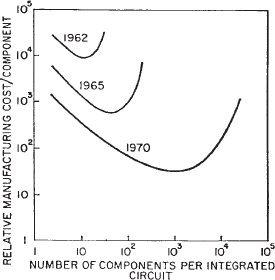
Fig. 1.
V. TWO-MIL SQUARES
With the dimensional tolerances already being employed in integrated circuits, isolated high-performance transistors can be built on centers two-thousandths of an inch apart. Such a two-mil square can also contain several kilohms of resistance or a few diodes. This allows at least 500 components per linear inch or a quarter million per square inch. Thus, 65 000 components need occupy only about one-fourth a square inch.
On the silicon wafer currently used, usually an inch or more in diameter, there is ample room for such a structure if the components can be closely packed with no space wasted for interconnection patterns. This is realistic, since efforts to achieve a level of complexity above the presently available integrated circuits are already under way using multilayer metallization patterns separated by dielectric films. Such a density of components can be achieved by present optical techniques and does not require the more exotic techniques, such as electron beam operations, which are being studied to make even smaller structures.
VI. INCREASING THE YIELD
There is no fundamental obstacle to achieving device yields of 100%. At present, packaging costs so far exceed the cost of the semiconductor structure itself that there is no incentive to improve yields, but they can be raised as high as is economically justified. No barrier exists comparable to the thermodynamic equilibrium considerations that often limit yields in chemical reactions; it is not even necessary to do any fundamental research or to replace present processes. Only the engineering effort is needed.
In the early days of integrated circuitry, when yields were extremely low, there was such incentive. Today ordinary integrated circuits are made with yields comparable with those obtained for individual semiconductor devices. The same pattern will make larger arrays economical, if other considerations make such arrays desirable.
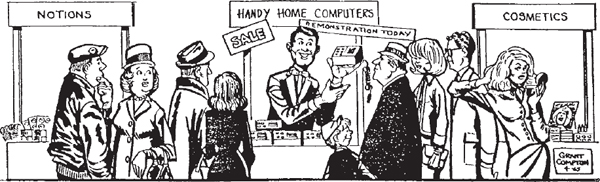
Fig. 2.
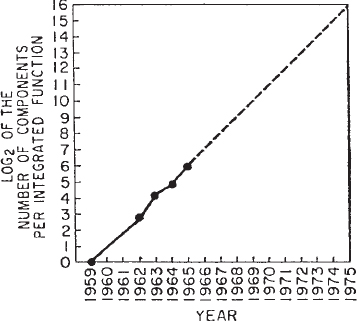
Fig. 3.
VII. HEAT PROBLEM
Will it be possible to remove the heat generated by tens of thousands of components in a single silicon chip?
If we could shrink the volume of a standard high-speed digital computer to that required for the components themselves, we would expect it to glow brightly with present power dissipation. But it won’t happen with integrated circuits. Since integrated electronic structures are two dimensional, they have a surface available for cooling close to each center of heat generation. In addition, power is needed primarily to drive the various lines and capacitances associated with the system. As long as a function is confined to a small area on a wafer, the amount of capacitance which must be driven is distinctly limited. In fact, shrinking dimensions on an integrated structure makes it possible to operate the structure at higher speed for the same power per unit area.
VIII. DAY OF RECKONING
Clearly, we will be able to build such component-crammed equipment. Next, we ask under what circumstances we should do it. The total cost of making a particular system function must be minimized. To do so, we could amortize the engineering over several identical items, or evolve flexible techniques for the engineering of large functions so that no disproportionate expense need be borne by a particular array. Perhaps newly devised design automation procedures could translate from logic diagram to technological realization without any special engineering.
It may prove to be more economical to build large systems out of smaller functions, which are separately packaged and interconnected. The availability of large functions, combined with functional design and construction, should allow the manufacturer of large systems to design and construct a considerable variety of equipment both rapidly and economically.
IX. LINEAR CIRCUITRY
Integration will not change linear systems as radically as digital systems. Still, a considerable degree of integration will be achieved with linear circuits. The lack of large-value capacitors and inductors is the greatest fundamental limitation to integrated electronics in the linear area.
By their very nature, such elements require the storage of energy in a volume. For high Q it is necessary that the volume be large. The incompatibility of large volume and integrated electronics is obvious from the terms themselves. Certain resonance phenomena, such as those in piezoelectric crystals, can be expected to have some applications for tuning functions, but inductors and capacitors will be with us for some time.
The integrated RF amplifier of the future might well consist of integrated stages of gain, giving high performance at minimum cost, interspersed with relatively large tuning elements.
Other linear functions will be changed considerably. The matching and tracking of similar components in integrated structures will allow the design of differential amplifiers of greatly improved performance. The use of thermal feedback effects to stabilize integrated structures to a small fraction of a degree will allow the construction of oscillators with crystal stability.
Even in the microwave area, structures included in the definition of integrated electronics will become increasingly important. The ability to make and assemble components small compared with the wavelengths involved will allow the use of lumped parameter design, at least at the lower frequencies. It is difficult to predict at the present time just how extensive the invasion of the microwave area by integrated electronics will be. The successful realization of such items as phased-array antennas, for example, using a multiplicity of integrated microwave power sources, could completely revolutionize radar.
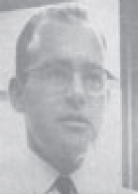
G. E. Moore is one of the new breed of electronic engineers, schooled in the physical sciences rather than in electronics. He earned a B.S. degree in chemistry from the University of California and a Ph.D. degree in physical chemistry from the California Institute of Technology. He was one of the founders of Fairchild Semiconductor and has been Director of the research and development laboratories since 1959.


