
9
The Reach of WIC
At the outset of this session, the workshop moderator, Gail Harrison, mentioned that the planning committee struggled with a title for the session. Its intent was to look at the overall influence of the Special Supplemental Nutrition Program for Women, Infants, and Children (WIC) on families and on society more broadly. Then session moderator Jackson Sekhobo offered brief remarks about why research on the reach of WIC is especially important at the local and state levels. Data are used by states for funding decisions, for which the key questions may be whether a program is effective and whether it contributes to the core mission of the agency. He emphasized the following four points:
-
From a state perspective, the most widely used indicators for WIC are participation rates among eligible persons and redemption rates among participants. Participation rates are useful for various stakeholders, including advocates and legislators.
-
Because states are expected to engage in program outreach and marketing, they must demonstrate success in penetrating hard-to-reach WIC-eligible populations.
-
Participation rates, redemption rates, and administrative expenses are all used in the federal funding formula for the allocation of funds to states, with more dollars directed to states with higher participation rates.
-
In terms of the Office of Management and Budget’s definition of an effective federally funded program, WIC can be considered effective because it reaches large numbers of eligible low-income
-
persons, it has been associated with improved health outcomes, and the increase in the cost of the food package over time has been less than the rate of inflation.
The challenge given to the presenters, Susan Bartlett and Loren Bell, and the discussant, Zoë Neuberger, was to address new ways of documenting the reach of WIC given various changes that have occurred within WIC, the impending health care reform, and the changing demographics of the WIC-eligible population.
PERSPECTIVES
Presenter: Susan Bartlett1
Useful Information for Policymakers
A group at Abt Associates used a series of questions to develop recommendations for a WIC research agenda. Starting with the question “What information would be most useful to policymakers?” the group laid out two broad topics for discussion: (1) “How well is WIC working now?” and (2) “How could WIC work better?” Under the first topic, the questions were centered on whether WIC is necessary, sufficient, benign, and cost-effective. The second topic focused on ways to increase WIC’s effectiveness in achieving objectives and ways to remove or reduce unintended adverse consequences.
Concerning the issue of whether to try to measure the overall impact of WIC, the group identified various reasons not to try, including the difficulty—perhaps impossibility—of measuring the impact accurately and the high level of support for WIC. However, it also identified a number of reasons to try to make such measurements, such as determining whether there are deleterious effects, identifying variations among subgroups that could lead to program improvements, and providing evidence to support increased program funding.
Potential Research Topics
The group’s discussions led to the identification of four research domains: (1) WIC participation, (2) a logic model for effects, (3) potential improvements to the program, and (4) experimental studies to investigate impacts. Each of these is discussed briefly below.
WIC Participation
A series of focus groups could help provide a better understanding of the characteristics of WIC participants and eligible non-participants. For example, compared with non-participants, are WIC participants more or less needy, motivated, or faced with problems related to time management or substance abuse? Three sets of focus groups were suggested, which would consist of (1) eligible non-participants, (2) late enrollees (pregnant women in their third trimester, postpartum women, and mothers of older infants and children), and (3) women who have left WIC. Such focus groups could offer insights on such topics as women’s reasons for not participating, their understandings of nutrition, the difficulties they encountered while on WIC, and their view of the foods provided. This information, in turn, could be used to generate hypotheses for further study.
Another approach to understanding participation would be to compare either the dietary intake of those who leave the program with that of those who stay or else the dietary intake of early entrants versus late entrants. This type of study would require prospective data on diet, some of which might be collected as part of the initial certification interview.
Logic Model
The concept of a logic model had been presented earlier in the workshop by Findley (see Chapter 8). A logic model for WIC would map out the pathways linking interventions with specific outcomes. Studies would be designed to test specific linkages in the model. Among the linkages that would be useful to investigate are interventions associated with the length of gestation; voucher redemptions; the consumption of WIC foods by participants and other household members; and changes that occur between the times of certification and recertification in such measures as weight status, iron status, and dietary patterns. The results would provide suggestive rather than definitive evidence about effects.
Potential Program Improvements
This research domain would address potential changes to WIC that could improve participants’ behaviors in the areas of diet, breastfeeding, smoking cessation, and various aspects of preventive care. One suggestion was to consider interventions that have been effective in these domains outside of WIC, such as home visits.
Bartlett identified several approaches for addressing possible ways to improve participants’ behaviors. Focus groups involving WIC participants could identify what it might take for them to change, and focus groups
with local WIC staff could identify the barriers to change that the staff have observed when working with participants. Bartlett suggested a number of “outside-the box” possibilities. These ideas included providing large (e.g., $100) vouchers for fruits and vegetables, offering new mothers a choice between formula and diapers, charging a co-payment for formula, providing vouchers to be used in fast-food restaurants for WIC-approved foods, and obtaining celebrity endorsements.
Experimental Studies
Abt Associates is conducting a randomized controlled trial that is examining the effects of enhanced breastfeeding support, especially more intensive contacts soon after birth. Pilot studies could be conducted to test some of the “outside the box” ideas mentioned above. To test the importance of the WIC food packages, for example, pilot studies could compare the results of providing WIC vouchers (or WIC electronic benefit transfer [EBT] cards), cash, and Supplemental Nutrition Assistance Program (SNAP) benefits.
THE NEW FOOD PACKAGE
Presenter: Loren Bell
In his presentation, Bell briefly described research being conducted by the Altarum Institute, focusing on two studies designed to examine the effects of the new food package on food purchasing behavior and on small stores. He then identified future research needs related to those topics and to broader issues.
Overview of Current Research
The new WIC food package will be a major focus of the Altarum Institute’s food assistance and nutrition activities over the next several years. It is viewed as the most dramatic change to WIC since WIC’s inception. The new package aligns nutrition messages with opportunities to purchase healthful foods, it provides opportunities for participants to change their behaviors, and it offers retail food stores the opportunity to make changes that could affect the communities’ access to more healthful foods. Box 9-1 highlights some of the topics and questions that are being addressed by Altarum Institute programs. Brief descriptions of two of those programs, the food purchasing pattern study and the small store participation study, follow.
|
BOX 9-1 Current Focus of Altarum Institute’s WIC Food Package Studies
|
Food Purchasing Pattern Study
The analysis of the food purchasing patterns of WIC clients uses point-of-sale purchasing data matched with WIC demographic data. The study is being conducted in a single state (Wisconsin) and includes mostly chain or major independent stores. Universal Product Code (UPC) data are being linked with WIC issuance records in order to obtain demographic profiles of the purchasing patterns. The patterns are being analyzed at four points in time—prior to implementation and at 6, 12, and 18 months after implementation—and focus groups are being used to examine behaviors.
Small Store Study
The second study is assessing the effect of the new WIC food package on small store participation in WIC. It is examining many factors, including the pre- and post-implementation participation of small rural and urban stores in four states (Pennsylvania, New Hampshire, Wisconsin, and Colorado); the factors contributing to ongoing participation or dropping out; policy decisions, implementation strategies, and wholesale networks; and the availability of new foods. Investigators are making inventories of food availability and freshness, and they are conducting interviews with store owners or managers and with state staff.
Future Research Needs
Based in part on preliminary findings from the two categories of ongoing studies described above, Bell identified the following research needs.
Client Purchasing and Behaviors
-
Changes in redemption patterns over the next 2 years;
-
Differences in redemption patterns between clients who have been on WIC before and clients new to WIC;
-
Seasonal variances in the purchase of fruits and vegetables;
-
The effect of store inventory on redemption patterns;
-
Factors related to food availability for minority populations;
-
Family influences and other factors that affect clients’ food purchase decisions;
-
Relationships of the WIC food package with grocer compliance, overcharges, and substitutions;
-
The economic effect of new WIC sales on the built environment; and
-
The effect of the volume of sales on the built environment.
Small Stores
-
Effects of the new WIC food package on the availability of healthful foods for inner city and rural families not on WIC;
-
Extent to which retail stores will value WIC and continue program participation;
-
Types of small stores that are successful in maintaining or growing WIC business; and
-
Long-term effects of the new WIC food package on store inventory decisions.
Closing Remarks
In closing, Bell offered several thoughts on WIC’s reach. WIC has the potential to have a significant economic and social impact on public health efforts to fight childhood obesity. Ongoing studies are needed to measure influencing factors and changes. EBT will provide significant opportunities for studies and the collection of new food purchasing data. Finally, WIC must be careful to examine the effect of changes, such as the new food package, on minority populations that are dependent on small stores, particularly with respect to access to healthful foods.
RESPONSE
Discussant: Zoë Neuberger
To set the stage for her remarks, Neuberger explained that the Center on Budget and Policy Priorities is a nonprofit public policy institute that
examines various policies with a particular focus on how they may affect low- and moderate-income households. She then spoke about funding for WIC, foods with extra ingredients, the responsiveness of WIC to the economic situation, and a planning process to synthesize and disseminate findings from WIC research.
Funding for WIC
WIC is a discretionary program, not an entitlement program. This means that people eligible for benefits will receive them only if sufficient funds are available. Since 1997, there has been a commitment to provide enough federal funds for WIC so that all eligible applicants can be served. A key reason for conducting research related to WIC is to assess WIC’s effectiveness, because evidence of its effectiveness could help maintain this commitment. The likely future budget environment makes a strong research base especially important.
Neuberger emphasized that budget projections for the U.S. national debt under current policies indicate clearly that the nation is on an unsustainable path (see Figure 9-1) and that changes must be made to address the debt. Likely changes include decreases in overall federal spending, especially in discretionary spending.
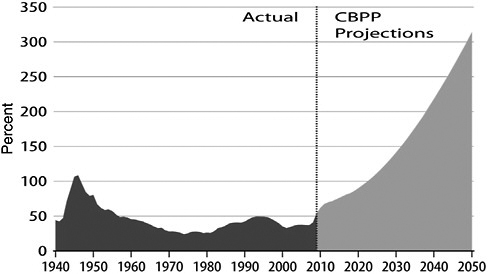
FIGURE 9-1 U.S. national debt as a share of the gross domestic product, 1940–2050.
NOTE: CBPP = Center on Budget and Policy Priorities.
SOURCE: CBPP (2010).
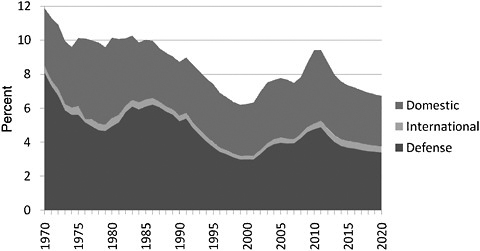
FIGURE 9-2 U.S. discretionary spending as a percentage of the gross domestic product, 1970–2020.
SOURCE: Center on Budget and Policy Priorities (CBPP), based on the Congressional Budget Office’s re-estimate of the President’s 2011 budget. CBPP adjusted domestic discretionary spending to include Pell grants, which the President proposed to reclassify as mandatory spending
WIC is part of the discretionary spending portion of the budget. In Figure 9-2, WIC is included in the medium-gray section at the top, which represents the domestic discretionary spending portion of the budget. It is worth noting that, based on the administration’s budget and forecasts, very substantial decreases in domestic discretionary spending have been projected (a 14 percent decrease between 2005 and 2020). It is anticipated that this will result in increased scrutiny on how WIC spends its funds and an increased need to demonstrate that WIC funds are spent effectively and lead to clearly defined benefits.
Functional Ingredients
Increasingly in the food marketplace, food producers add “functional ingredients”2 to their foods, and the producers generally charge higher prices for foods with these added ingredients. This practice poses a dilemma for WIC, which needs to decide whether to provide such foods. Currently, the Food and Drug Administration looks at the safety of the added ingredients but does not assess their benefits.
The Center on Budget and Policy Priorities favors the establishment of a process for assessing such added ingredients. Bills pending in Congress would do this using a two-step process: First, a methodology and framework for assessing the ingredients would be developed, and then the methodology would be applied to assess ingredients that USDA determines warrant review. Neuberger stated that this work should be done with dedicated funding rather than using the funds already allocated for WIC research.
Program Responsiveness to the Economic Situation
WIC participation has been growing about twice as fast as usual during this economic downturn. Based on unemployment rates and increases in poverty and food insecurity, however, the Center on Budget and Policy Priorities had actually expected WIC participation to increase at a much faster rate. Furthermore, the 9 percent growth in WIC participation since the start of the recession is far less than the 47 percent growth in participation that SNAP has experienced over the same period. Neuberger acknowledged that many components affect these numbers; but she said that the magnitude of the disparity in the growth of participation in WIC and SNAP calls for study of the reasons for the difference.
Synthesis and Dissemination of Research Findings
Neuberger’s top research priority would be to build mechanisms into the planning process for synthesizing and disseminating WIC research findings. She considers such an effort to be essential to making the results of the research useful to others. In developing the approach, careful attention needs to be given to the many different WIC stakeholders and to how the findings can be presented in forms that will be useful to them.
GROUP DISCUSSION
Moderator: Jackson P. Sekhobo
Many attendees participated in a wide-ranging discussion. Points raised about the research agenda are summarized below.
-
Factors to consider When conducting studies, it would be useful to consider the following, whenever applicable:
-
Regional and cultural differences.
-
Choices that states have made regarding allowed foods, split
-
-
-
tender for fruits and vegetables (i.e., with a split tender, WIC participants may combine cash or other legal tender with their fruit and vegetable vouchers when purchasing allowed fruits and vegetables). The U.S. Department of Agriculture (USDA) is making a database available regarding state policies before and after the change in the food package.
-
The degree to which stores adhere to rules.
-
The interface of WIC with other programs.
-
The various factors, including the value of individual food packages, that affect eligible women’s decision about whether or not to participate in WIC.
-
-
WIC participation In investigations of WIC participation, it would be useful to have information about the structure of WIC and WIC’s degree of dependency on and access to in-kind contributions (e.g., facilities and services provided by health departments). It is worth noting that WIC coverage rates3 for children have not increased even though the total number of children served by WIC has increased.
-
Redemption data Because difficulties arise when researchers attempt to obtain access to detailed WIC redemption data, strategies are needed to overcome concerns about confidentiality. One approach may be the application of algorithms that hide identifying personal data when obtaining data on WIC food purchases.
-
Realistic expectations In view of the relatively small amount of nutrition education and food that participants receive, researchers need to be cautious regarding setting expectations that are too high. A sizable amount of participants’ food may actually come from the private food assistance system (e.g., food pantries).
-
Partnerships Research on how to effectively broaden partnerships would be useful. Beneficial partnerships could include various organizations and stakeholders in the community. Among those mentioned were school nutrition directors, vendors, and those involved with specialty crops.
-
Audiences People and groups who could benefit from receiving information about WIC research findings include researchers, program administrators, congressional offices, and the media. The key to disseminating the research is to plan ahead for clear communications that use different types of synthesis and dissemination in order to meet the widely differing needs of these audiences. Atten-
-
tion should be paid to the dissemination of findings within WIC as well as to the audiences mentioned by Neuberger. Receiving such information could affect the attitudes of vendors toward being WIC partners, for example.
SUMMARY OF SUGGESTED RESEARCH TOPICS
Among the many research topics suggested during this session were WIC participation and responsiveness to the nation’s financial situation, various applications of the logic model to link interventions with outcomes, ways to have a positive effect on behaviors, the value of the WIC food packages, redemption patterns, the use of the EBT system in tracking food purchases, factors affecting food availability in different settings and for different racial and ethnic groups, and strengthening partnerships. There was a call to develop a plan, at the onset of the research agenda, for the synthesis and dissemination of research findings.
REFERENCE
CBPP (Center on Budget and Policy Priorities). 2010. The Right Target: Stabilize the Federal Debt. Washington, DC: CBPP. http://www.cbpp.org/cms/index.cfm?fa=view&id=3049 (accessed September 21, 2010).


