
Appendix C
Background Information on Policies and Processes Related to Technology Development
PLANNING, PROGRAMMING, BUDGETING, AND EXECUTION SYSTEM
The Planning Phase
The planning phase of the Planning, Programming, Budgeting, and Execution System (PPBES) begins with the Office of the Secretary of Defense (OSD) and the Joint Staff collaboratively articulating resource-informed national defense policies and military strategy known as the Strategic Planning Guidance (SPG).1 The SPG then shapes the “Enhanced” Planning Process (EPP). The result of EPP is a set of budget-conscious priorities for program development (military force modernization, readiness, and sustainability; and supporting business processes and infrastructure), and is written up in the Joint Programming Guidance (JPG). Figure C-1 links the planning and programming phases and helps Department of Defense (DoD) departments and agencies write their Program Objective Memorandums (POMs).
The Programming Phase
For the United States Air Force (USAF), the programming phase begins with the writing of the POM. The POM balances program budgets as set down in the
|
1 |
DAU Web site. Available at https://dap.dau.mil/aphome/ppbe/Pages/Default.aspx. Accessed August 10, 2010. |
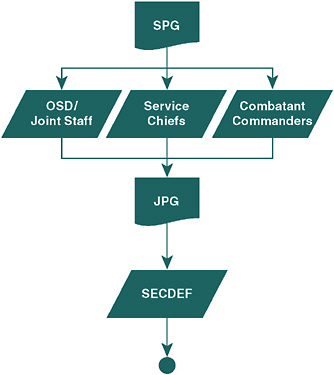
FIGURE C-1
The planning and programming phases’ linkage to Department of Defense departments. SOURCE: DAU. 2010. The Planning PPBE Phase. Available at https://dap.dau.mil/aphome/ppbe/Pages/Planning.aspx. Accessed August 10, 2010.
JPG. When complete, the POM describes, in detail, the proposed budget (forces, personnel, and funding) for the next 6 years.2 The POM may also describe what is not fully funded and the risks associated with the budget shortfall. Senior leaders of the OSD and Joint Staff review all of the military service POMs and integrate them into an overall coherent DoD program. For any shortfalls or any other issues with any portion of any POM, the OSD and Joint Staff can propose alternatives and marginally adjust budgets. As shown in Figure C-2, the Secretary of Defense settles any unresolved issues and writes them up in a Program Decision Memorandum (PDM).
The Budgeting Phase
The budgeting phase of the PPBES happens at the same time as the programming phase. Each DoD department and agency submits its budget estimate with its POM, and converts its program budget into the congressional appropriation structure format and submits it, along with justification. The budget forecasts
|
2 |
DAU. 2010. The Planning PPBE Phase. Available at https://dap.dau.mil/aphome/ppbe/Pages/Plan-ning.aspx. Accessed August 10, 2010. |
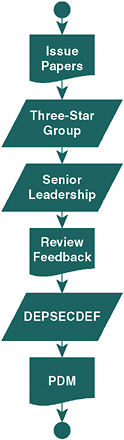
FIGURE C-2
The programming phase of Planning, Programming, Budgeting, and Execution (PPBE). SOURCE: DAU. 2010. The Programming PPBE Phase. Available at https://dap.dau.mil/aphome/ppbe/Pages/Programming.aspx. Accessed August 10, 2010.
only the next 2 years, but with more detail than in the POM. Office of the Under Secretary of Defense (Comptroller) and Office of Management and Budget (OMB) analysts review the submissions to ensure that program funding matches current policy, that individual programs are priced correctly, and that each program is fully justified to Congress. Typically, the analysts write up their questions during formal budget review hearings. After the hearings, each analyst prepares a Program Budget Decision (PBD) for each program, which proposes financial adjustments to address any issues or problems identified during the hearing. The PBD then goes to the Deputy Secretary of Defense for a decision. The decision goes in an updated budget submission to the OMB (as shown in Figure C-3). After that, the overall DoD budget is provided as part of the President’s Budget Request to Congress.3
Thus the PPBE process addresses preacquisition technology development only indirectly, and it delegates the responsibility for the review of individual program
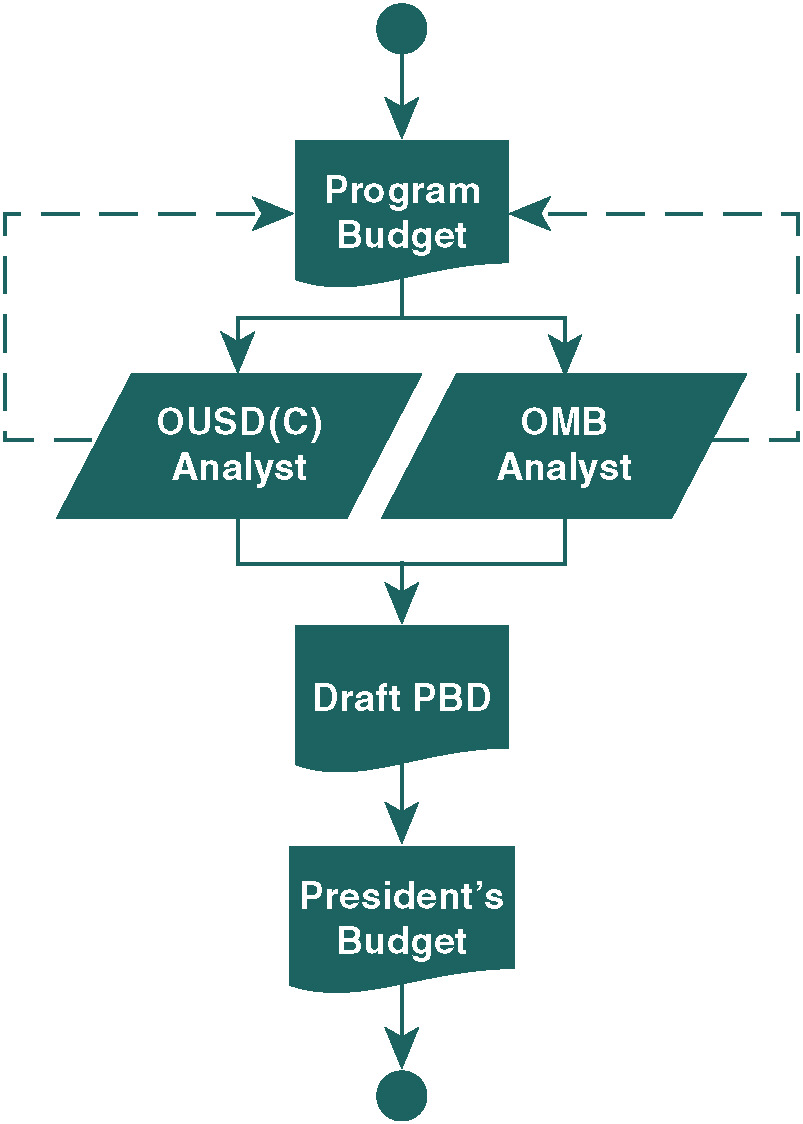
FIGURE C-3
The budgeting phase of Planning, Programming, Budgeting, and Execution (PPBE). SOURCE: DAU. 2010. The Budgeting PPBE Phase. Available at https://dap.dau.mil/aphome/ppbe/Pages/Budgeting.aspx. Accessed August 10, 2010.
activities to the services as part of their POM development, with OSD-level review only when adjustments are addressed during formal budget review hearings. The overall prioritization of USAF preacquisition technology development activities is handled during POM formulation and in detail only by the Air Staff Board Panels, and within each panel only for those Program Elements that are assigned.
DEPARTMENT OF DEFENSE INSTRUCTION 5000.02
The policy document DoD Instruction 5000.02 was released in December 2008. It updated the 5000 series policy document in order to incorporate congressionally mandated acquisition changes contained in the Weapon Systems Acquisition Reform Act (WSARA; Public Law 111-23), which was signed into law in May 2009.4 It also incorporated a number of policy memorandums that had previously been issued by the Undersecretary of Defense for Acquisition, Technology, and Logistics. One example is a policy memorandum on competition and prototyping.5
|
4 |
Available at http://www.ndia.org/Advocacy/PolicyPublicationsResources/Documents/WSARA-Public-Law-111-23.pdf. Accessed August 10, 2010. |
|
5 |
DoD. 2007. “Memorandum for Secretaries of the Military Departments, Chairman of the Joint Chiefs of Staff, Commander, U.S. Special Operations Command, Directors of the Defense Agen |
Although DoD Instruction 5000.02 discusses the preacquisition phase, it provides little “how-to” guidance, nor has it generated any formal direction either to train the workforce or to employ DoD Instruction 5000.02 effectively and measure the resulting ability of the workforce to execute acquisition programs successfully.
Two significant changes highlighted in DoD Instruction 5000.02 are (1) the requirement for competitive prototyping on all Major Defense Acquisition Programs (MDAPs), and (2) the relocation of the Preliminary Design Review (PDR) from taking place after Milestone B to occurring before Milestone B. This leads to a consequence (perhaps unintended) that a significant increase in research and development (R&D) investment is now required to fund the competitive prototyping efforts, as well as the necessary increased technical effort to define the product at a level of detail sufficient to meet PDR requirements. The policy does allow competitive prototyping to be waived, but, as discussed in Chapter 2 and Chapter 4, the process to obtain a waiver is not defined. Also, the timing of the PDR can be changed if approved by the Milestone Decision Authority.
AIR FORCE ACQUISITION IMPROVEMENT PLAN
As stated in Chapter 2 of this report, the USAF Acquisition Improvement Plan (AIP) does not directly address technology development for any phase of the acquisition life cycle. The purpose of the AIP, which was signed out to the field by the Secretary of the Air Force and the Air Force Chief of Staff, is explained in Box C-1.
The five initiatives that constitute the AIP6 and on which the Air Force has focused its attention and implementation activities to date include:
-
Revitalize the Air Force acquisition workforce.
-
Improve requirements generation process.
-
Instill budget and financial discipline.
-
Improve Air Force major source selections.
-
Establish clear lines of authority and accountability within acquisition organizations.7
|
cies. Subject: Prototyping and Competition.” Memorandum from the Under Secretary of Defense, September 19, 2007. Washington, D.C.: DoD. Available at https://dap.dau.mil/policy/Documents/Policy/20070921%20Prototyping%20and%20Competition%20ATL.pdf. Accessed August 10, 2010. |
|
6 |
USAF. 2009. Acquisition Improvement Plan. Washington, D.C.: Office of the Assistant Secretary of the Air Force (Acquisition). Available at http://www.dodbuzz.com/wp-content/uploads/2009/05/acquisition-improvement-plan-4-may-09.pdf. Accessed August 10, 2010. |
|
7 |
Extracted from “Air Force Officials Unveil New Acquisition Plan,” Tech. Sgt. Amaani Lyle. Secretary of the Air Force Public Affairs. May 11, 2009. Available at http://www.af.mil/news/story.asp?id=123148399. Accessed on January 12, 2011. |
|
BOX C-1 The Purpose of the Acquisition Improvement Plan MEMORANDUM FOR ALMAJCOM-FOA-DRU/CC DISTRIBUTION C MAY 4, 2009 SUBJECT: Air Force Acquisition Improvement Plan “The United States Air Force is committed to recapturing acquisition excellence by rebuilding an Air Force acquisition culture that delivers products and services as promised-on time, within budget and in compliance with all laws, policies and regulations. To do so, we have developed the attached Acquisition Improvement Plan.” “Our Challenge: Recapturing acquisition excellence requires an experienced, skilled, empowered, and accountable workforce, and begins with proper requirements and adequate and stable funding. The following five initiatives and their associated actions set forth a comprehensive improvement plan for addressing the foregoing acquisition issues.” SOURCE: Extracted from USAF 2009. “Acquisition Improvement Plan.” Washington, D.C.: Air Force. Available at http://www.dodbuzz.com/wp-content/uploads/2009/05/acquisition-improvement-plan-4-may-09.pdf. Accessed August 10, 2010. |
A close review of the five initiatives shows little focus on the preacquisition technology development phase.
JOINT CAPABILITIES INTEGRATION AND DEVELOPMENT SYSTEM
The Joint Capabilities Integration and Development System (JCIDS) plays a key role in identifying the capabilities required by the warfighters to support the National Defense Strategy, the National Military Strategy, and the National Strategy for Homeland Defense. The successful delivery of those capabilities relies on the JCIDS process working in concert with other joint and DoD decision processes. The procedures established in JCIDS support the Chairman of the Joint Chiefs of Staff and the Joint Requirements Oversight Council (JROC) in advising the Secretary of Defense in identifying and assessing joint military capability needs. The DoD has adopted Joint Capability Areas (JCAs) as its capability management language and framework. JCAs are collections of like DoD capabilities, functionally grouped
to support capability analysis, strategy development, investment decision making, capability portfolio management, and capabilities-based force development and operational planning. JCIDS uses the JCA as an organizing construct. The Functional Capabilities Boards are organized around the Tier 1 JCA, and the JCIDS documents link the capabilities identified to the applicable JCA.
Introduction to the JCIDS Process
A depiction of the relationship between the JCIDS process and key acquisition decision points is provided in the Figure C-4. The JCIDS process is closely linked to the Defense Acquisition System.8
The JCIDS process was created to support the statutory responsibility of the JROC to validate joint warfighting requirements. The JCIDS is also a key supporting process for DoD acquisition and Planning, Programming, Budgeting, and Execution (PPBE) processes. The primary objective of the JCIDS process is to ensure that the capabilities required by the joint warfighter are identified with their associated operational performance criteria so that the assigned missions can be successfully executed. This is done through an open process that provides the JROC with the information that it needs in order to make decisions on required capabilities. The JCIDS process supports the acquisition process by identifying and assessing capability needs and associated performance criteria to be used as a basis for acquiring the right capabilities, including the right systems. These capability needs then serve as the basis for the development and production of systems to fill those needs. Additionally, the JCIDS provides the PPBE process with affordability advice by assessing the development and production life-cycle cost.
During the technology development phase, the sponsor performs technology maturation activities, builds competitive prototypes, and may perform design activities leading to a Preliminary Design Review. The Initial Capabilities Document provides a wide aperture for operational capability to define system requirements and to encourage technological innovation.9 It is vital that the science and technology, users, training, and system developer communities collaborate to agree on a proposed solution that is affordable, militarily useful, and based on mature, demonstrated technology.
|
8 |
CJCS. 2009. Joint Capabilities Integration and Development System. Chairman of the Joint Chiefs of Staff Instruction. CJCSI 3170.01G. March 1, 2009. Washington, D.C.: JCS. Available at http://www.dtic.mil/cjcs_directives/cdata/unlimit/3170_01.pdf. Accessed August 10, 2010. |
|
9 |
For a definition of “Initial Capabilities Document,” see Part II of Enclosure D in: CJCS. 2009. Joint Capabilities Integration and Development System. Chairman of the Joint Chiefs of Staff Instruction. CJCSI 3170.01G. March 1, 2009. Washington, D.C.: JCS. Available at http://www.dtic.mil/cjcs_directives/cdata/unlimit/3170_01.pdf. Accessed August 10, 2010. |
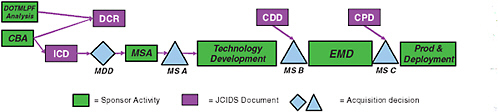
FIGURE C-4
Joint Capabilities Integration and Development System (JCIDS) process and key acquisition decision points. SOURCE: Joint Chiefs of Staff (JCS). 2009. Joint Capabilities Integration and Development System. Chairman of the Joint Chiefs of Staff Instruction. CJCSI 3170.01G. March 1, 2009. Washington, D.C.: JCS. Available at http://www.dtic.mil/cjcs_directives/cdata/unlimit/3170_01.pdf. Accessed August 10, 2010.
DEPARTMENT OF DEFENSE AND AIR FORCE COMPETITIVE PROTOTYPING
The Air Force has long used competitive prototyping with varying degrees of success, notably for aircraft and weapons development. For example, in the 1970s, the Air Force successfully managed the design and flight test of six new designs in three competitive prototype programs; that is, the YF-16/17, YA-9/10, and YC-14/15 aircraft. In the past several years, competitive prototyping has been effectively employed in a variety of air-to-surface weapons development programs, including the Joint Direct Attack Munition and Small Diameter Bomb.10 Key factors in the effective use of prototyping, either competitive or noncompetitive, include a definition and disciplined assessment of the critical technologies to be demonstrated, in addition to the specification of a few key system performance parameters. A structured test and evaluation program is critical in order to demonstrate each prototype’s capability and provide data for a comprehensive and objective assessment of the maturity of critical technologies. Additionally, discipline must be imposed downstream of the prototyping effort to minimize requirements changes.
In the past 3 years, there has been congressional legislation and OSD direction reinforcing the requirement for competitive prototyping when appropriate. In a September 19, 2007, memorandum, the Under Secretary of Defense for Acquisition, Technology, and Logistics directed that “Military Services and Defense Agencies will formulate all pending and future programs with acquisition strategies and fund-
|
10 |
GAO. 2010. Strong Leadership Is Key to Planning and Executing Stable Weapon Programs. GAO-10-522. Washington, D.C.: GAO. Available at http://www.ndia.org/Advocacy/LegislativeandFederalIssuesUpdate/Documents/May2010/GAO-StrongLeadershipinWeaponssystemsprograms.pdf. Accessed August 10, 2010. |
ing that provide for two or more competing teams producing prototypes through Milestone (MS) B.”11 WSARA requires competitive prototyping of systems before Milestone B, unless waived by the Milestone Decision Authority. The legislation further requires that a prototype be produced before Milestone B even if competitive prototyping is waived. The WSARA direction on prototyping has been incorporated in the Defense Acquisition Guidebook (DAG)12 as well as in DoD Instruction 5000.02.13 The DAG requires that the technology development strategy include a description of the prototyping strategy at the system and subsystem levels, as well as the number of prototype units that may be produced and employed during technology development and competitive prototyping.
The Air Force has responded to the congressional and OSD direction by updating internal guidance on competitive prototyping including AFI 63-101 on Prototyping.14 The Air Force prototype vision recognizes that risk is not limited to technology, but that it includes integration and manufacturability risks as well. The policy specifies that prototypes should be considered for critical technology elements, key manufacturing and integration risks, and demonstration of the ability of the planned system to meet user requirements.
|
11 |
DoD. 2007. “Memorandum for Secretaries of the Military Departments, Chairman of the Joint Chiefs of Staff, Commander, U.S. Special Operations Command, Directors of the Defense Agencies. Subject: Prototyping and Competition.” Memorandum from the Under Secretary of Defense, September 19, 2007. Washington, D.C.: DoD. Available at https://dap.dau.mil/policy/Documents/Policy/20070921%20Prototyping%20and%20Competition%20ATL.pdf. Accessed August 10, 2010. |
|
12 |
DAU. 2010. Defense Acquisition Guidebook. Fort Belvoir, Va.: Defense Acquisition University. Available at http://www.ndia.org/Advocacy/LegislativeandFederalIssuesUpdate/Documents/March2010/Defense_Acqauisition_Guidebook_3-10.pdf. Accessed August 11, 2010. |
|
13 |
DoD. 2008. Department of Defense Instruction. Subject: Operation of the Defense Acquisition System. 5000.02. Washington, D.C.: Office of the Under Secretary of Defense for Acquisition, Technology, and Logistics. Available at http://www.dtic.mil/whs/directives/corres/pdf/500002p.pdf. Accessed August 11, 2010. |
|
14 |
USAF. 2010. Air Force Guidance Memorandum to AFI 63-101: Acquisition and Sustainment Life Cycle Management. Washington, D.C.: Department of Defense. Available at http://www.af.mil/shared/media/epubs/AFI63-101.pdf. Accessed August 11, 2010. |


