
From the interior of the Sun to the upper atmosphere and near-space environment of Earth, and outward to a region far beyond Pluto where the Sun’s influence wanes, advances during the past decade in space physics and solar physics—the disciplines NASA refers to as heliophysics—have yielded spectacular insights into the phenomena that affect our home in space. This report, from the National Research Council’s (NRC’s) Committee on a Decadal Strategy for Solar and Space Physics (Heliophysics), is the second NRC decadal survey in heliophysics. Building on the research accomplishments realized over the past decade, the report presents a program of basic and applied research for the period 2013-2022 that will improve scientific understanding of the mechanisms that drive the Sun’s activity and the fundamental physical processes underlying near-Earth plasma dynamics; determine the physical interactions of Earth’s atmospheric layers in the context of the connected Sun-Earth system; and greatly enhance the capability to provide realistic and specific forecasts of Earth’s space environment that will better serve the needs of society. Although the recommended program is directed primarily to NASA (Science Mission Directorate–Heliophysics Division) and the National Science Foundation (NSF) (Directorate for Geosciences–Atmospheric and Geospace Sciences) for action, the report also recommends actions by other federal agencies, especially the National Oceanic and Atmospheric Administration (NOAA) and those parts of NOAA charged with the day-to-day (operational) forecast of space weather. In addition to the recommendations included in this summary, related recommendations are presented in the main text of Part I of this report.
RECENT PROGRESS: SIGNIFICANT ADVANCES FROM THE PAST DECADE
As summarized in Chapter 2 and discussed in greater detail in Chapters 8-10, the disciplines of solar and space physics have made remarkable advances over the past decade—many of which have come from
the implementation of the program recommended in the 2003 solar and space physics decadal survey.1 Listed below are some of the highlights from an exciting decade of discovery:
• New insights, gained from novel observations and advances in theory, modeling, and computation, into the variability of the mechanisms that generate the Sun’s magnetic field, and into the structure of that field;
• A new understanding of the unexpectedly deep minimum in solar activity;
• Significant progress in understanding the origin and evolution of the solar wind;
• Striking advances in understanding both explosive solar flares and the coronal mass ejections that drive space weather;
• Groundbreaking discoveries about the surprising nature of the boundary between the heliosphere—the immense magnetic bubble containing our solar system—and the surrounding interstellar medium;
• New imaging methods that permit researchers to directly observe space weather-driven changes in the particles and magnetic fields surrounding Earth;
• Significantly deeper knowledge of the numerous processes involved in the acceleration and loss of particles in Earth’s radiation belts;
• Major advances in understanding the structure, dynamics, and linkages in other planetary magnetospheres, especially those of Mercury, Jupiter, and Saturn;
• New understanding of how oxygen from Earth’s own atmosphere contributes to space storms;
• The surprising discovery that conditions in near-Earth space are linked strongly to the terrestrial weather and climate below;
• Evidence of a long-term decline in the density of Earth’s upper atmosphere, indicative of planetary change; and
• New understanding of the temporal and spatial scales involved in magnetospheric-atmospheric coupling in Earth’s aurora.
It is noteworthy that some of the most surprising discoveries of the past decade have come from comparatively small missions that were tightly cost-constrained, competitively selected, and principal-investigator (PI)-led—recommendations in the present decadal survey reflect this insight.
Enabled by advances in scientific understanding as well as fruitful interagency partnerships, the capabilities of models that predict space weather impacts on Earth have also made rapid gains over the past decade. Reflecting these advances and a society increasingly vulnerable to the adverse effects of space weather, the number of users of space weather services has also grown rapidly. Indeed, a growing community has come to depend on constant and immediate access to space weather information (see Chapter 7).
KEY SCIENCE GOALS FOR THE NEXT DECADE
The significant achievements of the past decade have set the stage for transformative advances in solar and space physics for the coming decade. Reports from the survey’s three interdisciplinary study panels (Chapters 8-10) enumerate the highest-priority scientific opportunities and challenges for the com-
________________________
1 National Research Council, The Sun to the Earth—and Beyond: A Decadal Research Strategy in Solar and Space Physics, The National Academies Press, Washington, D.C., 2003; and National Research Council, The Sun to the Earth—and Beyond: Panel Reports, The National Academies Press, Washington, D.C., 2003.
ing decade; collectively, they inform the survey’s four key science goals, each of which is considered of equal priority:
Key Science Goal 1. Determine the origins of the Sun’s activity and predict the variations in the space environment.
Key Science Goal 2. Determine the dynamics and coupling of Earth’s magnetosphere, ionosphere, and atmosphere and their response to solar and terrestrial inputs.
Key Science Goal 3. Determine the interaction of the Sun with the solar system and the interstellar medium.
Key Science Goal 4. Discover and characterize fundamental processes that occur both within the heliosphere and throughout the universe.
GUIDING PRINCIPLES AND PROGRAMMATIC CHALLENGES
To achieve these four key science goals, the survey committee recommends adherence to the following principles (Chapter 1):
• To make transformational scientific progress, the Sun, Earth, and heliosphere must be studied as a coupled system;
• To understand the coupled system requires that each subdiscipline be able to make measurable advances in achieving its highest-priority science goals; and
• Success across the entire field requires that the various elements of solar and space physics research programs—the enabling foundation comprising theory, modeling, data analysis, innovation, and education, as well as ground-based facilities and small-, medium-, and large-class space missions—be deployed with careful attention both to the mix of assets and to the schedule (cadence) that optimizes their utility over time.
The survey committee’s recommendations reflect these principles while also taking into account issues of cost, schedule, and complexity. The committee also recognizes a number of challenges that could impede achievement of the recommended program: the assumed budget might not be realized or missions could experience cost growth; the necessary activities have to be coordinated across multiple agencies; and the availability of appropriately sized and affordable space launch vehicles, particularly medium-class launch vehicles, is limited.
RECOMMENDATIONS—RESEARCH AND APPLICATIONS
The survey committee’s recommendations are listed in Tables S.1 and S.2; a more complete discussion of the research recommendations—the primary focus of this survey—is found in Chapter 4, along with a discussion of the applications recommendations, while Chapter 7 presents the committee’s vision, premised on the availability of additional funds, of an expanded program in space weather and space climatology. The committee’s recommendations are prioritized and integrated across agencies to form an effective set of programs consistent with fiscal and other constraints. An explicit cost appraisal for each NASA research recommendation is incorporated into the budget for the overall program (Chapter 6); however, for NSF programs, only a general discussion of expected costs is provided (Chapter 5).
TABLE S.1 Summary of Top-Level Decadal Survey Research Recommendations
|
|
||||
| Priority | Recommendation | NASA | NSF | Other |
|
|
||||
| 0.0 | Complete the current program | X | X | |
| 1.0 | Implement the DRIVE initiative Small satellites; midscale NSF projects; vigorous ATST and synoptic program support; science centers and grant programs; instrument development |
X | X | X |
| 2.0 | Accelerate and expand the Heliophysics Explorer program Enable MIDEX line and Missions of Opportunity |
X | ||
| 3.0 | Restructure STP as a moderate-scale, PI-led line | X | ||
| 3.1 | Implement an IMAP-like mission | X | ||
| 3.2 | Implement a DYNAMIC-like mission | X | ||
| 3.3 | Implement a MEDICI-like mission | X | ||
| 4.0 | Implement a large LWS GDC-like mission | X | ||
|
|
||||
TABLE S.2 Summary of Top-Level Decadal Survey Applications Recommendations
|
|
||||
| Priority | Recommendation | NASA | NSF | Other |
|
|
||||
| 1.0 | Recharter the National Space Weather Program | X | X | X |
| 2.0 | Work in a multiagency partnership to achieve continuity of solar and solar wind observations | X | X | X |
| 2.1 | Continue solar wind observations from L1 (DSCOVR, IMAP) | X | X | |
| 2.2 | Continue space-based coronagraph and solar magnetic field measurements | X | X | |
| 2.3 | Evaluate new observations, platforms, and locations | X | X | X |
| 2.4 | Establish a space weather research program at NOAA to effectively transition research to operations | X | ||
| 2.5 | Develop and maintain distinct funding lines for basic space physics research and for space weather specification and forecasting | X | X | X |
|
|
||||
Research Recommendations
Baseline Priority for NASA and NSF: Complete the Current Program
The survey committee’s recommended program for NSF and NASA assumes continued support in the near term for the key existing program elements that constitute the Heliophysics Systems Observatory (HSO) and successful implementation of programs in advanced stages of development.
NASA’s existing heliophysics flight missions and NSF’s ground-based facilities form a network of observing platforms that operate simultaneously to investigate the solar system. This array can be thought of as a single observatory—the Heliophysics Systems Observatory (HSO) (see Figure 1.2). The evolving HSO lies at the heart of the field of solar and space physics and provides a rich source of observations that can be used to address increasingly interdisciplinary and long-term scientific questions. Missions now under development will expand the HSO and drive scientific discovery. For NASA, these include the following:
• The Radiation Belt Storm Probes (RBSP; Living With a Star (LWS) program, 2012 launch2) and related Balloon Array for RBSP Relativistic Electron Losses (BARREL; first launch 2013) will determine the mechanisms that control the energy, intensity, spatial distribution, and time variability of Earth’s radiation belts.
________________________
2 Following its launch on August 30, 2012, RBSP was renamed the Van Allen Probes.
• The Interface Region Imaging Spectrograph (IRIS; Explorer program, 2013 launch) will deliver pioneering observations of chromospheric dynamics just above the solar surface to help determine their role in the origin of the fluxes of heat and mass into the corona and wind.
• The Magnetospheric Multiscale mission (MMS; Solar-Terrestrial Probes (STP) program, 2014 launch) will address the physics of magnetic reconnection at the previously inaccessible tiny scale where reconnection is triggered.
Compelling missions that are not yet in advanced stages of development but are part of a baseline program whose continuation NASA asked the survey committee to assume include the following:3
• Solar Orbiter (European Space Agency-NASA partnership, 2017 launch) will investigate links between the solar surface, corona, and inner heliosphere from as close as 62 solar radii.
• Solar Probe Plus (SPP; LWS program, 2018 launch) will make mankind’s first visit to the solar corona to discover how the corona is heated, how the solar wind is accelerated, and how the Sun accelerates particles to high energy.
The powerful fleet of space missions that explore our local cosmos will be significantly strengthened with the addition of these missions. However, their implementation as well as the rest of the baseline program will consume nearly all of the resources anticipated to be available for new starts within NASA’s Heliophysics Division through the midpoint of the overall survey period, 2013-2022.
For NSF, the previous decade witnessed the initial deployment in Alaska of the Advanced Modular Incoherent Scatter Radar (AMISR), a mobile facility used to study the upper atmosphere and to observe space weather events, and the initial development of the Advanced Technology Solar Telescope (ATST), a 4-meter-aperture optical solar telescope—by far the largest in the world—that will provide the most highly resolved measurements ever obtained of the Sun’s plasma and magnetic field. These new NSF facilities join a broad range of existing ground-based assets that provide an essential global synoptic perspective and complement space-based measurements of the solar and space physics system. With adequate science and operations support, they will enable frontier research even as they add to the long-term record necessary for analyzing space climate over solar cycles.
R1.0 Implement the DRIVE Initiative
The survey committee recommends implementation of a new, integrated, multiagency initiative (DRIVE— Diversify, Realize, Integrate, Venture, Educate) that will develop more fully and employ more effectively the many experimental and theoretical assets at NASA, NSF, and other agencies.
The DRIVE initiative encompasses specific, cost-effective augmentations to NASA and NSF heliophysics programs. Its implementation will bring existing “enabling” programs to full fruition and will provide new opportunities to realize scientific discoveries from existing data, build more comprehensive models, make theoretical breakthroughs, and innovate. With this in mind, the committee has as its first priority for both NASA and NSF—after completion of the current program—the implementation of an integrated, multiagency initiative comprising the following components:
________________________
3 In accordance with its statement of task, the survey committee did not reprioritize any NASA mission that was in formulation or advanced development. In addition, the study charge specified that Solar Orbiter and Solar Probe Plus would not be included in any prioritization of future mission opportunities.
- Diversify observing platforms with microsatellites and midscale ground-based assets.
- Realize scientific potential by sufficiently funding operations and data analysis.
- Integrate observing platforms and strengthen ties between agency disciplines.
- Venture forward with science centers and instrument and technology development.
- Educate, empower, and inspire the next generation of space researchers.
The five DRIVE components are defined in Chapter 4, with specific and actionable recommendations offered for each element. Implementation of the NASA portion of the DRIVE initiative would require an augmentation to existing program lines equivalent to approximately $33 million in current (2013) dollars (see Chapter 6).4 The cost and implementation of the NSF portion of DRIVE are described in Chapter 5. Although the recommendations for NSF within the DRIVE initiative are not prioritized, the survey committee calls attention to two in particular:
The National Science Foundation should:
- Provide funding sufficient for essential synoptic observations and for efficient and scientifically productive operation of the Advanced Technology Solar Telescope, which provides a revolutionary new window on the solar magnetic atmosphere.
- Create a new, competitively selected mid-scale project funding line in order to enable midscale projects and instrumentation for large projects. There are a number of compelling candidates for a midscale facilities line, including the Frequency-Agile Solar Radiotelescope (FASR), the Coronal Solar Magnetism Observatory (COSMO), and several other projects exemplifying the kind of creative approaches necessary to fill gaps in observational capabilities and to move the survey’s integrated science plan forward.
R2.0 Accelerate and Expand the Heliophysics Explorer Program
The survey committee recommends that NASA accelerate and expand the Heliophysics Explorer program. Augmenting the current program by $70 million per year, in fiscal year 2012 dollars, will restore the option of Mid-size Explorer (MIDEX) missions and allow them to be offered alternately with Small Explorer (SMEX) missions every 2 to 3 years. As part of the augmented Explorer program, NASA should support regular selections of Missions of Opportunity.
The Explorer program’s strength lies in its ability to respond rapidly to new concepts and developments in science, as well as in the program’s synergistic relationship with larger-class strategic missions.5 The Explorer mission line has proven to be an outstanding success, delivering—cost-effectively—science results of great consequence. The committee recommends increased support of the Explorer program to enable significant scientific advances in solar and space physics. As discussed in Chapter 4, the committee believes that the proper cadence for Heliophysics Explorers is one mission every 2 to 3 years. The committee’s recommended augmentation of the Explorer program would facilitate this cadence and would also allow selection of both small- and medium-class Explorers. Historically, MIDEX missions offered an opportunity to resolve many of the highest-level science questions, but they have not been feasible with the current Explorer budget.
________________________
4 The survey committee assumed inflation at 2.7 percent in program costs, the same as the percentage used by NASA for new starts.
5 National Research Council, Solar and Space Physics and Its Role in Space Exploration, The National Academies Press, Washington, D.C., 2003, p. 36.
Regular selections of Missions of Opportunity will also allow the research community to respond quickly and to leverage limited resources with interagency, international, and commercial flight partnerships. For relatively modest investments, such opportunities can potentially address high-priority science aims identified in this survey.
R3.0 Restructure Solar-Terrestrial Probes as a Moderate-Scale, PI-Led Line
The survey committee recommends that NASA’s Solar-Terrestrial Probes program be restructured as a moderate-scale, competed, principal-investigator-led (PI-led) mission line that is cost-capped at $520 million per mission in fiscal year 2012 dollars including full life-cycle costs.
NASA’s Planetary Science Division has demonstrated success in implementing mid-size missions as competed, cost-capped, PI-led investigations via the Discovery and New Frontiers programs. These are managed in a manner similar to Explorers and have a superior cost-performance history relative to that of larger flagship missions. The committee concluded that STP missions should be managed likewise, with the PI empowered to make scientific and mission design trade-offs necessary to remain within the cost cap (Chapter 4). With larger-class LWS missions and smaller-class Explorers and Missions of Opportunity, this new approach will lead to a more balanced and effective overall NASA Heliophysics Division mission portfolio that is implemented at a higher cadence and provides the vitality needed to accomplish the breadth of the survey’s science goals. The eventual recommended minimum cadence of STP missions is one every 4 years.
Although the new STP program would involve moderate missions being chosen competitively, the survey committee recommends that their science targets be ordered as follows so as to systematically advance understanding of the full coupled solar-terrestrial system:
R3.1 The first new STP science target is to understand the outer heliosphere and its interaction with the interstellar medium, as illustrated by the reference mission6 Interstellar Mapping and Acceleration Probe (IMAP; Chapter 4). Implementing IMAP as the first of the STP investigations will ensure coordination with NASA Voyager missions. The mission implementation also requires measurements of the critical solar wind inputs to the terrestrial system.
R3.2 The second STP science target is to provide a comprehensive understanding of the variability in space weather driven by lower-atmosphere weather on Earth. This target is illustrated by the reference mission Dynamical Neutral Atmosphere-Ionosphere Coupling (DYNAMIC; Chapter 4).
R3.3 The third STP science target is to determine how the magnetosphere-ionosphere-thermosphere system is coupled and how it responds to solar and magnetospheric forcing. This target is illustrated by the reference mission Magnetosphere Energetics, Dynamics, and Ionospheric Coupling Investigation (MEDICI; Chapter 4).
The rationale for all the selections and for their ordering is detailed in Chapter 4.
________________________
6 In this report, the committee uses the terms “reference mission” and “science target” interchangeably, given that the mission concepts were developed specifically to assess the cost of addressing particular high-priority science investigations. The concepts presented in this report underwent an independent cost and technical analysis by the Aerospace Corporation, and they have been given names for convenience; however, the actual recommendation from the committee is to address the science priorities enumerated in the reference mission concept.
Living With a Star
Certain landmark scientific problems are of such scope and complexity that they can be addressed only with major missions. In the survey committee’s plan, major heliophysics missions would be implemented within NASA’s LWS program; the survey committee recommends that they continue to be managed and executed by NASA centers. Other integral thematic elements besides the flight program are essential to the LWS science and technology program: the unique LWS research, technology, strategic capabilities, and education programs remain of great value.
R4.0 Implement a large Living With a Star mission to study the ionosphere-thermosphere-mesosphere system in an integrated fashion.
The survey committee recommends that, following the launch of RBSP and SPP, the next LWS science target focus on how Earth’s atmosphere absorbs solar wind energy. The recommended reference mission is Geospace Dynamics Constellation (GDC).
As detailed in Chapter 4, the GDC reference mission would provide crucial scientific measurements of the extreme variability of conditions in near-Earth space. Within anticipated budgets, the completion of the baseline LWS program, which includes the launch of two major missions—RBSP in 2012 and SPP in 2018—does not allow for the launch of a subsequent major mission in heliophysics until 2024, 6 years after SPP. This establishes what the survey committee regards as the absolute minimum cadence needed for major missions.
Applications Recommendations: Enabling Effective Space Weather and Climatology Capabilities
Multiple agencies of the federal government have vital interests related to space weather, and efforts to coordinate these agencies’ activities are seen in the National Space Weather Program (NSWP). Nonetheless, the survey committee concluded that additional approaches are needed to develop the capabilities outlined in the 2010 National Space Policy document and envisioned in the 2010 NSWP plan.7 Chapter 7 presents the committee’s vision for a renewed national commitment to a comprehensive program in space weather and climatology (SWaC). Enabling an effective SWaC capability will require action across multiple agencies and an integrated program that builds on the strengths of individual agencies.
A1.0 Recharter the National Space Weather Program
As part of a plan to develop and coordinate a comprehensive program in space weather and climatology, the survey committee recommends that the National Space Weather Program be rechartered under the auspices of the National Science and Technology Council. With the active participation of the Office of Science and Technology Policy and the Office of Management and Budget, the program should build on current agency efforts, leverage the new capabilities and knowledge that will arise from implementation of the programs recommended in this report, and develop additional capabilities, on the ground and in space, that are specifically tailored to space weather monitoring and prediction.
________________________
7 National Space Policy of the United States of America, June 28, 2010, available at http://www.whitehouse.gov/sites/default/files/national_space_policy_6-28-10.pdf. Committee for Space Weather, Office of the Federal Coordinator for Meteorological Services and Supporting Research, National Space Weather Program Strategic Plan, FCM-P30-2010, August 17, 2010, available at http://www.ofcm.gov/nswp-sp/fcm-p30.htm.
A2.0 Work in a multiagency partnership to achieve continuity of solar and solar wind observations.
The survey committee recommends that NASA, NOAA, and the Department of Defense work in partnership to plan for continuity of solar and solar wind observations beyond the lifetimes of ACE, SOHO, STEREO, and SDO. In particular:
A2.1 Solar wind measurements from L1 should be continued, because they are essential for space weather operations and research. The DSCOVR L1 monitor and IMAP STP mission are recommended for the near term, but plans should be made to ensure that measurements from L1 continue uninterrupted into the future.
A2.2 Space-based coronagraph and solar magnetic field measurements should likewise be continued.
Further, the survey committee concluded that a national, multifaceted program of both observations and modeling is needed to transition research into operations more effectively by fully leveraging expertise from different agencies, universities, and industry and by avoiding duplication of effort. This effort should include determining the operationally optimal set of observations and modeling tools and how best to effect that transition. With these objectives in mind:
A2.3 The space weather community should evaluate new observations, platforms, and locations that have the potential to provide improved space weather services. In addition, the utility of employing newly emerging information dissemination systems for space weather alerts should be assessed.
A2.4 NOAA should establish a space weather research program to effectively transition research to operations.
A2.5 Distinct funding lines for basic space physics research and for space weather specification and forecasting should be developed and maintained.
Implementation of a program to advance space weather and climatology will require funding well above what the survey committee assumes will be available to support its research-related recommendations to NASA (see Table S.1). The committee emphasizes that implementation of an initiative in space weather and climatology should proceed only if it does not impinge on the development and timely execution of the recommended research program.
RECOMMENDED PROGRAM, DECISION RULES, AND AUGMENTATION PRIORITIES FOR NASA
Recommended Program
The committee’s recommended program for NASA’s Heliophysics Division is shown in Figure S.1. As detailed in Chapter 6, the plan restores the medium-class Explorers and, together with small-class Explorer missions and Missions of Opportunity, achieves the recommended minimum mission cadence. The plan also begins the DRIVE initiative as early in the decade as budgets allow, with full implementation achieved by mid-decade. However, funding constraints affect the restoration and recommended rebalance of heliophysics program elements such that full realization of the survey committee’s strategy is not possible until after 2017 (see Figure S.1).
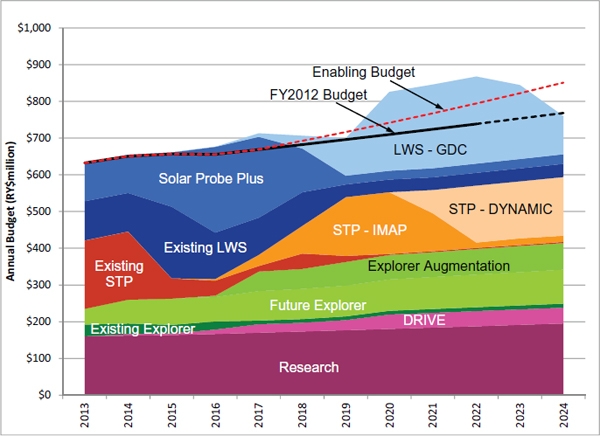
FIGURE S.1 Heliophysics budget and program plan by year and category from 2013 to 2024. The solid black line indicates the funding level from 2013 to 2022 provided to the survey committee by NASA as the baseline for budget planning, and the dashed black line extrapolates the budget forward to 2024. After 2017 the amount increases with a nominal 2 percent inflationary factor. Through 2016 the program content is tightly constrained by budgetary limits and fully committed for executing existing program elements. The red dashed “Enabling Budget” line includes a modest increase from the baseline budget starting in 2017, allowing implementation of the survey-recommended program at a more efficient cadence that better meets scientific and societal needs and improves optimization of the mix of small and large missions. From 2017 to 2024 the Enabling Budget grows at 1.5 percent above inflation. (Note that the 2024 Enabling Budget is equivalent to growth at a rate just 0.50 percent above inflation from 2009.) Geospace Dynamics Constellation, the next large mission of the LWS program after Solar Probe Plus, rises above the baseline curve in order to achieve a more efficient spending profile, as well as to achieve deployment in time for the next solar maximum in 2024. NOTE: LWS refers to missions in the Living With a Star line, and STP refers to missions in the Solar-Terrestrial Probes line.
Decision Rules to Ensure That Balanced Progress Is Maintained
The recommended program for NASA cost-effectively addresses key science objectives. However, the survey committee recognizes that the already tightly constrained program could face further budgetary challenges. For example, with launch planned in 2018, the Solar Probe Plus project has not yet entered
the implementation phase when expenditures are highest.8 Significant cost growth in this very important, but technically challenging, mission beyond the current cap has the potential to disrupt the overall NASA heliophysics program.
To guide the allocation of reduced resources, the committee recommends the following decision rules intended to provide flexibility and efficiency if funding is less than anticipated, or should some other disruptive event occur. These rules, discussed in greater depth in Chapter 6, would help maintain progress toward the top-priority, system-wide science challenges identified in this survey. The decision rules should be applied in the order shown to minimize disruption of higher-priority program elements:
Decision Rule 1. Missions in the STP and LWS lines should be reduced in scope or delayed to accomplish higher priorities (Chapter 6 gives explicit triggers for review of Solar Probe Plus).
Decision Rule 2. If further reductions are needed, the recommended increase in the cadence of Explorer missions should be scaled back, with the current cadence maintained as the minimum.
Decision Rule 3. If still further reductions are needed, the DRIVE augmentation profile should be delayed, with the current level of support for elements in the NASA research line maintained as the minimum.
Augmentations to Increase Program Value
The committee notes that the resources assumed in crafting this decadal survey’s recommended program are barely sufficient to make adequate progress in solar and space physics; with reduced resources, progress will be inadequate. It is also evident that with increased resources, the pace at which the nation pursues its program could be accelerated with a concomitant increase in the achievement of scientific discovery and societal value. The committee recommends the following augmentation priorities to aid in implementing a program under a more favorable budgetary environment:
Augmentation Priority 1. Given additional budget authority early in the decade, the implementation of the DRIVE initiative should be accelerated.
Augmentation Priority 2. With sufficient funds throughout the decade, the Explorer line should be further augmented to increase the cadence and funding available for missions, including Missions of Opportunity.
Augmentation Priority 3. Given further budget augmentation, the schedule of STP missions should advance to allow the third STP science target (MEDICI) to begin in this decade.
Augmentation Priority 4. The next LWS mission (GDC) should be implemented with an accelerated, more cost-effective funding profile.
________________________
8 On January 31, 2012, Solar Probe Plus passed its agency-level confirmation review and entered what NASA refers to as mission definition or Phase B of its project life cycle.
TABLE S.3 Fulfilling the Key Science Goals of the Decadal Survey
|
|
||||
| Advances in Scientific Understanding and Observational Capabilities | Goals | |||
|
|
||||
| Advances owing to implementation of the existing program | Twin Radiation Belt Storm Probes will observe Earth’s radiation belts from separate locations, finally resolving the importance of temporal and spatial variability in the generation and loss of trapped radiation that threatens spacecraft. | 2, 4 | ||
| The Magnetospheric Multiscale mission will provide the first high-resolution, three-dimensional measurements of magnetic reconnection in the magnetosphere by sampling small regions where magnetic field line topologies reform. | 2, 4 | |||
| Solar Probe Plus will be the first spacecraft to enter the outer atmosphere of the Sun, repeatedly sampling solar coronal particles and fields to understand coronal heating, solar wind acceleration, and the formation and transport of energetic solar particles. | 1, 4 | |||
| Solar Orbiter will provide the first high-latitude images and spectral observations of the Sun’s magnetic field, flows, and seismic waves, relating changes seen in the corona to local measurements of the resulting solar wind. | 1, 4 | |||
| The 4-meter Advanced Technology Solar Telescope will resolve structures as small as 20 km, measuring the dynamics of the magnetic field at the solar surface down to the fundamental density length scale and in the low corona. | 1, 4 | |||
| The Heliophysics Systems Observatory will gather a broad range of ground- and space-based observations and advance increasingly interdisciplinary and long-term solar and space physics science objectives. | All | |||
| New starts on programs and missions to be | The DRIVE initiative will greatly strengthen researchers’ ability to pursue innovative observational, theoretical, numerical, modeling, and technical advances. | All | ||
| implemented within the next decade | Solar and space physicists will accomplish high-payoff, timely science goals with a revitalized Explorer program, including leveraged Missions of Opportunity. | All | ||
| The Interstellar Mapping and Acceleration Probe, in conjunction with the twin Voyager spacecraft, will resolve the interaction between the heliosphere—our home in space—and the interstellar medium. | 2, 3, 4 | |||
| A new funding line for mid-size projects at the National Science Foundation will facilitate long-recommended ground-based projects, such as COSMO and FASR, by closing the funding gap between large and small programs. | All | |||
| New starts on missions to be launched early in the next decade | The Dynamical Neutral Atmosphere-Ionosphere Coupling mission’s two identical orbiting observatories will clarify the complex variability and structure in near-Earth plasma driven by lower-atmosphere wave energy. | 2, 4 | ||
| The Geospace Dynamics Constellation will provide the first simultaneous, multipoint observations of how the ionosphere-thermosphere system responds to, and regulates, magnetospheric forcing over local and global scales. | 2, 4 | |||
| Possible new start this decade given budget augmentation and/or cost reduction in other missions | The Magnetosphere Energetics, Dynamics, and Ionospheric Coupling Investigation will target complex, coupled, and interconnected multiscale behavior of the magnetosphere-ionosphere system by providing global, high-resolution, continuous three-dimensional images and multipoint in situ measurements of the ring current, plasmasphere, aurora, and ionospheric-thermospheric dynamics. | 2, 4 | ||
|
|
||||
EXPECTED BENEFITS OF THE RECOMMENDED PROGRAM
Implementation of the survey committee’s recommended program will ensure that the United States maintains its leadership in solar and space physics and will, the committee believes, lead to significant— even transformative—advances in scientific understanding and observational capabilities (Table S.3). In turn, these advances will support critical national needs for information that can be used to anticipate, recognize, and mitigate space weather effects that threaten human life and the technological systems society depends on.


