
Report of the Panel on Solar Wind-Magnetosphere Interactions
9.1 SUMMARY OF SWMI SCIENCE PRIORITIES AND IMPERATIVES
The magnetosphere is a central part of the solar and space physics system. Its various regions interact globally in complex, nonlinear ways with each other, with the solar wind, and with the upper atmosphere. These interactions occur by a number of fundamental physical processes that operate throughout the universe. The resulting dynamic variations in the magnetospheric environment also have important practical consequences for a society that is increasingly reliant on ground- and space-based technological systems that are sensitive to Earth’s space environment.
Significant progress has been made over the past decade in achieving the science objectives identified in the 2003 decadal survey for solar wind-magnetosphere interactions.1 This progress has been achieved through a powerful combination of tools, including new data from satellites launched during the decade or just before (e.g., Cluster, IMAGE, THEMIS, TWINS); analysis of data returned from earlier missions; data from instruments flown on non-NASA operational satellites; measurements from suborbital missions and from networks of ground-based observatories; greatly improved numerical simulations; analytical theory; and laboratory work.
For the coming decade, the Panel on Solar Wind-Magnetosphere Interactions (SWMI) identified a set of eight high-priority science goals for research in solar wind-magnetosphere interactions—goals that follow naturally from the progress that has been made and will contribute substantially toward accomplishing the decadal survey key science goals for solar and space physics identified in Chapter 1 of this report. These eight goals (which are not prioritized) are as follows:
SWMI Science Goal 1. Determine how the global and mesoscale structures in the magnetosphere respond to variable solar wind forcing.
________________________
1 National Research Council, The Sun to the Earth—and Beyond: A Decadal Research Strategy in Solar and Space Physics, The National Academies Press, Washington, D.C., 2003; and National Research Council, The Sun to the Earth—and Beyond: Panel Reports, The National Academies Press, Washington, D.C., 2003.
SWMI Science Goal 2. Identify the controlling factors that determine the dominant sources of magnetospheric plasma.
SWMI Science Goal 3. Understand how plasmas interact within the magnetosphere and at its boundaries.
SWMI Science Goal 4. Establish how energetic particles are accelerated, transported, and lost.
SWMI Science Goal 5. Discover how magnetic reconnection is triggered and modulated.
SWMI Science Goal 6. Understand the origins and effects of turbulence and wave-particle interactions.
SWMI Science Goal 7. Determine how magnetosphere-ionosphere-thermosphere coupling controls system-level dynamics.
SWMI Science Goal 8. Identify the structures, dynamics, and linkages in other planetary magnetospheric systems.
These are ambitious goals, and their accomplishment will require intelligent use of the variety of research tools that are available. Achieving some of them will require new measurements from strategic missions, either already under development (MMS and RBSP2) or to be started in the coming decade. Other contributions toward accomplishing these goals will come from community-proposed Explorer missions, suborbital flights, CubeSats, operational satellites, and instruments flown on commercial platforms as rides of opportunity. Studies that combine data from the numerous existing spacecraft will elucidate important aspects of global coupling, while analytical theory, laboratory studies, and especially powerful numerical simulations will complement the various spacecraft measurements in a synergistic attack on the science questions. However, because of budget constraints and as-yet immature technology, a number of critical investigations must be deferred to a later decade, requiring investments in the coming decade in the areas of technology innovation and development, as well as in ways to more effectively couple theory and data.
In this chapter, the SWMI panel advocates a coherent and balanced program of research in solar wind-magnetosphere interactions based on a prioritized set of imperatives that will enable a cost-effective approach to accomplishing the SWMI science goals. These imperatives are sorted into three categories: (1) missions, (2) DRIVE-related initiatives, and (3) space weather. For simplicity, the panel assigned each imperative to a single primary category, although some actually apply to multiple categories. The panel prioritized the imperatives not only within but also across the three categories in order to identify the most important and most cost-effective actions to accomplish its pressing science goals. The five overall SWMI highest-priority imperatives that are developed in this chapter are the following:
SWMI Imperative 1. Enhance the resources dedicated to the Explorer program and broaden the range of cost categories.
SWMI Imperative 2. Complete the strategic missions that are currently in development (MMS, RBSP/ BARREL) as cost-effectively as possible.
________________________
2 RBSP—the Radiation Belt Storm Probes mission—was launched successfully on August 30, 2012, shortly after the release of the prepublication version of this report. The mission has since been renamed the Van Allen Probes.
SWMI Imperative 3. Initiate the development of a strategic mission, like MEDICI, to determine how the magnetosphere-ionosphere-thermosphere system is coupled and responds to solar and magnetospheric forcing.
SWMI Imperative 4. Ensure strong continued support for existing satellite assets that can still contribute significantly to high-priority science objectives.
SWMI Imperative 5. Enhance and protect support for theory, modeling, and data analysis, including research and analysis programs and mission-specific funding.
Within the three categories, the panel’s full set of prioritized imperatives is as follows. The numbering in each category reflects each priority’s relative ranking among all three categories, as shown also in Table 9.4 at the end of this chapter.
1. Enhance the resources dedicated to the Explorer program and broaden the range of cost categories.
2. Complete the strategic missions that are currently in development (MMS, RBSP/BARREL) as cost-effectively as possible.
3. Initiate the development of a strategic mission, like MEDICI, to determine how the magnetosphere-ionosphere-thermosphere system is coupled and responds to solar and magnetospheric forcing.
4. Ensure strong continued support for existing satellite assets that can still contribute significantly to high-priority science objectives.
9. Develop a mechanism within NASA to support rapid development, deployment, and utilization of science payloads on commercial vehicles and other missions of opportunity. NSF and DOD efforts in this regard are also encouraged.
10. Through partnership between NASA’s Heliophysics Division and Planetary Division, ensure that appropriate magnetospheric instrumentation is fielded on missions to other planets. In particular, the SWMI panel’s highest priority in planetary magnetospheres is a mission to orbit Uranus.
11. Partner with other space agencies to implement consensus missions, such as a multispacecraft mission to address cross-scale plasma physics.
15. If resources permit, initiate a strategic mission like MISTE to simultaneously measure the inflow of energy to the upper atmosphere and the response of the ionosphere-thermosphere system to this input, in particular the outflow back to the magnetosphere.
5. Enhance and protect support for theory, modeling, and data analysis, including research and analysis programs and mission-specific funding.
6. Ensure continuity of measurements of the upstream solar wind and interplanetary magnetic field.
7. Invest significantly in developing the technologies to enable future high-priority investigations.
8. Ensure strong multiagency support for a broad range of ground-based assets that are a vital part of magnetospheric science.
14. Strengthen workforce, education, and public outreach activities.
16. Create an interagency joint laboratory astrophysics program that addresses issues relevant to space physics.
12. Encourage the creation of a complete architecture for the National Space Weather Program that would coordinate joint research, commercial, and operational space weather observations and define agency roles for producing, distributing, and forecasting space weather products. In addition the SWMI panel encourages all agencies to foster interactions between the research and operational communities and to identify funding for maintaining a healthy research-to-operations/operations-to-research program.
13. Implement a program to determine, based on past observations, the optimum set of measurements that are required to drive high-fidelity predictive models of the environment.
Implementation of these imperatives will enable achievement of the exciting and high-priority science goals laid out in this report, providing a strong foundation for the accomplishment of the long-term actions described earlier in this decadal survey. To summarize, eight overarching SWMI science goals motivate sixteen prioritized, actionable imperatives that are required to enable the goals (these prioritized imperatives and their mapping to decadal categories from Part I are shown in Table 9.4 at the end of this chapter).
9.2 INTRODUCTION TO SWMI SCIENCE
This section gives a brief introduction to the magnetosphere and its interactions with the solar wind and the upper atmosphere. This information provides a context for the subsequent discussion of the past decade’s accomplishments and important unanswered questions, leading to the SWMI panel’s science goals for the coming decade and the initiatives necessary to accomplish them.
9.2.1 What Is the Magnetosphere?
The magnetosphere (Figure 9.1) is a vast, highly coupled system governed by fundamental physical processes and characterized by complex, nonlinear linkages between its different parts. It is formed by the interaction of the solar wind plasma stream and its embedded magnetic field with Earth’s intrinsic magnetic field. Earth with its field is an obstacle in the solar wind flow, carving out a separate plasma domain where Earth’s field has dominant control over the motions of the electrically charged particles trapped there. These charged particles come from both the solar wind and Earth’s upper atmosphere. This region of dominance, the magnetosphere, extends out to approximately 10 Earth radii on the sunward side of Earth and, in a long “magnetotail,” extends to well beyond the Moon on the side away from the Sun. The shape of the magnetosphere is determined by the balance between the pressure exerted by the solar wind plasma and interplanetary magnetic field (IMF) and the pressure of Earth’s plasma and magnetic field. Earth is only one of six of the Sun’s planets (Mercury, Earth, Jupiter, Saturn, Uranus, and Neptune) that are known to have a magnetosphere by virtue of their intrinsic magnetic fields. Ganymede, one of Jupiter’s satellites, also has its own tiny magnetosphere embedded within Jupiter’s giant one.
9.2.1.1 Regions
The magnetosphere is made up of regions with different plasma characteristics. As illustrated in Figure 9.1, the shape of the underlying geomagnetic field lines governs the morphology of these various regions. Nearest Earth, there is a relatively cold and dense region called the plasmasphere. The plasma-sphere contains plasma that has escaped from the ionosphere, the ionized region of Earth’s upper atmosphere. Coincident with the plasmasphere or residing at slightly larger radial distances are higher-energy charged-particle populations called the ring current and radiation belts. Ring-current particles drift azi-
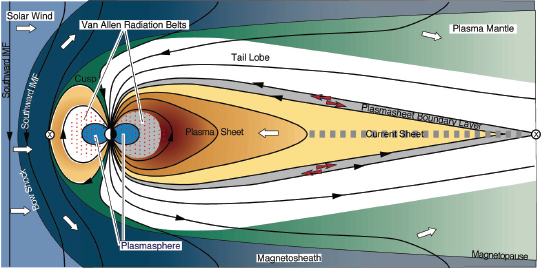
FIGURE 9.1 A schematic diagram of the magnetosphere, with various regions indicated. SOURCE: Adapted from L.A. Weiss, P.H. Reiff, R.V. Hilmer, J.D. Winningham, and G. Lu, Mapping the auroral oval into the magnetotail using dynamics explorer plasma data, Journal of Geomagnetism and Geoelectricity 44(12):1121, 1992.
muthally around Earth because of the strong magnetic field gradients, with positively charged ions drifting west and electrons drifting east, producing an electrical current large enough to substantially modify the global magnetic field. At still higher energies, the similarly drifting radiation-belt population possesses tremendous energy per particle, but because of its very low density carries little net current. Beyond the ring current and radiation belt is a low-density, hot plasma called the plasma sheet, extending to large distances into the magnetotail and serving as the reservoir for much of the plasma that ultimately feeds the inner-magnetosphere ring-current and radiation-belt populations. The high-latitude magnetic flux regions that are nearly devoid of plasma and that extend down the magnetotail from the polar caps are called the tail lobes. The magnetopause is the boundary of the magnetosphere, which separates it from the surrounding regions dominated by the solar wind and its magnetic field. Upstream from the magnetopause there is a standing shock wave, the bow shock, at which the supersonic solar wind is slowed and heated, enabling it to flow around the magnetospheric obstacle. The transition region of shocked solar wind between the bow shock and the magnetopause is known as the magnetosheath. A final region, beyond the bow shock, is called the foreshock, in which fast particles move upstream along the IMF and perturb the supersonic flow of the incoming solar wind. Another term that is often used synonymously with the magnetosphere-ionosphere system is “geospace.”
9.2.1.2 Physical Processes
Several primary physical processes produce the rich phenomenology of the structured, time-dependent magnetospheric system. “Magnetic reconnection” is the process by which energy stored in magnetic fields
is converted to plasma thermal energy, plasma bulk flow energy, and energized particles through a topological magnetic field reconfiguration. Charged particles in general conserve certain quantities of motion called adiabatic invariants, which relate aspects of the particle motion to magnetic field parameters and can lead to reversible energy changes. The term “wave-particle interactions” (WPIs) refers to the general and broad process by which electromagnetic waves and charged particles exchange energy and momentum. “Turbulence” describes the flow state of a fluid (including magnetized fluids) that is chaotic and stochastic. Turbulent media provide a rich opportunity for WPI. These same physical processes, determining the structure and dynamics of Earth’s coupled solar wind-magnetosphere system, also govern other planetary magnetospheres; by studying these fundamental processes in our own neighborhood, researchers glean universally applicable knowledge.
9.2.1.3 Coupling to the Ionosphere and Solar Wind
The magnetosphere is physically bounded by the ionosphere and solar wind at its lower and upper extents, respectively. Earth’s magnetosphere has no internal plasma sources, and so these boundary regions are the two major sources of magnetospheric plasma. The solar wind is a large source of protons and electrons into the magnetosphere, while the ionosphere contributes not only protons but also heavy ion species like oxygen, helium, and nitrogen, and their accompanying electrons. Furthermore, the solar wind and IMF, through magnetic reconnection and viscous interaction, drive convective flow throughout the magnetosphere. The ionosphere, with its high conductance, regulates and modulates this convective flow. In addition, the neutral gas of the upper atmosphere, known as the thermosphere, can also influence magnetospheric flow through ion-neutral collisions.
9.2.1.4 Space Weather and the Magnetosphere
“Space weather” is the name given to the time-dependent conditions and changes that occur in near-Earth space to the magnetospheric plasmas and fields. These include changes in the plasma density, temperature, and spatial distributions, from the cold plasmasphere to the very energetic radiation belts. In particular, space weather implies changes that have significant impact on technology and society. For example, the variable ionosphere and plasmasphere alter geolocation signals from GPS and transmissions from communication spacecraft; strong magnetospheric currents create geomagnetically induced currents in power distribution systems; energetic particles cause radiation damage to microelectronics and spacefarers; and substorm-related satellite charging causes malfunctions and surface degradation.
9.2.1.5 Magnetospheric Questions That Flow from the Motivations
The motivations underlying the study of solar and space physics3 apply directly to the study of Earth’s magnetosphere and its interaction with the solar wind and upper atmosphere: Earth’s magnetosphere (and those of other planets) is a fascinating, complex system, in which fundamental physical processes that operate throughout the universe combine with unique conditions of plasma sources, sinks, and drivers to create dynamic conditions that can affect humans and the technologies they depend on in space and sometimes on the ground.
________________________
3 See the introduction to Part II of this decadal survey report.
• Motivation 1. Understand our home in the solar system. The fundamental motivation of wanting to understand the fascinating Sun-Earth system drives the desire to learn what determines the dynamically changing charged-particle environment of the magnetosphere, from the lowest-energy particles emerging from the upper atmosphere, to the hazardous high-energy particles of the radiation belts. What exactly are the relationships between the different magnetospheric regions, and how are these regions coupled to the solar wind and upper atmosphere? How do these linkages determine magnetospheric dynamics? And what new insights do researchers gain from examining the similarities and differences in these regions and processes at other planets?
• Motivation 2. Predict the changing space environment and its societal impacts. A thorough understanding of this complex and highly coupled system will make it possible to predict its behavior under a variety of changing conditions, allowing anticipation and recognition of conditions that are adverse to human life and technology. Within the magnetosphere, researchers are particularly interested in how they can evaluate and predict damaging particle populations and electrodynamic fields.
• Motivation 3. Reveal universal physical processes. The geospace system constitutes a laboratory for exploring a wide variety of processes that operate throughout the universe. These include the ways in which ionized outflows can be driven from planetary atmospheres; how waves and particles provide coupling between disparate plasma regions; how plasmas interact with neutral materials; how magnetic reconnection occurs and how it energizes particles; how collisionless shock waves work; and how plasma turbulence is generated and dissipated and affects other dynamical processes.
The following sections outline recent progress made toward addressing the fundamental questions raised by these motivations; indicate the outstanding problems where significant progress can be accomplished in the near future, leading to the identification of specific science goals for the coming decade; and lay out the SWMI panel’s imperatives for actions that are needed to meet those goals.
9.3 SIGNIFICANT ACCOMPLISHMENTS OF THE PREVIOUS DECADE
The science of solar wind-magnetosphere interactions was established near the dawn of the space age, only 50 years ago. Since that time, knowledge of the magnetosphere has grown tremendously, progressing from discovery to understanding.
Early research focused on the discovery and exploration of the different regions that lie above Earth’s atmosphere: the radiation belts, the plasmasphere, the plasma sheet, and the solar wind. As researchers discovered these regions and the particle populations that define them, they sought to identify and understand the physical processes that accelerate and transport the particles. They also learned that the system is not static, but rather exhibits substantial variability with identifiable patterns. It became clear that different regions are not independent, but rather are intimately linked, and the variability and processes in one region can be clearly related to those in other regions.
Scientists now appreciate that the magnetosphere is a vast, highly coupled system that involves a wide array of fundamental physical processes and complex linkages between different regions. In the past decade this system’s impact on human technology and society has also come to be appreciated: storms and other disturbances in geospace have significantly disrupted and disabled spacecraft and ground-based power grids. Finally, as mankind has reached out to explore the solar system, researchers have discovered that other solar system bodies possess magnetospheres that exhibit many of the same processes found near Earth, but frequently manifested in different ways, and producing very different structure and dynamics.
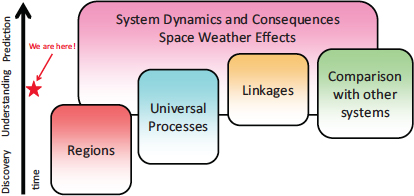
FIGURE 9.2 A schematic of the temporal progression of scientific research into solar wind-magnetosphere interactions, with time increasing upward.
Thanks to observations from new satellite missions, new analyses of data from previous missions, and improved numerical modeling capabilities, substantial progress has been made in the past decade to advance the field along the progression illustrated in Figure 9.2. Here the SWMI panel reviews some of these significant accomplishments. This review is by no means comprehensive, but it serves to illustrate the progress that continues to be made across a broad front of scientific endeavors. These accomplishments lay the foundation for what needs to be done in the future to continue the progression toward a comprehensive and actionable understanding of the SWMI system.
9.3.2.1 Statistical Description of Magnetospheric Properties
The decades-long reconnaissance of magnetospheric structure and dynamics has culminated in new statistical descriptions of plasma properties in the magnetosphere, particularly their systematic variation in response to solar wind drivers. For example, use of data sets that extend over more than a solar cycle showed the activity-dependent spatial distribution of plasma-sheet fluxes to be well described by a relatively simple convection model coupled with losses. These and similar results have solidified the statistical picture of the structure of the inner magnetosphere, but they do not capture the dynamic evolution of these regions, nor the coupling with the rest of the system.
9.3.2.2 Measuring Invisible Populations
During the past decade, several new techniques were exploited for measuring the plasma density over more extended regions than allowed by single-point, in situ measurements. On the ground, observations of field-line resonances enabled instantaneous determination of the equatorial plasma density over a broad spatial domain. In space, active radio sounding techniques probed the density variation along magnetic
field lines, and both radio sounding and extreme ultraviolet (EUV) images revealed not only the dynamics of the boundaries of the plasmasphere, but also actual global plasmaspheric density distributions. These advances made it possible for the first time to observe the global evolution of the plasmasphere in response to variable driving of the magnetosphere.
Energetic neutral atom (ENA) imaging established itself as a valuable tool in determining the global-scale configuration, dynamics, and composition of the ring current (e.g., see Figure 9.6 below). It was found that the peak of the ring-current proton distribution during the main phase of magnetic storms could lie not in the historically expected afternoon location, but in the early morning sector, revealing that the coupling with the ionosphere can very strongly alter the behavior of magnetospheric plasmas. In addition, the hydrogen component of the ring current builds up and decays gradually throughout a magnetic storm, but the oxygen component rises and falls impulsively. These variations in oxygen are often correlated with substorm injections, highlighting the coupling between the magnetosphere and ionosphere. These results represent more than a huge leap forward in system-level knowledge of the ring current; they also offer a tantalizing hint of the dynamic magnetospheric behavior that could be uncovered with higher-resolution, continuous, and global imaging.
9.3.3.1 Magnetic Reconnection
The recent decade has witnessed substantial progress in understanding how magnetic reconnection works. For example, increased computing power has allowed full-physics simulations describing the essential physics and structure of the diffusion region, the key region where magnetic field lines break and reform. The decoupling of ion and electron motions plays a key role, accelerating the energy release, creating high-speed electron beams, and warping the magnetic field. These predictions have facilitated the first direct detections of the ion diffusion region in the magnetosphere (Figure 9.3) and in the laboratory, as well as glimpses of the much smaller electron diffusion region. The observations in the vicinity of the diffusion region revealed surprisingly that electrons can be accelerated by reconnection to hundreds of kiloelectron volts.
The past decade has also witnessed surprises regarding the triggering and modulation of reconnection: theoretical studies using fully three-dimensional simulations revealed that the added dimension facilitates plasma instabilities that can disrupt the diffusion region, making reconnection highly turbulent. Observationally, reconnection seems to behave differently in different regions. On the dayside magnetopause, as well as recently discovered in the solar wind, magnetic reconnection can be quite steady in time and extended in space. In the magnetotail, however, reconnection is most often patchy and bursty, producing narrow flow burst channels. Using multispacecraft observations, these reconnection-generated flow channels have now been demonstrated to initiate magnetospheric substorms.
9.3.3.2 Wave-Particle Interactions
A delicate balance between acceleration and loss caused by wave-particle interactions controls the variability of radiation belt fluxes during geomagnetic storms. Understanding of magnetospheric plasma waves and their role in radiation belt dynamics has increased significantly during the past decade. Statistical analyses of satellite wave data have led to the development of global models of the wave environment. These have then been used to quantify the rates of energization and scattering loss to the atmosphere. Time-dependent two-dimensional and three-dimensional models for the radiation belts and the ring cur-
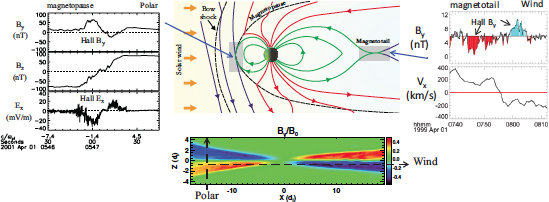
FIGURE 9.3 At the center is a schematic of the magnetosphere indicating the regions where magnetic reconnection usually occurs. The lower panel is a simulation result of the quadrupolar magnetic field topology in the ion diffusion region, and the left and right panels are observations of these field topologies by the Polar and the Wind spacecraft, respectively. For comparison, the relative motions of the two spacecraft through the reconnection region are indicated on the simulation result panel. The Hall field arises from the decoupling of the ions from the electrons. SOURCE: Left: Adapted from F.S. Mozer, S.D. Bale, and T.D. Phan, Evidence of diffusion regions at a subsolar magnetopause crossing, Physical Review Letters 89:015002, 2002. © 2002 The American Physical Society. Middle, upper: C. Day, Spacecraft probes the site of magnetic reconnection in Earth’s magnetotail, Physics Today 54:10, 2001. Middle, lower: Adapted from T.D. Phan, J.F. Drake, M.A. Shay, F.S. Mozer, and J.P. Eastwood, Evidence for an elongated (>60 ion skin depths) electron diffusion region during fast magnetic reconnection, Physical Review Letters 99:255002, 2007. © 2007 The American Physical Society. Right: Adapted from M. Øieroset, T.D. Phan, M. Fujimoto, R.P. Lin, and R.P. Lepping, In situ detection of collisionless reconnection in the Earth’s magnetotail, Nature 412:414-417, 2001, doi:10.1038/35086520.
rent, which incorporate the effects of wave-particle scattering, have been developed and are beginning to provide a more realistic picture of storm-time particle dynamics.
Satellite observations of peaks in the radial profiles of radiation-belt electrons have demonstrated that local acceleration due to WPI may at times dominate over traditionally accepted acceleration associated with diffusive radial transport. Diffusive radial transport may actually lead to enhanced losses at the magnetopause, causing a decrease in trapped flux rather than an increase. Particle interactions with “chorus” waves in particular have been shown to provide a major probable source of local acceleration. The source of plasmaspheric hiss, another wave mode known to be responsible for strong losses of radiation belt electrons near the edge of the plasmasphere, has been shown to be discrete chorus emissions generated in the low-density region outside the plasmapause (Figure 9.4). Chorus emissions have also been shown to be the dominant cause of scattering of plasma sheet electrons, leading to their precipitation into the atmosphere, where they produce the diffuse aurora. Intriguingly, recent observations of extremely large-amplitude waves suggest that nonlinear wave-particle physics may play an important role in radiation belt dynamics.
9.3.3.3 Turbulence
In the past decade the presence of large-amplitude MHD fluctuations in the magnetotail plasma sheet has been established by spacecraft measurements, and the spatial scales (~1 RE) and timescales (~1 minute)
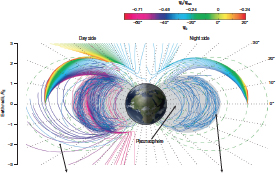
FIGURE 9.4 Ray path calculations showing how discrete whistler-mode chorus emissions generated outside the plasma-pause can be refracted into the plasmasphere, become trapped, and eventually merge to form incoherent plasmaspheric hiss. SOURCE: J. Bortnik, R.M. Thorne, and N.P. Meredith, The unexpected origin of plasmaspheric hiss from discrete chorus emissions, Nature 452:62-66, 2008, doi:10.1038/nature06741.
of the fluctuations have been determined. Global simulations of the solar-wind-driven magnetosphere are reaching high-enough spatial resolutions in the magnetotail to enable them to predict irregular vortical flows at these scales and to statistically match the properties of the vortical flows to observed fluctuations. However, the dynamical nature of these fluctuations, what causes them, and their influence on the behavior of the magnetosphere have not been determined. Fluid turbulence provides one pathway by which energy moves across scale sizes from large to small where energy can be dissipated in the form of heating. When and where turbulent processes play a significant role in magnetospheric dynamics remain unclear.
9.3.4.1 Coupling with the Solar Wind
The variable solar wind drives a wide range of variations in magnetospheric behavior. Over the past decade, continuous measurements of the solar wind combined with observations throughout geospace have enabled significant advances in identifying which specific large- and mesoscale solar-wind properties produce different modes of magnetospheric response (e.g., storms, steady magnetospheric convection events, sawtooth events). For example, studies have linked variations in the solar wind dynamic pressure to radiation-belt loss and energization processes. Other studies quantified that the strength of geomagnetic storms depends on both the electrodynamic coupling between the solar wind and the magnetosphere and plasma loading of the magnetosphere, including both ionospheric and solar wind sources. Spacecraft observations and numerical simulations reveal that solar-wind plasma entry into the magnetosphere is surprisingly efficient under “quiescent” conditions of northward interplanetary magnetic field. This plasma in turn participates as a substantial element of the storm-time ring-current development when southward interplanetary magnetic fields couple with and energize the magnetosphere. Additional progress has also been made in delineating the effects of smaller-scale solar wind variations on magnetospheric behavior. While some of the specific processes that mediate this coupling with the solar wind were clarified in the past decade, major questions remain regarding the spatial extent over which they operate and the condi-
tions that control their relative importance (such as small-scale solar wind dynamic pressure variations and how they drive ULF waves regionally and globally in the magnetosphere).
9.3.4.2 Magnetosphere-Ionosphere Coupling
Coupling between the magnetosphere and the ionosphere represents a key linkage in geospace. Over the past decade, combined ground-based and space-based observations, theory, and modeling greatly advanced understanding of this coupling as well as fostering new discoveries and new areas of investigation. Empirical studies of spacecraft data established correlations between solar wind and magnetosphere-ionosphere coupling parameters. For example, solar wind density and dynamic pressure increases lead to enhanced ionospheric outflow. Empirical relationships quantified how electromagnetic energy flux into the ionosphere led to consequent outflow rates. Supporting theory has shown that producing this outflow requires a multistep process involving a combination of WPI and electromagnetic forcing. Researchers have also realized the important consequences this outflowing ionospheric plasma has on the dynamic evolution of the magnetosphere. Observations have shown how this outflow merges with plasmas of solar wind origin in the plasma sheet, creating a multi-species plasma. Theorists have shown how differently reconnection behaves in multispecies plasmas, which in turn substantially modifies its impacts on magnetospheric evolution and topology. Multifluid global-scale simulations have confirmed the major role ionospheric outflow plays in the creation of periodic substorm or so-called sawtooth intervals (Figure 9.5). Although the basic correlations and the fundamental building blocks have been established, the creation of a complete theory of outflow and a detailed understanding of their magnetospheric consequences remains a goal for the next decade.
The past decade has witnessed a tremendous improvement in understanding how the inner magnetosphere responds to storm-time disturbances as a coherent system of coupled, mutually interacting plasmas. Imaging and global simulations have played a central role by providing quantitative contextual information that ties together single-point observations and gives much-needed global constraints for predictive models. The modern picture that has resulted is one where multiple dynamic linkages are initiated by processes with spatial scales ranging from highly localized to global.
Investigations uncovered key causal relationships between solar wind driving and inner-magnetospheric response. Changes in the north-south component of the IMF were shown to trigger the aurora, ring current injections, and the commencement or cessation of plasmaspheric erosion. Numerical models and global ENA images showed that the ring current is highly asymmetric during the main phase of storms (Figure 9.6). EUV images confirmed the predicted existence of plasmaspheric plumes (see Figure 9.6) and tracked their temporal evolution globally.
The directly driven response of the inner magnetosphere was found to engender electrodynamic coupling among different regions. For example, storm-time ring-current-ionosphere coupling profoundly distorts the inner magnetospheric field and feeds back to the ring current itself, skewing its peak toward dawn (see Figure 9.6). Moreover, subauroral polarization streams (SAPS) were identified as duskside flow channels, arising from ionospheric coupling, that maintain plumes long past the subsidence of solar wind driving. These studies affirmed early theoretical concepts,4 quantifying just how poorly shielded the innermost magnetosphere can be during rapid changes in magnetospheric convection.
________________________
4 See, for example, R.A. Wolf, M. Harel, R.W. Spiro, G.H. Voigt, P.H. Reiff, and C.-K. Chen, Computer simulation of inner magnetospheric dynamics for the magnetic storm of July 29, 1977, Journal of Geophysical Research 87:5949, 1982.
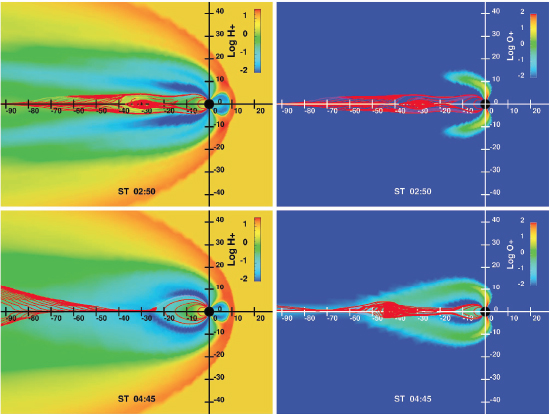
FIGURE 9.5 Multifluid MHD simulation results of substorm initiation without (left-hand panels) and with (right-hand panels) O+ outflow from the ionosphere. In the upper panels, both simulations show a plasmoid release. In the lower panels (~2 hours later), the magnetosphere has stabilized in the simulation without O+, while the result with O+ shows a second plasmoid release. The addition of O+ as a distinct fluid with a significant contribution to the mass density makes the magnetosphere repetitively unstable. SOURCE: M. Wiltberger, W. Lotko, J.G. Lyon, P. Damiano, and V. Merkin, Influence of cusp O(+) outflow on magnetotail dynamics in a multifluid MHD model of the magnetosphere, Journal of Geophysical Research-Space Physics 115:A00J05, 2010. Copyright 2010 American Geophysical Union. Reproduced by permission of American Geophysical Union.
The past decade of research has also identified other ways in which the ionosphere-thermosphere and magnetosphere affect each other: plasmaspheric corotation lag was discovered and interpreted as a consequence of two-way coupling between the magnetosphere-ionosphere-thermosphere regions. Recent work demonstrates that the diffuse aurora is the main source of energy deposition into the ionosphere and that relativistic precipitation can have important effects on atmospheric chemistry, including ozone depletion. Several serendipitous opportunities for imaging of both the northern and the southern aurorae simultaneously provided tests of auroral conjugacy and the dynamical processes thought to drive the aurorae.
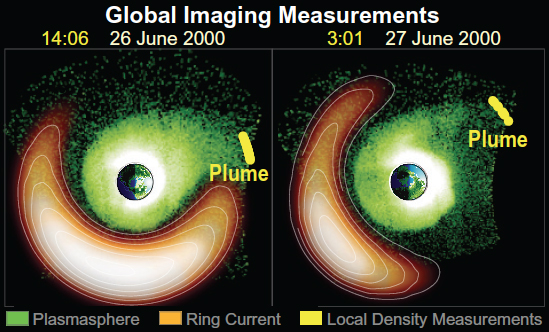
FIGURE 9.6 The past decade produced a new understanding of the system-level dynamics and mutual interaction of the plasmasphere (cold plasma) and ring current (warm plasma). Plasmaspheric images from the IMAGE satellite (in green, above) revealed coherent plume structure and plasmapause distortions from time-varying electric fields. IMAGE ENA images (orange, above) show the partial ring current whose pressure distorts the solar wind forcing field that erodes the plasmasphere. SOURCE: Adapted from J. Goldstein, B.R. Sandel, M.F. Thomsen, M. Spasojevi?, and P.H. Reiff, Simultaneous remote-sensing and in situ observations of plasmaspheric drainage plumes, Journal of Geophysical Research 109:A03202, doi:10.1029/2003JA010281, 2004. Copyright 2004 American Geophysical Union. Reproduced by permission of American Geophysical Union.
Coordinated studies employing imaging, remote sensing, modeling, and local measurements have demonstrated the critical importance of hot-cold plasma interactions. Imaging revealed the dynamics of ring-current-plasmasphere overlap (see Figure 9.6) and helped confirm the prediction that growth of ion cyclotron waves in this region can cause scattering losses of both energetic ions and radiation-belt electrons. Theoretical predictions that absence of cold dense plasma facilitates the acceleration of energetic electrons to relativistic energies were confirmed by observations. Studies showed that cold, dense plasma plays a pivotal role in defining the wave environment that controls energetic particle behavior, overturning the decades-old idea of a passive, quiescent plasmasphere in favor of an extremely dynamic, influential one. Other aspects of this influence included partial quenching of dayside magnetopause reconnection by plasmaspheric plumes and the creation of ionospheric density enhancements that refract and scintillate GPS signals, producing ranging errors of tens of meters.
It is clear that much progress has been made in understanding the system-level dynamics of the inner magnetosphere. In the coming decade, this knowledge must be refined and extended to encompass the entire magnetosphere-ionosphere-thermosphere system.
9.3.6 Comparative Magnetospheres
Over the past decade, researchers have made many advances toward understanding the structure, dynamics, and linkages in other planetary magnetospheres or systems with magnetospheric-like aspects.
For the inner rocky planets, there are new results on atmospheric loss at Mars, through numerical modeling of the solar wind interaction with the atmosphere, identification of Venus lightning from high-altitude radio wave measurements, and magnetospheric dynamics at Mercury, with events analogous to substorms at Earth.
In situ data have yielded a better understanding of the dynamics, structure, and linkages of Jupiter’s complex magnetosphere. Flux-tube interchange processes transport Io-originating plasma outward through weak, centrifugally driven transport on the dayside. On the evening and nightside, where there is no confinement by the solar wind, this transport occurs through a more explosive centrifugal instability, leading to plasmoid loss. Observations far down the distant magnetotail revealed anti-sunward flows of plasma every few days, as well as bursts of energetic particles accelerated in regions ~200 Jupiter radii down the tail on the dusk flank. Earth-orbiting satellites imaged X-ray emissions from the auroral/polar regions resulting from capture, acceleration, and subsequent atmospheric charge exchange of highly ionized heavy solar wind ions.
There have been advances in theoretical understanding and observational tests of the impact of solar wind dynamic pressure variations on Jovian auroral emissions, and significant progress in understanding magnetospheric interactions with Jupiter’s satellites, especially Io. ENA imaging demonstrated that an extensive torus of neutral gas from Europa has a significant impact on Jupiter’s magnetosphere.
Extensive measurements have been made of Saturn’s highly structured, interconnected, dynamical system. Magnetospheric phenomena reveal two distinct, narrow band modulations near Saturn’s rotation period (Figure 9.7a). Plumes of water gas and ice crystals emanate from rifts in the south polar region of Enceladus (Figure 9.7b). Negatively charged hydrocarbon ions were discovered in Titan’s ionosphere and may be important to the chemistry of Titan’s upper atmosphere. Flux-tube interchange in the middle magnetosphere followed by plasmoid release in the magnetotail was revealed as the primary transport mechanisms for cold Enceladus plasma. Solar wind pressure variations strongly modulate the activity in the outer magnetosphere, including Saturn kilometric radio emission and acceleration of energetic particles in Saturn’s ring current (Figure 9.7c). Saturn’s rotating ring current results from both relatively symmetric centrifugal acceleration of the sub-corotating cold plasma, and from more asymmetric hot plasma pressure.
9.4 SCIENCE GOALS FOR THE COMING DECADE
Today, researchers stand on the threshold of developing a comprehensive understanding of Earth’s magnetosphere, its coupled behavior, and its impacts. This understanding will enable a capability to anticipate, predict, and ameliorate the effects of variable space weather. In this section, the SWMI panel takes stock of where we are in the progression shown in Figure 9.2, and identifies the high-priority science goals that must be pursued in the coming decade. After describing each science goal, the panel discusses how their accomplishment relates to the achievement of the four decadal survey key science goals identified in Chapter 1 (see Box 9.1). Table 9.1 summarizes the expected contributions of the SWMI science goals to the decadal survey key science goals. Table 9.1 demonstrates that the discipline advances through a strategic and thoughtful combination of discovery-class observations promoting new physical models and theories, and the targeted observations needed to differentiate between competing physical theories.
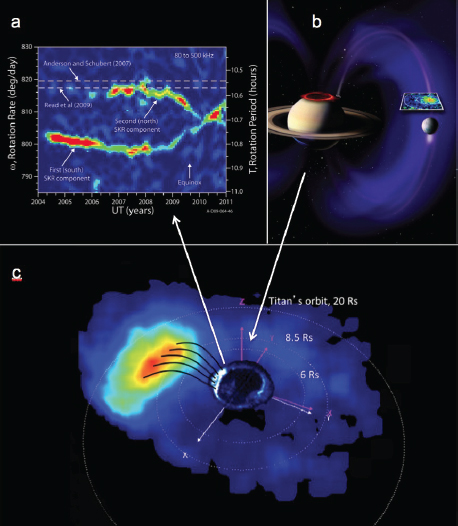
FIGURE 9.7 Saturn’s Enceladus-dominated, rotating magnetosphere. (a) Saturnian kilometric radio (SKR) periodicities. (b) Enceladus, its geysers, resulting plasma, and connection to Saturn’s ionosphere. (c) Return of energized plasma after tail plasmoid loss. These injections yield bright auroral displays in the same region as the SKR radio emissions. SOURCE: (a) D.A. Gurnett, J.B. Groene, A.M. Persoon, J.D. Menietti, S.-Y. Ye, W.S. Kurth, R.J. MacDowall, and A. Lecacheux, The reversal of the rotational modulation rates of the north and south components of Saturn kilometric radiation near equinox, Geophysical Research Letters 37:L24101, doi:10.1029/2010GL045796, 2010. Copyright 2010 American Geophysical Union. Reproduced by permission of American Geophysical Union. (b) JHUAPL/NASA/JPL/University of Colorado/Central Arizona College/ SSI. (c) Adapted from D.G. Mitchell, S.M. Krimigis, C. Paranicas, P.C. Brandt, J.F. Carbary, E.C. Roelof, W.S. Kurth, D.A. Gurnett, J.T. Clarke, J.D. Nichols, J.-C. Gérard, et al., Recurrent energization of plasma in the midnight-to-dawn quadrant of Saturn’s magnetosphere, and its relationship to auroral UV and radio emissions, Planetary and Space Science 57(14-15):1732-1742, doi:10.1016/j.pss.2009.04.002, 2009.
BOX 9.1 DECADAL SURVEY KEY SCIENCE GOALS
- Determine the origins of the Sun’s activity and predict the variations in the space environment.
- Understand the dynamics and coupling of Earth’s magnetosphere, ionosphere, and atmosphere and their response to solar and terrestrial inputs.
- Determine the interaction of the Sun with the solar system and the interstellar medium.
- Discover and characterize fundamental processes that occur both within the heliosphere and throughout the universe.
Observation from instruments on space platforms have provided researchers with a global view of the different plasma regions found in the magnetosphere and enabled a general understanding of their statistical structure and shape. During the past decade, space missions have delivered pathfinder global observations of some of the inner magnetospheric regions. These observations, from the IMAGE and TWINS satellites, were revolutionary in their global perspective but were unfortunately characterized by relatively low spatial and temporal resolution. Also during the past decade, from THEMIS and from serendipitous alignments of Heliophysics Systems Observatory satellites, researchers acquired pathfinder one-dimensional simultaneous in situ observations of the outer magnetosphere, but still have no unambiguous observations of its two-dimensional or three-dimensional structure and evolution. In sum, scientists do not know the instantaneous global and mesoscale structure of each of the various regions, nor how it evolves with time and solar wind driving.
To understand how the system as a whole behaves in response to variations in the solar wind driver requires a better view of the simultaneous evolution of the various parts of the system, leading to the first SWMI science goal for the coming decade.
9.4.1.1 SWMI Science Goal 1. Determine How the Global and Mesoscale Structures in the Magnetosphere Respond to Variable Solar Wind Forcing
Digging Deeper
Investigation into the global and mesoscale magnetospheric reaction to the solar wind is a challenging problem. Much like meteorology, the plasmas of geospace interact in a highly complex, nonlinear way. Actions and reactions feed back on each other. For example, merging of the magnetic fields of the solar wind and Earth may impose up to a few hundreds of thousands of volts across the entire magnetosphere, activating an enormous, global convection cycle that strips away tons of near-Earth plasma and drags Earthward the plasma-loaded magnetic field lines of the distant nightside magnetosphere. In response, geospace creates its own cross-scale network of intricately interconnected electrical currents and fields whose effect is anything but uniform. Partial and temporary shielding occurs in some regions, while amplification of solar wind driving occurs in other regions, although exactly where and on what timescales are poorly known. Internal feedback profoundly modifies the whole system and can outlast by hours the cessation of solar wind forcing.
Predicting the behavior of this highly coupled, self-modifying system will require powerful models that include many physical processes operating over a wide range of spatial and temporal scales. The development and validation of such models will require a strong foundation in observations of global
TABLE 9.1 Expected Level of Contribution of Each SWMI High-Priority Science Goal to Accomplishing the Decadal Survey Key Science Goals of Chapter 1
|
|
||||
| SWMI Science Goals | Decadal Key Science Goals | |||
| Determine the origins of the Sun’s activity and predict the variations in the space environment | Understand the dynamics and coupling of Earth’s magnetosphere, ionosphere, and atmosphere and their response to solar and terrestrial inputs | Determine the interaction of the Sun with the solar system and the interstellar medium | Discover and characterize fundamental processes that occur both within the heliosphere and throughout the universe | |
|
|
||||
| Determine how the global and mesoscale structures in the magnetosphere respond to variable solar wind forcing |  |
 |
 |
 |
| Identify the controlling factors that determine the dominant sources of magnetospheric plasma | |
|
|
|
| Understand how plasmas interact within the magnetosphere and at its boundaries | |
|
|
|
| Establish how energetic particles are accelerated, transported, and lost | |
|
|
|
| Discover how magnetic reconnection is triggered and modulated |  |
|
|
|
| Understand the origins and effects of turbulence and waveparticle interactions | |
|
|
|
| Determine how magnetosphere-ionosphere-thermosphere coupling controls system-level dynamics | |
|
|
|
| Identify the structures, dynamics, and linkages in other planetary magnetospheric systems | |
|
|
|
|
|
||||
| Contribution to Action | Major | Large | Significant | Some | Minimal | |
|
|
|
|
|
||
|
|
||||||
response. This foundation does not yet exist; to provide it will require instant-to-instant determination of the state of the system, at both global and mesoscales. Progress in the coming decade will thus require a comprehensive set of observations that connect global-scale changes to the mesoscale currents, flows, fields, heating, and particle acceleration that modify that global response. For example, continuous, global auroral imaging would enable researchers to follow rapid storm- and substorm-driven changes down to the scale of individual auroral arcs. Nonstop global plasma imaging could resolve the minute-to-minute development of cross-scale, cross-region plasma energization and transport, erosion of the plasmasphere, and development of internal structure. Uninterrupted radar measurements could follow ionospheric flows and fields. Additional observations that would help relate global and mesoscale magnetospheric evolution to solar wind driving would include continuous global distributions of field-aligned currents linking the magnetosphere and ionosphere, detailed measurements of ionospheric ion outflow, and observations of plasma-sheet and cusp plasma conditions and composition. The key to significant progress in this area is to have these global and mesoscale observations available simultaneously.
While touching on decadal survey key science goals 1, 3, and 4, this thrust is aimed squarely at decadal survey key science goal 2. This problem is one of the most challenging scientific problems remaining in the realm of geospace, and one of the most important to solve toward the goal of providing the capability to predict the effects of solar variability on the environment and on society. The geospace community has moved ever closer to that goal over the past several decades; with the proper focus and implementation, the coming decade can more fully realize the benefits to society of this endeavor.
Linkages
Researchers know that key regions are coupled and understand the general nature of the linkages. Some involve transfer of charged particles from one region to another, while others involve electrodynamic connections, and still others involve plasma instabilities and waves. Pathfinder observations have been collected of ionospheric plasma outflows, auroral and radiation-belt precipitation into the ionosphere, solar-wind plasma entry into the magnetosphere, and signatures of nonlinear feedback in the electrodynamic coupling between the solar wind, magnetosphere, and ionosphere. However, still lacking is a quantitative understanding of the linkages, including their critically important nonlinear, feedback aspects. In addition, researchers do not understand the dependence of these linkages on the conditions within the regions nor on the variability of the driver. Furthermore, there is compelling evidence that preconditioning, system memory, and prior history of the solar wind driver confound the coupling. Since history in the solar wind often does not repeat itself (except for recurring patterns such as stream interaction regions), this presents a challenge for general understanding.
To understand how the magnetospheric system as a whole behaves in response to variations in the solar wind driver, researchers need a quantitative understanding of these linkages, including what and how conditions control them and what the feedback processes are and how they work. These needs motivate the two SWMI science goals discussed next.
9.4.1.2 SWMI Science Goal 2. Identify the Controlling Factors That Determine the Dominant Sources of Magnetospheric Plasma
Digging Deeper
There are two primary sources for magnetospheric plasma: the solar wind and the ionosphere. Solar wind plasma enters predominantly via reconnection between interplanetary and magnetospheric magnetic fields; diffusive entry constitutes a smaller contribution. Ionospheric plasma enters by flowing outward into the magnetosphere, as the result of being heated and/or directly accelerated through auroral processes
and solar-wind influences. Solar wind and ionospheric plasma sources both show enhancements during geomagnetically active times, but through different causal pathways. Understanding the relative importance of these two sources as a function of time, space, and driving conditions is critical. For example, the ionospheric source is low-charge-state and heavy-ion rich, which affects magnetospheric dynamics differently than does the high-charge-state, proton-rich source, especially in storm-time ring current evolution, reconnection rates, plasma wave excitation and interactions, and instability thresholds.
Multiple observations at the magnetopause have demonstrated that reconnection between the geomagnetic field and the IMF controls solar wind entry into the magnetosphere. However, fundamental questions on this process remain. Even if given the IMF and solar wind conditions, the location and rate of reconnection still cannot be predicted. In addition, the relative importance of diffusive entry is still largely unknown even though assumed to be small most of the time. While diffusive processes are often assumed in cases where reconnection cannot explain observed entry, the conditions under which they occur have not been established and remain a mystery.
As illustrated by Figure 9.8, ionospheric outflow is a multistep process in which electromagnetic and particle inputs, driven by solar wind-magnetosphere interactions, heat the ionosphere. Waves, also driven
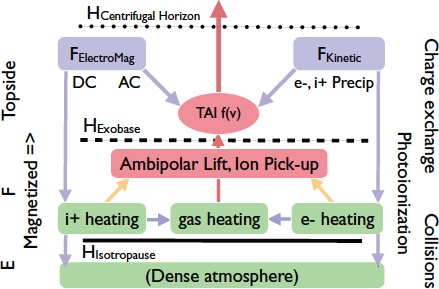
FIGURE 9.8 Schematic illustration of the outflow process. SOURCE: T.E. Moore, L. Andersson, C.R. Chappell, G.I. Ganguli, T.I. Gombosi, G. V. Khazanov, L.M. Kistler, D.J. Knudsen, M.R. Lessard, M.W. Liemohn, J.P. McFadden, et al., Mechanisms of Energetic Mass Ejection (MEME), white paper submitted to the Committee on a Decadal Strategy for Solar and Space Physics (Heliophysics). Adapted from R.J. Strangeway, R.E. Ergun, Y.-J. Su, C.W. Carlson, and R.C. Elphic, Factors controlling ionospheric out-flows as observed at intermediate altitudes, Journal of Geophysical Research 110:A03221, 2005, doi:10.1029/ 2004JA010829, as adapted by T.E. Moore and G.V. Khazanov, Mechanisms of ionospheric mass escape, Journal of Geophysical Research 115:A00J13, 2010, doi:10.1029/2009JA014905. Copyright 2010 American Geophysical Union. Reproduced by permission of American Geophysical Union.
by solar wind-magnetosphere interaction, further accelerate the ions with a component that drives them outward along geomagnetic field lines. While the basic components controlling outflow are understood, quantitative relationships between solar wind conditions and energy inputs, and between energy inputs and resulting outflow, have not been established.
For example, researchers do not know how the amount of electromagnetic energy entering the ionosphere depends on the specific solar wind conditions. In recent years, the spatial and temporal distribution of Poynting flux has received much attention. Driven by both dayside and nightside reconnection and associated fast flows, the associated Poynting flux drives not only convection but also ionospheric outflows and is now recognized as an important term in the ionospheric energy balance. The spatial and temporal variability of precipitating electron flux is also not well established, and the altitude and locations where these inputs deposit their energy are not yet clear. In addition, the atmospheric and ionospheric responses are poorly quantified.
Current understanding is limited by poor knowledge of the wave environment generated by the energy input; which waves accelerate and heat the plasma; and the impact of any feedback and saturation processes. These issues must be resolved in order to develop a predictive understanding of the ionospheric response to solar wind forcing; their resolution also has strong links to decadal survey key science goals 2 and 4. Identifying the factors that control solar wind and ionospheric contributions to magnetospheric populations is fundamental to determining the dynamics of the magnetosphere, ionosphere, and atmosphere, their coupling, and the response to solar wind variability.
SWMI science goal 3 is the panel’s second critical goal related to linkages between different regions and populations.
9.4.1.3 SWMI Science Goal 3. Understand How Plasmas Interact Within the Magnetosphere and at Its Boundaries
Digging Deeper
The interaction between the solar wind and magnetosphere results in energy and mass transfer across the magnetic fields at their interface. One key to understanding magnetospheric processes lies at the magnetopause. Past observations by single spacecraft or closely spaced spacecraft established that processes such as magnetic reconnection, diffusive entry, and Kelvin-Helmholtz instability operate at the magnetopause and lead to solar wind entry across the magnetopause These processes, especially reconnection, and their consequences depend on the IMF orientation, solar wind convection electric field, and solar wind pressure. Even within the magnetotail itself, significant ion densities are known to exist in the lobes, yet only a portion eventually enters into the plasma sheet; the remaining fraction escapes down the tail through the distant side of the near-Earth or mid-tail reconnection. This is another critical aspect of solar wind entry: solar wind plasma has not been at least quasi-trapped into the magnetosphere until it crossed the nightside reconnection separatrix. Due to the lack of large-scale observations of the outer magnetosphere, significant questions remain concerning the global consequences of these processes and their relative importance under different solar wind conditions.
Another crucial interface within the magnetosphere is that between the magnetotail and the inner magnetosphere. In response to solar-wind energy input, magnetotail processes produce narrow flow bursts, transporting plasmas and magnetic flux from the distant magnetotail to the inner magnetosphere. While the past decade revealed the size of individual flow channels and their temporal evolution, much remains unknown about their global occurrence properties. This limits the ability to understand the transport of magnetotail particles into the inner magnetosphere, where they interact with other particle populations. The current inability to observe the three-dimensional, time-dependent magnetotail limits the ability to
understand transport processes at the inner edge of the magnetotail and their response to time-varying solar wind.
Exquisite regions of overlap between the cold plasmasphere plasma and the hotter populations of the plasma sheet, ring current, and radiation belt define conditions in the inner magnetosphere. In the regions of overlap, these disparate plasmas interact with one another, largely through intermediary electromagnetic waves, leading to important dynamical consequences: enhanced particle precipitation, large-scale instabilities, particle energization, and enhanced transport. Because systems-level measurements have been insufficient, a quantitative understanding is lacking of how these particle interactions are controlled by external driving parameters and how important they are under various conditions. To predict how the system behaves in response to variations in the solar wind requires quantitative understanding of the nature and significance of the fundamental processes driven by these overlapping, disparate plasma populations. Progress in the coming decade requires a program incorporating coordinated multipoint and/or remote-sensing global measurements, along with global numerical simulations and local theory.
This goal directly addresses decadal survey key science goal 2, with significant contributions to understanding fundamental processes (key science goal 4) and enabling prediction of magnetospheric variability (key science goal 1).
Scientists have identified a range of important physical processes operating in different magnetospheric regions, and understand what their consequences are, locally and in some cases globally. This understanding stems from pathfinder observations of some of these processes and of the solar wind conditions under which they appear to operate. In addition, scientists eagerly anticipate information about reconnection and particle energization from the Magnetospheric Multiscale (MMS) and Radiation Belt Storm Probes (RBSP) missions. However, even with these additions to the Heliophysics Systems Observatory, adequate insight into the nature and consequences of important processes like turbulence and wave-particle interactions will still be lacking. Moreover, scientists do not know the relative effectiveness of these various processes under different conditions, nor how they turn on and off. To understand how the system as a whole behaves in response to variations in the solar wind driver, improved knowledge is needed of how various conditions control these processes, including their own nonlinear feedback. Thus, for the coming decade, including the goals for MMS and RBSP, there are three SWMI science goals (4-6 below) relating to fundamental physical processes in solar wind-magnetosphere interactions.
9.4.2.1 SWMI Science Goal 4. Establish How Energetic Particles Are Accelerated, Transported, and Lost
Digging Deeper
The flux of energetic particles in Earth’s radiation belts exhibits extreme variability, with timescales ranging from a few minutes to days. However, current understanding of the underlying physical mechanisms for this variability remains incomplete. The observed variability, particularly for energetic electrons in the outer radiation belt, has been associated with pronounced changes in either the acceleration or the loss processes, both of which are enhanced during geomagnetic activity associated with solar disturbances. The current difficulty in modeling radiation belt dynamics is due to the inability to adequately quantify the variability of the dominant source and loss processes under different levels of geomagnetic activity.
In the essentially collisionless magnetosphere, energetic particles tend to behave adiabatically in the absence of perturbing influences, that is, preserving certain characteristic invariant properties of their gyro, bounce, and drift motions when the magnetic fields they move within evolve slowly relative to the timescales of these motions. Changes in the adiabatic trapped particle motion are primarily due to interac-
tions with various plasma waves and shock fronts, which cause a violation of one or more of the adiabatic particle invariants, leading to loss to the atmosphere, exchange of energy between waves and particles, or radial transport. Waves responsible for such processes either are generated naturally during the injection of medium-energy particles into the inner magnetosphere, or are excited by macroscopic changes in the system caused by solar wind variations, interplanetary shocks, or substorm activity. Accurate modeling of the energetic particle source and loss processes thus requires a global understanding of all important waves, or shock characteristics, and the variability of their power spectra. Moreover, several of these important waves attain amplitudes at which nonlinear scattering occurs, but it is not yet known how pervasive such conditions are, nor how to incorporate them in global radiation belt models.
The radiation belt population is strongly coupled to changes in the medium-energy ring current and plasma-sheet populations, which provide a reservoir of both source particles and energy needed to accelerate a fraction of the lower-energy particles to radiation-belt energies. In this regard, RBSP stands to benefit from existing missions of the Heliophysics Systems Observatory. Electrons in the outer radiation belt are undoubtedly seeded by lower energy particles injected from beyond geostationary orbit. Missions such as Geotail, Cluster, and THEMIS provide these higher-altitude measurements needed to augment RBSP’s local studies of acceleration and heating in the radiation belts. Improvements in understanding how the radiation belts respond to changes in the solar wind will require the development of numerical codes capable of simulating the development of these populations and the magnetic field distortions they produce, the incorporation of physically realistic particle scattering and diffusion into such codes, and further detailed in situ observations to establish the exact nature of the scattering. Improved measurements of the spatial distribution of the radiation belt population are needed to discriminate between wave-driven energization processes that occur locally and energization that occurs via spatial diffusion. Further observations of the prompt acceleration of electrons and ions by interplanetary shocks penetrating into the magnetosphere are also required to establish the significance of this process.
Understanding the energization of the radiation belts was one of the top-level science objectives identified in the 2003 decadal survey5 and led not only to the impressive advances described in Section 9.3 but also to NASA’s RBSP. It is expected that RBSP will provide definitive answers to many of the outstanding questions in this area, but since it has not yet launched, the SWMI panel reiterates the enduring importance of those questions and endorses anew the science objectives of the RBSP mission.
Predicting the variability of the highly energetic and thus hazardous populations of our space environment is a central part of decadal survey key science goal 1. Since this variability is explicitly determined by processes operating within the magnetosphere in response to solar wind input, this goal also enables a significant portion of decadal survey key science goal 2. Those processes, as described above, are fundamental ones that presumably operate throughout the universe, including in other planetary magnetospheres, and so accomplishing this goal will also contribute significantly to decadal survey key science goal 4.
The second critical SWMI science goal related to universal physical processes is goal 5.
9.4.2.2 SWMI Science Goal 5. Discover How Magnetic Reconnection Is Triggered and Modulated
Digging Deeper
Magnetic reconnection is a ubiquitous process in plasmas in which magnetic field lines break and reform, causing an explosion powered by magnetic field annihilation. Examples of its fundamental role include releasing the energy that drives solar flares and coronal mass ejections, coupling the solar wind
________________________
5 National Research Council, The Sun to the Earth—and Beyond: A Decadal Research Strategy in Solar and Space Physics, The National Academies Press, Washington, D.C., 2003; and National Research Council, The Sun to the Earth—and Beyond: Panel Reports, The National Academies Press, Washington, D.C., 2003.
to Earth’s magnetosphere, and coupling plasma in the heliosphere to that in the interstellar medium. Magnetic reconnection is a multiscale process linking global physics with microphysics, and as such is a grand challenge problem. Geospace provides a unique opportunity to study magnetic reconnection because it is one of the few locations allowing in situ measurements of the reconnection process. These measurements facilitated great progress in the past decade, but critical questions remain unsolved.
How is magnetic reconnection triggered? A fundamental question remains as to exactly how the explosion is allowed to happen in magnetic reconnection. This occurs at very tiny scales and has eluded direct measurement. What turns on reconnection or suppresses it? On the dayside magnetosphere, magnetic reconnection often happens gradually over long time periods, whereas on the nightside, it suddenly turns on, explosively releasing large amounts of energy during a substorm. Why do these two regions behave so differently? Does inflowing turbulence inhibit or actually encourage reconnection? Questions similar to these were called out as one of the highest-priority science objectives of the 2003 decadal survey and are the focus of the upcoming Magnetospheric Multiscale Mission (MMS), now in development. The present survey finds that these questions continue to be of very high importance, and the SWMI panel anticipates major progress from MMS.
In addition to the microphysics questions to be addressed by MMS, there is a second fundamental issue regarding the reconnection process: How is magnetic reconnection modulated? A critical unsolved aspect of reconnection modulation is the relative role of global conditions (boundary conditions) versus microscale physics in determining the properties of reconnection. Addressing this question will require observations at both microscale and macroscales simultaneously. Specific questions regarding modulation are: What determines the temporal characteristics of reconnection? Does reconnection spontaneously create bubbles of magnetic field periodically? Or are these bubbles due to changing inflow conditions? How do changes in boundary conditions modify reconnection? How does shear flow affect the occurrence and efficiency of reconnection? How do different asymmetric inflow or outflow conditions affect the structure and dynamics of reconnection? How do multiple ion species affect reconnection? How does inflowing turbulence modulate magnetic reconnection?
Finally, the third frontier in reconnection physics is understanding its behavior in more realistic geometries. Current understanding of magnetic reconnection is limited primarily to a simplistic two-dimensional picture where magnetic field lines break at simple lines called x-lines. However, the solar wind flow around the tear-drop-shaped magnetosphere can break these simple x-lines into points called null points joined by magnetic separator lines. Does magnetic reconnection happen primarily at null points or separator lines? How fast does reconnection happen in these more complex three-dimensional geometries?
The questions outlined above, while specifically addressing decadal survey key science goal 4, also contribute to decadal survey key science goal 2.
The third SWMI science goal relating to fundamental physical processes is goal 6.
9.4.2.3 SWMI Science Goal 6. Understand the Origins and Effects of Turbulence and Wave-Particle Interactions
Digging Deeper
Turbulence has been detected in the collisionless plasma of Earth’s magnetotail, but the nature of the turbulence and its impacts on the dynamics of the magnetosphere are not known. Three major outstanding questions about the nature of the turbulence focus on its dynamics (What is the nature of the turbulent fluctuations and how do they interact to transfer energy?), its driving (What process supplies power to the turbulence?), and its dissipation (What physical processes extract energy from the turbulence and where does the power go?). Three outstanding questions about the impacts deal with three universal properties
of turbulence: mixing (Is there evidence for mixing?), energy cascade (How do the turbulent fluctuations interact to transfer energy?), and heating (What is the plasma heating rate and is the heating important?). It is not known whether turbulence affects transport and entropy conservation, and it is not known whether turbulence leads to reconnection events in the magnetotail or alters large-scale dynamics there.
The magnetosheath flow around the magnetosphere is also turbulent, and the same three questions about the nature of the turbulence apply: dynamics, driving, and dissipation. There is an additional question for the turbulent magnetosheath flow: Is eddy viscosity important for the coupling of the flow to the magnetosphere?
The turbulence inside and around the magnetosphere has potential impact on the dynamics of the magnetosphere and its response to solar input (decadal survey key science goal 2). Turbulence in both the magnetosheath and the magnetotail provides unique opportunities to discover and characterize fundamental processes that occur here and throughout the universe (decadal survey key science goal 4).
Wave-particle interactions are ubiquitous in the magnetosphere. Waves clearly play an important role in both energization and loss of ring current and radiation belt particles, but it is necessary to establish which WPIs are most effective. In the inner magnetosphere, current knowledge is limited to the statistical distributions of waves, and so moving forward will require a better characterization of the spatial-temporal structure of the waves and how they are produced. Researchers must understand how wave production is modulated by macroscale plasma properties and how high-frequency waves are modulated by lower-frequency, large-scale fluctuations. They must determine how particle populations are modified by wave-particle interactions and understand how that feeds back on wave generation. Finally, a better understanding is needed of the importance and detailed physics of nonlinear interactions with the large-amplitude waves that are observed.
The instabilities that occur in our solar system are expected to also occur throughout the universe, affecting particle populations in many different environments. Advancing understanding of the waves and their interaction with particles at Earth thus enables decadal survey key science goal 4. Moreover, determining the roles played by waves in energization and loss of magnetospheric particles will be necessary for advancing understanding to the point of predictive capability for the near-Earth environment, enabling decadal survey key science goals 1 and 2.
Serendipitous multipoint measurements by the Heliophysics Systems Observatory plus the global perspective from the IMAGE and TWINS missions have provided a greater appreciation for the degree to which the various regions and processes interact. Still, researchers have only a rudimentary understanding of how all the pieces fit together to determine the global magnetospheric response to solar wind variability. In particular, we lack a full understanding of how nonlinear feedback between the ionosphere and magnetosphere regulates magnetospheric dynamics. This motivates SWMI science goal 7.
9.4.3.1 SWMI Science Goal 7. Determine How Magnetosphere-Ionosphere-Thermosphere Coupling Controls System-Level Dynamics
Digging Deeper
In previous studies of the magnetosphere-ionosphere-thermosphere system, signs of nonlinear feedback were observed, and that the coupling affects the global transport of plasma is known. This nonlinear coupling involves both electrodynamic communication and mass exchange between these regions, but what controls the nonlinearities is not known. At a fundamental level, the mapping between a location
in the magnetosphere to the ionosphere can vary among models by more than 100 km, so ionospheric signatures cannot be properly attributed to the associated magnetospheric regions and processes. Since strong and variable currents significantly distort the magnetospheric magnetic field by different amounts under different conditions, determining this mapping is a challenging but important problem.
There are numerous examples of how magnetosphere-ionosphere-thermosphere coupling plays out in the system-level response, both through electrodynamics and through mass coupling.
On the electrodynamic side, the strength of the convective motion in the ionosphere saturates for high levels of solar wind driving. The exact physical mechanisms for this saturation effect remain unclear, but ionospheric conductance certainly plays a key role. As another example, the electrodynamic coupling with the magnetosphere extends down into the thermosphere, where the ionospheric convection can drive neutral-particle motions that in turn influence ionospheric drifts after the solar wind driving is reduced. These plasma drifts then are communicated back into the magnetosphere, where they affect the shape and evolution of the plasmasphere. Because the plasmasphere dominates the inner magnetospheric mass content and therefore the plasma wave properties, the location of the plasmaspheric edge dramatically influences the acceleration and loss processes of the ring current and radiation belts. Furthermore, it has been shown that strong field-aligned currents closing the partial ring current near the plasmasphere boundary can lead to the formation of SAPS, which have significant impacts throughout the system, including disturbances that propagate in the thermosphere down to equatorial latitudes. Finally, “slippage” between the intrinsic field of the rotating Earth and the magnetosphere is of fundamental interest but still limited basic understanding, perhaps with applications to concepts in coronal physics of interchange reconnection.
On the mass coupling side, it is known that ionospheric plasma is a vital component of the magnetosphere. Observations have shown that the ionosphere can be a dominant mass source for the energetic ring current during magnetospheric storms. Theoretical results indicate that this plasma will alter the wave processes as well as the rates of magnetic reconnection. How this plays out in the macroscopic evolution of the system, and whether it helps determine the global mode of magnetospheric behavior, are not fully understood.
Understanding the dynamic behavior of the coupled system is central to completing decadal survey key science goal 2 and undergirds the ability to make quantitative predictions about the space environment, making this goal also relevant to decadal survey key science goal 1. Furthermore, understanding system-level dynamics will help advance knowledge of the fundamental processes that couple the regions of geospace, providing a connection to decadal survey key science goal 4 as well.
9.4.4 Comparative Magnetospheres
Fifty years of robotic exploration of the solar system have led to flybys of all the major planets and orbital insertion around all but Uranus and Neptune.6 Researchers have found intrinsic magnetospheres at Mercury, Jupiter, Saturn, Uranus, Neptune, and Ganymede; induced magnetospheres at Venus and comets; and mini-intrinsic magnetospheres on Mars. Pathfinder magnetospheric observations have been made for all of these planets, but comprehensive measurements have been made only at Jupiter and Saturn and presently at Mercury by the MESSENGER mission. Even for Jupiter and Saturn, fundamental magnetospheric questions remain unanswered, including the degree of solar wind influence on the structure and dynamics. For the other planets, especially the outer ice giants, nothing is known about the dynamics or variability. A comprehensive understanding of magnetospheric physics requires measurements from a complete suite of magnetospheric instruments from satellites in orbit around other planets, ideally with
________________________
6 Pluto is no longer considered a major planet; a flyby of Pluto is anticipated in January 2015 by NASA’s New Horizons spacecraft.
simultaneous information about upstream solar wind conditions. In recognition of the relatively immature current understanding of other planetary magnetospheres, the corresponding critical science goal for the coming decade is SWMI science goal 8.
9.4.4.1 SWMI Science Goal 8. Identify the Structures, Dynamics, and Linkages in Other Planetary Magnetospheric Systems
Digging Deeper
Six planets in our solar system have strong internal magnetic fields and associated magnetospheres: Mercury, Earth, Jupiter, Saturn, Uranus, and Neptune. The sizes of these magnetospheres vary considerably (from ~1.5 to ~100 planetary radii), and their plasma and field structures are quite different, for reasons scientists have just begun to discover and explore.
At Earth the main plasma sources are solar wind capture and ionization of the upper atmosphere, and magnetospheric dynamics are driven largely by interactions with the solar wind. In other planetary magnetospheres there is considerable variety in both plasma sources and drivers. With no atmosphere or moons, Mercury’s small magnetosphere has no significant internal plasma source (aside from a small population of sputtered material from Mercury’s surface), and interaction with the solar wind is probably the primary source of energization and structure of the magnetospheric plasma. Giant-planet magnetospheres such as those of Jupiter and Saturn have dramatically different plasma sources and dynamics. Neutral gases produced by volcanic activity on Jupiter’s moon Io and water geysers on Saturn’s moon Enceladus provide the main internal plasma sources. The rapidly rotating planetary magnetic fields pick up and accelerate new plasma to form dense, spinning plasma disks whose outer edges are flung outward by centrifugal force and replaced by hotter, more tenuous bubbles of plasma that are drawn inward to fill the void. In these rotationally dominated giant magnetospheres, major, fundamental mysteries remain concerning time-variable magnetospheric rotation rates, poorly understood periodicities, plasma transport, and magnetosphere-ionosphere coupling.
Similar effects are expected to occur at Uranus and Neptune, although currently very little is known about the internal structure of the magnetospheres of these planets because of the limited data from the Voyager 2 flybys. Though their small icy moons are not believed to be primary plasma sources, thorough exploration of these magnetospheres will undoubtedly yield major new discoveries. The magnetospheres of Uranus and Neptune are fundamentally different from others in our solar system, in that their magnetic dipole axes are tilted by 59° and 47° relative to their rotational axes—with Uranus’s rotation axis lying uniquely very close to the orbital plane of the planet. These large tilts are believed to cause enormous rotationally induced variations and create complicated and unusually dynamic internal plasma structures— which may change profoundly in less than 1 planetary day. So far, the only existing measurements near these planets, from the single flyby of Voyager 2, were too limited to adequately resolve these complex rotational variations.
The space environments of other planets offer natural laboratories for exploration of a wider range of structures and dynamic linkages than are found at Earth. Scientific investigation of other planets enriches understanding of how fundamental processes manifest themselves in real space environments. Discoveries of unique features of other planetary magnetospheres—such as moons with volcanoes and geysers, and drastically tilted magnetic and rotational axes—hint at the variety of new phenomena and challenges to be found as human society expands into the larger universe. These discoveries are universal, applicable to all four decadal survey key science goals, but in particular, comparative magnetospheric studies document the variety of ways that the Sun interacts with the solar system (3) and enable exploration of fundamental processes over a broad range of conditions inaccessible at Earth (4).
Today, researchers are poised to acquire a comprehensive understanding of the magnetospheric system (Figure 9.9). The SWMI panel has identified eight critical science goals for research in solar wind-magnetosphere interactions that follow naturally from progress over the past decade. Achieving these eight SWMI science goals will contribute significantly to accomplishing the decadal survey key science goals (see Table 9.1). Reaching these goals will lead to a much-improved understanding of the coupled behavior of the magnetosphere and ionosphere. It will shed light on some of the most important physical processes operating in the universe, and it will provide a strong foundation for predicting magnetospheric behavior with societal impact.
Two of the SWMI science goals (4 and 5) will see major contributions from the RBSP and MMS missions already in development as a result of the 2003 decadal survey. Continued analysis of existing data sets can make contributions to all of the goals. However, to fully achieve these goals, new measurements are needed as well as complementary and important contributions from existing missions that provide
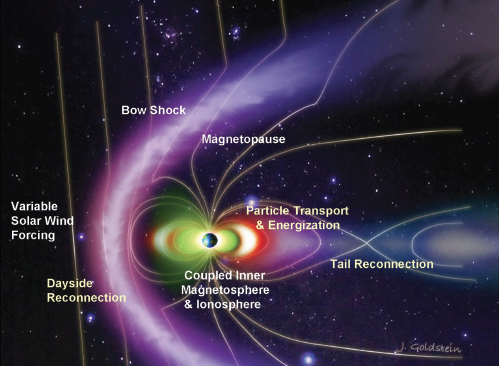
FIGURE 9.9 Illustration of the critical processes that drive the magnetosphere. To achieve a full understanding of the complex, coupled, and dynamic magnetosphere, it is essential to understand, by using a combination of imaging and in situ measurements, how global and mesoscale structures in the magnetosphere respond to variable solar wind forcing, and how plasmas and processes interact within the magnetosphere and at its outer and inner boundaries. SOURCE: Courtesy of Jerry Goldstein, Southwest Research Institute.
information about the external boundary conditions in geospace. As noted before, MMS and RBSP science objectives are extended when pursued in combination with other ongoing magnetospheric missions (Cluster, Geotail, THEMIS). Some will require strategic missions, while others can be acquired with smaller platforms, including Explorers, CubeSats, and commercial satellites. In the next section the initiatives necessary to accomplish the SWMI critical science goals are outlined.
The science goals described in Section 9.4 are ambitious, and their accomplishment will require intelligent use of the diverse research tools that are available:
Strategic missions. Strategic missions are the centerpiece of research in solar and space physics, requiring the largest budget and enabling researchers to address major portions of high-priority science that are not accessible by other tools.
Explorers. In science per dollar, NASA’s Explorer program has been extremely successful. Small and medium-class missions such as SAMPEX, IMAGE, TWINS, and THEMIS have significantly advanced solar and space physics, and these missions have been productive beyond their prime mission, producing even more results than originally proposed.
Suborbital program. The suborbital program includes rocket and balloon investigations, which do targeted science and can augment strategic missions, increasing total science return. For example, the upcoming BARREL balloon experiment will enhance RBSP by providing measurements of relativistic electron precipitation.
Small platforms. In the coming decade, even smaller platforms will continue to advance technology and will also perform focused science investigations. Three magnetospheric missions are currently under development as part of NSF’s new CubeSat program: CINEMA will image the ring current and measure particle precipitation; the CSSWE experiment measures electron and ion precipitation using a miniaturized RBSP REPT instrument; and the FIREBIRD mission will measure the spatial scale of relativistic electron microbursts that are part of bursty radiation belt losses.
Hosted payloads and commercial alternatives. In recent years, there has been increasing awareness of the potential to use alternative spacecraft and procurement methods to lower the cost and increase the frequency of opportunity of solar and space physics missions. These include hosted payloads on commercial satellites, the purchase of “commercial clone” spacecraft, and “data buy” (also called service-level agreement), whereby partial mission costs are paid upfront and the data are bought back after the spacecraft is successfully on orbit. Hosted payloads have already been successfully implemented. For example, the TWINS mission carries out stereo ENA imaging from hosted experiments on non-NASA, U.S.-government spacecraft. Such hosted payloads have the potential for supporting multipoint measurements at a significantly reduced cost, enabling the vision for an ever-more-capable Heliophysics Systems Observatory.
Heliophysics Systems Observatory. As amply demonstrated by the sampling of scientific accomplishments from the past decade presented above, major progress toward the SWMI panel science goals
can be expected from analysis of data from the NASA and other agency spacecraft already in orbit. Together with new missions as they come on line, these assets constitute the space-based elements of the Heliophysics Systems Observatory, providing multipoint simultaneous measurements essential to advancing the SWMI science goals.
Ground-based observations. Ground-based measurements are commonly combined with spacecraft measurements to understand magnetospheric processes. In some cases, it has proven beneficial to install additional ground-based instruments in support of a specific spacecraft mission. This is exemplified most recently by the THEMIS mission, which included a 20-camera all-sky imaging array and 21 magnetometers installed in the northern United States and Canada.
Theory and modeling. The complexity of the solar wind-magnetosphere-ionosphere system, combined with its vastness, guarantees that the system will be greatly undersampled regardless of the number of spacecraft placed in orbit. While global remote-sensing capabilities help, they introduce complexities of their own, such as the fact that they often view an optically thin medium. Thus, to fully exploit the variety of available measurements and to put them into the proper interpretive physical perspective, theory and modeling are crucial. The enormous improvements in numerical modeling capabilities over the past decades have led to major progress in physical understanding of the system; with appropriate investment, these improvements will continue through the next decade.
Laboratory experiments. With spacecraft measurements, scientists observe whatever behavior nature provides. There is no way to repeat an experiment or to isolate a single parameter for investigation in the classical model of physical experimentation. This can be remedied by supplementing satellite observations with appropriately designed laboratory experiments, which can reveal significant aspects of the physical processes operating in space. Such experiments also provide a touchstone for testing numerical models.
Grants programs. Finally, the heartbeat of space physics is the set of grants programs administered by NASA and NSF, which underlie essentially all the progress that emerges from the various data sources. These relatively small, investigator-led studies enable researchers to exploit the data from missions and connect them to relevant theoretical frameworks.
The SWMI panel strongly supports the survey committee’s conclusion that the key science goals identified in this decadal survey can be most effectively accomplished with a well-balanced program that uses the full spectrum of implementation options. This same approach is needed for the achievement of the SWMI panel goals discussed in this chapter. The optimum balance is of course challenging to identify, but in the course of this decadal survey, the SWMI panel identified a number of areas where new attention or enhanced resources could significantly increase the ability to deliver the important science goals outlined above. Seeking and protecting the appropriate balance of these capabilities is the overarching theme of the imperatives the SWMI panel believes are required to successfully address the critical SWMI science goals outlined above. These imperatives fall into three categories:
• Missions,
• DRIVE-related initiatives (see Chapter 4 for DRIVE description and discussion), and
• Space weather.
The remainder of this section addresses the SWMI panel’s imperatives in each of these categories.
One of the central elements in a robust program of scientific research in solar wind-magnetosphere interactions must be an ongoing sequence of strategic missions obtaining in-space measurements targeted at the highest-priority science objectives. Identification of new mission concepts to address the SWMI science objectives is an important element of this decadal survey. These new missions and the science they address must be considered against the backdrop of accomplishments from past missions, as well as the science that will be addressed by missions that are currently in development and missions that are still operating. Below, the SWMI panel reviews expectations from missions currently under development or still operating and considers the central role played by Explorers, PI-led missions that afford the maximum agility in identifying new and exciting science. The panel then presents the new strategic mission concepts that it found particularly compelling. Finally, some promising concepts are mentioned that will require significant development efforts in the coming decade to enable their application to the outstanding SWMI science problems of the future.
9.5.2.1 Missions Under Development
MMS
The Magnetospheric Multiscale Mission currently under development is designed to address key parts of SWMI critical science goal 5, to “discover how magnetic reconnection is triggered and modulated.” Earth’s magnetosphere provides one of the few opportunities to observe magnetic reconnection with in situ measurements. Specifically, MMS will focus on the kinetic microphysics of magnetic reconnection that occurs in tiny boundary layers at electron scales. Measuring these boundary layers requires multiple spacecraft with unprecedented spatial and temporal resolution. MMS is poised to provide the first glimpse of these electron layers and continues to be a high science priority for the coming decade.
RBSP/BARREL
The Radiation Belt Storm Probes mission currently in development directly addresses this decade’s SWMI critical science goal 4, to “establish how energetic particles are accelerated, transported, and lost.” To do so, RBSP’s mission objectives are threefold: (1) to discover the relative importance of various candidate mechanisms and when and where they act to accelerate and transport electrons and ions; (2) to quantify the balance between competing acceleration and loss mechanisms that determine time-varying radiation belt intensity and spatial distribution; and (3) to understand—to the point of predictability—how the radiation belts change dynamically. The instruments on the two RBSP spacecraft will provide the measurements needed to characterize and quantify the processes that produce relativistic ions and electrons. They will measure the properties of charged particles that comprise Earth’s radiation belts and the plasma waves that interact with them, the large-scale electric fields that transport them, and the magnetic field that guides them, all of which are required to develop a predictive understanding of radiation belt dynamics. The mission promises to make breakthrough discoveries and to rewrite the textbook on universal planetary radiation belt physics.
Over the past decade, the importance of relativistic electron losses from Earth’s radiation belts has also become increasingly clear. There is evidence that the radiation belts are emptied during the main phase of geomagnetic storms before being refilled by newly accelerated particles. However, the relative importance of atmospheric precipitation losses versus magnetopause losses is not known, and the processes that scatter relativistic particles into the atmosphere have not been experimentally validated. BARREL (Balloon Array for RBSP Relativistic Electron Losses) will augment RBSP by providing a low-altitude component to quantify electron precipitation. BARREL consists of several balloon campaigns during which an array of
X-ray detectors will be launched on stratospheric balloons to measure electron precipitation in conjunction with RBSP. These measurements will quantify the precipitation loss rate, will probe the global spatial structure of energetic precipitation for the first time, and, when combined with RBSP measurements, will allow for quantitative tests of wave-particle interaction theories.
The critical importance of these two missions for achieving some of the panel’s high-priority science objectives for the coming decade leads to the following SWMI imperative:
SWMI Imperative: Complete the strategic missions that are currently in development (MMS, RBSP/ BARREL) as cost-effectively as possible.
Solar Probe Plus and Solar Orbiter
These missions, while aimed directly at solar and heliospheric science objectives, are also likely to shed light on fundamental physical processes that are high on the list of science objectives for SWMI, namely, particle acceleration, reconnection, turbulence, and wave-particle interactions. Insights gained about how these processes work near the Sun can potentially help advance understanding of how they operate in near-Earth space, thereby helping address SWMI critical science goals 4 through 6.
9.5.2.2 Heliophysics Systems Observatory
The globally coupled nature of the solar wind-magnetosphere-ionosphere system demands simultaneous measurements of related phenomena in widely spaced locations. Thus, crucial information comes from combining observations from existing operating satellites, both from NASA (ACE, TWINS, SAMPEX, THEMIS, Cluster, planetary missions, and so on) and from other agencies and other nations (e.g., GOES, LANL, DMSP, POES). The demonstrated value of these existing assets far surpasses their original intended use, and it is extremely important that they continue to be supported for the contributions they can make to the evolving science objectives.
In the area of comparative magnetospheres, Juno will enter its prime mission phase when it arrives at Jupiter in 2016, while Cassini at Saturn is approved for a final mission extension to 2017, and Messenger will complete its prime mission early in the decade. Past and current missions continue to provide deep insights into general solar wind magnetosphere interactions. For example, Ganymede’s Alfvén wings have led to modern theories of Earth’s own polar cap potential saturation mechanism; Saturn’s explosive energy releases have much in common with substorm injections at Earth; and Jupiter’s interchange motions enabling convection under Io’s mass loading have led to similar theories pertaining to inward penetration of fast reconnection flows. As is the case for Earth-orbiting satellites, extended missions for planetary missions that continue to return valuable science data are strongly encouraged.
SWMI Imperative: A high priority of the panel is to ensure strong continued support for existing satellite assets that can still contribute significantly to high-priority science objectives. For example, careful optimization of existing assets to address RBSP and MMS objectives will result in a significant gain in the science return from these missions.
9.5.2.3 Explorers and Alternate Platforms
Since the inception of the space age, the Explorer program has been a mainstay of science return, including significant contributions to the progress outlined in Section 9.3. The Explorer missions, with science objectives and implementations identified competitively, provide scientific agility and the ability to
tap into the creativity of the science community. Thus, the SWMI panel supports a significant enhancement of resources dedicated to the Explorer program. This includes increases in the flight cadence of missions in this category, as well as launches of opportunity. The panel also supports the extension of the program limits to include so-called tiny Explorers (TEX) (~$50 million) and enhanced MIDEX (~$400 million) options, but emphasizes the importance of maintaining a high mission cadence.
SWMI Imperative: Enhance the resources dedicated to the Explorer program and broaden the range of cost categories.
The past decades have further demonstrated that suborbital missions and, more recently, CubeSats (a constellation of individual CubeSats might constitute a TEX mission) can make significant and very cost-effective contributions to addressing pressing science questions. They also serve as an instrument development platform and as a training ground for the future workforce. The SWMI panel encourages continued support for science investigations conducted on these small, cost-effective platforms. Moreover, the panel also calls on NASA and other agencies to develop an effective mechanism for supporting payloads on commercial vehicles, consistent with U.S. national space policy. Ideally, such a mechanism would allow the rapid development and deployment that are often required by these types of missions. The SWMI panel supports continuation of a cost-effective management program that applies risk/benefit tools appropriate to this cost category.
SWMI Imperative: Develop a mechanism within NASA to support rapid development, deployment, and utilization of science payloads on commercial vehicles and other missions of opportunity. NSF and DOD efforts in this regard are also encouraged.
9.5.2.4 New Strategic Missions
Analysis of the rich set of data derived from ongoing missions and missions in development, combined with new approaches that will emerge from the Explorer and other smaller mission lines, will provide a firm foundation for accomplishing the SWMI critical science goals outlined in this chapter for the coming decade. However, attaining those goals will also require crucial new observations that have previously been impossible. To obtain those essential observations will require investing in new strategic missions, targeted at the highest-priority science.
In the early stages of this decadal survey, the scientific community submitted a large number of mission concepts addressing different outstanding science questions. In evaluating these concepts, the panel considered the degree to which they address the SWMI science goals. The panel also weighed feasibility issues such as technology readiness and probable cost. Below, the science objectives and implementation strategies for the three top-ranked mission concepts considered by the SWMI panel are summarized. The panel emphasizes that, although it assigned them names for ease of discussion, these are only notional missions, devised to address the panel’s science objectives, with feasible technology and within a reasonable budget for a strategic mission. For the purposes of this study, it is the science objectives for the missions, not their specific implementations, that are most important.
Magnetosphere Energetics, Dynamics, and Ionospheric Coupling (MEDICI)
MEDICI (Figure 9.10) is the SWMI panel’s highest-ranked new strategic mission concept and the one it most strongly urges as a new start in the coming decade.
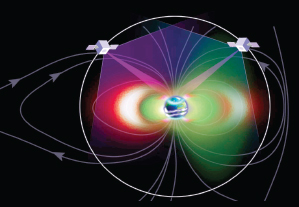
FIGURE 9.10 MEDICI targets complex, coupled, and interconnected multiscale behavior of the magnetosphere-ionosphere system by providing high-resolution, global, continuous three-dimensional images of the ring current (orange), plasma-sphere (green), aurora, and ionospheric-thermospheric dynamics and flows as well as multipoint in situ measurements. SOURCE: Courtesy of Jerry Goldstein, Southwest Research Institute.
Science Objectives. Geospace is intrinsically interconnected over diverse scales of space and time. Plasma and fields in the ionosphere and magnetosphere interact, and multiple processes compete simultaneously. Observation of the relationships among components is critical to understand and characterize collective behavior of this complex system across a broad range of spatial scales. MEDICI’s science questions address how the magnetosphere-ionosphere-thermosphere system is coupled and responds to solar and magnetospheric forcing. In particular, this mission concept directly addresses SWMI critical science goals 1 and 4, with very significant contributions as well to science goals 2 and 3 (Table 9.2).
MEDICI provides definitive, comprehensive answers to two fundamental science questions that have been outstanding for decades: (1) How are magnetospheric and ionospheric plasma transported and accelerated by solar wind forcing and magnetosphere-ionosphere coupling? (2) How do magnetospheric and ionospheric plasma pressure and currents drive cross-scale electric and magnetic fields, and how do these fields in turn govern the plasma dynamics? Each of these two linked questions focuses on a crucial aspect of the coupled dynamics of geospace. The first question looks at plasma transport: How are the cross-scale, dynamic, three-dimensional plasma structures of the ring current, plasmasphere, and aurora reshaped by acceleration and transport, what controls when and where ionospheric outflow occurs, and what are the cross-scale effects on the system? The second question targets the electrodynamics of magnetosphere-ionosphere coupling: What are the cross-scale, interhemispheric structure and timing of currents and fields that mediate magnetosphere-ionosphere coupling, and how do these MI coupling electromagnetic fields feed back into the system to affect the plasmas that generated them?
Mission Concept. MEDICI is a cross-scale science mission concept that uses both high-resolution stereo imaging and multipoint in situ measurements; as described in Part I of the report, MEDICI is an STP-class strategic mission, but PI-led, following the Planetary Division’s Discovery mission class. It also incorporates an array of contemporaneously existing ground-based and orbiting observatories. MEDICI employs two spacecraft that share a high circular orbit (see Figure 9.10), each hosting multispectral imagers,
TABLE 9.2 Level of MEDICI Contributions Toward Achieving SWMI High-Priority Science Goals
|
|
|
| MISTE Contribution | |
|
|
|
| Goal 1: Determine how the global and mesoscale structures in the magnetosphere respond to variable solar wind forcing. | |
| Goal 2: Identify the controlling factors that determine the dominant sources of magnetospheric plasma | |
| Goal 3: Understand how plasmas interact within the magnetosphere and at its boundaries. | |
| Goal 4: Determine how magnetosphere-ionosphere-thermosphere coupling controls system-level dynamics | |
| Goal 5: Establish how energetic particles are accelerated, transported, and lost. | |
| Goal 6: Discover how magnetic reconnection is triggered and modulated. | |
| Goal 7: Understand the origins and effects of turbulence and wave-particle interactions. | |
| Goal 8: Identify the structures, dynamics, and linkages in other planetary magnetospheric systems. | |
|
|
|
| Contribution to Goal | Major | Large | Significant | Some | Minimal | |
|
|
|
|
|
||
|
|
||||||
magnetometers, and particle instruments. This science payload captures the dynamics of the ring current, plasmasphere, aurora, and ionospheric-thermospheric plasma redistribution (Figure 9.11). In combination with ground-based and low-Earth-orbit data that yield detailed information on field-aligned currents, ionospheric electron densities, temperatures, and flows, MEDICI’s imagers and onboard in situ instruments will provide the means to link the global scale magnetospheric state with detailed ionospheric conditions and will yield data for global model validation.
MEDICI takes a major step forward in geospace imaging, by combining and improving crucial elements from several prior missions. The first multispectral, stereo geospace plasma imaging will reveal the three-dimensional structure of cardinal geospace plasmas and provide conjugate views of the northern and southern aurorae. Simultaneous two-point in situ measurements are closely coordinated with plasma imaging from state-of-the-art instruments to uncover transport and electrodynamic connections at different spatial scales throughout the magnetosphere-ionosphere-thermosphere system, enabling major new insights into cross-scale dynamics and complexity in geospace.
The MEDICI mission uses two identical nadir-viewing spacecraft in a shared 8-RE circular polar orbit with adjustable orbital phase separation (between 60° and 180° separation along track) to enable global stereo, multispectral imaging and simultaneous in situ observations. Circular orbits that avoid the most intense radiation environments provide continuous imaging and in situ measurements and enable a long-duration (up to 10-year) lifetime well beyond the required 2-year mission. MEDICI requires no new technology development; all instruments have high heritage.
Each of MEDICI’s key measurement goals contributes essential information about cross-scale geospace dynamics.
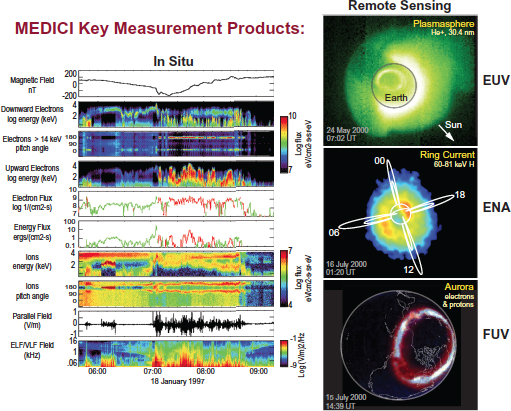
FIGURE 9.11 Examples of pathfinder observations for key MEDICI measurements. (Right) Multispectral, stereo, global imaging of hot and cold plasmas and auroral precipitation from IMAGE will be combined with (left) in situ observations of critical near-Earth plasmas and fields from the FAST satellite [Carlson et al., 1998] to understand the multiscale processes at work. SOURCE: Left: Adapted from C.W. Carlson, J. P. McFadden, R. E. Ergun, M. Temerin, W. Peria, F. S. Mozer, D. M. Klumpar, E. G. Shelley, W. K. Peterson, E. Moebius, R. Elphic, et al., FAST observations in the downward auroral current region: Energetic upgoing electron beams, parallel potential drops, and ion heating, Geophysical Research Letters 25(12):2017-2020, doi:10.1029/98GL00851, 1998. Copyright 1998 American Geophysical Union. Reproduced by permission of American Geophysical Union. Right: Courtesy of D. Mitchell, Johns Hopkins University, Applied Physics Laboratory.
The first goal is to continuously image the three-dimensional distribution of two critical inner magnetospheric plasmas. Using ENA imaging, the ring current and near-Earth plasma sheet are captured with sufficient temporal and spatial resolution (1 minute, 0.5 RE) to retrieve the electrical current system that distorts the magnetic field and that connects through the ionosphere producing the electric field. EUV imaging at 30.4 nm captures the plasmasphere with sufficient temporal/spatial resolution (1 minute, 0.05 RE) to retrieve cross-scale density structures and the global-to-local electric fields that drive the formation and evolution of these structures. State-of-the-art stereo imaging of the optically thin ENA and EUV signals enables determination of the three-dimensional structure of pressure, pitch angle, and density, revealing
energization, losses, and plasma sources and resolving cross-scale currents, fields, and flows that bind the system together.
The second goal is to image and measure the ionosphere-thermosphere system using multiple wavelengths of far ultraviolet (FUV): LBH long and short cameras, and spectrographic imaging (SI) at 121.6 nm and 135.6 nm. FUV imaging provides estimates of multiple geophysical quantities: precipitating particle flux, ionospheric electron density and conductivity, and thermospheric O/N2 ratio. Dynamical features in the ionosphere (e.g., polar cap ionization patches, positive and negative storm effects, neutral atmospheric responses to auroral heating, ionospheric scintillations and plasma bubbles) are tracked with global imaging at 5- to 10-km resolution. Variable phasing of the two circular-orbiting spacecraft provides simultaneous conjugate views of both northern and southern auroral emissions, uncovering the little-understood role of inter-hemispheric asymmetry on the global system behavior.
The third goal is to measure, in situ, the critical near-Earth plasmas and magnetic field in the cusp and near-Earth plasma sheet plasma. Onboard each of the two MEDICI spacecraft, plasma composition, electron plasma conditions, and magnetic field measurements characterize the plasma conditions, field distortions, and storm/substorm activity, and in combination with imaging allow researchers to follow the flow of ionospheric plasma and energy between the ionosphere and magnetosphere.
Complementing and augmenting the high-altitude observations, MEDICI includes funded participation for significant low-altitude components: measurements from a large range of resources, including DMSP or its follow-on Defense Weather Satellite System, IRIDIUM/AMPERE current maps, radar arrays from high to mid latitudes (SuperDARN, Millstone Hill, AMISR), GPS TEC maps, and magnetometer and ground-based auroral all-sky camera arrays. The result will be global specification of the ionospheric electric field and electric current patterns in both hemispheres, essentially completing the electrodynamic picture at low altitude. In principle, MEDICI measurements tackle a broader comparative planetary question, namely, the extent to which magnetospheres can act as shields against atmosphere erosion by the solar wind: Does ion outflow escape or remain in the magnetosphere to be recycled?
Contributions to the Heliophysics Systems Observatory. MEDICI will both benefit from and enhance the science return from almost any geospace mission that flies contemporaneously, such as upstream solar wind monitors, geostationary satellites, and low Earth orbit missions. In particular, by providing global context and quantitative estimates for magnetospheric-ionospheric plasma and energy exchange, MEDICI has significant value for missions investigating ionospheric conditions, outflow of ionospheric plasma into the magnetosphere, energy input from the magnetosphere into the ionosphere, and AIM coupling in general. Thus it will add value to a host of possible ionospheric strategic missions, Explorers, and rocket and balloon campaigns. A mission providing continuous imaging and in situ observations from two separate platforms also plays an important role in providing to geospace predictive models the indispensable validating observations of system-level interactions and processes. The likely long duration of the MEDICI mission will allow it to provide a transformative framework into which additional future science missions can naturally fit.
Table 9.2 summarizes MEDICI’s expected level of contribution to the SWMI science goals. In recognition of the need for crucial new observations to enable the accomplishment of these science objectives, the panel identified the following SWMI imperative:
SWMI Imperative: Initiate the development of a strategic mission, like MEDICI, to determine how the magnetosphere-ionosphere-thermosphere system is coupled and responds to solar and magnetospheric forcing.
Magnetosphere-Ionosphere Source Term Energetics (MISTE)
The SWMI panel’s second-highest-rated new strategic mission concept, the Magnetosphere-Ionosphere Source Term Energetics (MISTE) mission, seeks to resolve how ionospheric plasma escapes into the magnetosphere (Figure 9.12); as described in Part I of this decadal survey report, MISTE is an STP-class strategic mission, but PI-led, following the Planetary Division’s Discovery mission class. This concept directly addresses SWMI critical science goals 2 and 4, with additional contributions to goals 3 and 7. Although the science addressed by this mission is of high merit, the panel is aware that budget realities will likely prevent its initiation as a strategic mission in the coming decade. However, a valuable subset of the science described here may well be within reach of an Explorer mission.
Science Objectives. Certain magnetospheric processes strongly depend on the local concentration of heavy ions, which ultimately originate in Earth’s atmosphere. However, this concentration cannot be predicted with much accuracy because researchers cannot yet quantify the amount of outflow from a given input of electromagnetic energy or energetic particle flux into the high-latitude upper atmosphere. Thus, a comprehensive set of combined in situ and remote-sensing measurements is needed to determine how energy input to the high-latitude ionosphere leads to particle outflow and mass loading of the magnetosphere. The MISTE concept has been designed to simultaneously measure the inflow of energy to the upper atmosphere
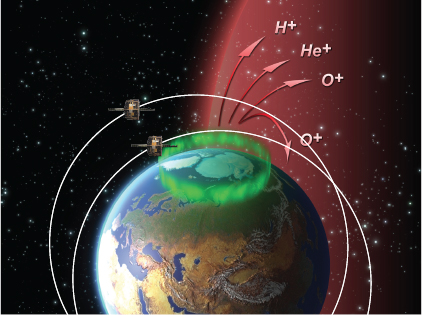
FIGURE 9.12 The notional MISTE orbit configuration, with 5,000-km apogee and perigee ranging from 200- to 500-km altitude. Phasing shifts will yield magnetic alignments at a range of spacecraft altitude offsets, and precession will provide alignments at all latitudes and local times. SOURCE: Courtesy of NASA and the European Space Agency.
and the response of the ionosphere-thermosphere system to this input, in particular the outflow back to the magnetosphere.
Mission Implementation and Strategy. The fundamental design of the MISTE mission concept is two identical spacecraft in highly inclined elliptical orbits with apogees 180° out of phase, as shown in Figure 9.12. The two satellites can then be positioned on their orbits to obtain magnetic conjunctions so that the energy input, the ionospheric heating and acceleration, and the outflow can be measured simultaneously. With apogee at 5,000-km altitude, the satellites will pass through the auroral acceleration region and observe the energization of the precipitating electrons and the wave heating and acceleration of the ionospheric ions. Perigee will vary from the topside ionosphere (500-km altitude) to below the F-layer peak (200-km altitude) in order to measure the range of energy deposition processes capable of causing ionospheric outflow. With an 80° orbital inclination, apogee will precess, allowing for this magnetic alignment to cover the entire high-latitude region. By varying the positions of the satellites along the orbit tracks, a span of intersatellite distances during these alignments can be sampled.
The notional mission has two dual-spinner spacecraft (spin axis perpendicular to the orbit), with a despun portion of each satellite with faces maintained in the ram and nadir directions and the other portion at a high spin rate of 15 rpm. The despun portion provides high-cadence measurements of cold particle populations and high-cadence auroral imaging. The faster-spinning portion enables the measurement of three-dimensional velocity-space distributions of ions and electrons. It also accommodates long spin-plane booms for high-resolution electric field measurements.
MISTE is designed to make a comprehensive suite of measurements to understand high-latitude energy input and ionospheric outflow. See Figure 9.13 for an example of the breadth of measurements from MISTE. To measure the low-altitude heating, the despun portion includes in situ sensors for measuring the neutral density, neutral winds, ion and neutral mass composition, and ion velocity. The input electromagnetic energy and electromagnetic waves that drive particle acceleration will be measured with axial electric field booms, four wire booms, and a magnetometer. The axial booms will be mounted to the despun platform, with one protruding through the center hole in the spinning section, while the wire booms are on the spinning platform.
The thermal and suprathermal ion and electron measurements, which provide both the input precipitating particle energy and the response to this input, are made by a combination of sensors. Sensors located at the ends of booms measure the very-low-energy ionospheric electron and ion three-dimensional velocity distributions in the 0.1- to ~20-eV range, outside the spacecraft’s sheath. Body-mounted sensors will cover ions and electrons over the plasma-sheet energy range from 20 eV to ~50 keV, including ion composition. A final in situ detector will measure the precipitating flux of 50-keV to 5-MeV electrons.
To give a broader context to the in situ measurements, two remote sensing instruments are included. An ultraviolet auroral imager will provide the regional context of the energy input to the upper atmosphere. An active sounder experiment will remotely sense the plasma density along the magnetic field line below the spacecraft. Together, these two instruments will provide a three-dimensional view of the region in which the in situ measurements are made.
The primary objective of the MISTE mission concept is to quantify the amount of ionospheric outflow given a particular intensity of electromagnetic or particle energy input to the upper atmosphere. Therefore, the primary instrumentation of MISTE is the in situ thermal and suprathermal particle detectors and the electric and magnetic field instruments. These observations could be made from a simpler mission design of twin single-spin spacecraft. That is, a critical subset of the MISTE objectives could be obtained with a dramatically reduced payload and mission concept. Ground-based observations of the neutral atmosphere
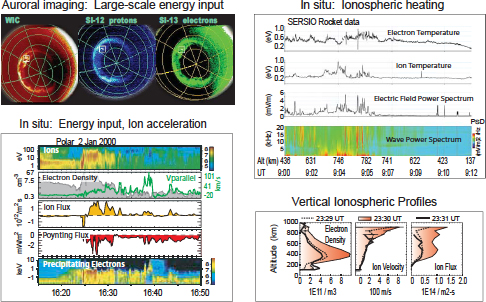
FIGURE 9.13 MISTE will explore the relationship between energy input from the magnetosphere to the ionosphere and the resulting ionospheric outflow. At magnetic alignment, the upper spacecraft (left column of panels) will provide detailed information of the magnetospheric energy inflow (both particle and electromagnetic), while the lower spacecraft (right column of panels) will observe the ionospheric heating and energization. SOURCE: Upper left: S.B. Mende, C.W. Carlson, H.U. Frey, T.J. Immel, and J.-C. Gérard, IMAGE FUV and in situ FAST particle observations of substorm aurorae, Journal of Geophysical Research 108(A4):8010, doi:10.1029/2002JA009413, 2003. Upper right and lower left: Adapted from K.M. Frederick-Frost, K.A. Lynch, P.M. Kintner, Jr., E. Klatt, D. Lorentzen, J. Moen, Y. Ogawa, and M. Widholm, SERSIO: Svalbard EISCAT rocket study of ion outflows, Journal of Geophysical Research 112:A08307, 2007. Lower right: W. Lotko, The magnetosphere ionosphere system from the perspective of plasma circulation: A tutorial, Journal of Atmospheric and Solar-Terrestrial Physics 69(3):191-211, doi:10.1016/j.jastp.2006.08.011, 2007.
and regional context could be used to complement a reduced payload, in particular to help understand why certain energy inputs result in particular outflow rates.
Table 9.3 summarizes the contributions MISTE would make to the SWMI critical science goals. The SWMI panel believes that these contributions would enable great progress toward the applicable objectives, but in recognition of probable budget constraints over the coming decade, the panel developed the following SWMI imperative:
SWMI Imperative: If resources permit, initiate a strategic mission like MISTE to simultaneously measure the inflow of energy to the upper atmosphere and the response of the ionosphere-thermosphere system to this input, in particular the outflow back to the magnetosphere.
TABLE 9.3 Level of MISTE Contributions Toward Achieving SWMI High-Priority Science Goals
|
|
|
| MISTE Contribution | |
|
|
|
| Goal 1: Determine how the global and mesoscale structures in the magnetosphere respond to variable solar wind forcing. | |
| Goal 2: Identify the controlling factors that determine the dominant sources of magnetospheric plasma. | |
| Goal 3: Understand how plasmas interact within the magnetosphere and at its boundaries. | |
| Goal 4: Establish how energetic particles are accelerated, transported, and lost. | |
| Goal 5: Discover how magnetic reconnection is triggered and modulated. | |
| Goal 6: Understand the origins and effects of turbulence and wave-particle interactions. | |
| Goal 7: Determine how magnetosphere-ionosphere-thermosphere coupling controls system-level dynamics. | |
| Goal 8: Identify the structures, dynamics, and linkages in other planetary magnetospheric systems. | |
|
|
|
| Contribution to Action | Major | Large | Significant | Some | Minimal | |
|
|
|
|
|
||
|
|
||||||
Uranus Orbiter
Because of the importance of understanding the range of processes operating in the universe, as well as their operation under different environmental conditions, continued progress in comparative magnetospheres is a key objective for the coming decade. Thus, it seems essential that NASA’s Heliophysics Division partner with the Planetary Division to ensure that appropriate magnetospheric instrumentation be fielded on missions to other planets. In particular, the SWMI panel’s highest priority in planetary magnetospheres is a mission to orbit Uranus. With a strongly tilted dipole and a rotational axis near the ecliptic plane, Uranus offers an example of solar wind/magnetosphere interactions under strongly changing orientations over diurnal timescales (Figure 9.14).
The complexity of the interactions of Uranus’s magnetosphere with the solar wind provides an ideal testbed of the most sophisticated models and theories. Indeed, one could argue that Uranus is too complex a system to study effectively without supporting data; however, the potential discoveries from its dynamo generation and its variability stand to open new chapters in comparative planetary magnetospheres and interiors. A Uranus orbiter is the third-ranked outer planets mission of the 2011 planetary decadal survey7 and has received extensive study. Key magnetospheric measurements for a Uranus mission would include magnetic field, plasma waves, plasma, energetic particles, dust and neutral mass spectra, and global images
________________________
7 National Research Council, Vision and Voyages for Planetary Science in the Decade 2013-2022, The National Academies Press, Washington, D.C., 2011.
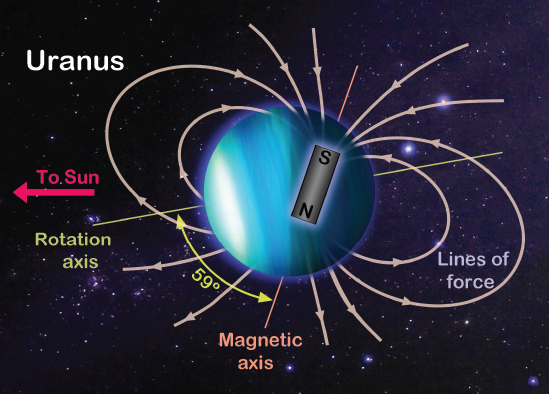
FIGURE 9.14 The magnetic dipole axis of Uranus is strongly tilted with respect to its rotational axis, which in turn lies near the orbital plane. Thus, depending on the season, the effects of solar wind-magnetosphere interaction vary dramatically over the course of each day. Uranus significantly expands the parameter range over which scientists can study magnetospheric structure and dynamics. SOURCE: Courtesy of Jerry Goldstein, Southwest Research Institute.
in UV, IR, and ENA. To make continued exciting progress toward understanding other magnetospheres, the SWMI panel concluded with the following SWMI imperative:
SWMI Imperative: Through partnership between NASA’s Heliophysics Division and Planetary Division, ensure that appropriate magnetospheric instrumentation is fielded on missions to other planets. In particular, the SWMI panel’s highest priority in planetary magnetospheres is a mission to orbit Uranus.
9.5.2.5 Future Strategic Missions
Determining how mesoscale and global structures in the magnetosphere respond to variable solar wind forcing and understanding how plasmas interact within the magnetosphere and at its boundaries both require observations that match these scales. This effort essentially necessitates global-scale imaging
and multisatellite constellation missions to obtain measurements of the physical parameters necessary to accomplish these science objectives. A MEDICI-like mission will address these objectives through global imaging, which is technically feasible primarily for the inner and middle magnetosphere. For the outer magnetosphere, which forms the primary solar-wind entry and energy-storage region, the highly tenuous plasma makes “imaging” by means of local measurements on many spatially separated satellites the best approach to resolving global and mesoscale structure. Below, some exciting mission concepts are highlighted that can address these challenging objectives but will require technology developments in the coming decade to achieve feasible cost and readiness levels.
Magnetospheric Constellation Mission (MagCon)
Science Goals. Understanding the mass and energy transport at global and mesoscales in Earth’s magnetospheric plasma sheet and reconnection regions of the near-Earth magnetotail, plus the dayside and flanks of the magnetopause and bow shock regions, can be implemented using a multisatellite in situ mission such as the MagCon mission. The prime overarching objective of the mission is to determine how the magnetosphere stores, processes, and releases energy in the magnetotail and accelerates particles that supply the inner magnetosphere’s radiation belts. It would track the spatial-temporal plasma structures and flows associated with the solar wind plasma entry across the magnetopause and transport within and through the magnetotail. On the dayside and flanks the constellation would provide multipoint measurements of the upstream solar wind input, and the response throughout the magnetosphere, enabling determination of how the entire system responds to variable solar wind driving. In the magnetotail it would provide a map of the global plasma flows and field configurations, leading to determination of whether they are internally developed or externally triggered. Throughout the mission, MagCon would provide a global “picture” of these otherwise invisible regions of the magnetosphere.
Mission Concept. MagCon uses many satellites separated by mesoscale distances (~1-2 RE) that make magnetic field plus plasma and energetic particle distribution function measurements at multiple points simultaneously with relatively rapid cadence. The mission requires a significant number of spacecraft, 36 in the concept the SWMI panel evaluated, to achieve mesoscale spacing while filling a significant fraction of the near-Earth space using orbits with perigees in the 7-8 RE range and apogees dispersed uniformly up to 25 RE with low inclination. The satellites would be simple ~30-kg-class spin-stabilized vehicles with their spin axes perpendicular to the ecliptic. Each spacecraft would carry a boom-mounted fluxgate magnetometer, a three-dimensional ion-electron plasma analyzer, and simple energetic ion-electron particle telescopes.
To implement such a constellation requires development of small satellite systems and instruments that can be more cheaply manufactured and tested in a reasonable time frame (2-3 years) with acceptable reliability levels, plus a better match between launch vehicle capabilities and constellation mission needs.
Magnetospheric Constellation and Tomography (MagCat)
Science Goals. With science objectives similar in many respects to those of MagCon, MagCat would address some of the most critical processes in Sun-Earth connections: plasma entry into the magnetosphere, plasma-sheet formation and dynamics, and investigation of bow-shock structure, plasmaspheric plumes, and other mesoscale structures that form in response to solar-wind variability. To achieve this objective requires observations with a minimum spatial resolution of 0.5 RE at a minimum time cadence of 15 s. MagCat could provide those required measurements.
Mission Concept. MagCat is a 20-spacecraft mission that would provide a combination of two-dimensional images of the equatorial outer magnetosphere and multipoint in situ observations made concurrently and in
the same imaged region. The spacecraft would be in two coplanar orbits that pass through critical regions in the magnetotail, flank, and subsolar magnetosphere. Each satellite would transmit radio waves to all others, obtaining 190 line-of-sight densities, enabling tomographic images of plasma density over large regions with an average spatial resolution of 0.32 RE at 12 s cadence. Each satellite would carry a suite of plasma and field instruments that provide complementary in situ data throughout the imaged area for ground truth as well as revealing the detailed plasma processes in the region. The nominal payload would include a 3-axis fluxgate magnetometer, electrostatic analyzers that measure three-dimensional ion and electron distributions, a relaxation sounder to determine the ambient density, and a radio tomography instrument. As for MagCon, the pre-CATE estimate for the MagCat mission was deemed beyond the scope of the budget in the coming decade. Thus, there is a similar need in the coming decade to develop cost-effective and efficient manufacturing procedures to mass produce a large number of spacecraft and instruments.
9.5.2.6 International Partnerships
International partnerships involving a consortium of individual space agencies can be an effective way to pool limited resources to achieve an outstanding science goal whose importance is agreed upon by a consensus of these agencies. For example, determining the cross-scale coupling physics involved in key plasma processes is believed to be crucial for complete understanding of the causes and consequences of these processes. None of the past, current (e.g., Cluster and THEMIS), or planned missions (e.g., MMS) are designed to address the cross-scale aspects of these processes. However, a mission concept has been developed in Japan, Canada, and Europe that involves a fleet of spacecraft performing simultaneous in situ measurements at electron, ion, and fluid scales. Such a mission can investigate how turbulence transports and dissipates energy over multiple scales and how kinetic microscale instabilities are modulated by macroscale properties of the plasma, as well as the relative role of global conditions versus microscale physics in determining the structure and dynamics of magnetic reconnection. These are all important aspects of SWMI critical science goals 6 and 7. This and other international, cross-agency partnerships should be pursued when available and possible.
SWMI Imperative: Partner with other space agencies to implement consensus missions, such as a multispacecraft mission to address cross-scale plasma physics.
In this section, the SWMI panel expands on a number of issues that have a material impact on the national ability to conduct an effective and productive solar and space physics research effort.
9.5.3.1 Solar Wind Monitor
Knowledge of upstream solar wind conditions, the interplanetary magnetic field, and solar energetic particles is required in essentially all of the programs that would address the SWMI science objectives. Currently, instruments on the ACE8 spacecraft, which orbits around the L1 libration point approximately 1.5 million km from Earth, provide these data. Follow-ons to ACE, which could also be instrumented with a solar coronagraph to view Earth-bound coronal mass ejections, are needed both to satisfy SWMI science goals and as part of a space weather forecasting system (see Chapter 7). The SWMI panel does not have
________________________
8 Information about the Advanced Composition Explorer (ACE) is available at http://www.srl.caltech.edu/ACE/.
a preference for which agency conducts this mission, but these data must be available on a continuous basis throughout the coming decade.
SWMI Imperative: Ensure continuity of measurements of the upstream solar wind.
9.5.3.2 Theory, Modeling, and Data Analysis
Efforts related to advancing theoretical and modeling studies of geospace are another key component of the solar and space physics research effort. The future of data analysis is becoming ever more closely linked with modeling, and tools need to be developed to enable a broad segment of the community to access and combine observations and model results. Currently, a great deal of the science return from NASA missions and NSF ground-based measurements occurs through theory, modeling, and data analysis supported in a portfolio of both NASA and NSF grants programs. The high productivity and cost-effectiveness of these programs argue strongly that major increases in science output can be achieved with modest funding increases. The SWMI panel therefore strongly encourages the agencies to enhance the funding of R&A programs. In a constrained funding environment, this is one of the most cost-effective ways to ensure that the high-priority science objectives outlined in this decadal survey will be accomplished.
In addition, the panel supports funding enhancements to enable the creation of a new program within NASA’s research portfolio to bring critical-mass multidisciplinary science teams together to address grand challenge problems. However, these proposed Heliophysics Science Centers must not be created at the expense of the current research programs, e.g., the Heliophysics Theory program. They must also be competed regularly and be focused on addressing a key science question.
The SWMI panel also strongly affirms the vital role that theory and modeling supported by mission funding play in advancing the science objectives of the missions. The panel believes that this role should be protected by requiring external reviews of the impacts of any theory-funding reductions on the ability of a mission to fulfill its science objectives.
SWMI Imperative: Enhance and protect support for theory, modeling, and data analysis, including research and analysis programs and mission-specific funding.
9.5.3.3 Innovation and Technology
In reviewing the white papers submitted from the community, the SWMI panel found that many relied on tried-and-true measurement techniques. However, while much can be accomplished with new applications of state-of-the-art technology, it is also clear that to accomplish the most challenging science objectives of the future, the development of new, innovative concepts will be necessary. Indeed, in an observation-driven field such as solar and space physics, it is often new observations that point the way to the science questions of the future.
Advanced instrumentation for constellation missions is an area of particular need for ultimate realization of the science goals the SWMI panel has outlined. Targeted research on how to acquire, analyze, and display the simultaneous measurements from many spacecraft is also needed, along with development of new ways to integrate global modeling and global observations.
Another area where technology development efforts could have a big scientific payoff is global imaging systems, particularly systems that can stand off, well outside the magnetosphere’s bow shock, and image its boundary structures using a range of techniques such as neutral atom imaging (ENA), scattered light, and X-ray emission. New instrumentation with increased sensitivity and resolution is needed to achieve spatial
resolutions (~0.5 RE) and image cadences (~15 min) sufficient to image the boundaries and visualize their motions and structure. New techniques for reducing background noise are also needed.
A number of the science goals outlined in Section 9.4 involve connecting phenomena and signatures that occur in the ionosphere with their corresponding phenomena and signatures in the magnetosphere. Because this connection occurs primarily via the geomagnetic field, which is strongly distorted and highly variable due to currents flowing within the magnetosphere itself, an accurate mapping between the ionosphere and magnetosphere for all relevant conditions is lacking. Current efforts to relate magnetospheric and ionospheric physics thus typically rely on empirical models based on statistical analysis of large data sets acquired over long time periods and under a variety of conditions. Techniques to definitively establish the instantaneous mapping are thus urgently needed.
It is the SWMI panel’s view that the current limited investment in technology development has discouraged the development of new instrument concepts. Therefore, the panel strongly supports the creation of a robust Heliophysics Instrument and Technology Development Program (HITDP) in the context of the NASA ROSES. In the panel’s opinion, this program should be funded sufficiently to support several grants at levels significantly larger than is possible at present through supporting research and technology.
Moreover, the missions of the future will require new satellite and systems technologies. Such technologies are most appropriately pursued by the Office of the Chief Technologist, in close consultation with the Heliophysics Division so that real mission needs are addressed. Possible technology development needs noted by the panel include, but are not limited to, techniques that make it feasible to produce and deploy large numbers of identical spacecraft at an affordable price and with high radiation tolerance; solar sails; advanced propulsion and power; low-cost launch vehicles; mass-production techniques; component miniaturization; and wireless communications within a satellite.
Another area where near-term investments will help reduce the risk and long-term cost of new instruments is in raising the technology readiness level (TRL) of the instruments of the future, particularly in the area of providing in-space operating experience. The panel believes that suborbital flights are cost-effective ways to mature instrument technologies for future science applications, even if no immediate science can be obtained from flying suborbitally. Thus, while the panel applauds and supports the science output of the suborbital program, it also encourages the utilization of suborbital flights for increasing the TRL of instruments with long-term science applications, but not necessarily science output from the flight itself.
SWMI Imperative: Invest significantly in developing the technologies to enable future high-priority investigations.
9.5.3.4 Ground-Based Instrumentation
Since the science objectives established by this panel emphasize a global view of the coupled magnetosphere-ionosphere-thermosphere system the SWMI panel strongly supports networks of ground-based instruments. For example, the MEDICI mission will be greatly enhanced by the data from magnetometer arrays and the SuperDARN network, and both MISTE and MEDICI benefit from the data provided by incoherent scatter radars (ISRs) and networks of all-sky cameras. The panel concluded that existing facilities, e.g., ISRs, SuperDARN, and magnetometer arrays, should continue to be supported, upgraded, and perhaps enhanced. Moreover, research drawing on increasing access to data from these instrument suites via the Internet would greatly benefit from the development of standards for data collection and access.
The SWMI panel takes note of successful NASA contributions in the past decade to ground-based assets that directly support their space missions, e.g., the THEMIS all-sky camera network, for which an example image is shown in Figure 9.15. The panel encourages continuation and expansion of these efforts. The
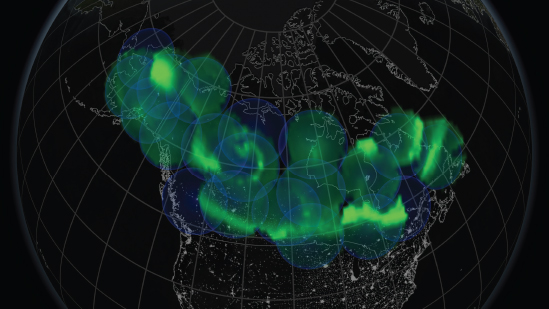
FIGURE 9.15 Composite auroral image constructed from the THEMIS All-sky Imager network. SOURCE: Courtesy of NASA/ Goddard Space Flight Center Scientific Visualization Studio; available at http://www.youtube.com/watch?v=GEebRsRnwm0.
panel also notes that DOD supports a number of ground-based observatories that contribute significantly to the science objectives outlined above and encourages continued sponsorship of those facilities as well. The panel further supports negotiation of international agreements to enable coordination and collaboration with non-U.S. ground-based capabilities.
SWMI Imperative: Ensure strong multiagency support for a broad range of ground-based assets that are a vital part of magnetospheric science.
9.5.3.5 Laboratory Studies
The SWMI panel endorses the recommendation in the plasma science decadal survey that the Department of Energy be the prime steward for laboratory plasma science. However, to enable research on basic plasma physics that will be of greater utility to SWMI science objectives, the panel supports the creation of an interagency joint laboratory astrophysics program. This program should be competed on a regular basis, include selection criteria that focus on issues relevant to space physics, contain a mechanism for outside investigators to have access to supported facilities, and be open to proposals from any institution.
SWMI Imperative: Create an interagency joint laboratory astrophysics program that addresses issues relevant to space physics.
9.5.3.6 Education and Workforce
At the most basic level, the field of solar and space physics needs a robust, well-trained, and talented workforce to accomplish its science goals, as well as an educated populace that recognizes the value of addressing these exciting scientific challenges. The SWMI panel therefore endorses curriculum development efforts across all academic levels, as well as faculty development programs. The panel notes in particular the success of the NSF Faculty Development in Space Science program and strongly supports its continuation and enhancement throughout the coming decade. The panel further endorses funded training opportunities for both undergraduate and graduate students, especially for participation in the development of flight hardware. Such opportunities could be provided by science grant augmentations, stand-alone education and public outreach grants, and mission-related funding.
SWMI Imperative: Strengthen workforce, education, and public outreach activities.
As suggested by its title, the long-term goal of this decadal survey is to have the knowledge to ensure the well-being of a society dependent on space. Actionable knowledge of space environment effects involves the ability to characterize conditions anywhere in the system at any time in the past, as well as to predict future conditions with good fidelity. This capability requires an understanding of the full, coupled solar-terrestrial system that encompasses all the regions, processes, and coupling described above, across spatial scales from meters to hundreds of Earth radii. It includes understanding the fundamental microscopic physics as well as the global system behavior in response to variable driving. The ultimate objective in the study of solar wind-magnetosphere interactions is to know how solar and solar-wind input at various spatial and temporal scales determines the nature and behavior of magnetospheric populations, structures, and processes and to be able to predict those that have significant space weather impacts.
There are three aspects of accomplishing this long-term goal:
- Establishment of the foundation of comprehensive scientific understanding;
- Development of sound, validated space environment models; and
- Fielding of the optimum operational assets to drive those models.
The scientific program presented above will put in place some of the tools essential to achieving this vision, particularly by defining outstanding questions that still inhibit a comprehensive scientific understanding.
The development of sound, validated space environment models requires a healthy research-to-operations/operations-to-research program. This in turn clearly necessitates communication and coordination between research-oriented agencies and operational agencies with end-use requirements so that a robust and adequately funded process exists for transitioning scientifically sound and operationally useful models between the two emphases.
Observations are critical for an effective space weather program because they support research and development of models and they drive models in their operational phase. Space weather observations are available from government research and some operational programs as well as from the commercial sector. Currently, each group in isolation develops observational requirements and observing systems to fulfill those requirements. To make more effective use of limited resources, these observations should be nationally coordinated, allowing research groups to provide input and possibly additional payloads to operational or commercial endeavors. Similarly, coordination would allow operational and commercial
entities to guide and use research observations. It is highly desirable that the National Space Weather Program (NSWP) be augmented to provide a mechanism for coordinating space weather observations, allowing for input to mission definition and payloads from all groups. The SWMI panel encourages the placement and coordination of space-weather-related observing systems on research, commercial, and government platforms to the greatest extent possible. The panel also supports development of mechanisms for real-time data acquisition and distribution from all available platforms.
More generally, to make the most of limited resources, an effective space weather program must be accomplished through coordinated activities within the government as well as with the commercial sectors. Currently several commercial and government groups provide various forms of space weather products with some limited coordination, yet many functions overlap. The panel urges that the NSWP be enhanced and clarified in order to delineate the roles for each agency, e.g., NASA, NOAA, NSF, the U.S. Geological Survey, DOD, and DOE, in producing and distributing data and models providing forecasting and space-weather-related products. The panel strongly endorses the undertaking of a high-level study to design a more complete overarching architecture for the NSWP that would define agency roles and coordinate observations.
SWMI Imperative: Encourage the creation of a complete architecture for the National Space Weather Program that would coordinate joint research, commercial, and operational space weather observations and define agency roles for producing, distributing, and forecasting space weather products. In addition the SWMI panel encourages all agencies to foster interactions between the research and operational communities and to identify funding for maintaining a healthy research-to-operations and operations-to-research program.
Achieving the key science goals of this decadal survey requires identifying the optimum set of operational observations to drive models that will enable specification and prediction of the environment throughout the magnetosphere. This effort may ultimately require an operational “great observatory” of satellites in appropriate orbits for monitoring crucial aspects of the input from and response to solar wind variability. In addition to providing the input necessary for high-fidelity environmental specifications, these measurements would provide routine context information for future targeted science experiments, much as magnetospheric activity indices are used today. Potential elements of such a space weather observatory could include a solar wind monitor (including IMF, energetic particle, and potentially coronagraphic measurements); high-altitude synoptic imaging of the aurorae, ring current, plasmasphere, and of the outer magnetospheric boundary; constellation observations of plasma entry and global tail structure; low-altitude, DMSP-like satellites to observe the magnetospheric input into the ionosphere and its response; multiple geosynchronous measurements of plasma, energetic particles, and magnetic field; RBSP-like monitors of the inner magnetospheric radiation environment; and a fine mesh of appropriate ground-based measurements. One important near-term investment is to determine, based on past observations of this nature, the optimum set of measurements that are required to drive high-fidelity predictive models of the environment.
SWMI Imperative: Implement a program to determine, based on past observations, the optimum set of measurements that are required to drive high-fidelity predictive models of the environment.
The SWMI imperatives presented above would all greatly enhance the ability to accomplish the science goals the panel has outlined, thereby providing the foundation needed for addressing the decadal survey’s
TABLE 9.4 Summary of SWMI Prioritized Imperatives
|
|
|||||
| Rank | Imperative | Missions | DRIVE | Space Weather |
|
|
|
|||||
| 1 | Enhance the resources dedicated to the Explorer program and broaden the range of cost categories. | ||||
| 2 | Complete the strategic missions that are currently in development (MMS and RBSP/BARREL) as cost-effectively as possible. | ||||
| 3 | Initiate the development of a strategic mission, like MEDICI, to determine how the magnetosphere-ionosphere-thermosphere system is coupled and responds to solar and magnetospheric forcing. | ||||
| 4 | Ensure strong continued support for extended missions that can still contribute significantly to high-priority science objectives. | ||||
| 5 | Enhance and protect support for theory, modeling, and data analysis, including research and analysis programs and mission-specific funding. | ||||
| 6 | Ensure continuity of measurements of upstream solar wind. | ||||
| 7 | Invest significantly in developing the technologies to enable future high-priority investigations. | ||||
| 8 | Ensure strong multiagency support for a broad range of ground-based assets that are a vital part of magnetospheric science. | ||||
| 9 | Develop a mechanism within NASA to support rapid development, deployment, and utilization of science payloads on commercial vehicles and other missions of opportunity. NSF and DOD efforts in this regard are also encouraged. | ||||
| 10 | Through partnership between NASA’s Heliophysics Division and Planetary Division, ensure that appropriate magnetospheric instrumentation is fielded on missions to other planets. In particular, the SWMI panel’s highest priority in planetary magnetospheres is a mission to orbit Uranus. | ||||
| 11 | Partner with other space agencies to implement consensus missions such as a multispacecraft mission to address cross-scale plasma physics. | ||||
| 12 | Encourage the creation of a complete architecture for the National Space Weather Program that would coordinate joint research, commercial, and operational space weather observations and define agency roles for producing, distributing, and forecasting space weather products. In addition the SWMI panel encourages all agencies to foster interactions between the research and operational communities and to identify funding for maintaining a healthy research-to-operations and operations-to-research program. | ||||
| 13 | Implement a program to determine, based on past observations, the optimum set of measurements that are required to drive high-fidelity predictive models of the environment, and to put in place a plan to ensure that the optimum set of observational capabilities is maintained. | ||||
| 14 | Strengthen workforce, education, and public outreach activities. | ||||
| 15 | If resources permit, initiate a strategic mission like MISTE to simultaneously measure the inflow of energy to the upper atmosphere and the response of the ionosphere-thermosphere system to this input, in particular the outflow back to the magnetosphere. | ||||
| 16 | Create an interagency joint laboratory physics program that addresses issues relevant to space physics. | ||||
|
|
|||||
key science goals. However, in times of constrained budgets, it may not be possible to enact all of these imperatives, and the panel has, therefore, undertaken a prioritization process to help identify which of these are the most important. The panel’s prioritization—which informed the survey committee but does not carry its imprimatur—is based on the overarching objective to identify initiatives that will most cost-effectively enable the science of the future. Accordingly, the SWMI panel adopted the following criteria:
• General considerations for prioritization
—Focus on elements that are directly relevant to the enumerated SWMI science goals.
—Consider historical evidence about contributions of various elements to scientific progress.
—Consider the cost of an imperative versus its likely return.
• For mission-related imperatives
—How well does the mission address the SWMI science goals?
—Is it highly focused or does it address a broader range of the goals?
—How feasible is it?
—Will it fit within the expected budget?
—What is the science return for the cost?
—Does it require technology development?
—What is the broader impact (for example, for the science objectives of the other panels and for the development of a forecasting system for space weather)?
• For other capabilities
—How central is the capability to the accomplishment of the SWMI science goals?
—Is it currently in danger?
—Could it make a much bigger contribution with a modest enhancement?
Using these criteria, the SWMI panel prioritized its imperatives not only within but also across the three categories discussed above—missions, DRIVE initiative, and space weather—in order to identify the most cost-effective approach to accomplishing its science goals. The full set of prioritized SWMI imperatives, with their mapping to the three categories, is presented in Table 9.4.
9.6 CONNECTIONS TO OTHER DISCIPLINES
9.6.1 Solar and Heliospheric Physics
It is clear from the foregoing discussion that the variable solar wind is the dominant driver of magnetospheric dynamics. To fully understand the ways in which long-term solar variations as well as short-term eruptive events such as solar flares or coronal mass ejections can produce dramatic effects of importance to humans at Earth, solar wind measurements upstream of Earth’s magnetosphere are essential. At present a nearly continuous record of measurements of the solar wind flow velocity, density, and temperature is available from the very early days of the space program up to the present time. Any interruption in the continuity of these measurements would have serious consequences for the ability to study the effects that solar variations have on Earth’s magnetosphere, ionosphere, and atmosphere, and for the ability to forecast significant societal impacts.
9.6.2 Atmosphere and Ionosphere
The past decade has significantly reinforced appreciation of the key influences the ionosphere has on magnetospheric behavior and of the importance of magnetospheric driving for ionospheric behavior. It is thus impossible to understand one without taking into account the two-way coupling with the other. While this decadal survey separates the two regions for ease of discussion, it is clear that they must be understood as a coupled system. During the coming decade one of the most important emphases of space physics research will be to clarify quantitatively the coupling of these elements in order to enable progress toward a predictive understanding of both.
The magnetospheres of other planets display not only certain close similarities, such as the formation of bow shocks and radiation belts, but also many processes that are markedly different, such as the source of charged particles within the radiation belts, which can vary from a mixture of the solar wind and ionosphere at Earth, to lava volcanoes and water geysers on small moons at Jupiter and Saturn. This rich diversity has provided surprising discoveries of the breadth of expression of fundamental physical processes that play important roles in the acceleration of charged particles and the generation of magnetic fields in planetary magnetospheres. Both planetary and magnetospheric understanding is thus enriched by the comparative study of magnetospheres. With orbital missions at many of the solar system’s other planets, comparative magnetospheric studies should increasingly provide insights into the diversity of magnetospheric processes and how they couple to the planets themselves.
9.6.4 Physics and Astrophysics
Many of the processes and phenomena that determine magnetospheric behavior act throughout the universe in settings as diverse as laboratory plasmas and supernova shock waves. The ability to observe and diagnose these processes in situ, with no interference from walls, is a powerful tool to enable basic understanding with broad applicability. Examples of such processes include magnetic reconnection, shock acceleration of charged particles, and the physics of rapidly rotating magnetized bodies. Moreover, the study of comparative magnetospheres not only elucidates the behavior of magnetized planets in our solar system, but also points the way to the potential breadth of behavior of magnetized bodies throughout the universe.
9.6.5 Complex Nonlinear System Studies
Eruptive solar processes such as solar flares and spontaneously occurring episodic dynamical variations in planetary magnetospheres known as magnetic substorms involve highly nonlinear systems. Similarly, planetary radiation belts evolve through a complicated and nonlinear combination of wave-particle processes that accelerate particles to very high energies, transport them throughout the system, and cause their loss. Although many of these phenomena are at best poorly understood, their study serves as an important driver for furthering understanding of the mathematical analysis of complex nonlinear systems. Predicting the behavior of the vast, coupled, multiscale, and nonlinear Sun-magnetosphere-atmosphere system presents a major challenge to mathematical and computational methods.


