
GLOBAL
TECHNOLOGY
Changes and Implications

SUMMARY OF A FORUM
Prepared by Steve Olson
for the
NATIONAL ACADEMY OF ENGINEERING
OF THE NATIONAL ACADEMIES
THE NATIONAL ACADEMIES PRESS
Washington, D.C.
www.nap.edu
THE NATIONAL ACADEMIES PRESS 500 Fifth Street, N.W. Washington, DC 20001
NOTICE: The subject of this report is the forum held during the 2010 Annual Meeting of the National Academy of Engineering.
Opinions, findings, and conclusions expressed in this publication are those of the forum participants and not necessarily the views of the National Academy of Engineering.
International Standard Book Number 13: 978-0-309-18504-2
International Standard Book Number 10: 0-309-18504-1
Copies of this report are available from the National Academies Press, 500 Fifth Street, N.W., Lockbox 285, Washington, DC 20055; (888) 624-8373 or (202) 334-3313 (in the Washington metropolitan area); online at http://www.nap.edu.
For more information about the National Academy of Engineering, visit the NAE home page at www.nae.edu.
Copyright 2011 by the National Academies. All rights reserved.
Printed in the United States of America
THE NATIONAL ACADEMIES
Advisers to the Nation on Science, Engineering, and Medicine
The National Academy of Sciences is a private, nonprofit, self-perpetuating society of distinguished scholars engaged in scientific and engineering research, dedicated to the furtherance of science and technology and to their use for the general welfare. Upon the authority of the charter granted to it by the Congress in 1863, the Academy has a mandate that requires it to advise the federal government on scientific and technical matters. Dr. Ralph J. Cicerone is president of the National Academy of Sciences.
The National Academy of Engineering was established in 1964, under the charter of the National Academy of Sciences, as a parallel organization of outstanding engineers. It is autonomous in its administration and in the selection of its members, sharing with the National Academy of Sciences the responsibility for advising the federal government. The National Academy of Engineering also sponsors engineering programs aimed at meeting national needs, encourages education and research, and recognizes the superior achievements of engineers. Dr. Charles M. Vest is president of the National Academy of Engineering.
The Institute of Medicine was established in 1970 by the National Academy of Sciences to secure the services of eminent members of appropriate professions in the examination of policy matters pertaining to the health of the public. The Institute acts under the responsibility given to the National Academy of Sciences by its congressional charter to be an adviser to the federal government and, upon its own initiative, to identify issues of medical care, research, and education. Dr. Harvey V. Fineberg is president of the Institute of Medicine.
The National Research Council was organized by the National Academy of Sciences in 1916 to associate the broad community of science and technology with the Academy’s purposes of furthering knowledge and advising the federal government. Functioning in accordance with general policies determined by the Academy, the Council has become the principal operating agency of both the National Academy of Sciences and the National Academy of Engineering in providing services to the government, the public, and the scientific and engineering communities. The Council is administered jointly by both Academies and the Institute of Medicine. Dr. Ralph J. Cicerone and Dr. Charles M. Vest are chair and vice chair, respectively, of the National Research Council.
This page intentionally left blank.
Preface
Engineers know what they mean by the word technology. They mean the things engineers conceive, design, build, and deploy. But what does the word global in the phrase global technology mean? Does it mean finding a way to feed, clothe, house, and otherwise serve the 9 billion people who will soon live on the planet? Does it mean competing with companies around the world to build and sell products and services? On a more immediate and practical level, can the rise of global technology be expected to create or destroy U.S. jobs?
A fascinating three-hour forum exploring these and related questions was held at the annual meeting of the National Academy of Engineering on October 4, 2010. The format of the forum was both simple and effective: we brought together seven extremely smart people and let them talk. Each brought a fascinating and unique perspective to the topic.
Esko Aho, executive vice president of corporate relations and responsibility at Nokia, spoke about the necessary ingredients that enable countries to be successful in an interconnected and technologically sophisticated world. Esko, who became prime minister of Finland when he was just 37 years old, deserves substantial credit for helping to make Finland a high-tech powerhouse.
Bernard Amadei, professor of civil engineering at the University of Colorado, discussed the responsibility of engineers to address the needs of all people in the world, not just those in the richest countries. Bernard is the founder of Engineers Without Borders-USA and Engineers Without Borders-International, a network of engineers from around the world who share knowledge and solve problems. These organizations have inspired many thousands of young people worldwide to share
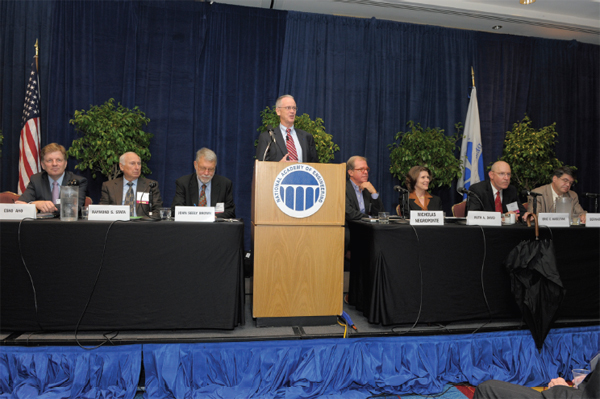
NAE President Charles M. Vest and forum panelists.
their knowledge and talents with people in less developed countries to improve their quality of life.
John Seely Brown, visiting scholar and advisor to the provost at the University of Southern California and for nearly two decades the director of the Xerox Corporation’s legendary Palo Alto Research Center, talked about how young people are changing the world through their use of technology. John—or JSB, as he is often called—has given himself the title “Chief of Confusion,” yet his remarks were anything but confusing. He provided remarkable insights into what it will mean to live in a world where people are linked together and doing things in ways that were previously unimagined.
Ruth David, president and chief executive officer of Analytic Services Inc. and a former deputy director for science and technology at the Central Intelligence Agency, analyzed the rapid recent expansion of the scientific and engineering research workforce around the world. The United States still leads in many measures of science and technology expertise and productivity, but other countries are narrowing the gap, which creates both challenges and opportunities for the United States.
Eric Haseltine, a consultant in management and innovation and for many years a leader of Disney Imagineering, discussed engineering in
a world where the boundaries of space and time are disappearing. The former associate director for science and technology in the Office of the Director of National Intelligence, Eric has an ideal background for observing global trends in science and technology.
Nicholas Negroponte, who with Jerome Wiesner co-founded the famous Media Lab at Massachusetts Institute of Technology (MIT), described his work with the One Laptop per Child Association Inc. The idea is deceptively simple: What if every child in the world had an inexpensive low-power laptop connected to the Web? The foundation has already distributed an astounding number of laptops in countries around the world, and in the process it is changing how people think about education and about society.
Raymond Stata, cofounder and chairman of the board of Analog Devices Inc. and a quintessential American technology-based entrepreneur, focused on the coming era of systems engineering. Ray came to the United States to study at MIT, stayed in the country to work, and cofounded what has become a globally successful company. When that company was challenged by foreign competitors, he rolled up his sleeves, spent innumerable hours studying the new world of quality management, and emerged with a company that was even stronger than before.
At the end of the forum, I conducted a simple poll of the seven panelists by asking them if globalization of technology is a good thing or a bad thing. Without hesitation, all responded that it is a good thing. The spread of technology throughout the world will bring hope and prosperity, but it will also increase complexity and risk. The global challenges for adequate water, food, health, energy, security, and a livable climate cannot be overcome by technology alone. But neither can any of them be overcome without technology.
Charles M. Vest, president
National Academy of Engineering
This page intentionally left blank.
Contents
1 Perspectives on Global Technology
Engineering for the Other 90 Percent
Global Expansion of the Research Workforce
The Global Youth Movement in Technology
The One Laptop per Child Revolution
The Coming Era of Systems Thinking
Erasing the Boundaries of Space and Time
2 Charting a Path into the Future
Integrating Social and Technological Systems
Bandwidth as a Factor in Competition


