
1
Introduction
The ocean dominates Earth’s surface and greatly affects our daily lives. It regulates Earth’s climate, plays a critical role in the hydrological cycle, sustains a large portion of Earth’s biodiversity, supplies food and mineral resources, constitutes an important medium of national defense, provides an inexpensive means of transportation, is the final destination of many waste products, is a major location of human recreation, and inspires our aesthetic nature.
– Oceanography in the Next Decade, 1992
In its 2004 report An Ocean Blueprint for the 21st Century, the U.S. Commission on Ocean Policy (USCOP) recommended the development of “a national ocean and coastal infrastructure and technology strategy to support science, resource management, assessments, enforcement, and education” (USCOP, 2004). One of the USCOP’s tasks was to develop an inventory of U.S. infrastructure for ocean science, education, and various management and industry activities; this revealed that significant components of the U.S. infrastructure were aged or obsolete, and in some areas capacity was insufficient to meet the needs of the ocean community. The USCOP expressed concern that there was a growing technology gap in U.S. facilities, as well as a decline of national leadership in marine technology development. Both of these issues could result in increasing reliance on foreign facilities, potentially reducing the access of U.S. researchers to new technologies, data, and opportunities.
In response to An Ocean Blueprint for the 21st Century, the administration formed the National Science and Technology Council’s Subcommittee on Ocean Science and Technology (SOST)1 to coordinate the nation’s ocean research enterprise among the federal agencies. In 2007, SOST released Charting the Course of Ocean Science in the United States for the Next Decade: An Ocean Research Priorities Plan and Implementation Strategy, with key strategies that focused on compelling ocean-related societal and scientific issues (stewardship of natural and cultural ocean resources, increasing resilience to natural hazards, enabling marine operations, the ocean’s role in climate, improving ecosystem health, and enhancing human health; JSOST, 2007). Through continued planning for ocean science needs beyond the next decade, SOST has been evaluating the current status and future needs of the nation’s research infrastructure. Federal agencies with ocean responsibilities will need to anticipate the directions that ocean research could take over the next decades because of the lengthy lead times for planning, designing, funding, and building major infrastructure assets, and because of the long service life of many of these assets (often 25-30 years or more). Balancing the competing needs of construction and ongoing support is a major challenge to sustaining the U.S. ocean research enterprise. Given current struggles to maintain, operate, and upgrade major infrastructure elements while maintaining a robust research portfolio, a strategic plan is needed for future investments to ensure that new facilities provide the greatest value, least redundancy, and highest efficiency in terms of operation and flexibility to incorporate new technological advances. SOST sought advice from the National Research Council on a strategy for addressing the nation’s ocean research infrastructure needs in 2030, focusing on facilities and hardware needed to address
|
BOX 1.1 Statement of Task The National Research Council will assemble an expert committee to provide advice and a perspective from the worldwide ocean community on the types of U.S. ocean infrastructure that will facilitate research in 2030, including advice as to what criteria may be most appropriate for setting priorities. The committee will identify major research questions anticipated to be at the forefront of ocean science in 2030 based on national and international assessments, input from the worldwide scientific community, and ongoing research planning activities. Next, the committee will define categories of infrastructure that should be included in planning for the nation’s ocean research infrastructure of 2030 and that will be required to answer the major research questions of the future, taking into consideration
The report will provide advice on the criteria and processes that could be used to set priorities for the development of new ocean infrastructure or replacement of existing facilities. It will not recommend specific new infrastructure or facility fabrication or construction investments. In undertaking this task, the committee will consider a variety of issues, such as partnerships with other nations and industry, constraints on acquisition and operation of research platforms, and suitability of facilities for addressing a diversity of scientific endeavors. In the same context as Charting the Course of Ocean Science in the United States for the Next Decade: An Ocean Research Priorities Plan and Implementation Strategy, this study will address societal issues. In addition, the committee will recommend ways in which the federal agencies can maximize the value of investments in ocean infrastructure. This may include practices that would facilitate the transition of facilities and infrastructure for research into operational use. |
significant oceanographic research questions. The Statement of Task is found in Box 1.1. Committee biographies can be found in Appendix A.
During the course of this study, the National Ocean Council was established to implement the Final Recommendations of the Interagency Ocean Policy Task Force (Executive Order 13547, July 19, 2010). The implementation strategy for the National Ocean Policy (CEQ, 2010) includes the following priorities: ecosystem-based management; coastal and marine spatial planning; informing decisions and improving decision making, coordination and support; resiliency and adaptation to climate change and ocean acidification; regional ecosystem protection and restoration; water quality and sustainable practices on land; changing conditions in the Arctic; and ocean, coastal, and Great Lakes observations, mapping, and infrastructure. SOST has also been in the process of updating Charting the Course of Ocean Science in the United States for the Next Decade: An Ocean Research Priorities Plan and Implementation Strategy.2
WHAT IS INFRASTRUCTURE?
The Merriam-Webster Dictionary3 defines “infrastructure” as “the underlying foundation or basic framework (as of a system or organization)” or “the resources (as personnel, buildings, or equipment) required for an activity.” Consistent with this definition, U.S. infrastructure for ocean research could be broadly defined as the full portfolio of platforms, sensors, data sets and systems, models, computational and network services, personnel, facilities, and enabling organizations that the nation can bring to bear to answer questions requiring understanding of the ocean.
For the purpose of this report, the committee adopts a slightly narrower definition that focuses on the shared or community resources accessible to the U.S. ocean research enterprise. This excludes personnel and resources associated exclusively with a particular investigator’s research activities, which are often very specialized, prototypes in devel
opment, or fully dedicated to a particular task. Under the committee’s definition, U.S. ocean research infrastructure is
the full portfolio of platforms, sensors, data sets and systems, models, supporting personnel, facilities, and enabling organizations that the nation can bring to bear to answer questions about the ocean, and that is (or could be) shared by or accessible to the ocean research community as a whole.
As defined here, ocean research infrastructure is a national portfolio of resources and assets that include technology, facilities, data, people, and institutions. This portfolio changes over time in response to federal, state, local, and private-sector investments in ocean research infrastructure and to developments in oceanography and other fields (information technology, power systems, robotics, and genomics, among others). The state of the nation’s ocean research infrastructure at any point in time determines how well, how quickly, and at what cost the nation can obtain answers to basic and applied questions about the ocean. However, significant components of U.S. ocean infrastructure are currently insufficient to meet needs for the ocean research community (see Box 1.2).
The committee defines the ocean research community in the broadest possible terms, with inclusion of the entire ocean science enterprise. While academia is a significant part of this group, the ocean research community encompasses scientists and policy makers at all levels of government and within industry and nonprofit foundations.
REPORT SCOPE
This report addresses the factors for federal agencies to consider as they plan investments that will affect ocean research infrastructure over the next 20 years. As noted above, the report focuses on components of infrastructure that are or could be shared as a community-wide resource. It excludes certain categories of ocean research personnel (such as principal investigators, administrators, and graduate students) and facilities and equipment that are private, proprietary, or in the inventory of an individual scientist and cannot be shared by the ocean research community as a whole.
The report describes categories of ocean research infrastructure, reviews how infrastructure components have evolved over the past 20 years, and considers the science questions that are likely to determine the infrastructure that will be needed in 2030. These science questions include basic, exploratory work that seeks to broaden our knowledge about the ocean in general ways, as well as applied work that seeks to generate information to address specific societal needs. The committee examines past trends in ocean research infrastructure development and categorizes essential infrastructure assets for the next 20 years, suggests how federal agencies could prioritize investments in ocean
|
BOX 1.2 Ocean Science Infrastructure on the Decline Many pieces of infrastructure that enable U.S. scientists to conduct crucial studies in the ocean are clearly degrading. In this box, two examples of at-risk infrastructure are discussed. Infrastructure capabilities that allow study of the high-latitude ocean are waning, although these regions are among the most sensitive to a warming climate due to the amplification of temperature changes nearest the poles. Arctic sea ice is already in decline (Stroeve et al., 2007), with implications for ecosystem changes, U.S. jurisdiction interests, national security, and commercial shipping routes. However, the United States is having difficulty ensuring the continued operation of ice-breaking research vessels able to function in multiyear ice. The largest icebreakers, the U.S. Coast Guard’s Polar Star and Polar Sea, are over 30 years old and have exceeded their service lives. At the time of writing, the Polar Star has recently been reactivated from caretaker status (where the crew is removed and engines and systems are shut down), and the Polar Sea returned to operations after engine casualties. Newer ice-breaking research vessels such as the U.S. Coast Guard Cutter Healy were designed to operate in multiyear ice only in conjunction with a heavier ship, which would break a path for them to follow. The lack of heavy icebreaker capabilities will cause the nation to be dependent on leasing or operating in collaboration with foreign icebreakers to conduct science missions in high latitudes. Additionally, resupply missions to Antarctic research bases are also dependent upon icebreakers from other countries. The current decrease in U.S. icebreaking capability makes high-latitude research more complex and adds an element of risk because the enabling infrastructure is not within the nation’s direct control. In addition, the U.S. Coast Guard is in danger of losing valuable skill sets, as crew from the heavy icebreakers are reassigned to different positions. Ocean color satellites have been a key contributor to understanding the impact of climate on ocean biology (Behrenfeld et al., 2006). Ocean color data are used in identifying and monitoring conditions that could lead to harmful algal blooms, and were used to identify patches of oil during the Gulf of Mexico Deepwater Horizon well explosion and oil spill. The Sea-viewing Wide Field-of-view Sensor (SeaWiFS)/Moderate Resolution Imaging Spectroradiometer (MODIS) sensors were launched in a sequence designed to provide a continuous, intercomparable time-series of chlorophyll concentrations throughout the ocean since 1997 (McClain, 2009). However, SeaWiFS ceased operations in December 2010 and both MODIS sensors are beyond their lifespan; there is no U.S. mission of equal quality planned to be in space until 2019 or later. The capability to produce climate-quality observations of ocean color is presently threatened, as some questions regarding access to foreign ocean color data remain unresolved. The ability to detect shifts in ocean biology on a global scale is endangered at a time when a shifting climate might be expected to cause significant change in oceanic primary production. |
research infrastructure, and discusses ways that the value of these investments could be maximized.
The report does not make recommendations about specific changes to U.S. ocean research infrastructure, nor does it assign priorities to future infrastructure investments or to the science questions that the shared infrastructure is intended to support. However, critical needs for specific infrastructure categories are mentioned in the text, in that the science research of the future cannot be done without these types of assets. Decisions regarding prioritization are to be made by federal agencies and other sponsors, with appropriate input from the broad ocean science community. It is the committee’s belief that the processes and considerations suggested in this report will inform the approach that federal agencies take over the next two decades to ensure the availability of an effective and efficient shared ocean research infrastructure for supporting world-class basic and applied ocean research in the United States.
SOCIETAL DRIVERS
Ocean research is driven by science questions. These questions, in turn, can arise from the work of individual investigators seeking to broaden basic knowledge and understanding of the ocean through exploration and scientific investigation of ocean phenomena, from the need to generate applied information to address specific societal concerns, or from some combination of basic and applied interests. A representative list of major science research questions for 2030, and their implications for infrastructure, is discussed in detail in Chapter 2. The list of major research questions could have been organized in a variety of ways, including by discipline, by region, or thematically. For this report, the committee chose an organization based on each question’s relationship to compelling societal objectives. These four overarching societal drivers are: enabling stewardship of the environment, protecting life and property, promoting sustainable economic vitality, and increasing fundamental scientific understanding. These objectives were determined by the committee, based on a synthesis of national ocean policy objectives (e.g., USCOP, 2004; JSOST, 2007; CEQ, 2010). It should be kept in mind that there is overlap between the societal drivers and the knowledge bases they require, and that some science questions could easily fall into more than one category. In this report, each question is placed in a single category.
Basic science questions evolve naturally, as research shifts the frontiers of knowledge and as technological advances make possible new kinds of inquiries. Applied science questions evolve as the information base increases or as national priorities change in response to major economic, political, and environmental developments. Some of the important societal needs related to the ocean have been with us for many years and are likely to remain important in 2030 and beyond (e.g., managing human activities such as fishing or energy extraction, mitigating impacts of natural hazards such as tsunamis, and using the ocean effectively for national security). These questions often remain unanswered because of limitations in the technology needed to address them. For example, genomics developments have recently enabled new fishery management options based on identification of distinct genetic subpopulations. Investments that motivate and nurture new technological developments and infrastructure are likely to allow previously unanswerable questions to gain traction. Other questions have gained in importance in recent years and are likely to be more prominent in 2030 than they are today or were in 1990 (e.g., the role of the ocean in global climate or on human health). The time is right for a new look at the ocean infrastructure that will be necessary to support these needs in the future: the traditional societal drivers of ocean research for much of the 20th century (national defense, offshore oil and gas, fisheries, and transportation) have been expanded into a broader context that now includes global climate change, environmental quality, energy, and ecological sustainability (CNA, 2007).
THE LINK BETWEEN OCEAN RESEARCH INFRASTRUCTURE AND SOCIETAL DRIVERS
Ocean research infrastructure provides the foundation on which basic and applied marine research activities are carried out. These research activities involve the deployment of platforms, sensors, and sampling devices to collect samples and data, the analysis of samples and data (often in shore-based facilities), and the construction of models to explain natural phenomena and develop predictive capabilities. The models drive future data needs, which, in turn, improve the models. Information produced by research and models represents the best answers to date to the questions that motivated the research. These answers advance fundamental understanding of ocean science and connected global issues, develop the future priorities related to ocean research and technology, and help inform policy decisions such as marine resource management. They also inform the next set of scientific questions that are asked as new phenomena, threats, and opportunities connected to the ocean are discovered. There are fundamental links between ocean research infrastructure, ocean science activities, and societal questions and the benefits associated with answering them (Figure 1.1).
The linkages shown in Figure 1.1 represent “flows” that often go in both directions, and it is possible to think of the connection between infrastructure and societal objectives as either top down or bottom up. Starting at the top, every societal objective implies a demand for certain information, the acquisition of which has a certain value for society. Acquiring the information often requires answering science questions and/or developing and validating models (for example, models of fish stock recruitment or climate change). Science questions lead to research activities (funded research projects of investigators in both public and private ocean organiza-
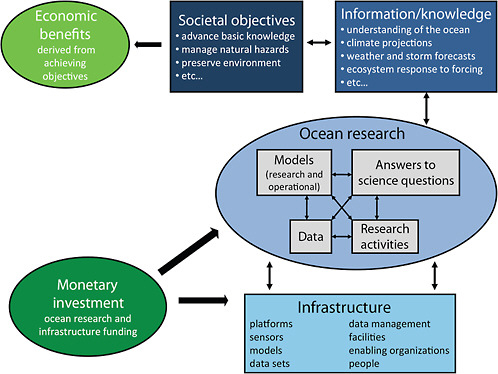
FIGURE 1.1 Conceptual diagram illustrating links between ocean infrastructure, scientific research, relevant societal objectives, and benefits associated with achieving these objectives.
tions), which result in data collection, analysis, and model development. Data and models also feed back to science questions and research activities by suggesting the next set of questions to be answered. All of this work relies on ocean research infrastructure for the tools and resources to collect, manage, and analyze data. Some models and data sets are considered part of the infrastructure (e.g., global ocean models, widely used climate models). Others, specific to the work of one or two investigators, would fall into ocean research. Ocean science and research activities make use of infrastructure (e.g., ships, buoys, community models) and, in some cases, add to the infrastructure (e.g., by developing new data sets that become part of infrastructure), leading to some overlap between infrastructure and research activities.
Following the linkages bottom up from infrastructure to societal benefits also suggests a useful approach to thinking about infrastructure priorities. Each piece of ocean research infrastructure has an associated cost. Each piece of infrastructure also enables or supports research and modeling activities and, therefore, supports the production of information, which contributes to certain societal objectives—and thus to the aggregate societal benefits produced. The task of prioritizing ocean research infrastructure investments can therefore be interpreted as maximizing the net benefits from infrastructure investments over time by choosing the best combination of infrastructure investments subject to a budget constraint for a given period of time.
A formal optimization of this kind requires extensive information about the value or benefit generated by achieving each societal objective to some degree, and about the linkages between each piece of infrastructure and these objectives in addition to the price of infrastructure. A rational approach to prioritizing investments in infrastructure has to assign (whether explicitly or implicitly) a value to both societal goals and to basic research and technology development. This report takes a first step in assembling that infor-
mation by associating science questions with infrastructure components (Chapter 4) and suggesting the factors that federal agencies should consider in quantifying the linkages between infrastructure investments and outcomes (Chapters 5 and 6). The uncertainty associated with future benefits from infrastructure investments, in part due to unanticipated applications, is also recognized in the report.
STUDY APPROACH
The Committee on an Ocean Infrastructure Strategy for U.S. Ocean Research in 2030 was assembled by the National Research Council to provide recommendations to SOST, which is composed of the federal agencies with interests and/or responsibility for the ocean environment. In addition to SOST agencies, the committee envisions that this report will be of use for policy makers and the greater oceanographic community.
The committee determined that the charge (Box 1.1) was written broadly and the most significant aspects of the charge were embedded in paragraph text. These main points are
-
Identify major research questions anticipated to be at the forefront of ocean science in 2030.
-
Define categories of infrastructure that should be included in planning for the nation’s ocean research infrastructure of 2030.
-
Provide advice on the criteria and processes that could be used to set priorities for the development of new ocean infrastructure or replacement of existing facilities.
-
Recommend ways the federal agencies can maximize the value of investments in ocean infrastructure.
-
Address societal issues in the same context as Charting the Course of Ocean Science in the United States for the Next Decade: An Ocean Research Priorities Plan and Implementation Strategy.
It is these five points that were used to structure the report. The Statement of Task also includes a bulleted set of considerations that are addressed within the report chapters and were used to focus and refine specific issues.
In order to address its charge and formulate conclusions and recommendations, the committee reviewed relevant ocean policy documents, community and agency strategic plans, peer-reviewed publications, and input from the ocean science community in response to a public solicitation. The information gathering process for this report also included presentations by and discussions with representatives of federal agencies, community groups, and experts in a variety of scientific and engineering disciplines. This was accomplished through meeting open sessions with invited presentations, a workshop with 20 invited speakers (Appendix B), community input solicited through advertisements in scientific journals, and a session at the 2010 Ocean Sciences Meeting (Appendix C).
REPORT ORGANIZATION
This report identifies a number of issues related to strategic thinking about ocean infrastructure needs and capabilities for 2030. Chapter 2 discusses major science research questions that are expected to be of importance in the next 20 years. In Chapter 3, the committee considers ocean infrastructure trends in the past 20 years (1990-2010) and categorizes the types of infrastructure for consideration when planning for future U.S. ocean research infrastructure. Linkages between the major research questions and needed infrastructure assets and capabilities for 2030 are explored in Chapter 4. Criteria and processes that could be used to set priorities for infrastructure investments is addressed in Chapter 5, while Chapter 6 evaluates ways that federal investments in ocean research infrastructure could be maximized.


