

Below is the uncorrected machine-read text of this chapter, intended to provide our own search engines and external engines with highly rich, chapter-representative searchable text of each book. Because it is UNCORRECTED material, please consider the following text as a useful but insufficient proxy for the authoritative book pages.
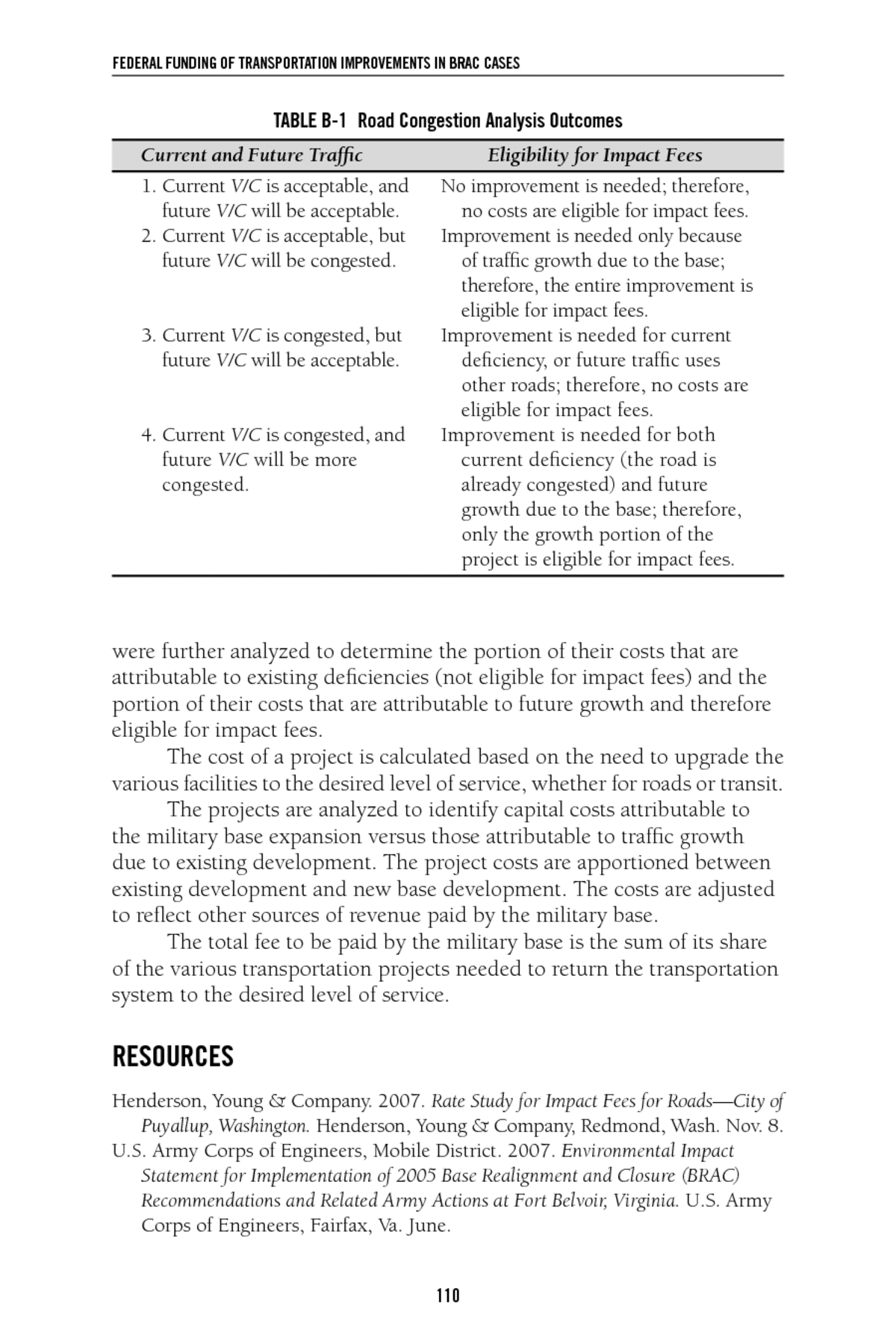
Appendix B IllustratIve example of Impact fee calculatIon for expansIon of mIlItary Bases c alculating impact fees for increases in military base personnel requires a number of steps that are similar to calculating impact fees for any new development. The process requires using a travel forecasting model to analyze the current and future volume of traffic on the areaâs roads. Estimating the traffic effects of any proposed development can produce considerable technical debate. Most cities and all major metro- politan planning organizations in the country maintain a regional travel demand model that is certified by the U.S. Environmental Protection Agency for estimating the effect on air quality and other impacts. These models are based on what is known as the four-step process involving trip generation, trip distribution, mode share, and assignment. In most urban areas, some roads are congested. As growth occurs, more roads become congested. A common measure of congestion is the ratio of traffic volume to the capacity of the roads (the V/C ratio). The volume is the number of trips on the road, and the capacity is the num- ber of trips the road is designed to accommodate. The design capacity corresponds to a specific service standard. When the volume is significantly less than the capacity, traffic flows freely, and the V/C ratio is low. When a road becomes congested, the vol- ume is close to (or exceeds) the capacity and the V/C ratio is high. A ratio of 0.75 is considered moderate; a ratio of 1.0 is the threshold at which the road âfails.â Each urban area can establish threshold criteria for when a V/C ratio is unacceptable. To identify the need for additional road capacity to serve military growth, trips are assigned to the road network, with a detailed list of current and future V/C ratios for significant arterial and collector roads in the urban area. The current ratios form a baseline to identify exist- ing deficiencies (these existing deficiencies cannot be corrected by new impact fees). The future ratios identify which roads will become con- gested as a result of future growth and are therefore eligible to be funded by impact fees. There are four possible combinations of current and future V/C ratios for trips on existing roads, as shown in the four outcomes listed in Table B-1. Any road segments that have Outcome 1 or 3 were excluded from consider- ation for impact fees. Any road segments with Outcome 2 were included in the list of roads eligible for impact fees. Any road segments with Outcome 4 109
federal fundIng of transportatIon Improvements In Brac cases taBle B-1 road congestion analysis outcomes Current and Future Traffic Eligibility for Impact Fees No improvement is needed; therefore, 1. Current V/C is acceptable, and no costs are eligible for impact fees. future V/C will be acceptable. Improvement is needed only because 2. Current V/C is acceptable, but of traffic growth due to the base; future V/C will be congested. therefore, the entire improvement is eligible for impact fees. Improvement is needed for current 3. Current V/C is congested, but deficiency, or future traffic uses future V/C will be acceptable. other roads; therefore, no costs are eligible for impact fees. Improvement is needed for both 4. Current V/C is congested, and current deficiency (the road is future V/C will be more already congested) and future congested. growth due to the base; therefore, only the growth portion of the project is eligible for impact fees. were further analyzed to determine the portion of their costs that are attributable to existing deficiencies (not eligible for impact fees) and the portion of their costs that are attributable to future growth and therefore eligible for impact fees. The cost of a project is calculated based on the need to upgrade the various facilities to the desired level of service, whether for roads or transit. The projects are analyzed to identify capital costs attributable to the military base expansion versus those attributable to traffic growth due to existing development. The project costs are apportioned between existing development and new base development. The costs are adjusted to reflect other sources of revenue paid by the military base. The total fee to be paid by the military base is the sum of its share of the various transportation projects needed to return the transportation system to the desired level of service. resources Henderson, Young & Company. 2007. Rate Study for Impact Fees for RoadsâCity of Puyallup, Washington. Henderson, Young & Company, Redmond, Wash. Nov. 8. U.S. Army Corps of Engineers, Mobile District. 2007. Environmental Impact Statement for Implementation of 2005 Base Realignment and Closure (BRAC) Recommendations and Related Army Actions at Fort Belvoir, Virginia. U.S. Army Corps of Engineers, Fairfax, Va. June. 110
