
Responses to PERAA: Initial Implementation
The District of Columbia has made many changes since the Public Education Reform Amendment Act (PERAA) of 2007 was enacted. Some have received much public scrutiny: schools have been closed, principals and teachers dismissed, and a new teacher’s union contract has been adopted. Other changes have received less attention, such as the formation of a new interagency commission to coordinate services available to children and young people and a new office to oversee the construction and renovation of schools. Information about many of these developments is available on the websites of various city agencies, and the local press and community-based groups have also reported on many of them.1
Systematically documenting the city’s efforts will be a critical component of the 5-year evaluation the law itself calls for, and until this is done, few firm conclusions can be drawn about how well the city has implemented PERAA and fulfilled the intentions of the law. As a first step in that process, this chapter presents a picture of the broad outlines of the city’s response to PERAA.
In assembling this information we relied primarily on information and materials supplied by city agencies and officials. We reviewed information made available to the public by DC Public Schools (DCPS), the Office of the State Superintendent of Education (OSSE), and the Department of
_______________
1Some early steps in the reform of DC schools under PERAA are described and evaluated in two reports, from the U.S. Government Accountability Office (2009), Ashby (2008); and a joint one from the 21st Century School Fund, the Urban Institute, and the Brookings Institution (2008).
Education headed by the deputy mayor of education, both in printed documents and on their websites. Officials of these agencies presented materials to the committee and staff and also answered specific questions about the school system. We also examined several reports produced by government agencies, research organizations and civic groups, as well as some media coverage. However, all these reports and other presentations were prepared for different purposes, and they used a variety of different methods: for this chapter, we used them primarily as sources of factual information not otherwise available; we discuss the sources further in Chapter 5.
We also note the potential for confusion regarding which entities in the city are responsible for which aspects of public education, because of the city’s unique political status and structure. We generally refer to “the city” or “the District” when discussing areas that are not solely the responsibility of the DCPS.
The scope of PERAA is quite broad. Its first eight titles lay out requirements for the governance, organization, and management of DC’s public schools; the corresponding functions of a state education agency; the management and construction of educational facilities; and the creation and oversight of charter schools. PERAA also establishes a structure to foster collaboration across agencies serving at-risk children in the city and calls for the appointment of an ombudsman so that the District’s residents have a mechanism for registering concerns and resolving disputes. PERAA also requires that benchmarks be established for annual assessments of progress in four key areas of the school system: business practices, human resources, academic plans, and annual achievements. The mayor is charged with conducting these assessments and reporting on them to the city council. The mayor is also charged with submitting to the council a 5-year assessment of the public education system established by PERAA (that is, the evaluation this committee was asked to design).
Figure 4-1 shows the governance structure for the city’s public schools before and after PERAA. The new structure is more complex than the old one, and the boundaries between the responsibilities of each of the new entities are not completely distinct, as shown in Table 4-1.
MAYORAL CONTROL: THE CHANCELLOR AND THE BUDGET
The most widely publicized change brought about by PERAA is the placement of DCPS directly under the oversight of the mayor. This change affords the mayor authority over most educational matters, ranging from school operations to personnel and labor relations, and grants the mayor
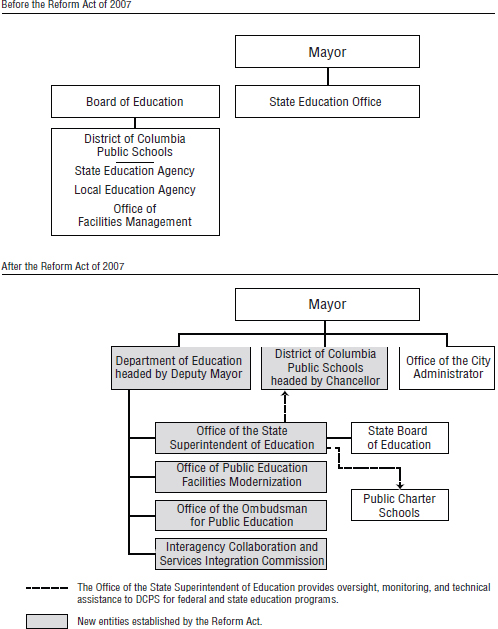
FIGURE 4-1 DCPS governance structure before and after PERAA.
SOURCE: U.S. Government Accountability Office (2009, p. 7).
responsibility for appointing a chancellor (to run DCPS), though the appointment has to be confirmed by the DC City Council.
The chancellor’s responsibilities, like those of most district superintendents, include establishing educational priorities, adopting curri-
TABLE 4-1 Offices with Responsibility for DC Public Schools
| Office and Mission | Areas of Responsibility |
| District of Columbia Public Schools (DCPS)—Office of the Chancellor To educate all children in the District of Columbia, providing the knowledge and skills they need to achieve academic success and choose a rewarding professional path. |
|
| Office of the Deputy Mayor for Education (DME) Support the mayor in developing and implementing a world-class education system that enables children, youth, and adults to compete locally and globally. |
|
| Office of the State Superintendent of Education (OSSE) Act as the state education agency for DC; sets policies, provides resources and support, and exercises accountability for all public education in DC. |
|
| DC State Board of Education (DCSBOE) Advise the state superintendent of education on educational matters, including state standards; state policies, including those governing special, academic, vocational, charter, and other schools; state objectives; and state regulations proposed by the mayor or the state superintendent of education. |
|
| Statewide Commission on Children, Youth, and Their Families (SCCYF) To improve services for vulnerable children by promoting social and emotional skills among children and youth through the oversight of a comprehensive integrated delivery system. |
|
| Office and Mission | Areas of Responsibility |
| Office of Public Education Facilities Modernization (OPEFM) To support high-quality education by rapidly and consistently providing and maintaining safe, healthy, modern, and comfortable learning environments. |
|
|
Public Charter School Board (PCSB) |
|
SOURCE: Compiled from the websites and fiscal 2011 annual reports of the relevant agencies and the District’s CapStat website, see http://capstat.oca.dc.gov/PerfInd_Education.aspx [accessed December 2010].
cula and assessments, and ensuring that the schools are appropriately staffed and managed. Unlike many other urban school chiefs, however, the DC chancellor is not responsible for facilities construction and modernization or for transportation: these functions fall under the Department of Education and the deputy mayor for education (discussed below).
Another critical area not under the mayor’s (or the chancellor’s) direct control is the budget. Annual budgets have to be submitted by the mayor to the city council for review and approval, and, with a two-thirds majority, the council can change the proposed budget.
As required by PERAA, the mayor appointed a new chancellor, who was confirmed by the city council in June 2007. This action proved to be among the most high profile and contentious aspects of the changes brought about by PERAA. Beginning with the politics surrounding her selection, Chancellor Michelle Rhee’s tenure was marked by controversy. It is widely understood that Mayor Fenty made a choice that reflected his view of the sort of reforms most needed to bring about change in the district: Chancellor Rhee was expected to make dramatic, rather than incremental, changes, and would focus on teacher quality (King, 2007; Turque and Cohen, 2010). (Chapter 5 provides a brief overview of the strategies Rhee and Fenty adopted.)
Other early controversies concerned school budget matters. For example, the city council held special hearings, in response to budget concerns, to review DCPS actions. A particularly heated hearing occurred in October 2009, after the chancellor announced her intention to terminate hundreds
of teachers because of a projected budget shortfall. Feelings ran high after this took place; for example, WTOP, a local news radio station, characterized the action this way: “DC Schools Chancellor Michelle Rhee told the DC City Council she ignored their mandate to cut funds from next year’s summer school program and instead fired hundreds of teachers” (Segraves, 2009, para. 3). Many school staff, as well as many District residents, disagreed vigorously and publicly with the decision.
Tensions between the chancellor and the council over budgetary questions and the related issues of teacher dismissals and school closures continued throughout Michelle Rhee’s tenure and raise many questions about strategic management of DCPS and how budgetary matters should or should not influence management decisions. The budget approval process required in PERAA appears to have been carried out as prescribed, but some observers question the adequacy of the process. For example, the executive director of the Federal City Council, John Hill, explained to the committee:
We believe that there needs to be a transparent budget that focuses on resources and supporting and expanding the work in terms of improving educational outcomes…anyone who has taken a look at the budget, even those who have studied it, it’s hard to understand from outside of the government, and sometimes even hard to understand within the government. And so we believe that it should be understandable by everyone.
Although these sorts of concerns are certainly not unique to the District, they do point to a desire by some residents for clearer and more accessible information regarding school and school district financing and budgeting.
DCPS’s limited authority over its own budgeting operations also has important implications for many planning, management, and operational aspects of the district. Thus, it will be important for the PERAA-required evaluation to document whether the budgetary process is working as the law intended, whether the law has resolved any long-standing problems with the budgetary process, and whether the law has introduced any unintended negative consequences.
STATE SUPERINTENDENT AND STATE BOARD OF EDUCATION
Two provisions of PERAA address the District’s unique status as a city that is not part of any state but is treated like a state for some federal purposes. PERAA calls for a new state superintendent of education to serve as the chief state school officer for the District (a general title that refers to the person in charge of public education in each state, though states may have other titles for this role). Thus, this individual is responsible for
functions typically handled at the state level, such as overseeing federal grants; setting standards consistent with the city’s school, college, and workforce readiness goals; establishing high school graduation requirements; and early childhood and adult education programs. The OSSE is also responsible for ensuring that the District tracks and makes available accurate and reliable data that can be used to monitor compliance with both state and federal law.
Like other state education agencies, OSSE works with a state board of education to develop state education standards as well as policies governing all public schools (including charters). The DC State Board of Education is specifically charged with approving the state accountability plan for the District’s schools, as well as a number of policies and regulations typically handled at the state level (e.g., who can accredit schools, rules for residency, standards for home schooling, school attendance requirements and so forth). The board has nine members: eight are elected by each of the city’s eight wards and the ninth member is elected at large.
An example of OSSE’s function was its role in coordinating the development and submission of two bids for federal “Race to the Top” initiative funding from the U.S. Department of Education, an effort that required the cooperation and support of many different agencies and organizations from across the city. One of the proposals won and will bring an additional $75 million in federal funds to the District’s schools.2
OSSE is also responsible for the development of the State Longitudinal Education Data (SLED) system required by PERAA, which will be a critical tool for planning, management, reporting, instruction, and evaluation; it is not yet operational. SLED is expected to house information that can be used to track long-term trends for students in both traditional and public charter schools. The system is expected to track information related to students’ educational growth and development from early care through elementary and secondary school and into college, adult education, and career pathways. After an initial release of a portion of the system in early 2009, OSSE later announced termination of the contract for the data system (Office of the State Superintendent of Education, 2010b). OSSE has solicited proposals from other firms and intends to have a new contract in place by the middle of 2011 (personal communication, February 22, 2011). OSSE staff told the committee that they have made progress in the interim, such as assigning unique identifiers to students and compiling enrollment and assessment data as they build the data warehouse.
_______________
2For details of the proposal and OSSE’s goals, see Office of the State Superintendent of Education (2010a); also see Chapter 5 for a discussion of the goals.
DEPARTMENT OF EDUCATION AND DEPUTY MAYOR
PERAA established a new city Department of Education headed by a deputy mayor for education who, like the chancellor, reports directly to the mayor. The department oversees several new education-related agencies: the OSSE, the Office of Public Education Facilities Modernization (OPEFM), the Office of the Ombudsman for Public Education (OOPE), and an Interagency Collaboration and Services Integration Commission. Other important responsibilities of the Department of Education include establishing a comprehensive data system (separate from SLED) capable of aggregating and linking information across multiple city agencies, and coordinating planning and policy development related to all education and education-related activities in the District.
PERAA also spells out the requirements for the Office of the Ombudsman, who is to be nominated by the mayor and approved by the city council and report to the deputy mayor for education. The ombudsman is expected to reach out to city residents and parents, facilitate communication between residents and the mayor’s office, respond to complaints, guide residents and parents to the school or agency staff who are in a position to assist them, and track complaints. This person is also charged with making recommendations for improving service delivery and responsiveness, based on the opinions and concerns of residents and parents.
An ombudsman was appointed in October 2007 and began issuing monthly reports of the office’s activities in October 2008. Most of the 1,100 issues cited in the reports related to DCPS, although some referred to the city’s public charter schools and the University of the District of Columbia, see http://ombudsman.dc.gov/ombudsman/site/default.asp [accessed October 2010]. The reports indicate that virtually all issues were “resolved,” without providing details. The last report was dated July 2009 and announced that “funding for the Office of the Ombudsman has been eliminated for Fiscal Year 2010.” The web page for the ombudsman is no longer operational (as of fall 2010).
The ombudsman was intended to be the primary channel through which public school parents could communicate with school officials and seek redress for complaints, and its absence is significant. As one person who spoke to the committee explained:
Another thing in the legislation [PERAA] was the new State Board of Education and the ombudsman. We did not support taking away the local school board. I can just tell you my own parent and school board experience in the past is that we need some kind of locally elected or representa-
tive body that has responsibility for local education issues, which can serve as a watchdog, be a point of access for the public. That was taken away with that school board. I think [those are] unresolved issues, as is what happens with the ombudsman, which may or may not be able to cover that, but it isn’t at the moment.
The OPEFM reports to the deputy mayor; its director is appointed by the mayor and confirmed by the city council. OPEFM replaces the Office of Facilities Management that had been housed within DCPS. Thus, OPEFM is set up to operate independently of DCPS, though its director is expected to consult regularly with the chancellor, a Public School Modernization Advisory Committee, and the state superintendent of education. OPEFM has the direct authority to initiate the construction and renovation of schools in accordance with a facilities master plan. The new agency is responsible for modernizing existing DCPS schools and facilities; developing a comprehensive plan that links maintenance and modernization; and managing routine maintenance, repairs, and small capital projects on DCPS schools and facilities.
The executive director of the OPEFM was appointed in June 2007 to oversee a 15-year modernization campaign expected to cost approximately $3.5 billion dollars.3 OPEFM’s first action was a stabilization effort to address such major problems as heating, cooling, and health and safety in schools. A master facilities plan was introduced in 2008, and updated in 2010 (Office of Public Education Facilities Modernization, 2010a). It mapped out a phased modernization approach designed to provide rapid improvement to every school in the city, with priority given to the learning environments most important to the academic program. The plan also recognizes special design and planning needs for different groups of students and student and community needs, including early childhood education, special education, school-based health services, co-location with charter schools, adult and postsecondary education, and variable enrollment levels. The head of OPEFM testified in March 2010 before the city council (Office of Public Education Facilities Modernization, 2010b):
Today, the city has an expanding portfolio of wonderful school buildings that have won praise locally from joyous students and parents, and nationally from the engineering/architectural and building industry. These modernized school buildings are evident throughout this city.
We discuss in Chapter 6 the preliminary results of these efforts.
_______________
3For more information on OPEFM, see: http://opefm.dc.gov/about.html [accessed October 2010].
Structures for Charter Schools
PERAA called for several changes in the governance of the city’s public charter schools. It established the DC Public Charter School Board (DCPCSB) and charged it with (1) ensuring a comprehensive application review process for approving charter schools, (2) providing effective oversight and meaningful support to the schools, and (3) actively engaging stakeholders and the community.4 In addition to the board role, OSSE has the authority to review charter schools to ensure that they are meeting state standards and complying with regulations.
Currently, some 39 percent of students (roughly 28,000) in public schools attend the 52 approved public charter schools on 93 campuses. Successes in some of the charter schools have received public attention (Mathews, 2006, 2007; Nanos, 2007; Turque, 2010; Wilson, 2009), but as a group they are achieving modest progress. Only five met the adequate yearly progress requirements (under the No Child Left Behind Act)5 for 2010, and several were closed in 2010 (District of Columbia Public Charter School Board, 2009, 2010a, 2010b; Fabel, 2010).
Advocacy groups, researchers, media commentators, and others—in DC and elsewhere—have raised a number of concerns about charter schools. Some people have worried that poor-quality charter schools are not being adequately monitored or closed down when necessary and that comparisons between traditional and charter schools are misleading, in part because charter schools are not, proportionally, serving as many students with disabilities (or students with as severe disabilities) as are the traditional schools. Others have been concerned that charter schools are at a disadvantage in securing suitable buildings in which to operate, that charter schools receive fewer public funds per student than do traditional public schools, and that the high salaries teachers in traditional schools will receive under the new Washington Teachers’ Union contract will make it more difficult for charter schools to recruit and retain effective teachers (see Lerner, 2010a, 2010b, 2010c, 2010d).6
Such questions suggest the need for evaluation of public charter schools and outcomes for students, as well as trends in enrollment patterns and the movement of students and teachers into and out of these schools.
_______________
4For more information about the DC public charter schools, see http://www.dcpubliccharter.com/About-the-Board/Board-Functions.aspx [accessed October 2010].
5A measure of school progress, based on student performance on standardized achievement tests, used to identify schools that are or are not meeting required improvement targets under the act.
6See also Friends of Choice in Urban Schools, http://www.focusdc.org/ [accessed November 2010].
PERAA also created an Interagency Collaboration and Services Integration Commission to address the needs of vulnerable children and youth. The work of the commission is guided by six citywide goals the District has established for its children and youth: children are ready for school; children and youth succeed in school; children and youth are healthy and practice healthy behaviors; children and youth engage in meaningful activities; children and youth live in healthy, stable, and supportive families; and all youth make a successful transition to adulthood (District of Columbia Public Schools, 2009).
The commission is expected to articulate a vision for meeting the needs of children in the District, to set priorities for program development, and to articulate how resources can be shared across agencies. PERAA specifically calls for the development of an interagency database and integrated service plans to address such issues as juvenile and family violence, social and emotional skills, and the physical and mental health of vulnerable children. The law gives the commission authority to combine resources from different city agencies and levels of government (including federal) for the purpose of improving service integration. The commission is also expected to engage in the design and implementation of evidence-based programs for children and to evaluate these programs to gauge their effects on broad indicators of social welfare, such as levels of violence, truancy, and delinquency, as well as on academic performance.
The directors of the mandated commission (named the Statewide Commission on Children, Youth, and Their Families, although that is not its name in PERAA) (Office of the Deputy Mayor for Education, 2010b) include the heads of city agencies concerned with the health and well-being of children and youth.7 In its first 18 months, the commission produced a “Children’s Health Action Plan” and began work on a citywide school health strategy. It also created a vetting program designed to increase the quality of afterschool programs provided by community-based partners in schools, and it has launched several school-level programs.
According to an independent evaluation of the commission (Development Services Group, 2008, pp. 10-11):
_______________
7The members are the mayor, city council chair, public education officials, and the heads of the Department of Human Services, the Child and Family Services Agency, the Department of Youth Rehabilitation Services, the Department of Corrections, the Department of Health, the Department of Mental Health, and the Metropolitan Police Department. Representatives from a number of other District agencies (e.g., the Department of Employment Services, the Children and Youth Investment Trust Corporation, and the Department of Disability Services) are also asked to observe and participate in the commission’s meetings.
[It has succeeded in establishing] a serious and credible process, with monthly meetings that involve the Mayor, the Deputy Mayor for Education, and the key child-serving and other agency heads…[and] early results of the implementation of the evidence-based programs, and of the training to support those programs, have been positive and promising.
The authors identify several areas for improvement: encouraging greater engagement of…school principals in the implementation of the programs; seeking ways to maintain a high level of support among teachers and other implementers, so that they can implement the programs faithfully; and involving the staff who implement the programs (e.g., school resource officers) in the planning and implementation process (Development Services Group, 2008, p. 92). They also call on the commission to provide stronger direction and coordination for the prevention programs, and to provide more services to children and families.
The commission’s most recent focus has been on developing a framework that can serve as a basis for a citywide strategic education and youth development plan that will integrate existing public, private, and nonprofit plans.8 The framework defines youth development as encompassing “health and safety, in-school-time, out-of-school time, social services, and community building, as it pertains to children, youth, and their families” (Office of the Deputy Mayor of Education, 2010a, p. 2).
There is no question that PERAA has been the catalyst for many changes to DC’s public schools. The governing structure has been significantly altered, new programs are in place, and new personnel have taken a number of actions, some bold and public and others that are less visible but perhaps equally influential. A more detailed assessment of what these new offices are accomplishing should be a primary component of the next phase of evaluation.
The structures and authorities established by PERAA do not seem to be completely settled at this point, however. In the context of the fiscal 2010 budget, for example, the city council and the mayor disagreed over whether to shift staff and funds from the deputy mayor’s office to the State
_______________
8These plans include the Child and Family Services Agency 2009 Resource Development Plan; the Child Health Action Plan, 2008, Department of Health; DC Public Schools Master Education Plan for a System of Great Schools; DC Public Schools Master Facilities Plan; the District of Columbia State-Level Education Strategic Plan, Fiscal Years 2009-2013; Making Student Achievement the Focus: A Five-Year Action Plan for District of Columbia Public Schools; Race to the Top Application/Implementation Plan; and the District’s Workforce Development Plan.
Board of Education. According to the Washington Post, this disagreement reflected “the council’s discontent with what some members see as a lack of transparency and accountability in the mayor’s efforts to transform the District’s struggling public school system” (Turque, 2009, para. 3). The same article noted that the council wanted to bolster the power of the state board by giving it more independence because of a concern that elected officials should not report to appointed officials (meaning the State Superintendent of Education).
In response to some of these proposed changes, then Chancellor Michelle Rhee (2009) submitted a formal letter to the council asking it to reconsider a number of recommendations that “begin to erode the structure established by…PERAA” and “undo key components of Act” (paras. 1-2). She noted the accomplishments of the deputy mayor—especially the accomplishments of the interagency commission, which the deputy mayor oversees—and explained that:
At this time, DCPS has neither the dedicated focus nor ability to continue this important work at this level. The Office of Youth Engagement (OYE), which the Committee of the Whole has proposed to oversee ICSIC [the interagency commission], has existed for only a few short months. OYE is building twilight programs, student attendance and truancy initiatives, and the Youth Engagement Academy. Next year, OYE will take on the mammoth task of implementing the new student discipline policy. At this time, it cannot take on the additional responsibilities of ICSIC without diverting its focus from these other important initiatives.9
Finally, she questioned the State Board of Education’s ability to take on the Office of the Ombudsman, and noted that “I believe the transfer of the Ombudsman to an expanded State Board is likely to politicize the Ombudsman’s office that has responded to over 1,000 parent and community concerns” (Rhee, 2009, para. 6).
Moreover, although PERAA has altered the way education is governed in the city, some observers suggest that it does not seem to have significantly reduced the layers of bureaucracy in the system. Without a doubt, the new arrangements are complex. The deputy mayor for education oversees every educational agency or entity in the city (OSSE, OPEFM, PCSB) except for the largest and perhaps most important one, DCPS. Each of the District’s charter schools is considered to be its own local education agency (LEA), and these are overseen the deputy mayor. However, under PERAA, the
_______________
9The city council’s Committee of the Whole is responsible for the city’s annual budget and financial plan and also for matters related to public education. The Office of Youth Engagement operates under the oversight of the Office of the Chief Academic Officer and is responsible for attendance, student behavior and school culture, and health and wellness.
executive director of the Office of Public Facilities Management (OPEFM), while housed under the deputy mayor, also reports to the Executive Office of the Mayor, and issues pertaining to school modernization must also be coordinated with chancellor, though the mechanisms through which this coordination is supposed to take place are not spelled out (Lew, 2007, p. 8).
The new roles and lines of authority and accountability may not be widely understood, and it is also not completely clear whether the existing arrangements are in fact what PERAA required. People who participated in a public forum held by the committee—not a representative sample of city residents—expressed concerns about the new arrangements. “The Department of Education…this is totally new that there would be a Deputy Mayor for Education,” one noted, adding, “I think you have to look at it. It has an immense portfolio. It’s confusing to figure out what’s happening there.” Another questioned whether these newly created positions have been vested with the resources and authority they need to accomplish their missions.
These accounts and exchanges shed light on a city that is still trying to strike the right balance with respect to authority and oversight of its educational agencies. They also support PERAA’s requirement for an independent program of evaluation that can provide detailed analysis of the effects and implementation of the new law—as well as the transparency and accountability that the community wants.
Ashby, C.M. (2008). District of Columbia Public Schools: While Early Reform Efforts Tackle Critical Management Issues, a District-Wide Strategic Education Plan Would Help Guide Long-Term Efforts. Testimony before the Subcommittee on Oversight of Government Management, the Federal Workforce, and the District of Columbia, Committee on Homeland Security and Governmental Affairs, U.S. Senate, GAO-08-549T.
Development Services Group. (2008). FY 2008 Annual Evaluation Report to the Interagency Collaboration and Services Integration Commission. Washington, DC: Author.
District of Columbia Public Charter School Board. (2009). City Collegiate Public Charter School Relinquishes Charter: Public Charter School Board Approves Other Requests & Proposals. December 23. Available: http://www.dcpubliccharter.com/News-Room.aspx?id=132 [accessed October 2010].
District of Columbia Public Charter School Board. (2010a). D.C. Public Charter School Board Proposes Charter Revocation of One School, Accepts Surrender of Two Others. June 22. Available: http://www.dcpubliccharter.com/News-Room.aspx?id=156 [accessed October 2010].
District of Columbia Public Charter School Board. (2010b). D.C. Public Charter School Board Revokes the Charter of Young America Works. April 28. Available: http://www.dcpubliccharter.com/News-Room.aspx?id=151 [accessed October 2010].
District of Columbia Public Schools. (2009). Working Draft: Making Student Achievement the Focus: A Five-Year Action Plan for District of Columbia Public Schools. Washington, DC: Author.
Fabel, L. (2010). Number of DC schools meeting national standards plunges. Washington Examiner, August 10. Available: http://www.washingtonexaminer.com/local/Number-ofD_C_-schools-meeting-national-standards-plunges-1008721-100309699.html [accessed October 2010].
Friends of Choice in Urban Schools. (2010). Friends of Choice in Urban Schools home page. Available: http://www.focusdc.org/ [accessed November 2010].
King, C.I. (2007). Coming soon: The real schools battle. Washington Post, September 27.
Lerner, M. (2010a). The D.C. charter facility allotment saga continues. Washington Examiner, March 16. Available: http://www.examiner.com/charter-schools-in-washington-dc/the-d-c-charter-facility-allotment-saga-continues [accessed October 2010].
Lerner, M. (2010b). Fairness for charter schools. Washington Examiner, June 6. Available: http://www.examiner.com/charter-schools-in-washington-dc/fairness-for-charter-schools [accessed October 2010].
Lerner, M. (2010c). Is funding of DC charter schools linked to quality? Washington Examiner, June 10. Available: http://www.examiner.com/charter-schools-in-washington-dc/is-funding-of-dc-charter-schools-linked-to-quality [accessed October 2010].
Lerner, M. (2010d). PCSB revokes charter of Young America Works, more should come. Washington Examiner, April 29. Available: http://www.examiner.com/charter-schools-inwashington-dc/pcsb-revokes-charter-of-young-america-works-more-should-come [accessed October 2010].
Lew, A.Y. (2007). Transition Plan: Office of Public Education Facilities Modernization. Available: http://opefm.dc.gov/OPEFM-TRANSITION_PLAN-Final_12-04-07.pdf [accessed November 2010].
Mathews, J. (2006). A miracle in the making? KIPP turns its efforts toward elementary schools. Washington Post Magazine, April 2. Available: http://www.kipp.org/news/the-washington-post-a-miracle-in-the-making-kipp-turns-its-efforts-toward-elementaryschools- [accessed March 2011].
Mathews, J. (2007). Rating education gains; achievement gaps, advanced placement exams, demographic shifts and charter schools: What do they add up to for students? Washington Post, June 11. Available: http://pqasb.pqarchiver.com/washingtonpost/access/1285888651.html?FMT=ABS&FMTS=ABS:FT&date=Jun+11%2C+2007&author=Jay+Mathews+-+Washington+Post+Staff+Writer&pub=The+Washington+Post&edition=&startpage=B.2&desc=Rating+Education+Gains%3B+Achievement+Gaps%2C+Advanced+Placement+Exams%2C+Demographic+Shifts+and+Charter+Schools%3A+What+Do+They+Add+Up+To+for+Students%3F [accessed October 2010].
Nanos, J. (2007). Teaching kids whole-life skills; NE charter school uses innovative program to combat teen pregnancy, The Washington Post, December 6. Available: http://pqasb.pqarchiver.com/washingtonpost/access/1393806781.html?FMT=ABS&FMTS=ABS:FT&date=Dec+6%2C+2007&author=Janelle+Nanos&pub=The+Washington+Post&edition=&startpage=T.1&desc=Teaching+Kids+Whole-Life+Skills%3B+NE+Charter+School+Uses+Innovative+Program+to+Combat+Teen+Pregnancy [accessed October 2010].
Office of Public Education Facilities Modernization. (2010a). Master Facilities Plan. Available: http://dc.gov/DCPS/About+DCPS/Strategic+Documents/Master+Facilities+Plan/Master+Facilities+Plan [accessed October 2010].
Office of Public Education Facilities Modernization. (2010b). Testimony of Allen Y. Lew, Executive Director, D.C. Office of Public Education Facilities Modernization, Before the Committee of the Whole Council of the District of Columbia. Public Oversight Hearing on Master Facilities Plan for the District of Columbia Public Schools. Available: http://opefm.dc.gov/pdf/Executive%20Director%20Lew%20Testimony%20at%20MFP%20Hearing%203-24-10.pdf [accessed March 2011].
Office of the Deputy Mayor for Education. (2010a). Framework for the Development of a Statewide Strategic Education and Youth Development Plan. Washington, DC: Author. Available: http://dme.dc.gov/DC/DME/Programs/EYD%20Framework%20FINAL.pdf [accessed March 2011].
Office of the Deputy Mayor for Education. (2010b). Statewide Commission on Children Youth and Their Families. Available: http://dme.dc.gov/DC/DME/Programs+and+Services/Statewide+Commission+on+Children+Youth+and+Their+Families/Statewide+Commission+on+Children+Youth+and+their+Families [accessed October 2010].
Office of the Ombudsman for Public Education. (2009). Office of the Ombudsman for Public Education Home Page. Available: http://ombudsman.dc.gov/ombudsman/site/default.asp [accessed October 2010].
Office of the State Superintendent of Education. (2010a). Section Criteria: Progress and Plans in the Four Education Reform Areas. Available: http://osse.dc.gov/seo/frames.asp?doc=/seo/lib/seo/cos/race_to_the_top/dc_rttt_section_vi_application.pdf [accessed November 2010].
Office of the State Superintendent of Education. (2010b). The Statewide Longitudinal Education Data System (SLED). Available: http://osse.dc.gov/seo/cwp/view,a,1222,q,561228,seoNav_GID,1507,seoNav,%7C31195%7C,,.asp [accessed November 2010].
Rhee, M. (2009). Letter to City Council Chairman Vincent Gray on Committee of the Whole Recommendations on Fiscal Year 2010 Budget. Available: http://www.dcpswatch.com/dcps/090505.htm [accessed March 2011].
Segraves, M. (2009). D.C. council grills Rhee on teacher layoffs. WTOP, October 30. Available: http://www.wtop.com/?sid=1798802&nid=25 [accessed October 2010].
Turque, B. (2009). Latest Fenty budget cuts funds for schools evaluation. Washington Post, July 21. Available: http://www.washingtonpost.com/wp-dyn/content/article/2009/07/20/AR2009072002991_pf.html [accessed October 2010].
Turque, B. (2010). Higher scores noted for KIPP program; Report finds charter students do better on math and science tests. Washington Post, June 22. Available: http://pqasb.pqarchiver.com/washingtonpost/access/2063430941.html?FMT=ABS&FMTS=ABS:FT&date=Jun+22%2C+2010&author=Bill+Turque&pub=The+Washington+Post&edition=&startpage=B.1&desc=Higher+scores+noted+for+KIPP+program%3B+Report+finds+charter%27s+students+do+better+on+math+and+science+tests [accessed October 2010].
Turque, B., and Cohen, J. (2010). Rhee’s approval rating in deep slide. Washington Post, February 1. Available: http://www.washingtonpost.com/wp-dyn/content/article/2010/01/31/AR2010013102757.html [accessed March 2011].
21st Century School Fund, Brookings Institution, and Urban Institute. (2008). Quality Schools, Healthy Neighborhoods, and the Future of DC, Policy Report. Washington, DC: Author. Available: http://www.21csf.org/csf-home/publications/QualitySchoolsResearchReport/QualitySchoolsPolicyReport9-18-08.pdf [accessed March 2011].
U.S. Government Accountability Office. (2009). District of Columbia Public Schools: Important Steps Taken to Continue Reform Efforts, But Enhanced Planning Could Improve Implementation and Sustainability. Washington, DC: Author. Available: http://www.gao.gov/new.items/d09619.pdf [accessed October 2010].
Wilson, T. (2009). Tapping into students’ brain power; program looks to classrooms for ideas on reducing energy use. Washington Post, May 14. Available: http://pqasb.pqarchiver.com/washingtonpost/access/1711568301.html?FMT=ABS&FMTS=ABS:FT&date=May+14%2C+2009&author=Timothy+Wilson&pub=The+Washington+Post&edition=&startpage=T.3&desc=Tapping+Into+Students%27+Brain+Power%3B+Program+Looks+to+Classrooms+for+Ideas+on+Reducing+Energy+Use [accessed November 2010].


