
National Water Resources Challenges Facing the U.S. Army Corps of Engineers
The U.S. Army Corps of Engineers has a long history of planning and managing important aspects of the nation’s water resources, including flood hazards, commercial navigation, coastal protection, and more recently, ecosystem protection and restoration. At the direction of the U.S. Congress, the Corps of Engineers has constructed, and today operates and maintains, multi-purpose dams, navigation channels, and levees in all fifty U.S. states. The Corps also plays key roles in port and harbor maintenance and in dredging and waterways management.
For much of its history, the Corps has enjoyed considerable authority and public confidence. Corps of Engineers dams, locks, navigation channels, levees, and other infrastructure have conferred many benefits to many parties and the nation. The Corps also has been a recognized leader in hydrologic and hydraulic engineering theory and practice, both nationally and around the world.
Over the years, changes in Corps decision-making authority, federal budgetary priorities, and shifts in national water planning goals have affected the agency’s water resources management program. Federal environmental legislation, emerging demands for protection and restoration of aquatic ecosystems, declining levels of federal investments in civil works infrastructure, devolving authority, and a need to provide benefits for an expanding range of constituents and sectors have increased the complexity and controversies surrounding the operational decisions, planning studies, and water resources work of the Corps. The expertise
and decision making of the Corps has been challenged in many instances and some of the public confidence the agency enjoyed in an earlier era has eroded.
This report is from the National Research Council (NRC) Committee on U.S. Army Corps of Engineers Water Resources Science, Engineering, and Planning (see Appendix C for a listing of and biographical information on committee members). The committee was established in late 2009 with sponsorship from the Corps of Engineers. The committee’s mandate is to provide strategic advice on emerging water resources issues and challenges (see Box 1 for this committee’s full statement of task). This initial 5-year project calls for annual reports. This is the first report in that series.
The Corps of Engineers is an agency within the U.S. Department of Defense and has both civilian and military responsibilities. Under the Corps civil works program and at the direction of Congress, the Corps plans, constructs, operates, and maintains a wide range of water resources projects. The Corps’ military program provides engineering, construction, and environmental management services for Department of Defense agencies (Carter and Cody, 2006). This report focuses on the
BOX 1
Statement of Task
Committee on U.S. Army Corps of Engineers Water
Resources Science, Engineering, and Planning
This committee will provide advice to the Corps of Engineers on a range of scientific, engineering, and water resources planning issues through periodic reports. This committee’s first report will identify emerging national water resources challenges and their implications for Corps of Engineers strategies and programs. The statements of task for subsequent reports will be determined through discussions between the committee and the Corps, and will be subject to approval of the NRC Governing Board’s Executive Committee.
Through its reports, the committee will provide advice to the Corps on agency practices that are valid or that should be revised, and help the Corps anticipate and prepare for emerging water resources planning challenges. Meetings between this committee and the Corps will allow for the identification of important and emerging water resources planning and policy issues of high priority to the agency and upon which they are seeking external advice. In addition to speaking with the Corps of Engineers, the committee often will engage invited speakers from other federal agencies, U.S. congressional staff, state governments, the private sector, and relevant stakeholders. The committee also may serve as a forum for occasional workshops on thematic issues, such as flood risk management, sustainable river system planning, hydroecosystem restoration, or implications to water management of climate change and variability.
Corps of Engineers’ water resources activities within its civil works mission. Within the civil works program, this report focuses on Corps water resources and management, and Corps infrastructure and activities that affect river and coastal hydrology and hydraulics. It does not investigate or comment upon the Corps’ regulatory activities within its civil works program, as those Corps activities are less related to planning and more related to regulating actions and impacts of other entities. The report also does not investigate Corps military engineering responsibilities and activities.
As explained in Box 1, this committee’s first report focuses on identifying “emerging national water resources challenges and their implications for Corps of Engineers strategies and programs.” This report addresses several overarching water resources planning issues as they relate to the Corps of Engineers. It is anticipated that these subsequent reports will explore specific Corps of Engineers program areas, special initiatives, and reports, and thus will investigate scientific and engineering issues in greater detail. Topics for the committee’s subsequent reports are not yet determined. As this project proceeds, future statements of task for this committee will be negotiated based on discussions between the Corps and the NRC regarding timely and appropriate topics. Preliminary discussions regarding the committee’s second report point to a prospect of a review of Corps of Engineers flood risk management programs.
This report was prepared on the basis of two open public meetings, which included presentations from several Corps of Engineers staff and other invited speakers, and a third, closed meeting at which the committee discussed its draft report. The committee has reviewed documents provided by the Corps and various stakeholders prior to and during the public meetings, and has reviewed other pertinent information, including a number of previous NRC reports on U.S. water resources issues and the activities of the Corps. Given the long-term nature of this project, as well as the many factors that affect Corps of Engineers policies and actions, this committee’s first report focuses on elucidation of the decision-making context in which the Corps operates. It offers several observations and findings about the conditions that affect and constrain the Corps of Engineers, but no recommendations. This report will serve as a foundational document that the committee will refer to and build upon in subsequent reports.
TWENTY-FIRST-CENTURY WATER RESOURCES PLANNING AND MANAGEMENT
The nature of the Corps of Engineers water resources program and its water projects have changed greatly over the past 50 years. The thrust
of hydrologic engineering activities across the nation has moved from an earlier era of building civil works infrastructure to a greater emphasis today on infrastructure maintenance and on restoring aquatic ecosystem functions and services in significantly altered hydro-systems. Dams have been constructed for flood control and/or navigation enhancement on most of the major rivers and many of their tributaries, and the flows and physical characteristics of nearly every major U.S. river are heavily controlled. Many of the nation’s largest dams and related hydropower, navigation, and water supply systems were constructed in the mid-twentieth century by the Corps of Engineers and the U.S. Bureau of Reclamation. In the 1930s, for example, Hoover Dam (Reclamation) on the Colorado River, Fort Peck Dam (Corps) on the Missouri River in Montana, and many of the navigation locks and dams on the upper Mississippi River (Corps) and the Ohio River (Corps) were constructed. In the 1940s, Grand Coulee Dam (Reclamation) on the Columbia River and the Shasta Dam (Reclamation) on the Sacramento River were completed. The 1950s and 1960s saw the construction of five major mainstem dams across the Missouri River (Corps), along with Glen Canyon Dam (Reclamation) on the Colorado River. The Corps of Engineers has constructed about 800 dams across the nation for a combination of flood control, hydropower production, navigation enhancement, and water supply purposes (see Appendix B). In addition, the Corps operates and maintains 12,000 miles of commercial inland channels, and maintains over 900 coastal, Great Lakes, and inland harbors. The Corps also has constructed or operates nearly 14,000 miles of levees in the federal levee system (USACE, 2011a).
The Corps of Engineers continues to play important roles in flood risk reduction, commercial navigation, and more recently, ecosystem restoration across the nation and in most of the nation’s major riverine, lacustrian, and coastal systems. The Corps, for example, is responsible for developing operating plans for the Missouri River mainstem dam and reservoir system, operations on the Upper Mississippi River-Illinois Waterway system, and is a leading partner in restoration activities in Florida’s Greater Everglades ecosystem. The thrust of Corps activities in these, and other, hydrologic and aquatic systems has shifted. Today there is less construction of large civil works projects but the operations and maintenance (O&M) functions for all existing infrastructure remains. These O&M functions today include working with stakeholders in setting reservoir release schedules and navigation pool elevations, ecosystem restoration, and endangered species protection.
The Corps also is challenged to operate in a setting of changing hydrologic realities and demands. For example, increasing urban water demands in some regions of the country, such as in the greater Atlanta metropolitan area, are stressing existing water supplies. At an aggregate
national level, however, total water withdrawals have leveled off, and total water withdrawals in 2005 were “slightly less than the estimate for 2000, and about 5 percent less than total withdrawals in the peak year of 1980” (Kenny et al., 2009). The Corps also must cope with hydrologic variations and extremes, owing to changes in land use, climate parameters, or some combination. The concept of hydrologic “nonstationarity” (Milly et al., 2008) is prompting reconsideration of some basic tenets of hydrologic analysis and hydraulic engineering, which will affect Corps planning and operations going forward. Potential impacts of sea level rise (Solomon et al., 2007) on Corps infrastructure and coastal ecosystems present important planning and operational issues. Changing water withdrawal patterns and shifting climate and hydrologic regimes are among many national water resources challenges facing the Corps of Engineers and other federal, state, and local entities with water planning and management responsibilities. (Table 1 provides a list of national water resources planning challenges identified by this committee; also see NRC, 2010, for a similar list.)
In response to these many water planning challenges, the Corps of Engineers has been adjusting its priorities and activities to reflect new objectives and priorities for the use of water resource systems. The Corps’ traditional responsibilities were in the areas of navigation enhancement and flood risk reduction. Corps of Engineers multi-purpose dams and
TABLE 1 National Water Resources Challenges
| • | Integrating floodplain management, risk management, public safety, and ecosystem values; |
| • | Aging water control infrastructure and port and inland navigation facilities; |
| • | Urban stormwater management and water supply; |
| • | Watershed restoration; |
| • | Quantifying and leveraging ecosystem services; |
| • | Accommodating diverse stakeholder preferences in operational decisions; |
| • | Integrating social and cultural values into technical aspects of water project decision making; |
| • | Defining tolerable risk for water resource projects; |
| • | Population and economic growth and increasing water demands; |
| • | Increasing demand for water resource projects with diminishing ability to fund those projects; |
| • | Reallocating water resources to new uses, including ecosystem restoration; |
| • | Mitigating nonpoint source discharges to improve water quality; |
| • | Planning for extreme climate events and changing climate conditions (nonstationarity); |
| • | Protection of endangered species while simultaneously meeting demands of traditional water users. |
water projects also provided hydropower, water supplies, and recreational benefits. In the mid-1990s, the Congress authorized the Corps to construct projects for ecosystem restoration goals. Over time the demands from the Corps and its water resources projects have broadened, and the Corps often has been expected—and challenged—to provide benefits to both traditional and newer project beneficiaries.
The Corps of Engineers, and the nation, today are constructing fewer civil works projects for water development than during the 1950s and 1960s. The Corps in many instances is working to provide a wider suite of benefits with existing water resources infrastructure. The Corps often is working in heavily altered ecosystems with major impoundments and extensive navigation channels, and many of their projects entail hydrologic and related adjustments (e.g., sediment transport and deposition processes) to these systems and a re-allocation of water-related benefits.
In an earlier era of national water development, Corps of Engineers civil works projects focused on construction of dam, levees, navigation channels, and other infrastructure. Over time, Congress has greatly broadened the Corps’ work program and responsibilities. Future Corps water resources activities will be less dedicated to construction of major new civil works, and more heavily focused on (1) operating, maintaining, rehabilitating, and upgrading existing infrastructure, (2) re-allocating reservoir storage and releases among changing water resources demands and users, and (3) providing some degree of ecosystem restoration and ecological services in heavily altered riparian and aquatic ecosystems.
NATIONAL WATER MANAGEMENT INFRASTRUCTURE AND INVESTMENTS
The nation has made considerable investments in water resources infrastructure in the form of dams, locks, levees, navigation channels, shoreline protection, and port and harbor facilities. As the extent of this infrastructure has grown, investment needs and priorities naturally have shifted from an emphasis on constructing new infrastructure, to operating, maintaining, and upgrading existing infrastructure. At the same time, demands for new and replacement infrastructure will continue. The investments that will be required to maintain and upgrade this infrastructure are considerable.
The past three decades have seen a significant decline in the value of the Corps of Engineers capital stock portfolio. An estimate of the value of that portfolio shows a decline from a peak value of $250 billion in 1983, to $165 billion today (2011; see Figure 1).
The trend of steadily declining investments in the nation’s water
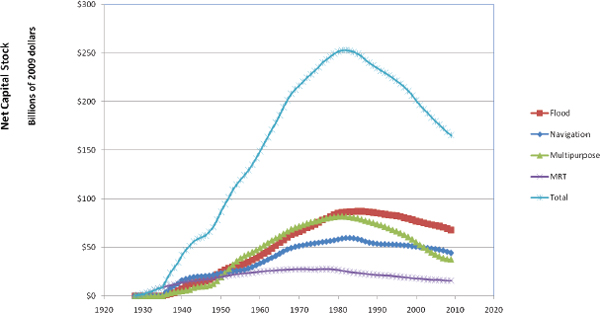
FIGURE 1 Net Capital Stock Estimates of Corps Civil Works Projects, 1928-2009 (2009 dollars). Investments made prior to 1928 are not included in the figure. The MRT acronym refers to “Mississippi River and Tributaries.”
SOURCE: Steven Stockton, U.S. Army Corps of Engineers, personal communication, 2010.
resources infrastructure is sobering in many respects. For example, some implications of these declining investments are reflected in the state of the nation’s levees. There are approximately 14,000 miles of levees in the federal levee system (USACE, 2011a) that were constructed by and/or are overseen by the Corps (and not counting levees built by local entities such as reclamation and drainage districts), with thousands of flood-prone communities located behind them. Many levees are in a state of deterioration, and many citizens and communities behind these levees have only a limited appreciation of the flood risks to which they are exposed.
There is no national inventory of all these levees, nor is there a systematic program of levee inspection and maintenance. A National Committee on Levee Safety was established in the 2007 Water Resources Development Act to develop a report and strategy for addressing national levee safety challenges. In addition, Congress funded the Corps of Engineers to undertake a national levee inventory, which is now completed, but mainly for levees in the federal levee system (USACE, 2011a). Similarly, many of the nation’s locks and dams that support commercial navigation are aging and in need of upgrades and repairs (e.g., see discussion of aging Ohio River locks and dams in Box 2). On the Upper Mississippi River-Illinois Waterway, in Title VIII of the 2007 Water Resources Development Act (WRDA) Congress authorized approximately $2 billion for new locks
BOX 2
Navigation Infrastructure Maintenance and Renewal on the Ohio River
The Ohio River has been changed significantly by an extensive system of 21 lock-dam facilities which allow for pool maintenance and year-round transportation of bulk commercial goods, especially coal. Without these navigation control systems, river transport and riverfront development would be significantly less than they are today. The Ohio River basin region has become dependent on the lock and dam infrastructure and the management services that it makes possible. However, these services are at increasing risk as the infrastructure and equipment that make year-round navigation possible and reliable continue to age without adequate maintenance and renewal.
An example of the infrastructure renewal challenge is provided by the Upper Ohio River navigation system (USACE, 2011c). The Emsworth, Dashields, and Montgomery lock-dam facilities are the first three locks and dams on the Ohio River below Pittsburgh. All three facilities were built prior to 1940 (Emsworth, 1922; Dashields, 1929; Montgomery, 1936), and are the oldest structures with the smallest lock chambers in the Ohio River system. In addition to limitations posed by inadequate lock capacity, all three have serious structural problems due to their age and do not conform to modern design criteria. All three facilities underwent major rehabilitation in the 1980s and early 1990s to extend the useful life of the projects another 25 years, but many known problems were not addressed, the 25-year extension period is now coming to an end, and substantial renewal can no longer be avoided. The Corps of Engineers undertook a long-range planning effort for the Upper Ohio navigation system in 2007 which is scheduled for completion in 2012. If funding for study completion, engineering and design, and construction is seamless and project authorization is timely, then lock replacement and other work at the Emsworth, Dashields, and Montgomery facilities could be potentially completed in 10-15 years. The history of similar projects in the Ohio River basin, however, suggests that financing and construction of new facilities will take much longer.
In the absence of funding for replacement of the infrastructure to return the Ohio River lock and dam system to its original reliability, and to bring the system up to modern design standards and capacity requirements, the three Upper Ohio River locks and dams are kept operating with repairs funded under the annual operating and maintenance budget of the Pittsburgh District of the Corps of Engineers. Funding for improvements to the infrastructure is largely limited to those that are deemed “emergency” in nature, e.g., the replacement of two gates on the Montgomery Dam which were damaged by a runaway barge in 2008. Eight additional gates are in need of replacement at the Montgomery Dam, but funds are not available for the $5 million cost of each gate.
SOURCES: David J. Heidish, U.S. Army Corps of Engineers, Pittsburgh District, personal communication, 2011; USACE, 2011c.
(that would replace existing ones) at five locations on the Mississippi River and two on the Illinois River.
Despite the declining trend in infrastructure investment, the Corps of Engineers can be expected to be directed occasionally to undertake a high-priority civil works project. There is no better example than the Corps’ post-Katrina work in strengthening the Greater New Orleans Hurricane and Storm Damage Risk Reduction System. Following Katrina, the U.S. Congress provided $14.5 billion of federal funding for levee and flood-wall repair and strengthening, pump station repairs and upgrades, levee armoring, and other infrastructure improvements across the Greater New Orleans metro area (USACE, 2011b). These construction activities extend across 350 miles of protective structures and include a large surge barrier (Inner Harbor Navigation Canal Surge Barrier). The Corps’ post-Katrina efforts illustrate a type of flood risk and emergency response challenge that the Corps will face in the future despite the declining trend in civil works infrastructure investment. These conditions also point to a national need for a Corps of Engineers that is able to respond to not-fully-anticipated water planning or emergency response needs.
There has been a declining level of investment in the civil works infrastructure owned and operated by the Corps of Engineers. Deferred costs of maintenance of the nation’s aging flood and hurricane protection, and navigation, infrastructure are considerable. Despite decreasing emphasis on new construction, Congress and the nation will continue to rely upon the Corps for emergency response activities and for periodic upgrades to civil works infrastructure.
CORPS OF ENGINEERS CAPACITIES AND PLANNING
Regardless of the trend in reduced investments in civil works infrastructure, needs and demands continue for operations and maintenance, upgrades in existing infrastructure, and for new water resources projects. At the same time, the Corps of Engineers remains responsible for operations and maintenance of a vast, existing infrastructure that includes approximately 700 dams and nearly 12,000 miles of federal levees (Appendix B). In addition to traditional services of flood control and navigation, the Corps of Engineers is often authorized to provide complementary benefits (e.g., water supply, hydroelectric power production), along with more recently authorized project purposes (e.g., aquatic ecosystem restoration).
In a previous era, the main disciplines represented within Corps of Engineers project planning were engineering, hydrology, hydraulics, and economics. These disciplines remain important in Corps planning and project operations. However, changes in the nature of Corps water
projects have entailed changes in the analytical methods and planning approaches needed to address a new planning environment. Examples of scientific and technical fields and applications that are driving the need for “new expertise” include infrastructure sensing; decision support systems; modeling and forecasting of global grain markets; integrated hydrological and ecosystem modeling; conceptual ecological model development for endangered species and other species of interest; waterway traffic modeling; risk analysis and communication; valuation of environmental benefits; and large-scale hydrologic system modeling. Also, as the Corps often plays a prominent role in facilitating multi-objective decisions among competing user groups, concepts and applications such as adaptive management, conflict resolution, and facilitation have become increasingly important.
A challenge for the Corps of Engineers in meeting water planning needs in today’s water management era is the need to develop new expertise at a time of a long-term decline in the number of Corps personnel and declining budgets for Corps research. Over the past three decades, the Corps has experienced a declining number of personnel. Employment within its civil works programs has dropped by roughly 25 percent since an employment peak in 1983 (but has experienced a recent uptick; see Figure 2).
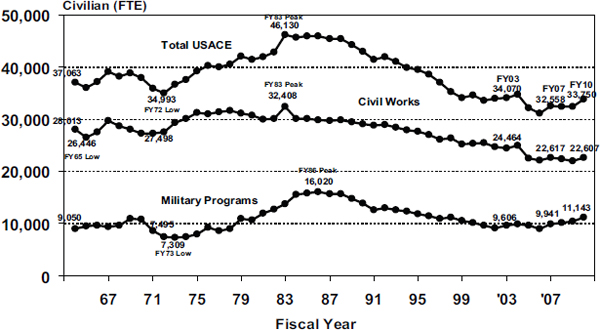
FIGURE 2 Corps of Engineers Staffing Trends, 1964-2010.
SOURCE: Bruce Carlson, U.S. Army Corps of Engineers, personal communication, 2011.
The Corps’ ability to adopt and implement more contemporary planning approaches may be stymied further by planning guidance and regulations that have not been updated to adequately reflect modern principles. For instance, the Corps of Engineers is mandated to comply with the federal Economic and Environmental Principles and Guidelines for Water and Related Land Resources Implementation Studies (U.S. Water Resources Council, 1983) to guide its water planning studies. Although of great utility in an earlier era, many groups have found the “Principles and Guidelines” document in need of modernization to conform better to today’s water planning context and needs (e.g., NRC, 2004). The ongoing effort by the White House Council on Environmental Quality (CEQ) to update the Principles and Guidelines document offers an opportunity to promote more efficient water resources planning by the Corps of Engineers and other federal agencies (see NRC, 2010, for a review of CEQ’s initial proposed changes to this document).
Despite declining investment levels and numbers of Corps personnel, the nation expects the Corps to provide a number of services, including flood risk management, water-based recreation, commercial navigation, ecosystem restoration, hydropower production, water supply, and coastal and beach protection. This situation leads to expectations that the Corps of Engineers and its civil works construction program cannot meet consistently.
AUTHORIZATION AND APPROPRIATIONS PROCESSES
Traditional Corps of Engineers water resources projects receive congressional authorization in a federal Water Resources Development Act, and receive project funding through a separate appropriations process. There is a growing number of federal water resources projects that have received congressional authorization, but are awaiting appropriations. This applies both to projects that have not yet started, and to projects that have begun but are unfinished. There also is a considerable backlog of maintenance.
One implication of this “backlog” of authorized projects that are not fully (or at all) funded is that newly authorized projects often must wait for appropriations until projects in the backlog first receive funding. The monetary value of the current backlog is estimated to be nearly $60 billion dollars (see Box 3 for more discussion of this backlog).
The size of this backlog implies that communities or other project beneficiaries often will wait years, if not a decade or longer, to receive federal water project funding. Further, the backlog exists in a setting in which a Corps of Engineers planning study typically requires several years (NRC, 1999). These realities can be frustrating for communities or other project
BOX 3
Corps of Engineers Civil Works Construction Backlog
The term “backlog” is used to describe generally Corps of Engineers water resources projects that have received congressional authorization, and await appropriations. Usually these projects have either been funded for construction, authorized by Congress, or have been identified in a feasibility report and continued into pre-construction engineering and design. The backlog represents the balance to complete construction for these specifically defined projects of known scope that local interests expect the Corps to build.
Projects in the backlog are normally divided into three categories: active, deferred, and inactive projects. Active projects are usually funded and supported by the non-federal sponsor and/or have been authorized. All these projects are being actively pursued.
The backlog for the Active projects is currently $59.6 billion.
Deferred projects have doubtful economic justification and need further study in order to determine their economic feasibility. Generally, they are not opposed by the nonfederal sponsor, but the nonfederal sponsor is unable to provide required cooperation. Inactive projects are not economically justified and it is anticipated that a restudy would not develop a justified plan.
The inactive and deferred projects backlog is about $2 billion. Since it is unlikely that these projects will ever be built, that amount is of little consequence to the overall backlog.
SOURCE: Bruce Carlson, U.S. Army Corps of Engineers, personal communication, 2011.
co-sponsors that perceive a need for federal support in new water project construction, or for upgrades or maintenance of existing infrastructure.
Another implication of this large and increasing backlog is that the demands for federally funded water resources projects are affecting the ability of the federal government, and agencies like the Corps of Engineers, to construct such projects reliably and efficiently (NAPA, 2007). Authorization of a federal water project through the WRDA process does not include a plan or timeline for project appropriations. Even if an authorized water project eventually receives federal appropriations, that funding often is delivered in incremental amounts. This process of partial project funding through the annual appropriations process results in many projects moving forward in a piecemeal, stop-start manner. This state of affairs can result in inefficient project delivery and higher overall costs, and may be damaging the Corps of Engineers’ credibility.
Given this backlog and the realities of modern budget constraints, the Congress and the nation may need to consider more efficient, creative,
and flexible approaches to managing flood risks, waterway congestion, endangered species and ecosystem protection, and other water-related challenges. The Corps and the nation may need to place a stronger emphasis on approaches and projects with reduced operation and maintenance needs for ensuring their long-term sustainability.
The backlog of authorized federal water resources projects that have not yet received appropriations, or which have begun some level of planning or construction and await additional funds for completion, is considerable. There is also a considerable backlog of existing water project and infrastructure maintenance. The collective backlog of unfinished work leads to projects being delayed, conducted in a stop-start manner, and to overall inefficient project delivery.
DECENTRALIZATION OF PLANNING AND OPERATIONAL DECISIONS
Another trend in U.S. water policy has been some decentralization of decision making, with more shared responsibilities among the Corps, and with project co-sponsors and other stakeholder groups. Although demands for federal involvement in and funding of water projects remain strong, several factors have relegated more decision-making authority to local entities and stakeholders.
Cost sharing. WRDA 1986 increased the financial responsibilities of local project co-sponsors. With increasing fiscal responsibility, local sponsors understandably have demanded a stronger voice in project planning and implementation. Although the Corps of Engineers has sought to become more responsive to local needs, cost-sharing requirements may be driving the Corps away from systems-based, watershed planning (NRC, 1999).
Stakeholder collaboration. Cost sharing and other requirements have resulted in more direct input from local stakeholder groups in water policy planning and decisions (NRC, 1999). The Corps has recognized this and is actively participating in multi-stakeholder forums in many areas of the country, such as the Missouri River Recovery Implementation Committee (MRRIC). The Corps thus is more frequently collaborating with local sponsors and other parties affected by federal water projects in identifying water resources priorities, resource limits, and trade-off decisions (see USACE and Illinois Department of Natural Resources, 2007, for an example of Corps-State of Illinois DNR cooperation). The Corps also is striving to strengthen relations and collaboration with nongovernmental organizations (see The Nature Conservancy, 2011) with interests and programs in water quality and ecosystem restoration. These conditions and trends present opportunities for the Corps to help multiple parties better
understand hydrologic and aquatic systems, and work toward compromise and consensus agreements which can be updated as environmental factors and economic conditions and preferences change over time.
Recognition of the limits of “top down” water management. Federal leadership remains important for numerous water programs and functions. At the same time, in fields such as flood risk management and mitigation, the importance of local and state government input and in sharing risks, and factors such as local land use zoning and regulations, have become increasingly clear and recognized. For example, a recent NRC report that advised the Corps of Engineers on hurricane protection and ecosystem restoration in southern Louisiana encouraged the Corps to work more closely with state and local entities. The report noted that, for example, “It is necessary to clearly delineate the roles of federal and state governments in the collaborative design and development of a comprehensive system that includes coastal, structural, and non-structural protections” (NRC, 2009b, p. 38). In recognition of these conditions and trends, the Corps of Engineers has established its Silver Jackets program. The program aims to provide Corps of Engineers technical assistance in flooding and other natural disasters within collaborative partnerships with state and local entities (see USACE, 2011d, for more information on the program).
Budget realities and constraints. Figure 1 reflects declining appropriations for federal water resources projects. The Corps recognizes this trend and acknowledges that its future roles will include more collaboration and partnerships, noting that they will “work collaboratively with a broad range of stakeholders to help solve water resources problems in an integrated and sustainable manner” (USACE, 2010). Moreover, these budget realities may herald a future with a stronger emphasis on projects that employ creative policy and operational strategies, and that entail reduced maintenance requirements and promote long-term sustainability. Examples of water planning and management approaches that may become more prominent and necessary in the future are floodplain management activities such as zoning, flood risk communication, and evacuation planning (see ASFPM, 2007; NRC, 2009a), and greater reliance on ecosystem services provided by restoration of wetlands and historic streambeds.
These changes pose challenges to a traditional, construction-oriented agency like the Corps of Engineers, and they portend a need for the Corps to make some shifts in overall program emphasis and staffing skills and disciplines. At the same time, they present opportunities for the Corps to provide needed services in nontraditional areas such as facilitation, adaptive management, and inter-agency cooperation. A good example of a proactive Corps of Engineers initiative in these areas is the development of a “Shared Vision Planning” approach at the Corps’ Institute for Water Resources (USACE, 2009). The computer-based, collaborative planning
approach supported by Shared Vision Planning holds promise in supporting the Corps as a facilitator and partner in multiple-stakeholder dialogue and in adaptive management. These areas and water planning approaches will be increasingly important for the Corps and essential to more efficient national water management.
The modern context for water resources management involves smaller budgets, cost sharing, an expanded range of objectives, and inclusion of more public and private stakeholders in management decisions. Two important implications of these conditions are (1) given current budget realities, the nation may have to consider more flexible, innovative, and lower cost solutions to achieving water-related objectives, and (2) the Corps of Engineers will by necessity work in settings with more collaboration and public and private partnerships than in the past.
Decentralization of some planning and operational decisions presents challenges for the Corps, but it also presents opportunities to participate in and facilitate decision making with its partners to leverage resources external to the Corps in new ways.
TRADITIONAL RESPONSIBILITIES AND EXPANDING MISSIONS
The past 50 years have seen the passage of landmark environmental and other legislation which has had important implications for the water resources work of the Corps. Key examples of this legislation are the National Environmental Policy Act of 1969, the Clean Water Act in 1972, and the Endangered Species Act in 1973. This legislation created numerous new responsibilities and requirements for the Corps of Engineers. More recent environmental legislation, such as proposed numeric nutrient criteria for lakes and flowing waters in Florida (USEPA, 2010), is creating additional planning and operational challenges for the Corps. The Corps of Engineers also is constrained and driven by a large body of other laws and authorizations. Like other federal agencies with multiple missions governed by multiple laws and associated regulations, it is a challenge for the Corps to reconcile inconsistencies within this body of laws and regulations which in aggregate comprise national water policy (NRC, 2004).
The new legislation and regulations have also charged the Corps of Engineers to undertake restoration of aquatic and wetland ecosystems in addition to the traditional water resources missions of flood control and navigation infrastructure. The Corps adopted ecosystem restoration as a mission and explicit project purpose in 1996, and restoration projects today comprise some of the agency’s largest activities—especially the Florida Everglades and coastal Louisiana restoration projects.
One result of these changes is that the Corps often is in a position of
trying to accommodate a range of very different constituencies, and trying to achieve a multitude of objectives that are not consistent and compatible. An example would be a conflict between meeting hydropower production goals, and ecosystem restoration to support endangered species, as each of these missions may require different, perhaps incompatible, reservoir release schedules. The Corps is often in the position of having to make a decision between operating a project for its legally mandated purpose, or complying with environmental protection mandates and ecosystem restoration recommendations from other agencies, the states, or the public. (One example of where the Corps must reconcile potentially conflicting legislation is in the Missouri River mainstem dam and reservoir system; see Box 4.)
The modern context of numerous objectives, constituencies, and governing legislation presents a complex management environment for the Corps. Like other federal agencies with multiple missions governed by a wide variety of often unintegrated and inconsistent laws and regulations, the agency must reconcile its inconsistencies in the absence of a formal national water policy or any body charged with developing and implementing one (Craig, 2008). Furthermore, because of natural limits of water resources systems, many Corps of Engineers’ actions and policies today necessarily entail “zero sum”-type trade-off decisions—or decisions which do not create new benefits, but rather re-distribute existing benefits among competing users (also see NRC, 2011).
This context of water policy decisions obviously can be contentious and it poses considerable challenges to the Corps. Reconciling these diverse and often conflicting obligations is at the core of “integrated water management,” which can be challenging in practice because of the fragmented, multi-stakeholder, multi-objective, and litigious water resources planning environment. Furthermore, these challenges may be magnified by factors such as scientific uncertainties, inter-agency or interstate disagreements, or unrealistic stakeholder expectations.
The Corps of Engineers is increasingly challenged to provide a wide variety of water project benefits, some of which often are not consistent and compatible with one another. Some of these challenges relate to inconsistencies in authorizing legislation and related regulations, while some relate to the natural limits of hydrologic and ecologic systems. As a result of these factors, the Corps increasingly finds itself involved in controversies over shared water resources that are beyond the agency’s mandates and resources to fully resolve.
BOX 4
Reconciling Multiple Authorities Along the Missouri River
The Corps of Engineers is authorized to operate and maintain the six major mainstem dams along the Missouri River. These dams along the Missouri impound the largest reservoir system in North America. Recently, there has been some devolution of decision-making authority for the Missouri River dam and reservoir system, but the Corps of Engineers clearly has retained its role as the river system’s “water master.”
The Corps faces innumerable challenges in trying to fulfill the authorized purposes of the dam and reservoir system, which include flood control; navigation; water supply; hydroelectric power generation; recreation; and fish and wildlife. In trying to balance these multiple uses of the river system, the Corps must consider various legislative acts and directives, such as the National Environmental Policy Act, the Clean Water Act, and the Endangered Species Act. In doing so, the Corps works closely with other federal agencies (especially the U.S. Fish and Wildlife Service) in making operational decisions for the river and the reservoir system. The Corps also must work closely with the Missouri River states, tribes, and many other stakeholder interests. The Missouri River Recovery Implementation Committee (MRRIC) was established in 2007 as a multiple stakeholder group to facilitate discussion and negotiations among the Corps and these diverse interests along the river.
The challenges of working under multiple authorities, and the inconsistencies that often arise among them, was clearly stated in 2002 by the then-Commanding General of the Corps Northwestern Division, General David Fastabend:
The challenge is that the people of the United States have—over time—told us to do many, many things. In the 1930s and 1940s the American people told us to build, operate and maintain the Missouri River mainstem system for multiple project purposes. Since that original mission, the American people have given us additional instructions. In the 1970s they gave us the Endangered Species Act and the National Environmental Policy Act…As you can well imagine, no one was able to “deconflict” the multiple instructions given to the U.S. Army Corps of Engineers. Our guidance is sometimes contradictory and the resolution of those contradictions is extremely problematic (Fastabend, 2002).
Two important initiatives taken since the early 2000s by the Corps to help reconcile some of these issues are the updating of its Master Manual for the Missouri River Mainstem Reservoir System (2004) and the establishment of the Missouri River Recovery Implementation Committee (2007).
FUTURE PROSPECTS FOR THE CORPS IN NATIONAL WATER RESOURCES MANAGEMENT AND LEADERSHIP
This report depicts a modern water project planning and policy context that has changed markedly from an earlier era of larger budgets, clearer priorities, and greater deference to Corps of Engineers plans and
actions. Demands for goods and services provided by Corps projects, and the nation’s riverine, wetland, and other aquatic systems, continue to expand and broaden; at the same time, federal budgets for water resources projects are declining. Furthermore, the Corps of Engineers has experienced a marked reduction in its civilian work force from an employment peak in the early 1980s.
The trends and conditions identified in this report present a water resources planning paradox for the Corps of Engineers and the nation. On the one hand, population and economic growth and increasing urban water demands in some areas of the country, occasional severe drought conditions, and new laws and authorities exert demands on the nation’s existing water resources and for infrastructure improvements and upgrades. The products and services provided by an entity like the Corps are as important as ever. At the same time, the Corps of Engineers, with its mandate for national water resources planning, is affected by declining levels of investment, decreases in personnel, changes and shifts in the nature of water resources projects, and staffing needs for the skills and capacities required to most effectively address emerging water challenges and related needs.
The Corps of Engineers clearly has entered an era of resource constraints, along with changing demands from the nation’s water systems and for Corps planning expertise. At the same time, the agency largely retains a structure with division and district offices across the nation that existed decades ago when the Corps was constructing far more civil works projects. Given the new realities described in this report, the U.S. Congress and the Corps of Engineers may wish to consider if there is a need to re-align or streamline the agency’s organizational structure to better fit modern conditions.
The Corps also may wish to carefully consider the future roles of its centers of expertise. There is likely to be a need for greater efficiencies in future Corps planning efforts. For example, a previous National Research Council committee concluded that, “Creating a means for drawing from Corps personnel across district lines and allowing Corps staff from its centers of expertise, such as the Corps Institute for Water Resources…and its Waterways Experiment Station…would allow the Corps to bring its best minds to bear upon its more complex planning studies” (NRC, 2004).
Another related organizational issue the Corps may wish to consider is the prospect for strengthening its relationships with the private sector through “public-private partnerships.” Collaboration with the private sector promises to become increasingly important for the Corps, and the agency may wish to augment those relationships with additional contracts with the private sector to supplement internal skills, explore
project financing alternatives, improve communications within project operations, or other opportunities.
It will be crucial that the Corps, the U.S. Congress, and the numerous partners and constituencies of the Corps acknowledge these new realities. All parties will have to consider the key priorities and responsibilities for the future Corps of Engineers. In order to reach more harmonious and more flexible hydro-system operational decisions and regimes, it will be important for the Corps and water user groups to acknowledge the limits of water system benefits (e.g., water supplies, ecosystem goods and services), and the need to distribute limited resources among many, often competing, users.
Although the changing societal and budgetary context for water resources management clearly presents challenges for the Corps, this also offers opportunities to develop and implement new, creative approaches to water management in which more responsibilities are shared with states and local governments, and other federal agencies. Examples of emerging areas and opportunities, and inter-agency collaboration, for the Corps include helping better integrate water quality regulation and management with water resources planning, groundwater storage and retrieval, and urban stormwater management. It also will be important for the Corps to continue to explore and develop different means and techniques for evaluating and explaining multi-objective, trade-off decisions. Examples of such techniques include negotiation and conflict resolution skills, multi-criteria decision analysis, and resource valuation and monetization.
The Corps of Engineers reflects a national water planning paradox: national water resources demands are increasing and becoming more complex, while at the same time, national investments in water infrastructure exhibit a declining trend. Moreover, in some parts of the nation there are additional water management objectives relevant to Corps project operations, such as water quality goals, in which the agency may be requested to expand its involvement.
The nation’s water planning needs and priorities promise to become even more contentious, complex, and harder to anticipate, in the future. As this report describes, the nature of water planning and the typical water resources project have shifted over the past 50 years. Examples of topics of priority and concern across the United States today are improved flood risk management, efficient water infrastructure planning and investments, navigation infrastructure, water-based recreation, hydropower generation, water supply, ecosystem restoration and endangered species protection, water quality, and understanding and managing water-related risks associated with hydrologic nonstationarity. The Corps of Engineers’ authorities, levels of staffing, and resources have gone through changes
over the years. At the same time, the Corps of Engineers retains a clear leadership role in many of the nation’s major river and aquatic systems, and there will be a continued need for an innovative and responsive Corps of Engineers to lead efforts in addressing national water planning challenges.


