
“Man did not weave the web of life; he is merely a strand in it. Whatever he does to the web, he does to himself.”
—Attributed to “Chief Seattle” (Noah Sealth, 1786-1866)
The public benefits from a wide variety of resources and processes that are provided by natural ecosystems. Collectively, these benefits are known as ecosystem services. Ecosystem services are produced as a byproduct of the functioning of the ecosystem—the interactions of plants, animals, and microbes with the environment. The benefits provided by ecosystem services are ubiquitous and immensely valuable to society. They include
• Provisioning services or the material goods provided by ecosystems (often simplified to food, feed, fuel, and fiber);
• Regulating services (e.g., climate regulation, flood control, water purification);
• Cultural services (e.g., recreational, spiritual, aesthetic); and
• Supporting services (e.g., nutrient cycling, primary production, soil formation).
These ecosystem services ultimately underpin the well-being of all people. When events occur that interrupt or interfere with the normal functioning of ecosystems, ecosystem services may be impacted, causing both short- and long-term harm to the ecosystem and those dependent upon it. Understanding and quantifying the nature and level of these impacts is a difficult and complex task, but can be used to establish appropriate procedures for recovery, restoration, management, and, when applicable, for seeking compensation for damages.
The Oil Pollution Act of 1990 creates a formal legal framework for determining when an oil spill results in an “injury” (defined as an observable or measurable adverse change in a natural resource or impairment of a natural resource service) to the “trust” resources or resource services.1 A
_____________
process known as Natural Resource Damage Assessment (NRDA) is used by “trustees” to determine the extent and severity of that injury. Trustees, who include representatives of the federal government, tribes, and affected state governments, must attempt to (1) quantify the extent of damage; (2) develop, implement, and monitor restoration plans; and (3) seek compensation for the costs of assessment and restoration from those deemed responsible for the injury. The goal of this effort is to “make the environment and the public whole for the injuries to natural resources and services” (NOAA, 1996).
Under common NRDA practice, losses are generally measured in ecological terms (e.g., number of acres damaged or number of fish killed) and restoration generally follows relatively straightforward equivalency approaches (e.g., acres of habitat restored or fish stocks replaced) (described in Chapter 2). The injuries to the ecosystem and the services it provides are quantified by comparing the services to a baseline when possible. When the service is well known (e.g., the income lost from the closure of a particular fishery), the assessment of injuries can be straightforward. However, for other services, their connection to ecosystem condition is less well established because baseline data have not been collected (e.g., hydrocarbon levels in marsh sediments) or baseline ecological data have not been linked to services (e.g., acreage of wetlands but not the value to fisheries).
Additional challenges to assessment arise as the spatial and temporal scale of the injured system, and the complexity of the ecosystem, increase. In these cases it becomes increasingly difficult to understand and account for the full range of ecological impacts and to translate those impacts into reductions of ecosystem services. It also becomes more difficult to determine what the baseline conditions might have been in ecosystems subject to other natural and manmade environmental changes unrelated to a specific event.
The Gulf of Mexico (GoM), often referred to as the Gulf of Mexico Large Marine Ecosystem (GoM LME), is remarkably rich and complex and provides a wealth of ecosystem services. The Gulf of Mexico provides important regulating, supporting, and cultural services, which include coastal tourism with an estimated worth of $19.7 billion per year (National Commission on the BP Deepwater Horizon Oil Spill and Offshore Drilling, 2011), storm surge protection by coastal wetlands, habitat for migrating waterfowl, cycling of nutrients from river discharges, and the unique cultural heritage of coastal communities. Provisioning services include food, biochemical and medicinal compounds, clean water, and energy in the form of crude oil and natural gas. In 2008, the GoM commercial fish and shellfish harvest yielded a dockside value of $659 million (1.27 billion pounds; NMFS, 2010). These commercial landings accounted for approximately 25 percent of the seafood
provided by the contiguous United States. The GoM also has significant recreational fisheries in which 3.2 million citizens participated in 2008; 92 percent were coastal county residents (NMFS, 2010). Sponges, tunicates, bryozoans, and other invertebrates of offshore hard banks also contribute provisioning ecosystem services such as pharmacological extracts used for treatment of cancer, cardiovascular disease, infections, and inflammation.
The long-term development and maintenance of oil and gas extraction infrastructure has generated a wealth of hydrocarbon resources from the GoM. In 2009, this extensive infrastructure generated offshore production of 29 percent of the total crude oil and 12 percent of the natural gas in the United States2; annual oil production in the GoM exceeded 1.6 million barrels of oil per day).3 However, this industry has also resulted in altered coastal zones and changed physical aspects of the coastline that may affect ecosystem services (Boesch and Rabalais, 1987), constructing numerous structures on the continental shelf and approximately 25,000 miles of active oil and gas pipeline on the GoM seafloor. Other pipeline corridors cross coastal wetlands. Inevitably, minor spills and leaks are associated with large-scale hydrocarbon production and shipping activities, but historically the GoM had been spared from a major industry-related accident.
That historical trend ended on April 20, 2010, when the Deepwater Horizon platform drilling the Macondo well in Mississippi Canyon Block 252 (DWH) exploded, killing 11 oil workers and injuring 17. This event, which resulted in nearly 5 million barrels (>200 million gallons) of crude oil released into the GoM over a period of three months, represents an industrial oil spill of unprecedented magnitude.4 The depth of the release (~1,500 m) and the potential impact this may have on poorly understood deep-sea ecosystems is also unprecedented. The combination of large commercial (such as menhaden, blue crabs, oysters, and brown, white, and pink shrimp) and recreational fisheries (such as red snapper, sea trout, and red drum), a vibrant tourism industry, and long-established oil production facilities makes the GoM the most economically productive body of water in North America. The spill had an immediate impact on this productivity. In the short term, up to 80,000 square miles of the U.S. Exclusive Economic Zone were closed to fishing, resulting in loss of food, jobs, and recreation. Similarly, coastal tourism, beach-going, boating, and other services were heavily affected. The long-term impacts on these as well as other regulating and supporting
_____________
2 See http://www.eia.gov/special/gulf_of_mexico/index.cfm.
services are much more difficult to discern. They may be considerable, and may be expressed over years to decades.
Of particular concern was the introduction of oil and dispersants from the DWH spill at approximately 1,500 m depth directly into a realm of poorly understood but abundant marine life that includes bottom-dwelling fish, deep sea corals, and chemosynthetic microbial communities. As oil and dispersants traveled through the water column, they interacted with microorganisms, zooplankton, pelagic fish, sea turtles, marine mammals, and eventually, as they entered the photic zone, marine plankton, fish and shrimp larvae, and floating eggs in the water column (e.g., bluefin tuna eggs). Some of the mixture made it to the surface onto beaches, and into salt marshes, mangroves, or mudflats; potentially impacting the ecosystems that support important fisheries productivity. Throughout the process, marine and terrestrial birds, reptiles, and other animals may have been exposed to chemically dispersed oil and dispersants (National Commission on the BP Deepwater Horizon Oil Spill and Offshore Drilling, 2011). To completely understand and quantify the impact of the oil spill thus requires a thorough understanding of the complex interactions and linkages between and among the various components and processes of these ecosystems (Figure I.1).
Complicating an understanding of the impact of the DWH spill is the fact that the GoM is an ecosystem that has been subjected to multiple sources of stress, both natural and manmade, to its ecological services. In addition to the long-term impacts of the oil and gas industry, there has been tremendous loss of coastal wetlands due to multiple interacting natural and human-caused changes in the geology, hydrology, and landscape. Louisiana has lost more than 2,300 square miles of coastal wetlands since initiation of levee-building in 1927 (National Commission on the BP Deepwater Horizon Oil Spill and Offshore Drilling, 2011) and the dredging of canals for access to oil platforms and navigation. Not only does the flood control system affect wetlands, but it also threatens the very existence of coastal communities that ring the Mississippi Delta. The natural processes of sedimentation and delta construction that have formed and evolved the region’s landforms over millennia are no longer in place. Before construction of the Mississippi River basin flood control structures, approximately 400 million metric tons of sediment were delivered annually to the Delta; today it is approximately 145 million metric tons (National Commission on the BP Deepwater Horizon Oil Spill and Offshore Drilling, 2011). A major component of this loss in sediment load is from the completion of dams and reservoirs on the Missouri River in the 1950s (Blum and Roberts, 2009). Each year nutrients from fertilizers used in Midwestern agriculture are carried down the Mississippi and Atchafalaya
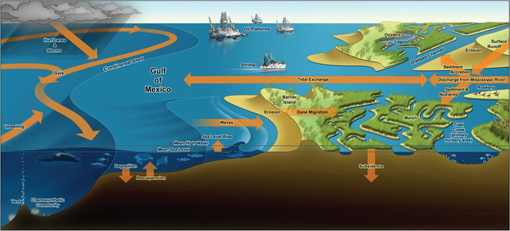
FIGURE I.1 Schematic drawing indicating various components and processes of the GoM ecosystem. A solid understanding of the complex interactions among these components is a key aspect of understanding the impact of the DWH spill on ecosystem services in the GoM. SOURCE: Alan Joyner, Red Twine Art & Design.
rivers, creating plankton blooms in the Gulf that result in the partial (hypoxia) or complete (anoxia) depletion of oxygen, and massive “dead zones” that can cover thousands of square miles of Gulf seafloor. Thus any analysis of the impact of the DWH spill on ecosystem services in the GoM must include consideration that the Gulf has been, and continues to be, affected by non-spill-related phenomena and that the baselines against which the impact of the spill must be judged are both spatially and temporally dynamic.
The magnitude and depth of the DWH event, in concert with the complexity of the GoM LME and the difficulties in establishing baseline values, pose serious challenges to those charged with carrying out the NRDA process, which historically has been applied to shallow-water events of much more limited extent and scale (see Box 2.1 on the North Cape Oil Spill). Indeed the National Commission on the BP Deepwater Horizon Oil Spill and Offshore Drilling describes the assessment of natural resource damage associated with this particular spill as “the largest and most complex that the government has ever undertaken to assess oil spill impacts” (National Commission on the BP Deepwater Horizon Oil Spill and Offshore Drilling, 2011).
At the time of writing this interim report, numerous studies focused on trying to understand the impact of the oil spill on the GoM LME are being
conducted, including many in support of the NRDA process. Many thousands of samples have been collected and observations made, and studies will continue for some time. Analyses are also under way; some of the results are being published while others are not yet public. It will take many years to fully analyze the data and some impacts may not become apparent until far into the future, if at all. Nonetheless, the government is obligated to conduct a timely NRDA process to address the public’s many concerns. An example that highlights the complicated nature of understanding the potential DWH
BOX I.1 DOLPHIN STRANDINGS IN THE GULF OF MEXICO:
THE CHALLENGING SEARCH FOR THE CAUSE
From January through April 24, 2011, 192 bottlenose dolphins, Tursiops truncatus, stranded along GoM’s coast from Florida to the Texas/Louisiana border at quadruple or more the average number recorded in the same period annually from 2002 through 2009. Over a third of them were stillborn and newborn calves. These strandings led to much media attention, public outcry, and the speculation that they were associated with the DWH spill. Strandings in 2010 were also higher than average, peaking in spring and early summer, but with no unusual number of calves.a In the midst of that peak came the April 20, 2010, DWH oil spill. On February 28, 2011, the strandings were officially declared an Unusual Mortality Event (NOAA, 2011a), a designation that calls for intensified data and sample collection, and a rigorous, coordinated study into the cause. At the same time, the event was included in the NRDA process, which assesses damages to marine mammals and their habitat attributed to the spill.
A study of this kind begins with the stranding pattern and proceeds to a comprehensive search for clues to mortality. For example, certain offshore forms, like sperm whales, Physeter macrocephalus, and pilot whales, Globicephala spp., come ashore in the tens to hundreds, at roughly the same time and place, in what are called mass strandings. The underlying cause is thought to be behavioral; once a critical member or number of the school heads to shore, the rest follow (Norris and Dohl, 1980). Bottlenose dolphins, however, do not fall into that category and usually strand alone or as mother-calf pairs. A few come ashore alive and some die on the beach, but most wash up already dead. Finding so many carcasses, as in the present event, suggests that over time, some enduring process or condition at sea is making dolphins sick or killing them.
Knowledge of the animal’s life history, its environment, past stranding accounts in the region and elsewhere, and the presence of other suspected conditions help narrow the search from possible to the more probable causes. Might this event be in any way similar to the 1990 episode along the Gulf coast, where
impacts is the 2010-2011 stranding of an unusual number of dolphins (many stillborn and newborn calves) along the GoM coast, which spurred a public outcry and immediate association with the DWH event. As detailed in Box I.1 however, many possible causes (natural and manmade) could be linked to the strandings, and only careful study and analysis will determine if the DWH spill was ultimately responsible.
Recognizing the unique aspects of the DWH spill (magnitude, duration, depth, and complexity of the ecosystems involved) and the ramifications of
in the first three months of the year, nearly 300 dead bottlenose dolphins were found on beaches from Florida to Texas? The cause was not established (Kuehl and Haebler, 1995). Could what is happening be the result of poisoning by a natural biotoxin produced by harmful algal blooms, like “red tide” or domoic acid from toxin-producing diatoms and transferred through prey fish? Bottlenose dolphins in Sarasota Bay, Florida, for instance, are commonly exposed to these toxins (Fire et al., 2008) and there is growing evidence that correlates exposure with stranding events along the southeastern and northern Gulf coasts (Flewelling et al., 2005; Fire et al., 2011). Might these strandings be due instead, or in addition to, an infectious disease, such as the ubiquitous morbilliviruses that wreak havoc in dolphins and whales (Duignan et al., 1996)? The stranding pattern supports both possibilities, while not excluding others. Harmful algal blooms can persist for months, as can an infectious disease that spreads from one dolphin to another. The high number of fetuses and young raises pointed questions: does illness cause early termination of pregnancy; are calves more vulnerable; do the mothers die first, leaving them helpless? Could anthropogenic contaminants play a role, such as polychlorinated biphenyls that are known to accumulate in dolphins in the region (Houde et al., 2006) and may reduce their ability to fight disease (Lahvis et al., 1995)? To determine if and how the DWH spill fits into the picture, the study will need to search for measurable differences in those dolphins that stranded before the spill versus after it (Geraci, 1990).
A probe of this depth and scale, on an event of this importance, will yield sufficient information that should shed light on the problem. The challenge, as usual, will be to tease out the cause and account for the roles of other influencing or confounding biological and environmental factors, including the DWH spill.
_____________
aSee running tally: www.nmfs.noaa.gov/pr/health/mmume/cetacean_gulfofmexico2010.htm.
these on the already complex task of assessing damages through the NRDA process, Congress sought external input on the process from the National Academy of Sciences (NAS). Funding was provided to the National Research Council (the operating arm of the NAS) through the National Oceanic and Atmospheric Administration (NOAA) to study approaches to evaluating the impact of the DWH spill related to the ecosystem services of the GoM. Specifically, the NAS was asked to address the questions listed in Box I.2.
It is important to note that the Statement of Task described above does not include a review of the ongoing damage assessment process. With respect to the DWH spill, such a review would be premature and inappropriate at present. It does, however, recognize (without stating explicitly) the challenges that the DWH spill will place on the ongoing NRDA process and seeks input from the NAS on new approaches that may aid and complement the NRDA process. In particular the Statement of Task focuses on an “ecosystem services” approach (NRC, 2005a) to assessing impact and to estimating the value of losses due to injury. Such an approach focuses not only on the restoration of damaged resources (as per NRDA practice) but also on establishing and maintaining the usefulness of those resources to the public. It is this broader view that may be particularly appropriate to an event of the magnitude, duration, depth, and complexity of the DWH spill.
A committee comprising 16 members (see Appendix A) representing a broad range of relevant disciplines (benthic ecology, biochemistry, biological oceanography, chemistry, ecology, economics, environmental engineering, environmental law, fisheries, geology, geophysics, human dimensions of natural resource management, microbiology, and veterinary medicine) was formed in January 2011 and held its first meeting January 24-25, 2011. To assist the federal agencies in their preparation of the NRDA, the committee was charged with providing an interim report approximately six months following the first meeting that addresses questions 1 through 3 of the Statement of Task. A final report, encompassing the interim report and including questions 4 through 8, is to be delivered after 24 months.
The generic questions 1 through 3 of the Statement of Task that are the focus of this interim report deal with best approaches to the difficult question of estimating the impact on ecosystem services of a human-caused disaster like the DWH spill. They seek to provide guidance on methods for identifying critical ecosystem services, for understanding the relevant spatial and temporal scales that need to be studied, and for establishing the baselines critical in determining the “injuries” caused by the incident. The third question focuses on the specific problem of assigning value to the impacted ecosystem services. These questions are best addressed with reference to
BOX I.2 STATEMENT OF TASK
1. What methods are available for identifying and quantifying various ecosystem services? What are the spatial and temporal scales conducive to research that provide meaningful information for the public and decision makers?
2. What methods and types of information can be used to approximate baselines (but for the spill) for distinguishing effects on ecosystem services specific to the spill?
3. What kinds of valuation methods are appropriate for measuring ecosystem services over time with regard to recovery under the following approaches: natural processes, mitigation, and restoration efforts? What baseline measures are available that would provide benchmarks for recovery and restoration efforts?
4. What ecosystem services (provisioning, supporting, regulating, and cultural services) were provided in the GoM LME prior to the oil spill? How do these differ among the subregions of the GoM?
5. In general terms, how did the spill affect each of these services, and what is known about potential long-term impacts given the other stresses, such as coastal wetland loss, on the Gulf ecosystem?
6. How do spill response technologies (e.g., dispersant use, coastal berm construction, absorbent booms, in situ burning) affect ecosystem services, taking into account the relative effectiveness of these techniques in removing or reducing the impacts of spilled oil?
7. In light of the multiple stresses on the GoM ecosystem, what practical approaches can managers take to restore and increase the resiliency of ecosystem services to future events such as the DWH spill? How can the increase in ecosystem resiliency be measured?
8. What long-term research activities and observational systems are needed to understand, monitor, and value trends and variations in ecosystem services and to allow the calculation of indices to compare with benchmark levels as recovery goals for ecosystem services in the GoM?
ecosystem services provided by the GoM LME and thus we will frame our responses within that context. We also acknowledge that there is a number of human health issues associated with the DWH event, but we will not address them, as they are specifically the subject of an Institute of Medicine (IOM) 2010 letter report: Research Priorities for Assessing Health Effects from the Gulf of Mexico Oil Spill (Institute of Medicine, 2010).
The lexicon of natural resource damage assessment uses many words that may seem familiar but have very specific (and sometimes multiple) definitions within the context of the process. Terms that will be used throughout the report are defined below. Chapter 1 outlines the geographic, oceanographic, and ecological context of the GoM LME. Chapter 2 explores the typical practice of damage assessment and introduces the ecosystem services approach to damage assessment. Chapter 3 describes methodologies for establishing baseline information for ecosystem services and, where possible, discusses existing baseline data. Finally, Chapter 4 takes a detailed look at the ecosystem services approach including methods to identify and quantify ecosystem services and, taking this one step further, looks at the most appropriate methodologies for assessing the value of key ecosystem services. Each of these issues, as well as the additional questions presented in the Statement of Task, will be addressed in more detail in the final report.
DEFINITIONS OF TERMS
Ecosystem: A complex, interactive system consisting of all organisms in a particular area, the physical components of the environment within which the organisms interact, physical features including hydrology, temperature, geology, air quality, and others, and the flow and transformation of energy and matter between organisms, and organisms and the environment. Eugene Odum defined an ecosystem as “Any unit that includes all of the organisms (i.e., the ‘community’) in a given area interacting with the physical environment so that a flow of energy leads to clearly defined trophic structure, biotic diversity, and material cycles (i.e., exchange of materials between living and nonliving parts) within the system” (Odum and Barrett, 2005). Increasingly, it is evident that human beings are a critical component of ecosystems; consideration of ecosystems must include the influence of human social structure on the ecosystem, as well as the influences of the ecosystem on human society.
Large marine ecosystem: In order to define specific large geographic areas for resource management, river basins, estuaries, and coastal shelf areas have been subdivided into “large marine ecosystems” (LMEs). LMEs are defined by unique hydrography, bathymetry, and productivity (Griffis and Kimball, 1996). They may cross international borders, providing unique opportunities and challenges for successful management.
The Gulf of Mexico is recognized as a distinct Large Marine Ecosystem. The GoM LME is one of the most biologically productive in the world. It
crosses boundaries between the United States, Cuba, and Mexico and provides an opportunity for transnational management of important natural and cultural resources. Habitats within the GoM LME include coastal wetlands, salt marshes, mangroves, sandy beaches, coastal shelf marine ecosystems, and deep-sea marine ecosystems. Each habitat provides distinct services that need to be accounted for in any valuation of the impacts of the Deepwater Horizon oil spill. The geographic, oceanographic, and ecological contexts of the GoM LME are discussed in Chapter 1.
Ecosystem structure: Ecosystem structure refers to both the (species) composition of the ecosystem (i.e., its various organisms) and the physical and biological organization defining how those parts are organized (NRC, 2005a). The Gulf of Mexico has recently been estimated to contain in excess of 15,000 species exclusive of microbes (Felder and Camp, 2010).
Ecosystem function: A process that takes place in an ecosystem as a result of the interactions of plants, animals, microorganisms, and their environment. Primary production, most notably the generation of plant material, is an example of an ecosystem function (NRC, 2005a). All recognized coastal and oceanic ecosystem functions operate in the Gulf of Mexico.
Ecosystem service: There is a rich and evolving literature on ecosystem services with a variety of definitions (e.g., Westman, 1977; Ehrlich and Mooney, 1983; de Groot, 1987; Barbier, 1994; Costanza et al., 1997; Daily, 1997; Wilson and Carpenter, 1999; de Groot et al., 2002, Millennium Ecosystem Assessment, 2005; NRC, 2005a; EPA, 2009; TEEB, 2009). The common thread through all of these definitions is a relationship between ecosystems and the value humans derive from them. In 2000, the United Nations commissioned the Millennium Ecosystem Assessment (MA) to summarize the current status and future conditions of biodiversity and ecosystems and determine the consequences of ecosystem change for human well-being. The MA defines ecosystem services as “the benefits provided by ecosystems to humans which contribute to making human life both possible and worth living.” Moreover, the MA defined explicit categories of ecosystem services including provisioning, regulating, cultural, and supporting services. These service categories are now widely accepted. In order to apply the MA definition to the GoM, the definition needs to make explicit the distinction between the different ecosystems present in the GoM LME and the goods and services provided by each.
Value: In this report we use the term value in the way that economists tend to define it. The value of an item is measured by its contribution to human well-being. A measure of the value of a good or service to an individual can be obtained by observing what the individual is willing to give up in exchange for an increase in the good or service. Economists typically attempt to measure benefits in monetary terms by seeing how much an individual would be willing to pay to obtain more of a good or service. Alternatively value can be measured by, what an individual would be willing to accept for less of the good or service. For ecosystem services that are provided to the public at large, the value of a change in the ecosystem service would be found by summing up the estimated values across all individuals affected by a change in the provision of the service. This aggregated value would then represent an overall societal value that occurs because of a change in the ecosystem.
Economists have several methods that may be used to determine the value of particular ecosystem services. These methods are generally divided into market valuation methods that are based on market prices, and non-market values in which proxies for prices are developed either from observed behavior (revealed preference methods) or from responses to survey questions (stated preference methods). Some ecosystem services contribute to marketed commodities (e.g., commercial fisheries) but most ecosystem services do not. It tends to be more difficult to place an economic value on a service where there is no actively traded good or service in a market. Though even among non-marketed ecosystem services there is a range of difficulty, with those that affect recreation being more amenable to valuation than the existence value of a species or spiritual or aesthetic values. This committee has been tasked with describing the strengths and weaknesses of various valuation methods rather than placing a specific monetary value or some other quantitative estimate of value on the impact of the DWH spill on ecosystem services. Approaches to valuation of ecosystem services will be discussed in Chapter 4.
Baseline: The condition of the natural resources and services that would have existed had the incident not occurred.5 Within the context of the DWH spill and a system like the GoM that has numerous factors impacting ecosystem health, the concept is to establish conditions “but for the spill.” Approaches for establishing baselines for various ecosystem services and baseline data sources (if available) for the GoM LME will be presented in
_____________
Chapter 3.
Resilience: Narrowly defined, resilience is the ability of an ecosystem to recover following a perturbation. As described in the NRC report Increasing Capacity for Stewardship of Oceans and Coasts (2008b), “Resilience thinking is one new approach to addressing the decline in the capacity of communities, ecosystems, and landscapes to provide essential services. The intent is to recognize the complexity and variability of ecosystems, including the human component, and to build nature-human systems that can adapt to incorporate new knowledge or adjust to changing conditions.”
This page intentionally left blank.


