
An Ecosystem Services Approach to Damage Assessment
The ecosystem services approach focuses not only on the restoration of damaged resources but also on establishing and maintaining the value of benefits derived from ecosystems to the public. This broader view may be of value for understanding an event of the magnitude, duration, and complexity of the Deepwater Horizon (DWH) spill and may offer more options for approaches to restoration. Final decisions on restoration projects will, of course, be an open process that includes stakeholders from local communities as well as the state and federal natural resources trustees. The incorporation of an ecosystem services approach to the damage assessment process should be beneficial in identifying a larger suite of restoration alternatives that can then be offered as options to the wider group of stakeholders.
In the Statement of Task (see Box S.1) the question “What are the available methods for identifying and quantifying the ecosystem services in the Gulf of Mexico (GoM)?” is posed. The committee deconstructed that question into the following: “What are the approaches to assessing the impacts of the DWH oil spill that affect the structure or function of the GoM ecosystem and how can these be translated into changes in quantity and value of ecosystem services?” In light of ongoing assessment efforts, it is important to ensure that evaluations of the impacts of human actions on the GoM are conducted in a systematic and uniform manner so that the results could be applicable to the ecosystem services analysis as well as to the damage assessment process. It is likely that some of the wealth of data collected for the ongoing damage assessment will be readily applicable to the ecosystem services analysis. A unique opportunity exists to benefit from the application of new approaches to both available data sets and emerging results from ongoing and future research to understand the impacts of the DWH oil spill and large-scale oil spills in general.
Chapter 2 provides a detailed characterization of the approach to evaluating impacts on the value of ecosystem services, including the questions
that need to be addressed in order to adequately characterize those impacts (see Figure 2.1). These questions—What are the impacts of human actions on environmental conditions that affect the structure or function of ecosystems? How do changes in the structure and function of ecosystems lead to changes in the provision of ecosystem services? How do changes in the provision of ecosystem services affect human well-being, and how can the value of the changes in services in terms of human well-being be quantified?—and the logic behind them set the stage for what is likely to have been done early in the Natural Resource Damage Assessment (NRDA) process, whether for the DWH spill or other incidents. Extending this process to consider how these impacts affect the provision of ecosystem services and ultimately how this leads to changes in human well-being is discussed in the following sections of this chapter.
ECOLOGICAL PRODUCTION FUNCTIONS: FROM ECOSYSTEMSTRUCTURE AND FUNCTION TO ECOSYSTEM SERVICES
Production functions are a standard tool used by economists to describe how inputs can be transformed into outputs. A production function gives the feasible output of goods and services that can be produced from a given set of inputs. For example, what is the maximum amount of steel (output) that can be produced from a given amount of iron ore, energy, machinery, and labor (inputs)? The notion of production functions applied to ecological systems has a long history in agricultural economics (e.g., crop yield functions) and resource economics (e.g., bioeconomic modeling of fisheries and forestry). Production functions have also been applied recently to the provision of ecosystem services (e.g., NRC, 2005a; Barbier, 2007; Daily et al., 2009; Tallis and Polasky, 2009). An ecological production function specifies the output of ecosystem services generated by an ecosystem given its current condition. Changes in ecosystem conditions, either from natural disturbances such as hurricanes, or from human disturbances such as an oil spill, will in general alter the amount of various ecosystem services provided. For example, degradation of coastal marshes may reduce protection from storm surges and reduce nursery habitat for fish, among other services.
For some ecosystem services, ecological production functions are fairly well understood and data exist that can be used to quantify the amount of a service provided. A good example of a fairly well understood and well studied ecosystem service is carbon sequestration in above-ground biomass for terrestrial ecosystems, particularly for forests. The U.S. Forest Service collects data on biomass in forests by stand age and tree species for different areas
of the country (Smith and Smith, 2006). These data, along with knowledge of the carbon ratio in biomass, can be used to calculate carbon sequestered in forests. In marine systems, production function approaches have been used to study the productivity of fisheries as a function of ecosystem conditions (Lynne et al., 1981; Kahn and Kemp, 1985; Ellis and Fisher, 1987; McConnell and Strand, 1989; Swallow, 1994; Parks and Bonifaz, 1997; Barbier and Strand, 1998; Barbier, 2000, 2003; Sathirathai and Barbier, 2001; Barbier et al., 2002) although there is far greater uncertainty in the functional relationship between habitat conditions and fishery productivity.
Table 2.1 to include data collection and analyses necessary to establish ecological production functions for two key ecosystem services in the Gulf of Mexico, hazard moderation (in the form of storm protection) and food (in the form of nursery habitat for fisheries). While in general a greater amount of vegetation or animal material (e.g., mangroves and oyster beds) will lead to greater dissipation of wave energy and provide more protection from coastal storms, the degree of protection will depend upon the timing of storms relative to the tide, height of the storm surge, the direction of the wind, speed of passage, and other factors. For many marine species, survival of larvae will depend upon water column conditions and currents at the time of spawning and quality and quantity of nursery habitat leading to highly variable recruitment from year to year.
Finding 4.1: Additional sampling and analyses could facilitate an ecosystem services approach by identifying the impacts on ecosystem function and structure that in turn affect the ecosystem services provided. The collection of these additional data would set the framework for establishing the impact of the spill on ecosystem services.
An example of an ecological production function for a key ecosystem service provided by coastal wetlands—hazard moderation (via storm surge protection)—is provided below (Box 4.1). This example outlines the challenges faced by those seeking to capture the full suite of ecosystem services in a complex environment, as well as the potential benefits of this broader view in assessing the impact of damages to the environment.
For many other ecosystem services, there is either a lack of mechanistic understanding, a lack of data, or both that prevents accurate quantification of ecosystem services as a function of ecosystem condition. Marine ecosystems are complex with many interacting processes and complex food-web dynamics. Such complexity makes it difficult to understand how disturbances
TABLE 4.1 An Expansion of Table 2.1 to Illustrate the Data and Methods Needed for an Ecological Production Function Approach for the Ecosystem Services of Hazard Moderation and Food from Coastal Wetlands.
|
|
||||||
|
Assessment Process for Ecosystem Services Approach |
||||||
|
|
||||||
|
Data Category |
Resource |
Typical Approach to the Assessment |
Ecosystem Service |
Type of Data Needed |
Ecological Production Function |
Type of Data Needed for Ecosystem Service |
|
|
||||||
|
Biological |
Wetland |
Determine spatial extent of vegetation oiled; collect and document any dead or oiled wildlife. |
Hazard Moderation (reduction in storm surges; see Box 4.1). |
1. Plant type (or species), height and density. 2. Percentage of area likely to experience acute toxicity and die off. 3. Cross-shore and along-shore extent of wetland harmed. 4. Estimates of ability of the wetland to reestablish with and without human intervention. |
1. Relationship between plant type, height, density, and areal extent of vegetation and reduction of wave energy. 2. Relationship of reduction in wave energy to likely reduction in storm surge. |
1. Collecting data on (1), (3), and (4). Data on wetland extent and amount oiled would be collected in a standard NRDA but other data would likely not be. 2. Building the functional relationships to translate from data on plant height, density and extent to likely height of storm surge. This may be done via empirical relationships and/or modeling. |
|
|
|
|
Food (production from commercial and recreational fisheries; see Box 4.2) |
1. Measures of fishery landings. 2. Measures of fishery stock and recruitment. 3. Estimates of the ability of wetlands to re-establish with and without human intervention. |
1. Relationship between wetland condition and fishery productivity |
1. Collecting data on (2) and (3). 2. Building the functional relationship between wetland condition and fishery productivity. This may be done via empirical relationships and/or modeling. |
|
|
||||||
BOX 4.1 HAZARD MODERATION (STORM SURGE PROTECTION): REGULATING SERVICE
Coastal wetlands include salt marshes and mangroves and can reduce the damaging effects of hurricanes on coastal communities (Badola and Husain, 2005; Danielsen et al., 2005; Das and Vincent, 2009).
Our knowledge of fluid dynamics and of the physical processes that govern the behavior of waves has advanced to the point where we can explain why wetlands reduce wave energy and protect coastal infrastructure (Massel et al., 1999; Narayan and Singh, 2006; Quartel et al., 2007; Vosse, 2008; Krauss et al., 2009). Reduction of wave energy depends on the structure of the plant canopy, its height and density, and the cross-shore and along-shore extent of the wetland (Narayan and Singh, 2006; Koch et al., 2009; Massel et al., 1999). The velocity of water traveling within a plant canopy is relatively lower than flow velocities above the canopy. Canopy height in relation to water depth is relevant because flow through the vegetation encounters a different level of friction than the water above the vegetation. Therefore, the total friction in the water column will be different as a function of depth for vegetated and non-vegetated areas. Because a mangrove canopy is taller and exerts more drag than a salt marsh community, mangroves are more effective at reducing wave energy than salt marshes. Quartel et al. (2007) suggested that the drag force exerted by a mangrove forest is a function of the projected cross-sectional area of the submerged canopy (denoted as A in the equation CD = 0.6e0.15A). For the same muddy surface without mangroves the drag is a constant 0.6. Mazda et al. (1997) observed that 100 m2 of mangrove forest was capable of reducing wave energy by 20 percent. Reduction in water levels across a mangrove area in Florida was 9.4 cm km–1 (Krauss et al., 2009). The dissipation of wave energy is also affected by topography. In a modeling study of sea-level rise and storm surge across the Louisiana coast, Vosse (2008) found that when the relative land elevation was decreased by 20 cm, wave heights increased 5-10 cm across the model domain, and when relative land elevation decreased 50 cm, wave heights increased 10-20 cm. The conclusion is that friction by the plant canopy dissipates energy and reduces wave heights, but the effect of the wetland surface depends on water depth. In the future, the effect of wetland surge dissipation will depend on the survival of the wetlands, because wetland survival will have a great effect on the height of the storm surge relative to mean sea level.
to an ecosystem will reverberate through the system and ultimately lead to changes in the provision of ecosystem services. A further complication in predicting the provision of ecosystem services arises from variability in environmental conditions that are characteristic of many coastal and marine ecosystems (Koch et al., 2009).
Ideally, a thorough ecosystem services analysis would be based on a mechanistic understanding of, and model for, the complex linkages and interdependencies of the ecosystem being studied. Such a model would allow for predicting the provision of ecosystem services given the state of the
ecosystem (i.e., the ecological production function). Establishing such an ecosystem model is perhaps the greatest challenge facing the application of an ecosystem services approach for damage assessment. One complicating aspect is that the damage assessment process does not lend itself to collecting data that would better inform our basic understanding of variability in biological processes across the GoM. Because of this and other factors, a complete ecosystem model for the Gulf of Mexico has yet to be developed. However, several marine ecosystem models have been developed that could be useful for analysis of ecosystem services in the Gulf of Mexico such as Atlantis (Fulton et al., 2011), Ecopath with Ecosim,1 and Marine In-VEST (Guerry et al., 20112). These models, and others, span a range of data requirements and modeling sophistication. Application of these models to a system as complex as the Gulf of Mexico in order to analyze the impact of an event of the magnitude of the DWH oil spill would require extensive data collection, model testing, and verification. Given the magnitude of the impacts and the importance of many GoM ecosystem services, however, such efforts may be justified. Models for specific ecosystem services (e.g., fisheries) or components of the ecosystem (e.g., wetlands) are more readily available and more easily applied and do not necessarily require extensive ecosystem modeling efforts in order to be successful. There may also be cases where the lack of scientific understanding, paucity of data, or the degree of environmental variability may be simply too great at this time to afford much confidence in predicting the quantity or value of ecosystem services generated. That said, utilizing the extensive data that have been collected for the damage assessment process in the GoM and the existing ecosystem models for the GoM presents a unique opportunity for enhancing our understanding of ecological production functions and the provision of ecosystem services in the GoM.
Finding 4.2: An ecosystem services approach to damage assessment and valuation offers great promise but accurate estimates may be limited to cases in which there is a mechanistic understanding of the service’s production function and environmental conditions are not highly variable. In other cases, however, the lack of scientific understanding, paucity of data, or great environmental variability may preclude quantification of ecosystem services with reasonable confidence.
_____________
1 See http://www.ecopath.org/.
APPROACHES TO VALUING ECOSYSTEM SERVICES
In Chapter 2 we addressed the question “what are the impacts of human actions on environmental conditions that affect the structure or function of ecosystems?” In the section above we discussed ecological production functions and their role in addressing “how do changes in the structure and function of ecosystems lead to changes in the provision of ecosystem services?” The next component of the ecosystem services approach focuses on establishing the value of ecosystem services. The value of an ecosystem service is the contribution of the service to human well-being. Ideally, valuation methods can provide a quantitative measure in a common metric to facilitate comparisons across services that indicates how much the availability of the service contributes to the improvement in human well-being. For example, how much money would people be willing to give up in exchange for restoring a coastal ecosystem? Answering this question involves identifying what ecosystem services might be affected by the restoration and by how much. For example, restoration might lead to improved fishing, improvement in water quality, and greater storm protection. Economic methods can then be applied to assess how valuable these changes in services are. Improved fishing may be quite valuable for commercial fishermen and avid recreational fishermen (and possibly for those who eat a lot of fish), but may be relatively unimportant for those who do not fish or consume seafood. Alternatively, in the case of damage to the environment that reduces services, valuation methods can be applied to assess how much value has been lost.
Economics provides well-developed methods grounded in established economic theory to measure values (see Freeman, 2003 for a thorough discussion of economic approaches to valuation and Chapter 4 in NRC, 2005a for a discussion of economic valuation techniques applied to ecosystem services). Economic analysis of ecosystem services can generate estimates of the value of services in terms of a common (monetary) metric. The economic approach to valuation begins with individuals and the tradeoffs they are willing to make. Economists assume that individuals have well-defined and stable preferences. Given preferences, the value of an ecosystem service can be measured in terms of what the individual would be willing to give up to get more of the ecosystem service. By measuring what an individual is willing to give up in terms of a common monetary metric, the economic approach to valuation generates measures of the relative value of goods and services.
Valuing multiple ecosystem services at one time with one survey is not commonly undertaken primarily to avoid survey respondent fatigue. The
more questions and text, and the greater complexity of the valuation scenario due to multiple services, the less reliable the answers will be for a given survey. Given the spatial extent of the DWH spill and the varied habitats impacted, there are numerous ecosystem services that could potentially be affected. The scope of the ecosystem services valuation exercises for a spill of this size could be challenging for the current practice of stated preference methods. Many ecosystem services are public goods. In economic terms, public goods are “non-rival” in consumption (one person’s use of a public good does not diminish the use of another) and “non-excludable” (once it is supplied it is freely available to everyone). For example, the light from a lighthouse is a public good. The light provides navigation services to all ships that pass within sight of it. Similarly, coastal ecosystem restoration may provide public goods of storm protection services and water purification services, which are then freely available to all nearby residents.
To assess the value of a public good requires adding up the value to all beneficiaries of the public good. Assessing the value of public goods is complicated by the fact that there is often no direct signal of value for many of the beneficiaries. For example, how can a public agency assess the value of the navigation service provided by the lighthouse or storm protection and water purification services provided by a coastal ecosystem? Closely related to the concept of public goods is the concept of common property resources. Common property resources, like oyster beds or fisheries, are resources subject to use by multiple parties. Because each user does not typically take into account the negative effect of their use on others, common property resources often suffer from over-use. In the extreme, when there are no limits on who can exploit the resource (“open access”), severe over-harvesting can occur, a result known as the “tragedy of the commons.” Below we describe some methods economists use to estimate the value of ecosystem services focusing on tools for “non-market” valuation that are particularly relevant to ecosystem services.
The economic approach to valuation of ecosystem services has its critics (e.g., McCauley, 2006; Norton and Noonan, 2007). Some environmental philosophers argue that nature has intrinsic value, i.e., value in and of itself, regardless of whether or not nature contributes to human well-being through the provision of ecosystem services (e.g., Norton, 1986; Rolston, 1988), and that humans have inherent obligations to protect and conserve nature. These duties cannot be avoided merely because some individual or group would benefit by doing so. Other critics of economic approaches to valuation question the accuracy of standard assumptions in economic models. Psychologists question the assumption that people have well-defined, stable and
consistent preferences that they bring to decision making. A body of work in both psychology and behavioral economics has documented systematic departures from classic assumptions of rational behavior (e.g., Kahneman and Tversky, 1979; Ariely, 2009). A body of experimental evidence suggests that people often construct their preferences when called upon to make decisions and are therefore sensitive to the context and framing of decisions (e.g., Lichtenstein and Slovic, 2006). Sociologists question the central focus on individuals and individual decisions, which they feel does not give proper consideration to how values are shaped by larger groups, norms, and culture. Despite these criticisms, virtually all valuation of ecosystem services to date has used the economic approach to quantify values. Other approaches to valuation of ecosystem services exist and these are briefly discussed later in this chapter in the section “Other Methods” (and see also EPA SAB, 2009 for a review of both economic and non-economic approaches).
ECONOMIC VALUATION METHODS
Economists have developed a variety of methods to quantify values of environmental and natural resources. Although some natural resources are traded in markets where prices can be used to value these resources, most elements of environmental quality are not traded in markets and have no direct measure of value. Economists have developed methods of non-market valuation over the last several decades that can be applied to value environmental quality and resources not traded in markets (Freeman, 2003). These methods were developed long before ecosystem services were part of the vernacular of how one describes the relationship between the environment and humans.
To assess the value of changes in ecosystem services from environmental impacts such as an oil spill, economic valuation methods need to be combined with ecological assessments of impacts. For example, changes in marsh, seagrass, oyster reefs, mangroves, and other habitats impacted by the oil spill could have a direct impact on ecosystem services supplied by these systems. Analysis of impacts on the supply of services combined with economic valuation methods can generate estimates of the value of changes in ecosystem services as a result of environmental changes. For example, Bell (1997) linked recreational catch to fishing effort and the contribution of wetlands to fishing productivity to estimate the value of wetlands in supporting recreational fishing. Lynne et al. (1981) related blue crab productivity and value to salt marsh along Florida’s Gulf Coast and found that the marginal value productivity of marsh varies with marsh area and fishing effort.
There are three main types of valuation methods applied to ecosystem services:
• revealed preference based on observed economic behavior,
• stated preference based on responses to survey questions, and
• cost-based methods such as avoided damages and replacement cost.
Revealed preference and stated preference methods generate estimates of benefits consistent with economic notions of what individuals would be willing to give up in terms of other goods or services to get more of an ecosystem service. Avoided damage, though labeled as a cost-based method, can also be thought of as measuring benefits. Damages are a cost while avoided damages are a benefit. For example, typically the marginal benefit of pollution abatement is viewed as equivalent to the marginal damages from pollution, i.e., the benefit of not polluting is not incurring the associated damages. Replacement cost, however, is a measure of costs rather than benefits. Because replacement costs measures costs not benefits, some economists do not include these approaches as a valid way to measure the value of ecosystem services. However, many economists view replacement costs as a valid approach to measuring what is lost when ecosystem services are lost or diminished as long as certain restrictive conditions, discussed below, are met.
Revealed Preference Methods
Under the broad heading of revealed preference methods, which infer economic values based on observed behavior, are various methods of both market and non-market valuation. For goods and services traded in markets, data on the amount bought and sold at various prices can be used to establish estimates of demand (willingness-to-pay) functions that measure the value of the goods and services to consumers. The value of a good or service can be measured by what an individual would be willing to pay to get more of the good or service. Market prices are what an individual actually has to pay to get more of the good or service. The gap between the individual’s willingness to pay and what they have to pay (price) is called consumer surplus and represents a monetary value of the gain in welfare to the individual from purchasing the good or service. An estimate of the willingness-to-pay can be derived from market data by noting that people should be willing to purchase the good up to the point at which willingness-to-pay is equal to price. By observing how much of each good
or service is purchased at different prices one can recover an estimate of the willingness-to-pay for different amounts of the good or service (see Freeman, 2003 for a more complete discussion). Some marine ecosystem services produce marketed goods for which market prices can be used for purposes of valuation. Commercial fisheries are a prime example. The most difficult part of measuring the impact of the DWH oil spill on commercial fisheries is not the valuation component to understand willingness-to-pay, but rather, measuring the impact of the spill on fishery productivity. Getting an estimate on the impact of the spill on fishery productivity requires estimating the change in productivity through time and not just the initial impact. That said, there remain challenges to valuation even with observable market prices. When consumers are uninformed about actual environmental conditions their choices may not accurately reflect their preferences (this issue is a concern for all valuation methods). Other issues related specifically to the commercial fishing example include uncertainty over how much and how long fears of contamination will depress demand for fish from the GoM and the difficulty of getting accurate cost data with which to estimate economic rents.
For most ecosystem services, however, markets do not exist, making estimation of values from ecosystem services more difficult. Without market prices other non-market methods must be used as proxies for prices. In some cases, the value of these non-marketed ecosystem services can be estimated using data on observed behavior of how much of a service is utilized and the cost to the individual of utilizing the service (e.g., travel cost methods), or by using data on related goods and services such as housing values (e.g., hedonic property price methods).
Travel cost studies (see example in Box 4.2) use information on trips that individuals make to recreational sites and the expenditures of time and money involved in making the trip (Freeman, 2003). Travel cost studies typically use “random utility models” in which the value (utility) of a visit to a given recreational site is a function of distance from sites, site access fees, observable site characteristics (environmental quality, site facilities, etc.), observable characteristics of individuals (income, education, etc.), as well as unobservable characteristics of the individual (idiosyncratic preferences). Travel cost methods allow an analyst to trace out a demand function for site visits by varying the implicit price of a visit (travel cost plus access fees) faced by individuals and observing the number of trips taken. Further, by looking at sites of varying environmental quality, the value of improved environmental quality can be estimated.
A number of studies have used travel cost methods in the Gulf region
BOX 4.2 RECREATIONAL CHARTER FISHING CASE STUDY
Saltwater fishing, using personal equipment or guides in the inshore areas and charter boats for offshore, is an important part of the identity of the Gulf Coast. Whole communities identify with this lifestyle and it is an important economic engine, for example Port Aransas, Texas; Venice, Louisiana; Biloxi/Gulfport, Mississippi; Orange Beach, Alabama; and Destin, Florida. One estimate puts the economic output of recreational saltwater fishing in the Gulf in 2006 at $8.1 billion dollars, which is about one-quarter of the total for the United States and it also accounted for 82,741 jobs (Southwick Associates, 2007). In that same year approximately 3.6 million anglers spent 424 million angler days saltwater fishing in Gulf waters (U.S. Department of the Interior, 2007). While not the predominant type of fishing in the Gulf, charter boats are still an important component of the recreational effort and help determine how many individuals access offshore waters.
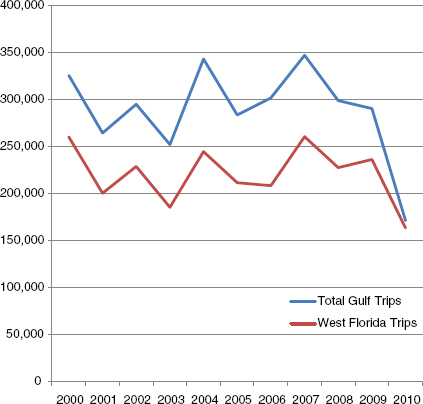
A dramatic shift in recreational fishing took place as a result of the oil spill, based on data from the Marine Recreational Information Program (MRIP) of the National Marine Fisheries Service for charter boat trips during May-August each year. From 2000 to 2009 the average number of charter boat trips per year in the Gulf (excluding Texas) was 226,192 and the west coast of Florida typically accounted for 75 percent of this business. In 2010 the number of trips dropped to 163,081 and even more illuminating of the impact of the oil spill was that Florida now accounted for 95 percent of that business (see figure).a In July and August of 2010 almost all of the activity took place in Florida with only 1,607 trips occurring in the remaining states. This is not surprising given that fishery closures during these months included over 30 percent of the federal waters of the GoM and virtually all marine waters up to over 100 miles offshore of the coasts of eastern Louisiana (east of Morgan City), Alabama, Mississippi, and 30 miles of the western panhandle of Florida.b
_____________
a The data fields selected in the Marine Recreational Information Program under Angler Effort are Waves = 3 & 4, Geographical Area = GOM, Type of Fishing = Charter Boats, Fishing Area = All Ocean Combined. 4, Geographical Area = GOM, Type of Fishing = Charter Boats, Fishing
b See http://sero.nmfs.noaa.gov/ClosureSizeandPercentCoverage.htm.
to assess the recreational value attributed to wetlands (Farber and Costanza, 1987; Costanza et al., 1989), beaches (Bell and Leeworthy, 1990; Freeman, 1995), and coral reefs (Bhat, 2003). Bhat (2003) interviewed 200 people in the Florida Keys and gathered information on the number of times they had visited the Keys, how far they traveled, how long it took them, their mode of transport, as well as demographic characteristics. Bhat (2003) found the use value per person per trip of the coral reefs in the Keys was $463 (1996 dollars) in its current state. When the quality of the coral was hypothetically improved by 100 percent, the use value increased to $783, demonstrating the monetary value of an improved environmental quality.
“Hedonic” property pricing methods use data on property values, char-
GOM Charter Boat Trips, 2000-2010.
acteristics of the property (lot size, structure square footage, age of structure, etc.), neighborhood characteristics, and environmental characteristics to estimate a multiple regression equation that predicts property price as a function of a change in a characteristic that affects property value. The results of the analysis can be used to assess how property values will likely change if environmental quality is changed, holding other characteristics that affect property value fixed. For example, how would two houses that are identical in lot size, square footage, number of bedrooms, age, etc., differ in value when one is located near a nice beach and the other located near a polluted beach? The hedonic property price method has been used widely to value such things as wetlands (Thibodeau and Ostro, 1981; Doss and Taff, 1996;
Mahan et al., 2000), parks and open space (Crompton, 2001; Lutzenhiser and Netusil, 2001), and views (Bourassa et al., 2004; Sander and Polasky, 2010). Hedonic property price analysis could be used to assess whether the DWH oil spill has had a negative impact on the value of coastal properties, but otherwise this method may be of limited utility in the case of the DWH spill.
A third revealed preference non-market valuation method is based on expenditures made by individuals or households to avoid health or environmental risks and is called averting behavior. Averting behavior methods are typically employed to measure the value that individual(s) place on avoiding undesirable health impacts such as the amount that households pay for water filtration or bottled water to avoid drinking perceived contaminated water (Dickie, 2003). For example, how much expense is incurred to buy filters or bottled water (Harrington et al., 1989; Abdalla et al., 1992)? Expenditures to avoid damages might not always be a good estimate of the willingness-to-pay (Courant and Porter, 1981). This method is likely to have limited applicability in the case of the DWH oil spill.
Stated-Preference Methods
Stated-preference methods use surveys where respondents are asked a series of questions in order to gain information about their values and preferences (Mitchell and Carson, 1989; Freeman, 2003). One of the stated preference methods is the contingent valuation method (CVM), which is used to elicit values that people place on an ecosystem service where implicit or explicit market price information does not exist (NRC, 2005a). Survey questions may directly elicit information about willingness to pay for an increase in an ecosystem service or willingness to accept a reduction in an ecosystem service. Alternatively, respondents may be asked whether they are willing to pay a specified value for a certain amount of an ecosystem service. A willingness-to-pay function can be derived varying the values and observing the proportion of respondents answering that they would be willing to pay that amount. CVM was used to value natural resource damage in the Exxon Valdez oil spill. The widely divergent estimates of CVM held by experts hired by Exxon and by the trustees in the case led NOAA to form a blue-ribbon panel to discuss the merits of CVM. The panel concluded that CVM was a valid non-market valuation method and could be used in NRDA cases and provided guidance on best practices (Arrow et al., 1993). However, the use of CVM to estimate environmental values remains controversial (see, for example, Hausman, 1993; Diamond and Hausman, 1994; Hanemann, 1994; Carson et al., 2001) and it has not been used extensively
in NRDA cases since the Exxon Valdez. On the other hand, there have been numerous CVM studies published over the past two decades. CVM studies applied in the Gulf coast include analysis of the value of habitat (Shivlani et al., 2003), recreational opportunities (Bergstrom et al., 1990; Barbier et al., 1997; Henderson and O’Neil, 2003; Murley et al., 2003; Johns et al., 2004), and water supply, regulation, and nutrient cycling for freshwater wetlands (Shrestha and Alavalapati, 2004).
Another use of CVM to quantify economic value of ecosystem services is conjoint analysis. This technique grew out of the marketing literature (Green and Srinivasan, 1978, 1990) where it was utilized to estimate prices for products given different product attributes. In environmental applications, respondents are asked to rank the alternative scenarios, each of which may have several attributes that change between the alternatives. By examining the trade-offs among the attributes, marginal willingness-to-pay for the attribute can be calculated when one of those attributes is price (Freeman, 2003). Similar to the conjoint method is the attribute-based stated-choice approach. Adamowicz et al. (1998) argue that stated-choice methods are more appropriate for assessing the impact on ecosystem services. The goal is to put the decision-maker in a realistic setting so they can compare alternatives that are described in terms of attributes. For example, Milon and Scrogin (2006) used the stated-choice method to assess the value of potential restoration plans for the Florida Everglades. Their results showed that individuals would be willing to pay more for structural restoration (e.g., increasing the number of wetland, dryland, and estuarine dependent species) than functional restoration (e.g., changing water flows that impact habitats).
The use of stated-preference methods remains controversial in NRDA cases, whether it is CVM, conjoint analysis, or other variants. Proponents claim that these methods can generate reliable estimates of environmental value provided that best practices are followed; furthermore, for non-use values such as existence values, stated preference are the only available methods. On the other hand, critics claim that such methods are unreliable and point to cases in which different framing of questions has generated widely divergent estimates of value. The committee was not asked to evaluate the merits of using stated-preference methods in NRDA and does not take a position on its use.
Cost-Based Methods
Some estimates of the value of ecosystem services have been generated by looking at costs incurred when the ecosystem services are lost or de-
graded. There are two sorts of cost-based methods that are commonly used in valuing ecosystem services—avoided damages and replacement costs. An avoided damaged approach estimates how damages would increase if the ecosystem service were diminished or absent. Replacement costs estimates the cost of providing the service via some alternative means. The method of avoided damages to value an ecosystem services uses estimates of likely damages that would be incurred with and without the ecosystem service. Avoided damages from maintaining an ecosystem that provides protection against storms, floods or other natural disasters are a measure of benefits provided by the ecosystem. This method is probably the most common method used to value coastal protection (Badola and Husain, 2005; Danielsen et al., 2005; Costanza, 2008; Das and Vincent, 2009). The value of coastal protection afforded by coastal wetlands is estimated by finding the difference in likely damages to coastal communities from a hurricane or other storm event in the case with intact coastal marshes versus degraded or no coastal marshes to absorb wave energy and reduce storm surge. For example, Costanza et al. (2008) used a regression model to analyze the damages from 34 major U.S. hurricanes since 1980. While wind speed was an important variable in estimating damage, they also found that wetlands helped to reduce damages. The estimated yearly marginal value of wetlands in the Gulf region in their analysis ranged from a low of $126 ha–1yr–1 in Louisiana to a high of $14,155 ha–1yr–1 in Alabama.
Another commonly used cost-based method to generate a value for ecosystem services is replacement cost, which is the cost of providing the service an alternative way such as replacing the service provided by ecosystems with a human-engineered approach. For example, clean drinking water can be provided by natural processes in intact watersheds or provided through a water filtration system. The most commonly cited example for the value of ecosystem services is the Catskills watershed providing clean drinking water for New York City. Replacing the clean water provided by the watersheds with a water filtration plan was estimated to cost $6 to $8 billion (Chichilnisky and Heal, 1998).
Many economists are skeptical of the use of replacement cost as a method of valuation, even though it is often used in valuing ecosystem services. The main reason for skepticism is that replacement cost is about cost rather than directly a measure of benefits. However, replacement cost can address the value of ecosystem provision of a service in certain instances (NRC, 2005a; EPA, 2009). To be a valid measure of the value of what an ecosystem provides, three conditions must be met (Shabman and Batie, 1978):
• there is a human-engineered solution that provides equivalent quality/quantity of the service provided by the ecosystem,
• the human-engineered solution is the least cost alternative of providing the service, and
• individuals in aggregate would be willing to incur the cost if the ecosystem service were not available.
If these conditions are satisfied, then the cost of replacement represents a lower bound of the value of what is lost when the ecosystem service is diminished or lost.
Benefit Transfer
Undertaking revealed, preference or stated, preference studies often involves expenditure of considerable time and resources. In cases where the time frame of analysis is short and the questions at stake are small in magnitude it may not be worthwhile undertaking original research to estimate environmental benefits. In such cases, benefit transfer can be used and in fact has been widely applied (EPA, 2009). Benefit transfer uses existing estimates of value from primary studies conducted in one location and applies them to a different location. In this sense, benefit transfer is not a valuation method in the same vein as those discussed above because it merely offers guidance on existing estimates that might be used in a new setting. There are two benefits transfer approaches commonly used: single point or average transfer, and function transfer. The single point or average transfer takes estimates from existing studies and applies those values to the new policy site. A function transfer can customize a value for the policy site using an estimated equation derived from the statistical relationship between the willingness-to-pay of individuals and their socio-economic characteristics (Freeman, 2003; NRC, 2005a). The function transfer is likely to be superior unless the application site is highly similar to the site where the original study was undertaken in all observable dimensions. In the case of the DWH spill and the impacted areas of the Gulf, it is unlikely that there are study sites of the appropriate scale and complexity that would be appropriate for comparison and transfer. Benefit transfer has a number of limitations and is not a good substitute for conducting primary research at the policy site of interest. For the Gulf of Mexico an additional major limitation of using benefit transfer is the lack of primary studies applicable to the habitats and ecosystem services for the
region.3 A special issue of Ecological Economics (Wilson and Hoehn, 2006) outlines the challenges of applying benefit transfer. Some benefit transfer studies have been conducted in the Gulf region focusing on the services provided by saltwater and freshwater wetlands, such as recreation, waste regulation, and gas regulation (Kazmierczak, 2001; Jenkins et al., 2010).
Finding 4.3: Primary research on the values of ecosystem services would provide additional grounding for the DWH damage assessment.
Valuation Studies of Previous Oil Spills
Valuation studies of previous oil spills provide a foundation from which to discuss valuation methodologies for ecosystem services potentially impacted by the DWH spill. The Exxon Valdez spill was the starting point for the application and evaluation of non-market valuation techniques for natural resource damage impacts. The national study conducted after the Exxon Valdez oil spill (Carson et al., 1997, 2003) to assess the damage to passive use values focused a debate on the appropriateness of CVMs to estimate damages. As a result NOAA formed its “blue ribbon panel” to assess the use of the CVM for passive use values and concluded that “useful information” conveyed for damage assessment (Arrow et al., 1993). Similar studies followed the 2002 Prestige oil spill in Europe. Loureiro et al. (2009) conducted a contingent valuation study, the first in Europe after a large oil spill, and found that the environmental and passive use losses for Spanish society was around 574 million euros. Other research was conducted on “what-if” scenarios, taking advantage of the notoriety of the Prestige spill. Van Biervliet et al. (2005, 2006) conducted an economic assessment of the loss of non-use values resulting from oil spill scenarios along the Belgian coast. Estimation results suggest that welfare losses might range from 120 million euros to 606 million euros and a program targeted at the prevention of oil spills could easily be defended as long as costs are no higher than 120 million euros.
Because oil spills may affect the livelihoods of those directly tied to the coast and sea, a number of studies have looked at these impacts, specifically. Hausman et al. (1995) modeled recreational demand behavior in Alaska to estimate welfare losses suffered by recreational users as a result of the Exxon Valdez oil spill. They found the loss to be less than $5 million. The social costs from a diminished commercial fishery in south-central Alaska, an important economic engine, was determined using a market model with an
_____________
3 See www.GecoServ.org for a gap analysis of valuation studies.
upper bound of the first-year social costs of $108 million and second-year effects as high as $47 million (Cohen, 1995). Garza-Gil et al. (2006) estimate the short-term economic damages from the Prestige oil spill in the Galician fishing and tourist activities could have reached five times more than the applicable limit of compensations. Utilizing landings in a purely market approach, Negro et al. (2009) show that some species landings increased after the spill while others decreased, relative to landings before the spill. They note the limitations of this approach in linking changes on landings to the Prestige oil spill and conclude that landings are sensitive to fishing effort, predator-prey interaction, and species sensitivity to oil.
Finding 4.4: Both market and non-market approaches to valuing eco-system services have become accepted and established practice over the past two decades since the Exxon Valdez oil spill. When appropriately applied, these techniques can generate valid estimates of value for ecosystem services lost due to human-caused and natural events.
Other Methods
There are a number of additional methods that are outside the traditional environmental and natural resource economics toolkit. Many of these other methods are reviewed in a recent study published by the U.S. EPA’s Science Advisory Board (EPA, 2009). These methods include social-psychological approaches that measure attitudes, preferences, and intentions; methods that involve individual narratives or focus groups; and behavioral observation methods. Additionally, civic valuation measures values when people consider their role as “citizen,” while referenda and initiatives provide information on how members of the voting public value action involving the environment, and citizen valuation juries measure stated values. Studies of voting on referenda and citizen valuation juries can provide information useful in estimating values (e.g., Vossler et al., 2003) but other methods are further afield and are not necessarily consistent with the economic approach to valuation. Several methods mentioned in the U.S. EPA Science Advisory Board study (EPA, 2009) focus more on the ecological function of habitats rather than on economic valuation of ecosystem services and so are more similar to HEA and REA. These methods include ecosystem benefit indicators, conservation valuation, energy analysis, and ecological footprint analysis. These latter approaches are generally not consistent with an economic valuation approach and would need additional justification before being adopted.
TABLE 4.2 Examples of GoM Ecosystem Services Values
|
|
|||||
|
Habitat |
Service |
Adjusted Values (2008) |
Units |
Method |
Author |
|
|
|||||
|
Beach |
Recreation |
$144 |
per visit |
Travel cost |
Freeman (1995) |
|
Beach |
Recreation |
$70 |
per person/ per day |
Travel cost |
Bell & Leeworthy (1990) |
|
Coral Reefs |
Recreation |
$635 |
per person/ per day |
Travel cost |
Bhat (2003) |
|
Saltwater Wetland |
Recreation |
$30 |
per hectare/ per year |
Travel cost |
Farber & Costanza (1987) |
|
Saltwater Wetland |
Food |
$3 |
per hectare |
Market prices |
Lynne et al. (1981) |
|
Saltwater Wetland |
Recreation |
$19,300 |
per hectare/ per year |
Contigent valuation |
Bell (1997) |
|
Saltwater Wetland |
Recreation |
$216 |
per hectare/ per year |
Contigent valuation |
Bergstrom et al. (1990) |
|
Saltwater Wetland |
Waste Regulation |
$681 |
per hectare/ per year |
Benefit transfer |
Kazmierczak (2001) |
|
|
|||||
Valuation Methods Applied to the Gulf of Mexico
Table 4.2 summarizes some of the studies mentioned above and provides a limited number of examples and results of where monetary valuation techniques have been used in the GoM region. These examples are by no means a complete list of studies conducted in the Gulf or an endorsement of these particular findings but are reported for illustrative purposes. It should be noted that the values generated from these studies are dependent on place and situation and thus are driven in a large part by the socio-economic characteristics of the respondents. However, these studies provide an important foundation from which additional Gulf-specific studies can be built.
Many services, especially those of a provisional or cultural nature, can have a monetary impact well beyond their immediate environs. These “economic impacts” from the oil spill can disrupt whole industries as is illustrated by the discussion on charter fishing in Box 4.2. Here the monetary impact is felt not only by the charter boat operators but also the supplier of fuel, lodging, food services, tackle, and equipment and by the employees of these establishments whose paychecks might be reduced. The same sort of impacts could be felt in any of the industries that were disrupted by the spill including commercial fishing, tourism, and oil and gas exploration and production as well as for industries that rely on products from the GoM yet are based outside the GoM region.
The theoretical foundations and the practical application of both revealed and stated preference approaches are well grounded in a rich literature. Cost-based approaches do not have the same grounding. Nonetheless, an avoided damages approach may be useful in estimating the value of coastal protection. Replacement cost might also be used but only if certain conditions described above are satisfied. The appropriate valuation methods to employ are dependent upon what ecosystem services are being measured, which is equivalent to saying it is important to have the right equipment for the sport in which you are participating. Travel cost approaches are most commonly used for measuring the value of recreational opportunities. Hedonic property price studies could be used to measure changes in values to coastal communities as a result of the DWH oil spill, but their use is limited to capturing only the impacts felt by property owners in coastal communities. Stated-preference methods can be used for virtually any ecosystem service, including nutrient regulation, storm protection, and erosion control, but careful attention needs to be paid to survey design to get reliable answers to valuation questions. Given the scope and scale of impact, the NRDA process would require rigorously derived values of ecosystem services impacted by the oil spill which would necessitate original valuation studies rather than relying on benefits transfer. However, values from previous work can be an important check on the validity of values estimated in oil spill-specific studies.
All of the economic valuation methods identified above can be effective in measuring value when applied appropriately and employing “best practices.” The NOAA Blue Ribbon panel (Arrow et al., 1993), for example, discusses at length a “best-practices” approach when utilizing a contingent valuation in order to generate useful information for damage assessment.
Examples for the Extension of an Ecosystem Services Approach to Include Valuation
Having discussed both the data and methods for assessing impact and quantifying the provision of ecosystem services for the case of wetlands and the ecosystem services of coastal protection and fisheries in the Gulf of Mexico (Table 4.3). To reiterate, the examples shown in Table 4.3 are meant to illustrate how an ecosystem services approach could be incorporated into the existing NRDA process; they are not intended to capture the full complexity of the three component steps involved in the ecosystem services approach or the ongoing NRDA process.
TABLE 4.3 Provision and Valuation for Coastal Wetlands for the Services of Hazard Moderation, Food, and Recreation
|
|
||||
|
Damage Assessment Practices |
Methodology for the Provision and Valuation of the Ecosystem Services Approach |
|||
|
|
||||
|
Data category |
Resource |
Typical approach to the assessment |
Ecosystem Service |
Type of data needed for ecological production function |
|
|
||||
|
Biological |
Wetland |
Determine exposure pathway and spatial extent of vegetation oiled; collect and document any dead or oiled wildlife. |
Hazard Moderation (reduction in storm surges; see Box 4.1) |
1. Plant type, (or species), height and density. 2. Percentage of area likely to experience acute toxicity and die off. 3. Cross-shore and along-shore extent of wetland harmed. 4. Estimates of ability of the wetland to reestablish with and without human intervention. |
|
|
||||
|
|
||||
|
|
||||
|
|
|
|
Food (commercial fisheries) |
1. Measures of fishery landings. 2. Measures of fishery stock and recruitment. 3. Estimates of the ability of wetlands to reestablish with and without human intervention. |
|
|
|
|
Recreation (Recreational fisheries) |
1. Measures of fishery landings. 2. Measures of fishery stock and recruitment. 3. Estimates of the ability of wetlands to reestablish with and without human intervention. |
|
|
|
|
|
|
|
|
||||
|
|
||||
|
|
||||
|
|
||||
|
Ecological production function |
Type of data needed for valuation |
Valuation method |
Type of data needed for valuation of ecosystem service |
|
|
|
||||
|
1. Relationship between plant type, height, density, and areal extent of vegetation and reduction of wave energy. 2. Relationship of reduction in wave energy to likely reduction in storm surge. |
1. Location of structures, infrastructure, agriculture, etc. near the coast. 2. Value of structures, infrastructure. |
Avoided cost: calculate the expected damages associated with storm surge. |
1. Collecting data on (1), (3), and (4). Data on wetland extent and amount oiled would be collected in a standard NRDA but other data would likely not be. 2. Building the functional relationships to translate from data on plant height, density and extent to likely height of storm surge. This may be done via empirical relationships and/or modeling. 3. Building the functional relationship that translates height of storm surge to expected damage. |
|
|
1. Relationship between wetland condition and fishery productivity. |
1. Market price of commercial fish. 2. Fishing cost per unit effort (capital, labor, fuel). |
Market valuation: calculate profit from fishing. Use market price and harvest data to calculate revenue. Use cost data along with revenue calculation to calculate profit. |
1. Collecting data on (2) and (3). 2. Building the functional relationship between wetland condition and fishery productivity. This may be done via empirical relationships and/or modeling. |
|
|
1. Relationship between wetland condition and fishery productivity. |
1. Survey information on fishing trips. |
Travel cost. Use information on recreation trips, time and resource costs of trips to calculate willingness-to-pay for recreational fishing trips. |
1. Collecting data on (2) and (3). 2. Building the functional relationship between wetland condition and fishery productivity. This may be done via empirical relationships and/or modeling. 3. Estimation of value using travel cost (random utility model). |
|
|
|
|
|
|
|
|
|
||||
Finding 4.5: Measurements and analysis such as illustrated in Table 4.3 would allow for the determination of the impact of the DWH spill related to the ecosystem function and structure of coastal wetlands and to quantify the impact on key ecosystem services. Further research is needed to determine the required measurements for the assessment of other ecosystem services and habitats.
SUMMARY
While the committee strongly believes that an ecosystem services approach has great potential, we also understand that it would be often difficult to implement due to limited understanding and limited data. The linkages between human actions, ecosystem structure and function, and the provision of ecosystem services are complex owing to system dynamics in which there is seldom a single impact and the fact that the occurrence of multiple impacts often results in non-linear changes. There are large gaps in current understanding of ecosystems and their provision of services, and often a paucity of data to quantify these services (Chee, 2004). There may also be unidentified links and feedbacks in ecosystems (Walker et al., 2009). In the context of the DWH spill, complex and interconnected system dynamics can make it difficult to isolate the impact of a single decision or action on overall system behavior. In addition, because of complex interconnections in systems, the impact of an action or decision at a particular place at a particular time can have impacts over large spatial and temporal scales (Boyd, 2010), further complicating the challenge of characterizing and projecting into the future the spatial and temporal human and ecological impacts from the DWH spill.
Ideally, one would like to have a fully developed and proven “end-to-end” ecosystem model that explicitly describes all important interactions. However, ecosystem models capable of incorporating complex system dynamics are still early in their evolution (Allen and Fulton, 2010). Such models do not exist for most ecosystems including the Gulf of Mexico. While complete ecosystem models might be ideal, they are not essential for making progress on evaluating ecosystem services. As a practical matter, reasonable estimates of ecosystem services can be made with simpler existing models that focus on particular aspects of ecosystems. Even though these models will omit some interconnections, if done in a thoughtful manner they may be able to capture the most important linkages and generate reasonable estimates of ecosystem service provision and value. The committee will explore these models in the final report.
In addition to understanding the provision of services, understanding the value of services in terms of human well-being also poses a number of issues. Economic approaches to valuation offer the promise of measuring benefits from ecosystem services in a common metric (money). However, some ecosystem service benefits are extremely difficult to accurately assess in monetary terms (e.g., spiritual, cultural, and aesthetic values). There are additional concerns over distributional equity: who benefits and who is harmed by changes in ecosystem conditions? Making the public whole via restoration is not simply a matter of making sure that aggregate net benefits with restoration are greater or equal to aggregate net benefits before the oil spill. Making the public whole also involves making sure that aggregate net benefits to various groups within society do not decline. Since many services emanate from public resources, for example national parks for recreation and oyster beds for food, it is important that the benefits of ecosystem services are enjoyed by as many as possible without excluding or negatively impacting one segment of the population.
An ecosystem services approach focuses not only on the restoration of damaged resources, but also on maintaining the usefulness of those resources to the public. On the other hand, an ecosystem services approach that restores the value of the services but does so via human-engineered substitutes (e.g., building a dyke or water filtration plant) will not result in making the environment whole. Some portions of the public may not view such actions as adequate restoration even though the value of services is made equivalent. There is also the danger that an ecosystem services approach will focus on a small subset of services and may not restore the full suite of ecosystem services valued by the public given the difficulty of valuing the complete set of ecosystem services (NRC, 2005a). To the extent that the public values the existence of habitat and species, regardless of the extent that these lead to provision of other ecosystem services beyond existence, the gap in practice between restoring ecosystem services and restoring habitat and species will be reduced. High existence values may mean making the environment whole would be necessary for making the public whole.
We also caution that our discussions have not touched on the issue of public involvement or review of any potential restoration project. It is clear that for the DWH spill public involvement and review will be a key element of decisions on restoration projects. It is likely that the value placed on particular habitats, restoration projects, or natural resources will vary with the community involved, which will add complexity to the overall process. Furthermore, improvements that increase the benefits from one ecosystem
service may come at the expense of another ecosystem service. What may be acceptable to one community may not be acceptable to another, and what is valued as a project by one state agency may not be valued in the same way by another. Much has been written about how best to make environmental decisions that affect broad communities within society (e.g., Cash et al., 2003; NRC, 2005b, 2008). Technical analyses of the value of ecosystem services should fit within a larger consultative process that involves affected communities.
Despite these limitations, shortcomings and uncertainties, the committee believes that attempts to incorporate an ecosystem services approach to understanding the impacts of the DWH spill would inevitably offer a much more comprehensive and realistic assessment. The tremendous amount of data that has been and will continue to be collected in connection with the DWH spill will facilitate such attempts. While the toolbox is not complete, especially for the complexities of the DWH oil spill, techniques and models are available to value ecosystem services, and research and application of new approaches are ripe for development. The committee will continue to explore the issues associated with potential benefits (and shortcomings) of applying an ecosystem services approach to damage assessment, as well as those associated with restoring (and perhaps increasing) ecosystem resilience for GoM, will be a focus in the production of its final report.


